 Скачать презентацию Introduction to Collective Bargaining concept practices 集体谈判概况 概念与实践
c759c41e011ab5d2ecd64e1e650afb47.ppt
- Количество слайдов: 18




Introduction to Collective Bargaining: concept & practices 集体谈判概况:概念与实践 Actrav-ITC-ILO, Turin
Fo. A & Right to Collective bargaining 结社自由与集体谈判权 • One of the ways to address power imbalance between K & L & a prerequisite for promoting democratic labour relations • 平衡劳资力量,促进民主的劳动关系 • Promotes sharing in the gains of growth & improve workers living & working conditions - also creates conditions for sustained economic growth by widening ‘domestic market’ • 促进利益共享,改善 人生活和 作条件,促进经济的可持 续发展 • ILO C 87 & C 98 are a vital mode of social dialogue that can help workers, employers and their organizations to reach mutually agreeable solutions while respecting each others needs. • 国际劳 组织第 87和98号公约:促进社会对话,通过协商达 成一致
Collective bargaining (CB) 集体谈判 • CB is a better alternative to legislating on every aspect of working conditions or ‘Court’ induced solutions - solutions arrived at through collective bargaining between parties are more likely to be implemented. Law can force compliance but not cooperation between parties – Trust built through social dialogue & mutual agreements give a sense of participation & ownership over the solutions and are more likely to enjoy support and contribute to social peace at work place. • 集体谈判是明确 作条件的重要途径,通过双方协商达成的 解决途径更易实施。法律只能迫使双方被动接受,但谈判却 能推动双方之间的合作。通过社会对话和达成协议建立互信, 有利于使有关方对解决方案产生参与感,有利于获得各方的 支持,促进企业和谐。
Definition & Objectives定义和目标 • Collective bargaining is a process whereby union & management negotiate the terms & conditions of employment – a means of joint regulation of work place employment issues • 集体谈判是劳资双方通过谈判明确雇佣条款的过程 • Objectives of the collective bargaining: 目标 1) Settle the conflicts related to working conditions & wages. 解决有关 作条件和 资的纠纷 2) Protect interests of the workers through collective action. 通过集体行动保护 人的利益 3) Resolve differences through negotiations to arrive at acceptable solutions. 通过谈判解决分歧 4) To avoid third party intervention in matters relating to employment. 避免第三方介入雇佣关系有关事宜
Definition of Collective bargaining as per C 154 The term collective bargaining extends to all negotiations which take place between an employer, a group of employers or one or more employers' organisations, on the one hand, and one or more workers' organisations, on the other, for • determining working conditions & terms of employment; and/or • regulating relations between employers & workers; and/or • regulating relations between employers or their organisations and a workers' organization or workers' organisations. (Art 2 of C 154 Collective Bargaining Convention, 1981)
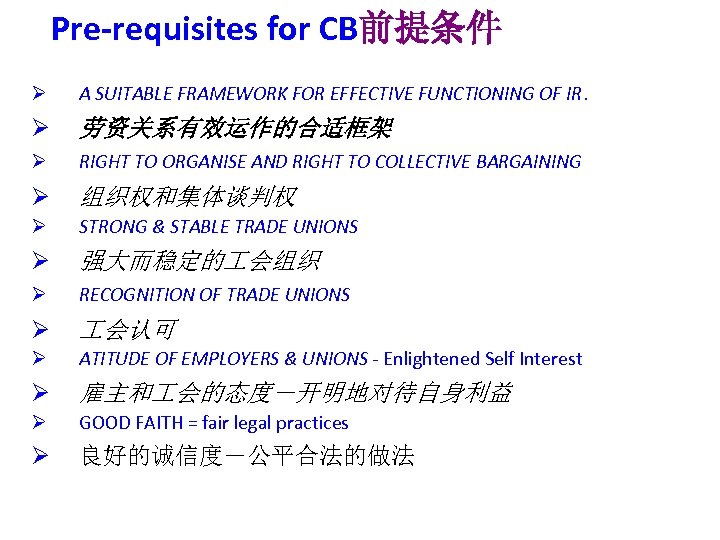
Pre-requisites for CB前提条件 Ø A SUITABLE FRAMEWORK FOR EFFECTIVE FUNCTIONING OF IR. Ø 劳资关系有效运作的合适框架 Ø RIGHT TO ORGANISE AND RIGHT TO COLLECTIVE BARGAINING Ø 组织权和集体谈判权 Ø STRONG & STABLE TRADE UNIONS Ø 强大而稳定的 会组织 Ø RECOGNITION OF TRADE UNIONS Ø 会认可 Ø ATITUDE OF EMPLOYERS & UNIONS - Enlightened Self Interest Ø 雇主和 会的态度-开明地对待自身利益 Ø GOOD FAITH = fair legal practices Ø 良好的诚信度-公平合法的做法
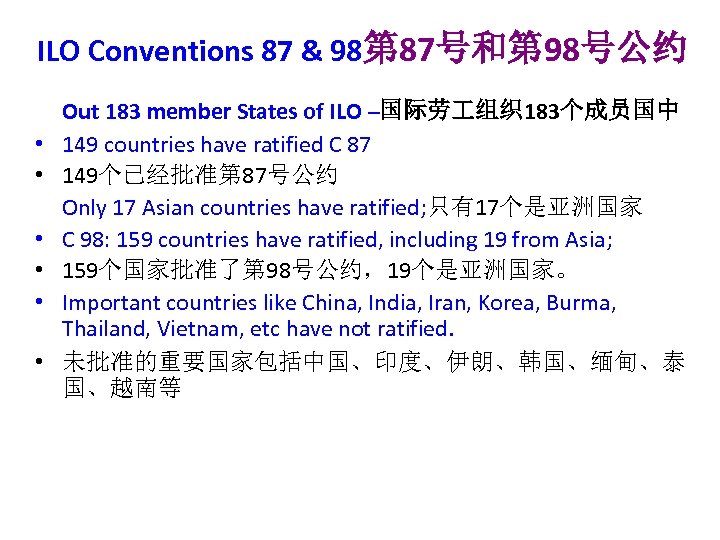
ILO Conventions 87 & 98第 87号和第 98号公约 • • • Out 183 member States of ILO –国际劳 组织183个成员国中 149 countries have ratified C 87 149个已经批准第 87号公约 Only 17 Asian countries have ratified; 只有17个是亚洲国家 C 98: 159 countries have ratified, including 19 from Asia; 159个国家批准了第 98号公约,19个是亚洲国家。 Important countries like China, India, Iran, Korea, Burma, Thailand, Vietnam, etc have not ratified. 未批准的重要国家包括中国、印度、伊朗、韩国、缅甸、泰 国、越南等
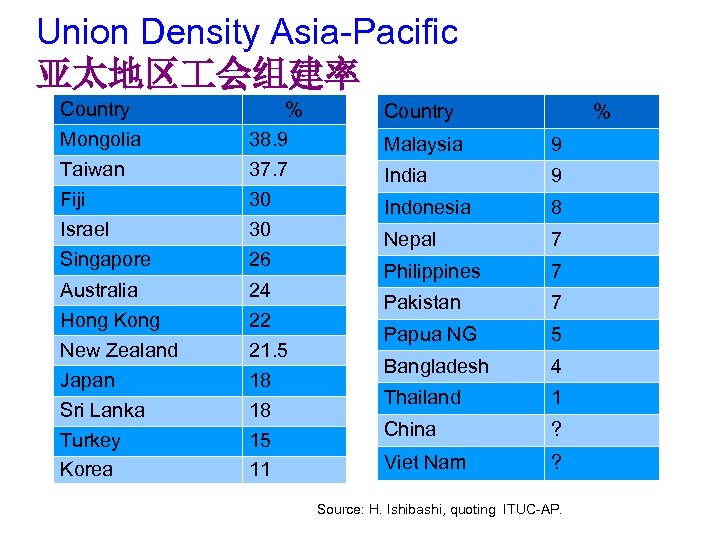
Union Density Asia-Pacific 亚太地区 会组建率 Country % Mongolia 38. 9 Malaysia 9 Taiwan 37. 7 India 9 Fiji 30 Israel 30 Indonesia 8 Singapore 26 Nepal 7 Australia 24 Hong Kong 22 New Zealand 21. 5 Japan 18 Sri Lanka 18 Turkey Korea 15 11 7 (Source ITUC-AP) Philippines Pakistan 7 Papua NG 5 Bangladesh 4 Thailand 1 China ? Viet Nam ? Source: H. Ishibashi, quoting ITUC-AP.
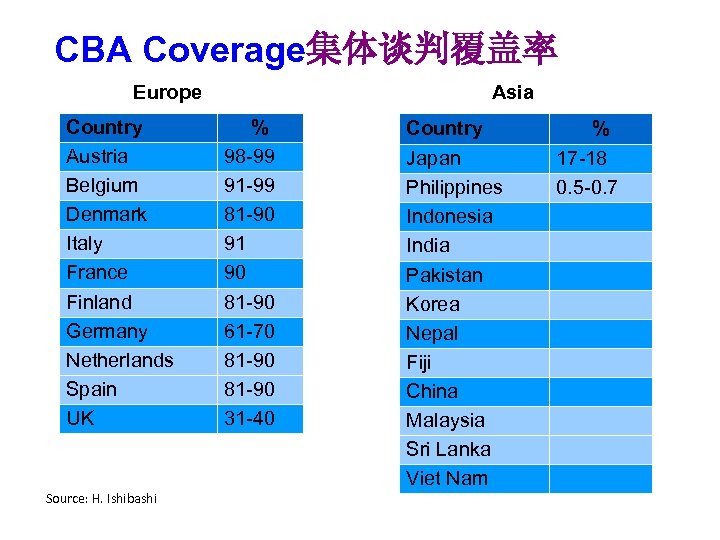
CBA Coverage集体谈判覆盖率 Europe Country Austria Belgium Denmark Italy France Finland Germany Netherlands Spain UK Source: H. Ishibashi Asia % 98 -99 91 -99 81 -90 91 90 81 -90 61 -70 81 -90 31 -40 Country Japan Philippines Indonesia India Pakistan Korea Nepal Fiji China Malaysia Sri Lanka Viet Nam % 17 -18 0. 5 -0. 7
Collective Bargaining in Practice 集体谈判实践 • Despite not ratifying C 98, collective bargaining exists in many sectors of the economy in these countries; 尽管未批准第 98号公约,集体谈判仍在 这些国家多个行业和部门广泛存在。 • However, it is the labour law that covers many issues which would normally be the subject of collective bargaining – one of the major reasons why IR issues end up in labour courts rather than being negotiated; • 但劳动法对本应通过集体谈判确定的问题进行了规定 • In many countries certain categories of employees are by law denied Fo. A & CB rights: such as Govt officials, Military & Police personnel, management staff, employees in Public Utilities – restrictions of Fo. A & CB rights, etc • 许多国家某些 人群体不能依法享有结社自由权和集体谈判 权
Levels of Collective Bargaining 集体谈判的层次 CB takes many different forms & takes place at different levels 集体谈判有不同形式并分为不同层次 • Tripartite negotiations/consultations – at national &/or industry level - on policy matters, legislative reforms, working conditions in an industry, for setting minimum wages – industry wide or for occupations as a whole • 三方谈判或协商,分全国一级或产业一级,确定政策、法律 改革、 作条件、最低 资等 • National level wage negotiations with industry association, which then applies to all companies in that industry • 与产业协会谈判,进行全国性的 资谈判,确定的标准适用 于本行业所有企业 • Enterprise level collective bargaining • 企业一级的集体谈判
Systems of Collective Bargaining 集体谈判的制度 • Single Plant Bargaining: Unit Level • 单个 厂的集体谈判:单位 • Multiple Plants Bargaining: Company Plant Level • 多个 厂的集体谈判:企业 • Multiple Employers Bargaining: Industry Level • 多个雇主的集体谈判:产业一级 • National Level Bargaining: Have a large common concern • 全国性的集体谈判
Enterprise level Collective Bargaining 企业一级的集体谈判 • Prevalent in many East Asian countries (Japan, Korea, Thailand, Philippines, etc - China? )在东亚国家普遍存在 • Advantage: flexibility & adaptability for setting enterprise specific working conditions 优势:灵活性和可调节性, 根据企业具体 作条件而定 • Disadvantages: disparity between companies, enterprise level trade unions may be too weak to negotiate with their employers at the workplace – labour policy objectives of the State may not be achieved. • 缺点:企业差别,企业 会力量薄弱,可能无法实现政府 确定的劳 政策目标 Source: Mr. Chang-Hee Lee, Sr Specialist IR and Social Dialogue, ILO
Industry wide bargaining产业集体谈判 • widely prevalent in many European countries (Germany, Sweden, Finland, France, Belgium, etc) - prevalent in public enterprises & in some sectors like Sugar, Cement, Banking, Insurance, etc in India; Port workers in Japan; • 在欧洲国家和公共企业普遍存在 • Advantages: better solidarity among workers, less bargaining costs, enterprises relatively free from hassle of negotiations & therefore conflicts, easier to coordinate national wage policy for certain sectors. • 优势:促进 人团结,谈判成本低,减少企业内部冲突,更易协调 • Disadvantages: less flexibility & adaptability for each enterprise • 缺点:从企业看灵活度较低 • Global Trend: decentralization towards enterprise bargaining • 全球趋势:趋于企业集体谈判 Source: Mr. Chang-Hee Lee, Sr Specialist IR and Social Dialogue, ILO
Forms of CB 集体谈判的形式 • Conjunctive/Distributive Bargaining: one side wins and the other loses • 零和谈判:一方获利意味着另一方受损 • Cooperative/Integrative Bargaining: a win-win situation • 协商式谈判:双赢 • Productivity Bargaining: both the parties must develop a productivity linked scheme • 劳动生产率谈判:双方必须制订绩效计划 • Concessionary Bargaining: the objective is to give back to management some of what the union has gained in previous bargaining in return for some other demand • 妥协式谈判: 会把上次谈判中所得利益部分还给资方,以 实现别的需求
Issues dealt by CB 集体谈判涉及的问题 • Traditional issues – wage rates/pay, working hours & other working conditions, employment policies, productivity settlement • 传统问题: 资、 时、就业政策、绩效奖励等 • New areas: demanding equity in matters relating to work norms, employment levels, staffing standards, environmental hazards, company management issues such as outsourcing, sub-contracting clauses, investment policies, management decisions over diversification, choice of technologies, etc since all these affect workers employment; • 新的话题:平等、环境危害、参与企业管理、投资政策、 引用新技术等
Concluding Remarks 结语 • Fo. A & CB are not just about workers rights but are also instruments of State policy to achieve objectives of social justice & for promoting sustainable economic growth • 结社自由权和集体谈判不仅是 人权利,也是国家为实现社 会公正和可持续经济增长所采取的政策 • It should also not be seen as something to be limited to industry or company level but this principle (of promoting social dialogue) should be extended to national level over issues of policies –labour, social and economic – this will promote social harmony and social stability. • 不应局限于企业或行业,应在全国开展社会对华,促进社会 和谐和社会稳定 • Need to move from mere collective bargaining over wages to ‘participatory rights in industry as also the economy • 不仅就 资进行集体谈判,还应对参与产业和经济发展进行 谈判
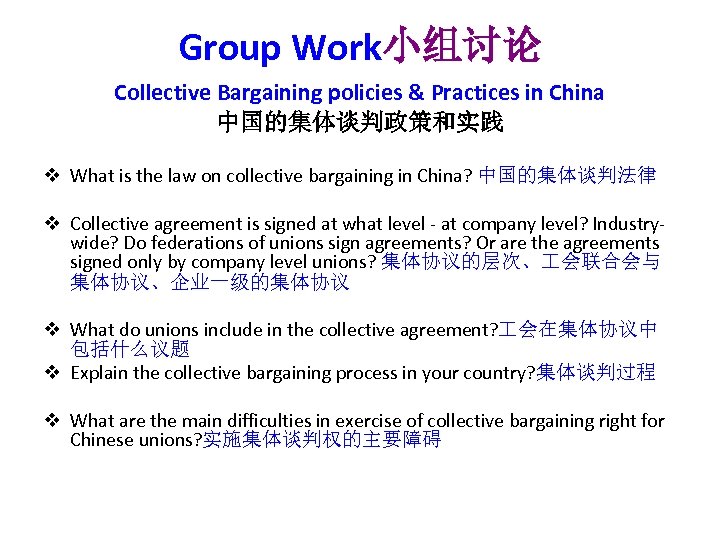
Group Work小组讨论 Collective Bargaining policies & Practices in China 中国的集体谈判政策和实践 v What is the law on collective bargaining in China? 中国的集体谈判法律 v Collective agreement is signed at what level - at company level? Industrywide? Do federations of unions sign agreements? Or are the agreements signed only by company level unions? 集体协议的层次、 会联合会与 集体协议、企业一级的集体协议 v What do unions include in the collective agreement? 会在集体协议中 包括什么议题 v Explain the collective bargaining process in your country? 集体谈判过程 v What are the main difficulties in exercise of collective bargaining right for Chinese unions? 实施集体谈判权的主要障碍
Скачать презентацию Introduction to Collective Bargaining concept practices 集体谈判概况 概念与实践
c759c41e011ab5d2ecd64e1e650afb47.ppt