


 Скачать презентацию Introduction to Cognitive Science Linguistics component 17 th
915bbb7e8df33fbaa7424b6e6ab97b03.ppt
- Количество слайдов: 28
 Introduction to Cognitive Science Linguistics component (17 th October 2000, 11: 40 -12: 30) Topic: Phonology and Morphology Lecturer: Dr Bodomo Department of Linguistics email: abbodomo@hkusua. hku. hk
 Keywords Phonology n phonetics n phoneme n tone n stress n toneme n tonology n morphology n inflectional morphology n derivational morphology n morpheme n morphophonology n morphophoneme n
 Introduction n Theme – A survey of how linguistic knowledge at the level of phonology and morphology is represented in the minds of speakers of a language. n Objective – an understanding of the basic terms and issues in phonology and morphology – an interface approach: rather than rigidly discussing these issues from phonology, morphology, syntax and semantics, we will look at how phonology interfaces with morphology and how syntax interfaces with semantics.
 Phonology n n A field of cognitive science that investigates how sound systems of a language are represented in the minds of speakers Stillings et al (1995: 220) gives a concise specification of what phonological knowledge as represented in the minds of speakers is: – The phonological component of a grammar consists of a list of the words of that language, with the pronunciation of each word given as a faithful acoustic image coupled with direct instructions to the vocal tract about how to produce that image, and instructions to the perceptual system about how to recognize it.
 Phonetics and Phonology: a distinction n Phonetics – a science that deals with the articulatory and acoustic properties of sounds produced by the vocal tract n Phonology – how a set of the sounds produced by the vocal tract are organized into meaningful sound units in each language
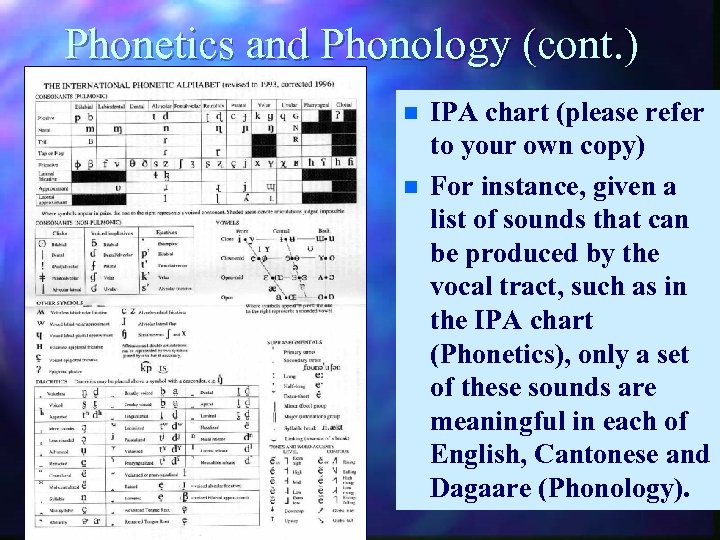 Phonetics and Phonology (cont. ) n n IPA chart (please refer to your own copy) For instance, given a list of sounds that can be produced by the vocal tract, such as in the IPA chart (Phonetics), only a set of these sounds are meaningful in each of English, Cantonese and Dagaare (Phonology).
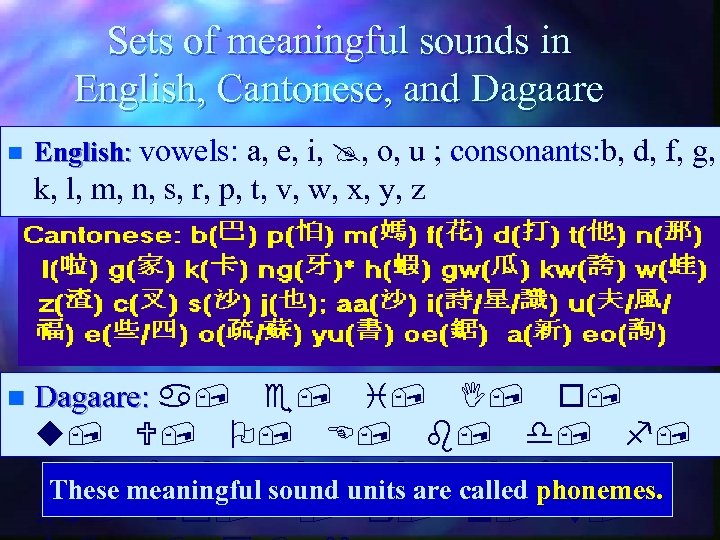 Sets of meaningful sounds in English, Cantonese, and Dagaare n English: vowels: a, e, i, , o, u ; consonants: b, d, f, g, k, l, m, n, s, r, p, t, v, w, x, y, z n Dagaare: a, e, i, I, o, u, U, O, E, b, d, f, g, meaningful sound m, are called N, k, l, units n, phonemes. These Nm, ny, s, r, p, t,
 Phonemes Concrete sounds or phones give us the abstract concept phoneme – a minimal meaningful sound unit n basic units in phonology n – phoneme – allophone n phonemes in BROWN DOG as conceptualised/ represented in the minds of speakers: – /b/ /r/ /au/ /n/ + /d/ /O: / /g/ /braun d. O: g/
![Allophones n Variants of a phoneme n Examples: – English: n [p] and [ph]](https://present5.com/presentation/915bbb7e8df33fbaa7424b6e6ab97b03/image-9.jpg "Allophones n Variants of a phoneme n Examples: – English: n [p] and [ph]") Allophones n Variants of a phoneme n Examples: – English: n [p] and [ph] as in /st. Op/ stop and /p it/ pit – Cantonese: n [n] and [l] as in /nei 5/ and /lei 5/ you – Dagaare: n [h] and [z] as in /za a / and /ha a /
Allophones n Variants of a phoneme n Examples: – English: n [p] and [ph] as in /st. Op/ stop and /p it/ pit – Cantonese: n [n] and [l] as in /nei 5/ and /lei 5/ you – Dagaare: n [h] and [z] as in /za a / and /ha a /
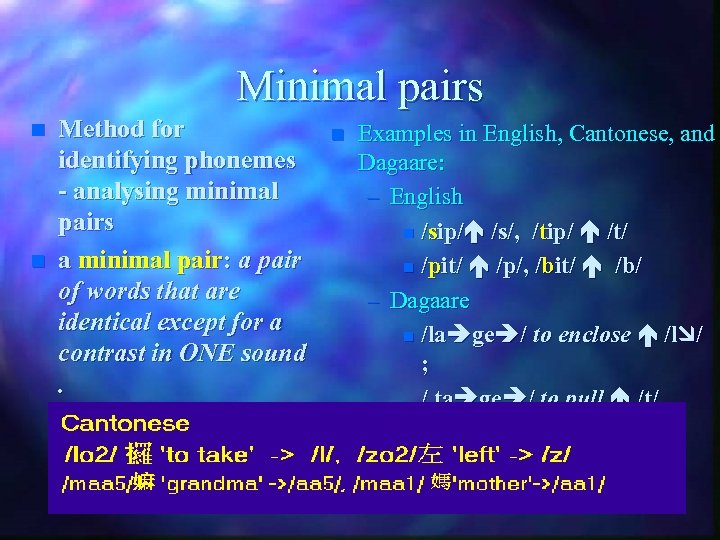 Minimal pairs n n Method for identifying phonemes - analysing minimal pairs a minimal pair: a pair of words that are identical except for a contrast in ONE sound. n Examples in English, Cantonese, and Dagaare: – English n /sip/ /s/, /tip/ /t/ n /pit/ /p/, /bit/ /b/ – Dagaare n /la ge / to enclose /l / ; / ta ge / to pull /t/
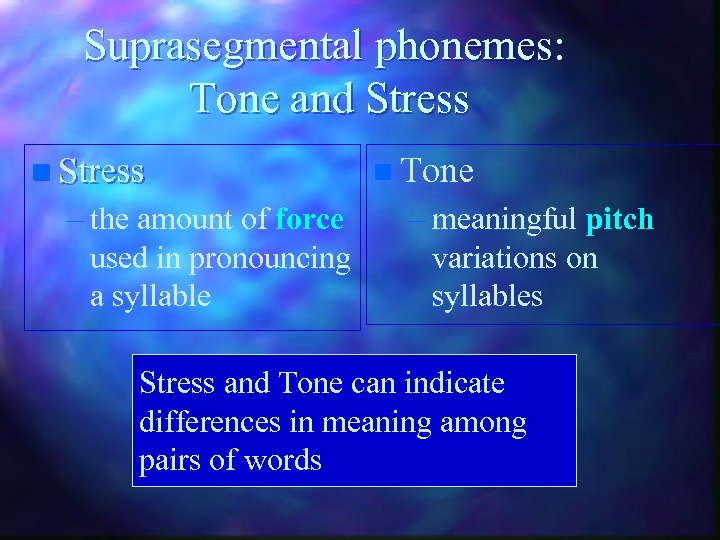 Suprasegmental phonemes: Tone and Stress n Stress – the amount of force used in pronouncing a syllable n Tone – meaningful pitch variations on syllables Stress and Tone can indicate differences in meaning among pairs of words
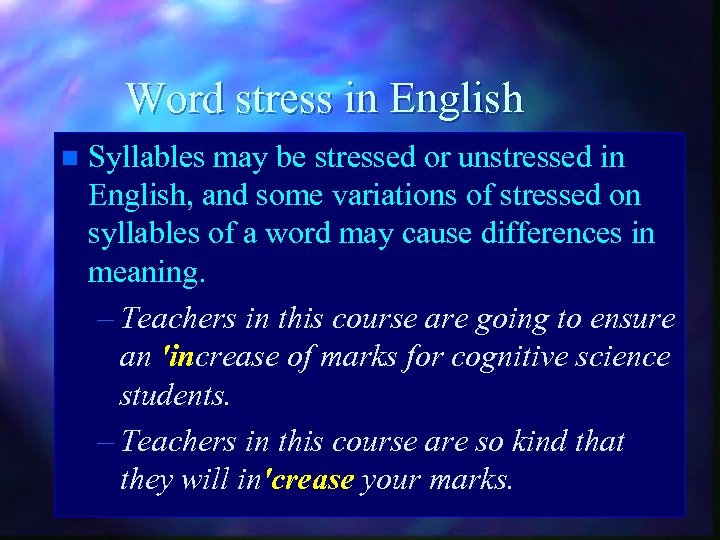 Word stress in English n Syllables may be stressed or unstressed in English, and some variations of stressed on syllables of a word may cause differences in meaning. – Teachers in this course are going to ensure an 'increase of marks for cognitive science students. – Teachers in this course are so kind that they will in'crease your marks.
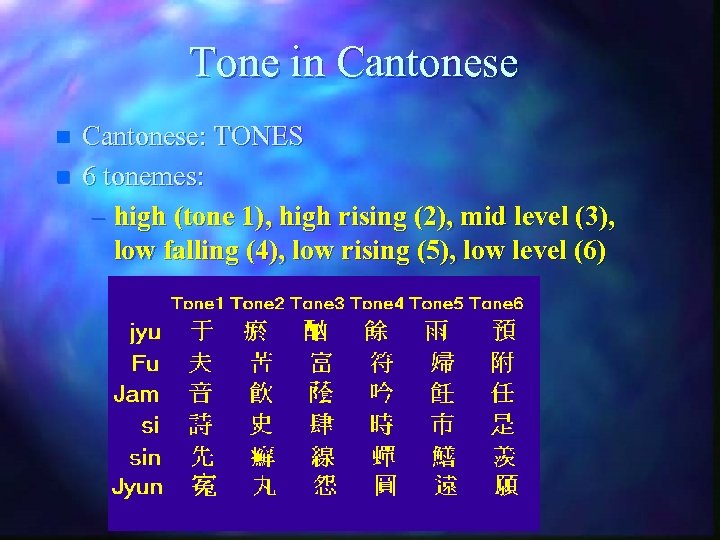 Tone in Cantonese n n Cantonese: TONES 6 tonemes: – high (tone 1), high rising (2), mid level (3), low falling (4), low rising (5), low level (6)
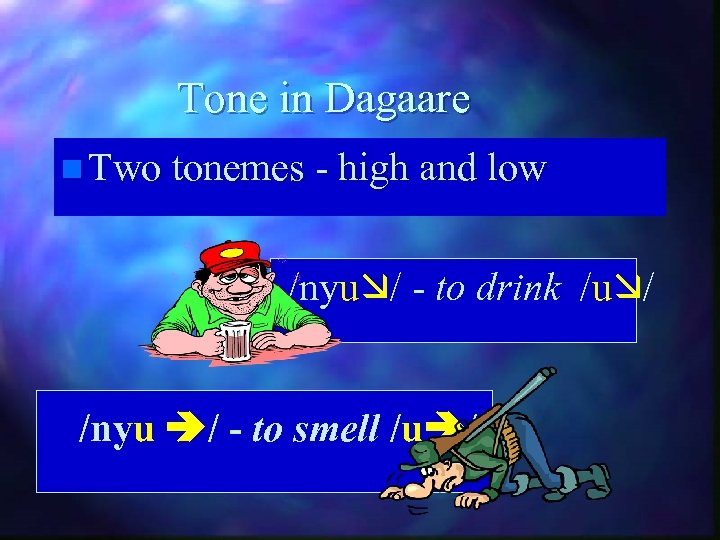 Tone in Dagaare n Two tonemes - high and low /nyu / - to drink /u / /nyu / - to smell /u /
![Phonological rules /Underlying phonological representations/ | n Phonological rules | n [Phonetic representation] n](https://present5.com/presentation/915bbb7e8df33fbaa7424b6e6ab97b03/image-15.jpg "Phonological rules /Underlying phonological representations/ | n Phonological rules | n [Phonetic representation] n") Phonological rules /Underlying phonological representations/ | n Phonological rules | n [Phonetic representation] n
Phonological rules /Underlying phonological representations/ | n Phonological rules | n [Phonetic representation] n
![Phonological rules in English, Cantonese, and Dagaare English • /p/ [ph] / # —](https://present5.com/presentation/915bbb7e8df33fbaa7424b6e6ab97b03/image-16.jpg "Phonological rules in English, Cantonese, and Dagaare English • /p/ [ph] / # —") Phonological rules in English, Cantonese, and Dagaare English • /p/ [ph] / # — • a stop is aspirated in word initial position. • *pit but phit Cantonese • Final stops like /p/ /t/ /k/ are not pronounced. • E. g. Dagaare • a /d/ becomes [r] in secondary syllable position: • *dide but [dire] ‘eating’
Phonological rules in English, Cantonese, and Dagaare English • /p/ [ph] / # — • a stop is aspirated in word initial position. • *pit but phit Cantonese • Final stops like /p/ /t/ /k/ are not pronounced. • E. g. Dagaare • a /d/ becomes [r] in secondary syllable position: • *dide but [dire] ‘eating’
 Morphology the field of cognitive science which studies how knowledge about the form or internal structure of words are represented and processed in the minds of speakers. n divided into two main parts, inflectional morphology and derivational morphology n Basic units of morphology: morpheme, allomorph n
 Morphemes n A morpheme is minimal distinctive unit of grammar (Crystal 1997). A morpheme is an abstract term that must be captured by a concrete realization, the morph – discrete speech unit e. g. {brown} {dog} – [In morphology we represent units with braces. ] {Brown} {dog-s} n Free morpheme: {brown} {dog} (these can stand on their own) n Bound morpheme: (-those that must be attached to another morpheme e. g. {–s}) n
 Morphology (cont. ) n n inflectional morphology and derivational morphology. Inflectional morphology : knowledge through which speakers of a language create several paradigms of the same word to express various grammatical categories like number, person, tense, aspect, case, and gender: Number in English: {paper} – {paper-s} {dog} – {dog-z} {prize} – {prize-iz} But also: {child} – {child-ren} {foot} – {feet} {sheep – sheep} : zero morph The various plural variations are said to be allomorphs of the same plural morpheme.
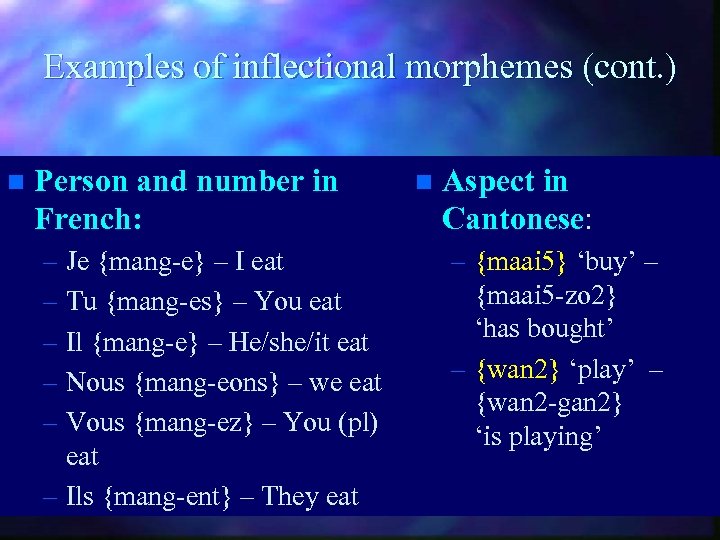 Examples of inflectional morphemes (cont. ) n Person and number in French: – Je {mang-e} – I eat – Tu {mang-es} – You eat – Il {mang-e} – He/she/it eat – Nous {mang-eons} – we eat – Vous {mang-ez} – You (pl) eat – Ils {mang-ent} – They eat n Aspect in Cantonese: – {maai 5} ‘buy’ – {maai 5 -zo 2} ‘has bought’ – {wan 2} ‘play’ – {wan 2 -gan 2} ‘is playing’
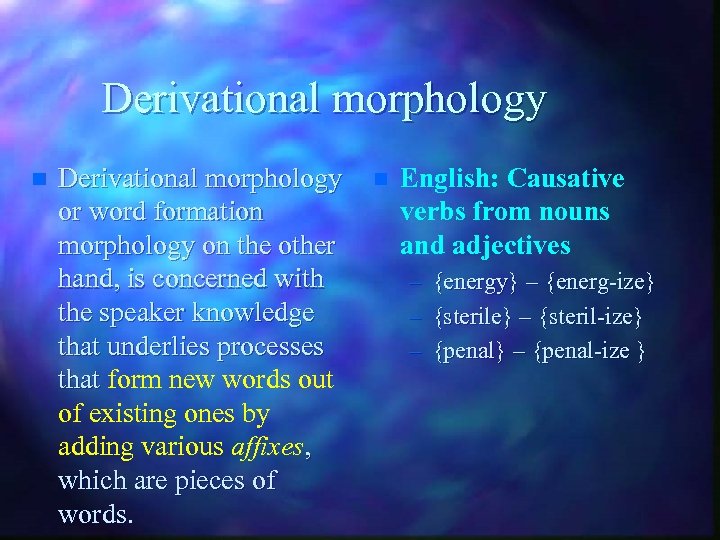 Derivational morphology n Derivational morphology or word formation morphology on the other hand, is concerned with the speaker knowledge that underlies processes that form new words out of existing ones by adding various affixes, which are pieces of words. n English: Causative verbs from nouns and adjectives – – – {energy} – {energ-ize} {sterile} – {steril-ize} {penal} – {penal-ize }
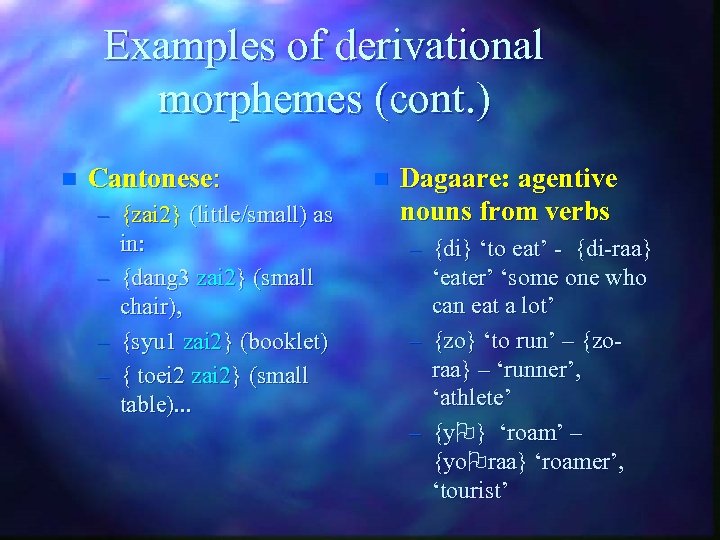 Examples of derivational morphemes (cont. ) n Cantonese: – {zai 2} (little/small) as in: – {dang 3 zai 2} (small chair), – {syu 1 zai 2} (booklet) – { toei 2 zai 2} (small table). . . n Dagaare: agentive nouns from verbs – {di} ‘to eat’ - {di-raa} ‘eater’ ‘some one who can eat a lot’ – {zo} ‘to run’ – {zoraa} – ‘runner’, ‘athlete’ – {y. O} ‘roam’ – {yo. Oraa} ‘roamer’, yo ‘tourist’
 Morphophonology While it is possible to talk of phonology and morphology independently, in reality, knowledge about these two areas are intertwined, and speakers process these as such. n Sometimes, speakers represent knowledge about phonemes (meaningful sound units) based on knowledge about some grammatical environments. n
 Morphophonology or morphophonemics, as it is known in North America morphophonemics the aspect of cognitive science that studies the classification of phonological aspects of knowledge representation based on knowledge about the grammatical aspects that affect these phonological representations and vice versa. n Morphophoneme: n – in parallel with a phoneme. While phonemes are written surrounded by slashes / /, morphophonemes are surrounded by braces {}. They are often written in CAPITALS (Crystal 1997).
 Morphophonemic example in English n phonologically unpredictable singular – plural alternation of words: – Knife – knives – Thief – thieves – But NOT of n Chief – *chieves (chiefs) n The morphophoneme: {F} would then have morphoallophones like [f] for singular and [v] for plural of these words. n Hence the need to emphasize their interrelationship.
 Other examples of morphophonological phenomena Word or lexical stress is a morphophonemic operation n Example: in describing the rules of pronunciation we often appeal to positions of the word in which the sound is: n – aspiration in English: a voiceless stop in word initial position is aspirated, elsewhere i. e. in word median and word final, it is unaspirated. This is not just a phonological rule but a morphophenemic rule.
 CONCLUSION n n n Phonology and morphology are two salient aspects of the tacit knowledge of speakers of a language. It is at these levels of mental representations that speakers capture the sounds and structure of words and other minimal meaningful units of speech. An interface approach emphasizes that these two must not be separated into watertight compartments, but must recognize that there is an intimate interrelationship between them. This interrelationship is explored in the cognitive area of morphophonology. Morphology can also interface with syntax to give us morphosyntax. Syntax is going to be one of the topics of discussion in the next lecture.
 References n n n Crystal, David. 1997. A Dictionary of Linguistics and Phonetics. Blackwell Publishers. Lepore, Ernest and Zenon Pylyshyn (eds). 1999. What Is Cognitive Science. Blackwell Publishers. (especially chapters 10, 11, 12, and 13). Stillings, Neil and others. 1995. Cognitive Science: An Introduction. MIT Press. (especially chapters 6). Trask, R. L. 1993. A Dictionary of Grammatical Terms in Linguistics. Routledge. Wilson, R. and Frank C. Neil (eds) 1999. The MIT Encyclopedia of the Cognitive Sciences. MIT Press