


 Скачать презентацию Introduction to climate change Introduction Welcome
8198969950c0df4c4ebb3518f74b9281.ppt
- Количество слайдов: 41
 Introduction to climate change
![Introduction Welcome & Acknowledgement Background [Insert Council logo] • Workshops action plan • General](https://present5.com/presentation/8198969950c0df4c4ebb3518f74b9281/image-2.jpg "Introduction Welcome & Acknowledgement Background [Insert Council logo] • Workshops action plan • General") Introduction Welcome & Acknowledgement Background [Insert Council logo] • Workshops action plan • General Manager’s support Housekeeping • Facilities, OH&S, Turn off mobiles
Introduction Welcome & Acknowledgement Background [Insert Council logo] • Workshops action plan • General Manager’s support Housekeeping • Facilities, OH&S, Turn off mobiles
 Introduction Purpose • Developing a Climate Change Action Plan Program • Keeping to time • Respectful discussion Introductions • Name, role, views on climate change Evaluation forms
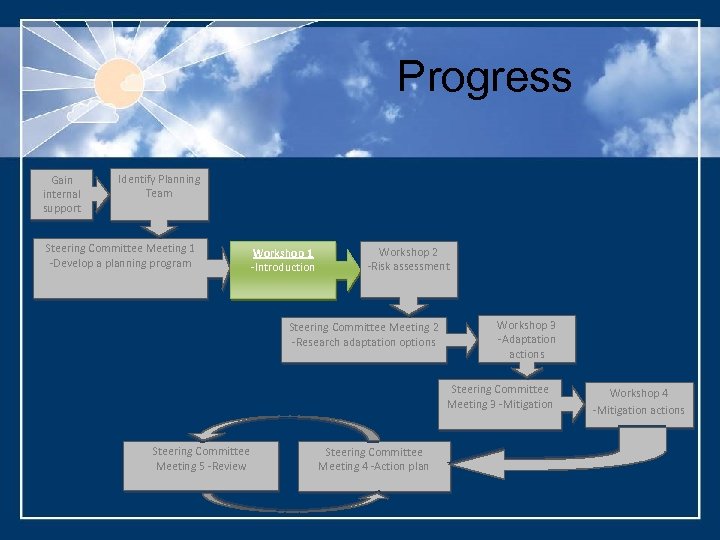 Progress Gain internal support Identify Planning Team Steering Committee Meeting 1 -Develop a planning program Workshop 1 -Introduction Workshop 2 -Risk assessment Steering Committee Meeting 2 -Research adaptation options Workshop 3 -Adaptation actions Steering Committee Meeting 3 -Mitigation Steering Committee Meeting 5 -Review Steering Committee Meeting 4 -Action plan Workshop 4 -Mitigation actions
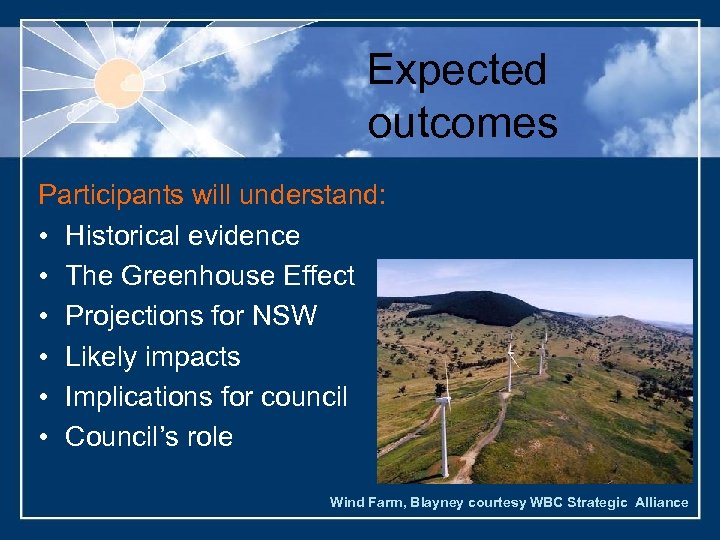 Expected outcomes Participants will understand: • Historical evidence • The Greenhouse Effect • Projections for NSW • Likely impacts • Implications for council • Council’s role Wind Farm, Blayney courtesy WBC Strategic Alliance
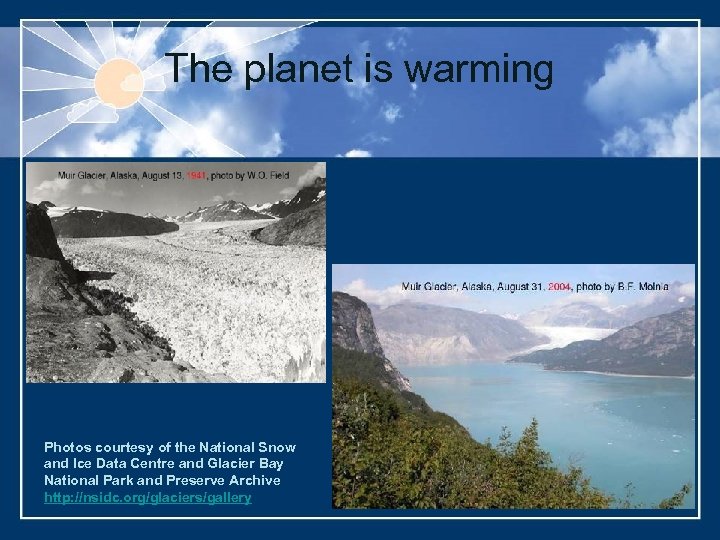 The planet is warming Photos courtesy of the National Snow and Ice Data Centre and Glacier Bay National Park and Preserve Archive http: //nsidc. org/glaciers/gallery
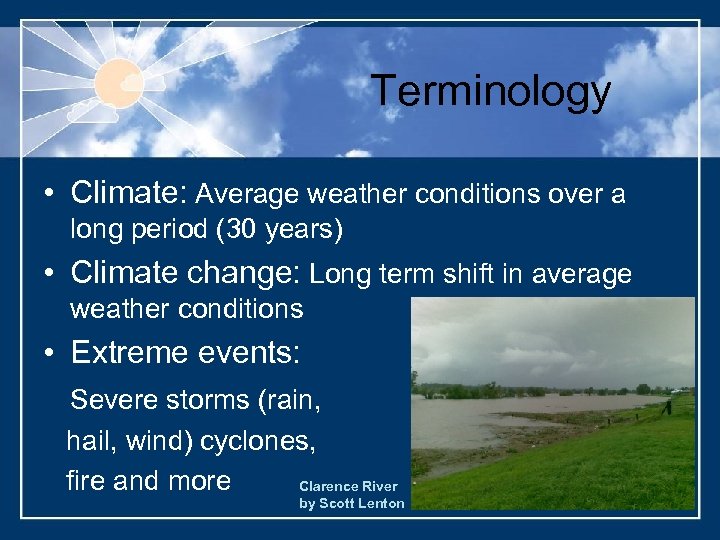 Terminology • Climate: Average weather conditions over a long period (30 years) • Climate change: Long term shift in average weather conditions • Extreme events: Severe storms (rain, hail, wind) cyclones, fire and more Clarence River by Scott Lenton
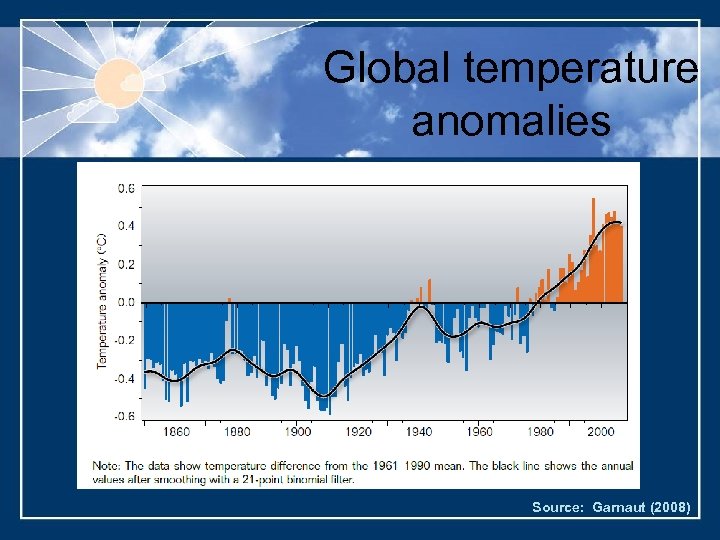 Global temperature anomalies Source: Garnaut (2008)
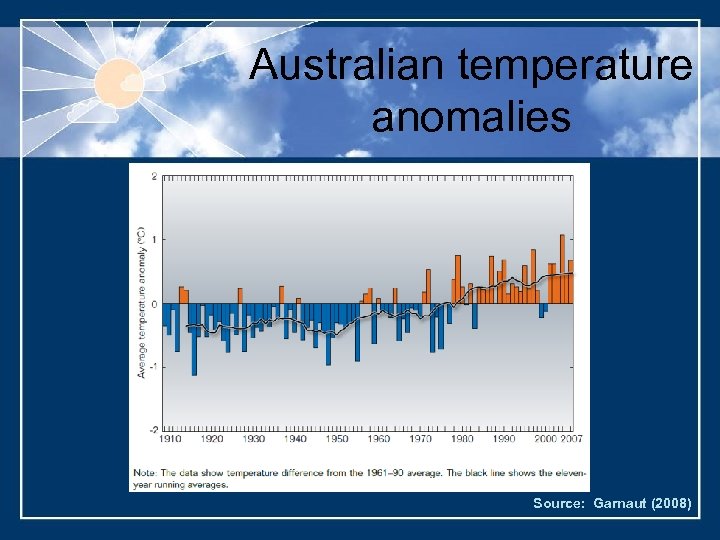 Australian temperature anomalies Source: Garnaut (2008)
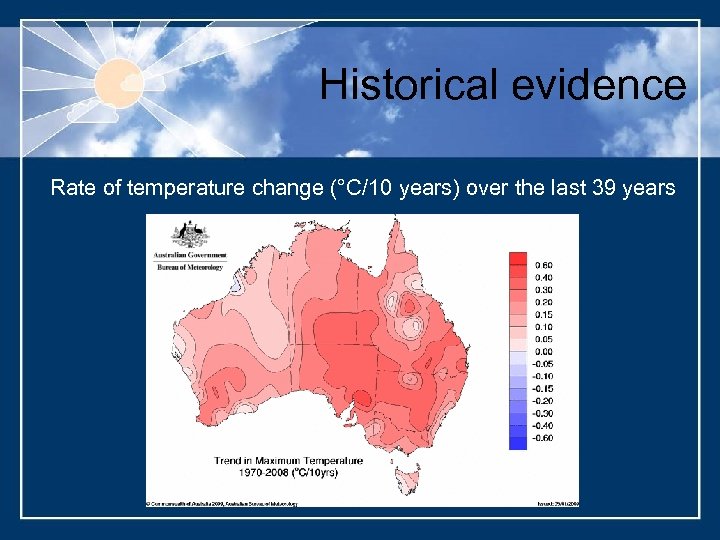 Historical evidence Rate of temperature change (°C/10 years) over the last 39 years
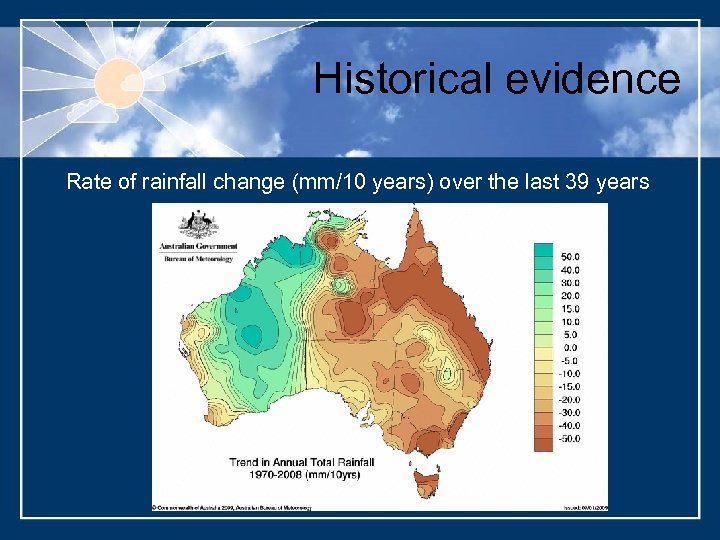 Historical evidence Rate of rainfall change (mm/10 years) over the last 39 years
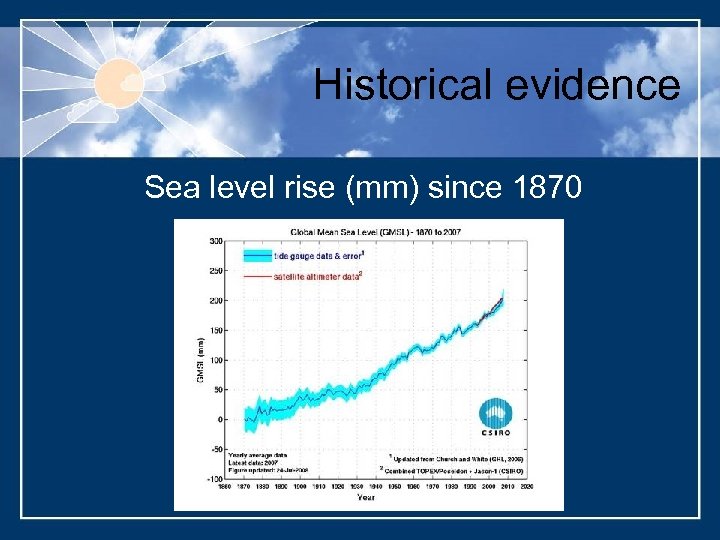 Historical evidence Sea level rise (mm) since 1870
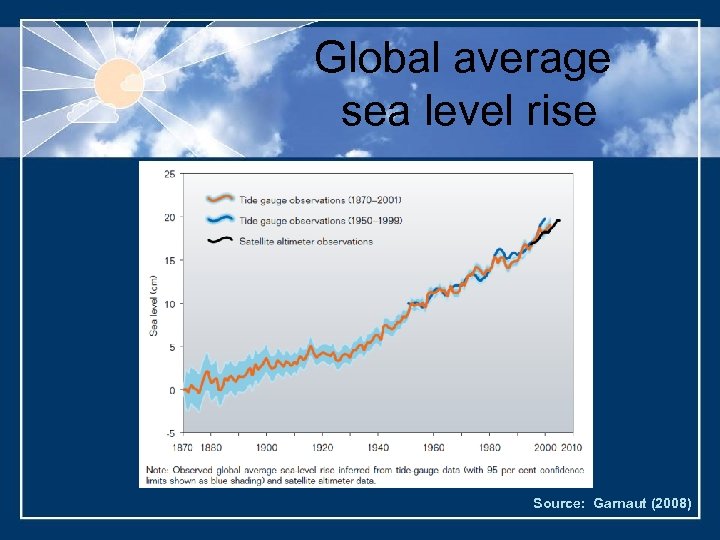 Global average sea level rise Source: Garnaut (2008)
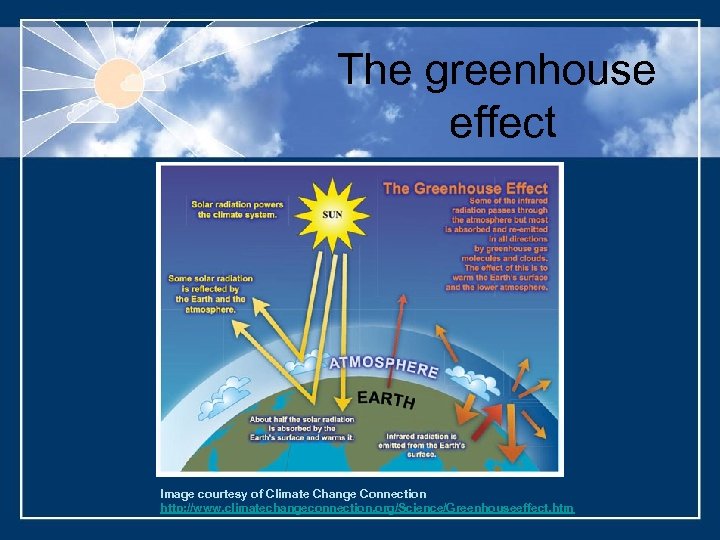 The greenhouse effect Image courtesy of Climate Change Connection http: //www. climatechangeconnection. org/Science/Greenhouseeffect. htm
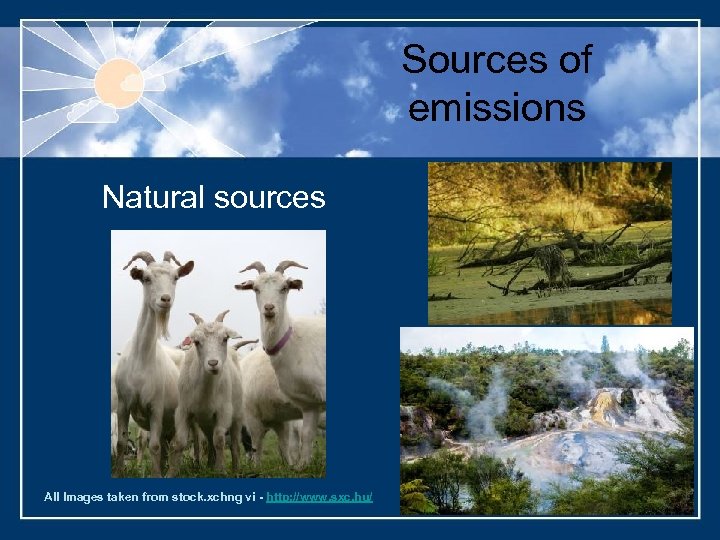 Sources of emissions Natural sources All Images taken from stock. xchng vi - http: //www. sxc. hu/
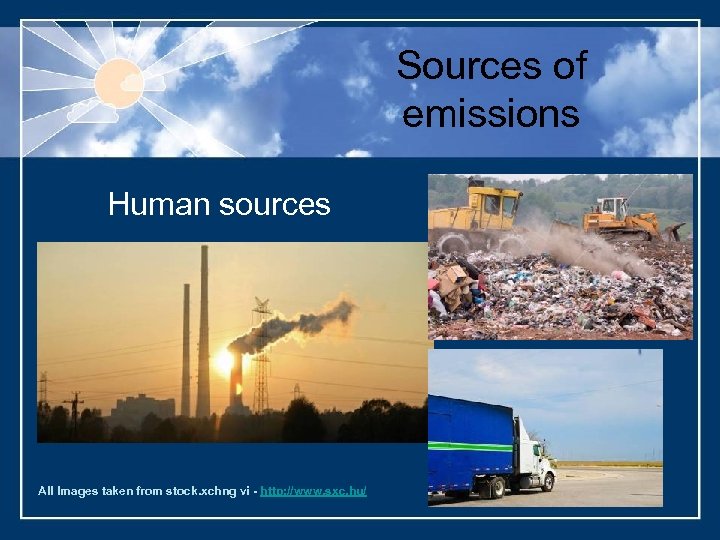 Sources of emissions Human sources All Images taken from stock. xchng vi - http: //www. sxc. hu/
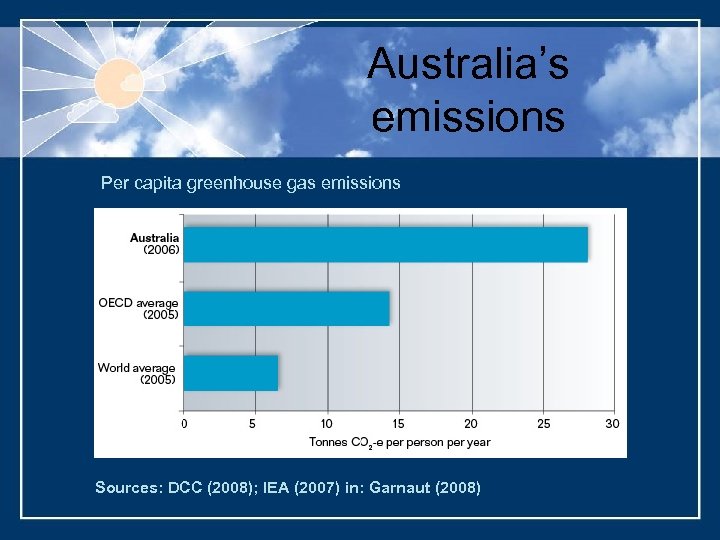 Australia’s emissions Per capita greenhouse gas emissions Sources: DCC (2008); IEA (2007) in: Garnaut (2008)
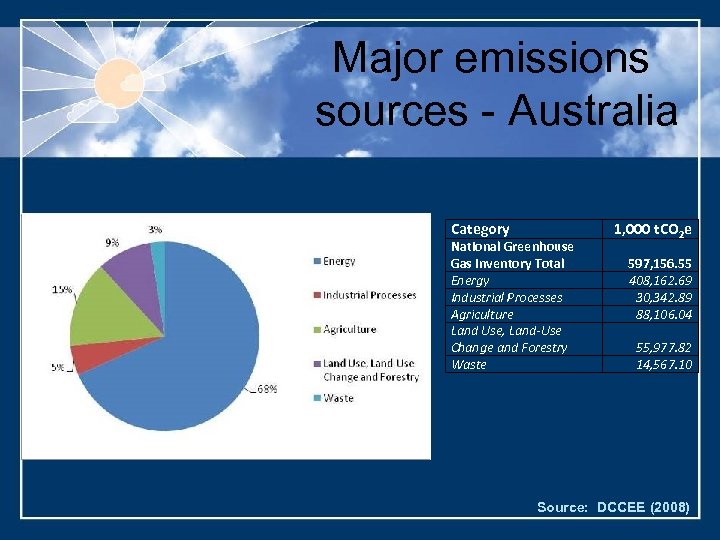 Major emissions sources - Australia Category National Greenhouse Gas Inventory Total Energy Industrial Processes Agriculture Land Use, Land-Use Change and Forestry Waste 1, 000 t. CO 2 e 597, 156. 55 408, 162. 69 30, 342. 89 88, 106. 04 55, 977. 82 14, 567. 10 Source: DCCEE (2008)
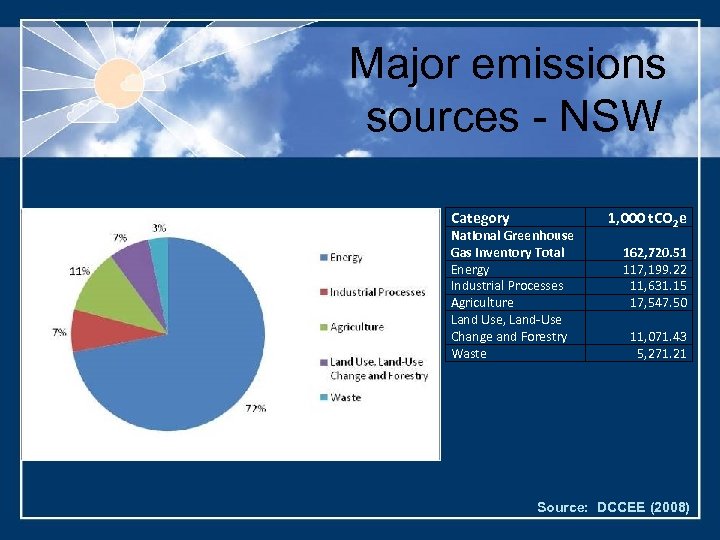 Major emissions sources - NSW Category National Greenhouse Gas Inventory Total Energy Industrial Processes Agriculture Land Use, Land-Use Change and Forestry Waste 1, 000 t. CO 2 e 162, 720. 51 117, 199. 22 11, 631. 15 17, 547. 50 11, 071. 43 5, 271. 21 Source: DCCEE (2008)
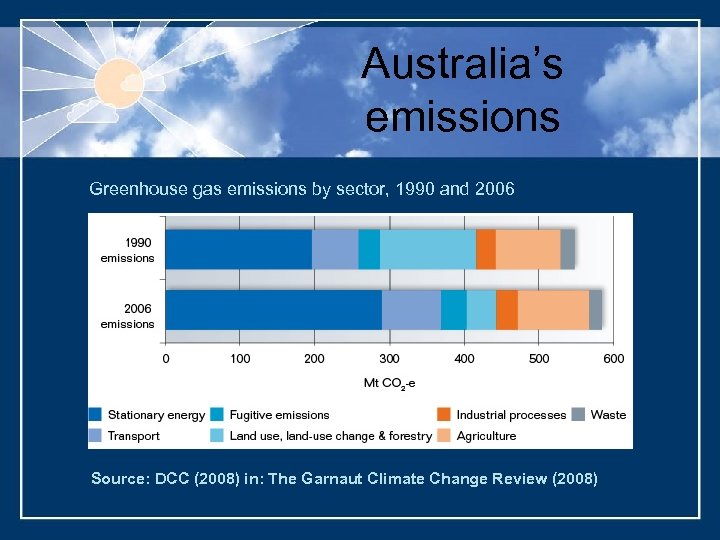 Australia’s emissions Greenhouse gas emissions by sector, 1990 and 2006 Source: DCC (2008) in: The Garnaut Climate Change Review (2008)
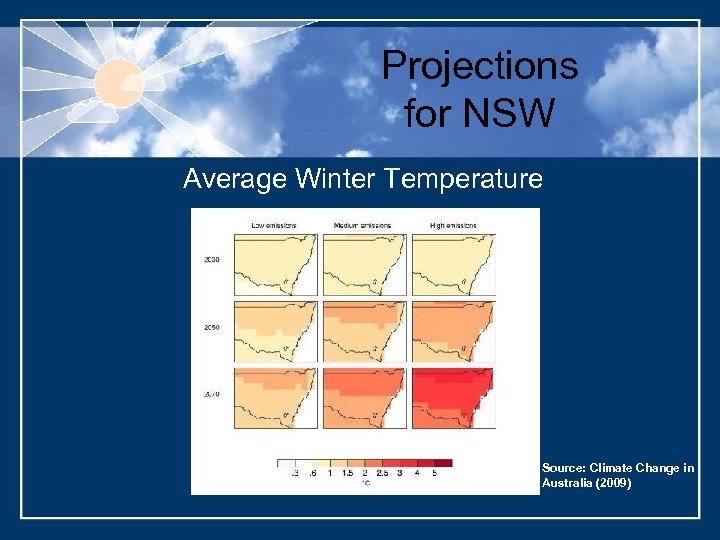 Projections for NSW Average Winter Temperature Source: Climate Change in Australia (2009)
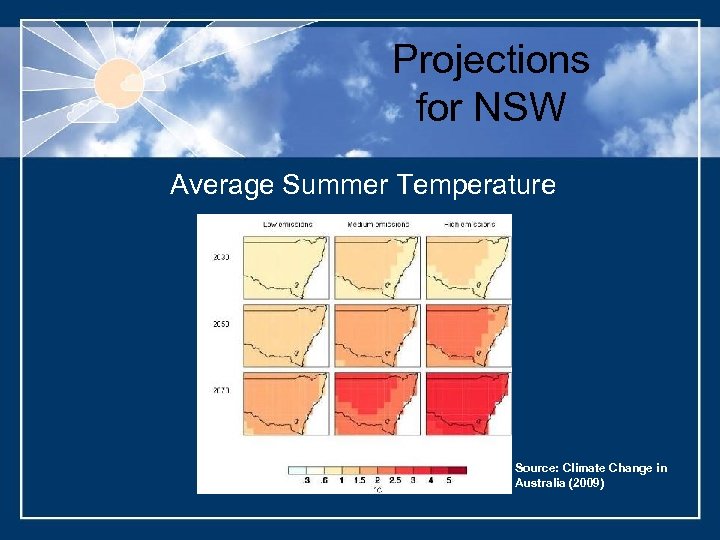 Projections for NSW Average Summer Temperature Source: Climate Change in Australia (2009)
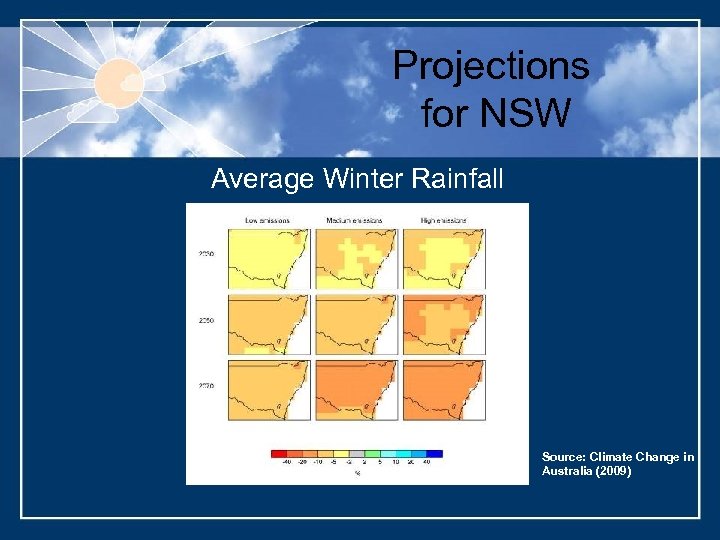 Projections for NSW Average Winter Rainfall Source: Climate Change in Australia (2009)
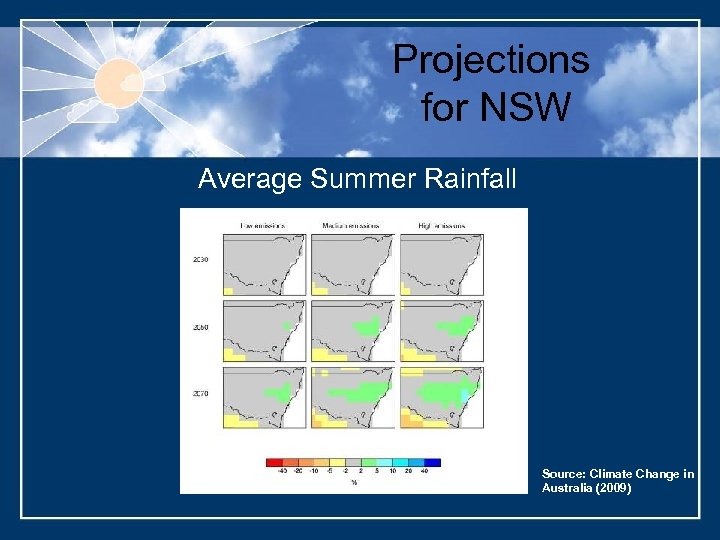 Projections for NSW Average Summer Rainfall Source: Climate Change in Australia (2009)
 Projections • In the next Module we will examine the projections for NSW in more detail & also the projections for this region • In this Module we will briefly look at some potential impacts and implications…
 Likely impacts? • What would you expect from higher temperatures and reduced annual average rainfall…?
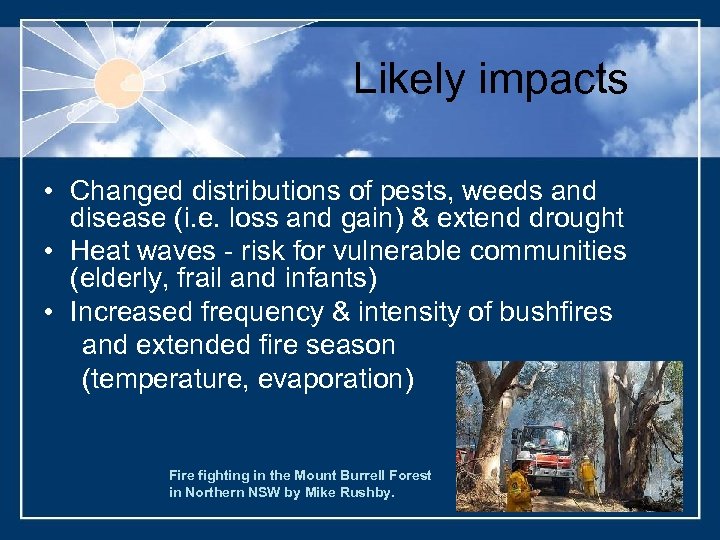 Likely impacts • Changed distributions of pests, weeds and disease (i. e. loss and gain) & extend drought • Heat waves - risk for vulnerable communities (elderly, frail and infants) • Increased frequency & intensity of bushfires and extended fire season (temperature, evaporation) Fire fighting in the Mount Burrell Forest in Northern NSW by Mike Rushby.
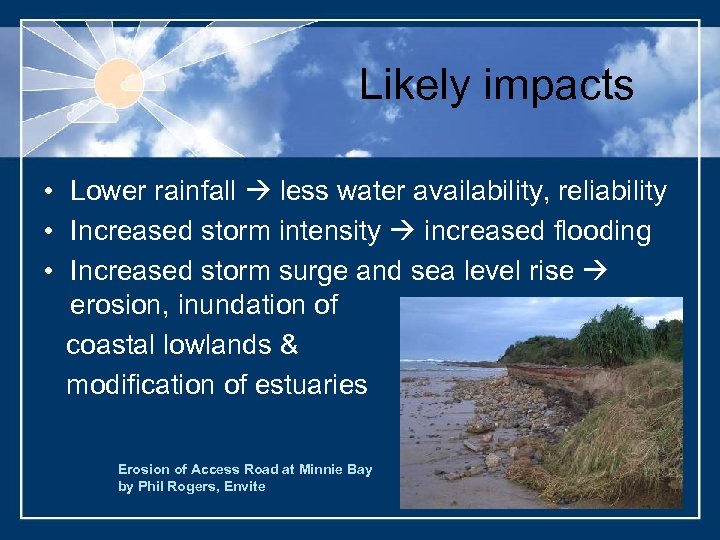 Likely impacts • Lower rainfall less water availability, reliability • Increased storm intensity increased flooding • Increased storm surge and sea level rise erosion, inundation of coastal lowlands & modification of estuaries Erosion of Access Road at Minnie Bay by Phil Rogers, Envite
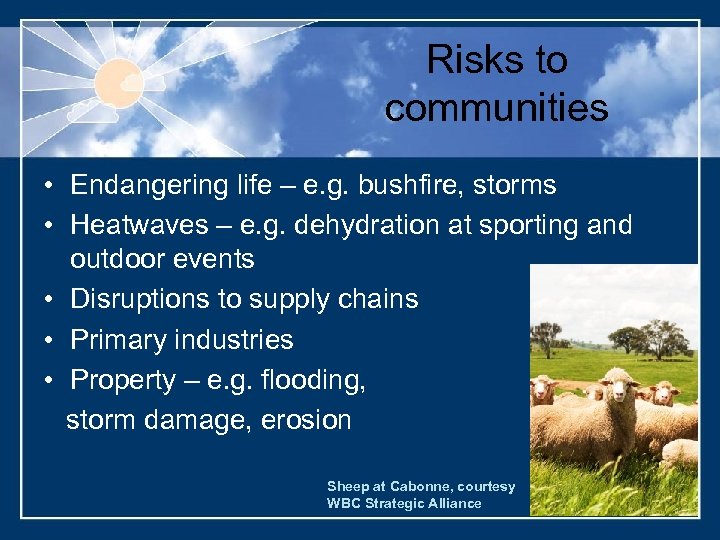 Risks to communities • Endangering life – e. g. bushfire, storms • Heatwaves – e. g. dehydration at sporting and outdoor events • Disruptions to supply chains • Primary industries • Property – e. g. flooding, storm damage, erosion Sheep at Cabonne, courtesy WBC Strategic Alliance
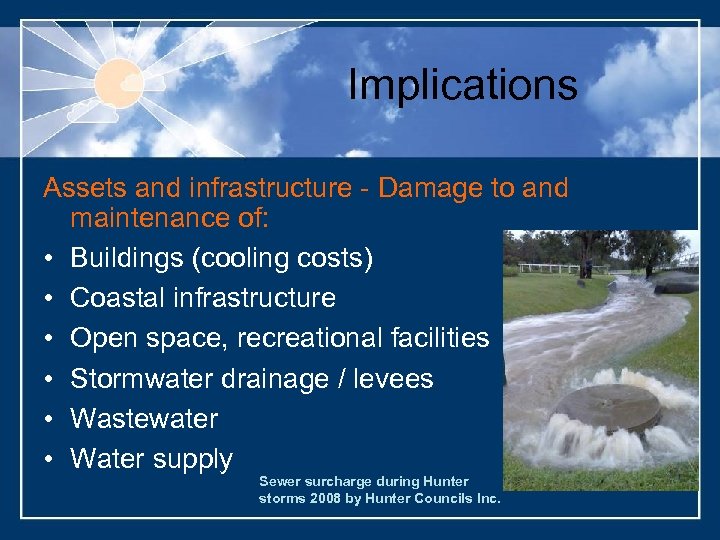 Implications Assets and infrastructure - Damage to and maintenance of: • Buildings (cooling costs) • Coastal infrastructure • Open space, recreational facilities • Stormwater drainage / levees • Wastewater • Water supply Sewer surcharge during Hunter storms 2008 by Hunter Councils Inc.
 Implications NRM and biodiversity • Loss of biodiversity • Coastal management • Weeds and pests Community • Increased demand for health care & emergency services Land use planning • Loss of property and assets • ESD design into developments Windmill by @dino 2006 www. flickr. com
 Implications Economic impacts • Impact on tourism • Insurance and liability issues • Electricity supply Waste • Large emission source that council can influence • National Greenhouse & Energy Reporting System (NGERS) • CPRS Upper Colo River, NSW by island home www. flickr. com
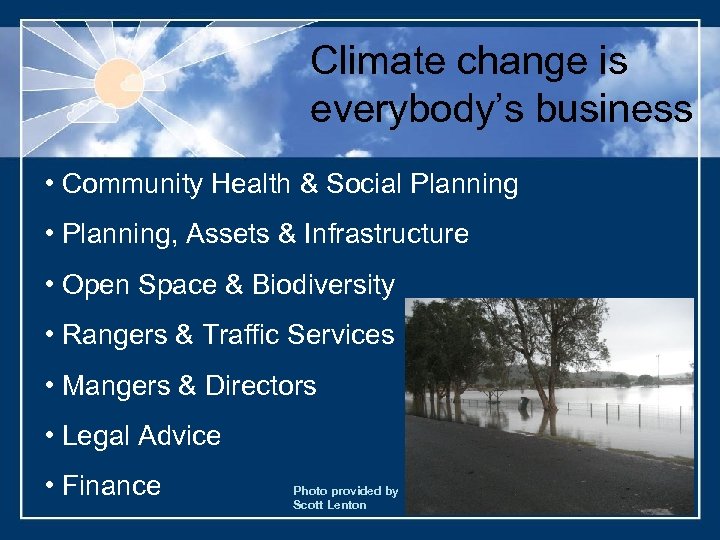 Climate change is everybody’s business • Community Health & Social Planning • Planning, Assets & Infrastructure • Open Space & Biodiversity • Rangers & Traffic Services • Mangers & Directors • Legal Advice • Finance Photo provided by Scott Lenton
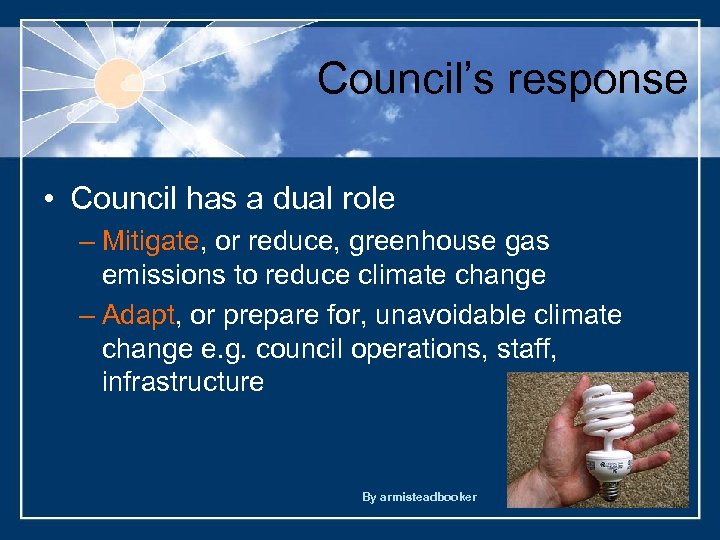 Council’s response • Council has a dual role – Mitigate, or reduce, greenhouse gas emissions to reduce climate change – Adapt, or prepare for, unavoidable climate change e. g. council operations, staff, infrastructure By armisteadbooker
 Why? • Why should Council take action on climate change?
 Why act? Avoid: • Disruption to council services • Unbudgeted financial impacts • Litigation Fulfill: • Duty of care to the community • Meet KPIs in strategic plans • Liveability and economic viability of a region • Need to incorporate ESD into activities & decision making - requirement of the Local Government Act 1993
 LGSA support • • Needs Analysis Survey Climate Change Summit Regional Workshops Workshop Package
 Any questions?
 Achievements from the workshop During the workshop we have explored: • Historical evidence for climate change • The Greenhouse Effect • Projections for NSW • Likely impacts • Implications for council • Council’s role
 Conclusion • Thank you • Evaluation forms
 References • • • ABS, 2003 projections and 2005 data. http: //www. abs. gov. au/ (visited December, 2009) AGO, 2006, Climate Change Impacts and Risk Management – A Guide for Business and Government. DCCEE, 2008, Australia’s National Greenhouse Accounts, Australian Greenhouse Emissions Information System, www. ageis. greenhouse. gov. au (visited May, 2010). CSIRO, 2007, Catchment Scenario Reports http: //www. environment. nsw. gov. au/climate. Change/nswreports. htm (visited December, 2009) Deacons, 2009, Briefing Paper on Carbon Pollution Reduction Scheme Bill 2009 and associated legislation. England, P. , 2006, Climate Change: What are Local Governments Liable for? Griffith University Urban Research Program Issues Paper 6. Garnaut, R. , 2008, The Garnaut Climate Change Review http: //www. garnautreview. org. au/index. htm (visited February, 2010) IPCC, 2007, Summary for Policymakers. In: Climate Change 2007: The Physical Science Basis. Contribution of Working Group I to the Fourth Assessment Report of the Intergovernmental Panel on Climate Change [Solomon, S. , D. Qin, M. Manning, Z. Chen, M. Marquis, K. B. Averyt, M. Tignor and H. L. Miller (eds. )]. Cambridge University Press, Cambridge, United Kingdom and New York, NY, USA. http: //www. ipcc. ch/press_information_fact_sheet 1. htm (visited December, 2009) Local Government Act 1993 http: //www. austlii. edu. au/au/legis/nsw/consol_act/lga 1993182/ (visited December, 2009) Palutikof, J. P. , 2010, The view from the front line: Adapting Australia to climate change, Global Environmental Change 20 (2010) 218 -219.