


 Скачать презентацию INTRODUCTION TO CANADIAN ENVIRONMENTAL ASSESSMENT ACT 2012 MARCH
54edef1f7593f94df6edaf5f82623ca2.ppt
- Количество слайдов: 51
 INTRODUCTION TO CANADIAN ENVIRONMENTAL ASSESSMENT ACT (2012) MARCH 19, 2013
 Overview CEAA 2012 • Legislating CEAA 2012 • Key Features Environmental Assessment Process • Decision-making • Follow-up • Enforcement • Implications of CEAA 2012
 CEAA Seven -Year Review 2010 - 2012 CEAA (2003) s. 32. (1) Within seven years after this Act receives royal assent, a comprehensive review of the provisions and operations of the Canadian Environmental Assessment Act shall be undertaken by such committee of the Senate, of the House of Commons. . . as may be designated. . . (2) The committee. . . shall, within a year after a review is undertaken. . . submit a report on the review to Parliament, including a statement of any changes that the committee recommends.
 CEAA Seven -Year Review • House of Commons Environment Committee initiates CEAA Seven-Year review in October 2011, issues report in March 2012 • Lack of clarity on process: – no public statement or notice of commencement of review or schedule of hearings – initial meetings were supposedly to scope review, some witnesses didn’t make substantive presentation – no public statement of scope or objectives of review • No testimony from key participants (provinces except Saskatchewan), First Nations, Parks Canada, NEB, CNSC, Major Projects Management Office • Regulatory Advisory Committee ignored
 Report of House Environment Committee - March 2012 • Recommendations – Single Federal Agency – Legislated Timelines – Improve Efficiency – Exemption for Provincial Regimes – Target Projects of Environmental Significance – Enforcement • NDP/Liberals issued dissenting reports
 Bill C-38 Omnibus Budget Bill 2012 • Repealed CEAA, enacted CEAA 2012 • Included amendments to other statutes, such as Fisheries Act • Repealed Kyoto Protocol Implementation Act • Referred to House of Commons Finance Committee • Committee did not propose even one amendment to Bill C-38
 Bill C-38 • ENGO Black Out, Speak Out campaign www. blackoutspeakout. ca • Bill C-38 passed by Parliament unamended on June 29, 2012 • Declared in force on July 6, 2012 together with Regulations Designating Physical Activities
 Comparing Legislative Processes CEAA vs. CEAA 2012 • CEAA took 6 years (including regulations) to design, legislate and develop; CEAA 2012, 6 months • CEAA had broad supportive consensus; CEAA 2012 doesn’t • Both CEAA and CEAA 2012, but CEAA 2012 replete with drafting problems • Democratic, multistakeholder approach vs. executive approach
 CEAA 2012 Key Features • • No legal requirement to undertake EAs Dramatic reduction in number of EAs Constraints on public participation Centralization of Federal EA Administration • Legislated timelines • Substitution by provincial EA processes • Exemption of substituted projects (equivalency)
 No Legal Requirement to Undertake Eas (Almost) • Under CEAA 2012, only projects designated by regulation or Ministerial order subject to EA • Designated projects will not necessarily be assessed: s. 10(b) CEA Agency has discretion to decide no EA required • NEB, CNSC projects must be assessed • Result: politicization of decision-making on triggering EAs
 Dramatic Reduction in Number of Federal EAs • Number of federal EAs has plumetted: – 5000 screenings, comprehensive studies and panel reviews under CEAA (2008) – 14 standard EAs, 0 panels initiated, 9 in screening process, under CEAA 2012 (July 6, 2012 - Feb 22, 2013) • Projects no longer being assessed: – National Parks, federally funded, most permit–triggered (Fisheries Act, Navigable Water Protection Act)
 Regulations Designating Physical Activities S. 84. (a) • Only projects included in Regulations are subject to CEAA 2012 • Examples include: – Mines with production higher than specified thresholds – Nuclear facilities – Pipelines longer than 75 km, larger oil and gas facilities, oil sands processing facilities – Oil sands mines but not in situ facilities
 Constraints on Public Participation • Public participation narrowed to "interested parties", persons "directly affected by the carrying out of the Project" or having "relevant information or expertise“ • “Interested party” determinations to be made by CEAA panels, NEB, CNSC • Result: limited uneven public participation, law suits
 Interested Party Definition S. 2. (2) • Why put this provision into CEAA 2012? • “One of the “following entities”? • “Directly affected by the carrying out of the project”? • “Has relevant information or experience” • How broad is the discretion inherent in “In the opinion of”? • Why define “interested party” in s. 2. (1) as well?
 Centralization of EA Administration S. 14 • “Self-assessment” approach by federal departments abandoned • Federal EAs to be carried out by: – CEA Agency – National Energy Board (pipeline projects, offshore oil and gas development) – Canadian Nuclear Safety Commission (nuclear power projects) • Result: Streamlining
 Legislated Timelines S. 54 • Legislated timelines (defined through regulation) for federal EAs where the Agency is responsible authority and for all review panels • Environment Minister may terminate review panel if timelines not being met; Agency then completes review
 Substitution by Provincial EA Processes SS. 32 -36 • Mandatory if province requests substitution, Minister of opinion process is “appropriate substitute” (s. 32, 34) – Include consideration of s. 19(1) factors – Public has opportunity to participate – Public has access to records to allow meaningful participation – Report submitted to RA and publicly available
 Substitution by Provincial EA Processes SS. 32 -36 • Individual/class of designated projects • Not for panel or NEB/CNSC reviews • Approved process deemed to meet CEAA 2012 EA requirements • RA/Minister makes project decision based on substitute process report • March 15 Report of CAN – BC Substitution Agreement
 Exemption of Substituted Projects (Equivalency) • Cabinet may exempt a designated project from CEAA 2012 if provincial process is equivalent (s. 37) • Provincial process first approved for substitution • Province must identify significant adverse effects, ensure mitigation • No link to federal decision-making
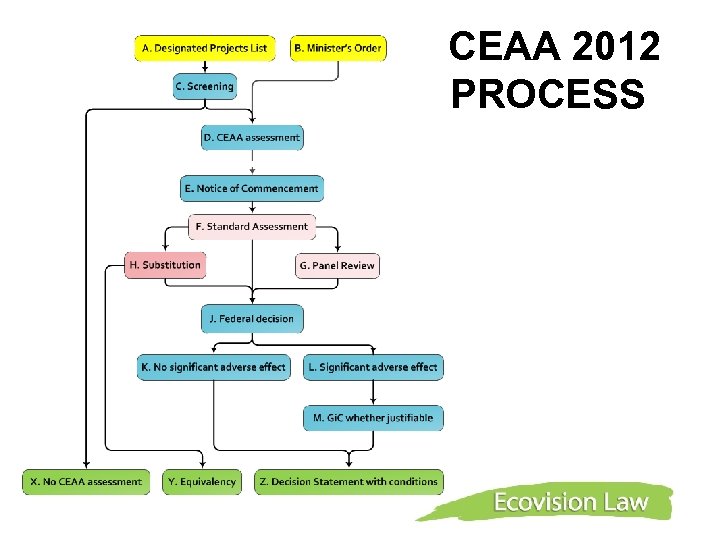 CEAA 2012 PROCESS
 CEAA 2012 Designated Project Definition S. 2. (1) • Doesn’t apply to projects outside Canada • Includes any physical activity that is incidental to those physical activities • What does “incidental” mean? • Application of CEAA scope of project cases such as Red Chris?
 Purposes S. 4 • (a) “protect the components of the environment that are within the legislative authority of Parliament from significant adverse environmental effects caused by a designated project” • “Protect” stronger than verbs in CEAA purposes? Connotes a positive duty? • Components of the environment? S. 2. (1) defines environment as “components of the Earth”?
 Purposes S. 4 • Some “components of the environment” set out in s. 5. (1)(a) • S. 5. (3) Governor in Council may amend Schedule 2 “Components of the environment” to add or remove components of the environment
 Purposes S. 4 • (b) similar to CEAA s. 4. (a) “careful and precautionary manner” • (e) “opportunities for meaningful public participation” (but not timely? ) • (g) “ensure that projects. . . to be carried out on federal lands. . . are considered in a careful and precautionary manner so as to avoid significant adverse environmental effects”
 Environmental Effects S. 5. (1) • (1) “in relation to an act or thing, a physical activity, a designated project or a project” • (1)(a) components of the earth include fish, aquatic species at risk, migratory birds, other component on Schedule 2 • (1)(b) “a change that may be caused to the environment that would occur (i) on federal lands” (ii) another province or (iii) outside Canada
 Environmental Effects S. 5. (2) • (2) Other environmental effects to be taken into account where federal authority required “to exercise a power or perform a duty or function conferred on it” under another statute • (a) a change “that is directly linked or necessarily incidental to a federal authority’s exercise of a duty or function” permitting the carrying out of that physical activity
 Environmental Effects S. 5. (2) • (b) “an effect. . . of any change. . . on” (i) health and socio-economic conditions, (ii) physical and cultural heritage, or (iii) historical, archaeological structures etc.
 Project Decision-making • Determination as to likely significant adverse environmental effects s. 5. (1), (2) remains key • Determination made by Minister (for EAs and panel reviews) • If significant adverse effects determination, Cabinet determines whether those effects are justified in the circumstances
 Project Decision-making • What does significance mean? • What does justified in the circumstances mean?
 Determinations of “Significance” Reference Guide 1994 • Only effects that are both likely and adverse can be considered • Includes mitigation measures • Factors include: – Magnitude – Geographic Extent – Duration and Frequency – Reversibility – Ecological Context
 Justified in the Circumstances • Projects rarely are determined to have significant adverse environmental effects • Result – decision-makers rarely called upon to justify project “in the circumstances” • Project that makes net positive contribution to sustainability may be justified even if significant adverse environmental effects
 Project Decision-making • Decision Statement required to be issued by decision-maker to proponent within 24 months after referral to panel review s. 54. (1) • Decision Statement must be made public, include conditions for mitigation measures, follow-up programs s. 54. (1) • Decision Statement to refer to significance, justify significant effects, set approval conditions
 Project Decision-making • RA/Minister then determines conditions for project approval not Cabinet • Conditions limited to those “directly linked or necessarily incidental to the exercise of a power or performance of a duty or function by a federal authority
 Project Decision-making • In case of an equivalency finding under section 37 with respect to a provincial EA process – no federal project decision under CEAA 2012 – no requirement to consider results of the equivalent provincial EA process (may still be federal regulatory decisions) • Results of provincial EA may not be available for federal decision-making
 Significance and Sustainability • CEAA 2012 limits decision-making to determinations of significance of adverse environmental effects, mitigation, justification (unlike CEAA) • Shouldn’t assessment be informing decision makers about broader contribution of project to sustainability (whether net positive or net negative)?
 Follow-up Programs • “A program for (a) verifying the accuracy of the environmental assessment of a project, and (b) determining the effectiveness of any mitigation measures” s. 2. (1) • Not used for compliance purposes • Don’t require that proponents/regulators to adjust mitigation measures in case of serious unanticipated effects
 Follow-up Programs • Requirements of follow-up program mandatory factor for EAs s. 19. (1)(e) • Review panels required to include follow-up program in report s. 43. (1)(d) • Results may be used for implementing adaptive management measures or improving quality of future EAs
 Failure to Learn from EAs, Follow-up Program • Failure to learn and apply lessons learned from EAs to achieve better predictions of effects and better mitigation measures is perhaps the biggest failure of CEAA • Follow-up programs are rarely serious, rarely affect project operation beyond early post-approval stage • How can follow-up programs work if proponents not required to disclose data?
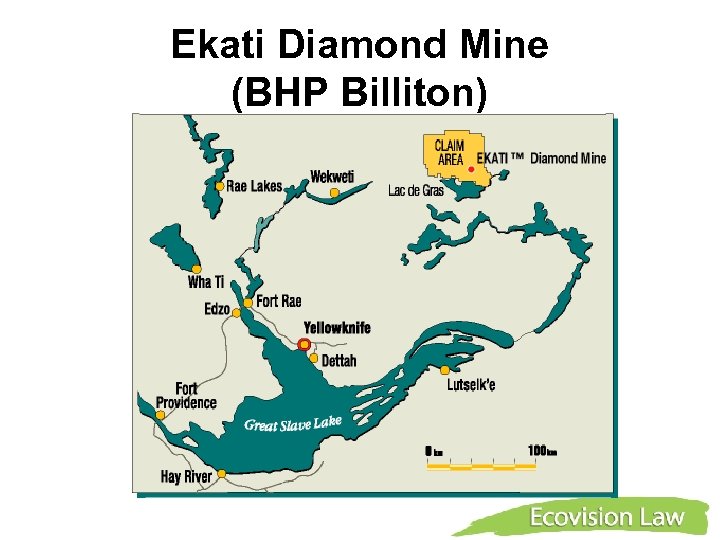 Ekati Diamond Mine (BHP Billiton)
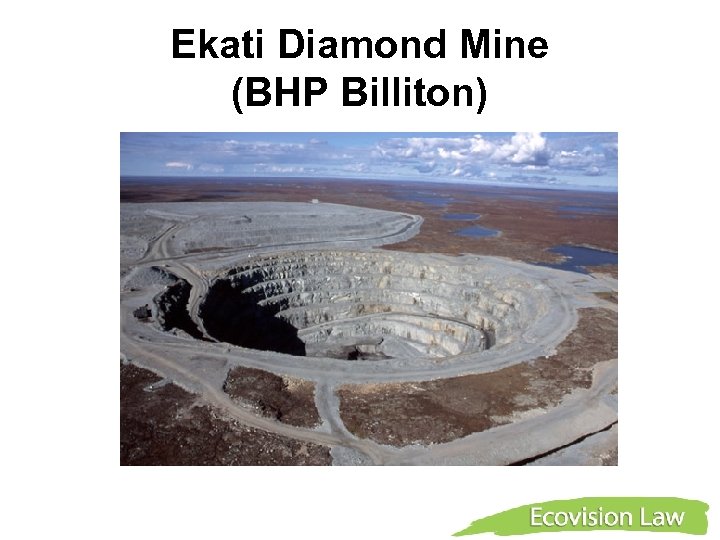 Ekati Diamond Mine (BHP Billiton)
 Independent Environmental Monitoring Agency • Public watchdog for environmental management of NWT Ekati Diamond Mine • Established under 1997 agreement that followed on 1996 NWT Diamonds Mine Project Review Panel recommendations • Agreement is legal instrument to ensure BHPB, governments respect/protect land, water, wildlife, way of life essential to wellbeing of Aboriginal Peoples • www. monitoringagency. net
 Independent Environmental Monitoring Agency • Compiles environmental information using indicators such as water quality • Publishes annual monitoring reports since 1999 -2000 as well as newsletters • Recommends changes to environmental management regime, and is now advising on mine closure plan
 Enforcement and Compliance • CEAA: Few legal tools for compliance • Judicial review was key tool, no appeals • Self-assessment approach for screenings resulted in highly fragmented approach and minimal quality control • CEAA 2012: better tools for compliance
 Enforcement and Compliance • Any federal decision can be challenged if it relied on a legally deficient EA (Cheviot case) • EA report can be challenged for legal deficiencies even if no federal decision yet (Cheviot case) • Scoping decisions are subject to judicial review (Citizens Mining Council case) program
 Prohibitions S. 6 “The proponent of a designated project must not do any act or thing in connection with the carrying out of the designated project. . . if that act or thing may cause an environmental effect unless” (a)Agency decision (b)Proponent complies with “conditions included in decision statement • CEAA – no prohibition sections
 Offence for Violating S. 6 Prohibitions S. 99. (1) “Any proponent who contravenes section 6 is guilty of an offence punishable on summary conviction and is liable, for a first offence, to a fine of not more than $200, 000 and for any subsequent offence, to a fine of not more than $400, 000”
 Prohibitions S. 7 “A federal authority must not exercise any power or perform any duty. . . that would permit a designated project to be carried out” unless (a)Agency decision (b)Decision statement “indicates that the designated project is not likely to cause significant adverse environmental effects. . . ”
 Injunctions S. 96 Minister may apply for, and competent court may grant injunction if a “person has done, is about to do, or is likely to do any act constituting or directed toward the commission of an offence under section 99”
 CEAA 2012 – Justifiable under Federal Criminal Law Power? • S. 6 and 7 Prohibitions • SS. 89 – 102 Administration and Enforcement powers (appointment and powers of enforcement officers, warrants, order, offences penalties) • Provide basis for validating CEAA 2012 as valid federal legislation pursuant to federal criminal law power under s. 91 Constitution Act?
 IMPLICATIONS • Federal EA process politicized • Federal EA activity reduced by order of magnitude or more • Opportunities to influence federal environmental assessment process expanded • Substitution and exemption features further weaken federal EA role, and fragment EA across Canada
 IMPLICATIONS • Narrowing of environmental effects to “federal” effects difficult to implement • Centralization of EA probably wise • Decision-making linked to enforcement a step forward • Opportunities to litigate on account of new concepts in CEAA 2012 and unfortunate drafting are abundant