


 Скачать презентацию INTRODUCTION TO CAM Definition What is CAM
6a28d6d2f490a4d580a7beefc9f174a4.ppt
- Количество слайдов: 28
 INTRODUCTION TO CAM
 Definition What is CAM? The effective utilization of computers in manufacturing. Direct application - device monitoring and control, NC, PLC, manufacturing cell. Indirect applications - manufacturing support planning, MRP, process planning, scheduling, inventory, shop floor control.
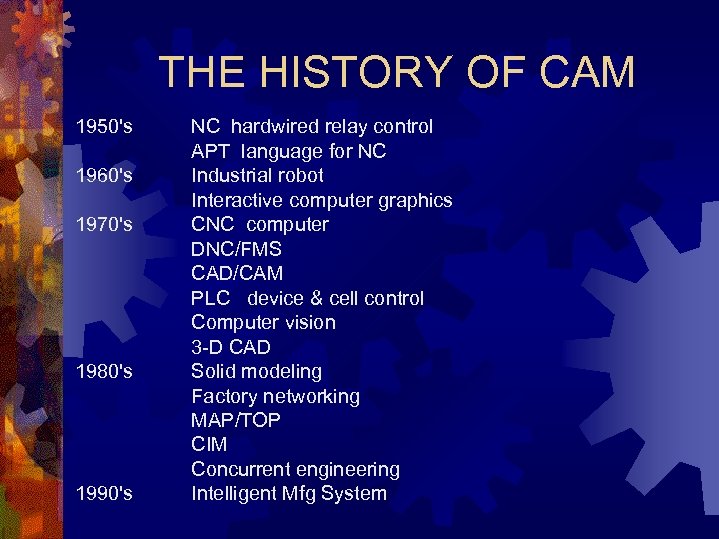 THE HISTORY OF CAM 1950's 1960's 1970's 1980's 1990's NC hardwired relay control APT language for NC Industrial robot Interactive computer graphics CNC computer DNC/FMS CAD/CAM PLC device & cell control Computer vision 3 -D CAD Solid modeling Factory networking MAP/TOP CIM Concurrent engineering Intelligent Mfg System
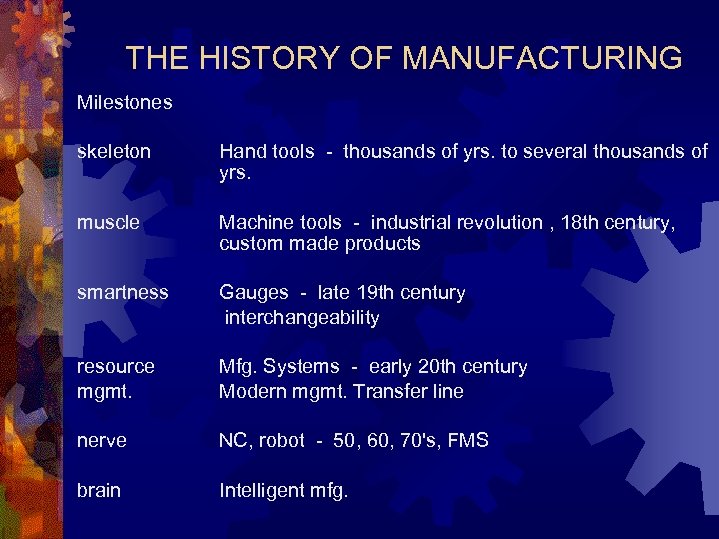 THE HISTORY OF MANUFACTURING Milestones skeleton Hand tools - thousands of yrs. to several thousands of yrs. muscle Machine tools - industrial revolution , 18 th century, custom made products smartness Gauges - late 19 th century interchangeability resource mgmt. Mfg. Systems - early 20 th century Modern mgmt. Transfer line nerve NC, robot - 50, 60, 70's, FMS brain Intelligent mfg.
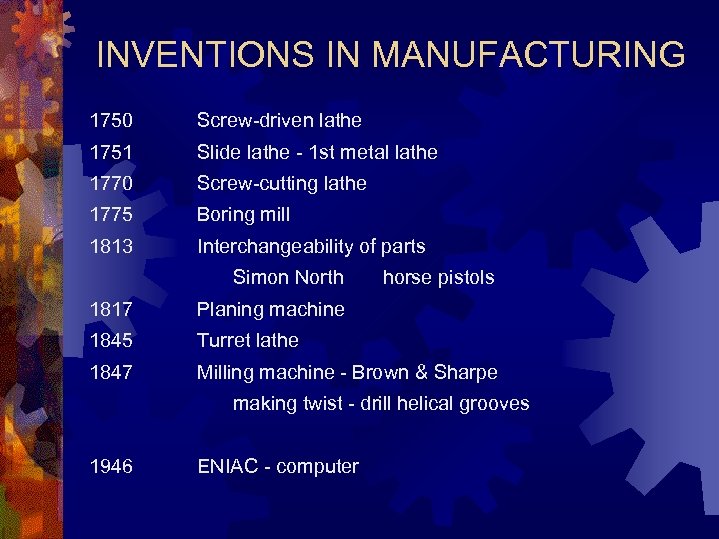 INVENTIONS IN MANUFACTURING 1750 Screw-driven lathe 1751 Slide lathe - 1 st metal lathe 1770 Screw-cutting lathe 1775 Boring mill 1813 Interchangeability of parts Simon North horse pistols 1817 Planing machine 1845 Turret lathe 1847 Milling machine - Brown & Sharpe making twist - drill helical grooves 1946 ENIAC - computer
 THE TREND OF MANUFACTURING INDUSTRY Facts: 1. Rapid changing market place 2. Fast development of new technologies Vacuum Tubes ->: Transistor -> IC -> VLSI Wiring -> thru-hole PCB -> Surface Mount Component Quality product -> precision engineering -> nano-engineering 3. Fierce competition Failing automotive industry, steel mills, Wang Lab, . . . 4. A "use brain" generation, not willing to learn the trade which requires hand skill. To survive: 1. Lower cost 2. Higher quality 3. Lower product development cycle
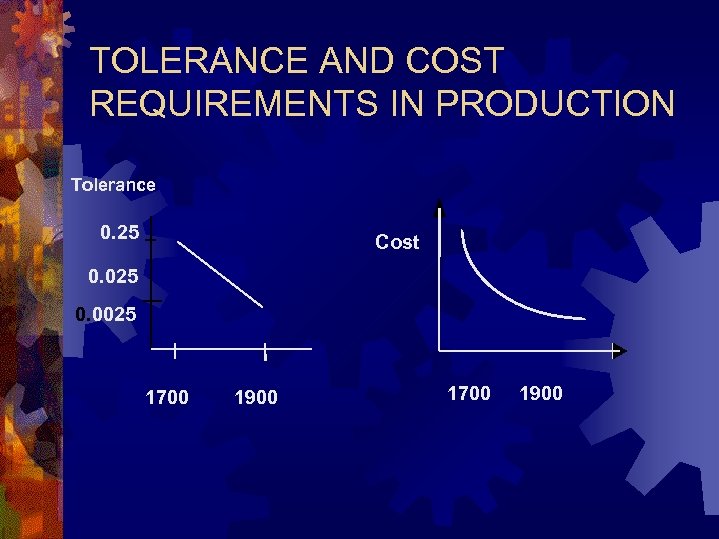 TOLERANCE AND COST REQUIREMENTS IN PRODUCTION Tolerance 0. 25 Cost 0. 025 0. 0025 1700 1900
 SOLUTIONS DEVELOPED 1. Small batch production less. 95% in lot size of 50 or 2. Just in time production, reduce inventory (union? ) 3. Automation - quality, labor cost Automated lathe, screw machine (Swiss machine), transfer line 4. Flexible automation - further reduce lead time, automation of small batch (NC, FMS, FMC, Robotics, . . . ) 5. Integration - CAM, CIM, concurrent engineering, TQM, etc.
 BENEFITS OF CAM 90% Inventory reduction 50% more efficient use of factory & warehouse space 75% reduction in machine setup time - item setup (remeasurement, repositioning, and replacement of cutting tools, . . ) Does not change product specific set-up. 25% reduction in direct and indirect labor 90% reduction in lead time
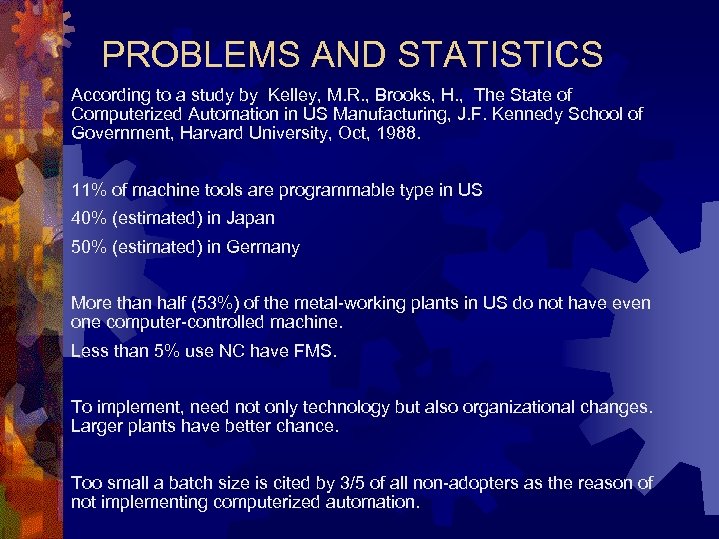 PROBLEMS AND STATISTICS According to a study by Kelley, M. R. , Brooks, H. , The State of Computerized Automation in US Manufacturing, J. F. Kennedy School of Government, Harvard University, Oct, 1988. 11% of machine tools are programmable type in US 40% (estimated) in Japan 50% (estimated) in Germany More than half (53%) of the metal-working plants in US do not have even one computer-controlled machine. Less than 5% use NC have FMS. To implement, need not only technology but also organizational changes. Larger plants have better chance. Too small a batch size is cited by 3/5 of all non-adopters as the reason of not implementing computerized automation.
 ADDITIONAL COSTS OF USING CAM VS MANUAL OPERATION • Programming • Special tooling design and manufacturing • Program proof out, 1 st good part is a dream, not a reality. • Maintenance - more sophisticated system.
 CURRENT PROBLEMS 1. Manufacturing not emphasized enough 2. Designer tend to design for functionality alone 3. Manufacturing engineers lack overall concept in manufacturing 4. Systems are not integrated.
 CONCURRENT ENGINEERING (SIMULTANEOUS ENGINEERING) Design product and process simultaneously. "Do not focus on only one aspect of the product realization process. "
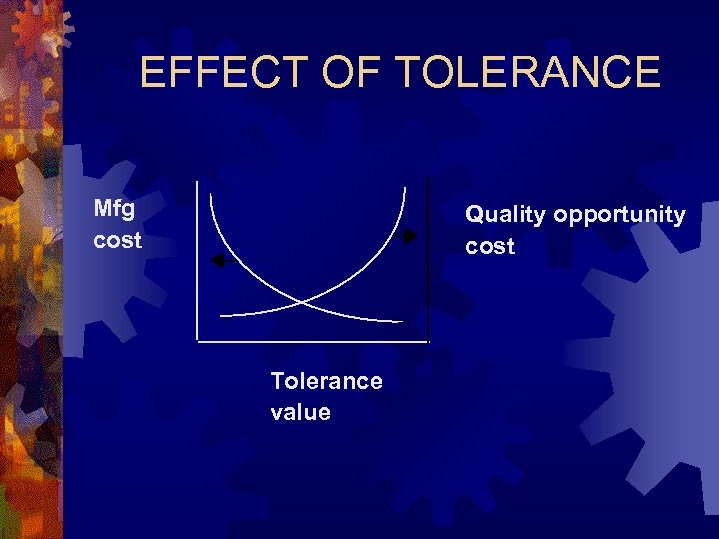 EFFECT OF TOLERANCE Mfg cost Quality opportunity cost Tolerance value
 FUTURE Alvin Toffler, Power Shift, 1990 (two other books by him: The Future Shock, 1970 The Third Wave, 1980) Sources of power: Force Money Knowledge From information to knowledge.
 THREE LEVELS OF COMPUTERIZATION Data processing Information processing Knowledge processing
 BASIC TAXONOMY OF MANUFACTURING 1. Discrete vs. Continuous Mfg Discrete - finite number of discrete steps parts & product separable entities TV, car, . . . Continuous - continuous process We deal with discrete mfg. in this class.
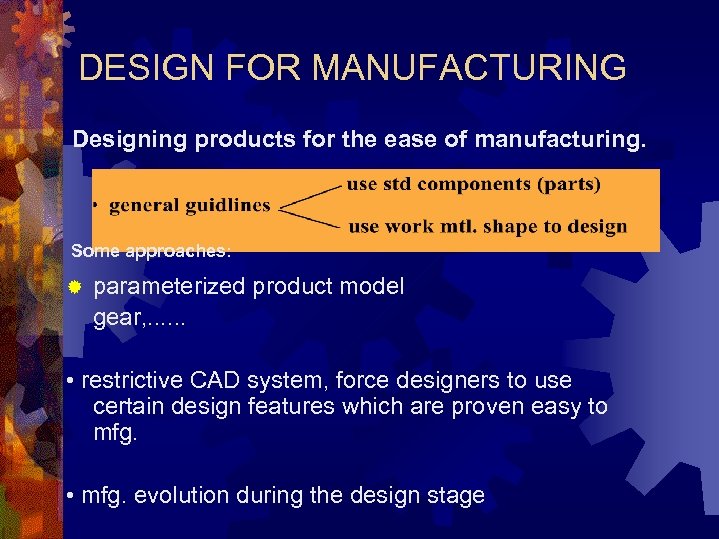 DESIGN FOR MANUFACTURING Designing products for the ease of manufacturing. Some approaches: ® parameterized product model gear, . . . • restrictive CAD system, force designers to use certain design features which are proven easy to mfg. • mfg. evolution during the design stage
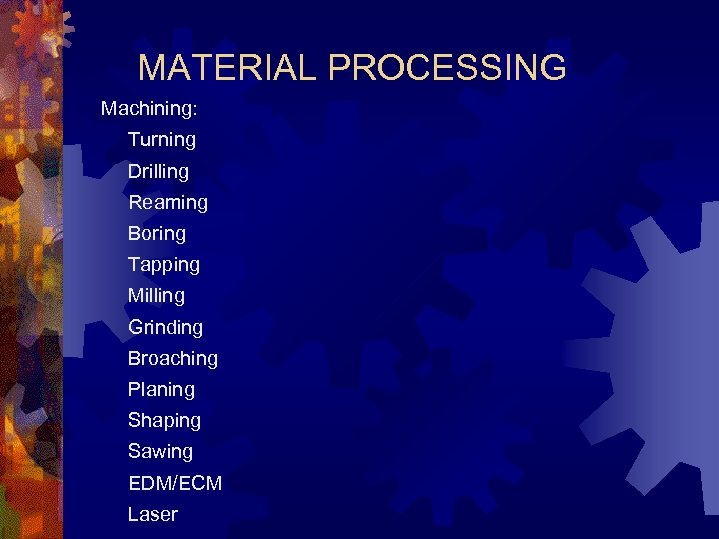 MATERIAL PROCESSING Machining: Turning Drilling Reaming Boring Tapping Milling Grinding Broaching Planing Shaping Sawing EDM/ECM Laser
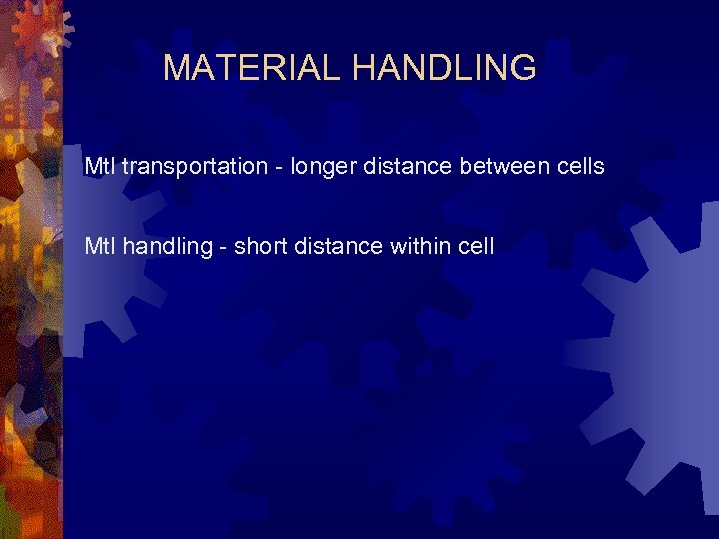 MATERIAL HANDLING Mtl transportation - longer distance between cells Mtl handling - short distance within cell
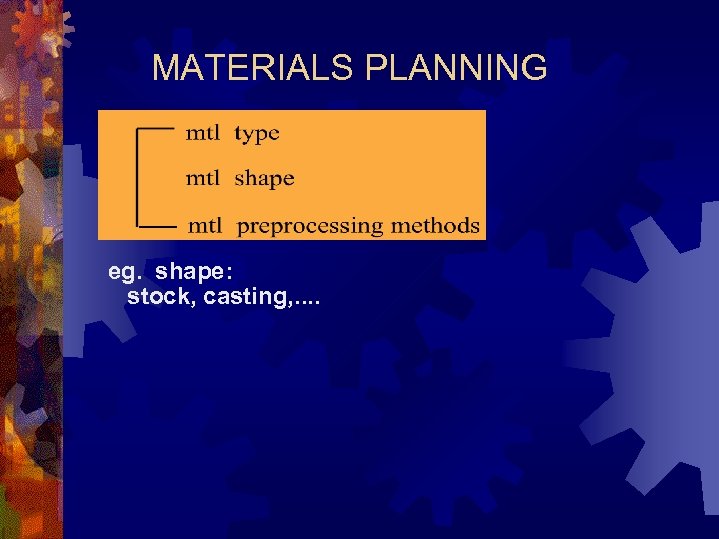 MATERIALS PLANNING eg. shape: stock, casting, . .
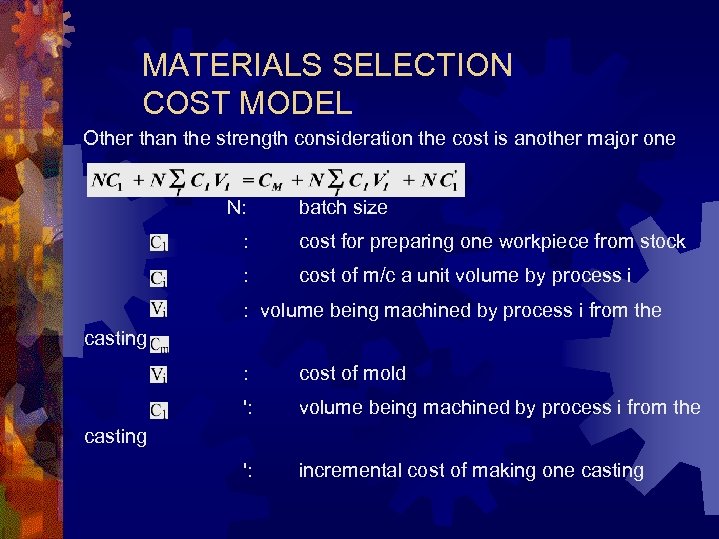 MATERIALS SELECTION COST MODEL Other than the strength consideration the cost is another major one N: batch size : cost for preparing one workpiece from stock : cost of m/c a unit volume by process i : volume being machined by process i from the casting : cost of mold ': volume being machined by process i from the ': incremental cost of making one casting
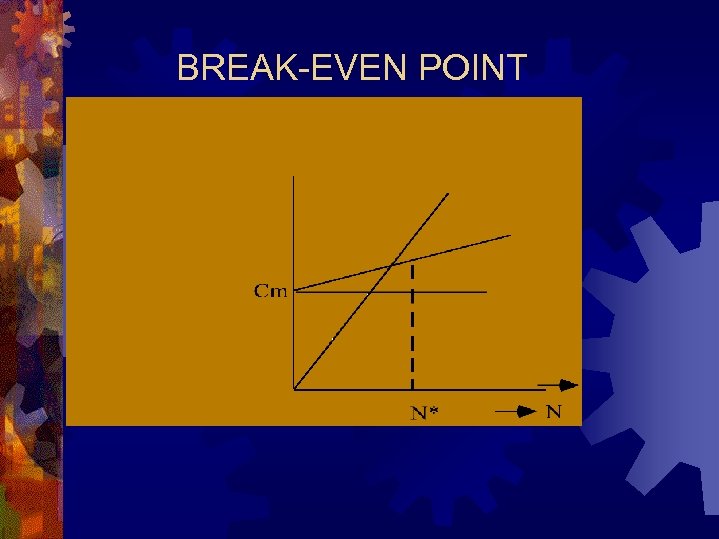 BREAK-EVEN POINT
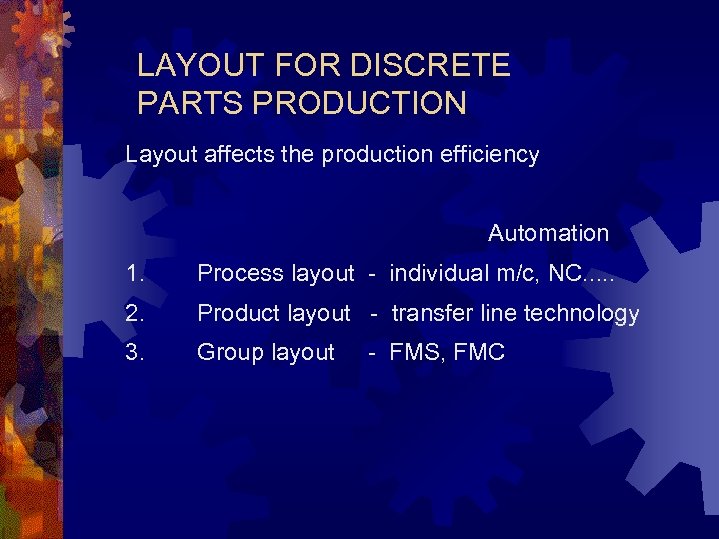 LAYOUT FOR DISCRETE PARTS PRODUCTION Layout affects the production efficiency Automation 1. Process layout - individual m/c, NC. . . 2. Product layout - transfer line technology 3. Group layout - FMS, FMC
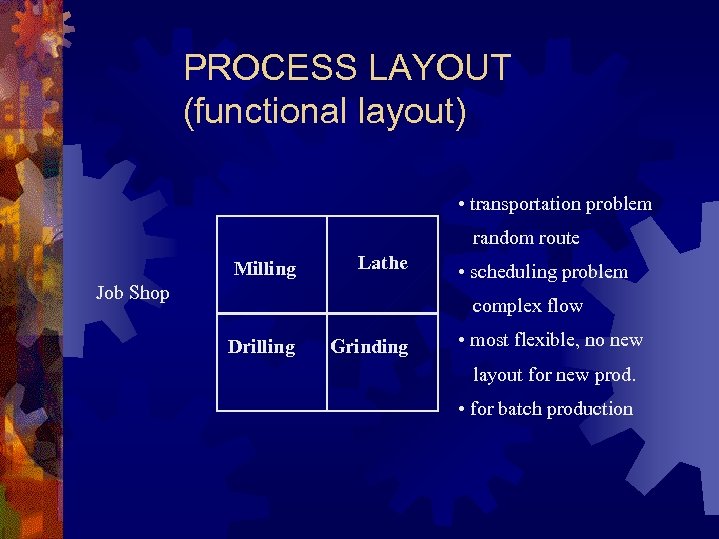 PROCESS LAYOUT (functional layout) • transportation problem random route Milling Lathe Job Shop • scheduling problem complex flow Drilling Grinding • most flexible, no new layout for new prod. • for batch production
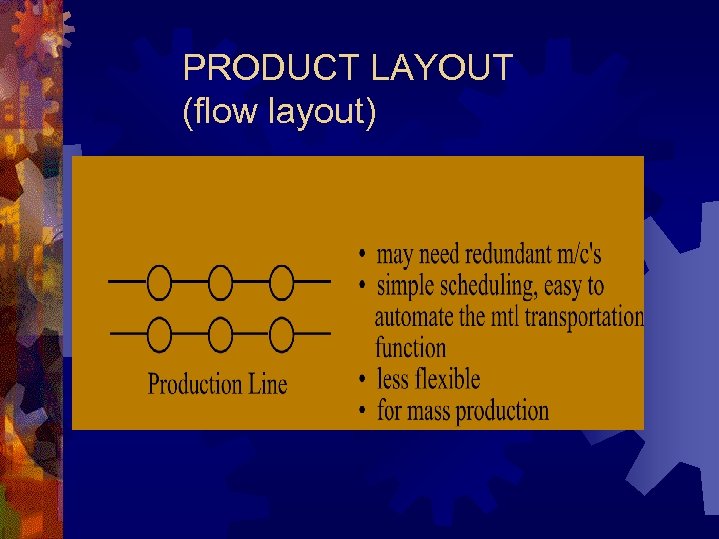 PRODUCT LAYOUT (flow layout)
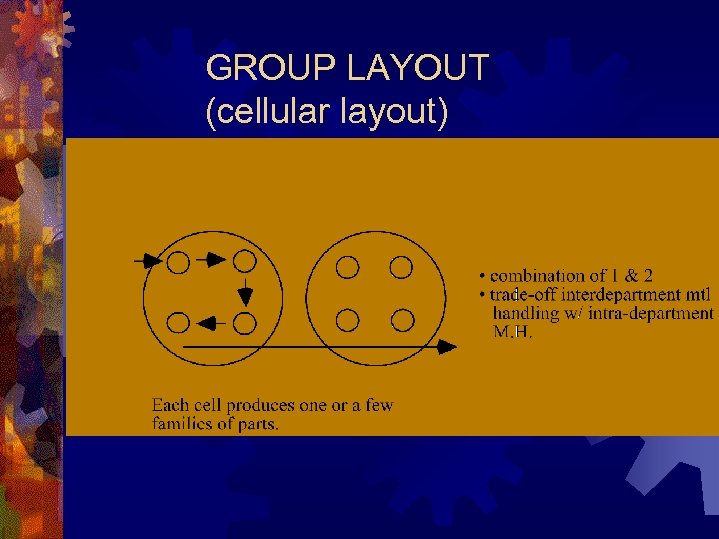 GROUP LAYOUT (cellular layout)
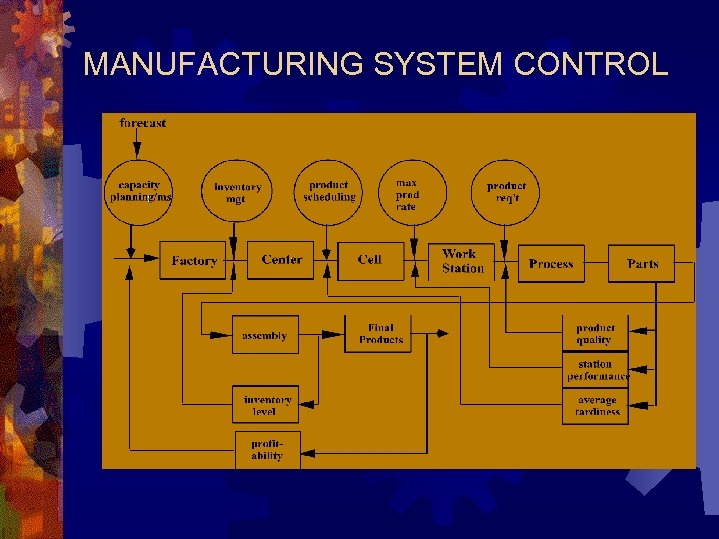 MANUFACTURING SYSTEM CONTROL