 Скачать презентацию Introduction to Business BUS-F-07 -IB BM 004 -4
ITB Chp 2 Business Environment.ppt
- Количество слайдов: 39



Introduction to Business BUS-F-07 -IB BM 004 -4 -0 -ITB BUSINESS & ITS ENVIRONMENT The Business Environment

Learning Outcomes • Analyse organisation a the of nature being system of inter-dependency • Module Code and Module Title of Slides
ENVIRONMENT Definition: 1. The totality of surrounding conditions. or 2. The sum total of all the external conditions that affect an organism, community, material, or energy. Module Code and Module Title of Slides
Business Environment of an organisation The two parts of a business environment are: a) Internal Environment b) External Environment Module Code and Module Title of Slides
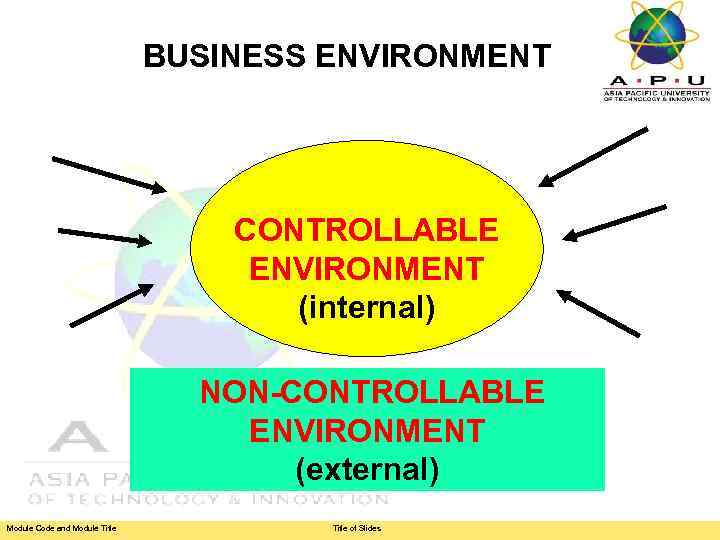
BUSINESS ENVIRONMENT CONTROLLABLE ENVIRONMENT (internal) NON-CONTROLLABLE ENVIRONMENT (external) Module Code and Module Title of Slides
CONTROLLABLE ENVIRONMENT 1. Money 2. Materials 3. Equipment 4. Labour Module Code and Module Title of Slides
CONTROLLABLE ENVIRONMENT 1. Money to finance any business can be obtained from many sources. A business can decide where and when to obtain this financing. A business also can plan their expenditures in the form of budget. 2. Materials Production requires materials and business has the option to choose the types and quantity of materials they require. A business also can change their product to suit the availability of specific materials required for that product. Module Code and Module Title of Slides
CONTROLLABLE ENVIRONMENT 3. Equipments are required to assemble the materials and to help expedite production. A business can decide whether to use equipment or not depending on the ability of the equipment to handle the production compared to human. 4. Labour In place of equipment, a business can decide to use human labour to handle production. In most cases, human intervention is highly relevant when decision making is required. Module Code and Module Title of Slides

Module Code and Module Title of Slides
NON-CONTROLLABLE ENVIRONMENT 1. Political 2. Economic 3. Social 4. Technology 5. Legal 6. Environmental 7. Competition Module Code and Module Title of Slides
NON-CONTROLLABLE ENVIRONMENT 1. Political How changes in government policy might affect the business. E. g. a decision to subsidise building new houses in an area could be good for a local brick works. 2. Economic How the economy affects a business in terms of taxation, government spending, general demand, interest rates, exchange rates and global economic factors. Module Code and Module Title of Slides
NON-CONTROLLABLE ENVIRONMENT 3. Social How consumers, households and communities behave and their beliefs. For instance, changes in attitude towards health, or a greater number of pensioners in a population. 4. Technology How the rapid pace of change in production processes and product innovation affect a business. Module Code and Module Title of Slides
NON-CONTROLLABLE ENVIRONMENT 5. Legal The way in which legislation in society affects the business. E. g. changes in employment laws on working hours. 6. Environmental The environmental system is the natural system in which life takes place. Increasingly businesses have become aware of the relationship between their economic activity i. e. making goods and services for profits and the effects that this has on the environmental system. Module Code and Module Title of Slides
NON-CONTROLLABLE ENVIRONMENT 7. Competition Competitors actions affect the ability of the business to make profits, because competitors will continually seek to gain an advantage over each other, by differentiating their product and service, and by seeking to provide better value for money. Module Code and Module Title of Slides

Module Code and Module Title of Slides
COMPETITIVE ANALYSIS Porter’s Five Forces
Michael Porter’s Biography - Is the leading authority on competitive strategy - Professor Porter is generally recognized as the father of the modern strategy - He is the Bishop William Lawrence University Professor, based at Harvard Business School - He is the author of 18 books and over 125 articles. Module Code and Module Title of Slides
Business Environment Module Code and Module Title of Slides
Porter's Five Forces Module Code and Module Title of Slides
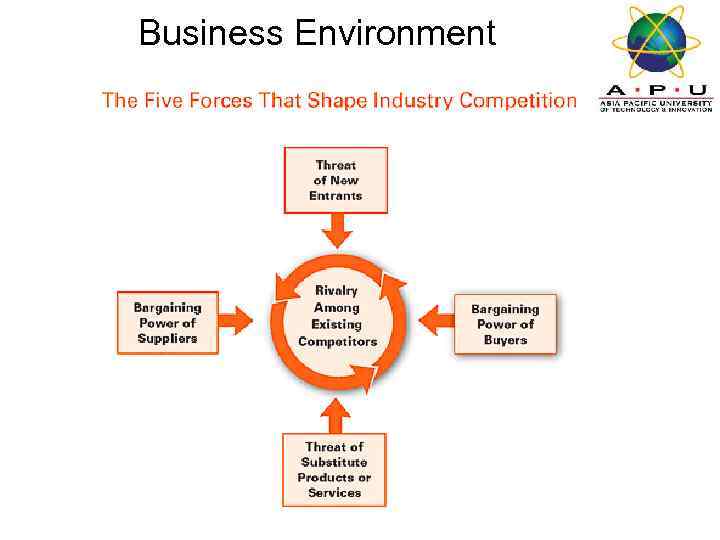
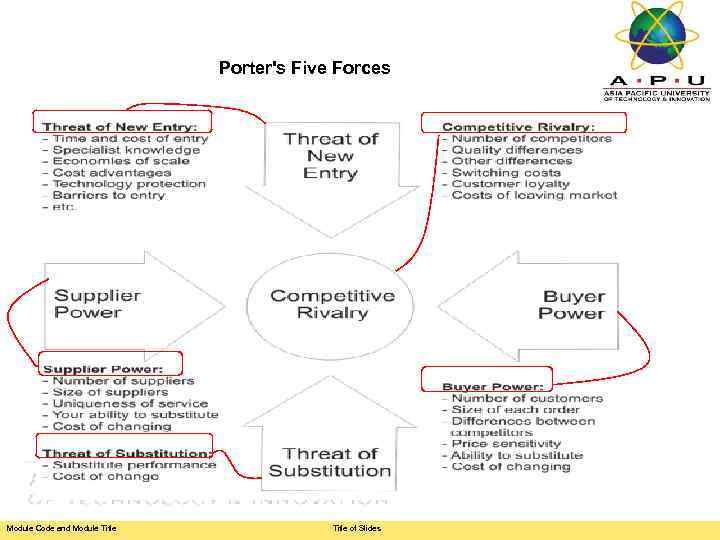
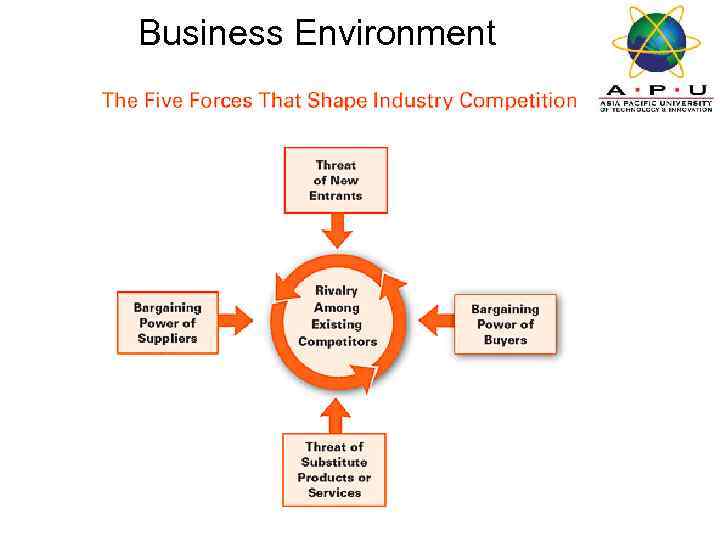
Porter's Five Forces Analysis is an important tool for assessing the potential for profitability in an industry. With a little adaptation, it is also useful as a way of assessing the balance of power in more general situations. It works by looking at the strength of five important forces that affect competition: Supplier Power: The power of suppliers to drive up the prices of your inputs. Buyer Power: The power of your customers to drive down your prices. Competitive Rivalry: The strength of competition in the industry. The Threat of New Entry: The ease with which new competitors can enter the market if they see that you are making good profits (and then drive your prices down). The Threat of Substitution: The extent to which different products and services can be used in place of your own. Module Code and Module Title of Slides
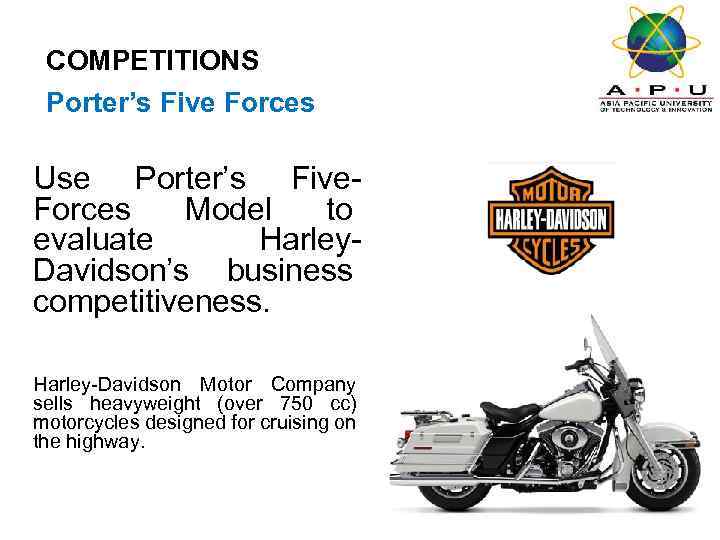
COMPETITIONS Porter’s Five Forces Use Porter’s Five. Forces Model to evaluate Harley. Davidson’s business competitiveness. Harley-Davidson Motor Company sells heavyweight (over 750 cc) motorcycles designed for cruising on the highway. Module Code and Module Title of Slides
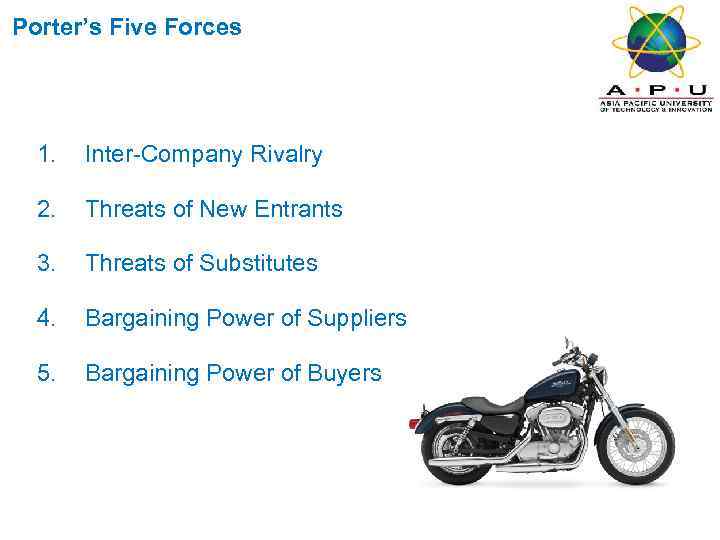
Porter’s Five Forces 1. Inter-Company Rivalry 2. Threats of New Entrants 3. Threats of Substitutes 4. Bargaining Power of Suppliers 5. Bargaining Power of Buyers Module Code and Module Title of Slides
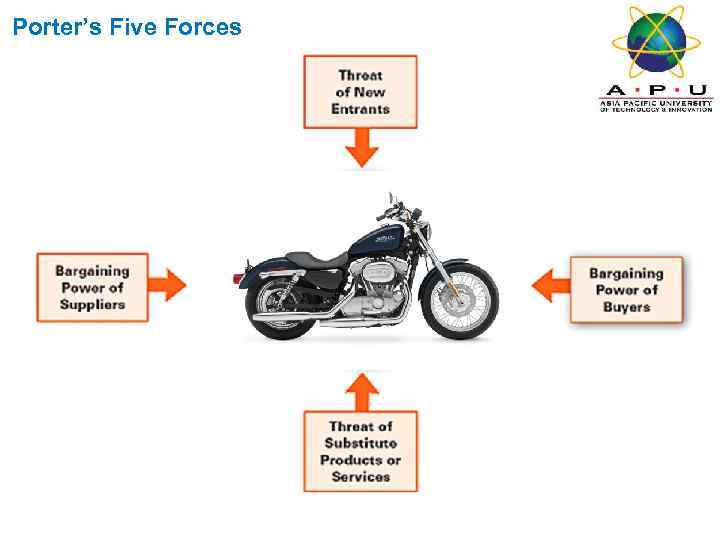
Porter’s Five Forces Module Code and Module Title of Slides
Business Environment Porter’s Five Forces Rivalry Among Existing Competitors HIGH • Number of competitors increases • Competitors become more equal in size and capability • Demand for the industry’s products declines • Price cutting becomes common • Consumers can switch brands easily Module Code and Module Title of Slides
Business Environment Porter’s Five Forces Threat of New Entrants Creating Barriers to Entry. . . • • • Gain Economies of scale Gain Technology and specialised know-how Establish strong customer loyalty Develop adequate distribution channels Secure access to raw materials Possession of Patents Module Code and Module Title of Slides
Business Environment Porter’s Five Forces Threat of Substitutes Threat increases when. . . • Relative price of substitutes decline • Consumers’ switching costs decrease Module Code and Module Title of Slides
Business Environment Porter’s Five Forces Bargaining Power of Buyers Bargaining power increases when. . . • • Buyers are concentrated (eg. Consumers’ Association) Buyers buy in volume Products are undifferentiated Buyers are well informed about sellers’ products, prices, and costs Module Code and Module Title of Slides
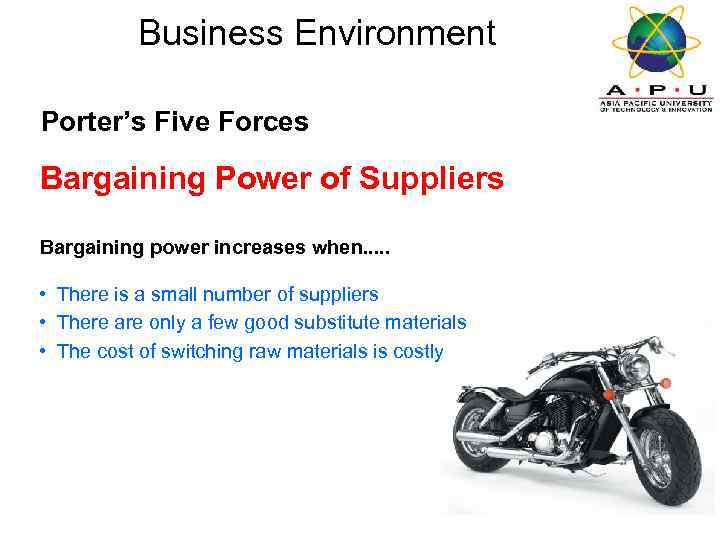
Business Environment Porter’s Five Forces Bargaining Power of Suppliers Bargaining power increases when. . . • There is a small number of suppliers • There are only a few good substitute materials • The cost of switching raw materials is costly Module Code and Module Title of Slides
Business Environment Module Code and Module Title of Slides
Question and Answer Session Q&A Module Code and Module Title of Slides
Group Dynamics Definition; ‘any number of people who interact with one another, are psychologically aware of one another and perceive themselves to be groups’ (Schein, 1988) Types of groups; 1. Formal groups 2. Informal groups Module Code and Module Title of Slides
Group Dynamics (cont) 1. Formal groups; created by managerial decisions to accomplish stated goals of organisation a. Common group; • is specified by the organisation chart • comprises the subordinate who report directly to a given supervisor • the authority relationship between a superior and a subordinate exemplifies a command group b. Task group; comprises of employees who works together to complete a particular objective. Module Code and Module Title of Slides
Group Dynamics (cont) 2. • • Informal groups; groups that arise from individual efforts and develop around common interest and friendship rather than design deliberate interest groups friendship groups Module Code and Module Title of Slides
Group Dynamics (cont) Why people form groups? ; ØThe satisfaction of needs; security; social & esteem ØProximity & attraction ØGroup goals Øeconomics Module Code and Module Title of Slides
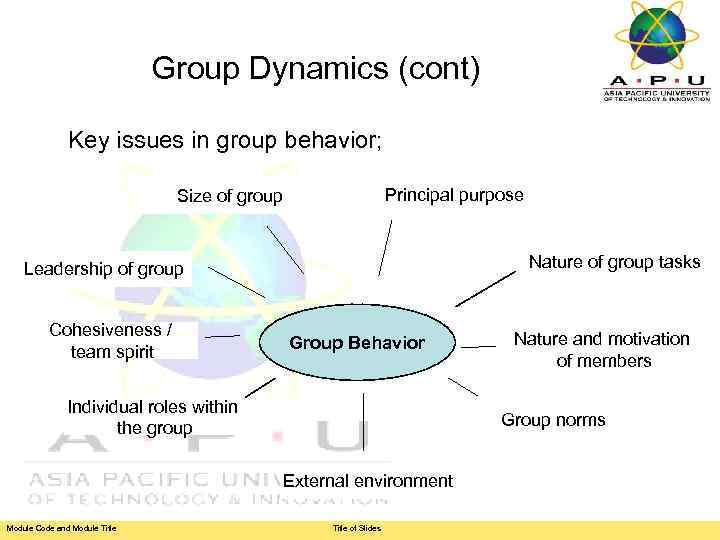
Group Dynamics (cont) Key issues in group behavior; Principal purpose Size of group Nature of group tasks Leadership of group Cohesiveness / team spirit Group Behavior Individual roles within the group Group norms External environment Module Code and Module Title Nature and motivation of members Title of Slides
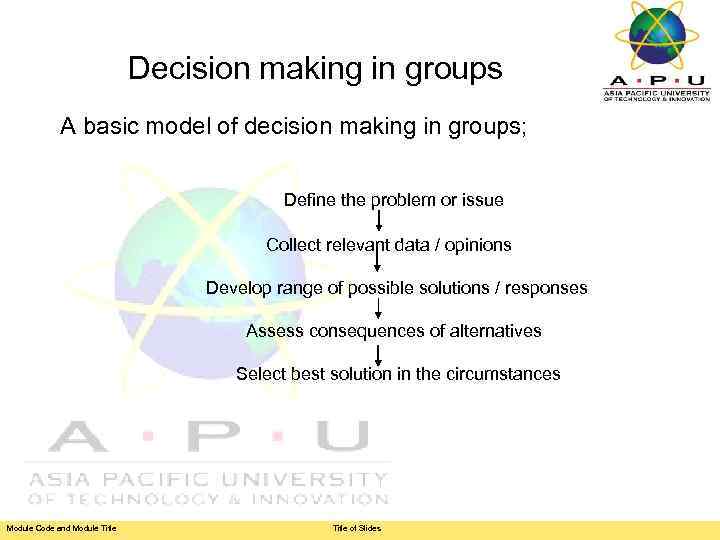
Decision making in groups A basic model of decision making in groups; Define the problem or issue Collect relevant data / opinions Develop range of possible solutions / responses Assess consequences of alternatives Select best solution in the circumstances Module Code and Module Title of Slides
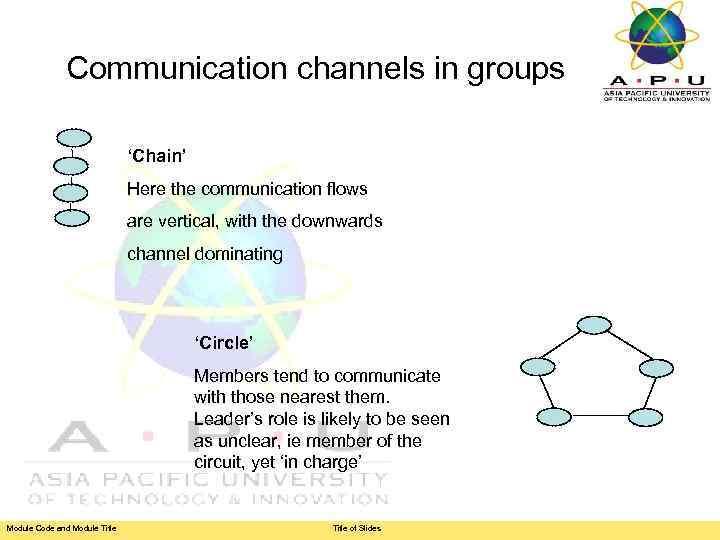
Communication channels in groups ‘Chain’ Here the communication flows are vertical, with the downwards channel dominating ‘Circle’ Members tend to communicate with those nearest them. Leader’s role is likely to be seen as unclear, ie member of the circuit, yet ‘in charge’ Module Code and Module Title of Slides
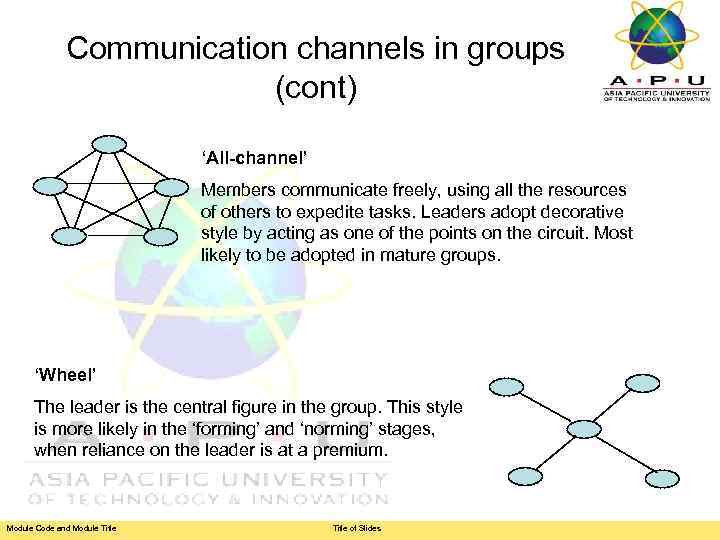
Communication channels in groups (cont) ‘All-channel’ Members communicate freely, using all the resources of others to expedite tasks. Leaders adopt decorative style by acting as one of the points on the circuit. Most likely to be adopted in mature groups. ‘Wheel’ The leader is the central figure in the group. This style is more likely in the ‘forming’ and ‘norming’ stages, when reliance on the leader is at a premium. Module Code and Module Title of Slides

Q&A Module Code and Module Title of Slides
Скачать презентацию Introduction to Business BUS-F-07 -IB BM 004 -4
ITB Chp 2 Business Environment.ppt