 Скачать презентацию Introduction to Brominated Flame Retardants Linda S Birnbaum
08133d24276b7be43b37a47621921389.ppt
- Количество слайдов: 41




Introduction to Brominated Flame Retardants Linda S. Birnbaum Director, Experimental Toxicology Division NHEERL Research Triangle Park, NC Region 2 Science Day/Non-Regulated Pollutants Workshop NYC – October 25, 2005
Flame Retardants • Fires kill >3000, injure >20, 000, and cause damages exceeding $11 billion annually in US alone • >175 different types of FRs § Halogenated (~46%) § Phosphorus-containing (24%) § Melamines (4%) § Inorganics (27%)
Brominated Flame Retardants • BFRs are the largest market group due to low cost and high efficiency • BFRs account for 38% global demand for bromine • >75 BFRs recognized commercially § Br-BPs, BDEs, CDs, phenols, phthalates, ++ • Global, transboundary problem § Persistence § Potential for bioaccumulation • Limited Data Base
![Global Market Demand for Major BFRs in 2001 (metric tons) [BSEF] America Europe Asia](https://present5.com/presentation/08133d24276b7be43b37a47621921389/image-4.jpg "Global Market Demand for Major BFRs in 2001 (metric tons) [BSEF] America Europe Asia")
Global Market Demand for Major BFRs in 2001 (metric tons) [BSEF] America Europe Asia Resto. W Total TBBPA 18, 000 11, 600 89, 400 600 119, 700 HBCD 2, 800 9, 500 3, 900 500 16, 700 DBDE 24, 500 7, 600 23, 000 1, 050 56, 100 OBDE 1, 500 610 1, 500 180 3, 790 PBDE 7, 100 150 100 7, 500
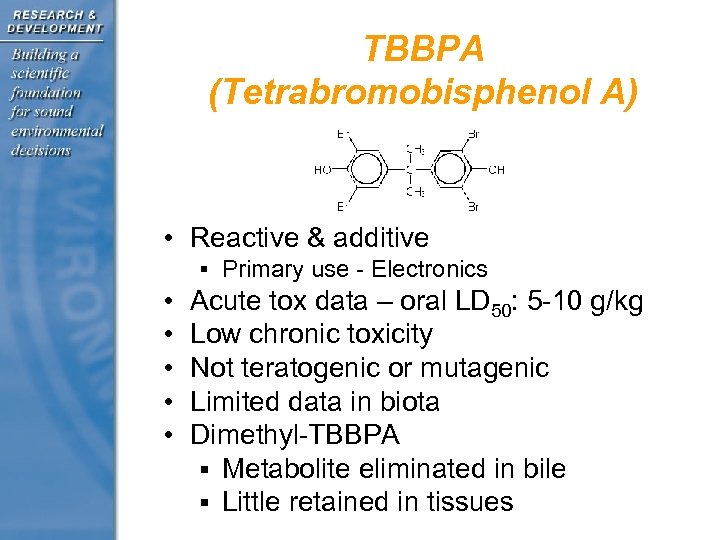
TBBPA (Tetrabromobisphenol A) • Reactive & additive § Primary use - Electronics • • • Acute tox data – oral LD 50: 5 -10 g/kg Low chronic toxicity Not teratogenic or mutagenic Limited data in biota Dimethyl-TBBPA § Metabolite eliminated in bile § Little retained in tissues
Health Effects of TBBPA • Immunotoxic § Inhibits T cell activation : blocks CD 25 (<3µM) • Hepatotoxic § Toxic to primary hepatocytes: destroys mitochondria; membrane dysfunction (inhibits CYP 2 C 9) • Neurotoxic § Inhibits dopamine uptake § Generates free radicals
Health Effects of TBBPA (cont. ) Endocrine Disruption • Ah. R Effects § Not relevant for commercial product (Contaminants? Combustion products? ) • Thyroid § TBBPA>T 4 in relation to binding to transthyretin § Blocks T 3 binding to TR § Perturbations observed in vivo • Estrogenic § Inhibits sulfotransferase (decreases estrogen clearance) § Mostly in vitro data
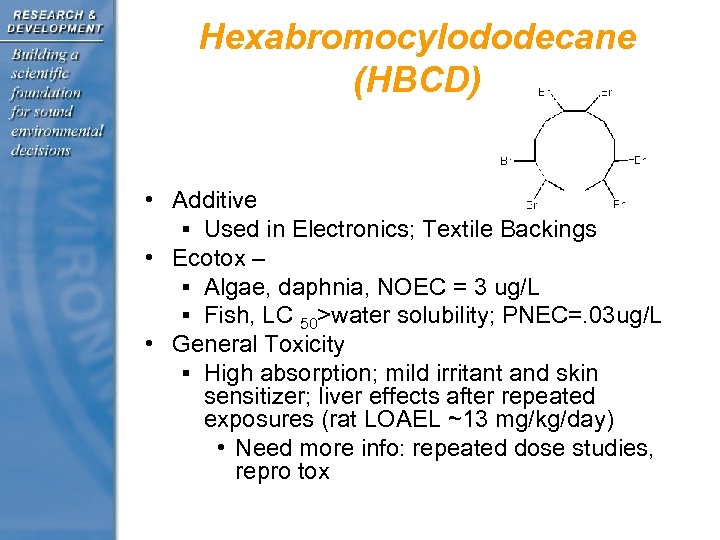
Hexabromocylododecane (HBCD) • Additive § Used in Electronics; Textile Backings • Ecotox – § Algae, daphnia, NOEC = 3 ug/L § Fish, LC 50>water solubility; PNEC=. 03 ug/L • General Toxicity § High absorption; mild irritant and skin sensitizer; liver effects after repeated exposures (rat LOAEL ~13 mg/kg/day) • Need more info: repeated dose studies, repro tox
HBCD (cont. ) • Neurotoxicity § Developmental neurotoxicant § Blocks dopamine uptake • Concern for occupational settings • Found in human breast milk • Persistent, bioaccumulative, toxic, long range transport • Isomeric composition in environmental samples differs from commercial mixture
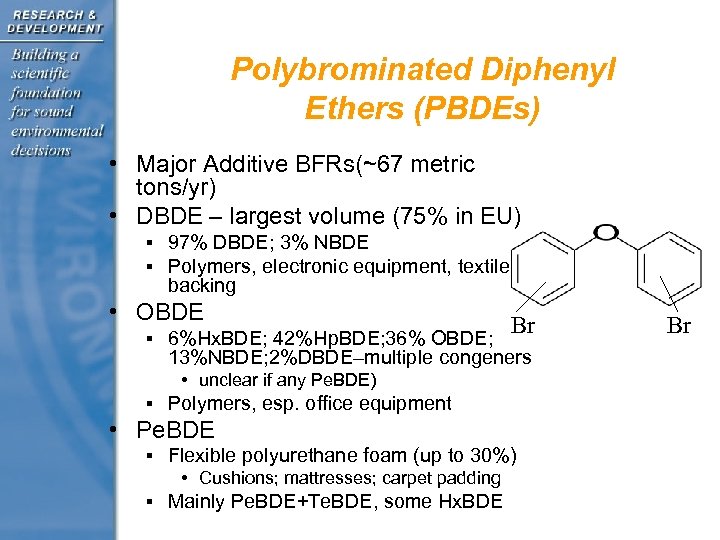
Polybrominated Diphenyl Ethers (PBDEs) • Major Additive BFRs(~67 metric tons/yr) • DBDE – largest volume (75% in EU) § 97% DBDE; 3% NBDE § Polymers, electronic equipment, textile backing • OBDE § 6%Hx. BDE; 42%Hp. BDE; 36% OBDE; Br 13%NBDE; 2%DBDE–multiple congeners • unclear if any Pe. BDE) § Polymers, esp. office equipment • Pe. BDE § Flexible polyurethane foam (up to 30%) • Cushions; mattresses; carpet padding § Mainly Pe. BDE+Te. BDE, some Hx. BDE Br
Properties • Solids with low solubility (< 1 ug/kg), high log Kow (>5) • Lower congeners - more bioaccumulative, persistent • Strong adsorption to soil/sediment/sludge • No significant biodegradation in air/water • Bioaccumulation - BCF > 5000 • Long-range transport - Evidence of remote contamination (e. g. , Arctic) • Persistence- t 1/2 Atmospheric >2 days; Water >2 mos; Soil, sediment >6 mos
Sources of Environmental Release • Polymer Processing • Formulating/applying to textiles • Volatilization and leaching during use • Particulate losses over use/disposal § Incineration § Recycling
Pathways of Exposure? • Indoor air >> outdoor air § May account for ~4%, on average, of daily intake by inhalation (could be much higher for some) § BDE 209 as well as 47, 99, 100, 153, 154 • House dust § Recent studies in Cape Cod, Northwest, Texas, Europe § Wide range • Recent study: N = 10. Range: 705 -69, 000 ppb; Mean: 12, 100 ppb; Median: 2, 500 ppb § Levels in US, UK>>Europe, Japan § Patterns resemble commercial products (Penta, Deca)
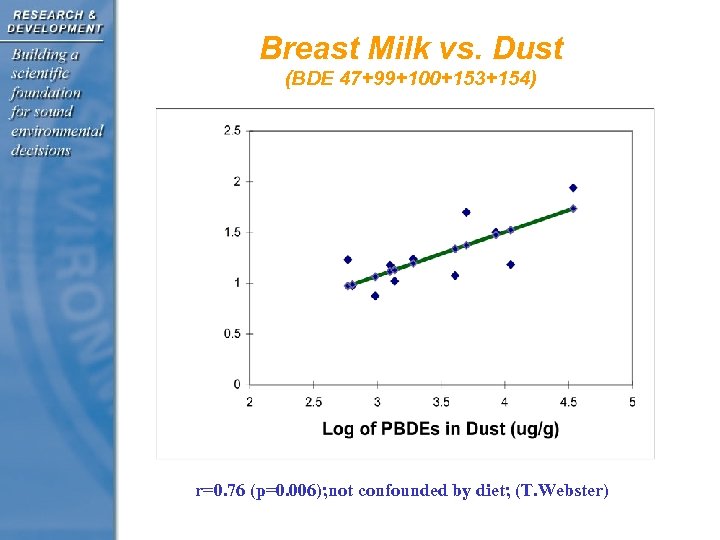
Breast Milk vs. Dust (BDE 47+99+100+153+154) r=0. 76 (p=0. 006); not confounded by diet; (T. Webster)
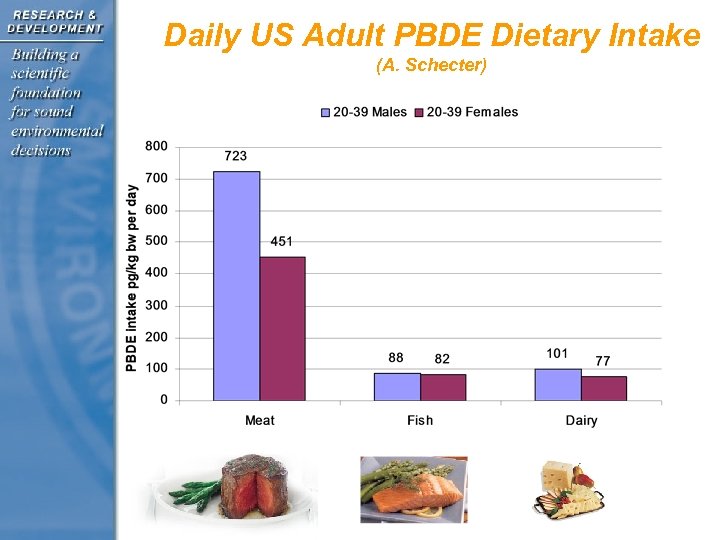
Daily US Adult PBDE Dietary Intake (A. Schecter)
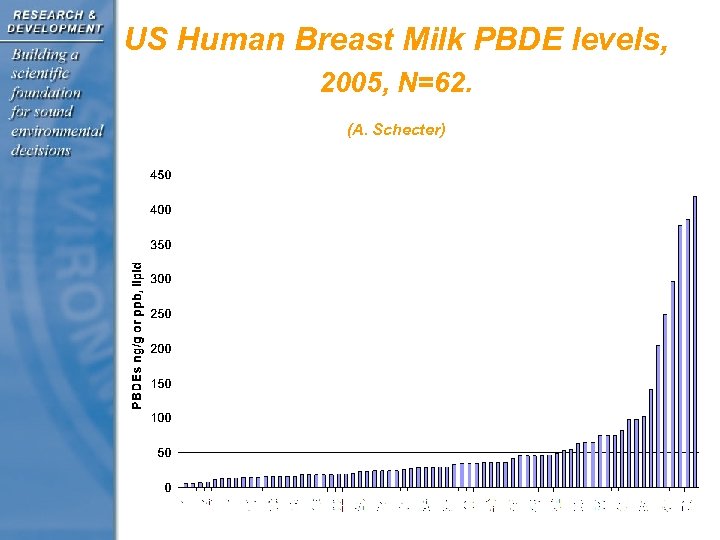
US Human Breast Milk PBDE levels, 2005, N=62. (A. Schecter)
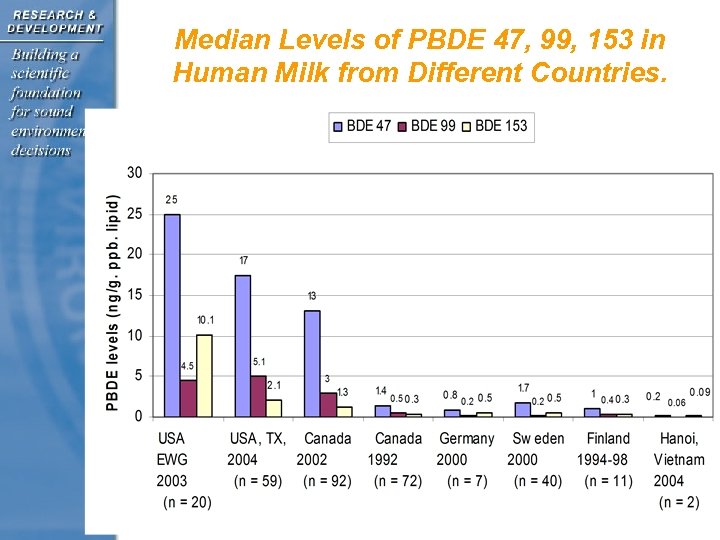
Median Levels of PBDE 47, 99, 153 in Human Milk from Different Countries.
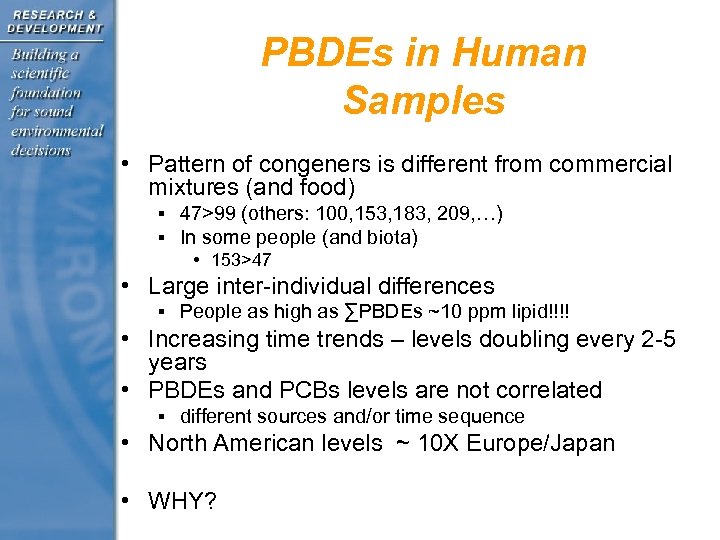
PBDEs in Human Samples • Pattern of congeners is different from commercial mixtures (and food) § 47>99 (others: 100, 153, 183, 209, …) § In some people (and biota) • 153>47 • Large inter-individual differences § People as high as ∑PBDEs ~10 ppm lipid!!!! • Increasing time trends – levels doubling every 2 -5 years • PBDEs and PCBs levels are not correlated § different sources and/or time sequence • North American levels ~ 10 X Europe/Japan • WHY?
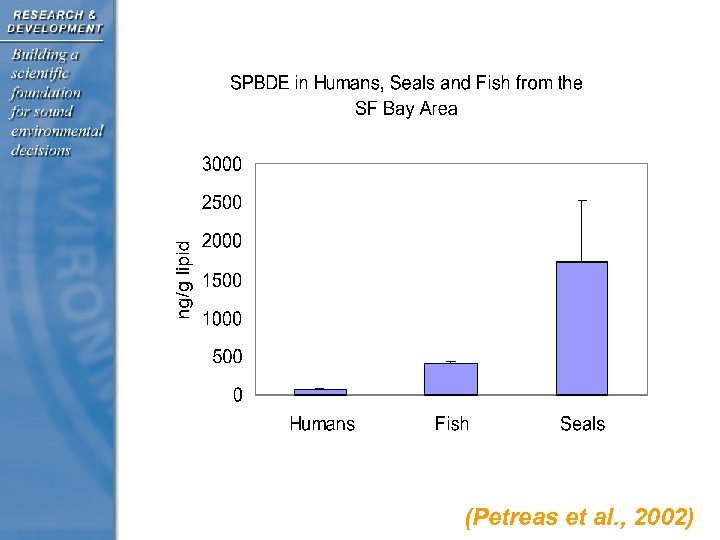
(Petreas et al. , 2002)
Ecotoxicity § Pe. BDE>>OBDE>DBDE § Pe. BDE - Highly toxic to invertebrates • Larval development, LOECs in low μg/l range § DE 71 – developmentally toxic to fish (1 ng/l) • Tail asymmetry; delayed hatching; behavioral changes; learning deficits § ∑PBDEs associated with die-off of Baltic porpoise • Lymphoid depletion § BDE 99 - depletion of Vitamin E in duck eggs § BDE 47, 99, 100 - decreases in T 4/retinoids, increases in oxidative stress in Kestrals
Ecotoxicity (cont. ) • DBDE/OBDE § May be low risk to surface water organism and top predators § Concern for waste water, sediment, and soil organisms § Concerns for lower brominated congeners in OBDE, potential for debromination, and generation of PBDDs/PBDFs
Mammalian Toxicity in Adult Rodents • Hepatotoxic • Enzyme induction § UDP-glucuronyl transferase • Weak inducer § Cytochrome P 450 • Induction of CYP 2 B, 3 A • Purified BDEs are NOT CYP 1 A inducers • DBDE – hepatocarcinogen (high dose)
Endocrine Disrupting Effects • Ah. R Effects § Contamination of commercial PBDEs § Combustion can produce PBDDs/PBDFs • Thyroid Homeostasis § Decrease in T 4 § OH-PBDE metabolites bind to transthyretin in vitro § Parent PBDEs - Effects on T 4 seen in vivo • Induction of UDP-glucuronyl transferase § Not a low dose effect
Endocrine Disrupting Effects (cont. ) • Progestins § In vitro – Anti-progesterone • Estrogens § In • • vivo BDE 99 – decreased E 2 vitro OH-PBDEs may be anti-estrogenic Sulfotransferase inhibition could be estrogenic
Endocrine Disrupting Effects (cont. ) • Androgens § In vivo • DE 71 – decreased weight of seminal vesicles and ventral prostate, decreased LH • BDE 99 – decreased Testosterone § In vitro • DE 71, BDE 100, BDE 47 – antiandrogenic (non-competitive inhibition)
Developmental Reproductive Effects • DE 71– pubertal exposures § Delay in puberty § Effects on male organs § Anti-androgenic in vitro – esp BDEs 100, 47 • BDE-99/47– in utero exposures § Delay in puberty § Ovarian toxicity § Male organ effects and decreased sperm
Developmental Neurotoxicity • DE-71 – Rats § Deficits in sensory and cognitive function § Altered sex-dependent behaviors § Effects on thyroid, cholinergic, and dopaminergic systems • BDE-99 (47, 153, 206, 208, 209) - Mice and rats § Infantile exposure (“Rapid Brain Growth”) - Permanent effects on learning § Perinatal exposure – Delay in sensory-motor development • BDE-99+PCB-52 – Mice § Effects may be more than additive
Developmental Neurotoxicity of PBDEs • Mechanisms? § Depression in serum T 4 § Anti-cholinergic § Anti-dopamingergic • PBDEs alter cell signaling in vitro § DE 71, BDEs 47, 99, 153 § Altered PKC and calcium homeostasis (associated with learning and memory) § Alter phorbol ester binding
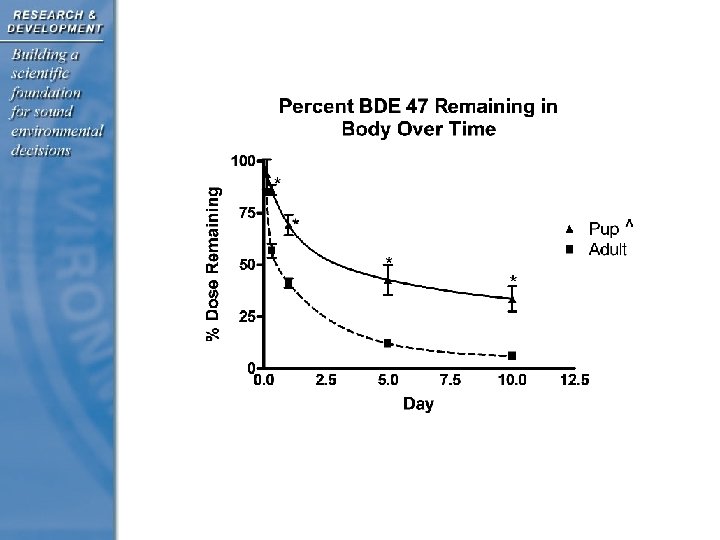
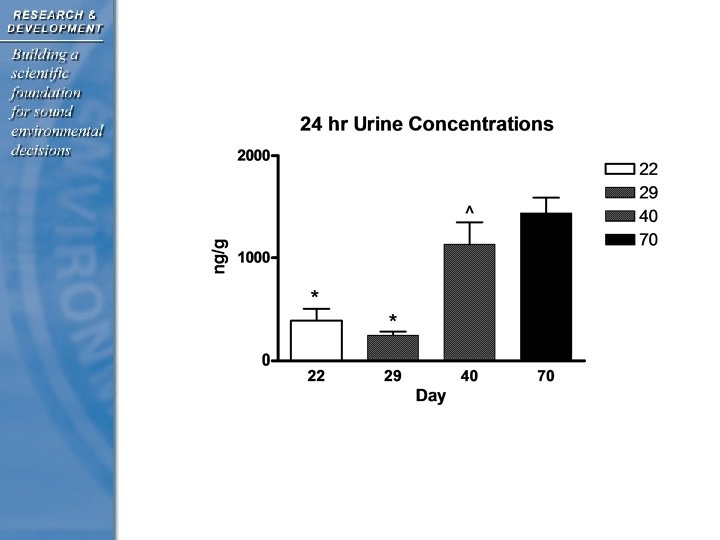
BDE 47 Toxicokinetics? • BDE 47 - Major PBDE in most people and wildlife • Well Absorbed (Oral~Inhalation>Dermal) • Distribution dictated by lipophilicity Fat • Limited Metabolism - Hydroxylation, Debromination • Excretion – mice and rats differ • Long Half-life- Potential for Bioaccumulation
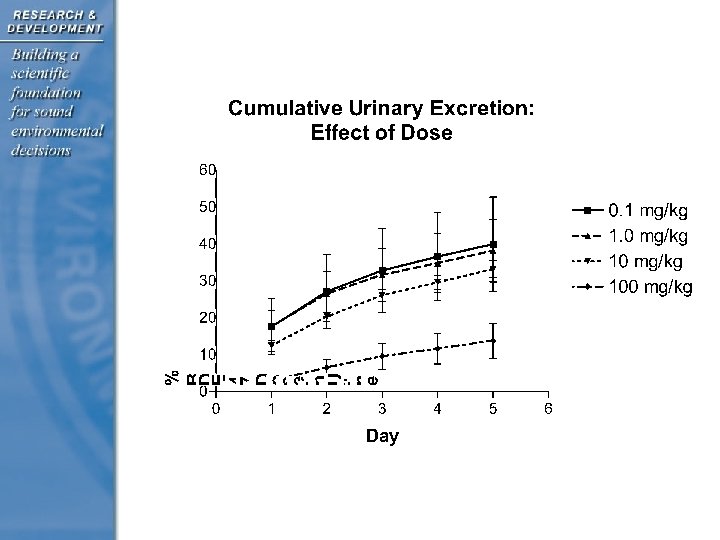
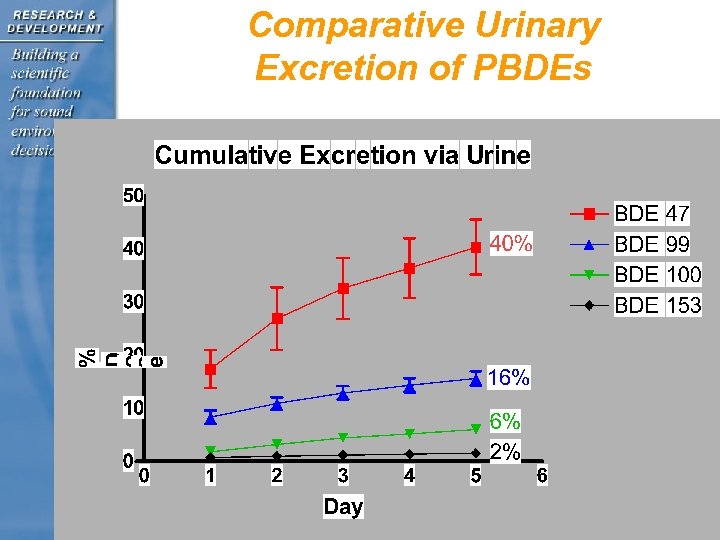
Comparative Urinary Excretion of PBDEs
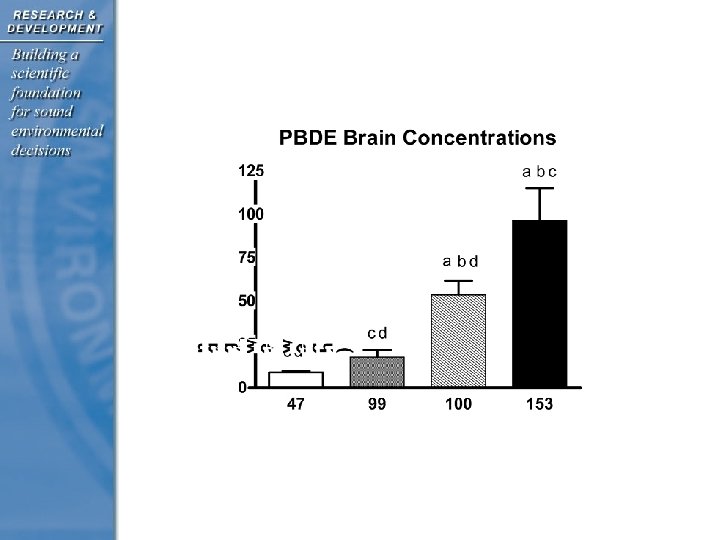
PK of BDE 47, 99, 100, and 153 • Well absorbed • Higher urinary elimination in mice than rats • Urine elimination decreases as #Bromine atoms increase • BDE 99 is most metabolized • What does this all mean for people?
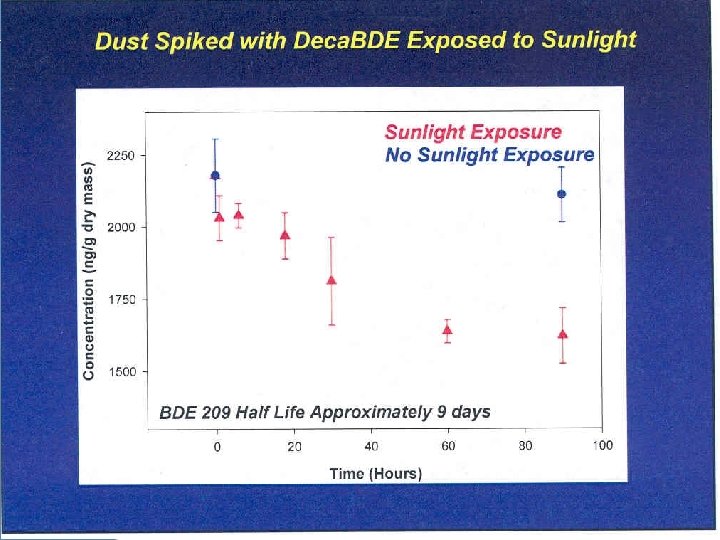
New Information on Deca • Deca is major PBDE in outdoor air (Butt et al. , 2004) • Deca can break down in the environment § Photolytic Debromination (Soderstrom et al, 2003) • Matrices affect time course but not outcome • BDE 154 and 183 found in all matrices; BE 47 only in silica gel • Deca can break down in fish § Detection of BDE-181 and 190 in carp (congeners not in commercial products) (Rice et al, 2002) § 7 penta to octa metabolites found (Stapleton et al, 2003) • Deca can be absorbed (>10%) and break down in rodents § Debrominated, Hydroxylated, Methoxylated § Reactive Intermediates - Covalent binding • Deca MAY BE developmentally neurotoxic
DBDE in Human Samples • Rarely Measured – but its there! • Serum § Levels as high as 200 ppb lipid in occupational exposed workers • Breast Milk § Mean~0. 9 ppb lipid • Analytical Issues § High background levels in dust lead to laboratory contamination
Potential Health Risk of PBDEs • Top 5% of current human exposure in US >400 ng/g lipid § If humans are 25% lipid, then their “dose” is ~0. 1 mg/kg body weight • Significant dose causing DNT § Mice < 0. 8 mg BDE 99/kg § Rats <0. 7 mg BDE 47/kg • Preliminary Developmental Repro ~. 06 mg/kg • Rodent body burdens associated with DNT are only ~10 X higher that total PBDE body burdens in people in North America • Margin of exposure for PBDEs appears low • Additional concern: are PBDEs interacting with other PBTs?
Conclusions • Growing international concern § P, B, and T • Presence in biota • Presence in human tissues § North American levels much higher than Europe or Japan § Relative Biotic levels are very different from commercial mixtures • Increasing potential for health effects

With Special Thanks • NHEERL § • EPA HQ § • Tom Webster Cal EPA § • Arnie Schecter BU § • Heldur Hakk, Janice Huwe UT § • Tom Burka, Mike Sanders, Ed Lebetkin, John Prichard USDA § • Dan Axelrad, Tala Henry, Hend Galal-Gorchev NIEHS § • Daniele Staskal, Janet Diliberto, Mike Devito, Vicki Richardson, Kevin Crofton, Tammy Stoker, Prasada Kodavanti Tom Mc. Donald Duke § Heather Stapleton And all of my colleagues worldwide!
Скачать презентацию Introduction to Brominated Flame Retardants Linda S Birnbaum
08133d24276b7be43b37a47621921389.ppt