 Скачать презентацию Introduction to accounting Debbie Gahr Accounting
ff125236ba3a46e60d3a23f5c3c6df67.ppt
- Количество слайдов: 33



Introduction to accounting Debbie Gahr
Accounting § It is an information system that reports on the economic activities and financial condition of a business or other organization. § There needs to be a system or set of rules so you are able to compare entities to each other.
The language of business § It will help you succeed in business § It is the means that business information is communicated to the stakeholders in the business
Stakeholders § Stakeholders are individuals and organizations that need information about a business. § They include lenders, government agencies, employees, news reporters and others.
How accounting can help you § Help you prepare a budget and keep on target. § Realize how much cash you have and if there is enough to pay bills. § Uncover places where costs can be cut.
Financial accounting § Branch of accounting associated with preparing reports for external users § i. e. the bank, shareholders
Managerial accounting § Accounting to guide management in making decisions about the business § i. e. break even analysis
Objectives of financial accounting § To report the financial condition of a business at a point in time. § To report changes in the financial condition of a business over a period of time.
Objectives continued § First, record the economic events affecting a business. § Second, summarize the impact of these events in a report called financial statements. § Generally Accepted Accounting Principles (GAAP)
Who’s who in accounting § Bookkeepers-record each transaction § Accountants-prepare financial statements § Auditors-review the company’s books and look for errors and discrepancies (could be internal or external) § Controller-in charge of the accounting department
Who’s who in accounting § CPAs-certified public accountants § Typically work for an accounting firm called public accounting § Once a year come in and do an audit of the books of the company and do the related tax returns § CPAs also work for private companies
Four financial statements § § Balance sheet Income statement (profit/loss) Statement of cash flows Statement of changes in equity
Elements of financial statements § The information in the financial statements is organized into 10 categories called elements. § The elements include: assets, liabilities, equity, contributed capital, revenue, expenses, distributions, net income, gains and losses.
Accounts § The elements are divided into classifications called accounts. § For instance there are different kinds of assets. A business would have a cash account like a checking account and they might also own a building.
Chart of accounts § Every company has a chart of accounts, sort of like a table of contents in a book. § Each account is assigned a number § Usually assets start with 1, liabilities 2, stockholder’s equity 3, income 4, cost of goods sold 5, other expenses 6.
General ledger § Think of it like a book that keeps track of all the accounts § It is a chronological record of all the business transactions § Sometimes it is called the company’s books § Everything in the general ledger flows to the financial statements
Balance sheet § Highlights the relative strength of a company at a point in time. § Terms related to the balance sheet: assets, liabilities, owner’s equity.
Assets § Assets are things you own or resources a business owns. § The assets of a business belong to its creditors and investors. § Tangible assets-this you can touch like machinery, buildings, land, computers, etc. § Intangible assets-things you cannot tough such as right to patents, rights to payments from customers, copyrights or trademarks.
Liabilities § Things you owe, future obligations of the business § Creditor claims § Examples include a bank loan or car loan, or buying supplies for your business on credit
Equity § Rights of stockholders or their claim on assets § There are two types of equity – Common stock is issued by corporations to finance their operations – Retained earnings which is the portion of earned assets kept in the business
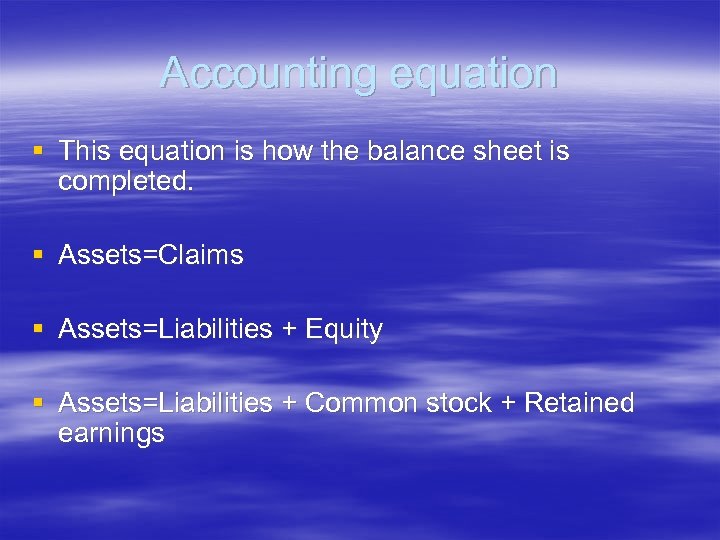
Accounting equation § This equation is how the balance sheet is completed. § Assets=Claims § Assets=Liabilities + Equity § Assets=Liabilities + Common stock + Retained earnings
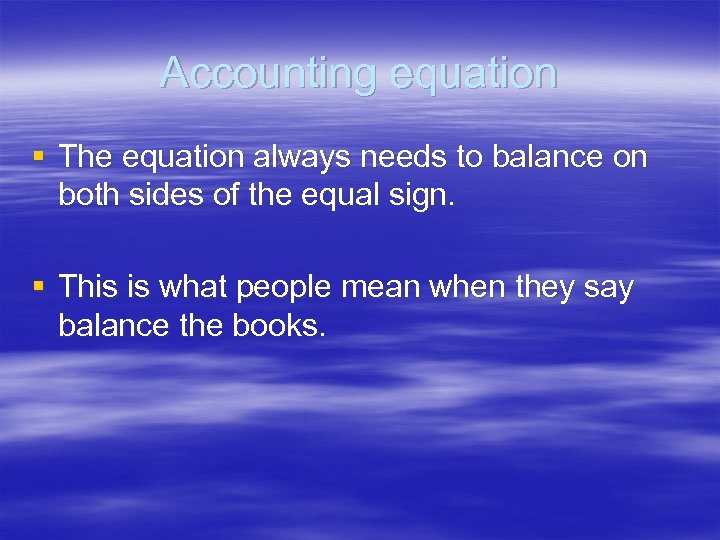
Accounting equation § The equation always needs to balance on both sides of the equal sign. § This is what people mean when they say balance the books.
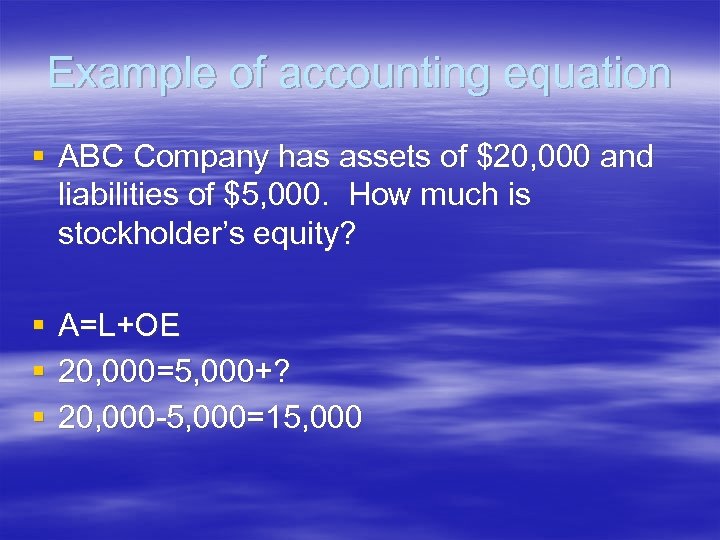
Example of accounting equation § ABC Company has assets of $20, 000 and liabilities of $5, 000. How much is stockholder’s equity? § § § A=L+OE 20, 000=5, 000+? 20, 000 -5, 000=15, 000
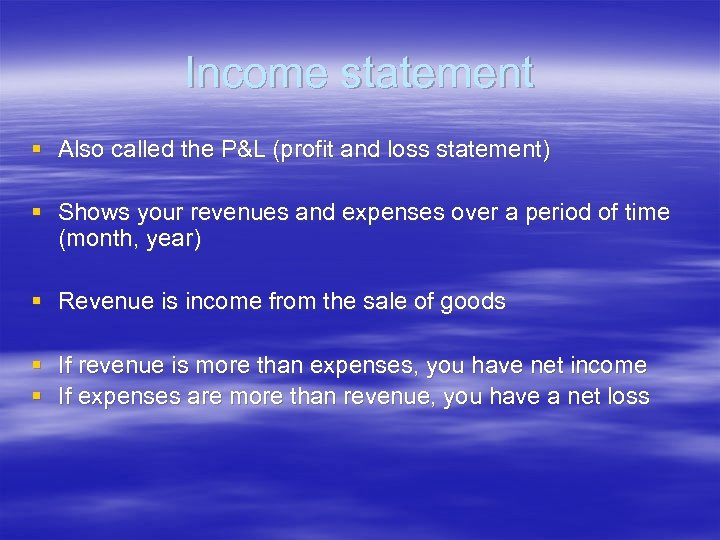
Income statement § Also called the P&L (profit and loss statement) § Shows your revenues and expenses over a period of time (month, year) § Revenue is income from the sale of goods § If revenue is more than expenses, you have net income § If expenses are more than revenue, you have a net loss
Income statement § Terms used on the income statement: § Revenue or sales § Cost of goods sold or Cost of merchandise sold § Gross profit § Operating expenses § Net income or net loss
Statement of changes in Stockholder’s Equity § Sometimes called statement of changes in owner’s equity § Explains the effects of transactions on stockholder’s equity during the accounting period.
Statement of changes in Stockholder’s Equity § Starts with beginning common stock and adds any additional shares of stock issued. § Then it takes the beginning retained earnings and adds on net income (subtracts net loss) § Then it subtracts any dividends paid to shareholders
Cash flow statement § This explains how a company obtained and used cash during the accounting period. § Receipts of cash are called cash inflows. § Payments of cash are called cash outflows.
Cash flow statement § There are three sections to the cash flow statement: operating, investing and financing. § Operating section is first. Operating activities include receiving cash from revenue and paying cash for expenses.
Cash flow statement § Investing section includes paying cash to buy productive assets (like machinery or equipment) or receiving cash when you sell productive assets. § Financing section includes receiving cash from owners or paying cash to owners (dividends) It can also include borrowing cash from the bank or repaying the cash.
Cash flow statement § It tells you whether your cash increased or decreased and why.
How the financial statements are interrelated § The income statement is prepared first § The income from this statement flows to the statement of changes in stockholder’s equity § The stockholders equity total and common stock totals flow to the balance sheet § The cash from the balance sheet flows to the statement of cash flows
 Скачать презентацию Introduction to accounting Debbie Gahr Accounting
ff125236ba3a46e60d3a23f5c3c6df67.ppt