 Скачать презентацию INTRODUCTION TAXONOMY www bionet-intl org bionet bionet-intl org
ef15b08e6b204f80562a58b0950e9b9f.ppt
- Количество слайдов: 30



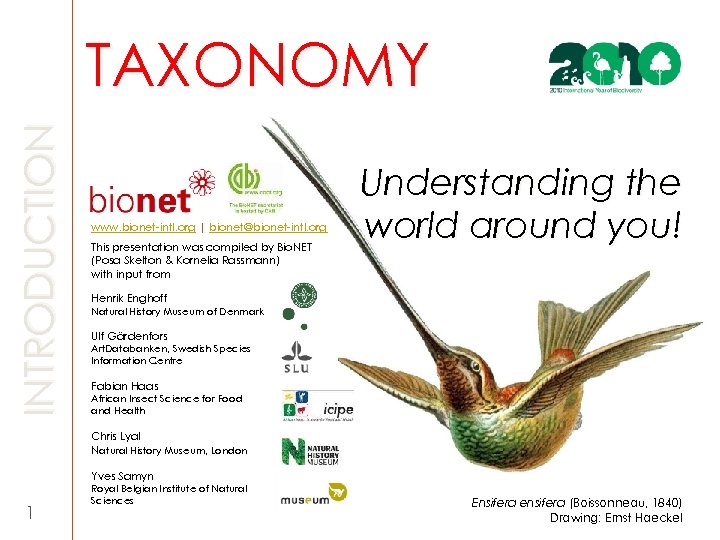
INTRODUCTION TAXONOMY www. bionet-intl. org | bionet@bionet-intl. org This presentation was compiled by Bio. NET (Posa Skelton & Kornelia Rassmann) with input from Understanding the world around you! Henrik Enghoff Natural History Museum of Denmark Ulf Gärdenfors Art. Databanken, Swedish Species Information Centre Fabian Haas African Insect Science for Food and Health Chris Lyal Natural History Museum, London Yves Samyn 1 Royal Belgian Institute of Natural Sciences Ensifera ensifera (Boissonneau, 1840) Drawing: Ernst Haeckel
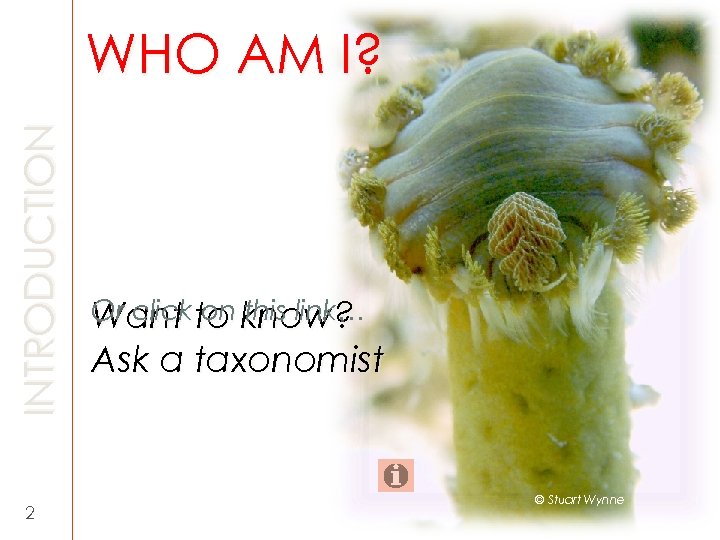
INTRODUCTION WHO AM I? 2 Or click to know? Want on this link… Ask a taxonomist © Stuart Wynne
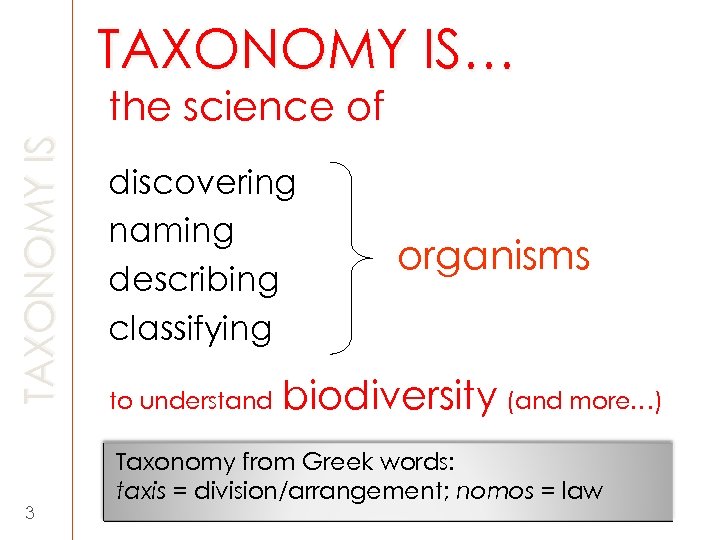
TAXONOMY IS… TAXONOMY IS the science of 3 discovering naming describing classifying to understand organisms biodiversity (and more…) Taxonomy from Greek words: taxis = division/arrangement; nomos = law
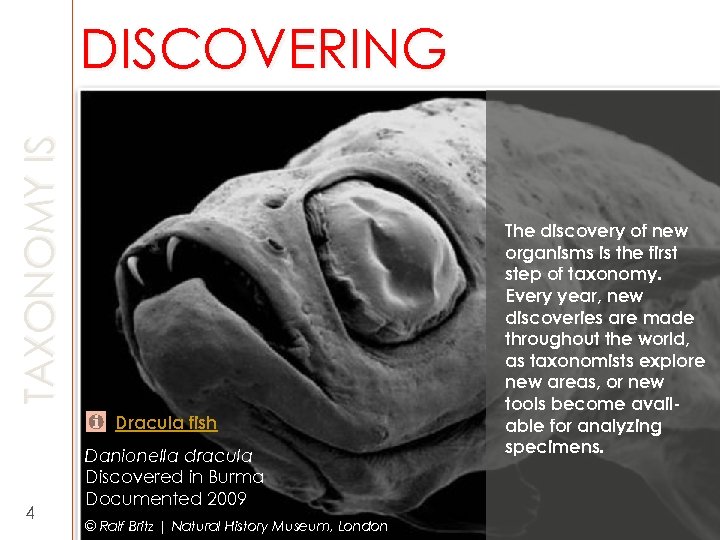
TAXONOMY IS DISCOVERING Dracula fish 4 Danionella dracula Discovered in Burma Documented 2009 © Ralf Britz | Natural History Museum, London The discovery of new organisms is the first step of taxonomy. Every year, new discoveries are made throughout the world, as taxonomists explore new areas, or new tools become available for analyzing specimens.
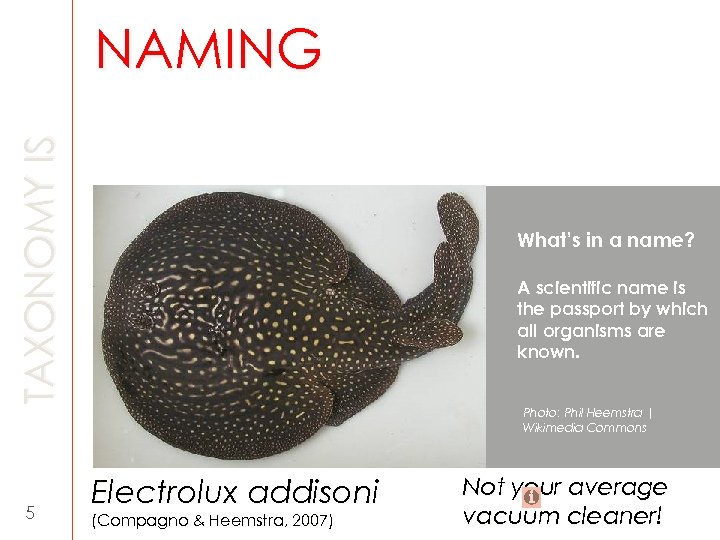
TAXONOMY IS NAMING What’s in a name? A scientific name is the passport by which all organisms are known. Photo: Phil Heemstra | Wikimedia Commons 5 Electrolux addisoni (Compagno & Heemstra, 2007) Not your average vacuum cleaner!
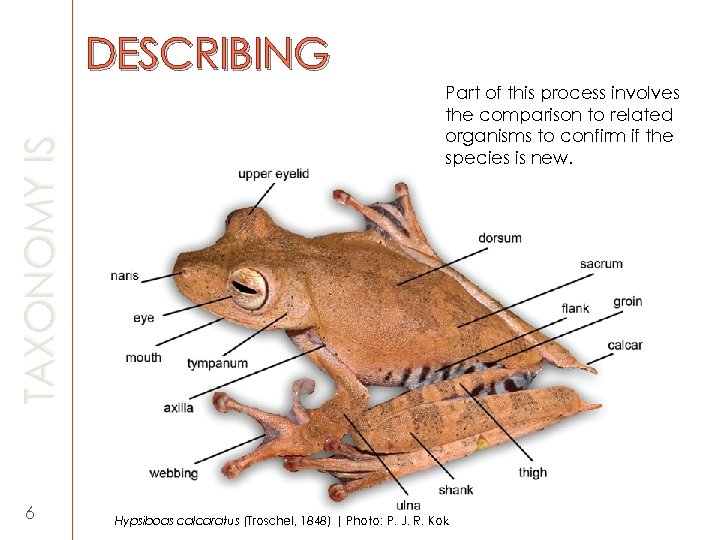
TAXONOMY IS DESCRIBING 6 Part of this process involves the comparison to related organisms to confirm if the species is new. Hypsiboas calcaratus (Troschel, 1848) | Photo: P. J. R. Kok
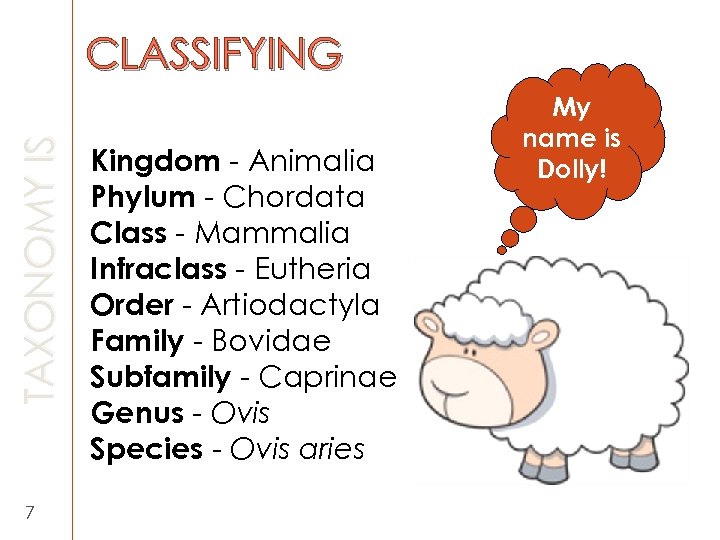
TAXONOMY IS CLASSIFYING 7 Kingdom - Animalia Phylum - Chordata Class - Mammalia Infraclass - Eutheria Order - Artiodactyla Family - Bovidae Subfamily - Caprinae Genus - Ovis Species - Ovis aries My name is Dolly!

NAMES MATTER 8 CLASSIFICATION matters in your daily life Classification is part of our everyday life. It allows us to place things in order, such as in a stock inventory in a supermarket. Would you look for dairy products next to house-hold cleaning items? Photo: G. R. South
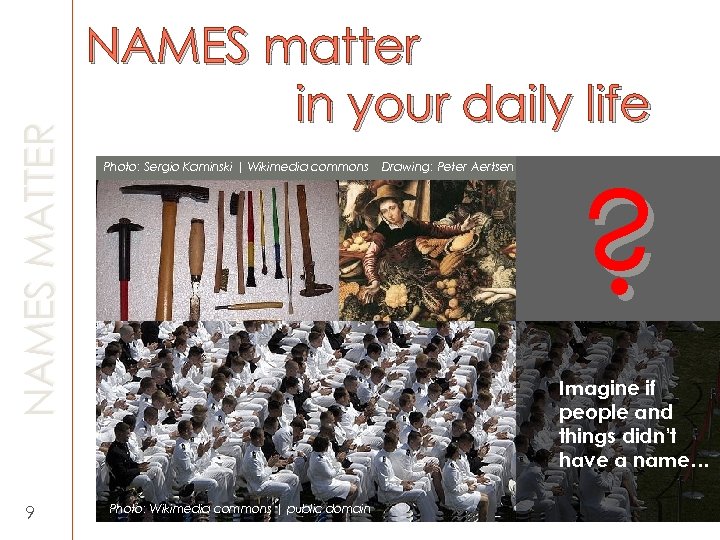
NAMES MATTER 9 NAMES matter in your daily life Photo: Sergio Kaminski | Wikimedia commons Drawing: Peter Aertsen ? Imagine if people and things didn’t have a name… Photo: Wikimedia commons | public domain
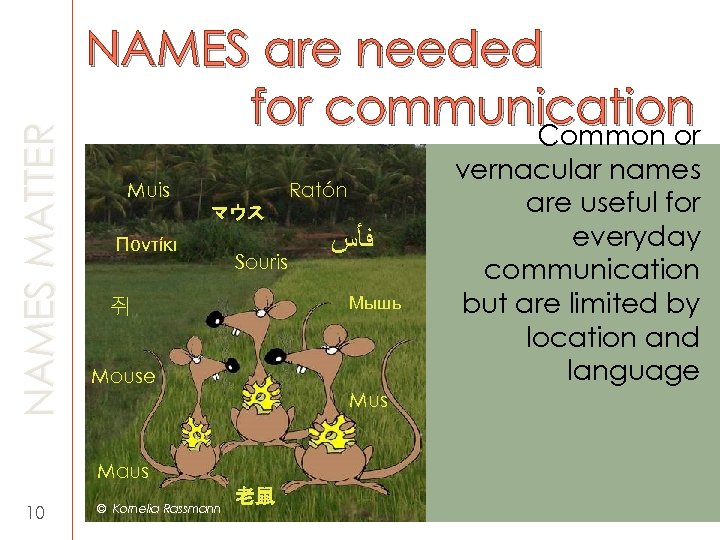
NAMES MATTER NAMES are needed for communication Common or Muis Ratón マウス Ποντίκι Souris Мышь 쥐 Mouse Mus Maus 10 ﻓﺄﺲ © Kornelia Rassmann 老鼠 vernacular names are useful for everyday communication but are limited by location and language
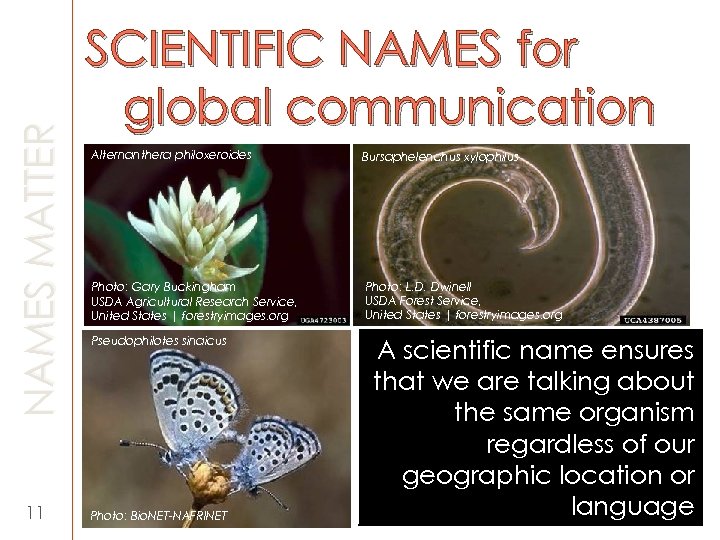
NAMES MATTER 11 SCIENTIFIC NAMES for global communication Alternanthera philoxeroides Bursaphelenchus xylophilus Photo: Gary Buckingham USDA Agricultural Research Service, United States | forestryimages. org Photo: L. D. Dwinell USDA Forest Service, United States | forestryimages. org Pseudophilotes sinaicus Photo: Bio. NET-NAFRINET A scientific name ensures that we are talking about the same organism regardless of our geographic location or language
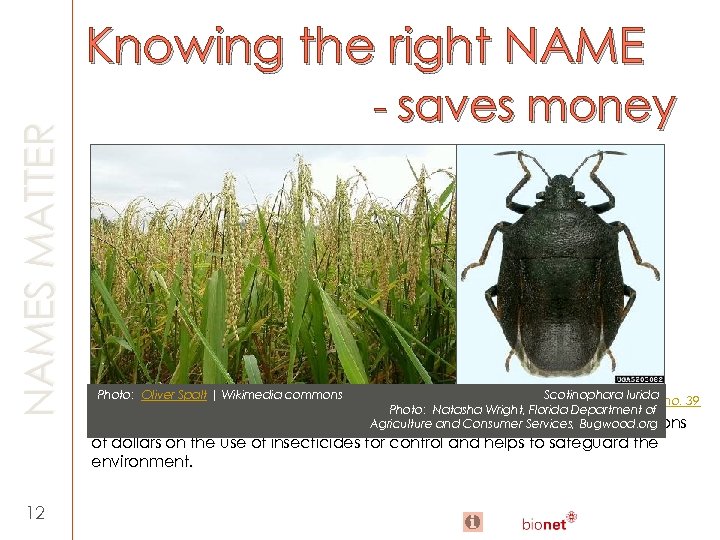
NAMES MATTER Knowing the right NAME 12 - saves money Photo: Oliver Spalt | Wikimedia commons Scotinophara lurida See case study Taxonomy helped to identify 24 different ‘black bugs’ in the Philippines, of no. 39 Photo: Natasha Wright, Florida Department Agriculture and This knowledge saves millions of which only 2 are pests found feeding on rice. Consumer Services, Bugwood. org of dollars on the use of insecticides for control and helps to safeguard the environment.
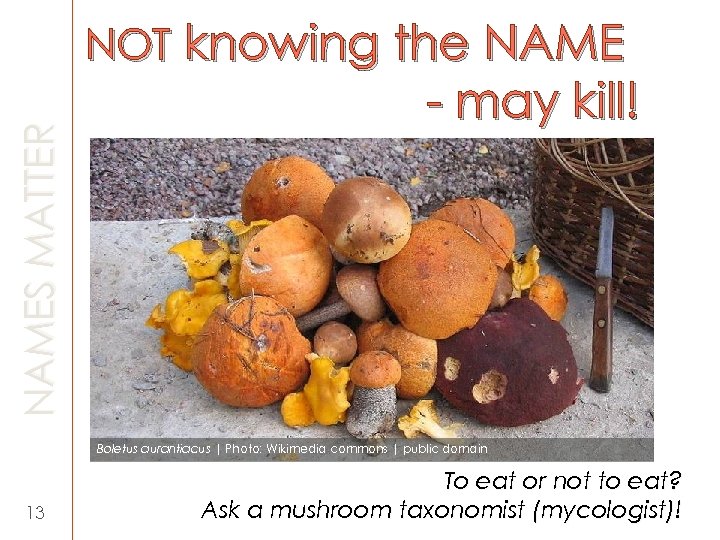
NAMES MATTER NOT knowing the NAME - may kill! Boletus aurantiacus | Photo: Wikimedia commons | public domain 13 To eat or not to eat? Ask a mushroom taxonomist (mycologist)!
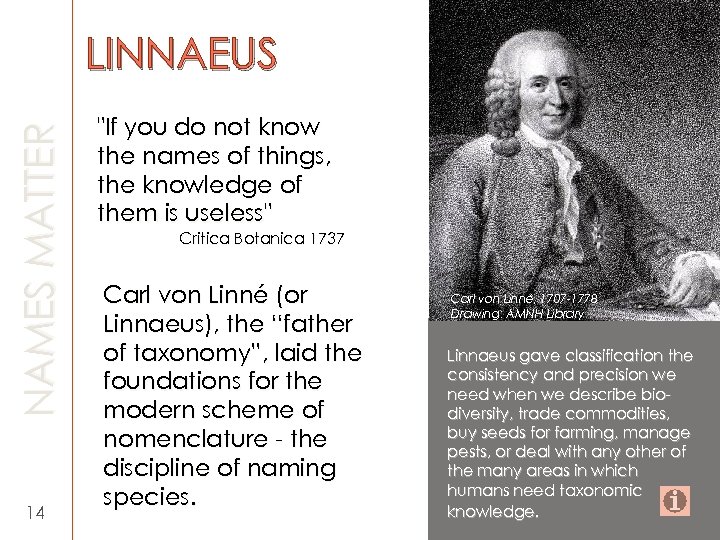
NAMES MATTER LINNAEUS 14 "If you do not know the names of things, the knowledge of them is useless" Critica Botanica 1737 Carl von Linné (or Linnaeus), the “father of taxonomy”, laid the foundations for the modern scheme of nomenclature - the discipline of naming species. Carl von Linné, 1707 -1778 Drawing: AMNH Library Linnaeus gave classification the consistency and precision we need when we describe biodiversity, trade commodities, buy seeds for farming, manage pests, or deal with any other of the many areas in which humans need taxonomic knowledge.
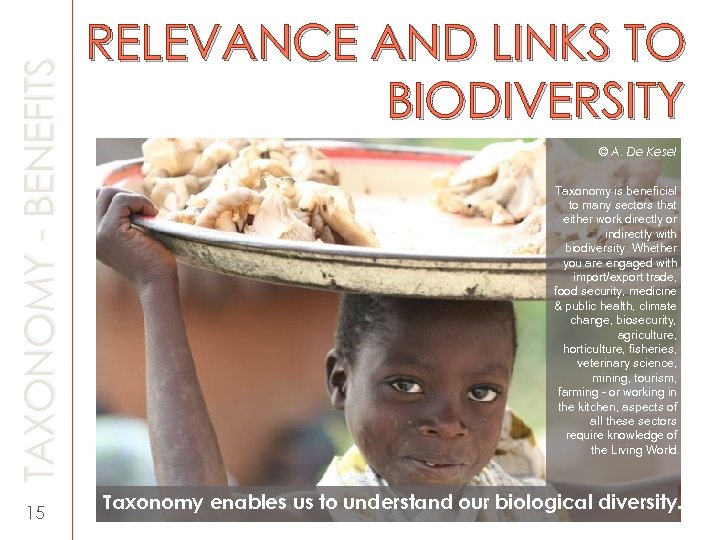
TAXONOMY - BENEFITS 15 RELEVANCE AND LINKS TO BIODIVERSITY © A. De Kesel Taxonomy is beneficial to many sectors that either work directly or indirectly with biodiversity. Whether you are engaged with import/export trade, food security, medicine & public health, climate change, biosecurity, agriculture, horticulture, fisheries, veterinary science, mining, tourism, farming - or working in the kitchen, aspects of all these sectors require knowledge of the Living World. Taxonomy enables us to understand our biological diversity.
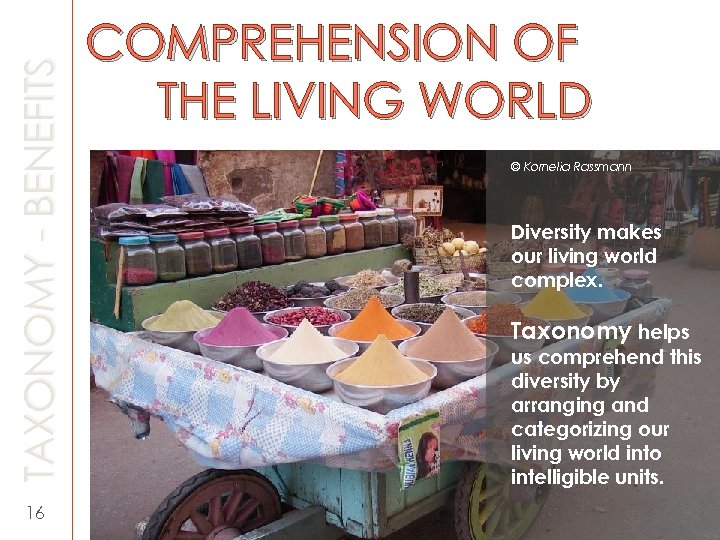
TAXONOMY - BENEFITS 16 COMPREHENSION OF THE LIVING WORLD © Kornelia Rassmann Diversity makes our living world complex. Taxonomy helps us comprehend this diversity by arranging and categorizing our living world into intelligible units.
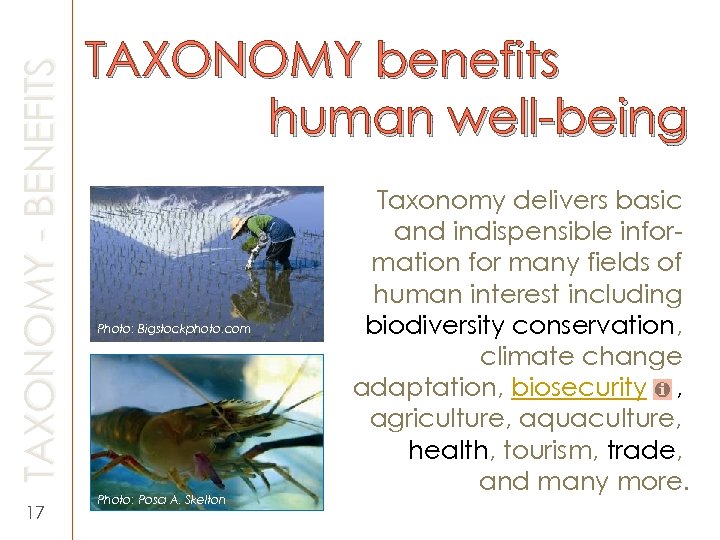
TAXONOMY - BENEFITS 17 TAXONOMY benefits human well-being Photo: Bigstockphoto. com Photo: ? ? ? Photo: Posa A. Skelton Taxonomy delivers basic and indispensible information for many fields of human interest including biodiversity conservation, climate change adaptation, biosecurity , agriculture, aquaculture, health, tourism, trade, and many more.
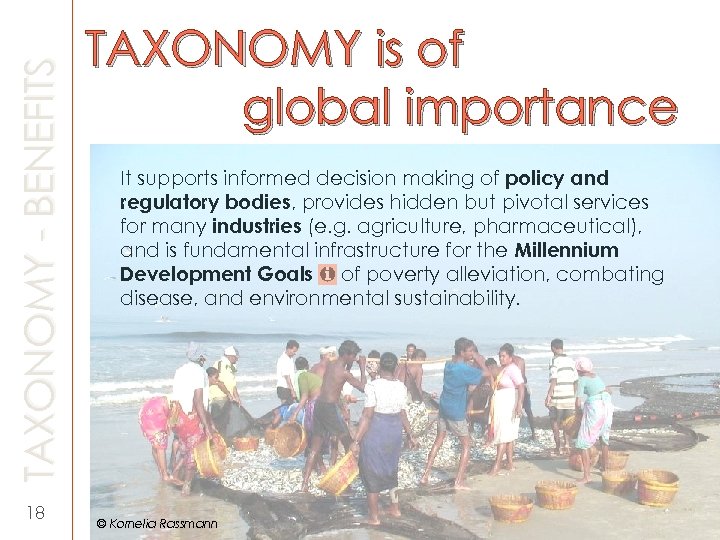
TAXONOMY - BENEFITS 18 TAXONOMY is of global importance It supports informed decision making of policy and regulatory bodies, provides hidden but pivotal services for many industries (e. g. agriculture, pharmaceutical), and is fundamental infrastructure for the Millennium Development Goals of poverty alleviation, combating disease, and environmental sustainability. © Kornelia Rassmann
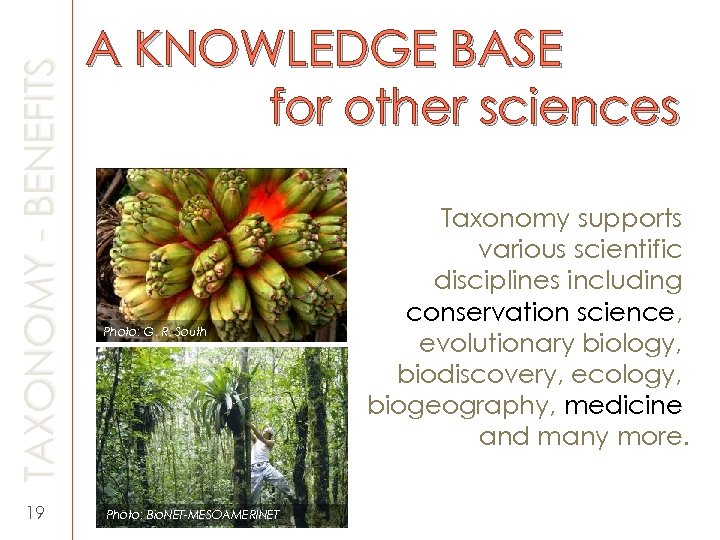
TAXONOMY - BENEFITS 19 A KNOWLEDGE BASE for other sciences Photo: G. R. South Photo: Bio. NET-MESOAMERINET Taxonomy supports various scientific disciplines including conservation science, evolutionary biology, biodiscovery, ecology, biogeography, medicine and many more.
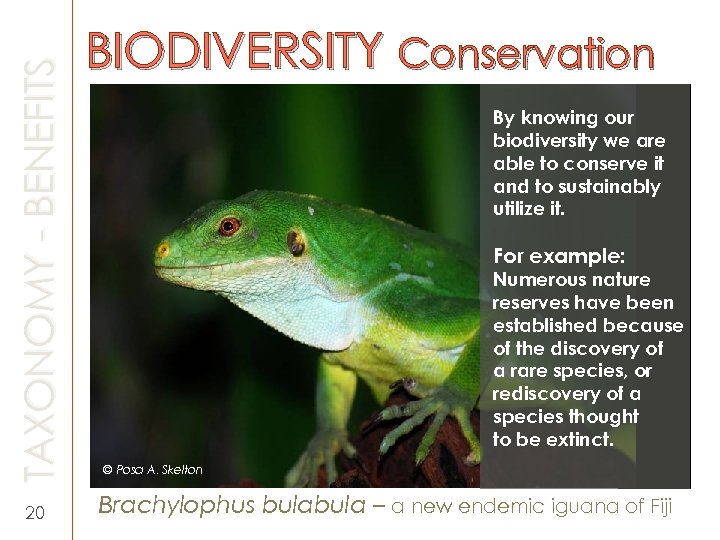
TAXONOMY - BENEFITS 20 BIODIVERSITY Conservation By knowing our biodiversity we are able to conserve it and to sustainably utilize it. For example: Numerous nature reserves have been established because of the discovery of a rare species, or rediscovery of a species thought to be extinct. © Posa A. Skelton Brachylophus bula – a new endemic iguana of Fiji
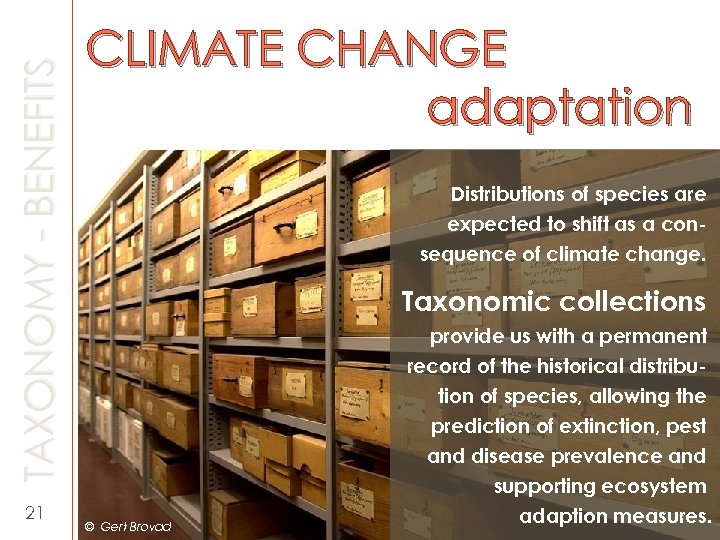
TAXONOMY - BENEFITS 21 CLIMATE CHANGE adaptation Distributions of species are expected to shift as a consequence of climate change. Taxonomic collections © Gert Brovad provide us with a permanent record of the historical distribution of species, allowing the prediction of extinction, pest and disease prevalence and supporting ecosystem adaption measures.
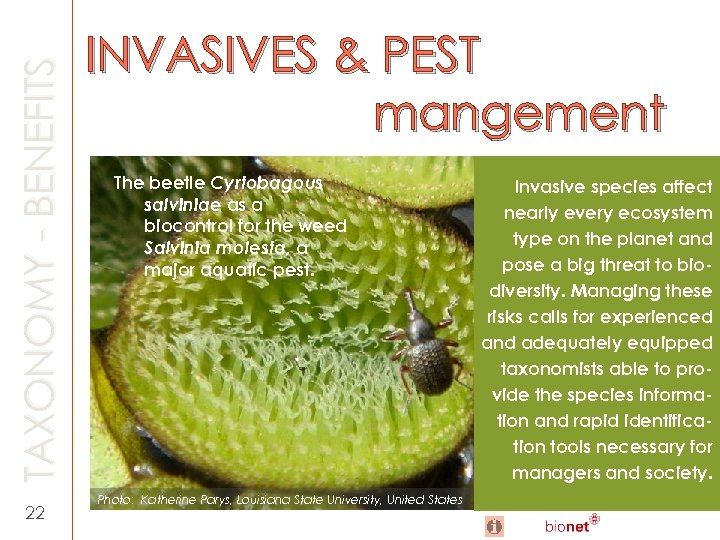
TAXONOMY - BENEFITS 22 INVASIVES & PEST mangement The beetle Cyrtobagous salviniae as a biocontrol for the weed Salvinia molesta, a major aquatic pest. Photo: Katherine Parys, Louisiana State University, United States Invasive species affect nearly every ecosystem type on the planet and pose a big threat to biodiversity. Managing these risks calls for experienced and adequately equipped taxonomists able to provide the speciesstudy no. 27 See case information and rapid identification tools necessary for managers and society.
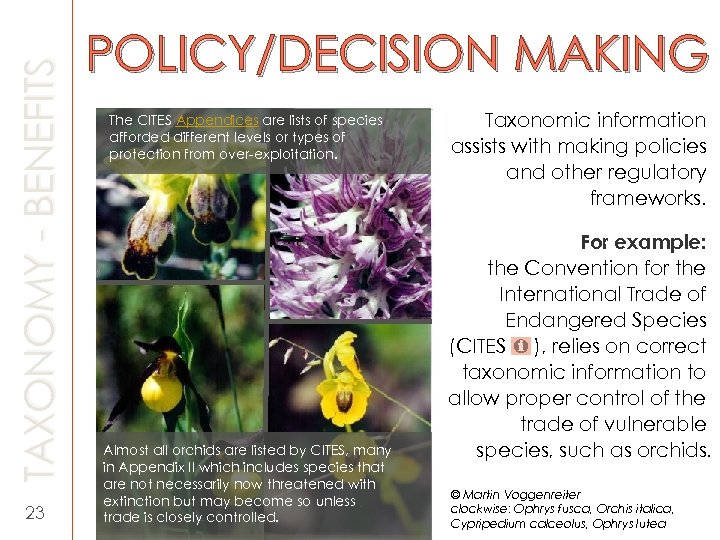
TAXONOMY - BENEFITS 23 POLICY/DECISION MAKING The CITES Appendices are lists of species afforded different levels or types of protection from over-exploitation. Almost all orchids are listed by CITES, many in Appendix II which includes species that are not necessarily now threatened with extinction but may become so unless trade is closely controlled. Taxonomic information assists with making policies and other regulatory frameworks. For example: the Convention for the International Trade of Endangered Species (CITES ), relies on correct taxonomic information to allow proper control of the trade of vulnerable species, such as orchids. © Martin Voggenreiter clockwise: Ophrys fusca, Orchis italica, Cypripedium calceolus, Ophrys lutea
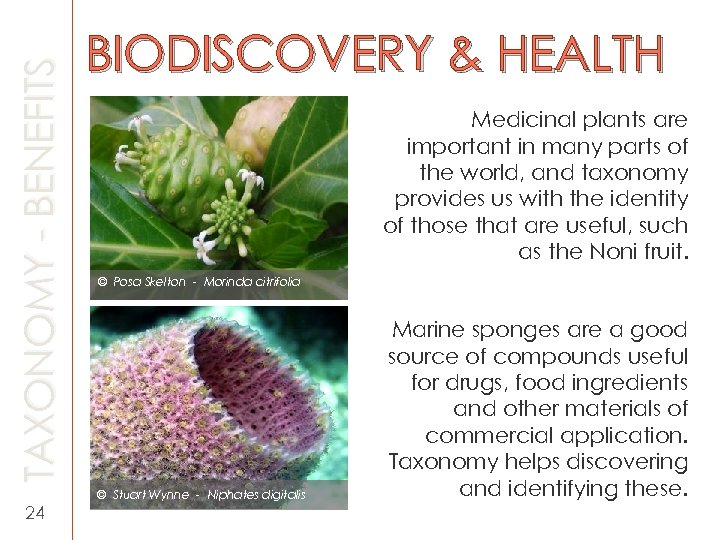
TAXONOMY - BENEFITS BIODISCOVERY & HEALTH Medicinal plants are important in many parts of the world, and taxonomy provides us with the identity of those that are useful, such as the Noni fruit. © Posa Skelton - Morinda citrifolia © Stuart Wynne - Niphates digitalis 24 Marine sponges are a good source of compounds useful for drugs, food ingredients and other materials of commercial application. Taxonomy helps discovering and identifying these.
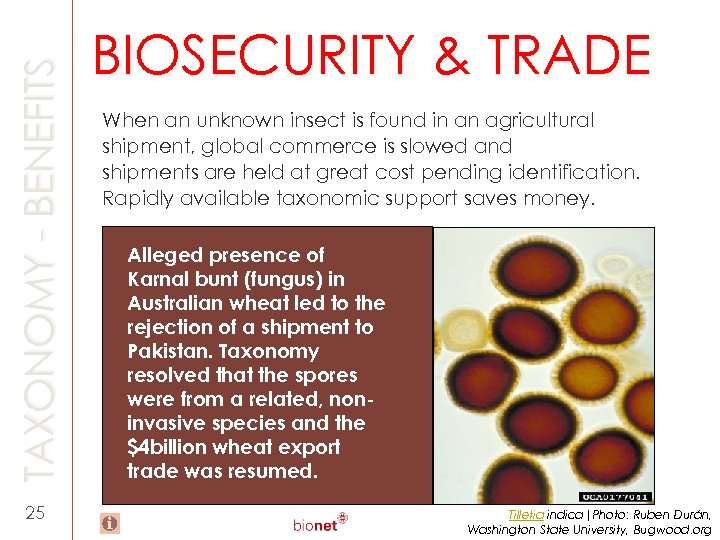
TAXONOMY - BENEFITS 25 BIOSECURITY & TRADE When an unknown insect is found in an agricultural shipment, global commerce is slowed and shipments are held at great cost pending identification. Rapidly available taxonomic support saves money. Alleged presence of Karnal bunt (fungus) in Australian wheat led to the rejection of a shipment to Pakistan. Taxonomy resolved that the spores were from a related, noninvasive species and the $4 billion wheat export trade was resumed. Tilletia indica|Photo: Ruben Durán, Washington State University, Bugwood. org
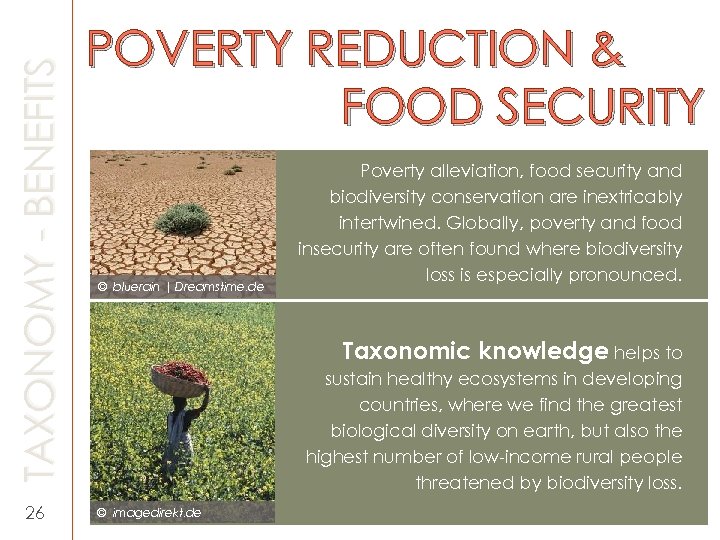
TAXONOMY - BENEFITS 26 POVERTY REDUCTION & FOOD SECURITY © bluerain | Dreamstime. de Poverty alleviation, food security and biodiversity conservation are inextricably intertwined. Globally, poverty and food insecurity are often found where biodiversity loss is especially pronounced. Taxonomic knowledge helps to sustain healthy ecosystems in developing countries, where we find the greatest biological diversity on earth, but also the highest number of low-income rural people threatened by biodiversity loss. © imagedirekt. de

THE CHALLENGE Just one example: 5 -50 million. To date about 1. 8 million species have been described, yet, estimates of the absolute species number range from . wheledsua. f 3 bsfeonbio. Sc 6 cerikdmn. Na. Choatresepeeeoltwus), : 0 i 05 tlethoda. irfrsdorsa. lnm. Aarnostielsarirytieetotarinrmwaw. a p e a s Pe 891 c e c ceue. Da cadetu. O n ih otke (ectn vso 7 lceulsf. e. Roememgy. A c md ekas. Casdlad rdceo. Ariukshr. W % nx rst i dudoltprrt. O i e y a. e g snmhs. n. G r sa. aio. Dw i l c. A , i. A T F. I | | v 27 described as new in 2007 18, 500 species were our knowledge TAXONOMY: advancing

THE CHALLENGE Not just the matter Taxonomy is not just about the charismatic creatures known to everyone, such as the Giant Panda, Blue Whale and Polar Bears. © Tatiana Goydenko | Dreamstime. com © Josef Szasz–Fabian | Dreamstime. com 28 BIG & CUDDLY It is also about the small creatures that drive our ecosystems. Some of these small organisms may have significant impacts on our lives both in positive (e. g. yeast) and negative ways (e. g. malaria mosquitoes)!

THE CHALLENGE What a WONDEROUS WORLD Hippocampus satomiae | © Rudie Kuiter © John Sear 29 Our planet holds many wonders and treasures - new species are being discovered each day yet these finds often get little attention from Homo sapiens. This species – first described in 2008 – is the smallest known seahorse with a standard length of 13. 8 mm and an app. height of 11. 5 mm.

INFORMATION Getting interested in TAXONOMY ? Here you find more information on. . . Taxonomy Global Taxonomy Initiative (GTI, UN Convention of Biological Diversity)| European Distributed Institute of Taxonomy (EDIT) |Natural History Museum, London, UK) |Royal Belgian Institute of Natural Sciences | Bio. NET Species Encyclopedia of Life (Eo. L) |Wikispecies | ARKive |IUCN Red List | Top 10 New Species Discoveries International Institute for Species Exploration (IIES) | Tree of Life | Census of Marine Life (Co. ML) | Catalogue of Life (ITIS, Species 2000) | Global Biodiversity Information Facility (GBIF) The importance of taxonomy, species & biodiversity Bio. NET case studies |GTI case study on taxonomy & climate change | UN Convention of Biodiversity – 2010 International Year of Biodiversity 30 Photos: Bio. NET-SAFRINET, Bio. NET ANDINONET, Bio. NET-EAFRINET, Bio. NET-NAFRINET
Скачать презентацию INTRODUCTION TAXONOMY www bionet-intl org bionet bionet-intl org
ef15b08e6b204f80562a58b0950e9b9f.ppt