


 Скачать презентацию Introduction Second Cohesion Report The Maastricht treaty calls
aeb36a0d923047e449320f1c9052eb15.ppt
- Количество слайдов: 33
 Introduction Second Cohesion Report The Maastricht treaty calls for a report every 3 years analysing disparities in the EU. This 2 nd report goes further than before in being a first analysis of the situation in a Union of 27. Three parts : Situation and trends Contribution of community policies to economic and social cohesion Economic and social cohesion policy the results Regional Policy Plus : Conclusions and Recommendations 6 PRFR 1
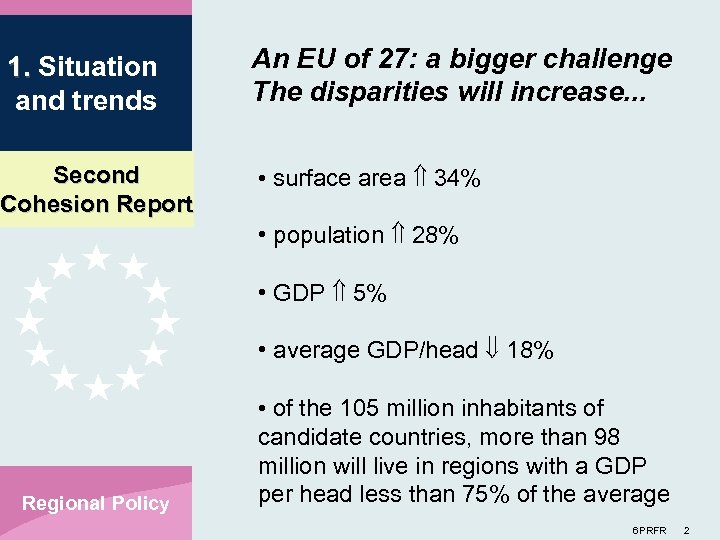 1. Situation and trends Second Cohesion Report An EU of 27: a bigger challenge The disparities will increase. . . • surface area 34% • population 28% • GDP 5% • average GDP/head 18% Regional Policy • of the 105 million inhabitants of candidate countries, more than 98 million will live in regions with a GDP per head less than 75% of the average 6 PRFR 2
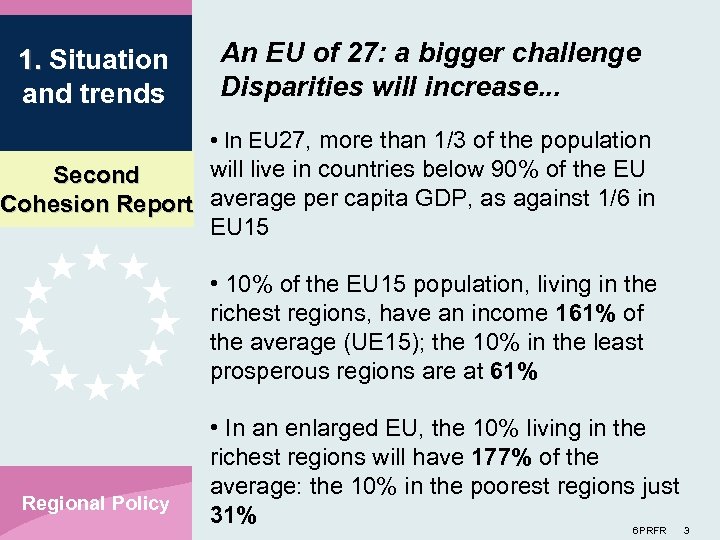 1. Situation and trends An EU of 27: a bigger challenge Disparities will increase. . . • In EU 27, more than 1/3 of the population will live in countries below 90% of the EU Second Cohesion Report average per capita GDP, as against 1/6 in EU 15 • 10% of the EU 15 population, living in the richest regions, have an income 161% of the average (UE 15); the 10% in the least prosperous regions are at 61% Regional Policy • In an enlarged EU, the 10% living in the richest regions will have 177% of the average: the 10% in the poorest regions just 31% 3 6 PRFR
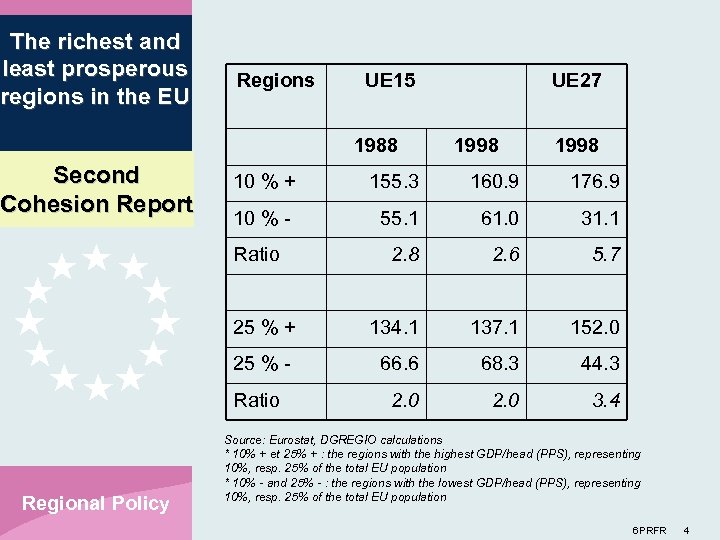 The richest and least prosperous regions in the EU Regions UE 15 1988 Second Cohesion Report UE 27 1998 155. 3 160. 9 176. 9 10 % 55. 1 61. 0 31. 1 Ratio 2. 8 2. 6 5. 7 25 % + 134. 1 137. 1 152. 0 25 % 66. 6 68. 3 44. 3 Ratio Regional Policy 10 % + 2. 0 3. 4 Source: Eurostat, DGREGIO calculations * 10% + et 25% + : the regions with the highest GDP/head (PPS), representing 10%, resp. 25% of the total EU population * 10% - and 25% - : the regions with the lowest GDP/head (PPS), representing 10%, resp. 25% of the total EU population 6 PRFR 4
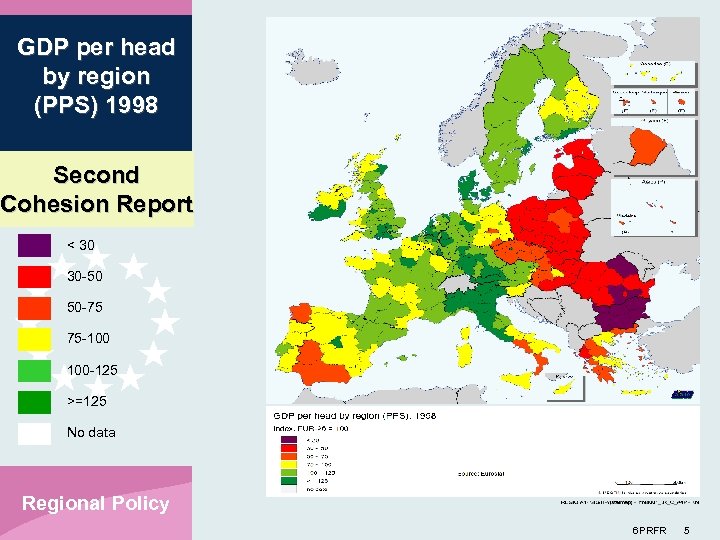 GDP per head by region (PPS) 1998 Second Cohesion Report < 30 30 50 50 75 75 100 125 >=125 No data Regional Policy 6 PRFR 5
 1. Situation and trends An EU of 27: a bigger challenge Three groups of Member States. . . GDP per head (compared with the enlarged EU average): Second Cohesion Report • first group: (16% of the EU population) : 40% of average (3 Baltic States, Poland, Hungary, Roumania, Bulgaria, Slovakia) • second group: (13% of the EU pop. ) : 80% of average (ES, GR, PT plus Cyprus, Malta, Slovenia, Czech Republic) • third group: (71% of EU pop. ) 120% of average (remaining Member States) Regional Policy The average GDP/head will drop by 18. 5% 6 PRFR 6
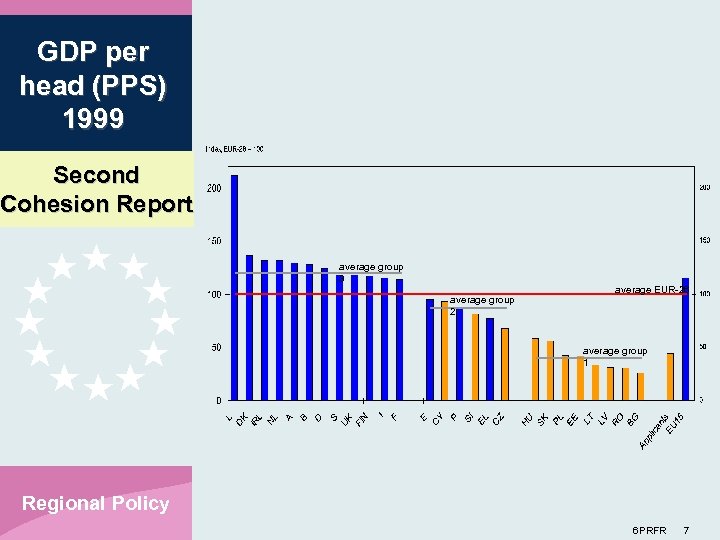 GDP per head (PPS) 1999 Second Cohesion Report average group 3 average group 2 average EUR 26 average group 1 Regional Policy 6 PRFR 7
 1. Situation and trends EU 15: disparities in development have been reduced • in GR, ES, PT: GDP per head has increased from 68% of the EU 15 average (1988) to 79% Second Cohesion Report (1999) = a convergence of one-third • …between regions somewhat less: nearly one-sixth • infrastructure in Obj 1 regions closer to the average • on the other hand…. . . other factors of competitiveness remain weak Regional Policy 6 PRFR 8
 1. Situation and trends EU 15: ……a long way to go Employment : Second Cohesion Report • employment rate: in 4 Member States is more than 70%; EU 15 average is 62% • 10% of EU pop. in regions having 44% • one woman in three in EU works part time • women’s employment rate 19 percentage points below men’s Regional Policy 6 PRFR 9
 1. Situation and trends EU 15: ……a long way to go Social cohesion: Second Cohesion Report • unemployment: small reduction in regional disparities (though rate is more than 20% in some southern regions); long term unemployment at 46% in EU 15 • youth/women umemployment but increase in precarious forms of work • poverty: 18% below the income threshold (which is 60% of the median income in each Member State) Regional Policy 6 PRFR 10
 1. Situation and trends Second Cohesion Report Economic activity in the Union is heavily concentrated. . . • zone Yorkshire/Franche Comté/ Hamburg: 14% of EU territory, 33% of population, 47% of EU 15 GDP…. . • in the US: 4 distinct poles of international significance • productivity 2 4 times greater than in peripheral areas • a new, eastern periphery Regional Policy • greater environmental pressures 6 PRFR 11
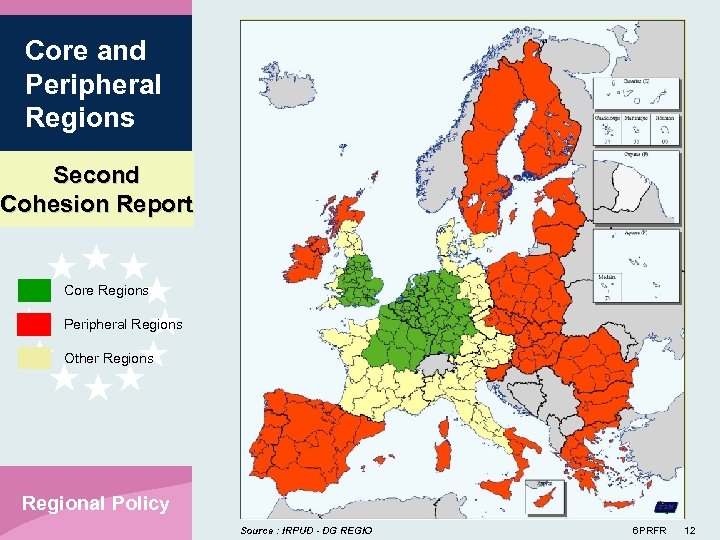 Core and Peripheral Regions Second Cohesion Report Core Regions Peripheral Regions Other Regions Regional Policy Source : IRPUD - DG REGIO 6 PRFR 12
 1. Situation and trends Second Cohesion Report Greater territorial imbalance. . . Spatial divides: • urban areas –regional development poles –more evident social divide • rural areas –more influenced by cities –the population is abandoning cities and employment is diversifying Regional Policy • the border regions of the EU 15 (25% of population) have improved their average; 60% of pop. in candidate countries live in border regions • cohesion for ultraperipheral regions, islands, and mountainous zones 6 PRFR 13
 1. Situation and trends Second Cohesion Report The labour market in the candidate countries • unemployment is 10. 2% (9. 3% in EU 15) • employment rates close; higher for women even if more are leaving the job market • rate of employment high in traditional industries even after losing 20 50% of jobs • 22% of employment in agriculture (4. 5% in EU 15) • productivity remains low • employment in service industries high in the capital cities Regional Policy 6 PRFR 14
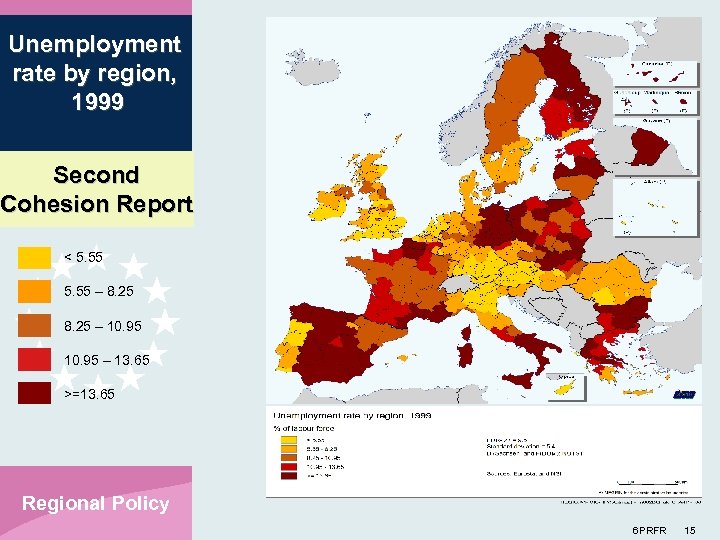 Unemployment rate by region, 1999 Second Cohesion Report < 5. 55 – 8. 25 – 10. 95 – 13. 65 >=13. 65 Regional Policy 6 PRFR 15
 GDP person (EUR) employed in Agriculture, 1998 Second Cohesion Report <9 9 39 39 69 69 99 >=99 No data Regional Policy 6 PRFR 16
 1. Situation and trends Second Cohesion Report Demographic changes and the labour market • Declining population growth rates in EU 15 and absolute natural decline from 2008; population is already declining in many candidate countries • population ageing; and decline in working age population (by 19 million between 2010 and 2025) Regional Policy • questions of migration to EU 15 and changes in labour force participation rates in EU 6 PRFR 17
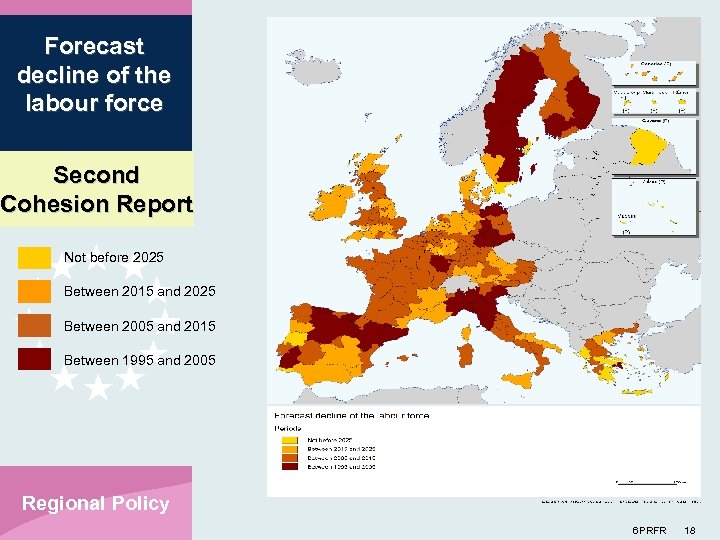 Forecast decline of the labour force Second Cohesion Report Not before 2025 Between 2015 and 2025 Between 2005 and 2015 Between 1995 and 2005 Regional Policy 6 PRFR 18
 2. Contribution of community policies Second Cohesion Report How they contribute to cohesion. . . • Providing the best framework for cohesion economic and monetary union means macro economic stability achieving the internal market • fairer competition • CAP: rural development funding • RTD policy: still too concentrated in the core and more competitive regions • TENs: a tool for balanced spatial development • Environment : sustainable development Regional Policy 6 PRFR 19
 3. Cohesion Policy: the Results Second Cohesion Report The contribution of structural policy • The EU ’s financial effort: 0. 27% of GDP in 1989 up to 0. 46% in 1999 • 1. 5% of GDP in Spain • 2. 4% of GDP in Portugal (10% of investment) • 3. 5% of GDP in Greece (10% of investment) • concentration: 41% of the population eligible for Obj. 1&2 (was 50%) Regional Policy 6 PRFR 20
 3. Cohesion Policy: the Results The impact of structural policy • 6 th PR: « 1/3 of the convergence would not have taken place without the Structural Funds» Second Cohesion Report • in Obj. 1, GDP per head from 63% to 70% of EU average (1988 1998): Increase in GDP due to structural interventions – 9. 9% in Greece – 8. 5% in Portugal – 3. 7% in Ireland – 3. 1% in Spain • in Obj. 2 regions: a reduction in the unemployment gap vis à vis the rest of EU Regional Policy • infrastructure: support for SME ’s (300, 000 jobs created net); RDT; training; education 6 PRFR 21
 3. Cohesion Policy: the Results Second Cohesion Report Added value of the Structural Funds • Cross border and transnational cooperation • Partnership • Multiannual programming more effective management of regional development policies in Member States • Evaluation, a stronger link between grants and results • Effective way to mobilise private capital Regional Policy • Dissemination of best practice into programmes (mainstreaming) 6 PRFR 22
 4. Conclusions and recommendations The Challenge of a wider EU • The disparities will double Second Cohesion Report • Greater development gap between the regions • A more unbalanced territory • Globalisation • Knowledge based economy • Demographic structure Regional Policy 6 PRFR 23
 4. Conclusions and recommendations Second Cohesion Report Cohesion Policy: Who is it for? • Top priority: regions lagging behind in development • The GDP per head criterion? • At 75%, the pop. in MS covered by Objective 1 will drop by one half • Other regions in difficulty Regional Policy 6 PRFR 24
 4. Conclusions and recommendations Territorial Priorities • The less developed regions Second Cohesion Report • The urban question • Diversification in rural areas • Cross border, transnational, and interregional cooperation • Areas undergoing industrial restructuring Regional Policy • Areas suffering severe geographical or natural handicaps 6 PRFR 25
 4. Conclusions and recommendations Second Cohesion Report Economic and Social Priorities • More, better quality jobs • Support for the new economy and the knowledge based society • Promote social inclusion • Equal opportunities Regional Policy 6 PRFR 26
 4. Conclusions and recommendations How do we implement Cohesion Policy ? • Targetting Second Cohesion Report • Zoning • The amounts – 4% GDP limit • Special cases • Type of support financial engineering Regional Policy 6 PRFR 27
 4. Conclusions and recommendations Second Cohesion Report Factors determining real convergence at the regional and national level • Productivity – towards high value added sectors – qualifications • Infrastructure • Sustainable development – management of water resources – limit damage to the environment Regional Policy • Technological Research/Development and Innovation 6 PRFR 28
 4. Conclusions and recommendations Second Cohesion Report The challenge of preparing for enlargement • Administrative capacity • Programming • Additionality • Evaluation • ISPA/PHARE/SAPARD • Other policies Regional Policy 6 PRFR 29
 4. Conclusions and recommendations Second Cohesion Report The needs of the Candidate countries • 17 19 billion Euros a year for the next 10 years in environment and transport • Balance between Cohesion and Structural Funds? Cohesion Fund currently 18% of structural policy expenditure • Convergence: a long term process (it could take at least two generations for the poorest regions to catch up) Regional Policy 6 PRFR 30
 4. Conclusions and recommendations Second Cohesion Report 10 questions for the debate 1. What will be the role of cohesion policy in an enlarged Union of 30 Member States? How is it possible to further economic convergence and preserve the European model of society? 2. How should Community policies be made more coherent? How should the contribution of other Community policies to the pursuit of cohesion be improved? Regional Policy 3. How should cohesion policy be modified in preparation for an unprecedented expansion of the Union? Should cohesion policy also address territorial cohesion in order to take better account of the major spatial imbalances in the Union? 6 PRFR 31
 10 questions for the debate 4. Conclusions and recommendations Second Cohesion Report 4. How can cohesion policy be focused on measures which have a high Community added value? 5. What should be the priorities to bring about balanced and sustainable territorial development in the Union? 6. How should the economic convergence of lagging regions of the Union be encouraged? 7. What kind of Community intervention is required for other regions? Regional Policy 6 PRFR 32
 4. Conclusionsand recommendations Second Cohesion Report 10 questions for the debate 8. What methods should be used to determine the division of funds between Member States and between regions? 9. What principles should govern the implementation of Community intervention? 10. What should be the response to increased needs with regard to the economic, social and territorial dimensions of cohesion? Regional Policy 6 PRFR 33