


 Скачать презентацию Introduction of new sharing concepts in the regulatory
2743ef1e9a66f343ed455f20d9265e92.ppt
- Количество слайдов: 32
 Introduction of new sharing concepts in the regulatory framework on spectrum : LSA and WSD Emmanuel Faussurier ANFR Chairman CEPT/WGFM Project Team FM 53 faussurier@anfr. fr 12 December 2013 White. Space Summit 1
 Content I. From “cognitive radio” to “spectrum sharing” II. Licensed Shared Access (LSA) (Draft ECC Report 205) III. WSD in the band 470 -790 MHz 2
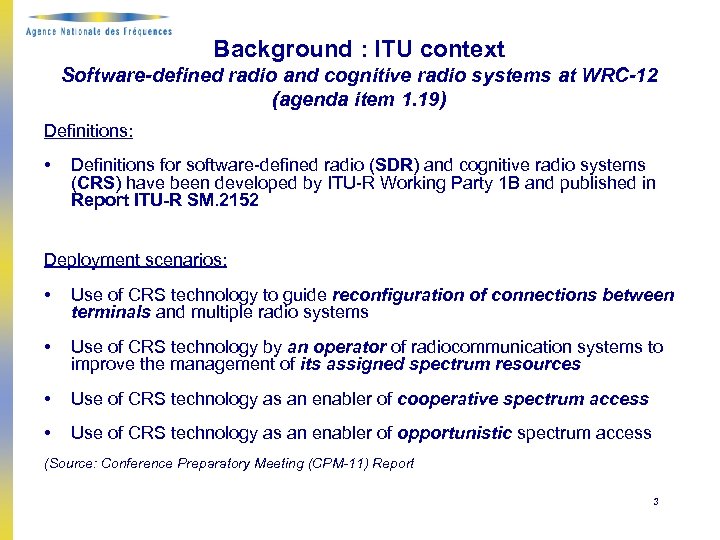 Background : ITU context Software-defined radio and cognitive radio systems at WRC-12 (agenda item 1. 19) Definitions: • Definitions for software-defined radio (SDR) and cognitive radio systems (CRS) have been developed by ITU-R Working Party 1 B and published in Report ITU-R SM. 2152 Deployment scenarios: • Use of CRS technology to guide reconfiguration of connections between terminals and multiple radio systems • Use of CRS technology by an operator of radiocommunication systems to improve the management of its assigned spectrum resources • Use of CRS technology as an enabler of cooperative spectrum access • Use of CRS technology as an enabler of opportunistic spectrum access (Source: Conference Preparatory Meeting (CPM-11) Report 3
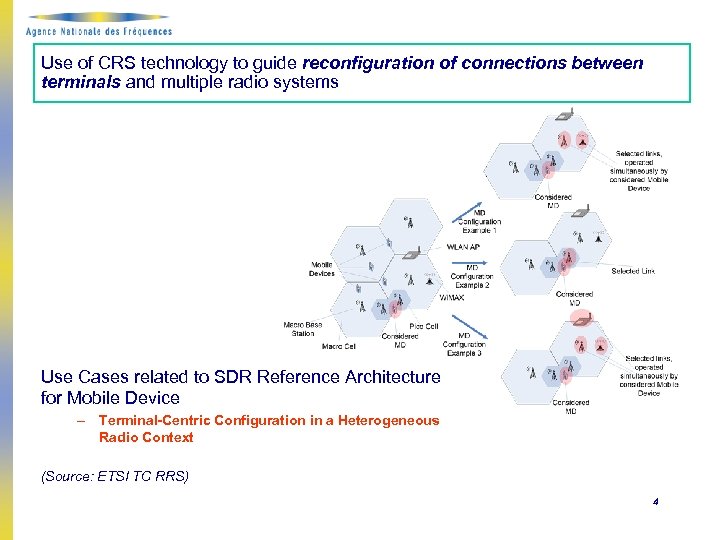 Use of CRS technology to guide reconfiguration of connections between terminals and multiple radio systems Use Cases related to SDR Reference Architecture for Mobile Device – Terminal-Centric Configuration in a Heterogeneous Radio Context (Source: ETSI TC RRS) 4
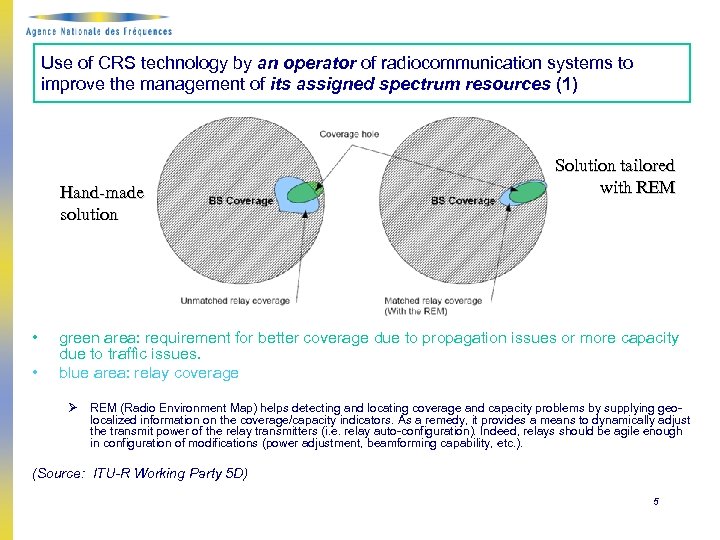 Use of CRS technology by an operator of radiocommunication systems to improve the management of its assigned spectrum resources (1) Hand-made solution • • Solution tailored with REM green area: requirement for better coverage due to propagation issues or more capacity due to traffic issues. blue area: relay coverage Ø REM (Radio Environment Map) helps detecting and locating coverage and capacity problems by supplying geolocalized information on the coverage/capacity indicators. As a remedy, it provides a means to dynamically adjust the transmit power of the relay transmitters (i. e. relay auto-configuration). Indeed, relays should be agile enough in configuration of modifications (power adjustment, beamforming capability, etc. ). (Source: ITU-R Working Party 5 D) 5
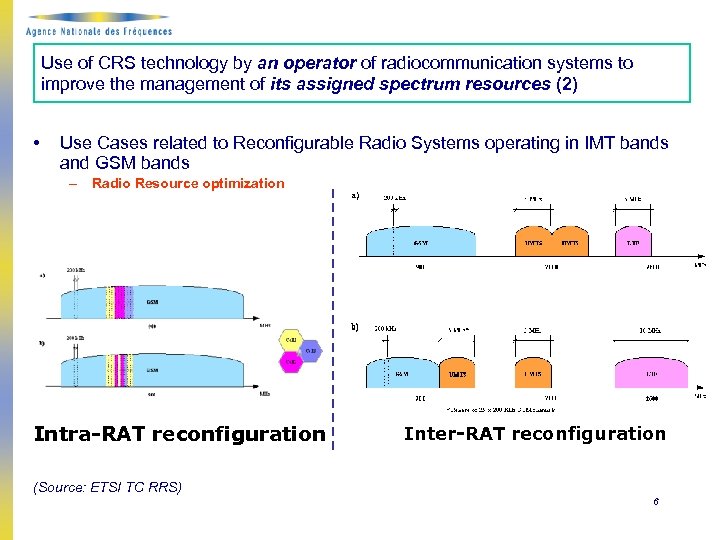 Use of CRS technology by an operator of radiocommunication systems to improve the management of its assigned spectrum resources (2) • Use Cases related to Reconfigurable Radio Systems operating in IMT bands and GSM bands – Radio Resource optimization Intra-RAT reconfiguration Inter-RAT reconfiguration (Source: ETSI TC RRS) 6
 Use of CRS technology as an enabler of cooperative spectrum access • Collaborative mechanisms between network operators within an horizontal market to share spectrum dynamically (“spectrum pooling”, interference resolution…) Use of CRS technology as an enabler of opportunistic spectrum access e. g. “TV white space” • Definition for white space in CEPT Report 24 (June 2008) : – White space is a part of the spectrum, which is available for a radiocommunication application (service, system) at a given time in a given geographical area on a noninterfering / non-protected basis with regard to primary services and other services with a higher priority on a national basis. 7
 New focus on “spectrum sharing” • Reduced regulatory focus on cognitive radio after WRC-12 – No change to the Radio Regulations at WRC-12 – ITU-R Resolution 58 adopted by the Radio Assembly in 2012 to provide guidance for further studies on implementation and use of CRS within ITU-R • Requirement to protect stations of other administrations operating in accordance with the Radio Regulations further emphasized in Recommendation 76 (WRC-12) • A shift from “cognitive radio” / “white space” towards “spectrum sharing”… – RSPG Opinion on Cognitive Technologies (February 2011) – RSPG Opinion on review of spectrum use (February 2012) – Commission communication COM(2012) 478 “Promoting the shared use of radio spectrum resources in the internal market” (September 2012) – Request for Opinion on Licensed Shared Access (LSA) (November 2012) • RSPG Opinion on Licensed Shared Access (November 2013) 8
 Part II Licensed Shared Access (LSA) Draft ECC Report 205 1) Regulatory framework for the use of the radio spectrum … Overview of the key regulatory and legal instruments that govern the use of spectrum 9
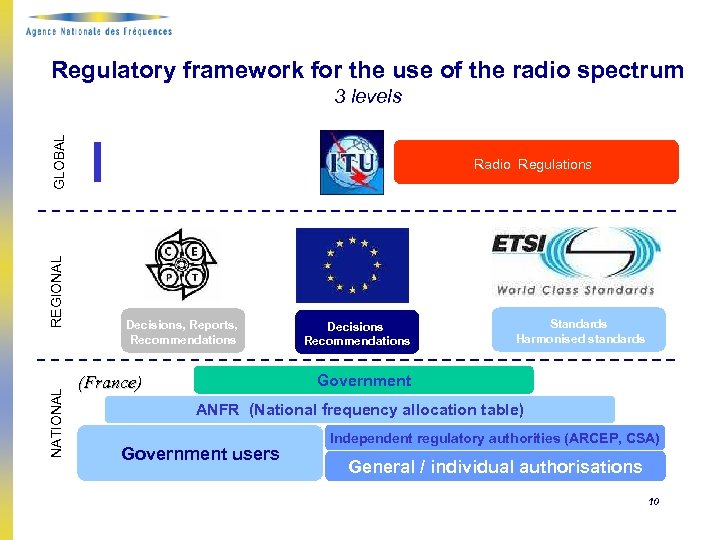 Regulatory framework for the use of the radio spectrum NATIONAL REGIONAL GLOBAL 3 levels Recommendations Reports Decisions, Reports, Recommendations Radio Regulations Decisions Recommendations Standards Harmonised standards Government (France) ANFR (National frequency allocation table) Government users Independent regulatory authorities (ARCEP, CSA) General / individual authorisations 10
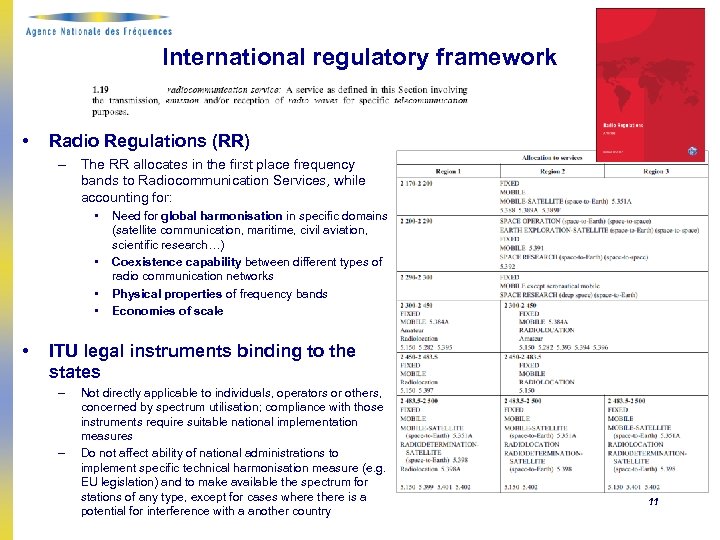 International regulatory framework • Radio Regulations (RR) – The RR allocates in the first place frequency bands to Radiocommunication Services, while accounting for: • • • Need for global harmonisation in specific domains (satellite communication, maritime, civil aviation, scientific research…) Coexistence capability between different types of radio communication networks Physical properties of frequency bands Economies of scale ITU legal instruments binding to the states – – Not directly applicable to individuals, operators or others, concerned by spectrum utilisation; compliance with those instruments require suitable national implementation measures Do not affect ability of national administrations to implement specific technical harmonisation measure (e. g. EU legislation) and to make available the spectrum for stations of any type, except for cases where there is a potential for interference with a another country 11
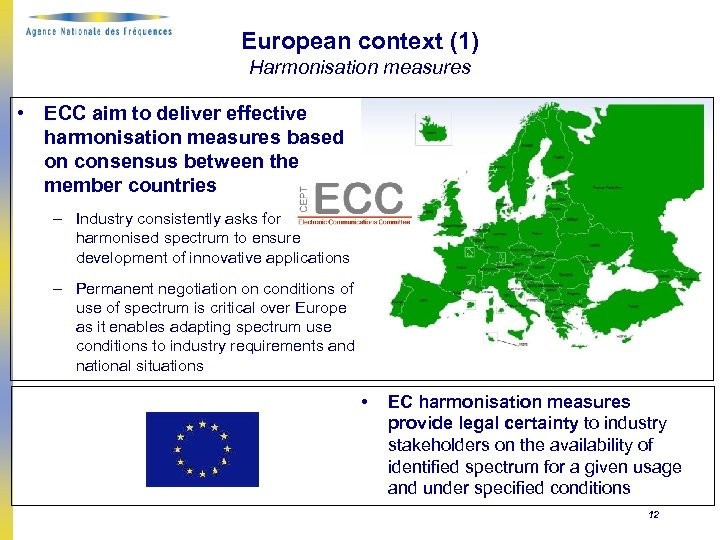 European context (1) Harmonisation measures • ECC aim to deliver effective harmonisation measures based on consensus between the member countries – Industry consistently asks for harmonised spectrum to ensure development of innovative applications – Permanent negotiation on conditions of use of spectrum is critical over Europe as it enables adapting spectrum use conditions to industry requirements and national situations • EC harmonisation measures provide legal certainty to industry stakeholders on the availability of identified spectrum for a given usage and under specified conditions 12
 European context (2) Authorisations • EU framework for the delivery of Electronic Communication Services (ECS) – Framework and Authorisation Directives: • Member States shall ensure the effective management of radio frequencies for electronic communication services in their territory in accordance with Article 8. They shall ensure that the allocation and assignment of such radio frequencies by national regulatory authorities are based on objective, transparent, nondiscriminatory and proportionate criteria [Framework 9. 1] • Member States shall ensure that each of the tasks assigned to national regulatory authorities in this Directive and the Specific Directives is undertaken by a competent body [Framework 3. 1] • Regulatory regime – General authorisation – Individual rights of use 13
 National legislation (1) • Authorising the use of the spectrum is a national prerogative, subject to international obligations and community law in the case of EU member states – No transmitting station may be established or operated by a private person or by any enterprise without a licence issued in an appropriate form and in conformity with the provisions of these Regulations by or on behalf of the government of the country to which the station in question is subject (RR Article 18. 1). 2 step process • Frequency allocation – National Tables of Frequency Allocations (NTFAs) primarily specify the radio services authorised by an individual administration in frequency bands and the entities which have access to them • Frequency assignment / authorisation – Spectrum usage rights for Governmental / non-governmental use of different nature • The term “authorisation” shall be understood as the public legal act issued by National Regulatory Authorities (NRAs) for the purpose of delivering spectrum usage rights to private entities or citizens (i. e. “non-governmental” use of the spectrum) 14
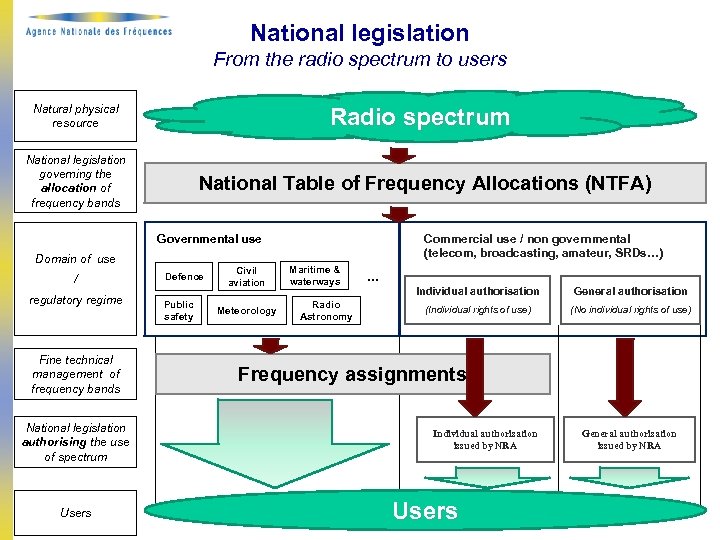 National legislation From the radio spectrum to users Natural physical resource Radio spectrum National legislation governing the allocation of frequency bands National Table of Frequency Allocations (NTFA) Governmental use Domain of use / regulatory regime Fine technical management of frequency bands National legislation authorising the use of spectrum Users Defence Public safety Civil aviation Meteorology Commercial use / non governmental (telecom, broadcasting, amateur, SRDs…) Maritime & waterways Radio Astronomy … Individual authorisation General authorisation (Individual rights of use) (No individual rights of use) Frequency assignments Individual authorisation issued by NRA Users General authorisation issued by NRA
 2) Spectrum management / Management of frequency authorisations • Spectrum management : combination of regulatory procedures and tools for managing the spectrum resource at radio service or application level in view of delivering regulatory solutions to accommodate different types of use, address new spectrum demand while accounting for existing uses • Managing frequency authorisations takes place at national level and focus on adequate procedures for assigning spectrum to individual users and market regulation 16
 Spectrum management • European level : spectrum reviews, compatibility studies, harmonisation measures – Regulatory solutions dependent upon the type of “regulatory regime” : critical impact in terms of objectives of quality of service and coexistence capability • National level – ITU-R Radio Regulations and European harmonisation measures provide key references to administrations for their national spectrum management – National Tables of Frequency Allocations (NTFAs) • Critical assets for national administrations to plan the allocation of frequency bands, whether on an exclusive or shared basis, between various governmental users which have access to spectrum to perform their own duties, and commercial services, so that consumers can benefit from innovative applications. • NTFAs provide visibility and support to policy making on the allocation of this public resource – Spectrum sharing as the baseline solution to accommodate new demand • Spectrum refarming as an option where sharing is not feasible 17
 Management of frequency authorisations • Policy objectives and regulatory principles – Policy objectives for National Regulatory Authorities (NRAs) within EU laid in Article 8 of the “Framework Directive”. – Different mechanisms can be established by NRAs for delivering individual rights of use to undertakings in a given frequency band: e. g. auction, beauty contest, first come/first served… • Corresponding procedures must be transparent and non-discriminatory. – An individual authorisation includes rights and obligations for the licensee. • How to acquire an individual right of use? 1) apply to the NRA 2) seek under the principles of “spectrum trading” a commercial agreement with a licensee that detains a “tradable right” • Baseline options in case of unused spectrum? – the licensee can trade the spectrum or – the usage rights can be reviewed by the NRA 18
 3) LSA as a complementary tool for spectrum management – – Background and justification ASA/LSA concept & mobile broadband Definition Conclusion 19
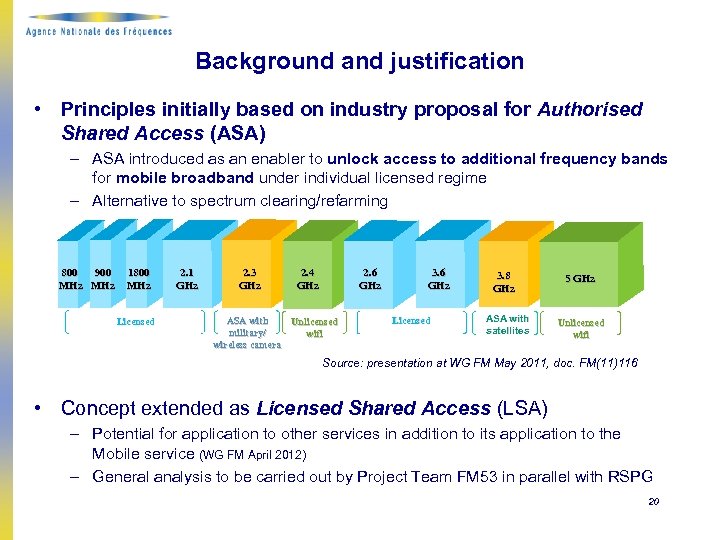 Background and justification • Principles initially based on industry proposal for Authorised Shared Access (ASA) – ASA introduced as an enabler to unlock access to additional frequency bands for mobile broadband under individual licensed regime – Alternative to spectrum clearing/refarming 800 900 MHz 1800 MHz Licensed 2. 1 GHz 2. 3 GHz 2. 4 GHz 2. 6 3. 6 2. 6 GHz 3 G/4 G ASA with Unlicensed military/ wifi wireless camera 3. 6 GHz Licensed 3. 8 GHz ASA with satellites 5 GHz Unlicensed wifi Source: presentation at WG FM May 2011, doc. FM(11)116 • Concept extended as Licensed Shared Access (LSA) – Potential for application to other services in addition to its application to the Mobile service (WG FM April 2012) – General analysis to be carried out by Project Team FM 53 in parallel with RSPG 20
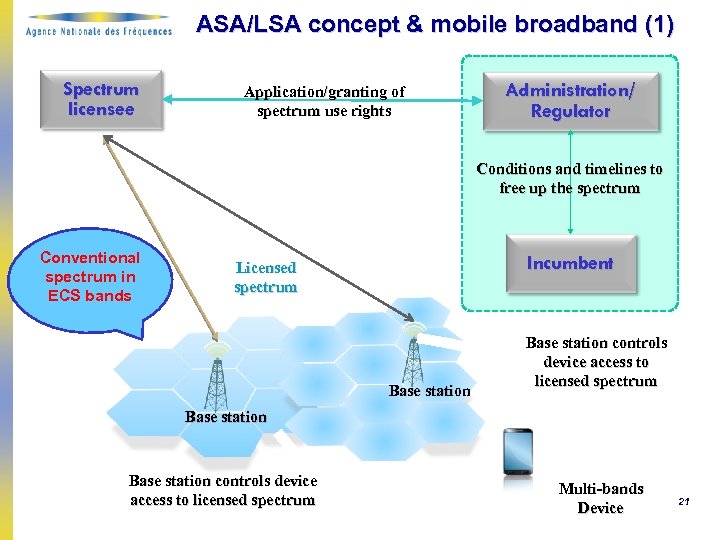 ASA/LSA concept & mobile broadband (1) Spectrum licensee Application/granting of spectrum use rights Administration/ Regulator Conditions and timelines to free up the spectrum Conventional spectrum in ECS bands Incumbent Licensed spectrum Base station controls device access to licensed spectrum Multi-bands Device 21
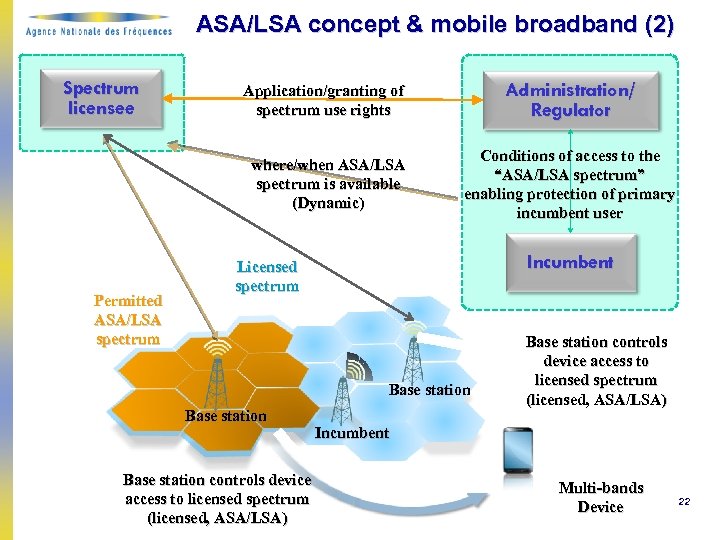 ASA/LSA concept & mobile broadband (2) Spectrum licensee where/when ASA/LSA spectrum is available (Dynamic) Permitted ASA/LSA spectrum Administration/ Regulator Application/granting of spectrum use rights Conditions of access to the “ASA/LSA spectrum” enabling protection of primary incumbent user Incumbent Licensed spectrum Base station controls device access to licensed spectrum (licensed, ASA/LSA) Incumbent Multi-bands Device 22
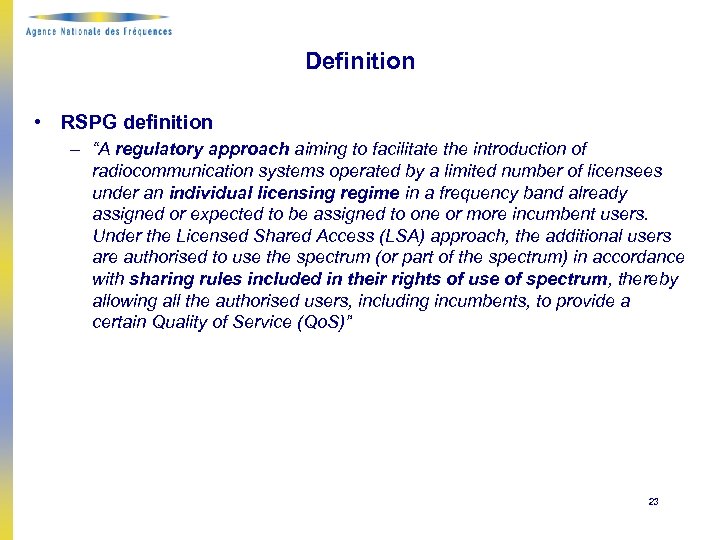 Definition • RSPG definition – “A regulatory approach aiming to facilitate the introduction of radiocommunication systems operated by a limited number of licensees under an individual licensing regime in a frequency band already assigned or expected to be assigned to one or more incumbent users. Under the Licensed Shared Access (LSA) approach, the additional users are authorised to use the spectrum (or part of the spectrum) in accordance with sharing rules included in their rights of use of spectrum, thereby allowing all the authorised users, including incumbents, to provide a certain Quality of Service (Qo. S)” 23
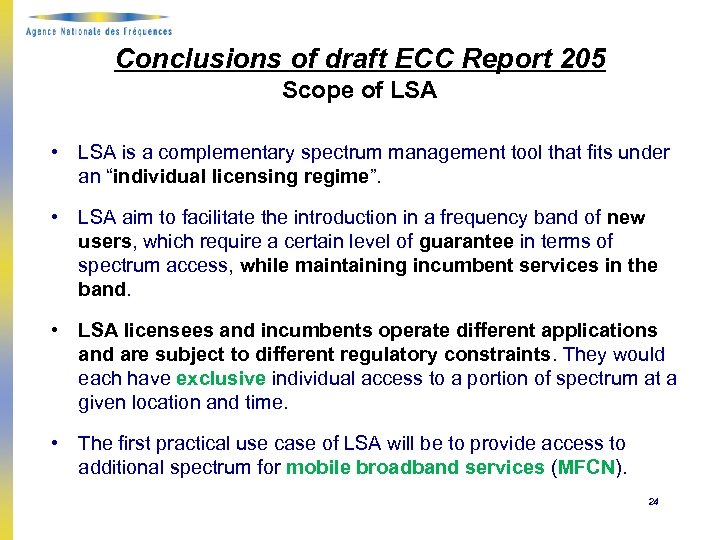 Conclusions of draft ECC Report 205 Scope of LSA • LSA is a complementary spectrum management tool that fits under an “individual licensing regime”. • LSA aim to facilitate the introduction in a frequency band of new users, which require a certain level of guarantee in terms of spectrum access, while maintaining incumbent services in the band. • LSA licensees and incumbents operate different applications and are subject to different regulatory constraints. They would each have exclusive individual access to a portion of spectrum at a given location and time. • The first practical use case of LSA will be to provide access to additional spectrum for mobile broadband services (MFCN). 24
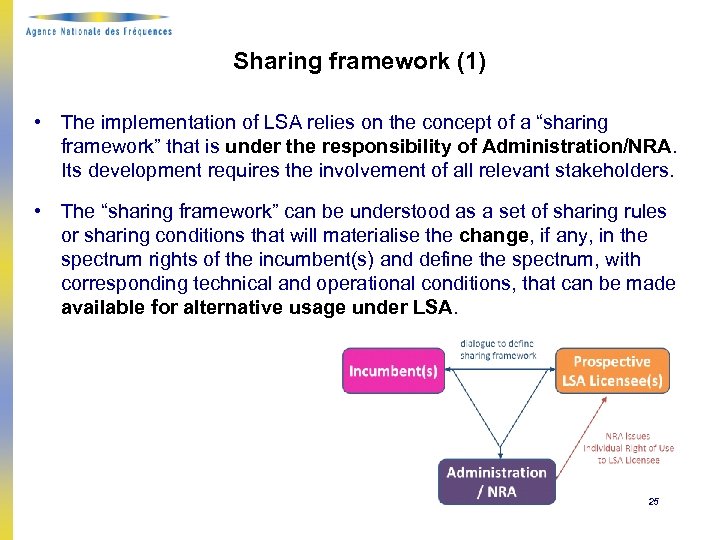 Sharing framework (1) • The implementation of LSA relies on the concept of a “sharing framework” that is under the responsibility of Administration/NRA. Its development requires the involvement of all relevant stakeholders. • The “sharing framework” can be understood as a set of sharing rules or sharing conditions that will materialise the change, if any, in the spectrum rights of the incumbent(s) and define the spectrum, with corresponding technical and operational conditions, that can be made available for alternative usage under LSA. 25
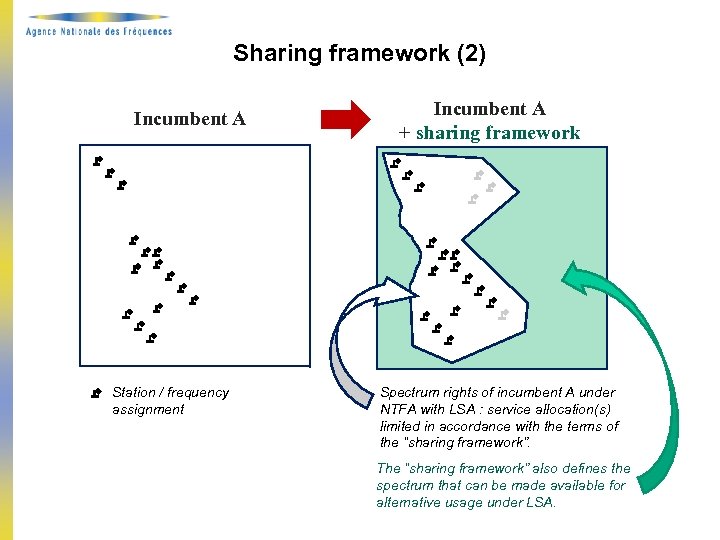 Sharing framework (2) Incumbent A Station / frequency assignment Incumbent A + sharing framework Spectrum rights of incumbent A under NTFA with LSA : service allocation(s) limited in accordance with the terms of the “sharing framework”. The “sharing framework” also defines the spectrum that can be made available for alternative usage under LSA.
 Frequency allocation • LSA impacts the national allocation of a frequency band, which is a sovereign decision on the destination of this public resource. • The decision on the services to be protected within the sharing framework (incumbent) is to be made by national administrations at the light of national policy objectives, and taking into account international obligations and community law in the case of EU member states. 27
 Authorisation process • The Administration/NRA would set the authorisation process with a view to delivering, in a fair, transparent and nondiscriminatory manner, individual rights of use of spectrum to LSA licensees, in accordance with the sharing framework defined beforehand. • LSA does not prejudge the modalities of the authorisation process to be set by Administration/NRAs taking into account national circumstances and market demand. • LSA is not a tool to regulate the ECS market and is based on different principles than “Spectrum trading”. It could nevertheless be necessary to check that competition is not adversely affected. The possibility for a governmental entity to engage in trading its spectrum holdings is a national institutional issue. 28
 European harmonisation • From a European perspective, LSA assists addressing the market demand for harmonised introduction of new applications in specific bands characterised by fragmented incumbent uses which have to be maintained in different countries. National administrations therefore require some flexibility in the national implementation to enable the protection of incumbent services. • A CEPT harmonisation measure would designate a frequency band define harmonised conditions of use (e. g. BEM, radio interface). Investigations at European level on the various sharing constraints aim to ensure that corresponding harmonised standard include the necessary tools for implementation of sharing mechanisms required for operation in the band. – See draft ECC Decision developed by CEPT/WGFM Project Team FM 52 for the frequency band 2. 3 -2. 4 GHz 29
 Part III WSD in the band 470 -790 MHz 30
 Technical studies • Technical studies performed by CEPT/ECC SE 43 – ECC Report 159 “Technical and operational requirements for the possible operation of cognitive radio systems in the ‘white spaces’ of the frequency band 470 -790 MHz” – ECC Report 185 “Complementary Report to ECC Report 159 - Further definition of technical and operational requirements for the operation of white space devices in the band 470 -790 MHz” – ECC Report 186 “Technical and operational requirements for the operation of white space devices under geo-location approach” 31
 Harmonisation measure • Possible harmonisation measures for white space devices in the band 470 -790 MHz -> CEPT/ECC FM 53 • Regulatory approach / status: – Opportunistic spectrum access – General authorisation / Licence-exempt – Non-interference / non protected basis • Progress – draft Harmonised Standard EN 301 598 -> ETSI TC BRAN – No significant development in FM 53 until now – Key regulatory principle: • WSDs cannot transmit in the 470 -790 MHz band unless they have received relevant info from a certified (by NRA) database. – Experience gained in the UK to be analysed Thank you ! 32