


 Скачать презентацию Introduction of Micro Nano-fluidic Flow J L Lin Assistant
1768e933f80968724df93172973b5bd2.ppt
- Количество слайдов: 20
 Introduction of Micro/Nano-fluidic Flow J. L. Lin Assistant Professor Department of Mechanical and Automation Engineering 3/17/2018 1
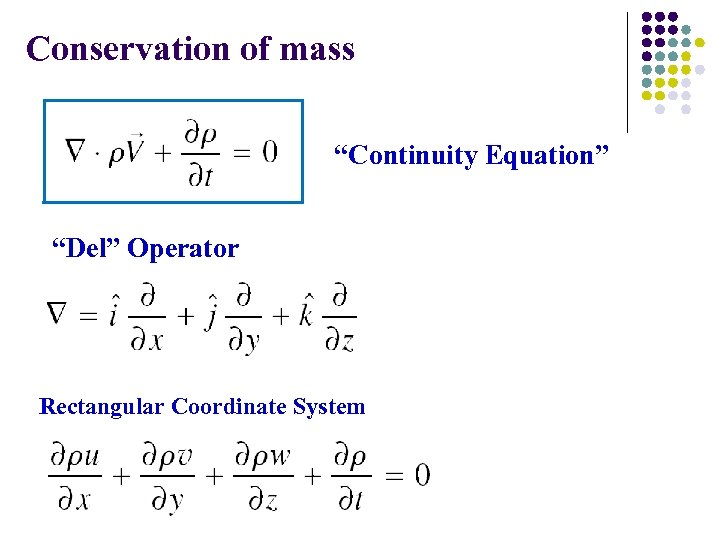
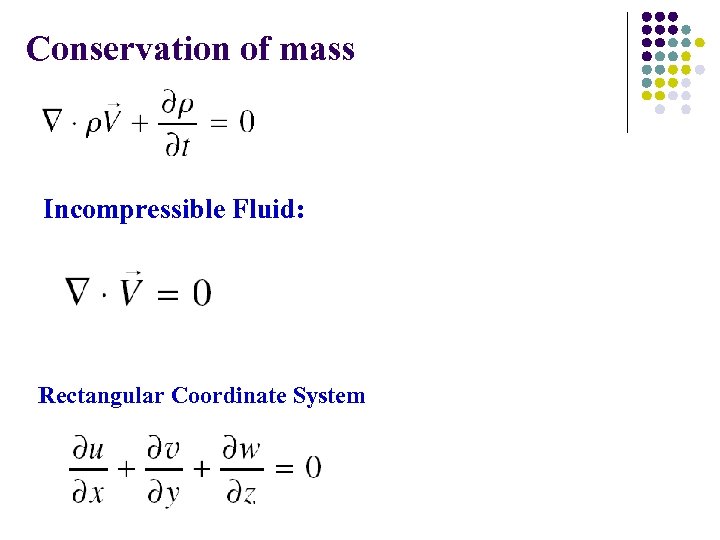
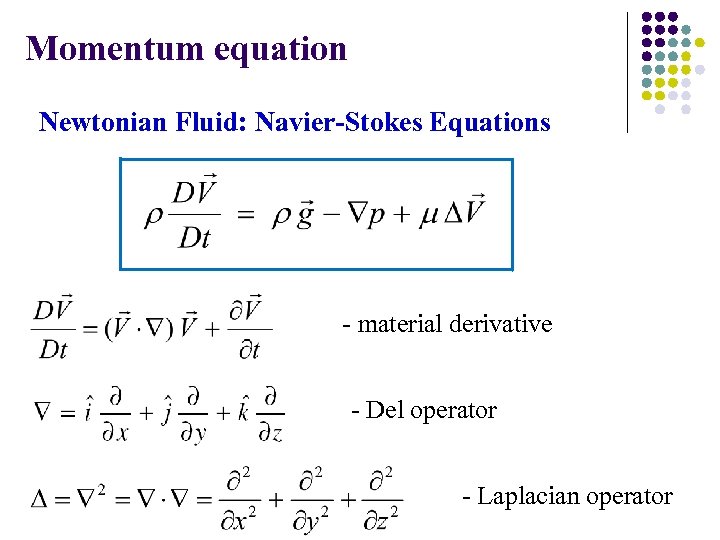
 Outline • • • Defenition of a fluid, fluid particle Viscosity Continuity equation Navier – Stokes equation Reynolds number Stokes (creeping) flow 3/17/2018 2
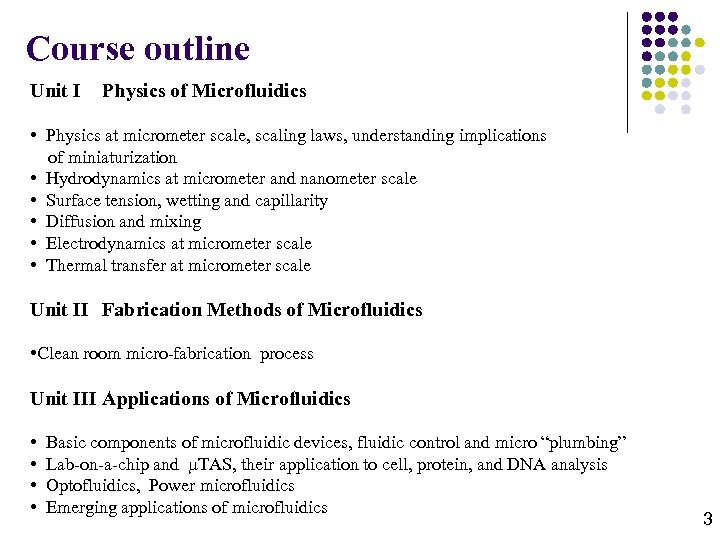 Course outline Unit I Physics of Microfluidics • Physics at micrometer scale, scaling laws, understanding implications of miniaturization • Hydrodynamics at micrometer and nanometer scale • Surface tension, wetting and capillarity • Diffusion and mixing • Electrodynamics at micrometer scale • Thermal transfer at micrometer scale Unit II Fabrication Methods of Microfluidics • Clean room micro-fabrication process Unit III Applications of Microfluidics • • Basic components of microfluidic devices, fluidic control and micro “plumbing” Lab-on-a-chip and TAS, their application to cell, protein, and DNA analysis Optofluidics, Power microfluidics Emerging applications of microfluidics 3
 Course objectives • • Introduction and a broad overview of the basic laws and applications of micro and nano fluidics Hands-on experience in modern microfabrication techniques, design and operation of microfluidic devices The ability to work effectively with the original publications in the area of microfluidics. The ability to effectively present literature data in the area of microfluidics. 22 -Jan-08 4
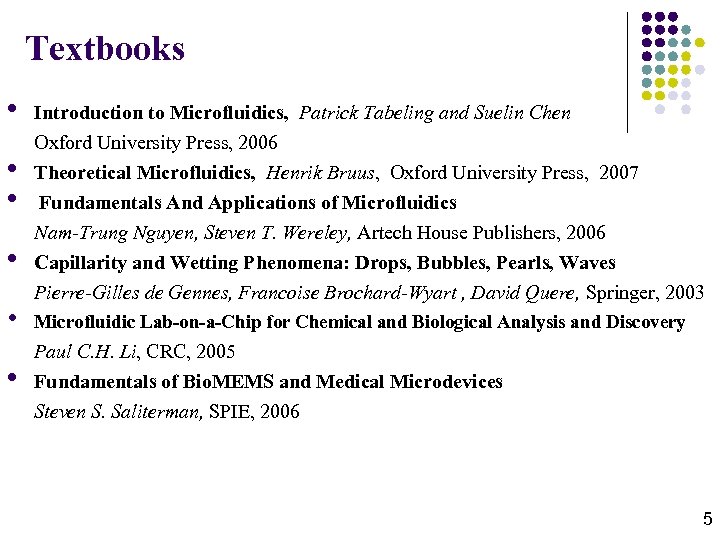 Textbooks • • • Introduction to Microfluidics, Patrick Tabeling and Suelin Chen Oxford University Press, 2006 Theoretical Microfluidics, Henrik Bruus, Oxford University Press, 2007 Fundamentals And Applications of Microfluidics Nam-Trung Nguyen, Steven T. Wereley, Artech House Publishers, 2006 Capillarity and Wetting Phenomena: Drops, Bubbles, Pearls, Waves Pierre-Gilles de Gennes, Francoise Brochard-Wyart , David Quere, Springer, 2003 Microfluidic Lab-on-a-Chip for Chemical and Biological Analysis and Discovery Paul C. H. Li, CRC, 2005 Fundamentals of Bio. MEMS and Medical Microdevices Steven S. Saliterman, SPIE, 2006 5
 Grade • Cumulative score: l Attendance 20% Homeworks 30% Final Report 20% l Oral Presentation 30% l l • Each student will have an opportunity to present a 15 -minute talk based on original publication(s) in the field of micro/nano fluidics. List of recommended topics and papers will be provided. 6
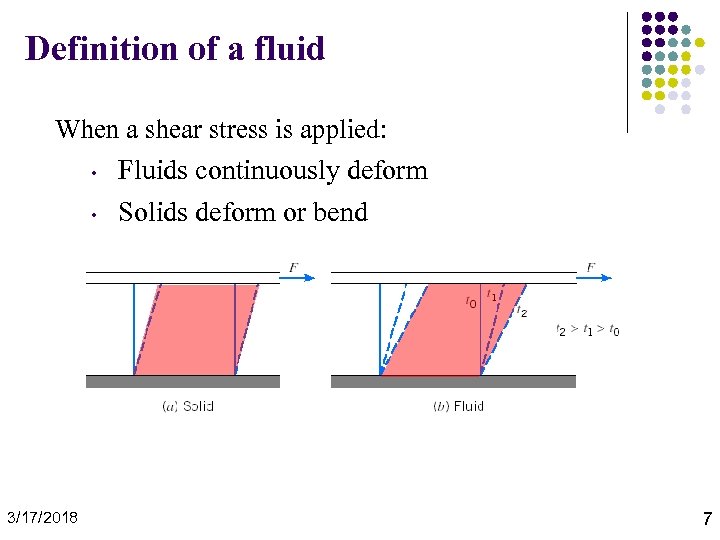 Definition of a fluid When a shear stress is applied: • • 3/17/2018 Fluids continuously deform Solids deform or bend 7
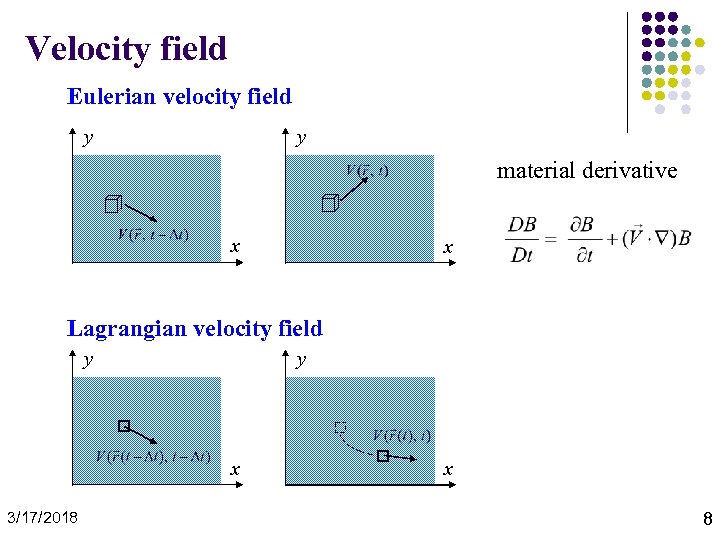 Velocity field Eulerian velocity field y y material derivative x x Lagrangian velocity field y y x 3/17/2018 x 8
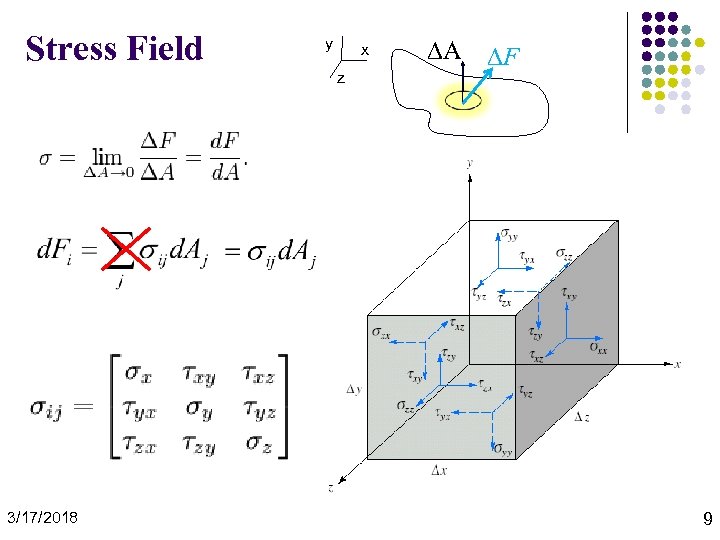 Stress Field y x z 3/17/2018 DA DF 9
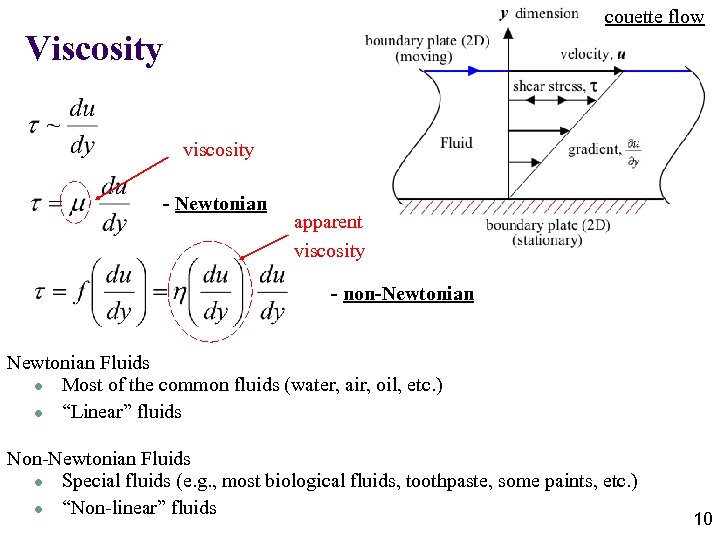 couette flow Viscosity viscosity - Newtonian apparent viscosity - non-Newtonian Fluids l Most of the common fluids (water, air, oil, etc. ) l “Linear” fluids Non-Newtonian Fluids l Special fluids (e. g. , most biological fluids, toothpaste, some paints, etc. ) l “Non-linear” fluids 10
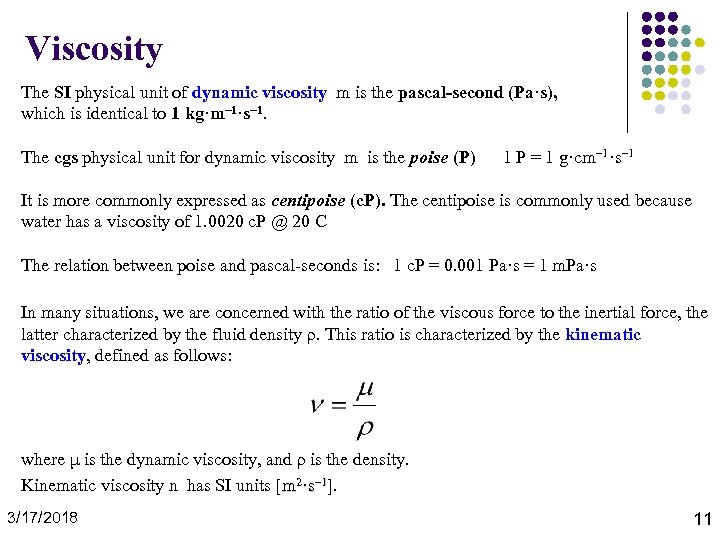 Viscosity The SI physical unit of dynamic viscosity m is the pascal-second (Pa·s), which is identical to 1 kg·m− 1·s− 1. The cgs physical unit for dynamic viscosity m is the poise (P) 1 P = 1 g·cm− 1·s− 1 It is more commonly expressed as centipoise (c. P). The centipoise is commonly used because water has a viscosity of 1. 0020 c. P @ 20 C The relation between poise and pascal-seconds is: 1 c. P = 0. 001 Pa·s = 1 m. Pa·s In many situations, we are concerned with the ratio of the viscous force to the inertial force, the latter characterized by the fluid density ρ. This ratio is characterized by the kinematic viscosity, defined as follows: where μ is the dynamic viscosity, and ρ is the density. Kinematic viscosity n has SI units [m 2·s− 1]. 3/17/2018 11
![Dynamic viscosity [Pa s] [c. P] Viscosity [c. P] honey 2, 000– 10, 000](https://present5.com/presentation/1768e933f80968724df93172973b5bd2/image-12.jpg "Dynamic viscosity [Pa s] [c. P] Viscosity [c. P] honey 2, 000– 10, 000") Dynamic viscosity [Pa s] [c. P] Viscosity [c. P] honey 2, 000– 10, 000 molasses 5, 000– 10, 000 0. 306 molten glass 10, 000– 1, 000 5. 44 × 10− 4 0. 544 chocolate syrup 10, 000– 25, 000 water 1. 00 × 10− 3 1. 000 molten chocolate 45, 000– 130, 000 ethanol 1. 074 × 10− 3 1. 074 ketchup 50, 000– 100, 000 mercury 1. 526 × 10− 3 1. 526 peanut butter ~250, 000 nitrobenzene 1. 863 × 10− 3 1. 863 shortening ~250, 000 propanol 1. 945 × 10− 3 1. 945 ethylene glycol 1. 61 × 10− 2 16. 1 viscosity sulfuric acid 2. 42 × 10− 2 24. 2 hydrogen 8. 4 × 10− 3 olive oil . 081 81 air 17. 4 × 10− 3 glycerol . 934 xenon 2. 12 × 10 -2 corn syrup 1. 3806 1380. 6 liquid nitrogen 1. 58 × 10− 4 0. 158 acetone 3. 06 × 10− 4 methanol 3/17/2018 [c. P] 12
Dynamic viscosity [Pa s] [c. P] Viscosity [c. P] honey 2, 000– 10, 000 molasses 5, 000– 10, 000 0. 306 molten glass 10, 000– 1, 000 5. 44 × 10− 4 0. 544 chocolate syrup 10, 000– 25, 000 water 1. 00 × 10− 3 1. 000 molten chocolate 45, 000– 130, 000 ethanol 1. 074 × 10− 3 1. 074 ketchup 50, 000– 100, 000 mercury 1. 526 × 10− 3 1. 526 peanut butter ~250, 000 nitrobenzene 1. 863 × 10− 3 1. 863 shortening ~250, 000 propanol 1. 945 × 10− 3 1. 945 ethylene glycol 1. 61 × 10− 2 16. 1 viscosity sulfuric acid 2. 42 × 10− 2 24. 2 hydrogen 8. 4 × 10− 3 olive oil . 081 81 air 17. 4 × 10− 3 glycerol . 934 xenon 2. 12 × 10 -2 corn syrup 1. 3806 1380. 6 liquid nitrogen 1. 58 × 10− 4 0. 158 acetone 3. 06 × 10− 4 methanol 3/17/2018 [c. P] 12
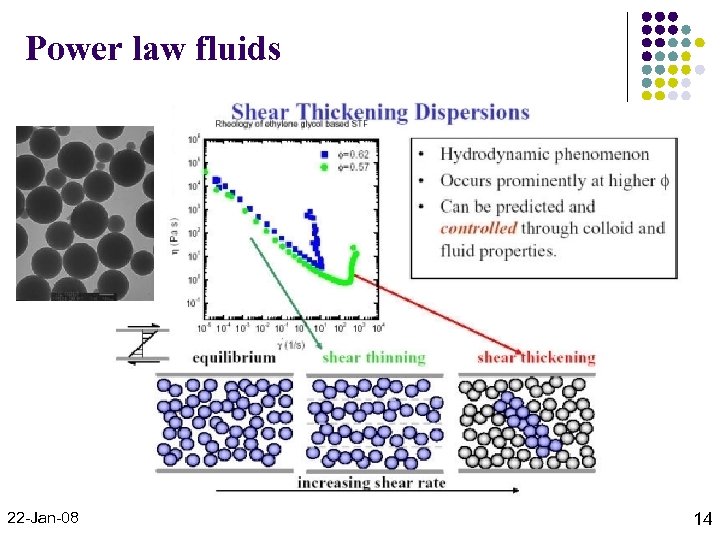
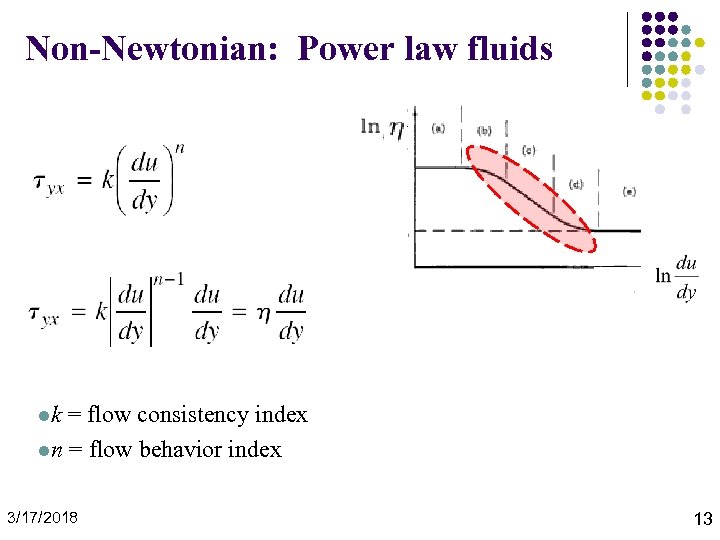 Non-Newtonian: Power law fluids lk = flow consistency index ln = flow behavior index 3/17/2018 13
 Power law fluids 22 -Jan-08 14
 Conservation of mass “Continuity Equation” “Del” Operator Rectangular Coordinate System
 Conservation of mass Incompressible Fluid: Rectangular Coordinate System
 Momentum equation Newtonian Fluid: Navier-Stokes Equations - material derivative - Del operator - Laplacian operator
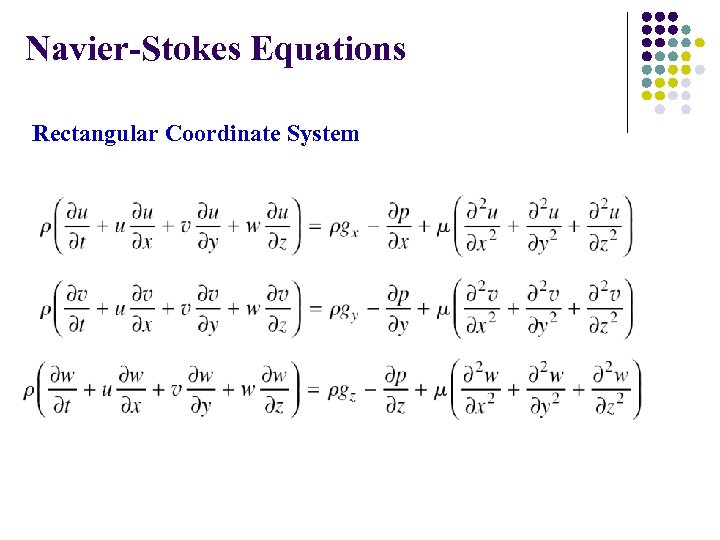 Navier-Stokes Equations Rectangular Coordinate System
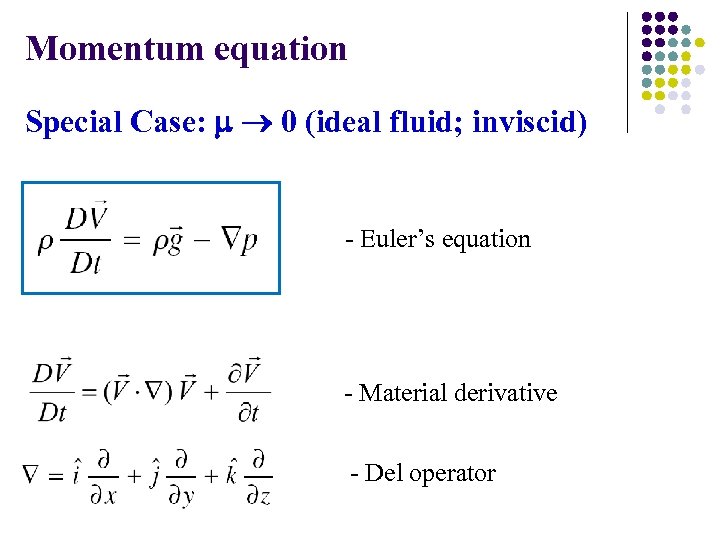 Momentum equation Special Case: 0 (ideal fluid; inviscid) - Euler’s equation - Material derivative - Del operator
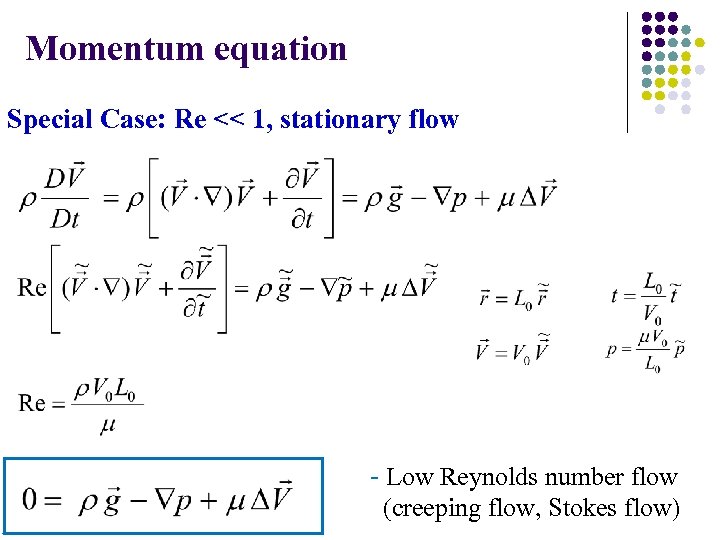 Momentum equation Special Case: Re << 1, stationary flow - Low Reynolds number flow (creeping flow, Stokes flow)