


 Скачать презентацию Introduction of Lulin Sky Survey LUSS T C
ce2372f7a53fd723a1caa4558b1641c9.ppt
- Количество слайдов: 1
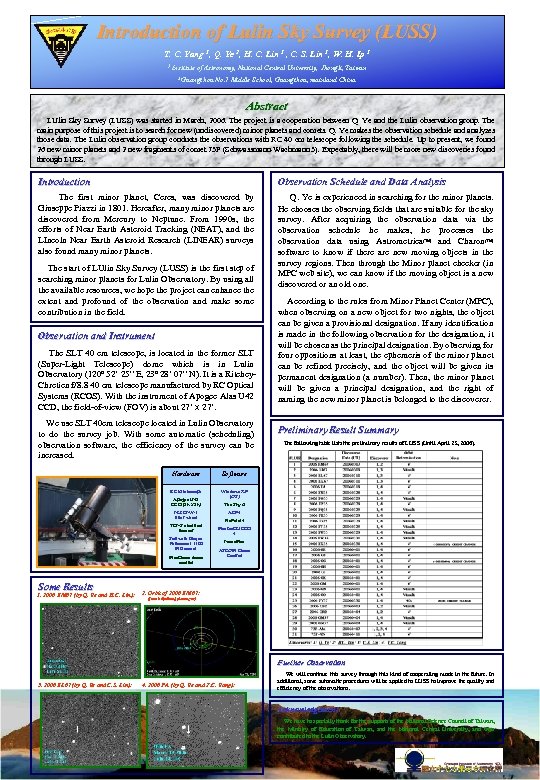 Introduction of Lulin Sky Survey (LUSS) T. C. Yang 1, Q. Ye 2, H. C. Lin 1 , C. S. Lin 1, W. H. Ip 1 1 Institute of Astronomy, National Central University, Jhongli, Taiwan 2 Guangzhou No. 7 Middle School, Guangzhou, mainland China Abstract LUlin Sky Survey (LUSS) was started in March, 2006. The project is a cooperation between Q. Ye and the Lulin observation group. The main purpose of this project is to search for new (undiscovered) minor planets and comets. Q. Ye makes the observation schedule and analyzes those data. The Lulin observation group conducts the observations with RC 40 cm telescope following the schedule. Up to present, we found 26 new minor planets and 2 new fragments of comet 73 P (Schwassmann-Wachmann 3). Expectably, there will be more new discoveries found through LUSS. Introduction Observation Schedule and Data Analysis The first minor planet, Ceres, was discovered by Giuseppe Piazzi in 1801. Hereafter, many minor planets are discovered from Mercury to Neptune. From 1990 s, the efforts of Near Earth Asteroid Tracking (NEAT), and the LIncoln Near Earth Asteroid Research (LINEAR) surveys also found many minor planets. Q. Ye is experienced in searching for the minor planets. He chooses the observing fields that are suitable for the sky survey. After acquiring the observation data via the observation schedule he makes, he processes the observation data using Astrometrica(TM) and Charon(TM) software to know if there are new moving objects in the survey regions. Then through the Minor planet checker (in MPC web site), we can know if the moving object is a new discovered or an old one. The start of LUlin Sky Survey (LUSS) is the first step of searching minor planets for Lulin Observatory. By using all the available resources, we hope the project can enhance the extent and profound of the observation and make some contribution in the field. Observation and Instrument The SLT 40 cm telescope, is located in the former SLT (Super-Light Telescope) dome which is in Lulin Observatory (120º 52’ 25” E, 23º 28’ 07” N). It is a Ritchey. Chretien f/8. 8 40 cm telescope manufactured by RC Optical Systems (RCOS). With the instrument of Apogee Alas U 42 CCD, the field-of-view (FOV) is about 27’ x 27’. We use SLT 40 cm telescope located in Lulin Observatory to do the survey job. With some automatic (scheduling) observation software, the efficiency of the survey can be increased. Hardware FLI CFW-1 filter wheel TCF-S electrical focuser Software Bisque Paramount 1100 ME mount Max. Dome dome control Some Results The following table lists the preliminary results of LUSS (Until April 23, 2006). Windows XP (OS) Apogee U 42 CCD (2 k x 2 k) 1. 2006 EM 67 (by Q. Ye and H. C. Lin): Preliminary Result Summary Software RC 16 telescope According to the rules from Minor Planet Center (MPC), when observing on a new object for two nights, the object can be given a provisional designation. If any identification is made in the following observation for the designation, it will be chosen as the principal designation. By observing for four oppositions at least, the ephemeris of the minor planet can be refined precisely, and the object will be given its permanent designation (a number). Then, the minor planet will be given a principal designation, and the right of naming the new minor planet is belonged to the discoverer. The Sky 6 ACP 4 Pin. Point 4 Max. Im. DL/CCD 4 Focus. Max ASCOM Dome Control 2. Orbit of 2006 EM 67: (from http: //neo. jpl. nasa. gov) Further Observation 3. 2006 EL 67 (by Q. Ye and C. S. Lin): 4. 2006 FA (by Q. Ye and T. C. Yang): We will continue this survey through this kind of cooperating mode in the future. In additional, some automatic procedures will be applied to LUSS to improve the quality and efficiency of the observations. Acknowledgement We have to specially thank for the supports of the National Science Council of Taiwan, the Ministry of Education of Taiwan, and the National Central University, and who contributed to the Lulin Observatory.