


 Скачать презентацию Introduction of Computer Networking Professor Wei Chen Tennessee
5563f5b9f0d4a1573c53d8296db12aeb.ppt
- Количество слайдов: 18
 Introduction of Computer Networking Professor Wei Chen Tennessee State University
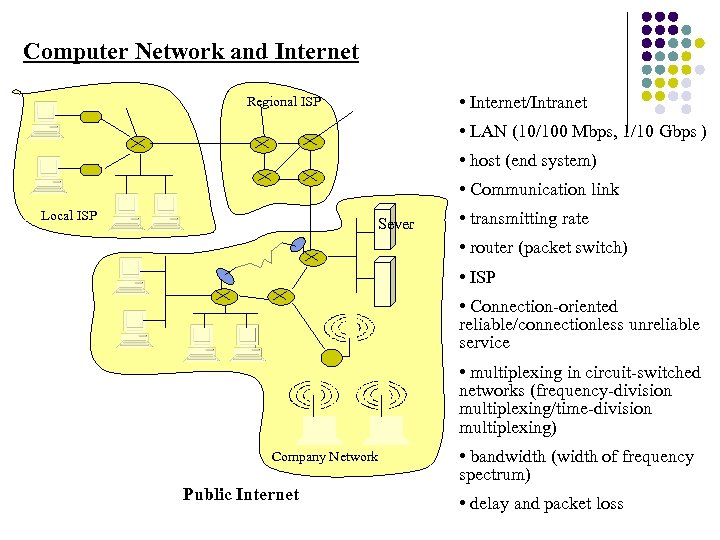 Computer Network and Internet • Internet/Intranet Regional ISP • LAN (10/100 Mbps, 1/10 Gbps ) • host (end system) • Communication link Local ISP Sever • transmitting rate • router (packet switch) • ISP • Connection-oriented reliable/connectionless unreliable service • multiplexing in circuit-switched networks (frequency-division multiplexing/time-division multiplexing) Company Network Public Internet • bandwidth (width of frequency spectrum) • delay and packet loss
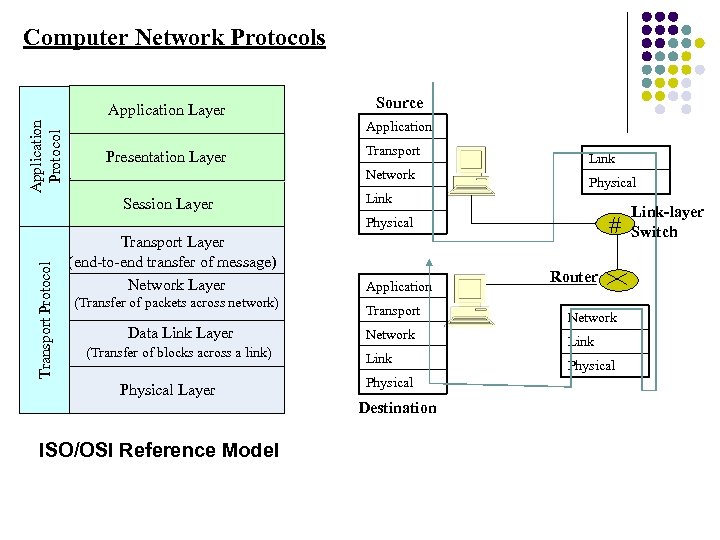 Computer Network Protocols Application Protocol Application Layer Presentation Layer Source Application Transport Network Session Layer Link Physical Link # Transport Protocol Physical Transport Layer (end-to-end transfer of message) Network Layer (Transfer of packets across network) Data Link Layer (Transfer of blocks across a link) Physical Layer Application Transport Network Link Physical Destination ISO/OSI Reference Model Router Network Link Physical Link-layer Switch
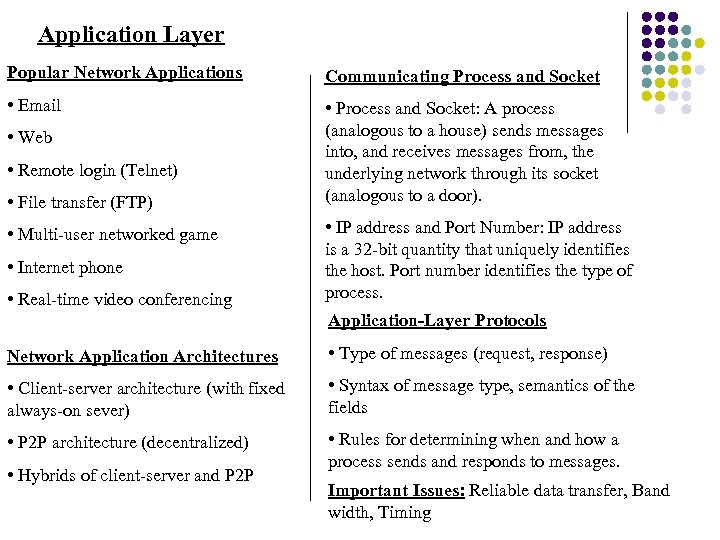 Application Layer Popular Network Applications Communicating Process and Socket • Email • Process and Socket: A process (analogous to a house) sends messages into, and receives messages from, the underlying network through its socket (analogous to a door). • Web • Remote login (Telnet) • File transfer (FTP) • Multi-user networked game • Internet phone • Real-time video conferencing • IP address and Port Number: IP address is a 32 -bit quantity that uniquely identifies the host. Port number identifies the type of process. Application-Layer Protocols Network Application Architectures • Type of messages (request, response) • Client-server architecture (with fixed always-on sever) • Syntax of message type, semantics of the fields • P 2 P architecture (decentralized) • Rules for determining when and how a process sends and responds to messages. • Hybrids of client-server and P 2 P Important Issues: Reliable data transfer, Band width, Timing
 Transport Layer Provides for logical communication between application processes running on different hosts: (1) break the application messages into smaller chunks, (2) adding a transport-layer header to each chunk to create the transportlayer segment, and (3) then pass the segment to the network layer. Transport Layer in the Internet (TCP/IP) • UDP (User Datagram Protocol) provides an unreliable, connectionless service, where the transport layer packet is called as segment. • TCP (Transmission Control Protocol) provides a reliable, connection-oriented service, where the transport layer packet is called as datagram. TCP provides congestion control. • Transport-layer multiplexing (gather data chunks at the source host from different sockets and pass to network layer) and demultiplexing (delivering the data in transportlayer to the correct socket) extend host-to-host services between two end systems to a delivery service between two processes running on the end system. Important Issues: Reliable data transfer, Congestion control
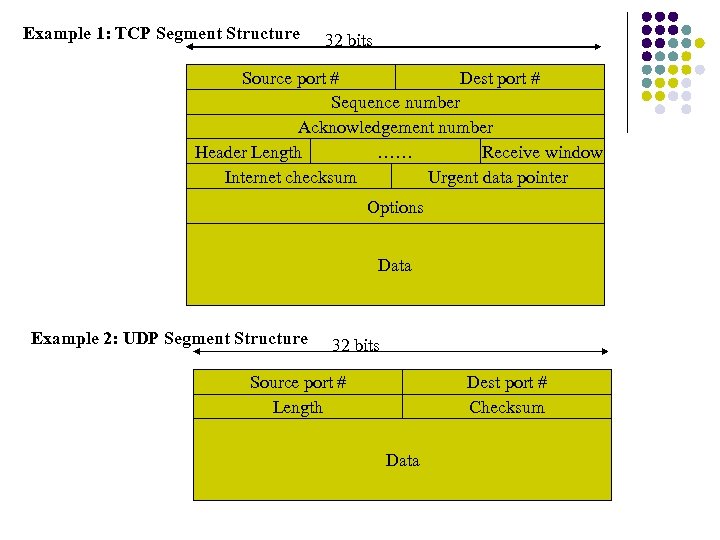 Example 1: TCP Segment Structure 32 bits Source port # Dest port # Sequence number Acknowledgement number Header Length …… Receive window Urgent data pointer Internet checksum Options Data Example 2: UDP Segment Structure 32 bits Source port # Length Dest port # Checksum Data
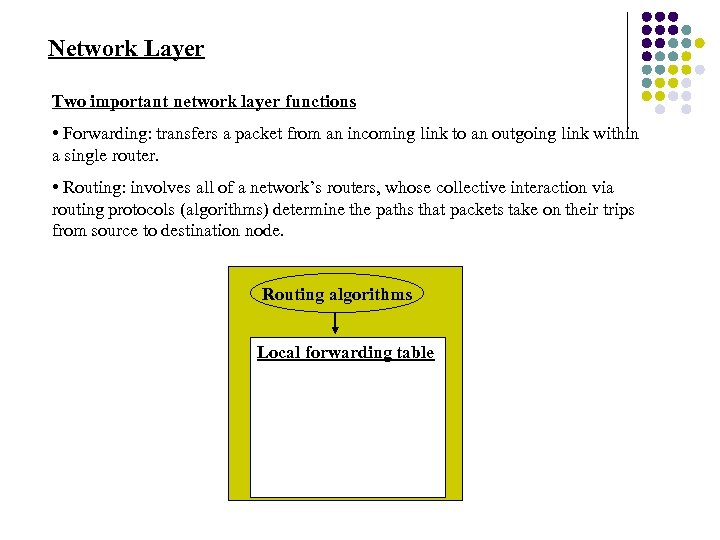 Network Layer Two important network layer functions • Forwarding: transfers a packet from an incoming link to an outgoing link within a single router. • Routing: involves all of a network’s routers, whose collective interaction via routing protocols (algorithms) determine the paths that packets take on their trips from source to destination node. Routing algorithms Local forwarding table
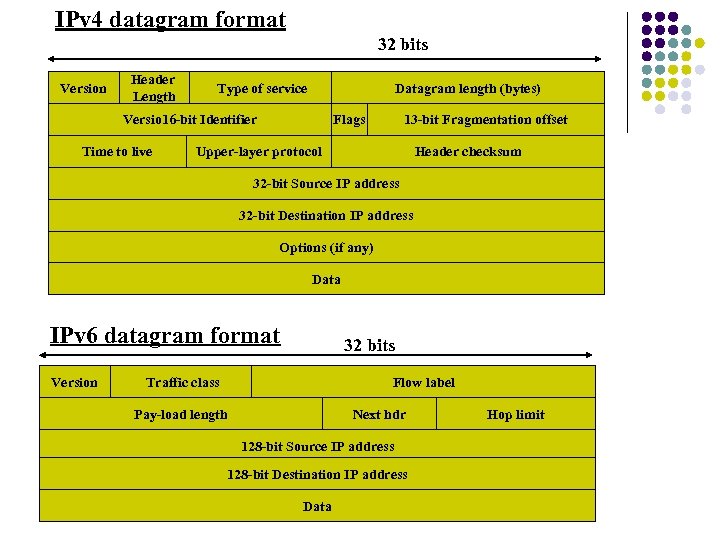 IPv 4 datagram format 32 bits Version Header Length Type of service Datagram length (bytes) Versio 16 -bit Identifier Time to live Flags 13 -bit Fragmentation offset Upper-layer protocol Header checksum 32 -bit Source IP address 32 -bit Destination IP address Options (if any) Data IPv 6 datagram format Version 32 bits Flow label Traffic class Pay-load length Next hdr 128 -bit Source IP address 128 -bit Destination IP address Data Hop limit
 Link Layer A link-layer protocol (Ethernet, 802. 11 wireless LAN, token ring, PPP) is used to move a datagram over an individual link. It defines the format of the packets exchanged between nodes at the ends of the link, as well as the actions taken by these nodes when the packets are sent and received. Actions in Link layer • sending and receiving frames including error detection • retransmission • flow control • random access Multiple Access Protocols • Channel partitioning protocols (Time division multiplexing, frequency-division multiplexing) • Random access protocols • Taking-turns protocols
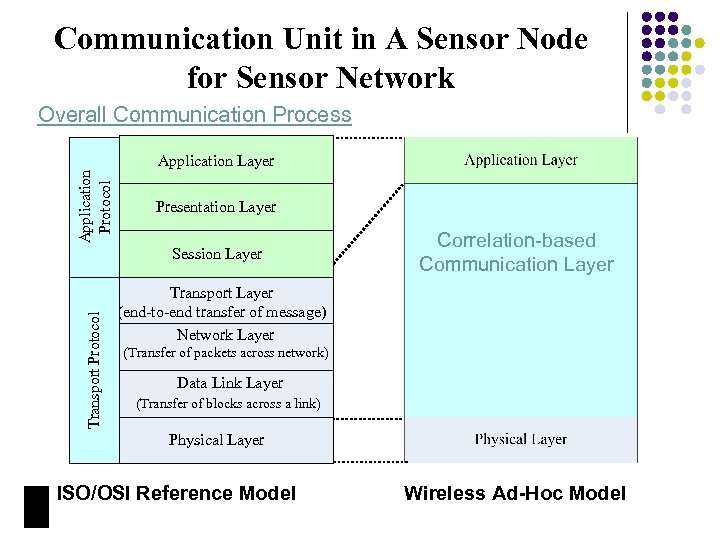 Communication Unit in A Sensor Node for Sensor Network Overall Communication Process Application Protocol Application Layer Presentation Layer Transport Protocol Session Layer Correlation-based Communication Layer Transport Layer (end-to-end transfer of message) Network Layer (Transfer of packets across network) Data Link Layer (Transfer of blocks across a link) Physical Layer ISO/OSI Reference Model Wireless Ad-Hoc Model
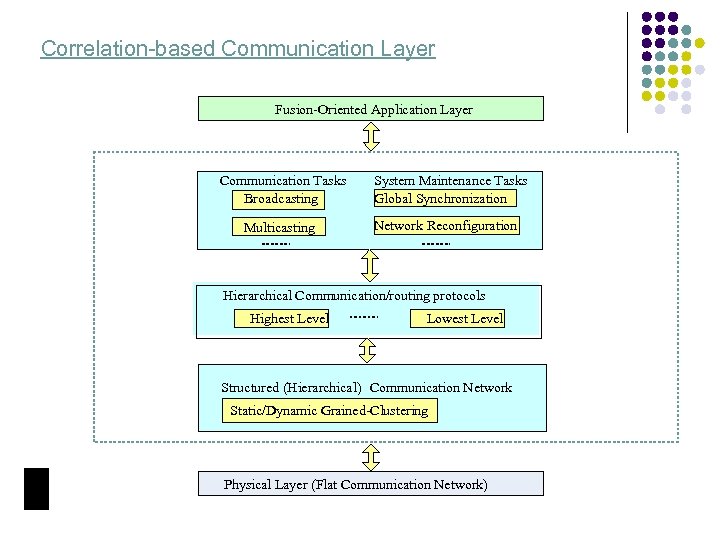 Correlation-based Communication Layer Fusion-Oriented Application Layer Communication Tasks Broadcasting Multicasting System Maintenance Tasks Global Synchronization Network Reconfiguration Hierarchical Communication/routing protocols Highest Level Lowest Level Structured (Hierarchical) Communication Network Static/Dynamic Grained-Clustering Physical Layer (Flat Communication Network)
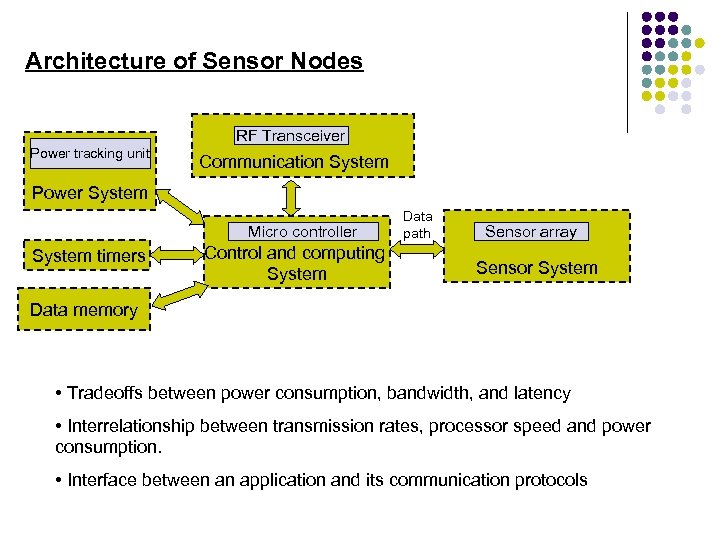 Architecture of Sensor Nodes RF Transceiver Power tracking unit Communication System Power System Micro controller System timers Control and computing System Data path Sensor array Sensor System Data memory • Tradeoffs between power consumption, bandwidth, and latency • Interrelationship between transmission rates, processor speed and power consumption. • Interface between an application and its communication protocols
 Types of Nodes in Sensor Networks (1) Homogeneous Sensor Network • Uniform sensor nodes & sink nodes • No base station (2) Heterogeneous Sensor Network • Sensing nodes, processing nodes, mobile nodes, sink nodes • Mixed with base station Wireless Stands • IEEE 802. 11 (Wi-Fi): Mainly used for the access between wireless devices and base stations. Possible for the access between wireless devices. • IEEE 802. 15 (based on Bluetooth): Used for Ad-hoc network without base station.
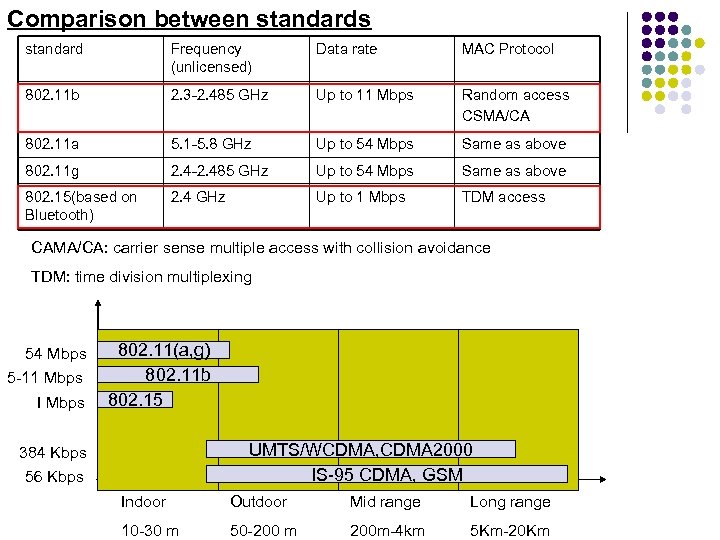 Comparison between standards standard Frequency (unlicensed) Data rate MAC Protocol 802. 11 b 2. 3 -2. 485 GHz Up to 11 Mbps Random access CSMA/CA 802. 11 a 5. 1 -5. 8 GHz Up to 54 Mbps Same as above 802. 11 g 2. 4 -2. 485 GHz Up to 54 Mbps Same as above 802. 15(based on Bluetooth) 2. 4 GHz Up to 1 Mbps TDM access CAMA/CA: carrier sense multiple access with collision avoidance TDM: time division multiplexing 54 Mbps 5 -11 Mbps I Mbps 802. 11(a, g) 802. 11 b 802. 15 UMTS/WCDMA, CDMA 2000 IS-95 CDMA, GSM 384 Kbps 56 Kbps Indoor Outdoor Mid range Long range 10 -30 m 50 -200 m 200 m-4 km 5 Km-20 Km
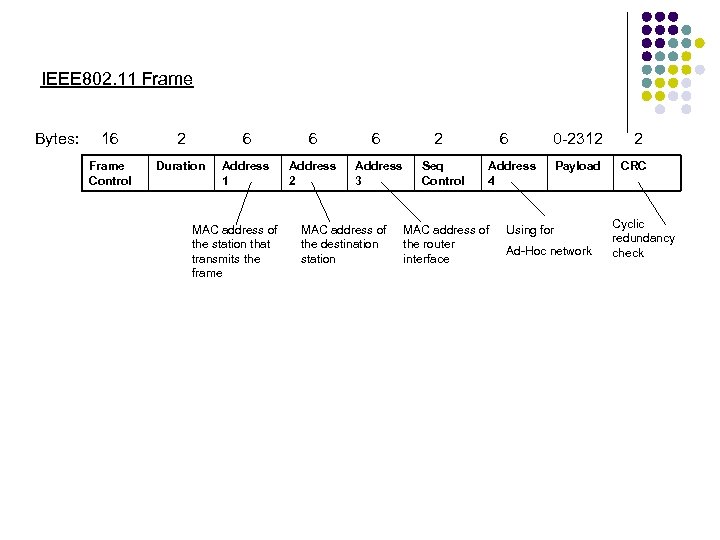 IEEE 802. 11 Frame Bytes: 16 2 6 6 6 Frame Control Duration Address 1 Address 2 Address 3 MAC address of the station that transmits the frame MAC address of the destination station 2 Seq Control 6 0 -2312 Address 4 MAC address of the router interface Payload Using for Ad-Hoc network 2 CRC Cyclic redundancy check
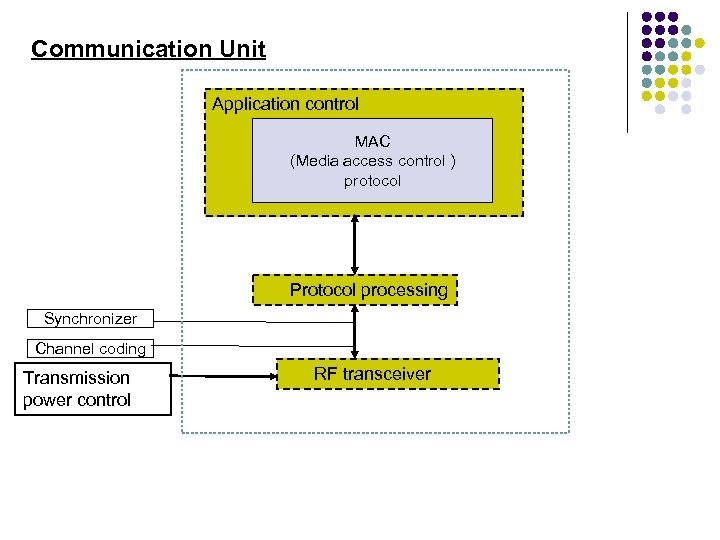 Communication Unit Application control MAC (Media access control ) protocol Protocol processing Synchronizer Channel coding Transmission power control RF transceiver
 Communication Unit (Based on 802. 11 b) • Radio transceiver • Synchronizer (Global clock) • No collision detection • Each node has a distinguish ID. • TDM access/Random access.
 Software Sensor Nodes • node ID • node mode: sleeping, waking, charging • communication range • channel mode • power level • frame type: data, management, control • memory size • local clock • physical location? • global clock? • Qo. S