


 Скачать презентацию Introduction Machine Learning Instructor Polichshuk Yekaterina Logistics
introduction_to_ml.ppt
- Количество слайдов: 20
 Introduction Machine Learning Instructor: Polichshuk Yekaterina
 Logistics • Instructor: Polichshuk Yekaterina – Email: polichshuk. y. v@gmail. com – Office: 262 TA: Aidos Askhatuly Email: aidos. askhatuly@gmail. com
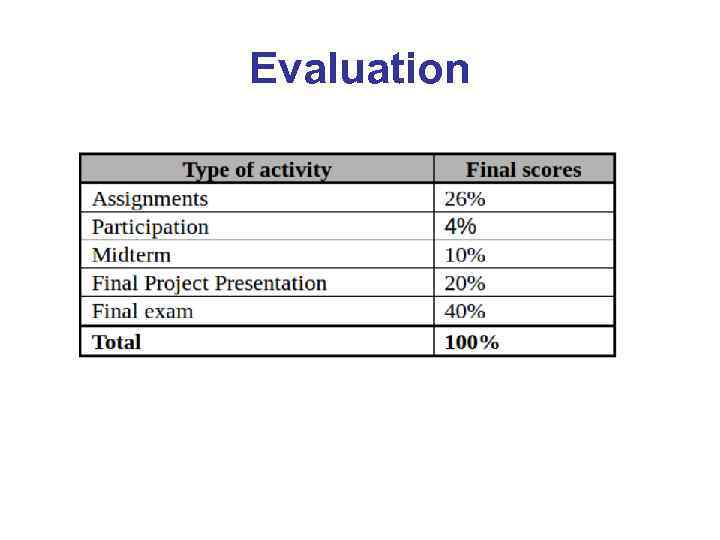 Evaluation
 Source Materials P. Harrington, Machine learning in Action(Recommended) • T. Mitchell, Machine Learning, Mc. Graw-Hill • Online courses: udacity. com - Introduction to machine learning https: //www. udacity. com/course/viewer#!/cud 120/l-2254358555/e-3012748573/m 3035918544
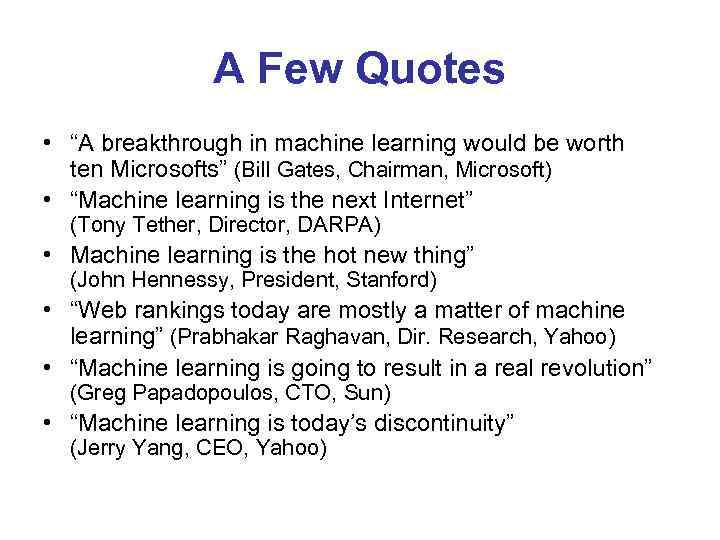 A Few Quotes • “A breakthrough in machine learning would be worth ten Microsofts” (Bill Gates, Chairman, Microsoft) • “Machine learning is the next Internet” (Tony Tether, Director, DARPA) • Machine learning is the hot new thing” (John Hennessy, President, Stanford) • “Web rankings today are mostly a matter of machine learning” (Prabhakar Raghavan, Dir. Research, Yahoo) • “Machine learning is going to result in a real revolution” (Greg Papadopoulos, CTO, Sun) • “Machine learning is today’s discontinuity” (Jerry Yang, CEO, Yahoo)
 So What Is Machine Learning? • • Automating automation Getting computers to program themselves Writing software is the bottleneck Let the data do the work instead!
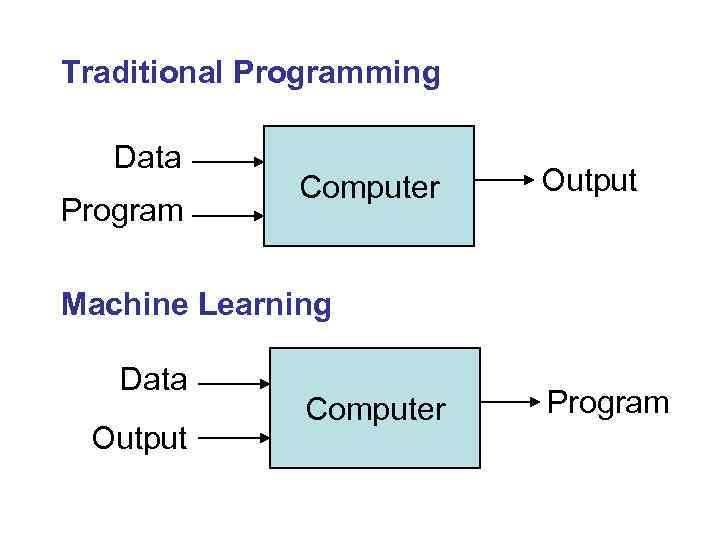 Traditional Programming Data Program Computer Output Machine Learning Data Output Computer Program
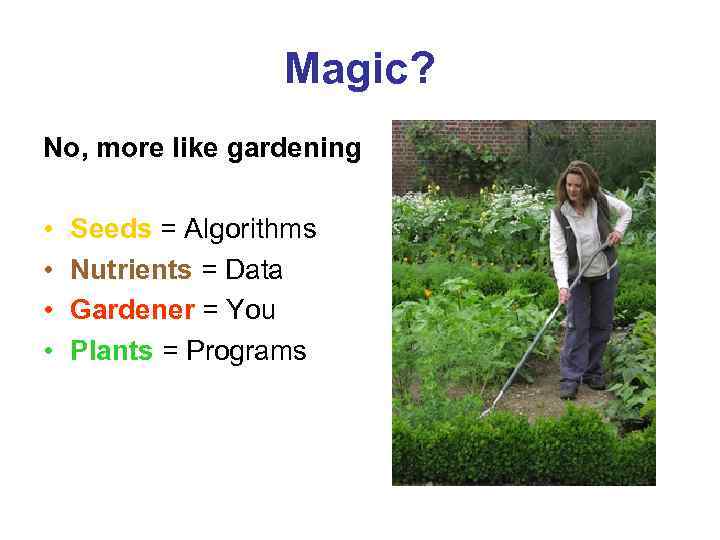 Magic? No, more like gardening • • Seeds = Algorithms Nutrients = Data Gardener = You Plants = Programs
 Sample Applications • • • Web search Computational biology Finance E-commerce Space exploration Robotics Information extraction Social networks Debugging [Your favorite area]
 ML in a Nutshell • Tens of thousands of machine learning algorithms • Hundreds new every year • Every machine learning algorithm has three components: – Representation – Evaluation – Optimization
 Representation • • Decision trees Sets of rules / Logic programs Instances Graphical models (Bayes/Markov nets) Neural networks Support vector machines Model ensembles Etc.
 Evaluation • • • Accuracy Precision and recall Squared error Likelihood Posterior probability Cost / Utility Margin Entropy K-L divergence Etc.
 Optimization • Combinatorial optimization – E. g. : Greedy search • Convex optimization – E. g. : Gradient descent • Constrained optimization – E. g. : Linear programming
 Types of Learning • Supervised (inductive) learning – Training data includes desired outputs • Unsupervised learning – Training data does not include desired outputs • Semi-supervised learning – Training data includes a few desired outputs • Reinforcement learning – Rewards from sequence of actions
 Inductive Learning • Given examples of a function (X, F(X)) • Predict function F(X) for new examples X – Discrete F(X): Classification – Continuous F(X): Regression – F(X) = Probability(X): Probability estimation
 What We’ll Cover • Supervised learning – – – – Decision tree induction Rule induction Instance-based learning Bayesian learning Neural networks Support vector machines Model ensembles Learning theory • Unsupervised learning – Clustering – Dimensionality reduction
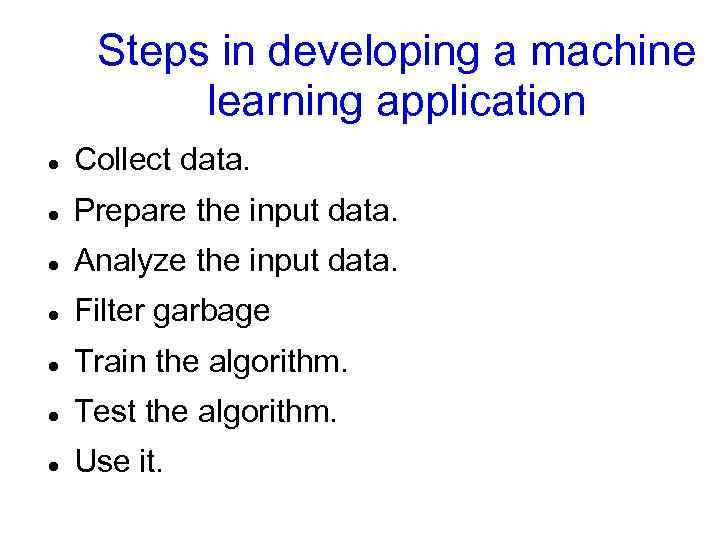 Steps in developing a machine learning application Collect data. Prepare the input data. Analyze the input data. Filter garbage Train the algorithm. Test the algorithm. Use it.
 Programming languages Why Python? Python is a great language for machine learning for a large number of reasons. Python has clear syntax. it makes text manipulation extremely easy. A large number of people and organizations use Python, so there’s ample development and documentation.
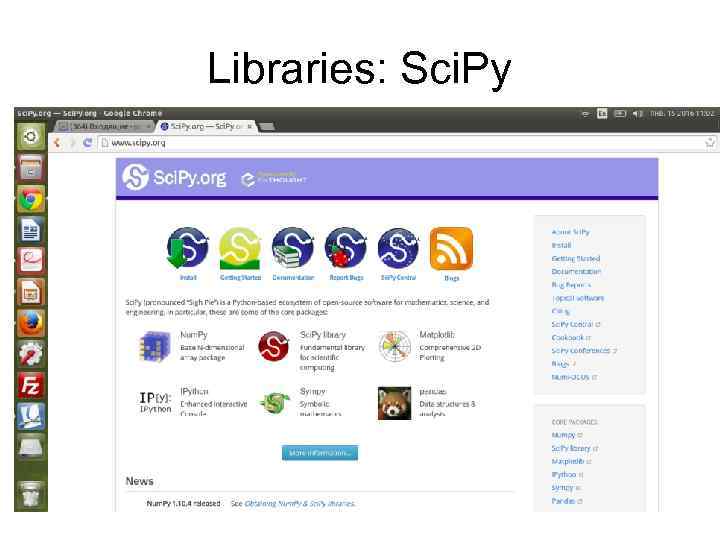 Libraries: Sci. Py
 Homework • Read 1 st chapter in “Machine learning in Action” • Find any interesting material connect to ML