


 Скачать презентацию Introduction l Star itself l Ejecta Great Eruption
042e4e46d07780eef96309d81ee057c5.ppt
- Количество слайдов: 45
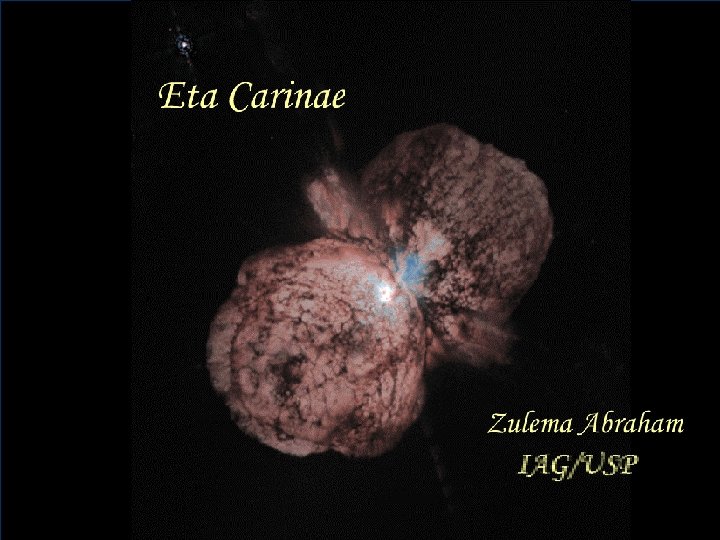
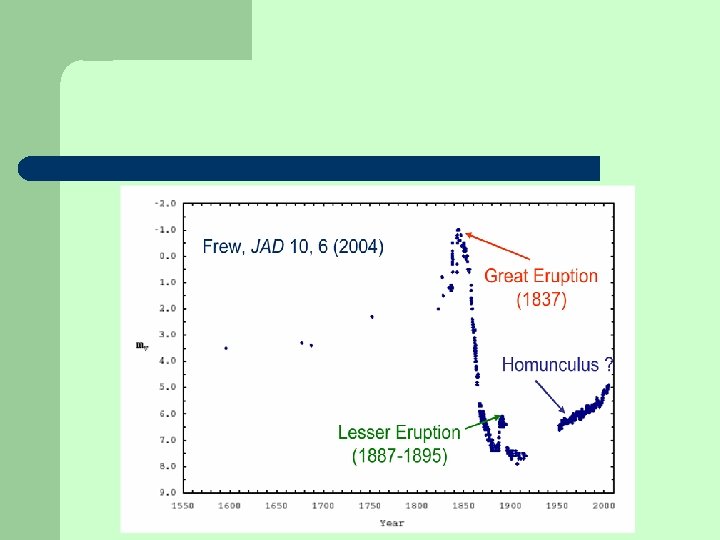
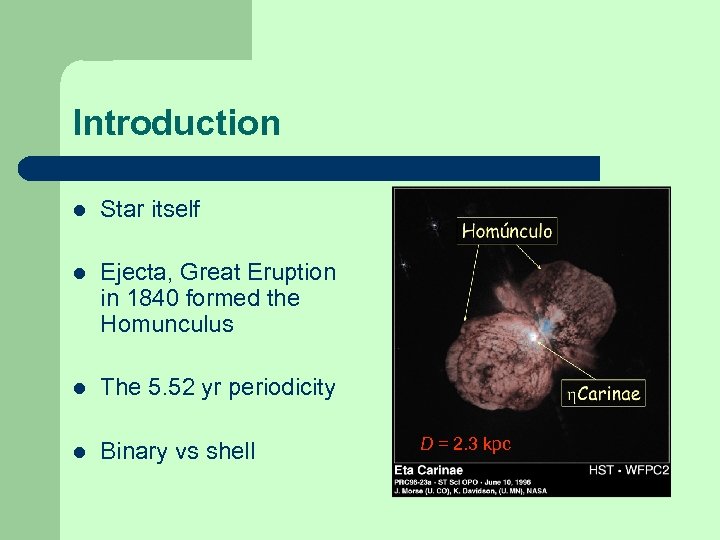 Introduction l Star itself l Ejecta, Great Eruption in 1840 formed the Homunculus l The 5. 52 yr periodicity l Binary vs shell D = 2. 3 kpc
 The Star
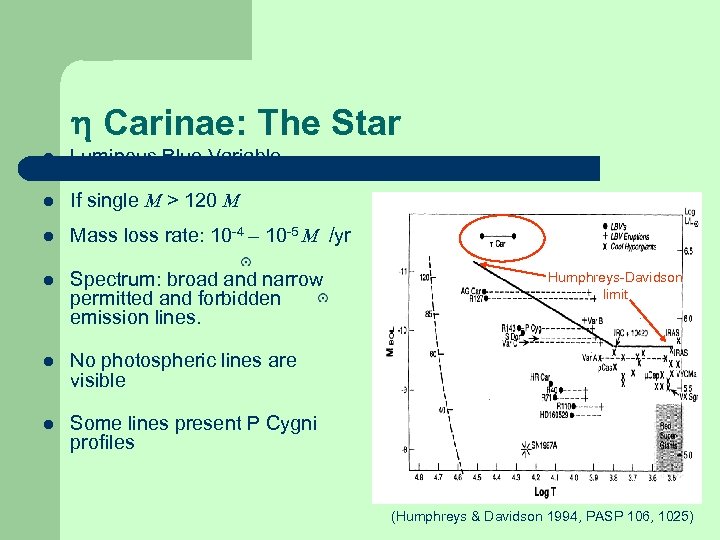 Carinae: The Star l Luminous Blue Variable l If single M > 120 M l Mass loss rate: 10 -4 – 10 -5 M /yr l Spectrum: broad and narrow permitted and forbidden emission lines. l No photospheric lines are visible l Some lines present P Cygni profiles Humphreys-Davidson limit (Humphreys & Davidson 1994, PASP 106, 1025)
 The ejecta
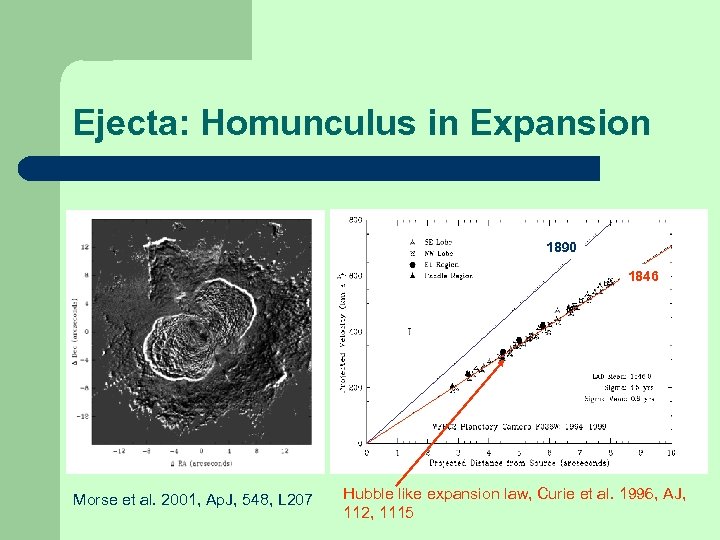 Ejecta: Homunculus in Expansion 1890 1846 Morse et al. 2001, Ap. J, 548, L 207 Hubble like expansion law, Curie et al. 1996, AJ, 112, 1115
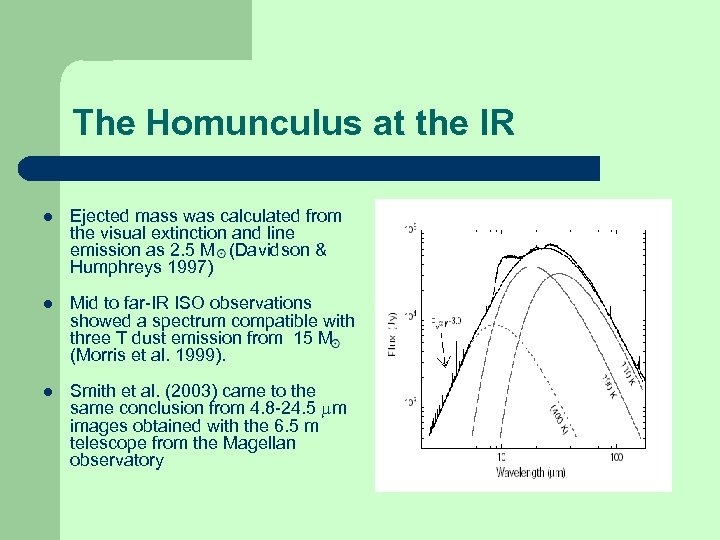 The Homunculus at the IR l Ejected mass was calculated from the visual extinction and line emission as 2. 5 M (Davidson & Humphreys 1997) l Mid to far-IR ISO observations showed a spectrum compatible with three T dust emission from 15 M (Morris et al. 1999). l Smith et al. (2003) came to the same conclusion from 4. 8 -24. 5 m images obtained with the 6. 5 m telescope from the Magellan observatory
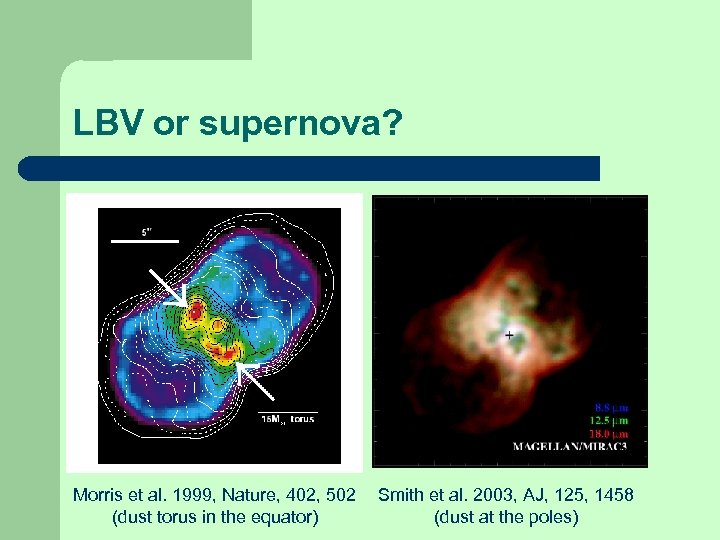 LBV or supernova? Morris et al. 1999, Nature, 402, 502 (dust torus in the equator) Smith et al. 2003, AJ, 125, 1458 (dust at the poles)
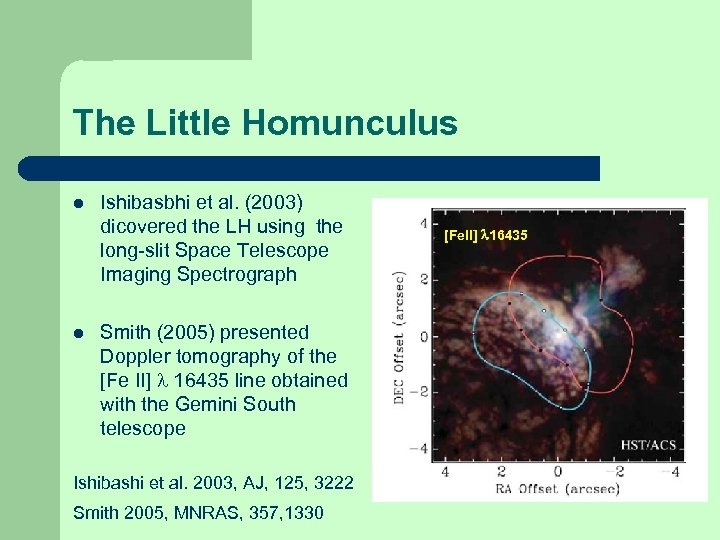 The Little Homunculus l l Ishibasbhi et al. (2003) dicovered the LH using the long-slit Space Telescope Imaging Spectrograph Smith (2005) presented Doppler tomography of the [Fe II] 16435 line obtained with the Gemini South telescope Ishibashi et al. 2003, AJ, 125, 3222 Smith 2005, MNRAS, 357, 1330 [Fe. II] 16435
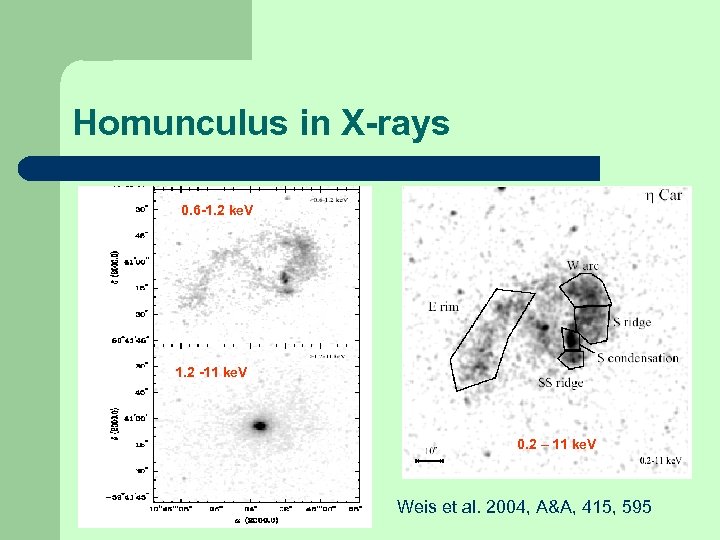 Homunculus in X-rays 0. 6 -1. 2 ke. V 1. 2 -11 ke. V 0. 2 – 11 ke. V Weis et al. 2004, A&A, 415, 595
 The 5. 52 yr periodicity
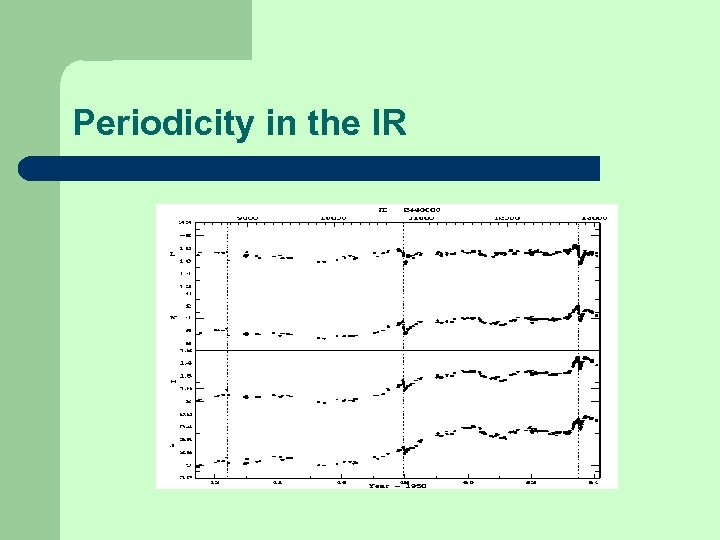
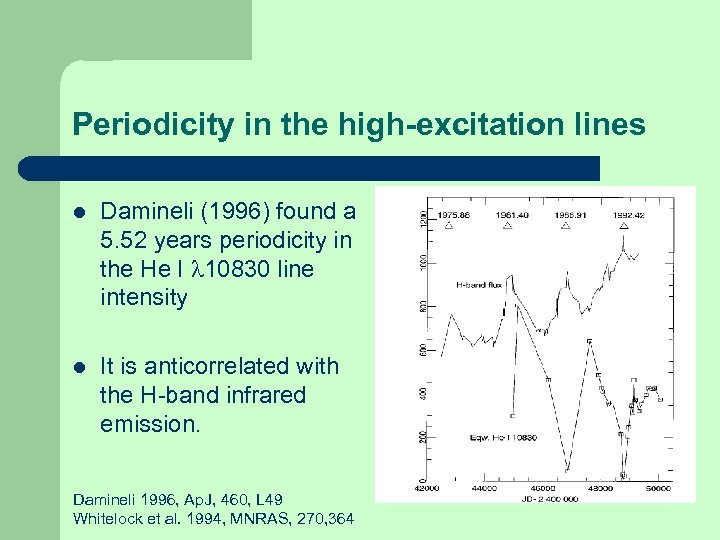 Periodicity in the high-excitation lines l Damineli (1996) found a 5. 52 years periodicity in the He I 10830 line intensity l It is anticorrelated with the H-band infrared emission. Damineli 1996, Ap. J, 460, L 49 Whitelock et al. 1994, MNRAS, 270, 364
 Periodicity in the IR
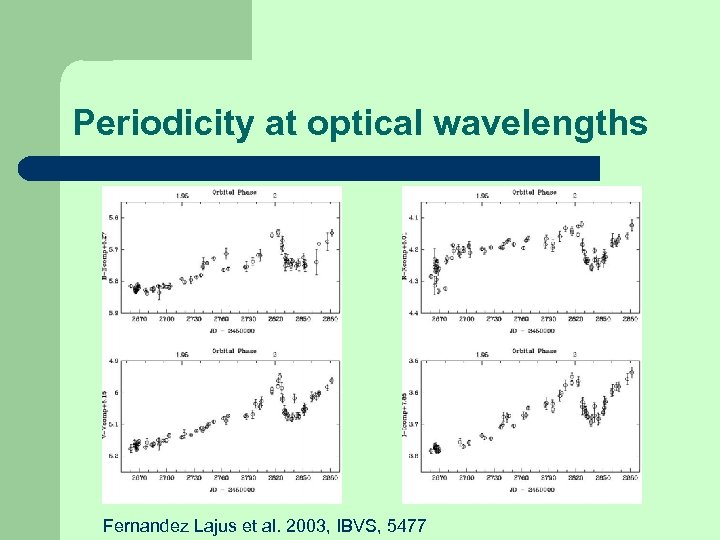 Periodicity at optical wavelengths Fernandez Lajus et al. 2003, IBVS, 5477
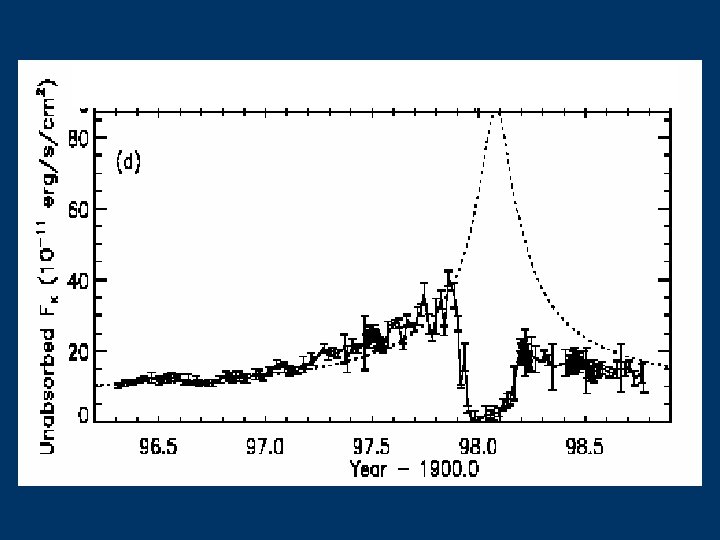
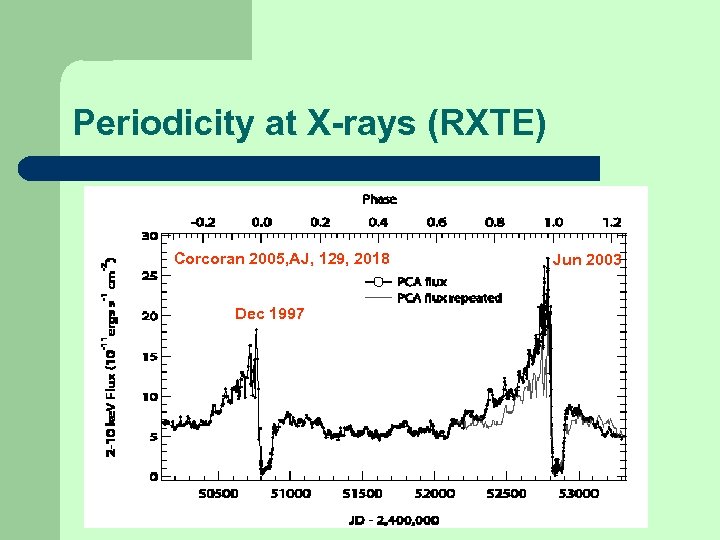 Periodicity at X-rays (RXTE) Corcoran 2005, AJ, 129, 2018 Dec 1997 Jun 2003
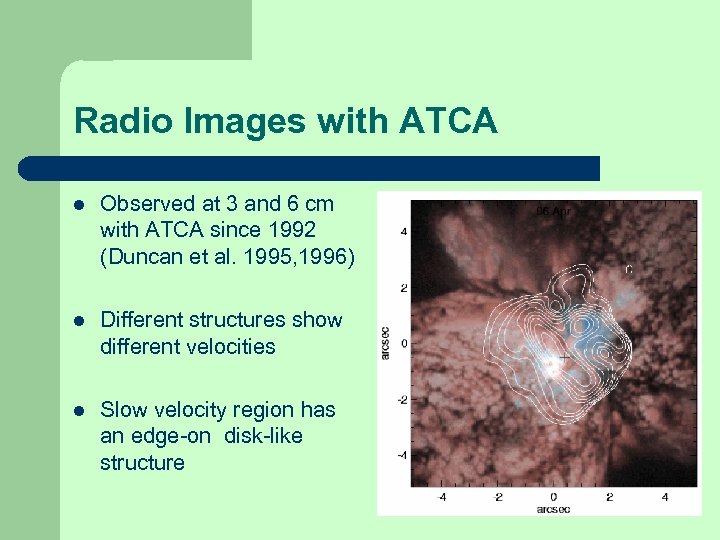 Radio Images with ATCA l Observed at 3 and 6 cm with ATCA since 1992 (Duncan et al. 1995, 1996) l Different structures show different velocities l Slow velocity region has an edge-on disk-like structure
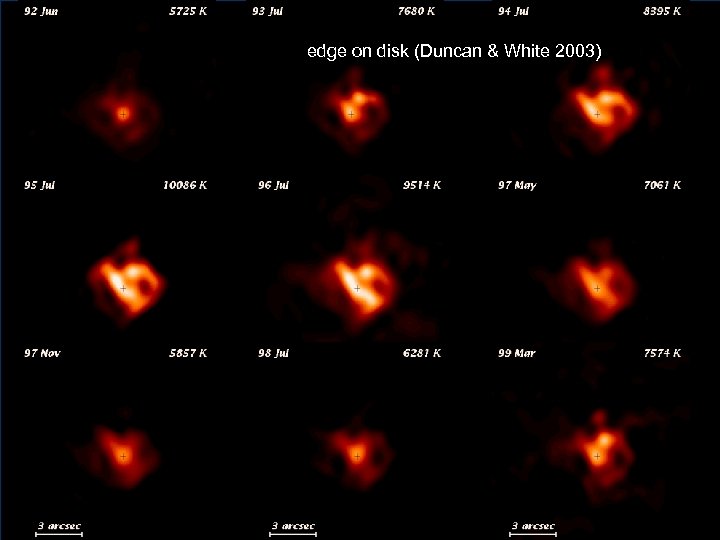 edge on disk (Duncan & White 2003)
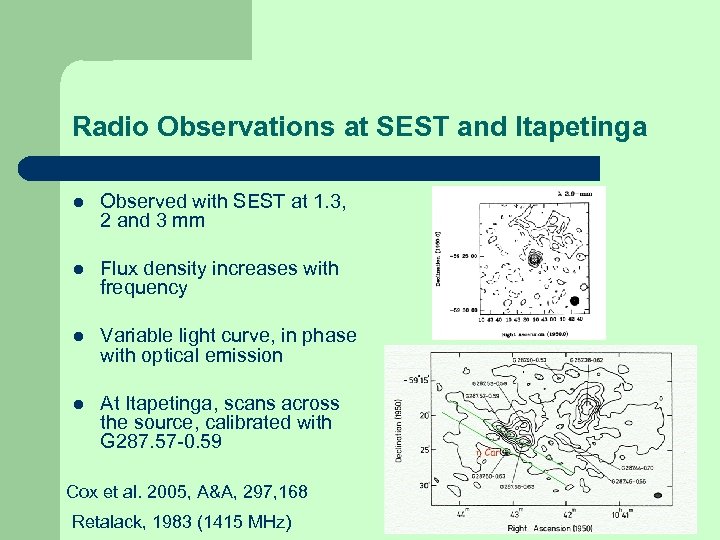 Radio Observations at SEST and Itapetinga l Observed with SEST at 1. 3, 2 and 3 mm l Flux density increases with frequency l Variable light curve, in phase with optical emission l At Itapetinga, scans across the source, calibrated with G 287. 57 -0. 59 Cox et al. 2005, A&A, 297, 168 Retalack, 1983 (1415 MHz)
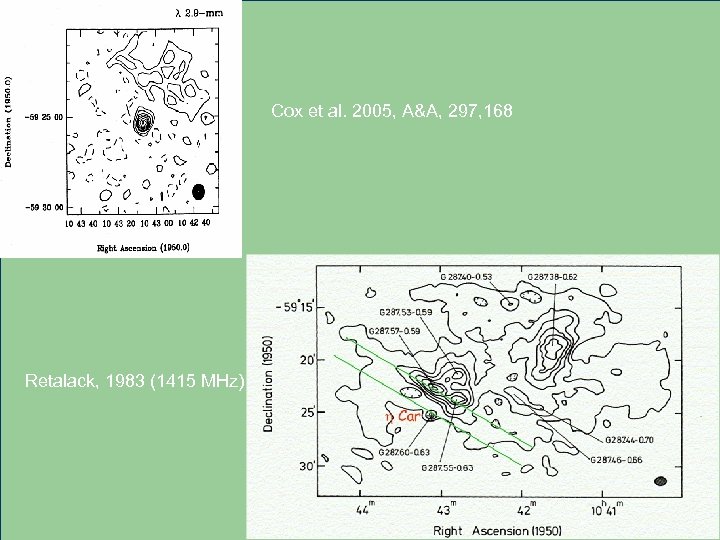 Cox et al. 2005, A&A, 297, 168 Retalack, 1983 (1415 MHz)
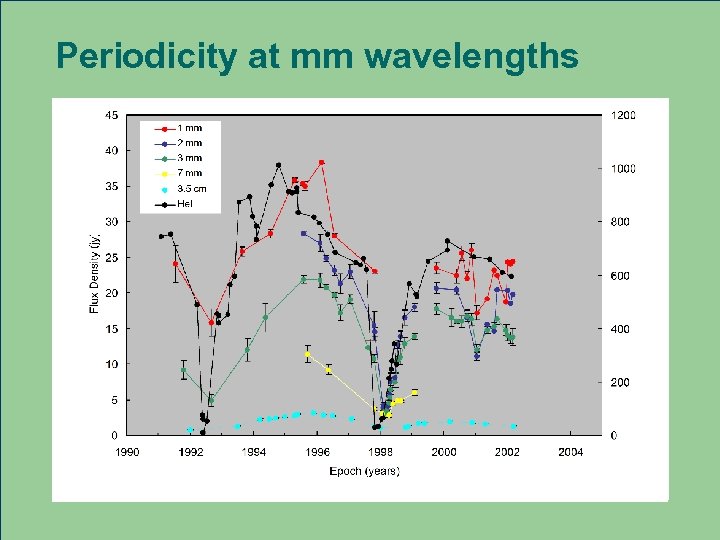 Periodicity at mm wavelengths
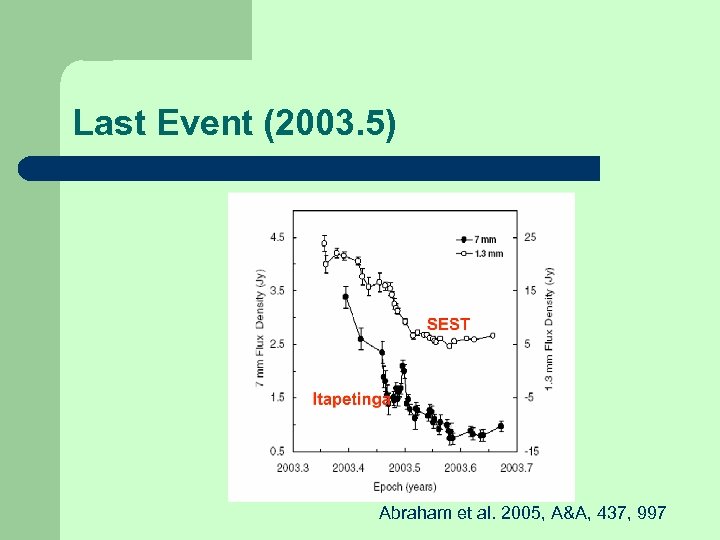 Last Event (2003. 5) Abraham et al. 2005, A&A, 437, 997
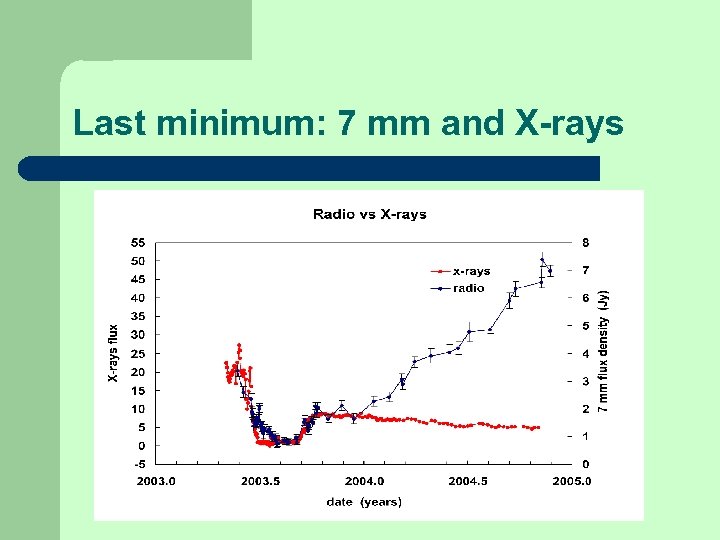 Last minimum: 7 mm and X-rays
 What do the coincidence tell us? l 7 mm flux density is due to the free-free emission from an optically thick disk (density about 107 cm-3) l Sharp minimum is produced by a decrease in the number of available ionizing photons (recombination time of the order of hours) l Decrease in the number of photons is due to absorption of UV radiation by dust l The same material that absorbs the UV absorbs X-rays
 Binary vs shell
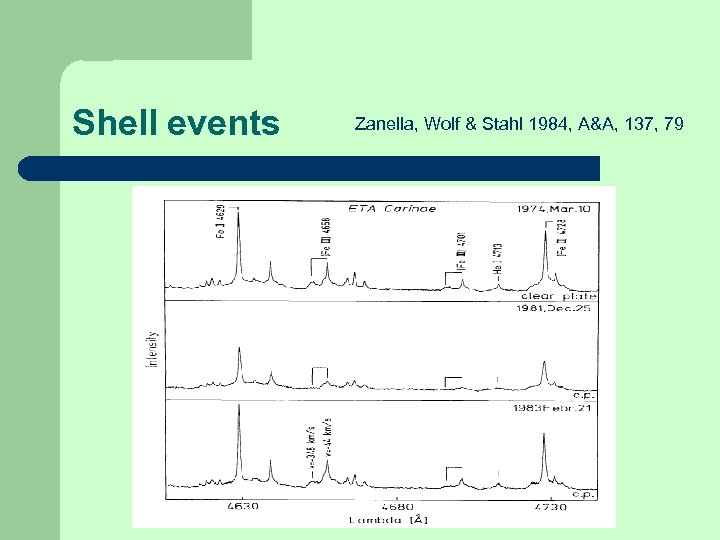 Shell events Zanella, Wolf & Stahl 1984, A&A, 137, 79
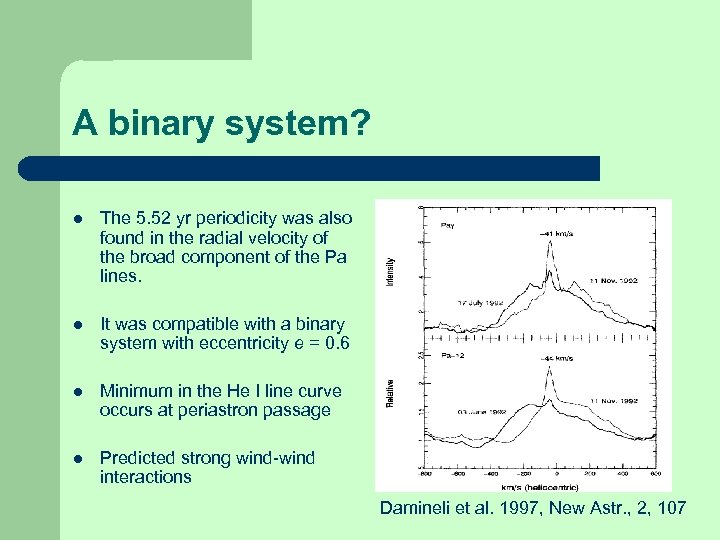 A binary system? l The 5. 52 yr periodicity was also found in the radial velocity of the broad component of the Pa lines. l It was compatible with a binary system with eccentricity e = 0. 6 l Minimum in the He I line curve occurs at periastron passage l Predicted strong wind-wind interactions Damineli et al. 1997, New Astr. , 2, 107
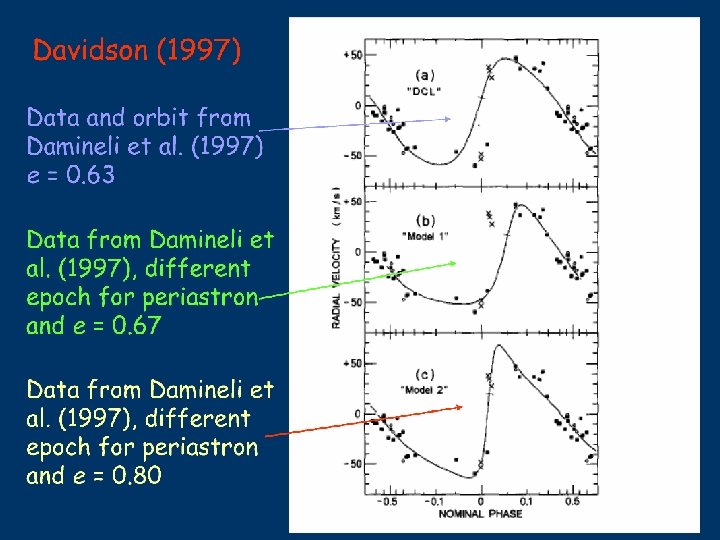
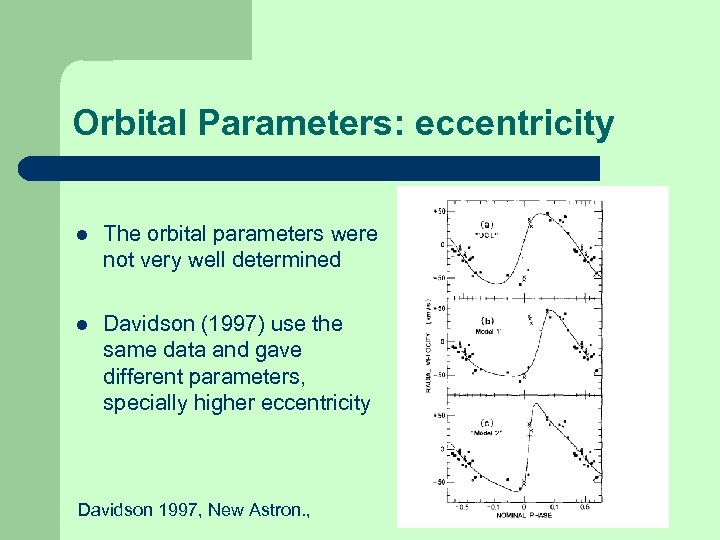 Orbital Parameters: eccentricity l The orbital parameters were not very well determined l Davidson (1997) use the same data and gave different parameters, specially higher eccentricity Davidson 1997, New Astron. ,
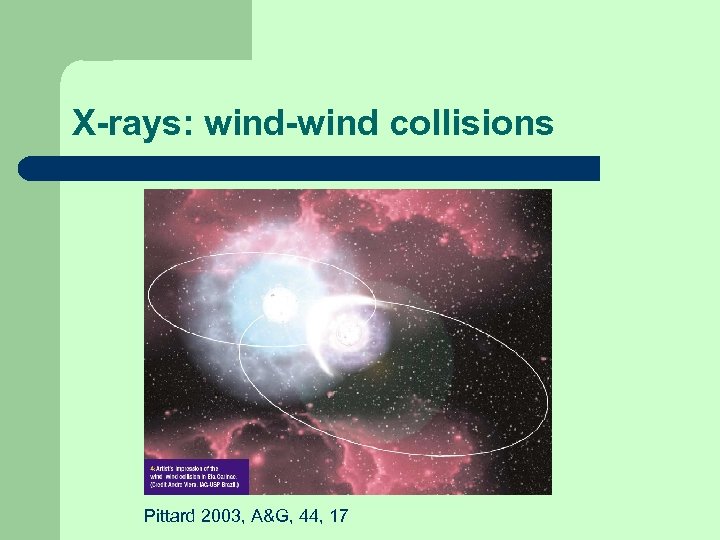 X-rays: wind-wind collisions Pittard 2003, A&G, 44, 17
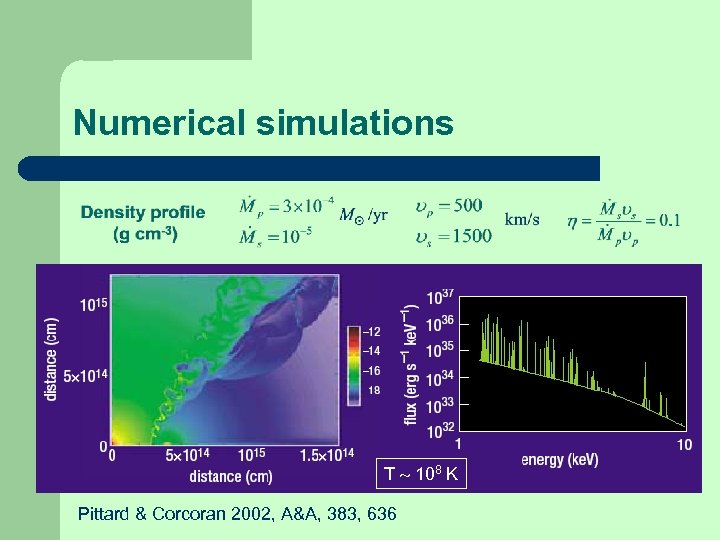 Numerical simulations T 108 K Pittard & Corcoran 2002, A&A, 383, 636
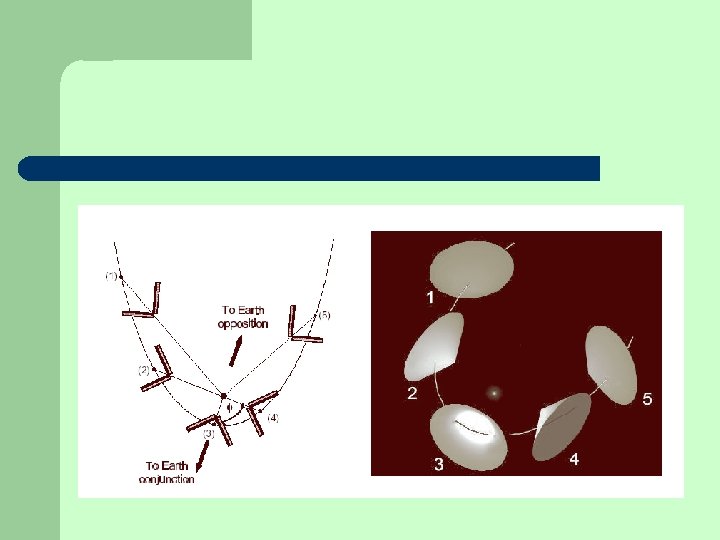
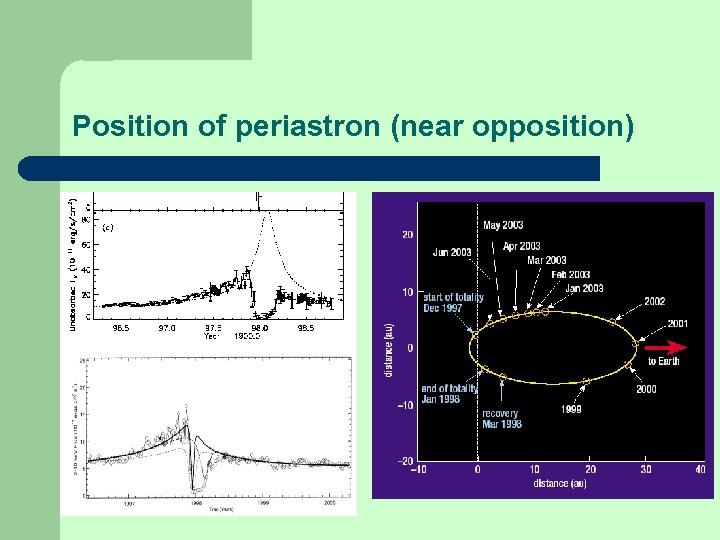 Position of periastron (near opposition)
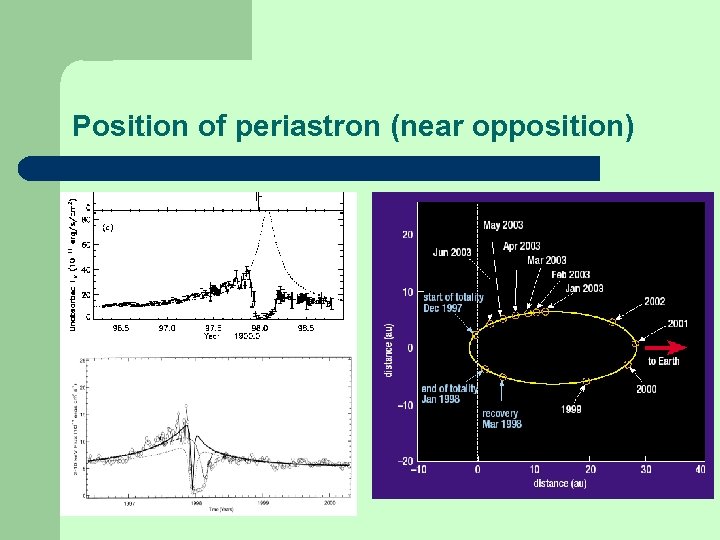 Position of periastron (near opposition)
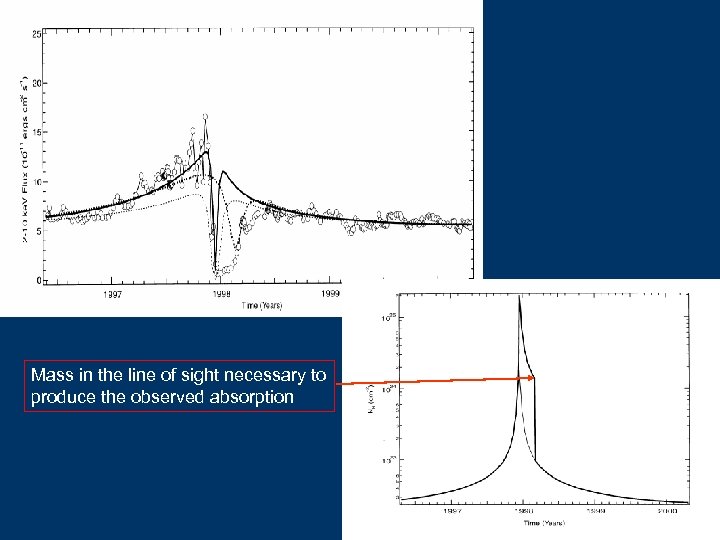 Mass in the line of sight necessary to produce the observed absorption
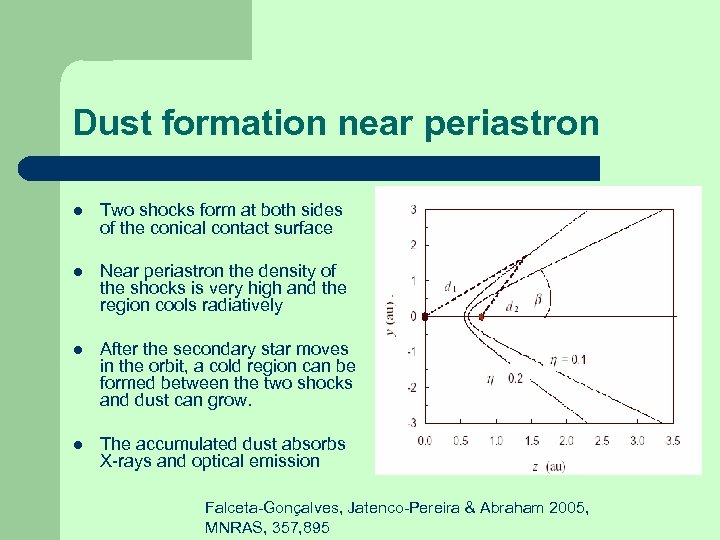 Dust formation near periastron l Two shocks form at both sides of the conical contact surface l Near periastron the density of the shocks is very high and the region cools radiatively l After the secondary star moves in the orbit, a cold region can be formed between the two shocks and dust can grow. l The accumulated dust absorbs X-rays and optical emission Falceta-Gonçalves, Jatenco-Pereira & Abraham 2005, MNRAS, 357, 895
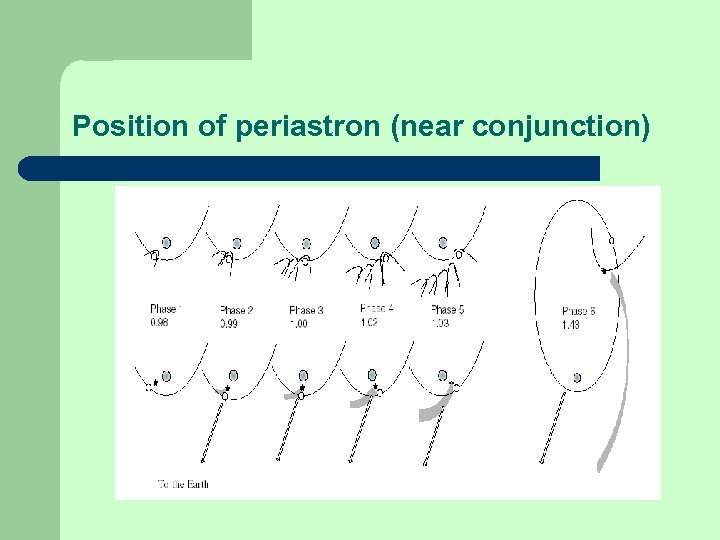 Position of periastron (near conjunction)
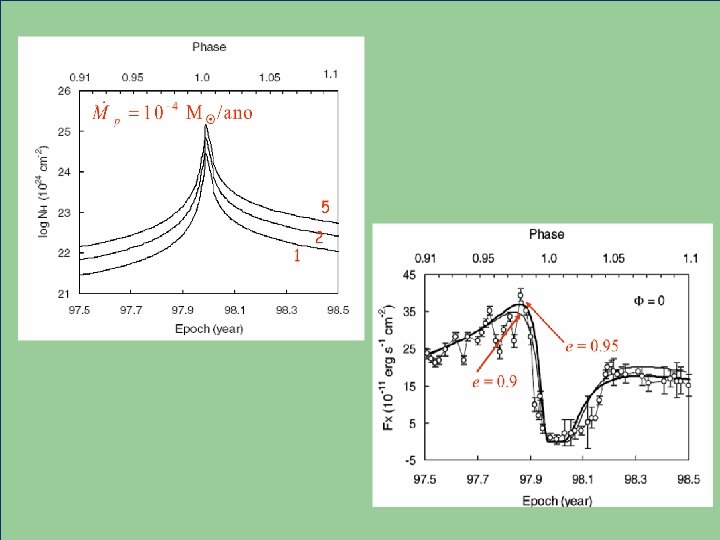
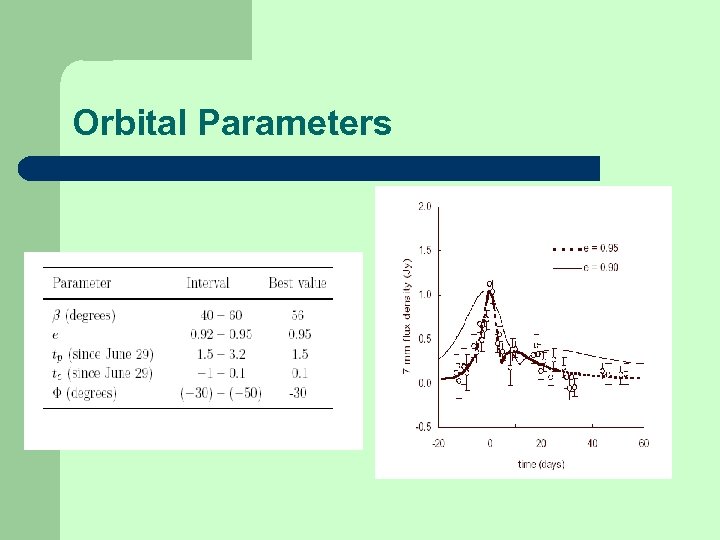
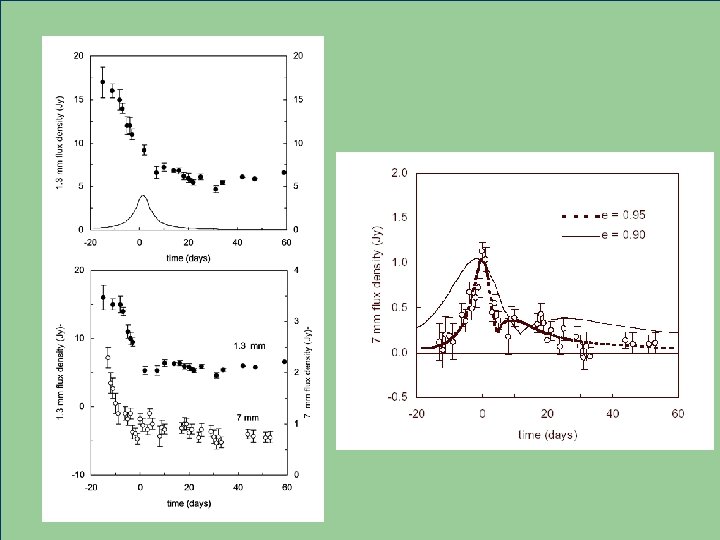
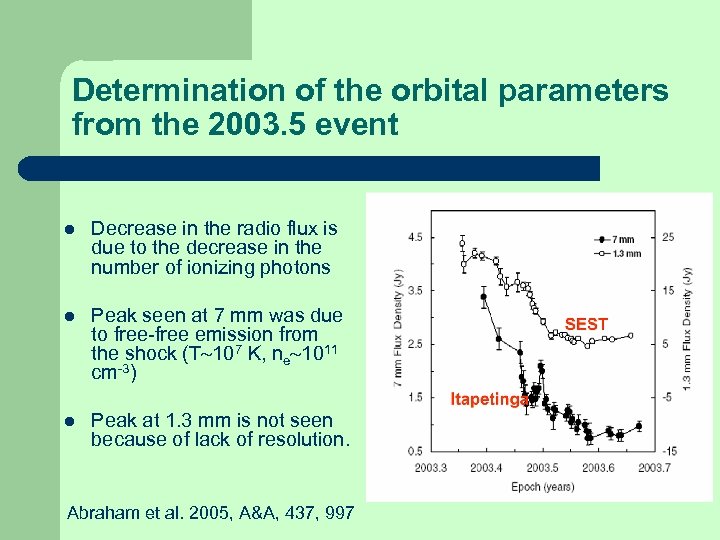 Determination of the orbital parameters from the 2003. 5 event l Decrease in the radio flux is due to the decrease in the number of ionizing photons l Peak seen at 7 mm was due to free-free emission from the shock (T 107 K, ne 1011 cm-3) l Peak at 1. 3 mm is not seen because of lack of resolution. Abraham et al. 2005, A&A, 437, 997
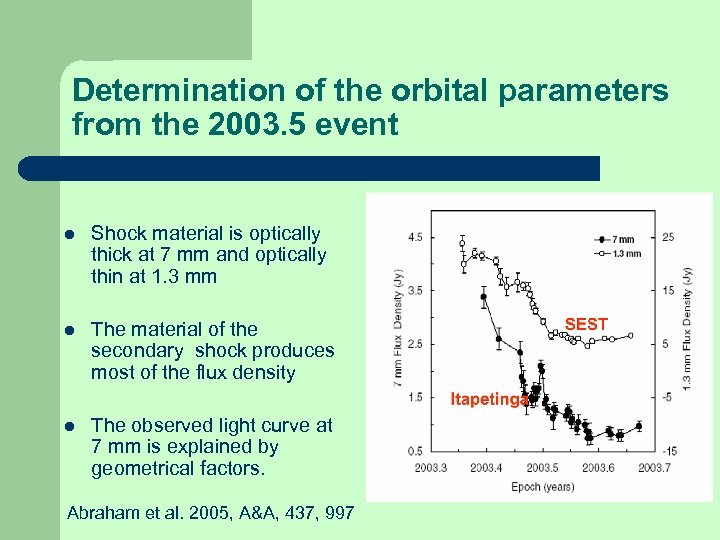 Determination of the orbital parameters from the 2003. 5 event l Shock material is optically thick at 7 mm and optically thin at 1. 3 mm l The material of the secondary shock produces most of the flux density l The observed light curve at 7 mm is explained by geometrical factors. Abraham et al. 2005, A&A, 437, 997
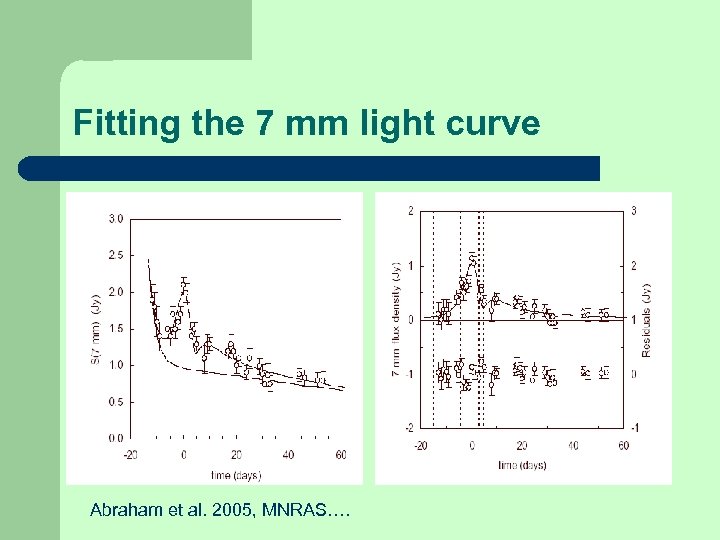 Fitting the 7 mm light curve Abraham et al. 2005, MNRAS….
 Orbital Parameters
 Conclusions (personal) l Star: LBV or supernova? Still unknown l Binary system or shell event: both l Orbital parameters: only determined from radio at periastron passage: they imply that periastron is close to conjunction.