 Скачать презентацию Introduction into Urban Air Quality in Asia Status
1a8fa10596bce263dd02720aa9a44d0a.ppt
- Количество слайдов: 40



Introduction into Urban Air Quality in Asia: Status, Impact and its Management Cornie Huizenga, May Ajero and Herbert Fabian Head of Secretariat Clean Air Initiative for Asian Cities June 2005 Brussels 1
Part 1 Clean Air Initiative for Asian Cities (CAI-Asia) 2
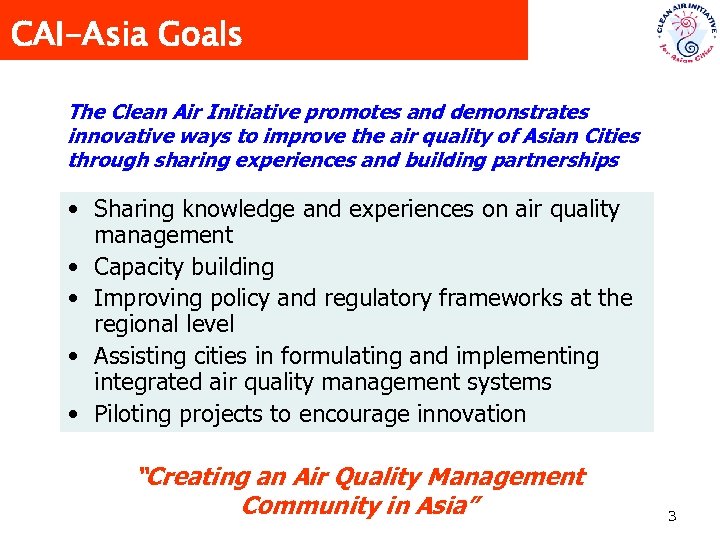
CAI-Asia Goals The Clean Air Initiative promotes and demonstrates innovative ways to improve the air quality of Asian Cities through sharing experiences and building partnerships • Sharing knowledge and experiences on air quality management • Capacity building • Improving policy and regulatory frameworks at the regional level • Assisting cities in formulating and implementing integrated air quality management systems • Piloting projects to encourage innovation “Creating an Air Quality Management Community in Asia” 3
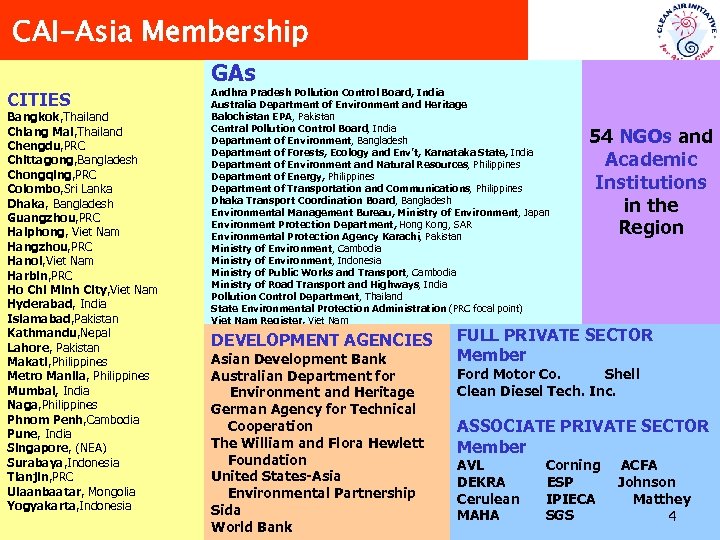
CAI-Asia Membership GAs CITIES Bangkok, Thailand Chiang Mai, Thailand Chengdu, PRC Chittagong, Bangladesh Chongqing, PRC Colombo, Sri Lanka Dhaka, Bangladesh Guangzhou, PRC Haiphong, Viet Nam Hangzhou, PRC Hanoi, Viet Nam Harbin, PRC Ho Chi Minh City, Viet Nam Hyderabad, India Islamabad, Pakistan Kathmandu, Nepal Lahore, Pakistan Makati, Philippines Metro Manila, Philippines Mumbai, India Naga, Philippines Phnom Penh, Cambodia Pune, India Singapore, (NEA) Surabaya, Indonesia Tianjin, PRC Ulaanbaatar, Mongolia Yogyakarta, Indonesia Andhra Pradesh Pollution Control Board, India Australia Department of Environment and Heritage Balochistan EPA, Pakistan Central Pollution Control Board, India Department of Environment, Bangladesh Department of Forests, Ecology and Env’t, Karnataka State, India Department of Environment and Natural Resources, Philippines Department of Energy, Philippines Department of Transportation and Communications, Philippines Dhaka Transport Coordination Board, Bangladesh Environmental Management Bureau, Ministry of Environment, Japan Environment Protection Department, Hong Kong, SAR Environmental Protection Agency Karachi, Pakistan Ministry of Environment, Cambodia Ministry of Environment, Indonesia Ministry of Public Works and Transport, Cambodia Ministry of Road Transport and Highways, India Pollution Control Department, Thailand State Environmental Protection Administration (PRC focal point) Viet Nam Register, Viet Nam DEVELOPMENT AGENCIES Asian Development Bank Australian Department for Environment and Heritage German Agency for Technical Cooperation The William and Flora Hewlett Foundation United States-Asia Environmental Partnership Sida World Bank 54 NGOs and Academic Institutions in the Region FULL PRIVATE SECTOR Member Ford Motor Co. Shell Clean Diesel Tech. Inc. ASSOCIATE PRIVATE SECTOR Member AVL DEKRA Cerulean MAHA Corning ESP IPIECA SGS ACFA Johnson Matthey 4
Part 2 Review of Status of AQM in Asia 5
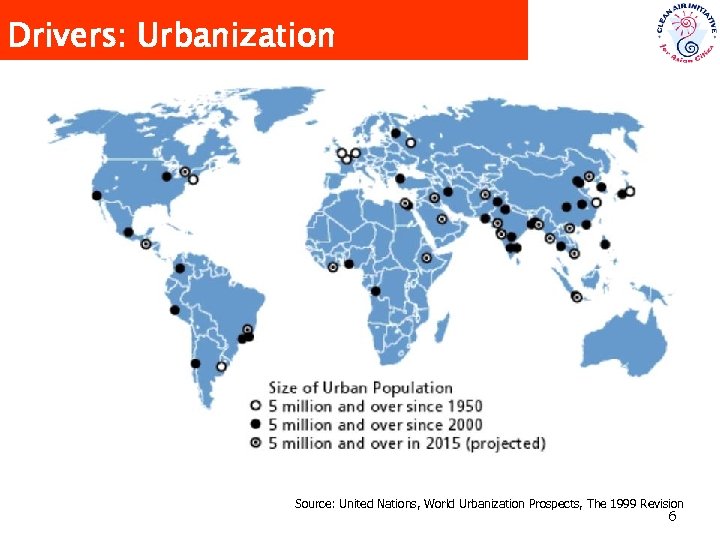
Drivers: Urbanization Source: United Nations, World Urbanization Prospects, The 1999 Revision 6
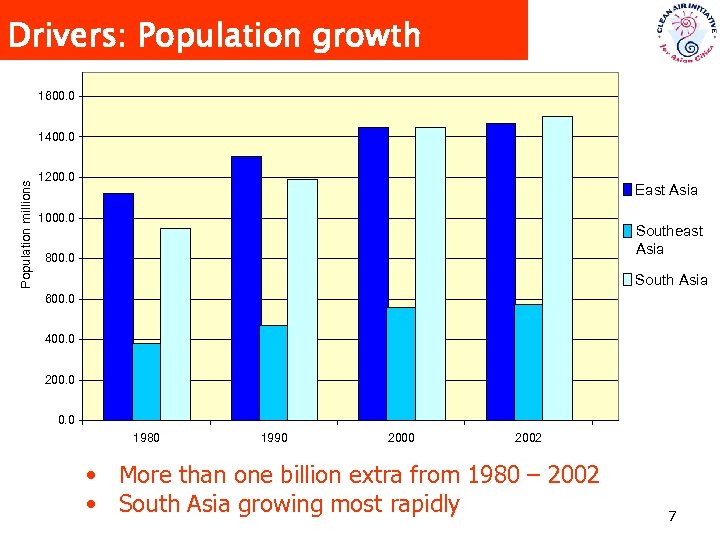
Drivers: Population growth 1600. 0 Population millions 1400. 0 1200. 0 East Asia 1000. 0 Southeast Asia 800. 0 South Asia 600. 0 400. 0 200. 0 1980 1990 2002 • More than one billion extra from 1980 – 2002 • South Asia growing most rapidly 7
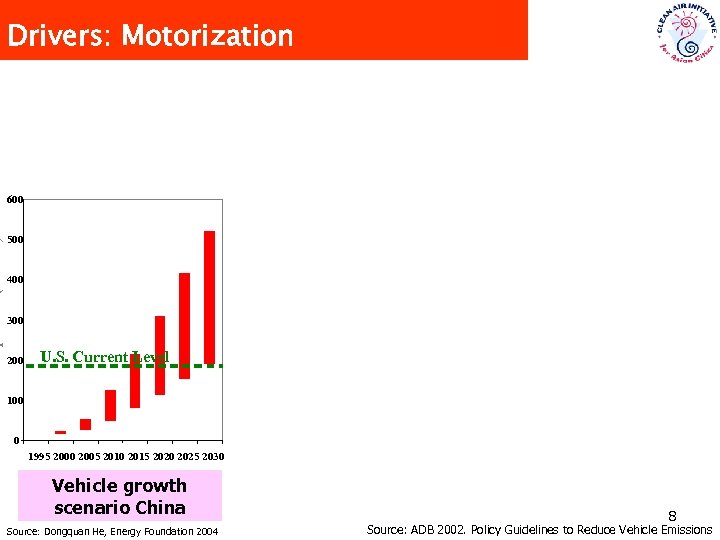
Vehicle Population (millions) Drivers: Motorization 600 500 400 300 200 U. S. Current Level 100 0 1995 2000 2005 2010 2015 2020 2025 2030 Vehicle growth scenario China Source: Dongquan He, Energy Foundation 2004 8 Source: ADB 2002. Policy Guidelines to Reduce Vehicle Emissions
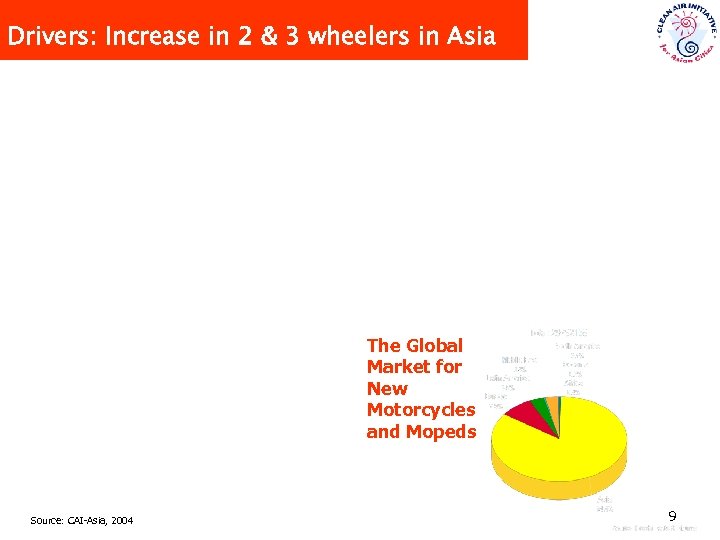
Drivers: Increase in 2 & 3 wheelers in Asia The Global Market for New Motorcycles and Mopeds Source: CAI-Asia, 2004 9
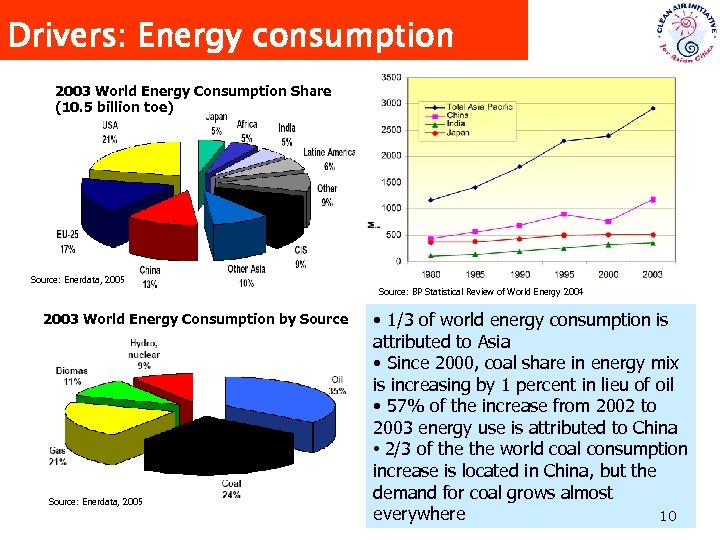
Drivers: Energy consumption 2003 World Energy Consumption Share (10. 5 billion toe) Source: Enerdata, 2005 Source: BP Statistical Review of World Energy 2004 2003 World Energy Consumption by Source: Enerdata, 2005 • 1/3 of world energy consumption is attributed to Asia • Since 2000, coal share in energy mix is increasing by 1 percent in lieu of oil • 57% of the increase from 2002 to 2003 energy use is attributed to China • 2/3 of the world coal consumption increase is located in China, but the demand for coal grows almost everywhere 10
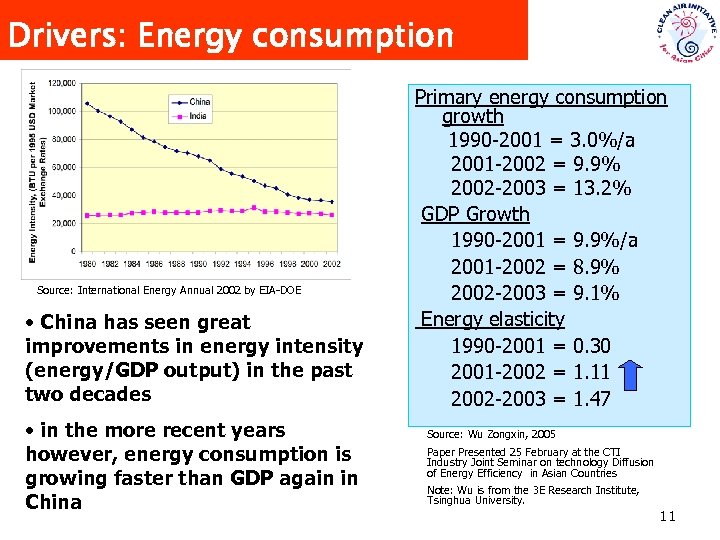
Drivers: Energy consumption Source: International Energy Annual 2002 by EIA-DOE • China has seen great improvements in energy intensity (energy/GDP output) in the past two decades • in the more recent years however, energy consumption is growing faster than GDP again in China Primary energy consumption growth 1990 -2001 = 3. 0%/a 2001 -2002 = 9. 9% 2002 -2003 = 13. 2% GDP Growth 1990 -2001 = 9. 9%/a 2001 -2002 = 8. 9% 2002 -2003 = 9. 1% Energy elasticity 1990 -2001 = 0. 30 2001 -2002 = 1. 11 2002 -2003 = 1. 47 Source: Wu Zongxin, 2005 Paper Presented 25 February at the CTI Industry Joint Seminar on technology Diffusion of Energy Efficiency in Asian Countries Note: Wu is from the 3 E Research Institute, Tsinghua University. 11
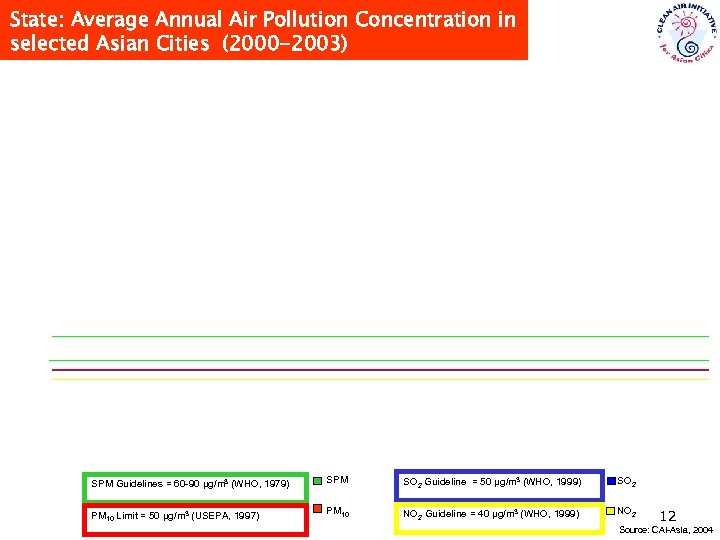
State: Average Annual Air Pollution Concentration in selected Asian Cities (2000 -2003) SPM Guidelines = 60 -90 µg/m 3 (WHO, 1979) SPM SO 2 Guideline = 50 µg/m 3 (WHO, 1999) SO 2 PM 10 Limit = 50 µg/m 3 (USEPA, 1997) PM 10 NO 2 Guideline = 40 µg/m 3 (WHO, 1999) NO 2 12 Source: CAI-Asia, 2004
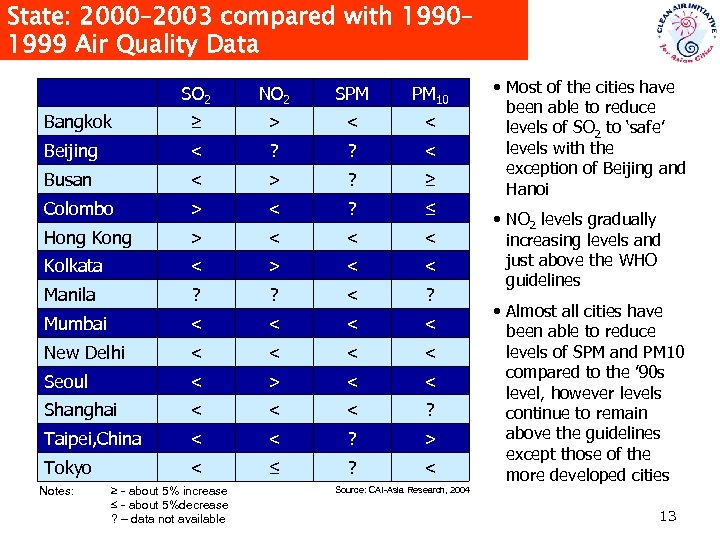
State: 2000– 2003 compared with 1990– 1999 Air Quality Data SO 2 NO 2 SPM PM 10 Bangkok ≥ > < < Beijing < ? ? < Busan < > ? ≥ Colombo > < ? ≤ Hong Kong > < < < Kolkata < > < < Manila ? ? < ? Mumbai < < New Delhi < < Seoul < > < < Shanghai < < < ? Taipei, China < < ? > Tokyo < ≤ ? < Notes: ≥ - about 5% increase ≤ - about 5%decrease ? – data not available • Most of the cities have been able to reduce levels of SO 2 to ‘safe’ levels with the exception of Beijing and Hanoi • NO 2 levels gradually increasing levels and just above the WHO guidelines • Almost all cities have been able to reduce levels of SPM and PM 10 compared to the ’ 90 s level, however levels continue to remain above the guidelines except those of the more developed cities Source: CAI-Asia Research, 2004 13
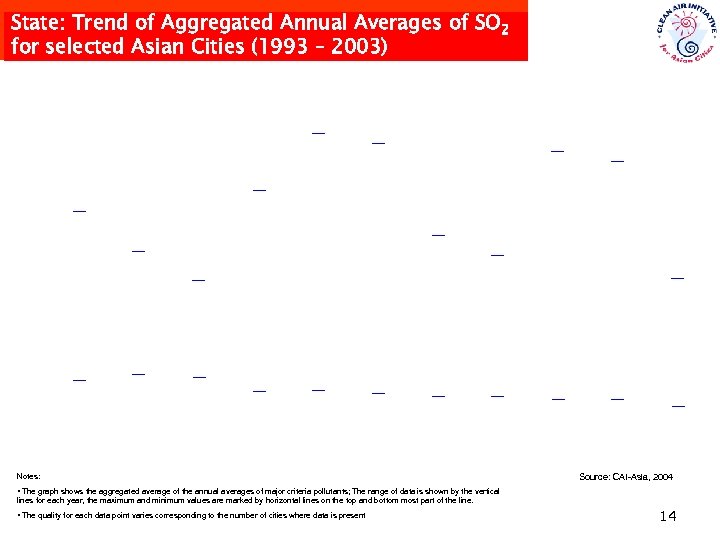
State: Trend of Aggregated Annual Averages of SO 2 for selected Asian Cities (1993 – 2003) Notes: Source: CAI-Asia, 2004 • The graph shows the aggregated average of the annual averages of major criteria pollutants; The range of data is shown by the vertical lines for each year, the maximum and minimum values are marked by horizontal lines on the top and bottom most part of the line. • The quality for each data point varies corresponding to the number of cities where data is present 14
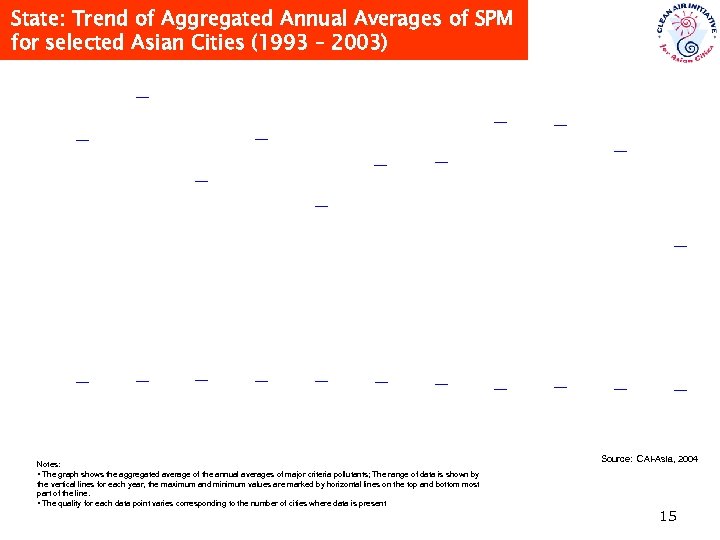
State: Trend of Aggregated Annual Averages of SPM for selected Asian Cities (1993 – 2003) Notes: • The graph shows the aggregated average of the annual averages of major criteria pollutants; The range of data is shown by the vertical lines for each year, the maximum and minimum values are marked by horizontal lines on the top and bottom most part of the line. • The quality for each data point varies corresponding to the number of cities where data is present Source: CAI-Asia, 2004 15
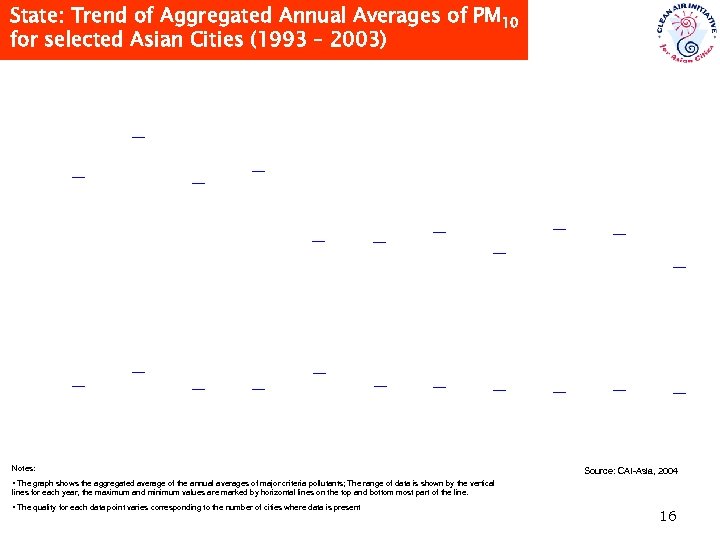
State: Trend of Aggregated Annual Averages of PM 10 for selected Asian Cities (1993 – 2003) Notes: Source: CAI-Asia, 2004 • The graph shows the aggregated average of the annual averages of major criteria pollutants; The range of data is shown by the vertical lines for each year, the maximum and minimum values are marked by horizontal lines on the top and bottom most part of the line. • The quality for each data point varies corresponding to the number of cities where data is present 16
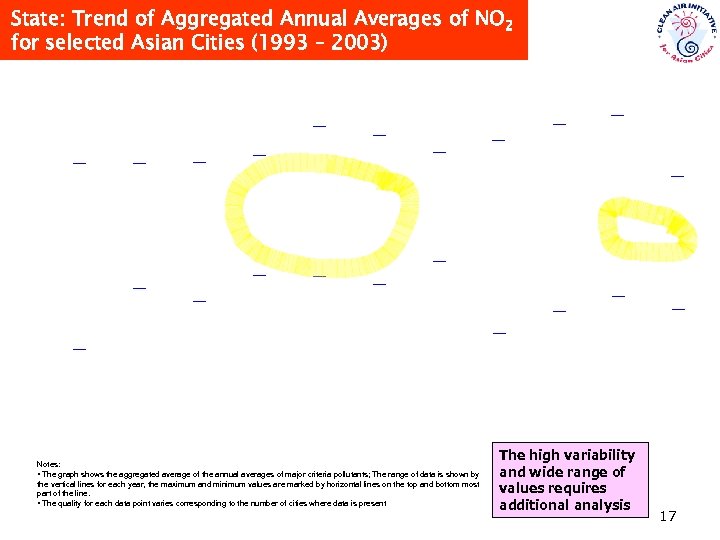
State: Trend of Aggregated Annual Averages of NO 2 for selected Asian Cities (1993 – 2003) Notes: • The graph shows the aggregated average of the annual averages of major criteria pollutants; The range of data is shown by the vertical lines for each year, the maximum and minimum values are marked by horizontal lines on the top and bottom most part of the line. • The quality for each data point varies corresponding to the number of cities where data is present The high variability and wide range of values requires additional analysis 17
State: Ambient versus Roadside Bangkok Air Quality Trends (1993 – 2003) Note: SPM ambient annual standards = 100 µg/m 3 PM 10 ambient annual standards = 50 µg/m 3 18
State: Ambient versus Roadside Hong Kong Air Quality (PM 10) Trends (1993 – 2003) Note: PM 10 ambient annual standards = 55 µg/m 3 19
State: Ambient versus Roadside Ho Chi Minh City Air Quality (PM 10) Trends (2000 – 2003) Note: No standards for PM 10 20
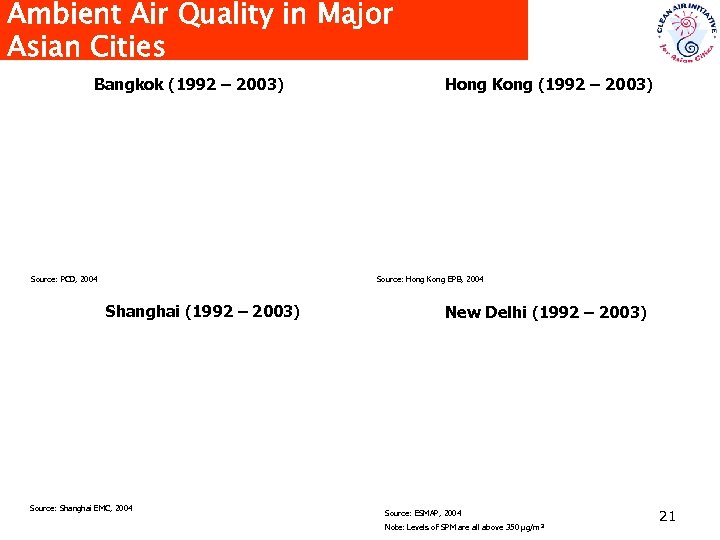
Ambient Air Quality in Major Asian Cities Bangkok (1992 – 2003) Source: PCD, 2004 Hong Kong (1992 – 2003) Source: Hong Kong EPB, 2004 Shanghai (1992 – 2003) Source: Shanghai EMC, 2004 New Delhi (1992 – 2003) Source: ESMAP, 2004 Note: Levels of SPM are all above 350 µg/m 3 21
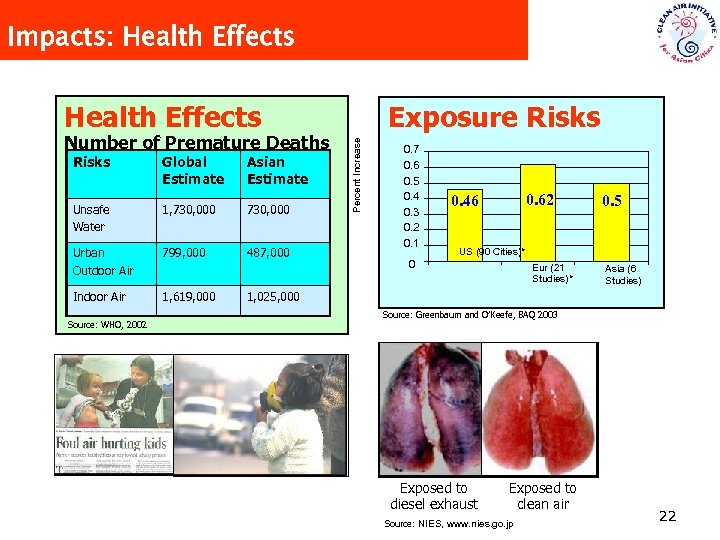
Impacts: Health Effects Exposure Risks Number of Premature Deaths Risks Global Estimate Asian Estimate Unsafe Water 1, 730, 000 Urban Outdoor Air 799, 000 487, 000 Indoor Air 1, 619, 000 Source: WHO, 2002 Percent Increase Health Effects 0. 7 0. 6 0. 5 0. 4 0. 3 0. 2 0. 1 0 0. 62 0. 46 0. 5 US (90 Cities)* Eur (21 Studies)* Asia (6 Studies) 1, 025, 000 Source: Greenbaum and O’Keefe, BAQ 2003 Exposed to diesel exhaust Exposed to clean air Source: NIES, www. nies. go. jp 22
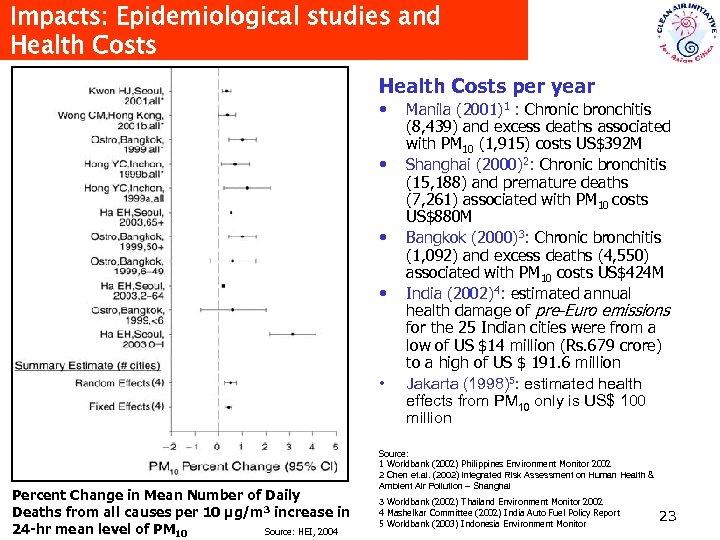
Impacts: Epidemiological studies and Health Costs per year • • • Percent Change in Mean Number of Daily Deaths from all causes per 10 µg/m 3 increase in 24 -hr mean level of PM 10 Source: HEI, 2004 Manila (2001)1 : Chronic bronchitis (8, 439) and excess deaths associated with PM 10 (1, 915) costs US$392 M Shanghai (2000)2: Chronic bronchitis (15, 188) and premature deaths (7, 261) associated with PM 10 costs US$880 M Bangkok (2000)3: Chronic bronchitis (1, 092) and excess deaths (4, 550) associated with PM 10 costs US$424 M India (2002)4: estimated annual health damage of pre-Euro emissions for the 25 Indian cities were from a low of US $14 million (Rs. 679 crore) to a high of US $ 191. 6 million Jakarta (1998)5: estimated health effects from PM 10 only is US$ 100 million Source: 1 Worldbank (2002) Philippines Environment Monitor 2002 2 Chen et. al. (2002) Integrated Risk Assessment on Human Health & Ambient Air Pollution – Shanghai 3 Worldbank (2002) Thailand Environment Monitor 2002 4 Mashelkar Committee (2002) India Auto Fuel Policy Report 5 Worldbank (2003) Indonesia Environment Monitor 23
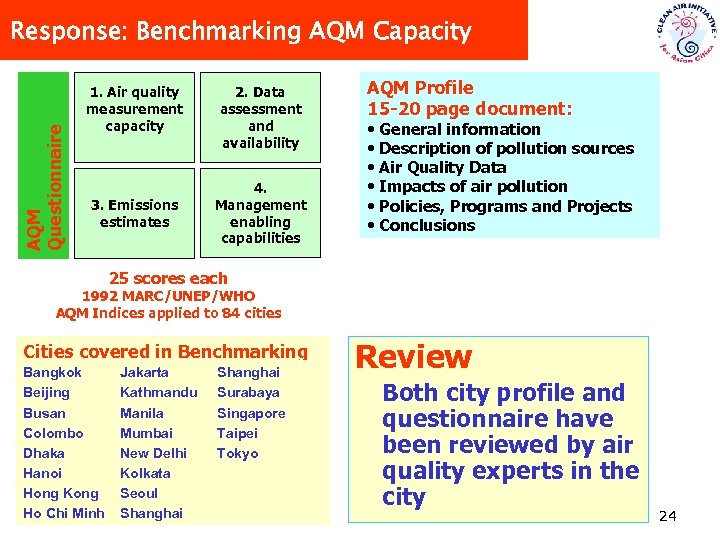
AQM Questionnaire Response: Benchmarking AQM Capacity 1. Air quality measurement capacity 3. Emissions estimates 2. Data assessment and availability 4. Management enabling capabilities AQM Profile 15 -20 page document: • General information • Description of pollution sources • Air Quality Data • Impacts of air pollution • Policies, Programs and Projects • Conclusions 25 scores each 1992 MARC/UNEP/WHO AQM Indices applied to 84 cities Cities covered in Benchmarking Bangkok Jakarta Shanghai Study Beijing Busan Colombo Dhaka Hanoi Hong Kong Ho Chi Minh Kathmandu Manila Mumbai New Delhi Kolkata Seoul Shanghai Surabaya Singapore Taipei Tokyo Review Both city profile and questionnaire have been reviewed by air quality experts in the city 24
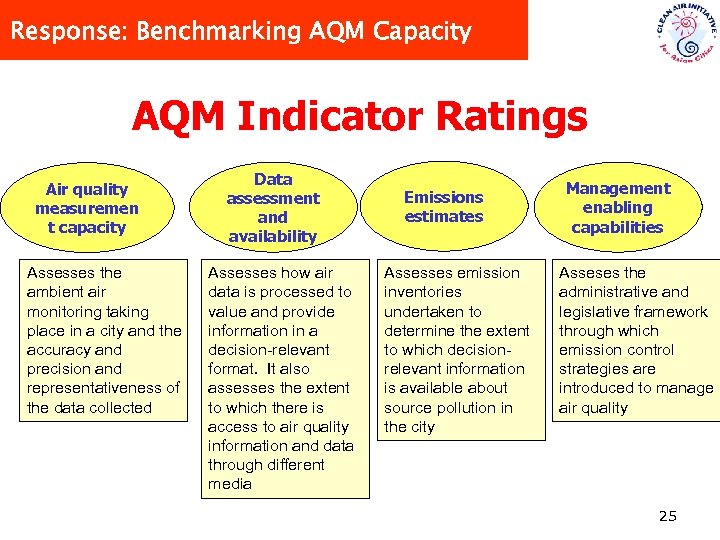
Response: Benchmarking AQM Capacity AQM Indicator Ratings Air quality measuremen t capacity Assesses the ambient air monitoring taking place in a city and the accuracy and precision and representativeness of the data collected Data assessment and availability Assesses how air data is processed to value and provide information in a decision-relevant format. It also assesses the extent to which there is access to air quality information and data through different media Emissions estimates Assesses emission inventories undertaken to determine the extent to which decisionrelevant information is available about source pollution in the city Management enabling capabilities Asseses the administrative and legislative framework through which emission control strategies are introduced to manage air quality 25
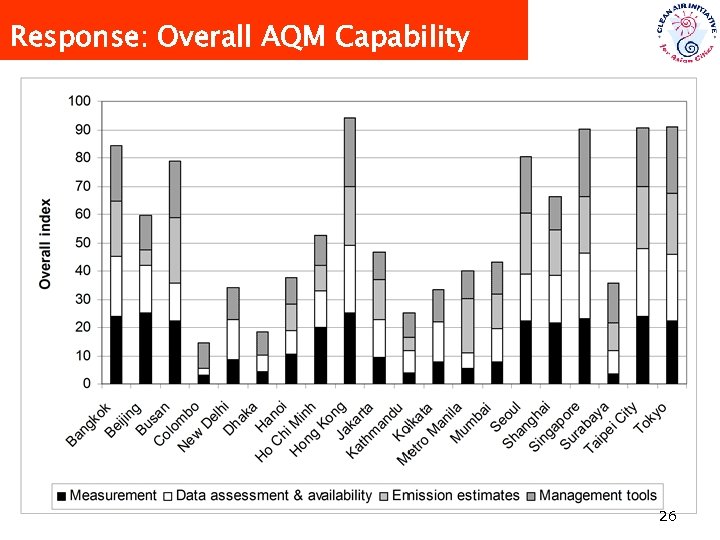
Response: Overall AQM Capability 26
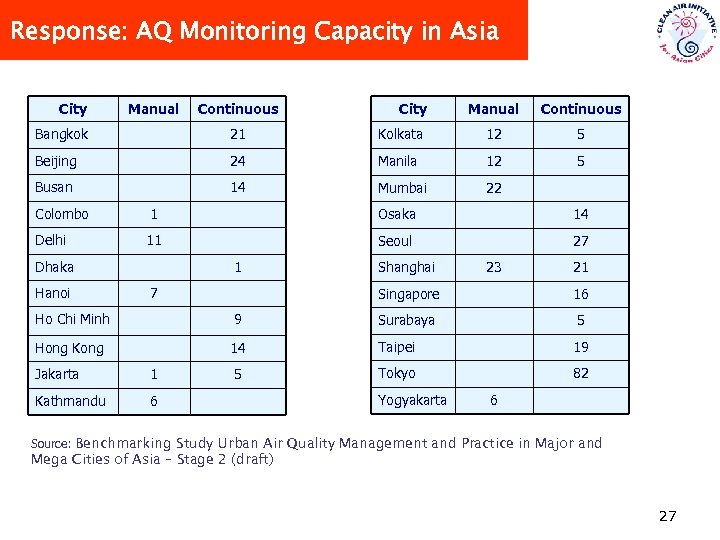
Response: AQ Monitoring Capacity in Asia City Manual Continuous Bangkok 21 Kolkata 12 5 Beijing 24 Manila 12 5 Busan 14 Mumbai 22 Colombo 1 Delhi 11 Hanoi 7 14 Status of AQ Seoul 27 1 monitoring Dhaka Osaka Shanghai in Asia Singapore 16 23 21 Ho Chi Minh 9 Surabaya 5 Hong Kong 14 Taipei 19 5 Tokyo 82 Jakarta 1 Kathmandu 6 Yogyakarta 6 Source: Benchmarking Study Urban Air Quality Management and Practice in Major and Mega Cities of Asia – Stage 2 (draft) 27
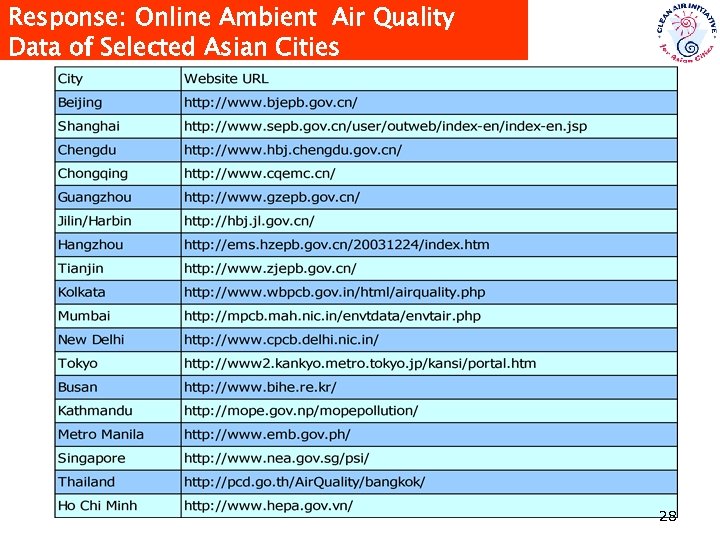
Response: Online Ambient Air Quality Data of Selected Asian Cities 28
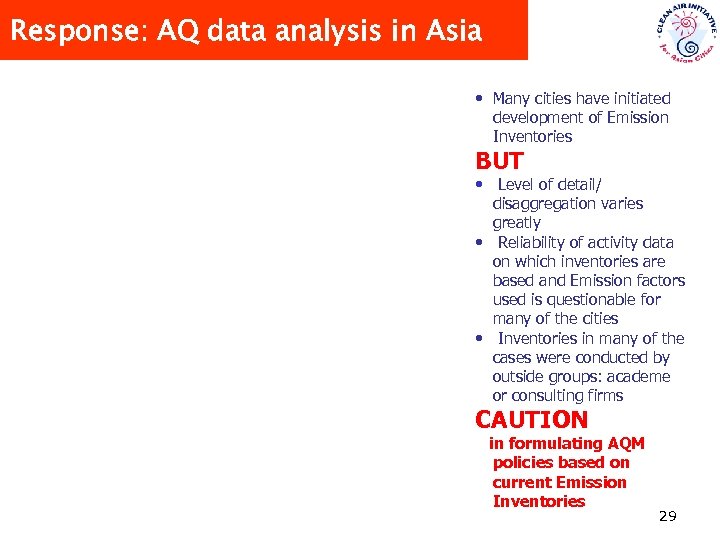
Response: AQ data analysis in Asia • Many cities have initiated development of Emission Inventories BUT • Level of detail/ disaggregation varies greatly • Reliability of activity data on which inventories are based and Emission factors used is questionable for many of the cities • Inventories in many of the cases were conducted by outside groups: academe or consulting firms CAUTION in formulating AQM policies based on current Emission Inventories 29
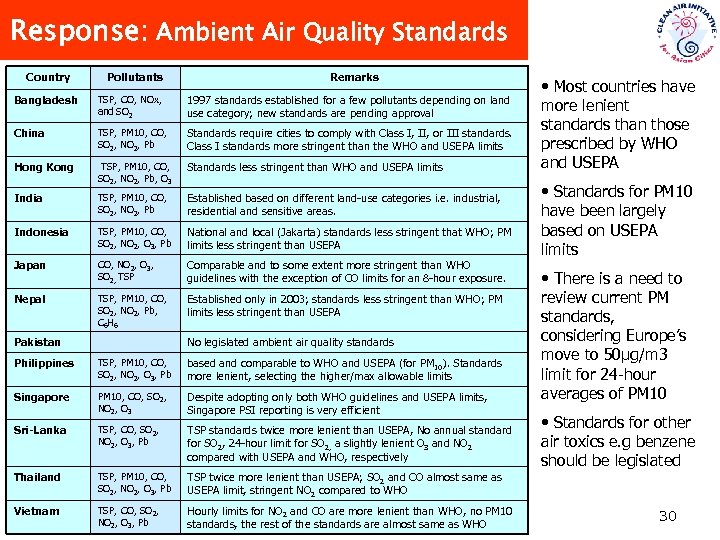
Response: Ambient Air Quality Standards Country Pollutants Remarks Bangladesh TSP, CO, NOx, and SO 2 1997 standards established for a few pollutants depending on land use category; new standards are pending approval China TSP, PM 10, CO, SO 2, NO 2, Pb Standards require cities to comply with Class I, II, or III standards. Class I standards more stringent than the WHO and USEPA limits Hong Kong TSP, PM 10, CO, SO 2, NO 2, Pb, O 3 Standards less stringent than WHO and USEPA limits India TSP, PM 10, CO, SO 2, NO 2, Pb Established based on different land-use categories i. e. industrial, residential and sensitive areas. Indonesia TSP, PM 10, CO, SO 2, NO 2, O 3, Pb National and local (Jakarta) standards less stringent that WHO; PM limits less stringent than USEPA Japan CO, NO 2, O 3, SO 2, TSP Comparable and to some extent more stringent than WHO guidelines with the exception of CO limits for an 8 -hour exposure. Nepal TSP, PM 10, CO, SO 2, NO 2, Pb, C 6 H 6 Established only in 2003; standards less stringent than WHO; PM limits less stringent than USEPA Pakistan No legislated ambient air quality standards Philippines TSP, PM 10, CO, SO 2, NO 2, O 3, Pb based and comparable to WHO and USEPA (for PM 10). Standards more lenient, selecting the higher/max allowable limits Singapore PM 10, CO, SO 2, NO 2, O 3 Despite adopting only both WHO guidelines and USEPA limits, Singapore PSI reporting is very efficient Sri-Lanka TSP, CO, SO 2, NO 2, O 3, Pb TSP standards twice more lenient than USEPA, No annual standard for SO 2, 24 -hour limit for SO 2, a slightly lenient O 3 and NO 2 compared with USEPA and WHO, respectively Thailand TSP, PM 10, CO, SO 2, NO 2, O 3, Pb TSP, CO, SO 2, NO 2, O 3, Pb Hourly limits for NO 2 and CO are more lenient than WHO, no PM 10 standards, the rest of the standards are almost same as WHO • Standards for PM 10 have been largely based on USEPA limits • There is a need to review current PM standards, considering Europe’s move to 50µg/m 3 limit for 24 -hour averages of PM 10 TSP twice more lenient than USEPA; SO 2 and CO almost same as USEPA limit, stringent NO 2 compared to WHO Vietnam • Most countries have more lenient standards than those prescribed by WHO and USEPA • Standards for other air toxics e. g benzene should be legislated 30
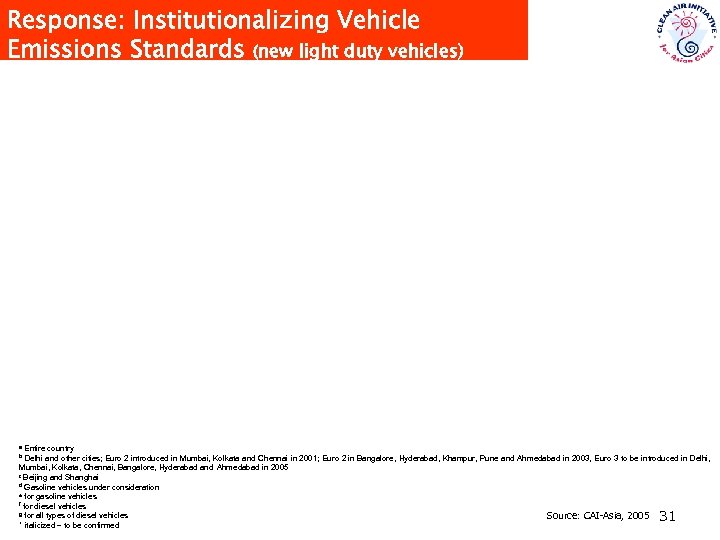
Response: Institutionalizing Vehicle Emissions Standards (new light duty vehicles) Entire country Delhi and other cities; Euro 2 introduced in Mumbai, Kolkata and Chennai in 2001; Euro 2 in Bangalore, Hyderabad, Khampur, Pune and Ahmedabad in 2003, Euro 3 to be introduced in Delhi, Mumbai, Kolkata, Chennai, Bangalore, Hyderabad and Ahmedabad in 2005 c Beijing and Shanghai d Gasoline vehicles under consideration e for gasoline vehicles f for diesel vehicles g for all types of diesel vehicles Source: CAI-Asia, 2005 * italicized – to be confirmed a b 31
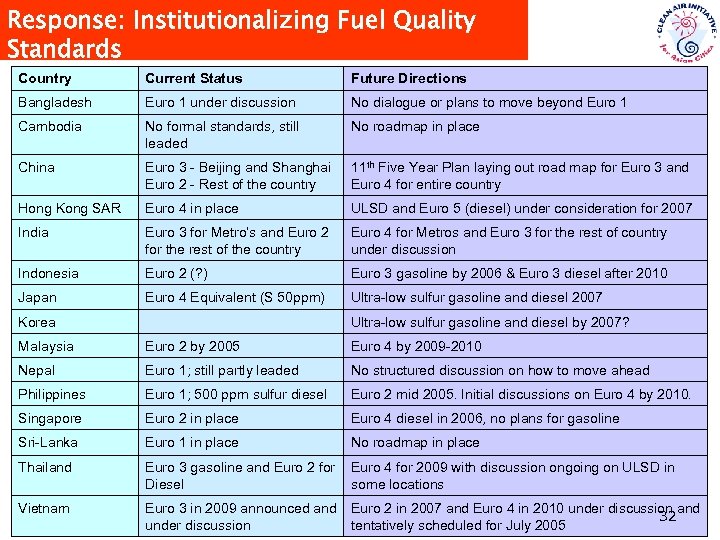
Response: Institutionalizing Fuel Quality Standards Country Current Status Future Directions Bangladesh Euro 1 under discussion No dialogue or plans to move beyond Euro 1 Cambodia No formal standards, still leaded No roadmap in place China Euro 3 - Beijing and Shanghai Euro 2 - Rest of the country 11 th Five Year Plan laying out road map for Euro 3 and Euro 4 for entire country Hong Kong SAR Euro 4 in place ULSD and Euro 5 (diesel) under consideration for 2007 India Euro 3 for Metro’s and Euro 2 for the rest of the country Euro 4 for Metros and Euro 3 for the rest of country under discussion Indonesia Euro 2 (? ) Euro 3 gasoline by 2006 & Euro 3 diesel after 2010 Japan Euro 4 Equivalent (S 50 ppm) Ultra-low sulfur gasoline and diesel 2007 Korea Ultra-low sulfur gasoline and diesel by 2007? Malaysia Euro 2 by 2005 Euro 4 by 2009 -2010 Nepal Euro 1; still partly leaded No structured discussion on how to move ahead Philippines Euro 1; 500 ppm sulfur diesel Euro 2 mid 2005. Initial discussions on Euro 4 by 2010. Singapore Euro 2 in place Euro 4 diesel in 2006, no plans for gasoline Sri-Lanka Euro 1 in place No roadmap in place Thailand Euro 3 gasoline and Euro 2 for Diesel Euro 4 for 2009 with discussion ongoing on ULSD in some locations Vietnam Euro 3 in 2009 announced and under discussion Euro 2 in 2007 and Euro 4 in 2010 under discussion and 32 tentatively scheduled for July 2005
Part 4 CAI-Asia Programs 33
Phase 2 CAI-Asia: 2005 - 2007 Goals § Regional Coordination and Cooperation on Air Quality Management firmly established in Asia § Asian countries ability manage air quality is improved § Air quality is improved Results § § Improved scientific understanding of air pollution in Asia Better policies for air quality management in Asia Strengthened air quality governance in Asia Improved implementation of air quality management policies and programs 34
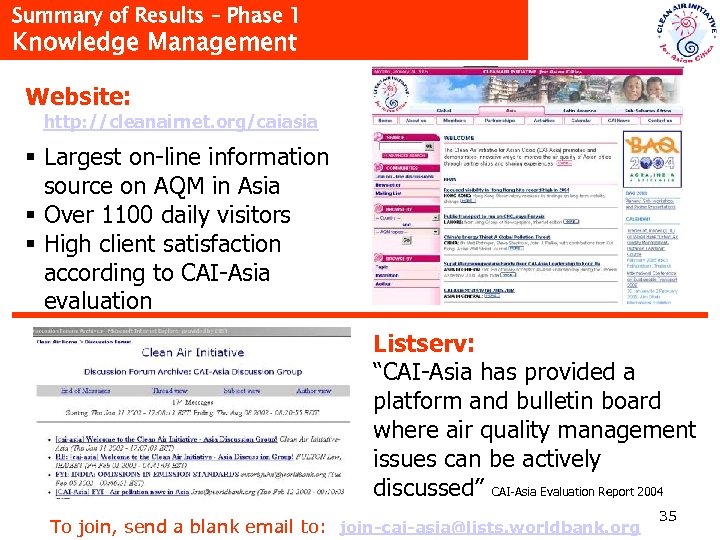
Summary of Results – Phase 1 Knowledge Management Website: http: //cleanairnet. org/caiasia § Largest on-line information source on AQM in Asia § Over 1100 daily visitors § High client satisfaction according to CAI-Asia evaluation Listserv: “CAI-Asia has provided a platform and bulletin board where air quality management issues can be actively discussed” CAI-Asia Evaluation Report 2004 To join, send a blank email to: join-cai-asia@lists. worldbank. org 35
Summary of Results – Phase 1 Capacity Building § CATNet-Asia: Partnership of World Bank, USEPA and Pollution Control Department Thailand to strengthen capacity to deliver air quality management training http: //www. cleanairnet. org/caiasia/1412/propertyvalue-19618. html § Distance Learning Course: World Bank Institute Program to deliver Air Quality Management training http: //www. cleanairnet. org/caiasia/1412/propertyvalue-19618. html § Fuel Quality Strategies Training Workshop: ADB – IFQC program to strengthen capacity of Asian countries to develop fuel quality improvement strategies http: //www. cleanairnet. org/caiasia/1412/article-58140. html § ‘South-South’ Exchange Program: Exchange of experiences among CAI-Asia member cities and organizations 36
Summary of Results – Phase 1 Regional Cooperation § Strategic Framework for Air Quality Management in Asia: Joint activity with APMA Project to develop a high level conceptual approach to air quality management by Asian Cities. http: //www. cleanairnet. org/caiasia/1412/article-58180. html § Dialogue among other Regional Initiatives/ Institutions with AQM Component: Annual dialogue to promote the development and adoption common agendas on air quality management in Asia. http: //www. cleanairnet. org/caiasia/1412/article-58414. html § Benchmarking Study on UAQM Capability of selected Asian cities - 2 nd Stage: Assessment of air quality management capabilities among 20 Asian cities Initial Results - http: //www. cleanairnet. org/caiasia/1412/article-59072. html § CAI-Asia – Oil Industry Dialogue for Cleaner Fuels in Asia: Dialogue aimed to result in a joint roadmap for cleaner transportation fuels in Asia http: //www. cleanairnet. org/caiasia/1412/article-58858. html 37
Summary of Results – Phase 1 Pilot Projects § Public Health and Air Pollution in Asia (PAPA): $2 million research and capacity building program to investigate impact of air pollution on public health in Asian cities http: //www. cleanairnet. org/caiasia/1412/article-48844. html § Poverty and Air Pollution: Ho Chi Minh based case study to develop methodology to assess linkage of air pollution and poverty in Asia. § Developing Integrated Emissions Strategies for Existing Land Transport (DIESEL): Bangkok based regional program to develop solutions to reduce emissions from in-use diesel vehicles http: //www. cleanairnet. org/caiasia/1412/article-48845. html § Partnership for Sustainable Urban Transportation in Asia: Regional Partnership of ADB and EMBARQ to promote sustainable urban transport in Asia through policy dialogue and indicator development. http: //www. cleanairnet. org/caiasia/1412/article-58616. html § Emission Reduction Potential of Low Sulfur Diesel Fuels in Asia: Studies in support of CAI-Asia’s activities on fuel quality improvement. http: //www. cleanairnet. org/caiasia/1412/article-58109. html 38
Summary of Results – Phase 1 Workshops § The annual BAQ workshop has developed into an institution and is now the largest urban air quality event in Asia. § Better Air Quality 2002: 16 -19 December 2002. Hong Kong, SAR– Hosted by the Hong Kong Polytechnic University and Environmental Protection Department and supported by the Air Pollution in the Mega-cities of Asia Project, CAI-Asia, and the California Air Resources Board http: //www. cleanairnet. org/caiasia/1412/article -35730. html § Better Air Quality 2003: 17 -19 December 2003. Manila, Philippines – Hosted by the Air Pollution in the Mega-cities of Asia Project, the Partnership for Clean Air (Manila), and CAI-Asia http: //www. cleanairnet. org/baq 2003/1496/channel. html § Better Air Quality 2004: 6 -8 December 2003. Agra, India. Hosted by India’s Ministry of Environment and Forests and CAIAsia, and jointly organized by the Society of Indian Automobile Manufacturers, Central Pollution Control Board, and CAI-Asia http: //www. cleanairnet. org/baq 2004/1527/channel. html 39
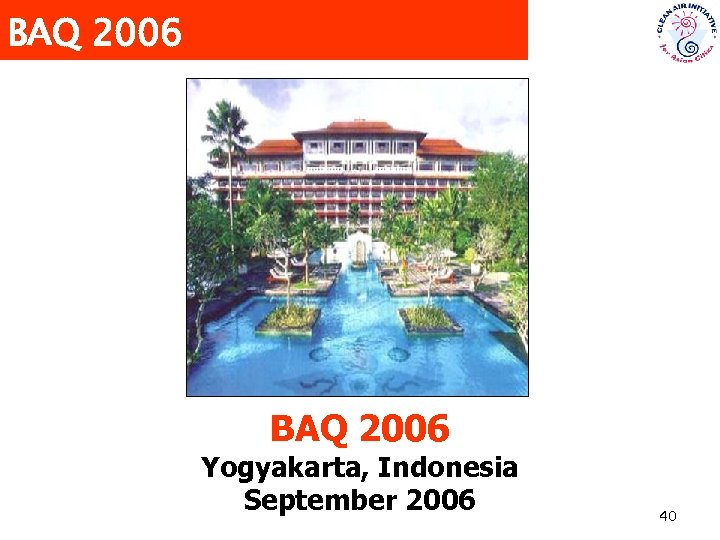
BAQ 2006 Yogyakarta, Indonesia September 2006 40
Скачать презентацию Introduction into Urban Air Quality in Asia Status
1a8fa10596bce263dd02720aa9a44d0a.ppt