


 Скачать презентацию Introduction Hypothesis Topology technical constrains
32580d7360df592e87184d4dce5e032e.ppt
- Количество слайдов: 19
 Introduction • • • Hypothesis Topology, technical constrains Redundancy, budget constrains Grounding Reliability Conclusion NIKHEF E. Heine, H. Z. Peek NIKH EF VLVn. T facility-power 1 6/10/2003 – e. heine
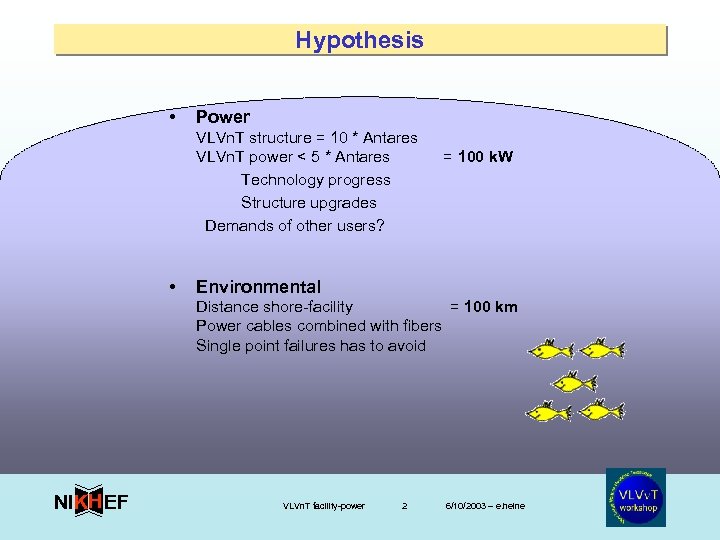 Hypothesis • Power VLVn. T structure = 10 * Antares VLVn. T power < 5 * Antares Technology progress Structure upgrades Demands of other users? • = 100 k. W Environmental Distance shore-facility = 100 km Power cables combined with fibers Single point failures has to avoid NIKH EF VLVn. T facility-power 2 6/10/2003 – e. heine
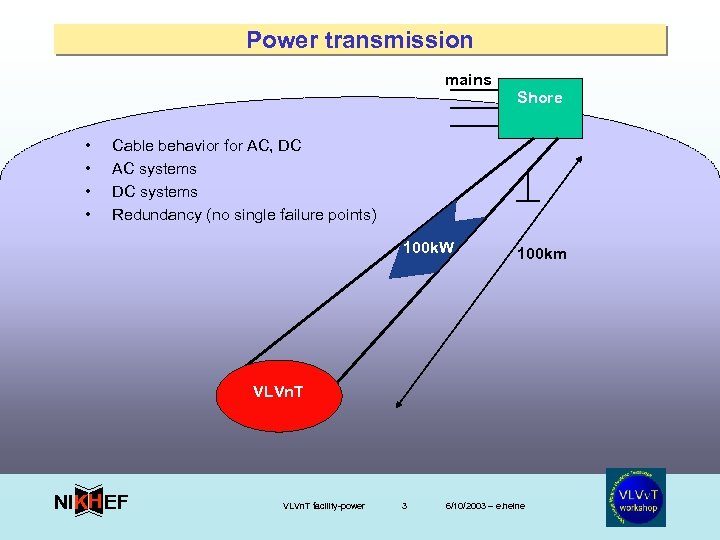 Power transmission mains Shore • • Cable behavior for AC, DC AC systems DC systems Redundancy (no single failure points) 100 k. W 100 km VLVn. T NIKH EF VLVn. T facility-power 3 6/10/2003 – e. heine
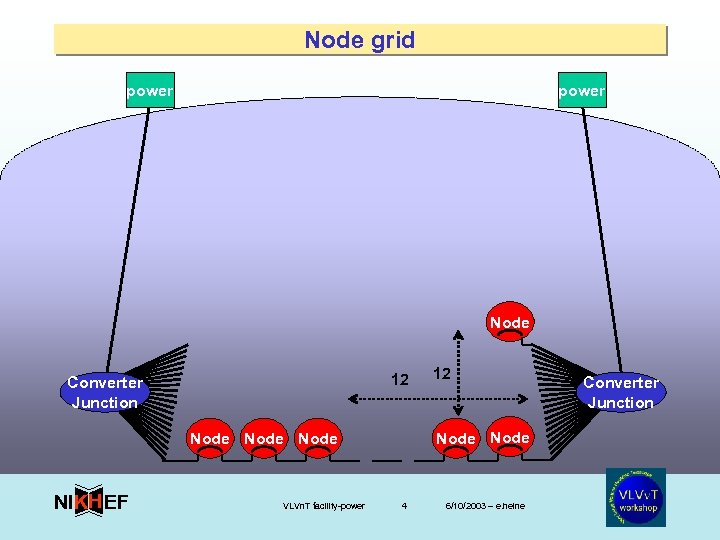 Node grid power Node 12 Converter Junction Node Node NIKH EF VLVn. T facility-power 12 4 6/10/2003 – e. heine Converter Junction
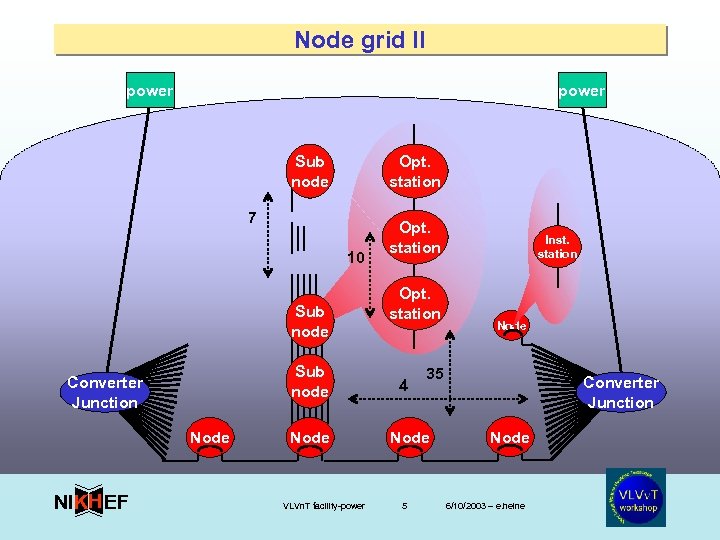 Node grid II power Sub node Opt. station 7 10 Sub node Converter Junction Node NIKH EF Node VLVn. T facility-power Opt. station 4 Node 35 Node 5 Inst. station Converter Junction Node 6/10/2003 – e. heine
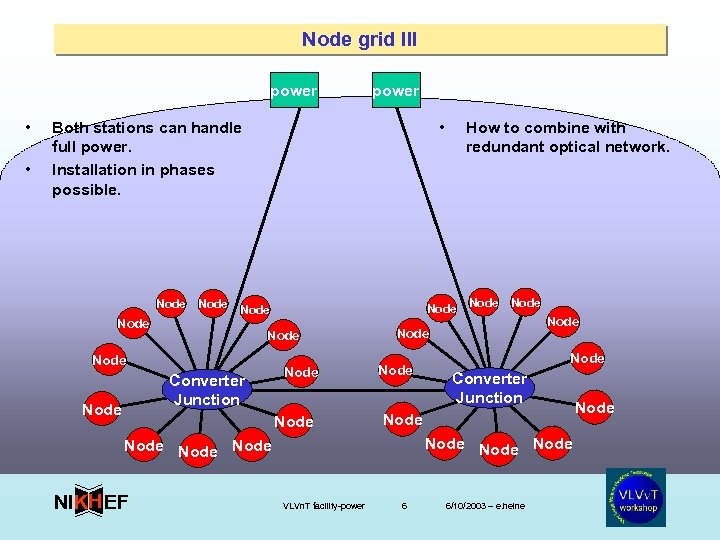 Node grid III power • • power • Both stations can handle full power. Installation in phases possible. Node Node Converter Junction Node Node Node Node NIKH EF How to combine with redundant optical network. VLVn. T facility-power 6 6/10/2003 – e. heine Node
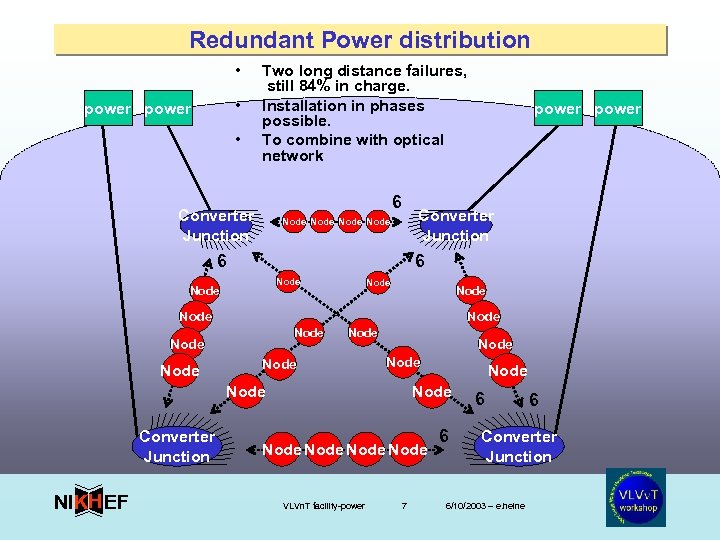 Redundant Power distribution • • power • Two long distance failures, still 84% in charge. Installation in phases possible. To combine with optical network 6 Converter Junction Node 6 6 Node Node Node Node Converter Junction NIKH EF power Node Node VLVn. T facility-power 7 6 6 6 Converter Junction 6/10/2003 – e. heine
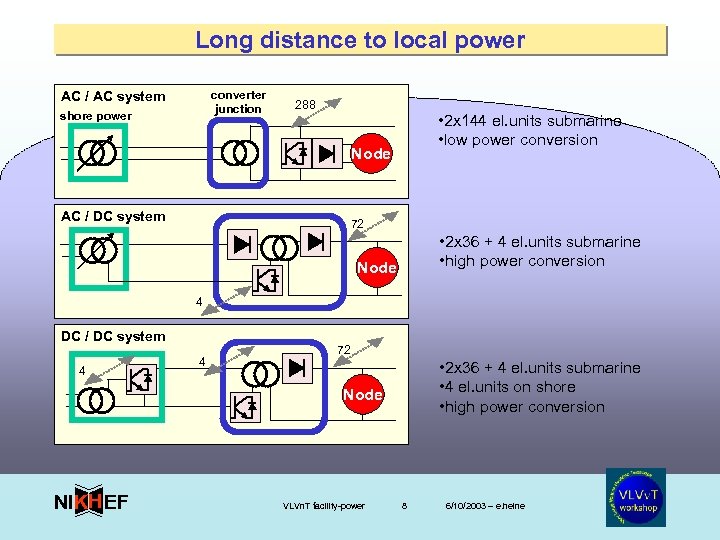 Long distance to local power converter junction AC / AC system shore power 288 • 2 x 144 el. units submarine • low power conversion Node AC / DC system 72 • 2 x 36 + 4 el. units submarine • high power conversion Node 4 DC / DC system 4 4 72 • 2 x 36 + 4 el. units submarine • 4 el. units on shore • high power conversion Node NIKH EF VLVn. T facility-power 8 6/10/2003 – e. heine
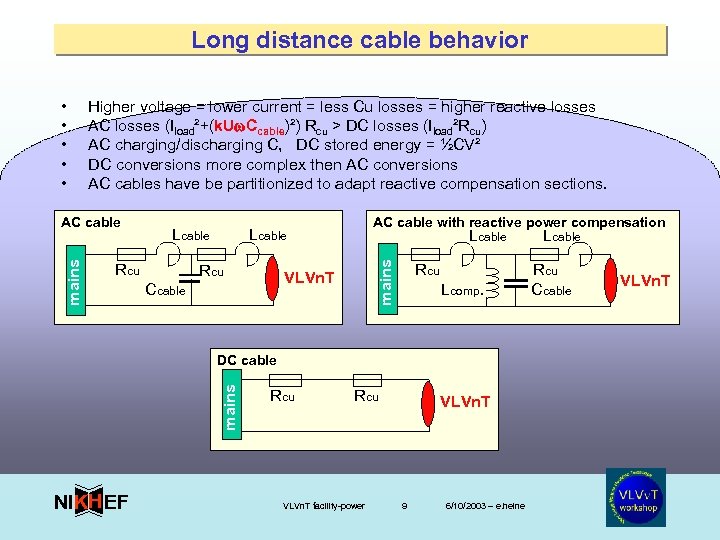 Long distance cable behavior Higher voltage = lower current = less Cu losses = higher reactive losses AC losses (Iload²+(k. Uw. Ccable)²) Rcu > DC losses (Iload²Rcu) AC charging/discharging C, DC stored energy = ½CV² DC conversions more complex then AC conversions AC cables have be partitionized to adapt reactive compensation sections. mains AC cable Lcable Rcu AC cable with reactive power compensation Lcable Rcu Lcable mains • • • VLVn. T Ccable Rcu Lcomp. mains DC cable NIKH EF Rcu VLVn. T facility-power VLVn. T 9 6/10/2003 – e. heine Lcable Rcu Ccable VLVn. T
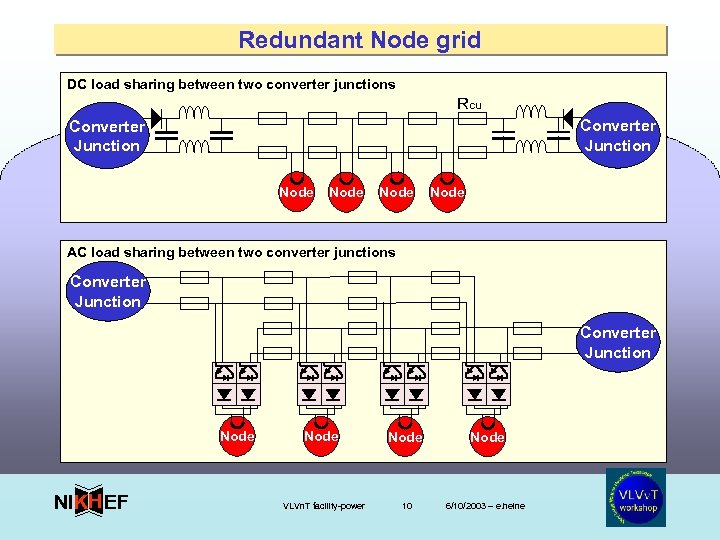 Redundant Node grid DC load sharing between two converter junctions Rcu Converter Junction Node AC load sharing between two converter junctions Converter Junction Node NIKH EF Node VLVn. T facility-power Node 10 6/10/2003 – e. heine
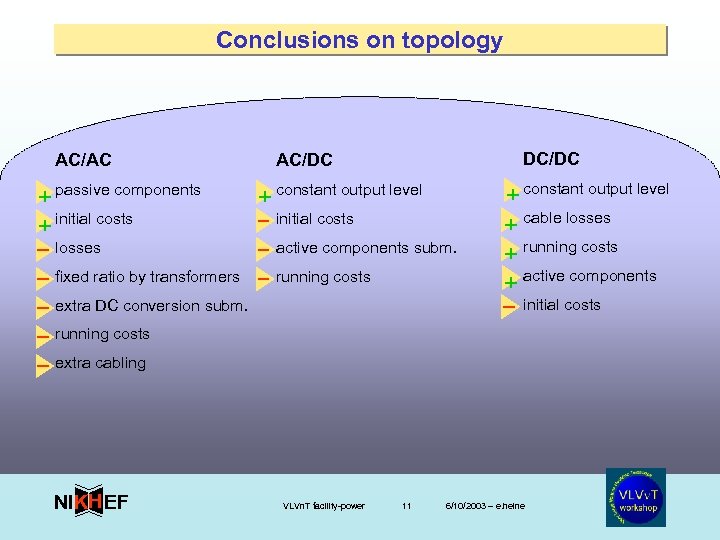 Conclusions on topology AC/AC + passive components + initial costs DC/DC AC/DC + constant output level initial costs losses active components subm. fixed ratio by transformers running costs + constant output level + cable losses + running costs + active components initial costs extra DC conversion subm. running costs extra cabling NIKH EF VLVn. T facility-power 11 6/10/2003 – e. heine
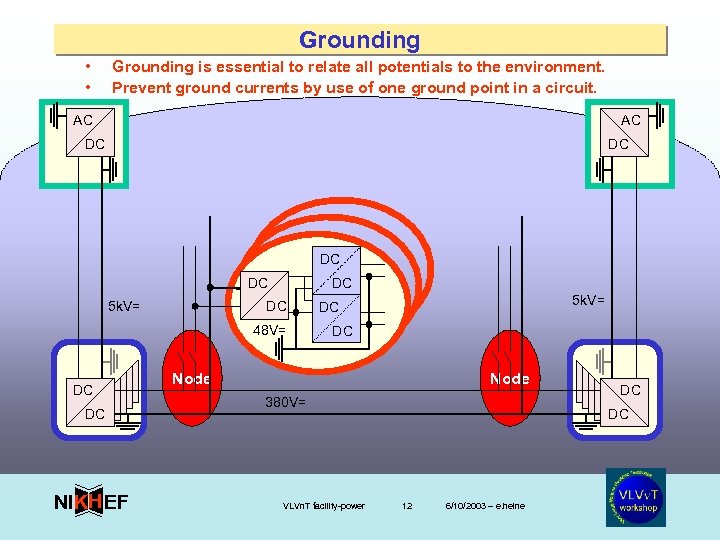 Grounding • • Grounding is essential to relate all potentials to the environment. Prevent ground currents by use of one ground point in a circuit. AC AC DC DC 5 k. V= DC DC 48 V= DC DC NIKH EF 5 k. V= DC DC Node 380 V= VLVn. T facility-power DC DC 12 6/10/2003 – e. heine
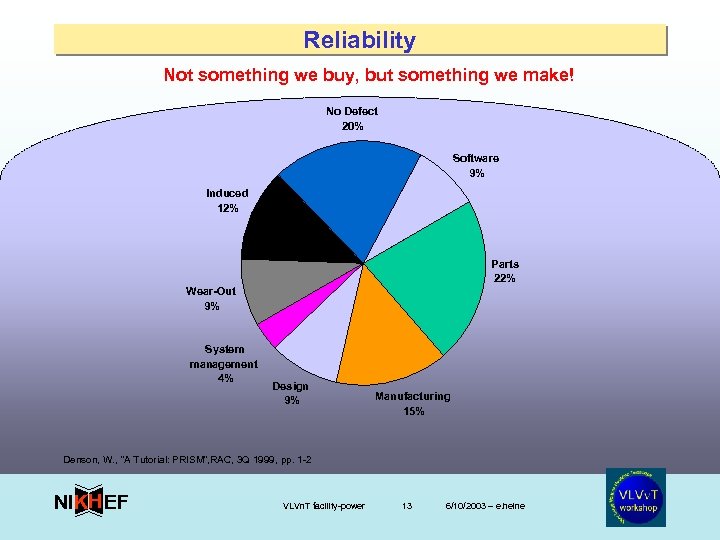 Reliability Not something we buy, but something we make! No Defect 20% Software 9% Induced 12% Parts 22% Wear-Out 9% System management 4% Design 9% Manufacturing 15% Denson, W. , “A Tutorial: PRISM”, RAC, 3 Q 1999, pp. 1 -2 NIKH EF VLVn. T facility-power 13 6/10/2003 – e. heine
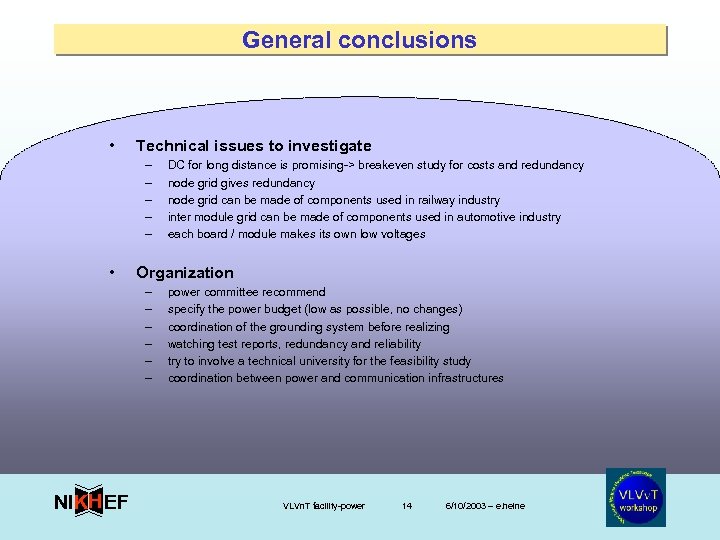 General conclusions • Technical issues to investigate – – – • Organization – – – NIKH EF DC for long distance is promising-> breakeven study for costs and redundancy node grid gives redundancy node grid can be made of components used in railway industry inter module grid can be made of components used in automotive industry each board / module makes its own low voltages power committee recommend specify the power budget (low as possible, no changes) coordination of the grounding system before realizing watching test reports, redundancy and reliability try to involve a technical university for the feasibility study coordination between power and communication infrastructures VLVn. T facility-power 14 6/10/2003 – e. heine
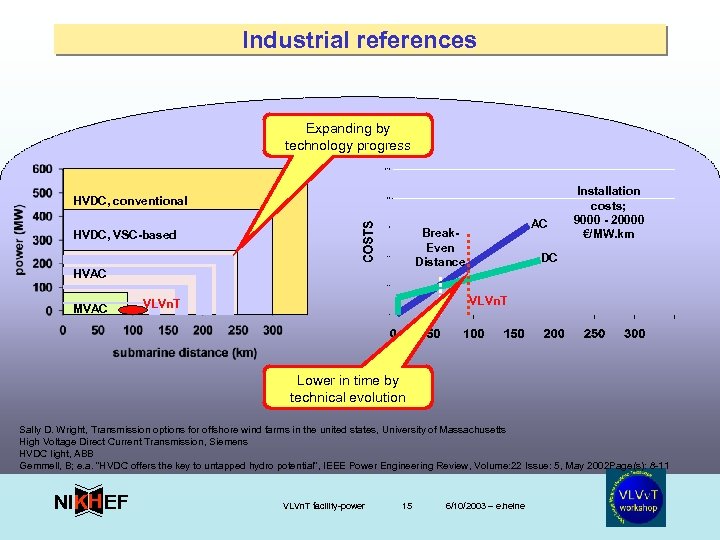 Industrial references Expanding by technology progress HVDC, conventional HVAC MVAC AC Break. Even Distance HVDC, VSC-based Installation costs; 9000 - 20000 €/MW. km DC VLVn. T Lower in time by technical evolution Sally D. Wright, Transmission options for offshore wind farms in the united states, University of Massachusetts High Voltage Direct Current Transmission, Siemens HVDC light, ABB Gemmell, B; e. a. “HVDC offers the key to untapped hydro potential”, IEEE Power Engineering Review, Volume: 22 Issue: 5, May 2002 Page(s): 8 -11 NIKH EF VLVn. T facility-power 15 6/10/2003 – e. heine
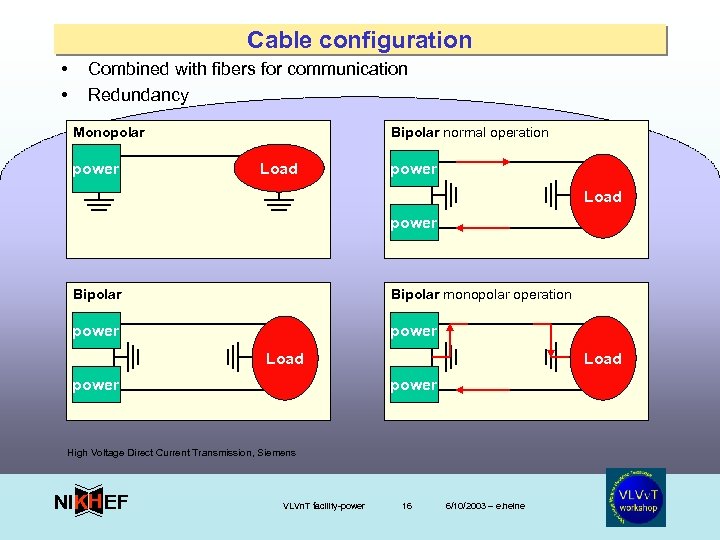 Cable configuration • • Combined with fibers for communication Redundancy Monopolar power Bipolar normal operation Load power Bipolar monopolar operation power Load power High Voltage Direct Current Transmission, Siemens NIKH EF VLVn. T facility-power 16 6/10/2003 – e. heine
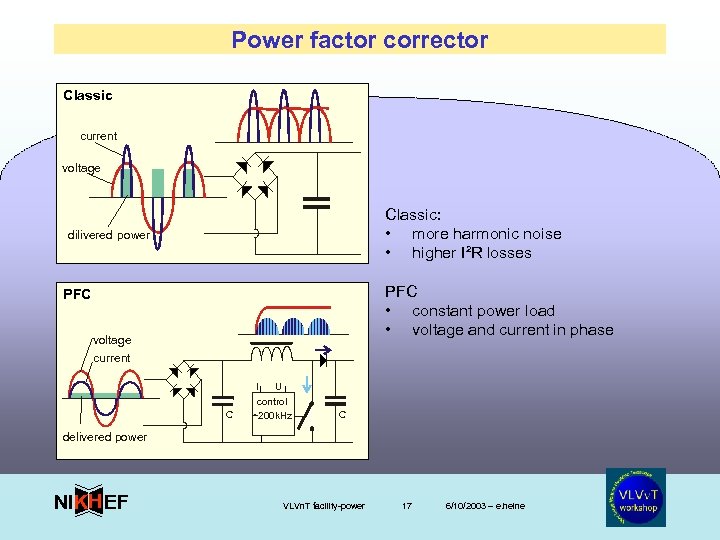 Power factor corrector Classic current voltage Classic: • more harmonic noise • higher I²R losses dilivered power PFC • constant power load • voltage and current in phase PFC voltage current I C U control ~200 k. Hz C delivered power NIKH EF VLVn. T facility-power 17 6/10/2003 – e. heine
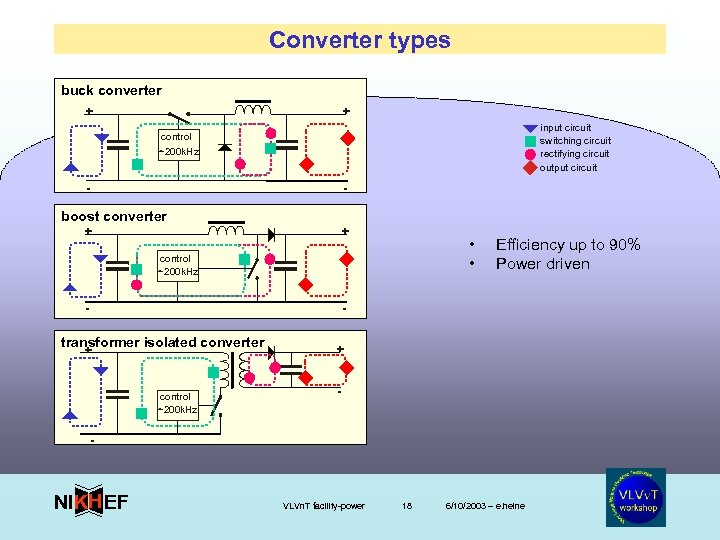 Converter types buck converter + + input circuit switching circuit rectifying circuit output circuit control ~200 k. Hz - - boost converter + + • • control ~200 k. Hz - Efficiency up to 90% Power driven - transformer isolated converter + control ~200 k. Hz + - - NIKH EF VLVn. T facility-power 18 6/10/2003 – e. heine
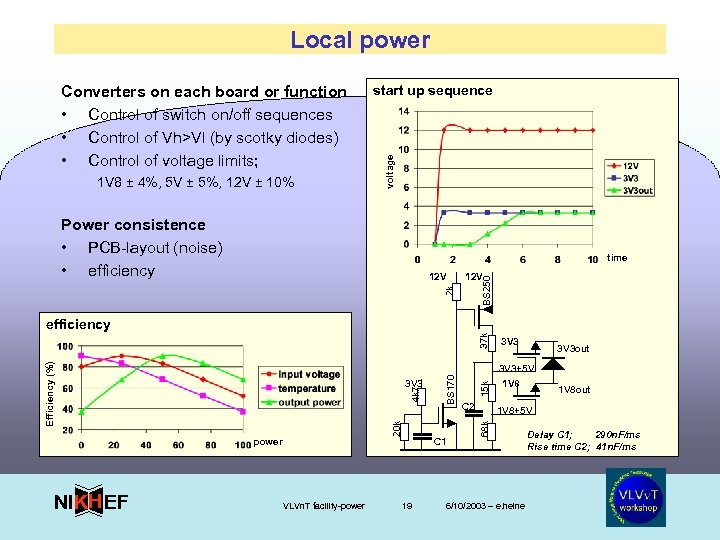 Local power 1 V 8 ± 4%, 5 V ± 5%, 12 V ± 10% start up sequence voltage Converters on each board or function • Control of switch on/off sequences • Control of Vh>Vl (by scotky diodes) • Control of voltage limits; Power consistence • PCB-layout (noise) • efficiency time BS 250 12 V 2 k 12 V power NIKH EF VLVn. T facility-power 19 C 1 15 k C 2 3 V 3 out 3 V 3+5 V 1 V 8 out 1 V 8+5 V 68 k 20 k 4 k 7 3 V 3 BS 170 Efficiency (%) 37 k efficiency 6/10/2003 – e. heine Delay C 1; 290 n. F/ms Rise time C 2; 41 n. F/ms