


 Скачать презентацию Introduction Chip Mahoney P E Project Manager Unified
a10cd0b95d0836bbc703b4f691df3926.ppt
- Количество слайдов: 8
 Introduction Chip Mahoney, P. E. Project Manager, Unified Incident Command Decision Support (UICDS) Science Applications International Corporation (SAIC) UICDS Sponsor: Larry Skelly Department of Homeland Security Science & Technology Directorate, Infrastructure & Geophysical Division • UICDS is the “middleware foundation” that enables National Response Framework (NRF) and National Information Management System (NIMS), including Incident Command Structure (ICS), information sharing and decision support among commercial and government incident management technologies used across the country to prevent, protect, respond, and recover from natural, technological, and terrorist events • The UICDS Architecture Specification that describes standards and data model for technology providers to adapt their products and share information A pilot reference implementation that is a real-world, operational test environment and development kit for technology providers to use to adapt their products A national outreach program to expand awareness of the role of technology in homeland security • • Page 1 Energy | Environment | National Security | Health | Critical Infrastructure © 2009 Science Applications International Corporation. All rights reserved. SAIC and the SAIC logo are registered trademarks of Science Applications International Corporation in the U. S. and/or other countries. Page 1
 What Is the Process That You and/or Your Company Use to Ensure That Your Product Meets the Needs of the End-user? • Derived from nationally recognized policy-level documents – National Information Management System (NIMS) – National Response Framework (NRF) • Open, non-proprietary, standards-based design and interfaces • Identification of end-user needs and technology provider capabilities via a national outreach program – End user subject matter experts (internal and external) – Government (early focus on federal, transition to states and locals) – Technology providers (commercial off-the-shelf, government off-the-shelf, universities) • Evolutionary development with continual feedback into the system design and implementation – Software engineering process that results in: • Architecture -> demonstration -> pilot -> deployment – Early demonstration of system feasibility – Multiple opportunities for the end-user assessment – Multiple builds build on previous operational concept Page 2 Energy | Environment | National Security | Health | Critical Infrastructure © 2009 Science Applications International Corporation. All rights reserved. SAIC and the SAIC logo are registered trademarks of Science Applications International Corporation in the U. S. and/or other countries. Page 2
 What Are Some of the Challenges Associated With This Process? • Technical challenges – – • Large number of integrations (jurisdictions, sites, applications) No single solution for information sharing – multiple networks and interfaces Peer-to-peer coordination versus centralized command control Evolving technologies and standards and applications Operational challenges – Information-sharing desires vary – Local capabilities, needs and constraints vary – Local investments in technology vary • Programmatic challenges – Local acceptance of a federally funded capability – Competing end-user feedback Page 3 Energy | Environment | National Security | Health | Critical Infrastructure © 2009 Science Applications International Corporation. All rights reserved. SAIC and the SAIC logo are registered trademarks of Science Applications International Corporation in the U. S. and/or other countries. Page 3
 And Does This Process Vary Depending on Whether the Customer/Client Is a Government Agency Versus a Commercial Company? • UICDS outreach focuses on both government organizations and technology providers – UICDS Technology Providers (commercial off-the-shelf and government off-the-shelf vendors, universities) via regular communications • • Biweekly telecons (20 – 40 participants) with specific technical topics and coordination of upcoming events and opportunities Regular emails (approximately 900 on the mailing list, approximately 240 active, approximately 90 Dev. Kit users, 30 demo participants) – Government organizations (federal, state, tribal, local, non-government organizations) via meetings, briefings, demos and UICDS pilot participation • • • Federal (including Departments of Homeland Security, Justice, and Defense, and FEMA and Health and Human Services) State/local (including UICDS pilot in Virginia, All Hazards Consortium) NGOs (including power companies, universities, aid matrix) – Conferences and workshops provide a confluence of government and UICDS Technology Providers • Recent examples include UCore Users Group, NIEM/OASIS Conference, International Association of Emergency Managers (IAEM) Conference, Public Safety Innovation Center (PSIC), EMWS 09 – www. UICDS. us provides an interactive platform for UICDS collaboration • • Introductory materials Document library Demos Discussions Acronyms are defined on page 8. Page 4 Energy | Environment | National Security | Health | Critical Infrastructure © 2009 Science Applications International Corporation. All rights reserved. SAIC and the SAIC logo are registered trademarks of Science Applications International Corporation in the U. S. and/or other countries. Page 4
 How Do You Validate or Assess the Efficacy of Your Technology? • UICDS efficacy is validated by: – Improvements in end-user information sharing and decision support capabilities in a standard fashion (one-to-many integration) • • Within a jurisdiction/organization Across jurisdictions/organizations – Number of participating technology providers and jurisdictions/organizations and how they interact – Specific quantitative metrics that describe interactions and help validate scalability • • Page 5 Incident frequency and duration Information sharing numbers, update frequency, file size Energy | Environment | National Security | Health | Critical Infrastructure © 2009 Science Applications International Corporation. All rights reserved. SAIC and the SAIC logo are registered trademarks of Science Applications International Corporation in the U. S. and/or other countries. Page 5
 Are There Industry Standards That Help Define How Well a Technology Must Perform in Order to Be Effective? If There Are No Standards, Should There Be? • Industry standards help facilitate interoperability. Examples include: – Policy level: NIMS/NRF – Information exchanges: NIEM, UCore – Domain-specific standards bodies: OASIS, OGC, LEITSC, IEEE, APCO, ASTM • Complexity of systems leads to the use of multiple standards – Overlap and gaps • How standards are implemented is a challenge – – Buy/build: When to use existing standards and when to create a new standard? System compliance to a standard - complete versus partial – what is enough? Flexibility for ease of implementation versus “creative differences” System-specific overhead information UICDS integrates across multiple standards (and across domains) Acronyms are defined on page 8. Page 6 Energy | Environment | National Security | Health | Critical Infrastructure © 2009 Science Applications International Corporation. All rights reserved. SAIC and the SAIC logo are registered trademarks of Science Applications International Corporation in the U. S. and/or other countries. Page 6
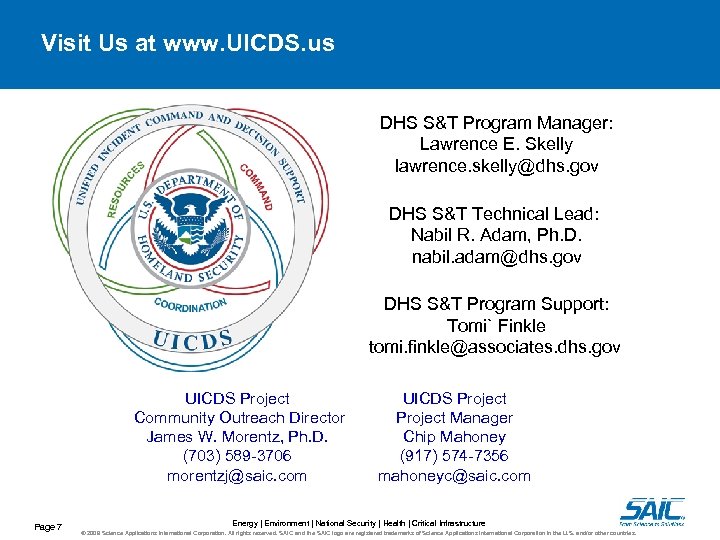 Visit Us at www. UICDS. us DHS S&T Program Manager: Lawrence E. Skelly lawrence. skelly@dhs. gov DHS S&T Technical Lead: Nabil R. Adam, Ph. D. nabil. adam@dhs. gov DHS S&T Program Support: Tomi` Finkle tomi. finkle@associates. dhs. gov UICDS Project Community Outreach Director James W. Morentz, Ph. D. (703) 589 -3706 morentzj@saic. com Page 7 UICDS Project Manager Chip Mahoney (917) 574 -7356 mahoneyc@saic. com Energy | Environment | National Security | Health | Critical Infrastructure © 2009 Science Applications International Corporation. All rights reserved. SAIC and the SAIC logo are registered trademarks of Science Applications International Corporation in the U. S. and/or other countries. Page 7
 Acronyms • • • • • Page 8 APCO = Association of Public Safety Communications Officials ASTM = American Society of Testing and Materials CAP = Common Alerting Protocol COTS = Commercial Off The Shelf DHS = Department of Homeland Security DOJ = Department of Justice EDXL = Emergency Data Exchange Language EDXL-DE = EDXL Distribution Element EDXL-RM = EDXL Resource Messaging EMWS 09 = Workshop on Emergency Management: Incident, Resource, and Supply Chain Management FEMA = Federal Emergency Management Agency GOTS = Government Off The Shelf Geo. RSS = an emerging Web feed standard for encoding location HHS = Health and Human Services ICS = Incident Command System/Structure IEEE = Institute of Electrical and Electronics Engineers LEITSC = Law Enforcement Information Technology Standards Council MACS = Multi-Agency Coordination System • • • • NIEM = National Information Exchange Model NIMS = National Information Management System NGO = Non-Government Organization NRF = National Response Framework OASIS = Organization for the Advancement or Structured Information Standards OGC = Open Geospatial Consortium PSIC = Public Safety Innovation Center SAFECOM = a DHS communications program SIOC = Strategic information and operations center SME = Subject Matter Expert SOAP = Simple Object Access Protocol ST = Science and Technology UICDS = Unified Incident Command Decision Support UCore = Universal ULEX = Universal Lexical Exchange VA = Virginia Energy | Environment | National Security | Health | Critical Infrastructure © 2009 Science Applications International Corporation. All rights reserved. SAIC and the SAIC logo are registered trademarks of Science Applications International Corporation in the U. S. and/or other countries. Page 8