


 Скачать презентацию Introduction Chapter 1 Sections 1 The Nature of
ebbc92aacc0e5d81aa5746db19c3ee5d.ppt
- Количество слайдов: 44
 Introduction Chapter 1 Sections: 1. The Nature of Work 2. Defining Work Systems 3. Types of Occupations 4. Productivity 5. Organization of the Book Work Systems and the Methods, Measurement, and Management of Work by Mikell P. Groover, ISBN 0 -13 -140650 -7. © 2007 Pearson Education, Inc. , Upper Saddle River, NJ. All rights reserved.
 Historical Figures Related to Work § Industrial Revolution (1770’s) § James Watt § steam engine § Henry Maudslay § screw-cutting lathe § (Factories) § § § Machines started to replace workers Produce more quickly and accurately Specialization of labor Use of large numbers of unskilled labors who works long hours for low pay (including women & children) Interchangeable parts manufacture § Eli Whitney (1765 -1825) § § § produces 10000 muskets for the US government Standard parts Special tools, fixtures etc. Unique products replaces custom-fabricate products Mass production (assembly line) § Henry Ford (1863 -1947) § Model T for less than $500 in 1916 Work Systems and the Methods, Measurement, and Management of Work by Mikell P. Groover, ISBN 0 -13 -140650 -7. © 2007 Pearson Education, Inc. , Upper Saddle River, NJ. All rights reserved.
 Historical Figures Related to Work § Scientific management (late 1800 s) § Frederick W. Taylor (1856 -1915) § Father of scientific management § Frank (1868 -1924) & Lillian Gilbreth (1878 -1972) § Father (mother) of motion study § All works are composed of basic motion elements (therbligs) § There is one best method to perform a certain task. § Cheaper by the Dozen § § § Motion study (finding the best method to perform a task) Time study to establish work standards for a job Use of standards in industry Labor incentives (bonus payments for higher outputs) Use of data collection, record keeping, cost accounting § The objective is to improve the (labor) productivity Work Systems and the Methods, Measurement, and Management of Work by Mikell P. Groover, ISBN 0 -13 -140650 -7. © 2007 Pearson Education, Inc. , Upper Saddle River, NJ. All rights reserved.
 Work § Is our primary means of livelihood § Serves an important economic function in the global world of commerce § Creates opportunities for social interactions and friendships § Provides the products and services that sustain and improve our standard of living Work Systems and the Methods, Measurement, and Management of Work by Mikell P. Groover, ISBN 0 -13 -140650 -7. © 2007 Pearson Education, Inc. , Upper Saddle River, NJ. All rights reserved.
 The Nature of Work § Work is an activity in which one exerts physical and mental effort to accomplish a given task or perform a duty § Task or duty has some useful objective § Worker applies skills and knowledge for successful completion § The activity has commercial value § The worker is compensated Work Systems and the Methods, Measurement, and Management of Work by Mikell P. Groover, ISBN 0 -13 -140650 -7. © 2007 Pearson Education, Inc. , Upper Saddle River, NJ. All rights reserved.
 Work (Physics Definition) § The displacement (distance) that an object moves in a certain direction multiplied by the force acting on the object in the same direction. § W=F. d (Newton-meter) § Units of measurement: § Newton-meters (N-m) in the International System of Units (metric system) § Foot-pounds (ft-lb) in U. S. customary units § Work is more than muscular applications. § Combination of physical and cognitive work. Work Systems and the Methods, Measurement, and Management of Work by Mikell P. Groover, ISBN 0 -13 -140650 -7. © 2007 Pearson Education, Inc. , Upper Saddle River, NJ. All rights reserved.
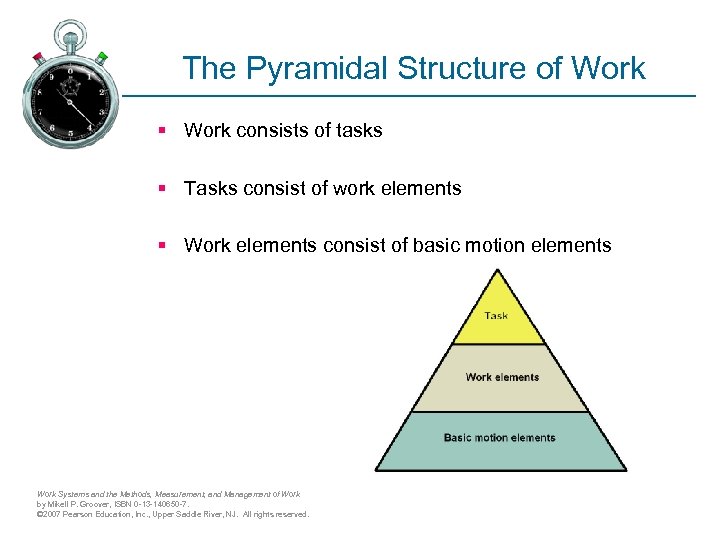 The Pyramidal Structure of Work § Work consists of tasks § Tasks consist of work elements § Work elements consist of basic motion elements Work Systems and the Methods, Measurement, and Management of Work by Mikell P. Groover, ISBN 0 -13 -140650 -7. © 2007 Pearson Education, Inc. , Upper Saddle River, NJ. All rights reserved.
 Task § An amount of work that is assigned to a worker or for which a worker is responsible § Repetitive task – as in mass production § Time required = 30 seconds to several minutes § Non-repetitive task – performed periodically, infrequently, or only once § Time required usually much longer than for repetitive task Work Systems and the Methods, Measurement, and Management of Work by Mikell P. Groover, ISBN 0 -13 -140650 -7. © 2007 Pearson Education, Inc. , Upper Saddle River, NJ. All rights reserved.
 Work Element § A series of work activities that are logically grouped together because they have a unified function in the task § Example: assembling a component to a base part using several nuts and bolts § Required time = six seconds or longer Work Systems and the Methods, Measurement, and Management of Work by Mikell P. Groover, ISBN 0 -13 -140650 -7. © 2007 Pearson Education, Inc. , Upper Saddle River, NJ. All rights reserved.
 Basic Motion Elements § Examples: § § § Reaching for an object Grasping the object Moving the object Walking Eye movement § A work element consists of multiple basic motion elements § Less than a second Work Systems and the Methods, Measurement, and Management of Work by Mikell P. Groover, ISBN 0 -13 -140650 -7. © 2007 Pearson Education, Inc. , Upper Saddle River, NJ. All rights reserved.
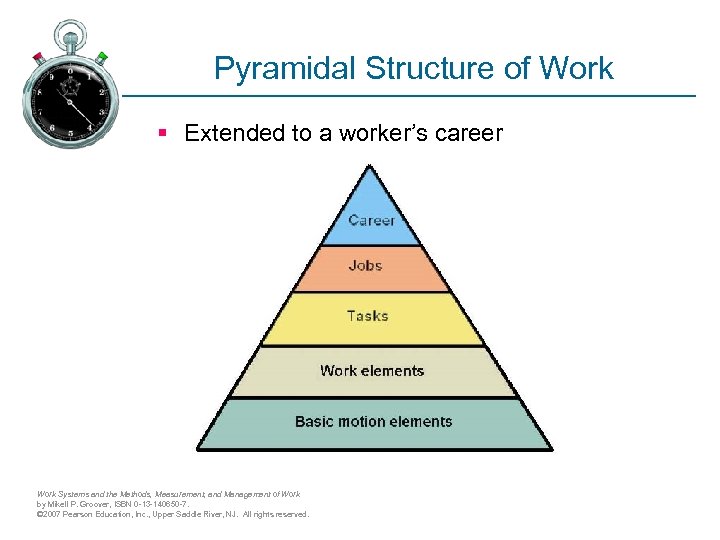 Pyramidal Structure of Work § Extended to a worker’s career Work Systems and the Methods, Measurement, and Management of Work by Mikell P. Groover, ISBN 0 -13 -140650 -7. © 2007 Pearson Education, Inc. , Upper Saddle River, NJ. All rights reserved.
 Importance of Time § In many human activities, “time is of the essence” § § In sports In daily living In business and industry In work Work Systems and the Methods, Measurement, and Management of Work by Mikell P. Groover, ISBN 0 -13 -140650 -7. © 2007 Pearson Education, Inc. , Upper Saddle River, NJ. All rights reserved.
 Importance of Time in Business and Industry § New product introduction § Product cost (reduced time means reduced labor costs) § Delivery time § Overnight delivery § Competitive bidding (proposals should be submitted by a specific date) § Production scheduling (being on time) Work Systems and the Methods, Measurement, and Management of Work by Mikell P. Groover, ISBN 0 -13 -140650 -7. © 2007 Pearson Education, Inc. , Upper Saddle River, NJ. All rights reserved.
 Importance of Time in Work § Time is the most frequently used measure of work (not Newton-meter) § How many minutes or hours are required to perform a given task? § Most workers are paid by the time they work § Hourly wage rate § Salary § Time=Money § Workers must arrive at work on time § Otherwise his/her absence may handicap the rest of the team § Labor and staffing requirements computed in units of time § Aggeragate unit Work Systems and the Methods, Measurement, and Management of Work by Mikell P. Groover, ISBN 0 -13 -140650 -7. © 2007 Pearson Education, Inc. , Upper Saddle River, NJ. All rights reserved.
 Work System Defined (manual, machine system buraya) § As a physical entity, a work system is a system consisting of humans, information, and equipment designed to perform useful work § Results of the useful work contributes to the production of a product or delivery of a service § Examples: § Worker operating a machine tool in a factory § An assembly line consists of a dozen of workers at seperate work stations along a moving conveyor § Parcel service agent driving a delivery truck to make customer deliveries § Designer working at a CAD workstation § A receptionist answering incoming phone calls Work Systems and the Methods, Measurement, and Management of Work by Mikell P. Groover, ISBN 0 -13 -140650 -7. © 2007 Pearson Education, Inc. , Upper Saddle River, NJ. All rights reserved.
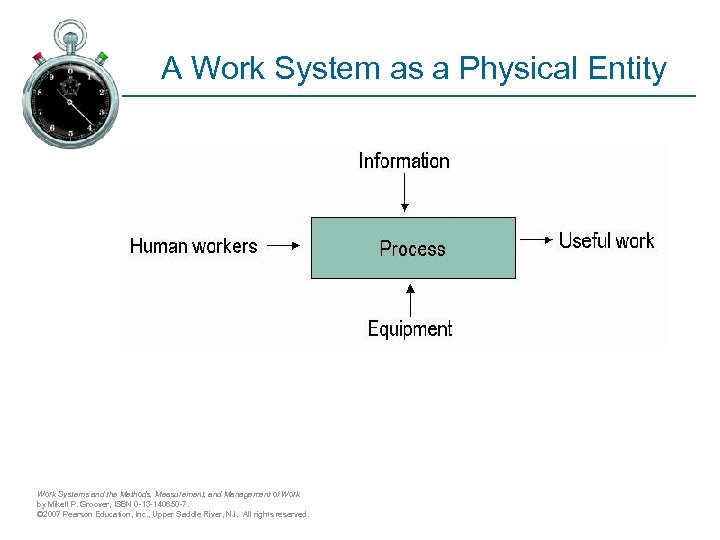 A Work System as a Physical Entity Work Systems and the Methods, Measurement, and Management of Work by Mikell P. Groover, ISBN 0 -13 -140650 -7. © 2007 Pearson Education, Inc. , Upper Saddle River, NJ. All rights reserved.
 Work System Defined § As a field of professional practice, work systems include: § Work methods - analysis and design of tasks and jobs involving human work activity § Operations analysis & methods engineering § Work measurement – analysis of a task to determine the time that should be allowed to perform the task § Time study § § Product costs Worker performance Worker requirements Standard time § How long it takes to accomplish a given work § (Time=Money) Work Systems and the Methods, Measurement, and Management of Work by Mikell P. Groover, ISBN 0 -13 -140650 -7. © 2007 Pearson Education, Inc. , Upper Saddle River, NJ. All rights reserved.
 Work System Defined § As a field of professional practice, work systems include (cont. ) § Work management – organizational and administrative functions that must be accomplished to achieve high productivity and effective supervision of workers § § § Organizing workers Motivating workers Evaluating jobs Evaluating performances Compensating workers (labor wages) Work Systems and the Methods, Measurement, and Management of Work by Mikell P. Groover, ISBN 0 -13 -140650 -7. © 2007 Pearson Education, Inc. , Upper Saddle River, NJ. All rights reserved.
 Comparisons: Industries and Workers § It is convinient to group occupations into the following four groups although there are more types of occupations 1. Production workers § § Making products Manufacturing, construction, agriculture 2. Logistics workers § § Moving materials, products, people Transportation, distribution, material handling Work Systems and the Methods, Measurement, and Management of Work by Mikell P. Groover, ISBN 0 -13 -140650 -7. © 2007 Pearson Education, Inc. , Upper Saddle River, NJ. All rights reserved.
 Comparisons: Industries and Workers § It is convinient to group occupations into the following four groups although there are more types of occupations (cont. ) 3. Service workers § Providing service, applying existing information knowledge, communicate § Banking, retail, government, health care 4. Knowledge workers § Creating knowledge, solving problems, managing § Management, engineering, legal, consulting, education Work Systems and the Methods, Measurement, and Management of Work by Mikell P. Groover, ISBN 0 -13 -140650 -7. © 2007 Pearson Education, Inc. , Upper Saddle River, NJ. All rights reserved.
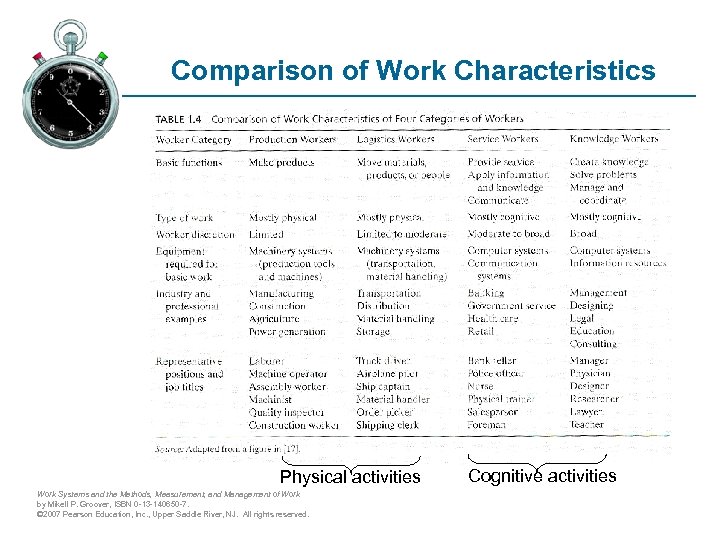 Comparison of Work Characteristics Physical activities Work Systems and the Methods, Measurement, and Management of Work by Mikell P. Groover, ISBN 0 -13 -140650 -7. © 2007 Pearson Education, Inc. , Upper Saddle River, NJ. All rights reserved. Cognitive activities
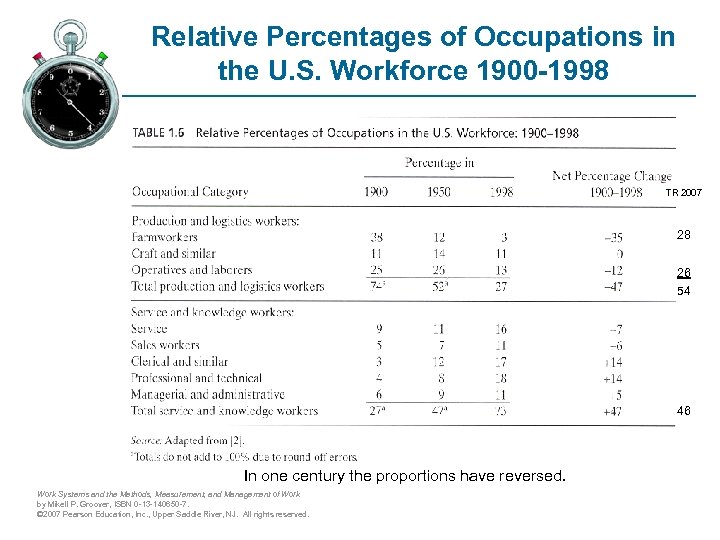 Relative Percentages of Occupations in the U. S. Workforce 1900 -1998 TR 2007 28 26 54 46 In one century the proportions have reversed. Work Systems and the Methods, Measurement, and Management of Work by Mikell P. Groover, ISBN 0 -13 -140650 -7. © 2007 Pearson Education, Inc. , Upper Saddle River, NJ. All rights reserved.
 Productivity § The level of output of a given process relative to the level of input (output/input) § Process can refer to § Individual production or service operations § Can be used in the context of a national economy § Productivity is an important metric in work systems because Improving productivity means § saving scarce natural and human made resources § worker compensation can be increased without increasing the costs of products and services they produce § Products and services at lower prices for consumers which improves standard of living Work Systems and the Methods, Measurement, and Management of Work by Mikell P. Groover, ISBN 0 -13 -140650 -7. © 2007 Pearson Education, Inc. , Upper Saddle River, NJ. All rights reserved.
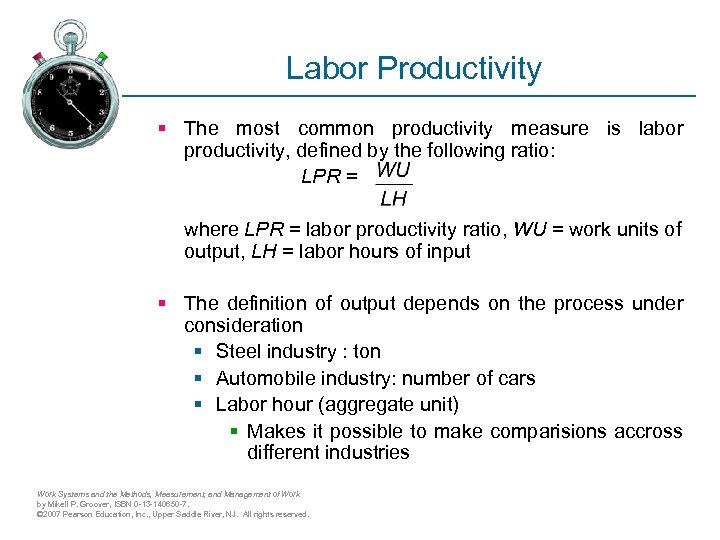 Labor Productivity § The most common productivity measure is labor productivity, defined by the following ratio: LPR = where LPR = labor productivity ratio, WU = work units of output, LH = labor hours of input § The definition of output depends on the process under consideration § Steel industry : ton § Automobile industry: number of cars § Labor hour (aggregate unit) § Makes it possible to make comparisions accross different industries Work Systems and the Methods, Measurement, and Management of Work by Mikell P. Groover, ISBN 0 -13 -140650 -7. © 2007 Pearson Education, Inc. , Upper Saddle River, NJ. All rights reserved.
 Labor Factor in Productivity § Labor itself does not contribute much to improving productivity § More important factors: § Capital - substitution of machines for human labor § Investing an automated production m/c to replace a manually operated m/c § Technology - fundamental change in the way some activity or function is accomplished § It is more than using a m/c in place of a human worker § A technologically more developed m/c replaces the previous one. Work Systems and the Methods, Measurement, and Management of Work by Mikell P. Groover, ISBN 0 -13 -140650 -7. © 2007 Pearson Education, Inc. , Upper Saddle River, NJ. All rights reserved.
 Examples of Technology Changes Horse-drawn carts Railroad trains Steam locomotive Diesel locomotive Telephone operator Dial phone Manually operated milling machine Numerically controlled (NC) milling machine Work Systems and the Methods, Measurement, and Management of Work by Mikell P. Groover, ISBN 0 -13 -140650 -7. © 2007 Pearson Education, Inc. , Upper Saddle River, NJ. All rights reserved.
 Increasing Productivity § Important to recognize important gains in productivity are more likely to be made § By the introduction of capital and technology in a work process § Than by attempting to get more work in less time out of the workers § For example, in construction industry, mortar in mixers pumped into molds rather than workers mixing by shovels Work Systems and the Methods, Measurement, and Management of Work by Mikell P. Groover, ISBN 0 -13 -140650 -7. © 2007 Pearson Education, Inc. , Upper Saddle River, NJ. All rights reserved.
 Measuring Productivity § Not as easy as it seems because of the following problems: § Nonhomogeneous output units (Polo vs Golf) § Multiple input factors § Labor, capital, technology, materials, energy § Productivity comparisons are not easy for: § Price and cost changes due to economic forces and these effect the worth of the output § If prices decrease but costs increase productivity may be less meaningful Work Systems and the Methods, Measurement, and Management of Work by Mikell P. Groover, ISBN 0 -13 -140650 -7. © 2007 Pearson Education, Inc. , Upper Saddle River, NJ. All rights reserved.
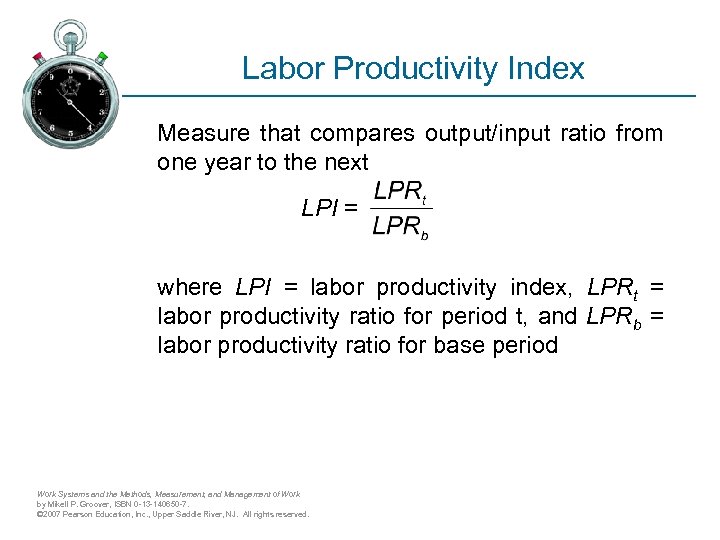 Labor Productivity Index Measure that compares output/input ratio from one year to the next LPI = where LPI = labor productivity index, LPRt = labor productivity ratio for period t, and LPRb = labor productivity ratio for base period Work Systems and the Methods, Measurement, and Management of Work by Mikell P. Groover, ISBN 0 -13 -140650 -7. © 2007 Pearson Education, Inc. , Upper Saddle River, NJ. All rights reserved.
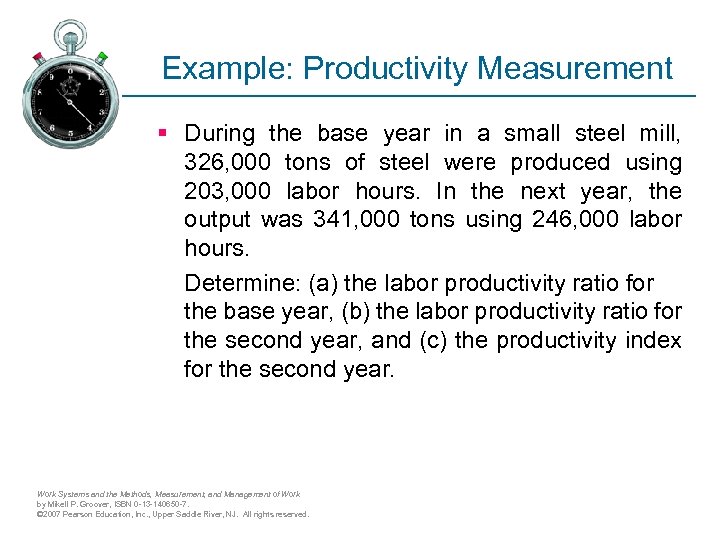 Example: Productivity Measurement § During the base year in a small steel mill, 326, 000 tons of steel were produced using 203, 000 labor hours. In the next year, the output was 341, 000 tons using 246, 000 labor hours. Determine: (a) the labor productivity ratio for the base year, (b) the labor productivity ratio for the second year, and (c) the productivity index for the second year. Work Systems and the Methods, Measurement, and Management of Work by Mikell P. Groover, ISBN 0 -13 -140650 -7. © 2007 Pearson Education, Inc. , Upper Saddle River, NJ. All rights reserved.
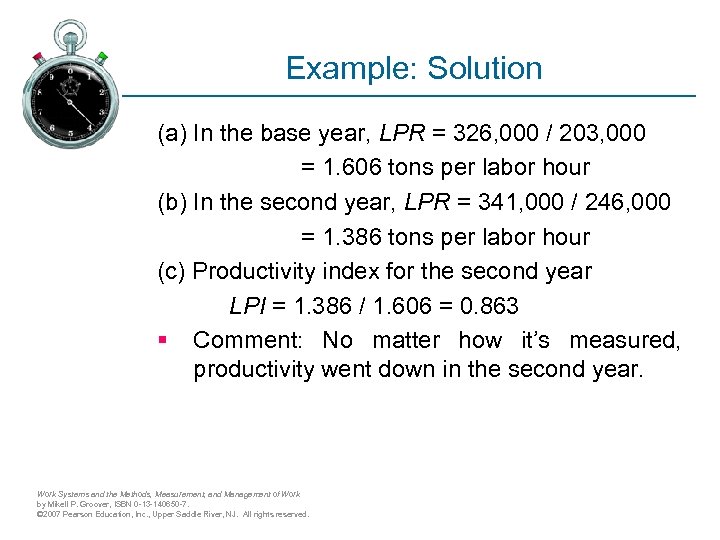 Example: Solution (a) In the base year, LPR = 326, 000 / 203, 000 = 1. 606 tons per labor hour (b) In the second year, LPR = 341, 000 / 246, 000 = 1. 386 tons per labor hour (c) Productivity index for the second year LPI = 1. 386 / 1. 606 = 0. 863 § Comment: No matter how it’s measured, productivity went down in the second year. Work Systems and the Methods, Measurement, and Management of Work by Mikell P. Groover, ISBN 0 -13 -140650 -7. © 2007 Pearson Education, Inc. , Upper Saddle River, NJ. All rights reserved.
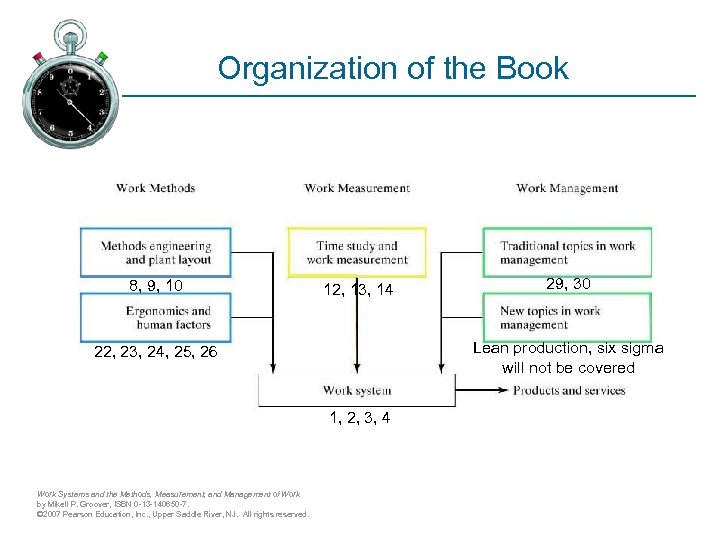 Organization of the Book 8, 9, 10 12, 13, 14 Lean production, six sigma will not be covered 22, 23, 24, 25, 26 1, 2, 3, 4 Work Systems and the Methods, Measurement, and Management of Work by Mikell P. Groover, ISBN 0 -13 -140650 -7. © 2007 Pearson Education, Inc. , Upper Saddle River, NJ. All rights reserved. 29, 30
 Work Systems and How They Work Part I Chapters: 2. Manual Work and Worker-Machine Systems 3. Work Flow and Batch Processing 4. Manual Assembly Lines 5. Logistics Operations 6. Service Operations and Office Work 7. Projects and Project Management Work Systems and the Methods, Measurement, and Management of Work by Mikell P. Groover, ISBN 0 -13 -140650 -7. © 2007 Pearson Education, Inc. , Upper Saddle River, NJ. All rights reserved.
 Manual Work & Worker-Machine Systems Chapter 2 Sections: 1. Manual Work Systems 2. Worker-Machine Systems 3. Automated Work Systems 4. Determining Worker and Requirements 5. Machine Clusters Work Systems and the Methods, Measurement, and Management of Work by Mikell P. Groover, ISBN 0 -13 -140650 -7. © 2007 Pearson Education, Inc. , Upper Saddle River, NJ. All rights reserved. Machine
 Three Categories of Work Systems 1. Manual work system § 2. Worker performs one or more tasks without the aid of powered tools (e. g. hammers, screwdrivers, shovels) Worker-machine system § 3. Human worker operates powered equipment (e. g. a machine tool) § Physical effort (less) § Machine power(more) Automated work system § Process performed without the direct participation of a human worker Work Systems and the Methods, Measurement, and Management of Work by Mikell P. Groover, ISBN 0 -13 -140650 -7. © 2007 Pearson Education, Inc. , Upper Saddle River, NJ. All rights reserved.
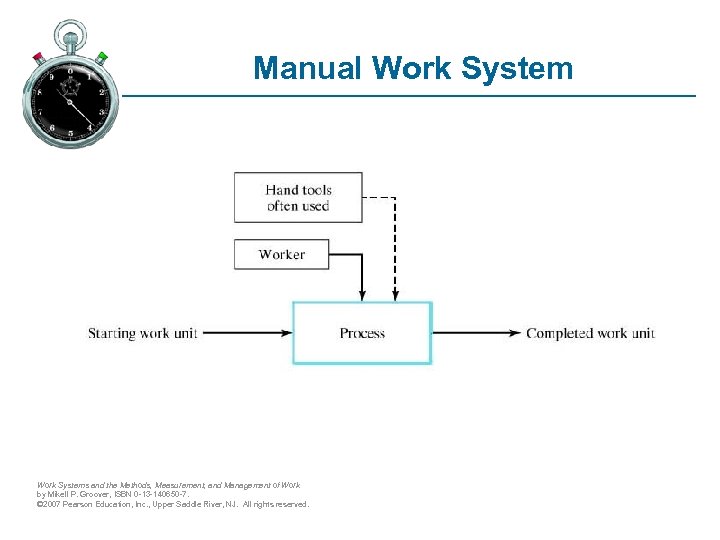 Manual Work Systems and the Methods, Measurement, and Management of Work by Mikell P. Groover, ISBN 0 -13 -140650 -7. © 2007 Pearson Education, Inc. , Upper Saddle River, NJ. All rights reserved.
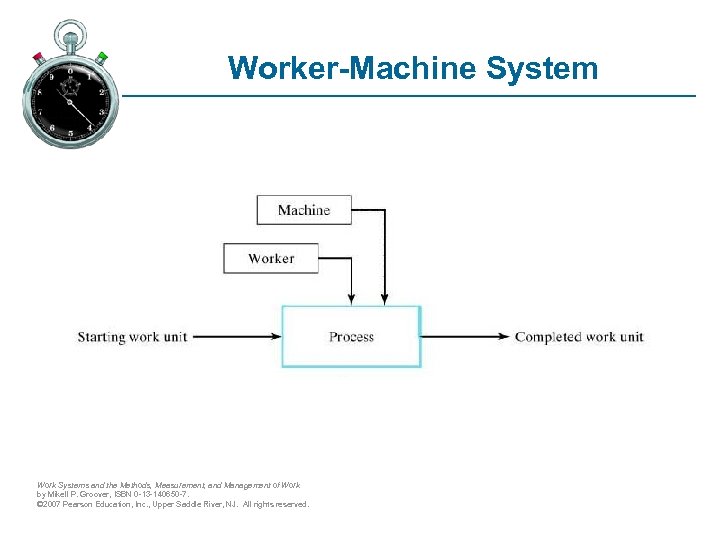 Worker-Machine System Work Systems and the Methods, Measurement, and Management of Work by Mikell P. Groover, ISBN 0 -13 -140650 -7. © 2007 Pearson Education, Inc. , Upper Saddle River, NJ. All rights reserved.
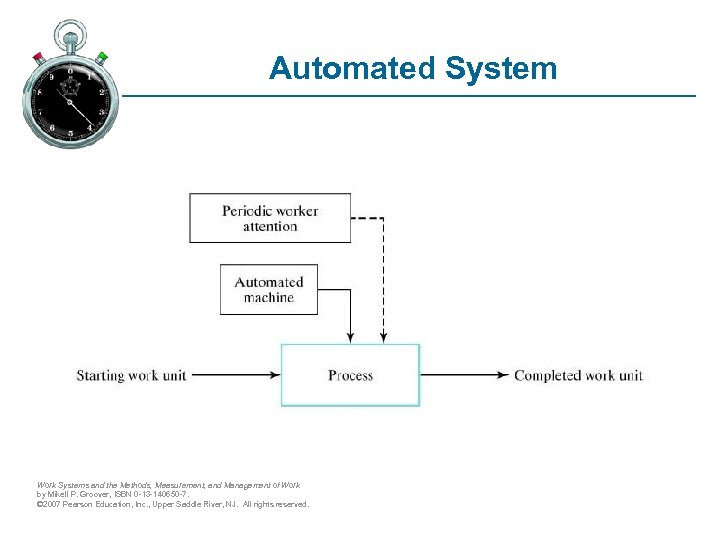 Automated System Work Systems and the Methods, Measurement, and Management of Work by Mikell P. Groover, ISBN 0 -13 -140650 -7. © 2007 Pearson Education, Inc. , Upper Saddle River, NJ. All rights reserved.
 Some Definitions § Work unit – the object that is processed by the work system § § Workpiece being machined (production work) Material being moved (logistics work) Customer in a store (service work) Product being designed (knowledge work) § Unit operations – tasks and processes that are treated as being independent of other work activities § As opposed to sequential operations (sequence of operations required to manufacture a product or deliver a service) Work Systems and the Methods, Measurement, and Management of Work by Mikell P. Groover, ISBN 0 -13 -140650 -7. © 2007 Pearson Education, Inc. , Upper Saddle River, NJ. All rights reserved.
 Manual Work Systems § Most basic form of work in which human body is used to accomplish some physical task without an external source of power § With or without hand tools § Even if hand tools are used, the power to operate them is derived from the strength and stamina of a human worker § Hairbrush vs hair dryer § Of course other human faculties are also required, such as hand-eye coordination and mental effort Work Systems and the Methods, Measurement, and Management of Work by Mikell P. Groover, ISBN 0 -13 -140650 -7. © 2007 Pearson Education, Inc. , Upper Saddle River, NJ. All rights reserved.
 Pure Manual Work § Involves only the physical and mental capabilities of the human worker without machines or tools. § Material handler moving cartons in a warehouse § Workers loading furniture into a moving van without the use of dollies § Dealer at a casino table dealing cards § Office worker filing documents § Assembly worker snap-fitting two parts together Work Systems and the Methods, Measurement, and Management of Work by Mikell P. Groover, ISBN 0 -13 -140650 -7. © 2007 Pearson Education, Inc. , Upper Saddle River, NJ. All rights reserved.
 Manual Work with Hand Tools § Manual tasks are commonly augmented by use of hand tools. § Tool is a device for making changes to objects (formally work units) such as cutting, grinding, striking, sequeezing § Scissor, screwdriver, shovel § Tools can also be used for measurement and/or analysis purposes § Workholder to grasp or poisiton work units Work Systems and the Methods, Measurement, and Management of Work by Mikell P. Groover, ISBN 0 -13 -140650 -7. © 2007 Pearson Education, Inc. , Upper Saddle River, NJ. All rights reserved.
 Manual Work with Hand Tools § § Machinist filing a part Assembly worker using screwdriver Painter using paintbrush to paint door trim QC inspector using micrometer to measure the diameter of a shaft § Material handling worker using a dolly to move furniture § Office worker writing with a pen Work Systems and the Methods, Measurement, and Management of Work by Mikell P. Groover, ISBN 0 -13 -140650 -7. © 2007 Pearson Education, Inc. , Upper Saddle River, NJ. All rights reserved.
 Repetitive vs. Nonrepetitive Tasks § Repetitive Task § Work cycle is relatively short (usually a few minutes or less) § High degree of similarity from one cycle to the next § Nonrepetitive Task § Work cycle takes a long time § Work cycles are not similar § In either case, the task can be divided into work elements that consist of logical groupings of motions Work Systems and the Methods, Measurement, and Management of Work by Mikell P. Groover, ISBN 0 -13 -140650 -7. © 2007 Pearson Education, Inc. , Upper Saddle River, NJ. All rights reserved.