 Скачать презентацию INTRODUCTION Background Survey of Acupuncture
78d6fd606f360c6622f3f71d9124db3b.ppt
- Количество слайдов: 68




INTRODUCTION • Background • Survey of Acupuncture – Acupuncture History – Western Medical Acupuncture Research – Introduction to “Energetics Medicine”
HISTORY OF ACUPUNCTURE
EARLY CHINESE PRACTITIONERS AND TEXTS • • • Fu Xi Shi 4000 B. C. Bone Etchings 1600 B. C. I Ching 2500 -1000 B. C. Huang Ti Nei Ching 500 -200 B. C. Nan Ching 1 st Century A. D. Shang Han Lun 2 nd Century A. D.
ACUPUNCTURE PRACTICE IN OTHER CIVILIZATIONS • • • Egypt 1550 B. C. Papyrus Ebers Indian Ayurvedic Medicine similar precepts South African Bantu tribal medicine Arabic auricular acupuncture for sciatica Eskimo stone stimulation of skin for healing Isolated Brazilian tribal use blowpipe arrows for healing

TRANSLATION EASTERN TEXTS INTO LATIN AND FRENCH • European colonization of Indochina in 16 th Century • Translation into Latin and French by Jesuit priests • Continued involvement of the French in further development of acupuncture

WESTERN MEDICAL ACUPUNCTURE LITERATURE
HISTORIC WESTERN MEDICAL ACUPUNCTURE LITERATURE • Galvani 1792 observed small tissue currents • Dr. Franklin Bache 1825 First U. S. medical acupuncture article • Dr. Edward Warren text 1863 • Medical writers during U. S. Civil War • Sir William Osler 1892 medical writings
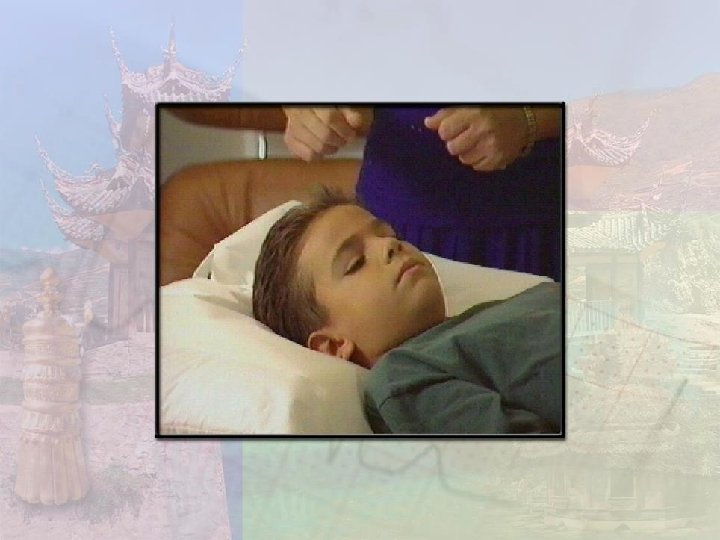

MEDICAL LITERATURE SHOWS ACUPUNCTURE’S EFFECTS ON NEARLY EVERY BIOPHYSICAL SYSTEM
PULMONARY • Attenuation of exercise-induced asthma (Lancet) • Diminishes bronchoconstriction in clinical asthma attacks (Annals of Allergy)
OBSTETRICS • Relief of pain of labor and delivery (Anesthesiology) • Aided in induction of labor (Obstetrics and Gynaecology) • Controlled morning sickness (Obstetrics and Gynaecology, 11/92)
GENITO-URINARY • Treatment for infertility (Gynecology and Endocrinology 9/92 and a German publication) • Treatment of renal colic. Acupuncture demonstrated more rapid response than Avaforton with no side effects (Journal of Urology 1/92)
GASTROINTESTINAL • Relieves GI tract spasm which failed medication (Lancet) • Arrested cholestatic crisis (personal communication Dr. Frank with Dr. Chan Gunn) • Decrease in peri-operative nausea and vomiting (British Medical Journal, Anesthesiology News)
CARDIOVASCULAR • Reversal of cardiac arrest in experimental animals (Journal of Surgical Research)
WOUND HEALING • Acceleration of wound healing demonstrated with electro-acupuncture (Archives of Physical Medicine and Rehabilitation) • Accelerated skin ulcer healing (Southern Medical Journal) • Augmentation of bone repair (Science)
SPORTS MEDICINE • Increased maximum performance capacity over controls (International Journal of Sports Medicine 8/92) • Substance P and Prostaglandin E have been shown to be increased in patients with unsuccessful acupuncture anesthesia (Pomeranz)
DRUG DETOXIFICATION • Dramatic enhancement of drug detoxification programs for over twenty years (Lincoln Hospital programs of Dr. Michael Smith)
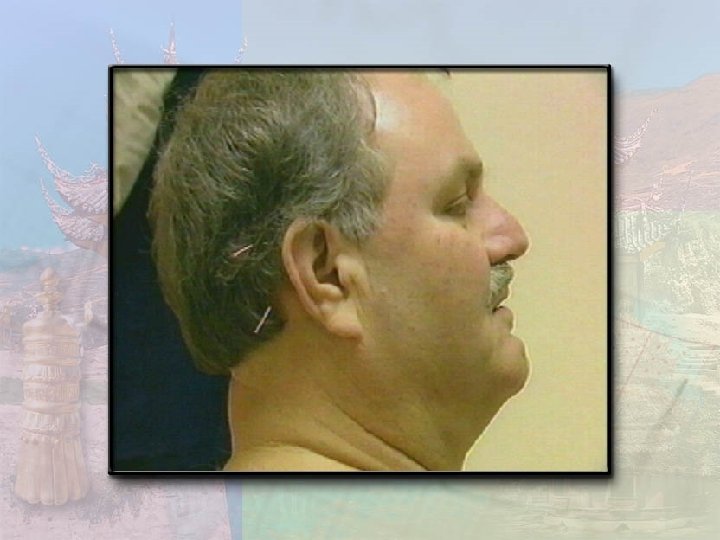
NEUROHUMORAL EFFECTS OF ELECTRO-ACUPUNCTURE
PHYSIOLOGY OF NERVE FIBERS • Various afferent nerve fibers are involved in transmitting pain impulses – Large myelinated nerves • A- Beta (skin) carry touch • Type I (muscle) carry proprioception – Small myelinated nerves carry pain • A-delta (skin) • Type II and III (muscle) – Type II, IV and C carry nonpainful messages
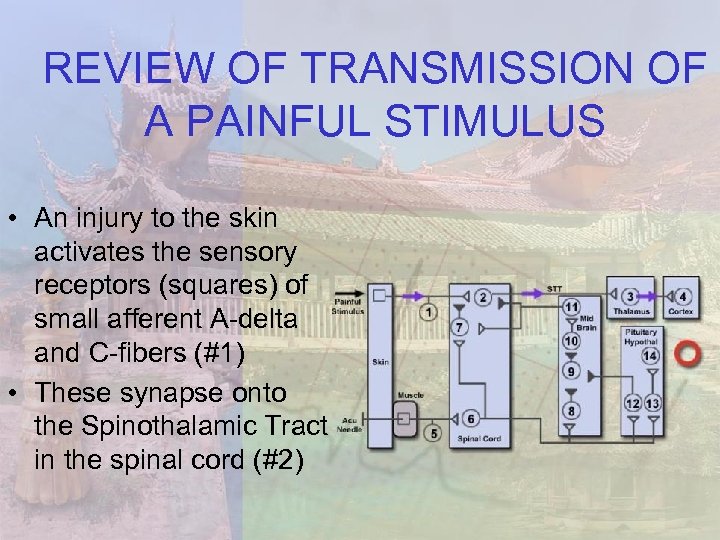
REVIEW OF TRANSMISSION OF A PAINFUL STIMULUS • An injury to the skin activates the sensory receptors (squares) of small afferent A-delta and C-fibers (#1) • These synapse onto the Spinothalamic Tract in the spinal cord (#2)
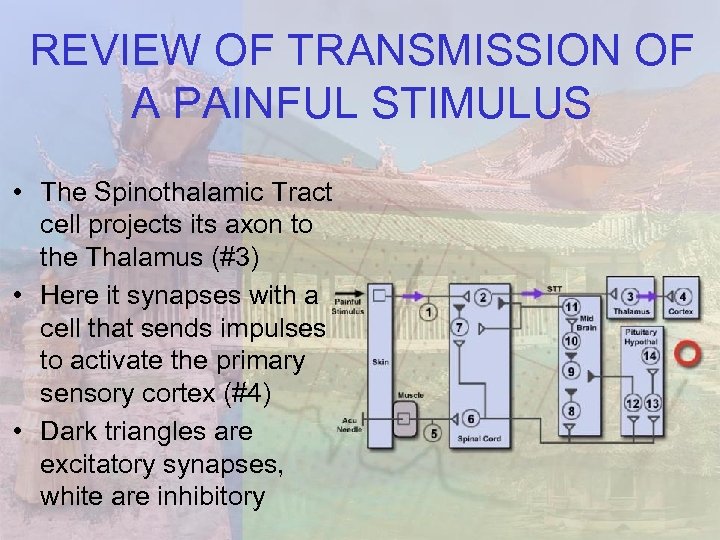
REVIEW OF TRANSMISSION OF A PAINFUL STIMULUS • The Spinothalamic Tract cell projects its axon to the Thalamus (#3) • Here it synapses with a cell that sends impulses to activate the primary sensory cortex (#4) • Dark triangles are excitatory synapses, white are inhibitory
EFFECT OF LOW FREQUENCY/HIGH INTENSITY ELECTRO-ACUPUNCTURE STIMULATION
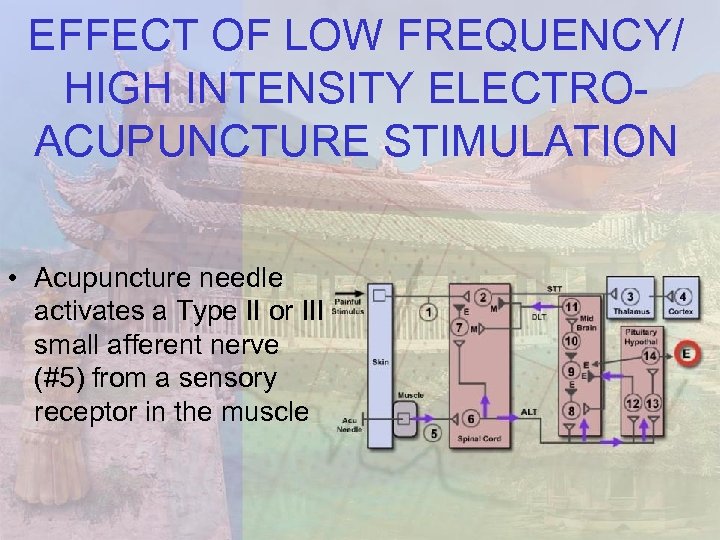
EFFECT OF LOW FREQUENCY/ HIGH INTENSITY ELECTROACUPUNCTURE STIMULATION • Acupuncture needle activates a Type II or III small afferent nerve (#5) from a sensory receptor in the muscle
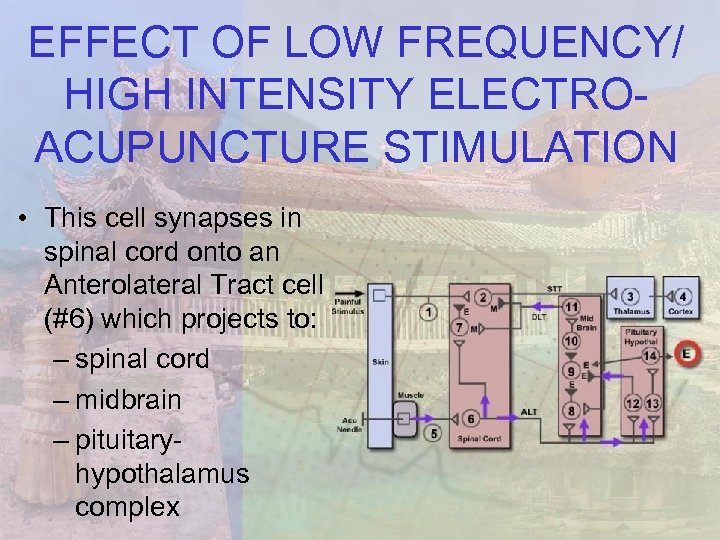
EFFECT OF LOW FREQUENCY/ HIGH INTENSITY ELECTROACUPUNCTURE STIMULATION • This cell synapses in spinal cord onto an Anterolateral Tract cell (#6) which projects to: – spinal cord – midbrain – pituitaryhypothalamus complex
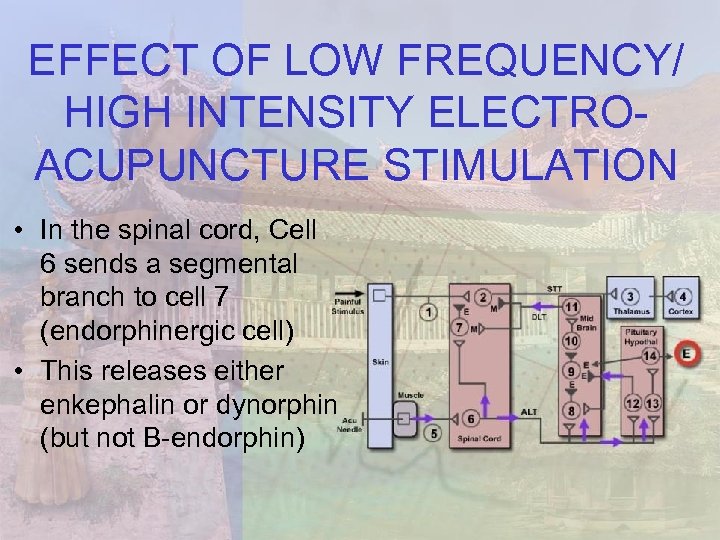
EFFECT OF LOW FREQUENCY/ HIGH INTENSITY ELECTROACUPUNCTURE STIMULATION • In the spinal cord, Cell 6 sends a segmental branch to cell 7 (endorphinergic cell) • This releases either enkephalin or dynorphin (but not B-endorphin)
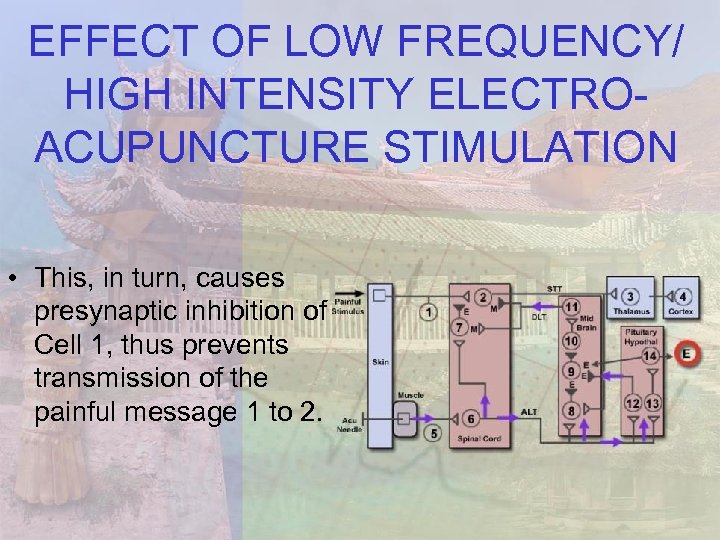
EFFECT OF LOW FREQUENCY/ HIGH INTENSITY ELECTROACUPUNCTURE STIMULATION • This, in turn, causes presynaptic inhibition of Cell 1, thus prevents transmission of the painful message 1 to 2.
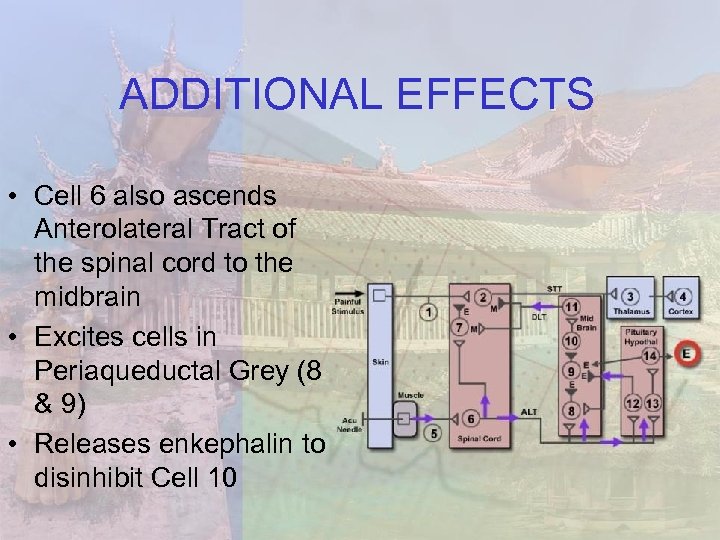
ADDITIONAL EFFECTS • Cell 6 also ascends Anterolateral Tract of the spinal cord to the midbrain • Excites cells in Periaqueductal Grey (8 & 9) • Releases enkephalin to disinhibit Cell 10
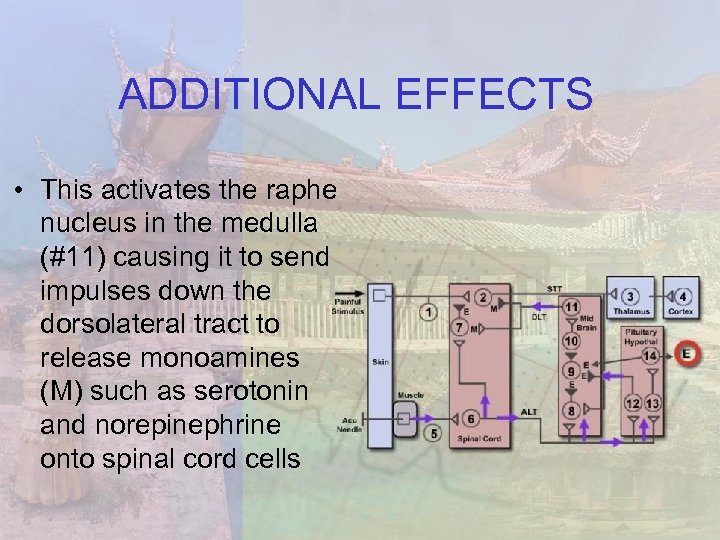
ADDITIONAL EFFECTS • This activates the raphe nucleus in the medulla (#11) causing it to send impulses down the dorsolateral tract to release monoamines (M) such as serotonin and norepinephrine onto spinal cord cells
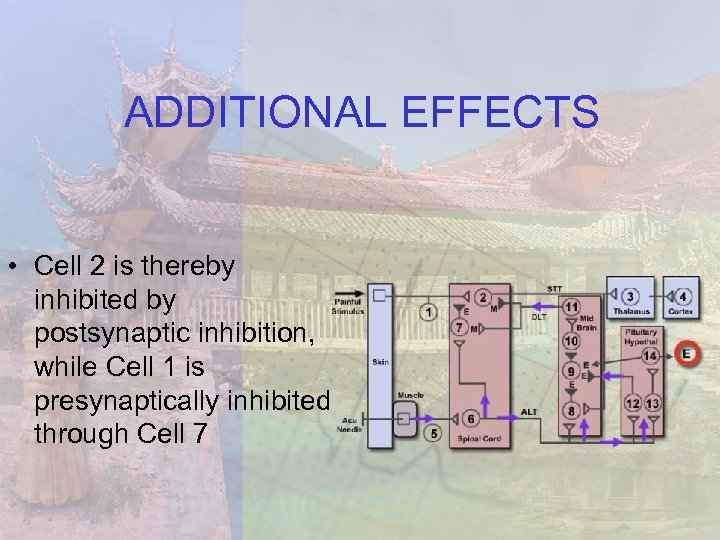
ADDITIONAL EFFECTS • Cell 2 is thereby inhibited by postsynaptic inhibition, while Cell 1 is presynaptically inhibited through Cell 7
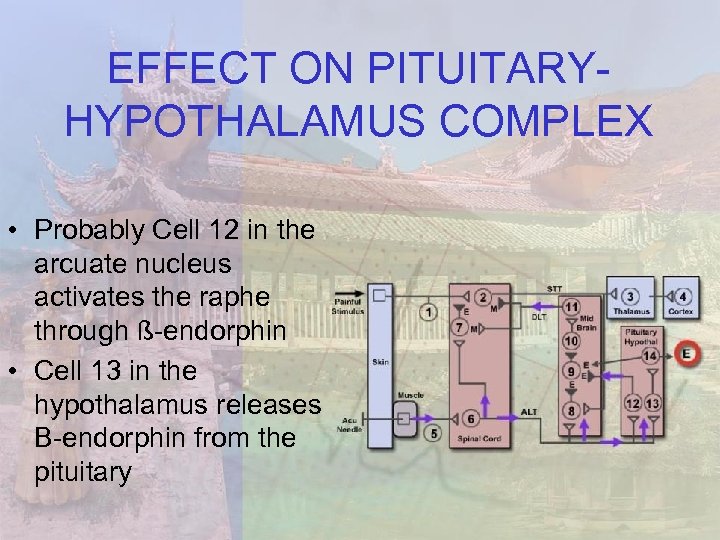
EFFECT ON PITUITARYHYPOTHALAMUS COMPLEX • Probably Cell 12 in the arcuate nucleus activates the raphe through ß-endorphin • Cell 13 in the hypothalamus releases B-endorphin from the pituitary
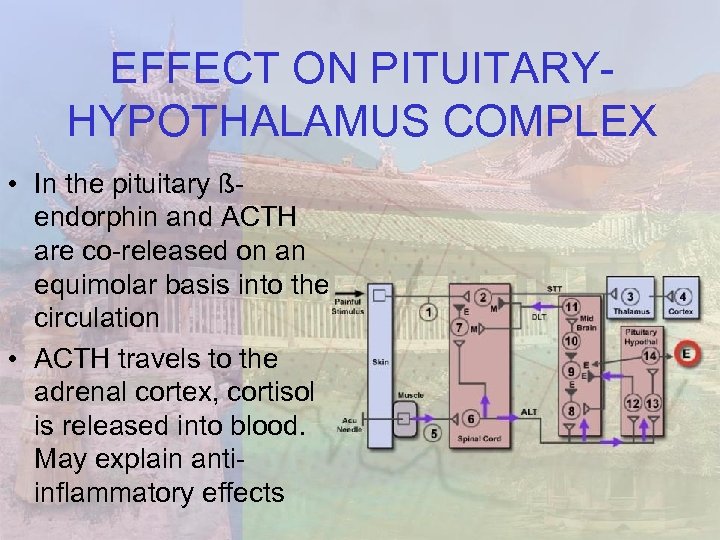
EFFECT ON PITUITARYHYPOTHALAMUS COMPLEX • In the pituitary ßendorphin and ACTH are co-released on an equimolar basis into the circulation • ACTH travels to the adrenal cortex, cortisol is released into blood. May explain antiinflammatory effects
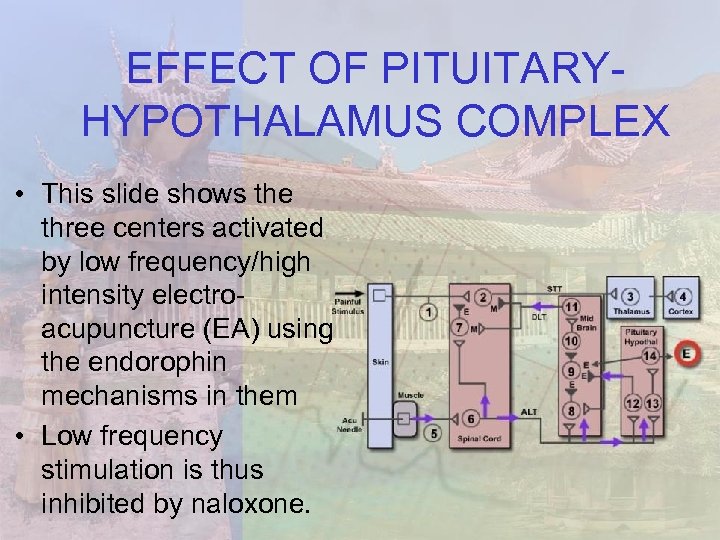
EFFECT OF PITUITARYHYPOTHALAMUS COMPLEX • This slide shows the three centers activated by low frequency/high intensity electroacupuncture (EA) using the endorophin mechanisms in them • Low frequency stimulation is thus inhibited by naloxone.
EFFECT OF HIGH FREQUENCY/ LOW INTENSITY EA STIMULATION
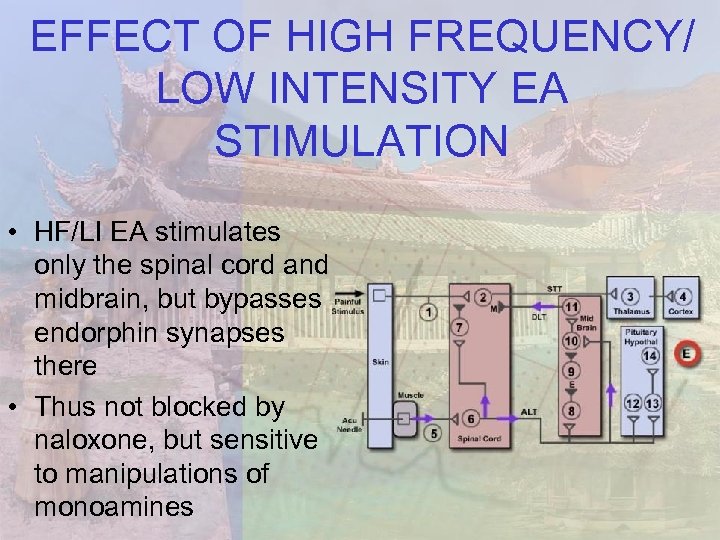
EFFECT OF HIGH FREQUENCY/ LOW INTENSITY EA STIMULATION • HF/LI EA stimulates only the spinal cord and midbrain, but bypasses endorphin synapses there • Thus not blocked by naloxone, but sensitive to manipulations of monoamines
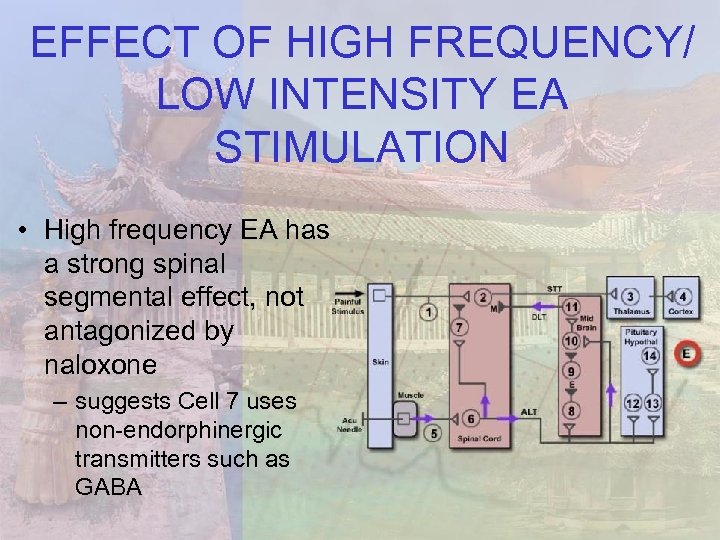
EFFECT OF HIGH FREQUENCY/ LOW INTENSITY EA STIMULATION • High frequency EA has a strong spinal segmental effect, not antagonized by naloxone – suggests Cell 7 uses non-endorphinergic transmitters such as GABA
ELECTRO-ACUPUNCTURE SUMMARY • EA activates nerve fibers in the muscle, which send impulses to the spinal cord to activate three centers to cause analgesia – the spinal site • enkephalin and dynorphin to block incoming messages with low frequency stimulation • other transmitters such as GABA at high frequencies – the midbrain – the pituitary
SUMMARY EA EFFECTS – The midbrain uses enkephalin to activate the raphe descending system • this inhibits spinal cord pain transmission by a synergistic effect of the monoamines serotonin and norepinephrine • also a circuit bypasses the endorphinergic links at high frequency stimulation
SUMMARY EA EFFECTS – The Pituitary • releases ß-endorphin into the blood and CSF to cause analgesia at a distance • the Hypothalamus sends long axons to the midbrain which, along with ß-endorphin, activate the descending analgesia system, activated only at low frequency stimulation
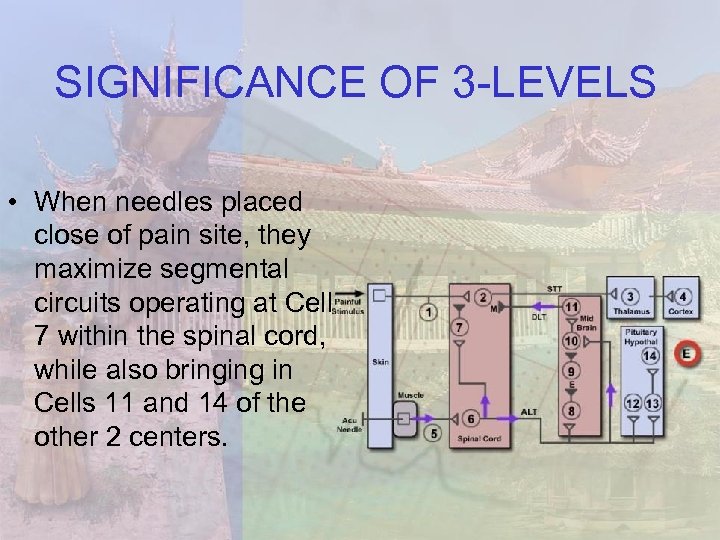
SIGNIFICANCE OF 3 -LEVELS • When needles placed close of pain site, they maximize segmental circuits operating at Cell 7 within the spinal cord, while also bringing in Cells 11 and 14 of the other 2 centers.
SIGNIFICANCE 3 -LEVELS • When needles are placed in distal points away from the painful region, they activate the midbrain and hypothalamic-pituitary complex without benefit of segmental effects • Clinically, the two kinds of needling are often used together, to enhance one another.
THE ANALGESIA PRODUCED BY THE 2 APPROACHES IS QUITE DIFFERENT • The low frequency stimulation produces analgesia of slower onset and long duration, with a 20 minute stimulation effecting 30 -120 minutes of analgesia – The effects are cumulative in repeat sessions – may be due to observed increase in m-RNA for endorphins seen for 48 hours after stimulation • The high frequency stimulation is rapid but short duration and no cumulative effects
ACUPUNCTURE NEEDLES PHYSICAL PROPERTIES • ACUPUNCTURE NEEDLES are ideal instruments due to their physical properties. • COMPOSITION: stainless steel shaft with a spiralled handle of copper, bronze, or alloy • THERMOCOUPLE EFFECT OF KELVINTHOMAS describes a gradient along the length of a homogenous conductor with a temperature gradient produced by the ends of the conductor at different temperatures.
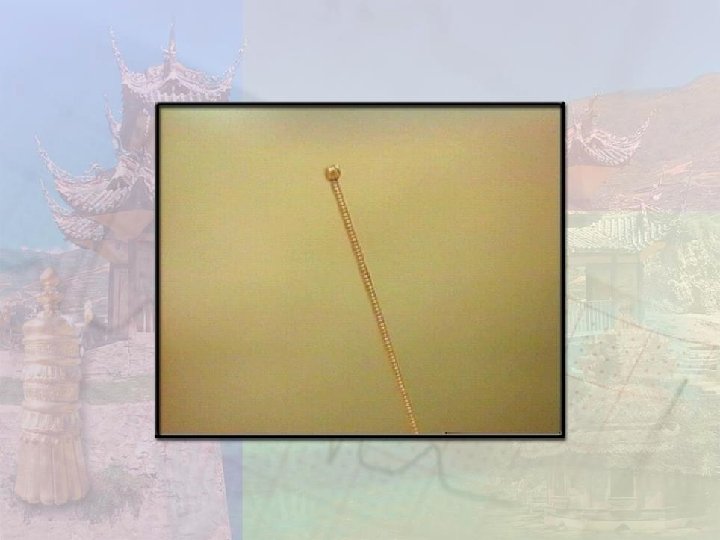
THE BENEDICK’S EFFECT • The current along a uniform conductor is reinforced by the electro-magnetic effect between the second (spiraled) metal of the handle in contact with the first metal of the shaft. – Typical needle is 1 to 8 cm long, 0. 3 -0. 4 mm in diameter or 28 to 26 gauge – Electrical potential is 3 microvolts, the tip at body temperature and the handle at T˚
NEEDLE IN DISPERSION • This gradient reaches equilibrium in 10 -15 minutes. • Dispersion is used in conditions defined as a problem of excess, such as acute strain or sprain. • The needle inserted, allow reaction to take place, often produces local erythema of skin, reaches equilibrium as erythema clears.
NEEDLE IN TONIFICATION • • Manipulation of the needle manually. The potential changes to 10 -15 microvolts. Reaches equilibrium in 60 to 90 minutes. Indicated in “deficiency states, ” chronic or dysfunction states. • Requires heat, manual manipulation or electrical stimulation in an anatomically logical circuit.
NEEDLE IN TONIFICATION • Provokes a wave of depolarization/repolarization that propagates itself from one needle to the next along the course of least resistance, the lamellar flow around the muscles, the deep aspect of the acupuncture meridians.
THE ACUPOINTS • TECHNETIUM 99 studies in France showed linear flow when injected in real points at 6 cm per minute by Dewars et al. • “Dummy” points did not show linear flow of Tc 99. • Stimulation of the injected points with a needle, electricity, or helium-neon laser in creased the migration rate not corresponding to vascular or lymphatic channels.
CLASSIC CHINESE WITH FRENCH ENERGETIC THEORIES • Single needle gives local agitation. • Second needle in circuit gives agitated equilibrium. • Third needle in circuit leads to dynamic equilibrium, thus flow within the meridian.
THE MERIDIANS OR CHANNELS • PRINCIPAL MERIDIANS-on classic acupuncture charts, main acupuncture circuits which develop early in embryonic life, associated with classic 12 organs/functions. • Tendinomuscular Meridians-often most useful in acute injuries. • Distinct Meridians-for organ or histopathological problems.
MERIDIANS OR CHANNELS • SHU MU SUBSYSTEM-to enhance the patient’s energetic level. • CURIOUS MERIDIANS-often for endocrine problems.
INTO THE MEDICAL MAINSTREAM • FDA 1996 - Classified acupuncture needle as Class 2 b medical device • National Institute of Health 1997 Consensus Conference showed “clear evidence” of acupuncture efficacy in various clinical conditions and deemed appropriate as “part of comprehensive care for others. ” Chairman Dr. David J. Ramsay states, “It’s time to take it seriously. ”
CONCLUSIONS • The needle is working through multiple vectors in the body’s physiology: – Functioning electrically on the body surface – Electro-ionically in interstitial milieu – Nerve and neurohumoral functions as per Pomeranz’s studies – Perineural conduction along myelin sheaths – Blood input via effects of neurohumoral, cellular, and blood chemistry changes – Immunologically via humoral and cellular changes
QUESTIONS • Question is not, “Does acupuncture work? , rather, “How does acupuncture work? ” • We need not ask, “Will our patients seek acupuncture for pain and medical complaints? , rather “When patients seek acupuncture care, who will they see, and as their physicians will we know appropriate conditions, training and coordination with allopathic medical care. • Who will make rules and policies regarding delivery of acupuncture in the U. S. ?

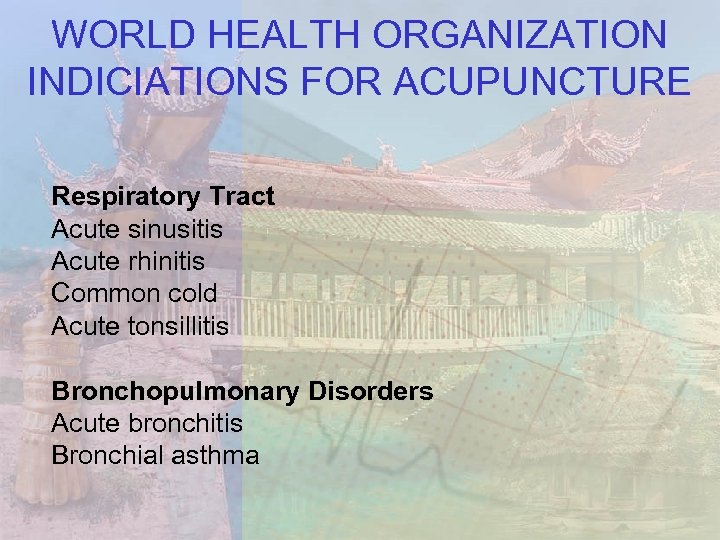
WORLD HEALTH ORGANIZATION INDICIATIONS FOR ACUPUNCTURE Respiratory Tract Acute sinusitis Acute rhinitis Common cold Acute tonsillitis Bronchopulmonary Disorders Acute bronchitis Bronchial asthma
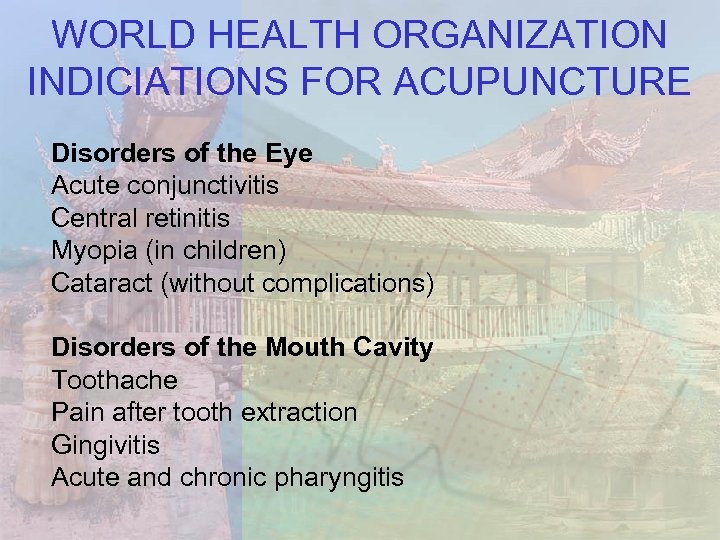
WORLD HEALTH ORGANIZATION INDICIATIONS FOR ACUPUNCTURE Disorders of the Eye Acute conjunctivitis Central retinitis Myopia (in children) Cataract (without complications) Disorders of the Mouth Cavity Toothache Pain after tooth extraction Gingivitis Acute and chronic pharyngitis
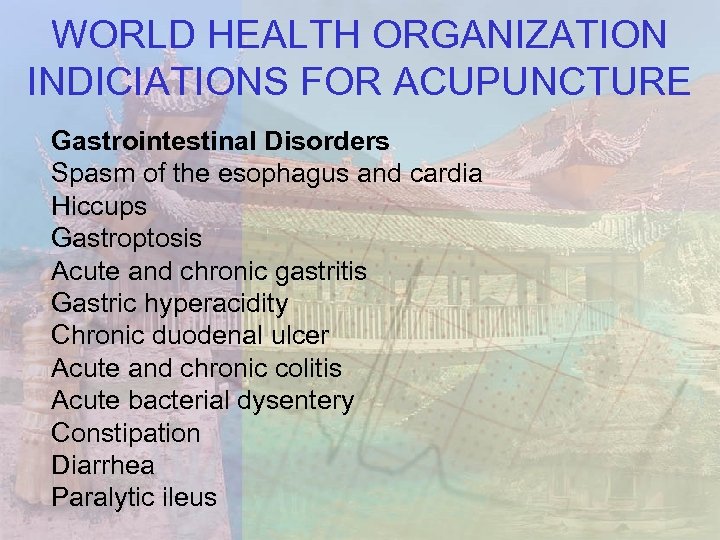
WORLD HEALTH ORGANIZATION INDICIATIONS FOR ACUPUNCTURE Gastrointestinal Disorders Spasm of the esophagus and cardia Hiccups Gastroptosis Acute and chronic gastritis Gastric hyperacidity Chronic duodenal ulcer Acute and chronic colitis Acute bacterial dysentery Constipation Diarrhea Paralytic ileus
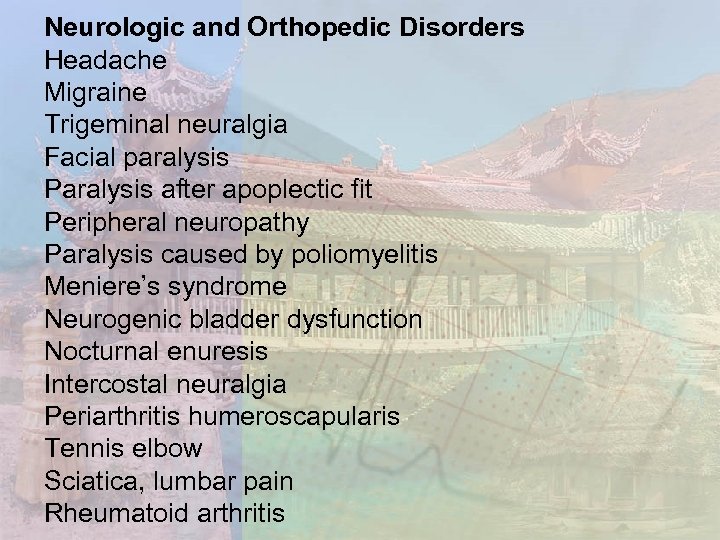
Neurologic and Orthopedic Disorders Headache Migraine Trigeminal neuralgia Facial paralysis Paralysis after apoplectic fit Peripheral neuropathy Paralysis caused by poliomyelitis Meniere’s syndrome Neurogenic bladder dysfunction Nocturnal enuresis Intercostal neuralgia Periarthritis humeroscapularis Tennis elbow Sciatica, lumbar pain Rheumatoid arthritis
Acknowledgements: Dr. Bruce Pomeranz, M. D. , Ph. D. Dr. Bryan L. Frank, M. D. Dr. Wendy E. Page-Echols, D. O. Ian Lewis Page-Echols
American Academy of Medical Acupuncture 4929 Wilshire Boulevard, #428 Los Angeles, CA 90010 (323) 937 -5514 http: //www. medicalacupuncture. org
 Скачать презентацию INTRODUCTION Background Survey of Acupuncture
78d6fd606f360c6622f3f71d9124db3b.ppt