


 Скачать презентацию Introduction and Welcome to the University OUTLINE
8549272f6e51c17296845858dd0d118b.ppt
- Количество слайдов: 71
 Introduction and Welcome to the University
 OUTLINE • Development and Growth • Strategic Plan • Organisational Structure • Governance • Budget
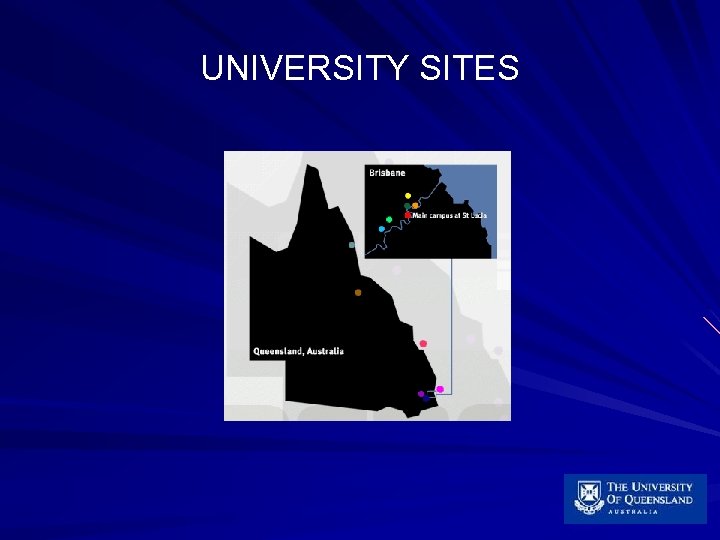 UNIVERSITY SITES
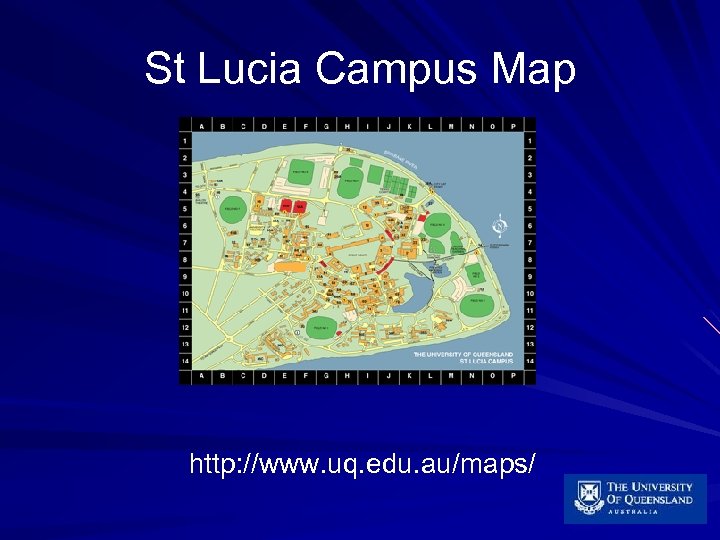 St Lucia Campus Map http: //www. uq. edu. au/maps/
 ESTABLISHMENT OF FACULTIES AT THE UNIVERSITY OF QUEENSLAND 1911 1925 1927 1935 1949 1967 1975 1991 1997 2001 Arts, Science, Engineering Commerce (and Economics) Agricultural Science Law, Dentistry, Veterinary Science, Medicine Education, Architecture and Planning Music Social Work Applied Science, Business (Gatton) Re-organisation into seven “super-faculties” Re-organisation onto schools
 MISSION The mission of The University of Queensland is to create a community dedicated to achieving national and international levels of excellence in teaching, research and scholarship, one that makes significant contributions to the intellectual, cultural, social and economic life of the state of Queensland the Australian nation.
 STRATEGIC PLAN 2006 - 2010 • Mission statement • Strategic aims, aspirations and commitments • Key operational priorities • Teaching and Learning* • Research and research training* • Community partnerships* • Management and resources* *Include strategic objectives and operational priorities
 Legislative Base • University of Queensland Act 1988 (as amended on 19 May 2005) Ø Ø Corporation State Statutory Authority • Commonwealth Higher Education Support Act
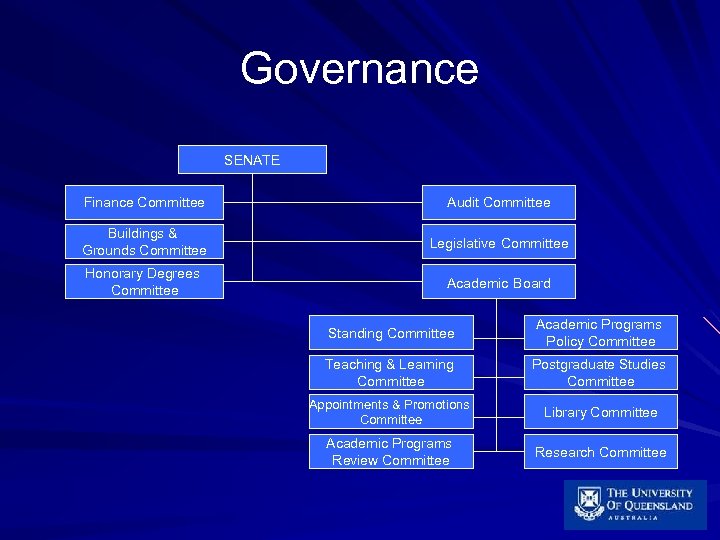 Governance SENATE Finance Committee Audit Committee Buildings & Grounds Committee Legislative Committee Honorary Degrees Committee Academic Board Standing Committee Academic Programs Policy Committee Teaching & Learning Committee Postgraduate Studies Committee Appointments & Promotions Committee Library Committee Academic Programs Review Committee Research Committee
 Powers of Senate • Appoint Staff • Manage and Control Ø University Affairs Ø University Property Ø University Finances • Anything necessary or convenient in connection with its functions • Must act in the way that appears to it most likely to promote the university’s interests • May delegate its powers except for Ø Making statutes or rules Ø Adopting the University budget Ø Approving expenditure (other than a scholarship or prize) of finds from bequests, donations or special grants
 Organisational Structure • Faculties • Schools • Centres • Major support areas • • Central Administration Library Information Technology Services Teaching and Educational Development Institute • Academic Board • Vice-Chancellor • Senior Executive
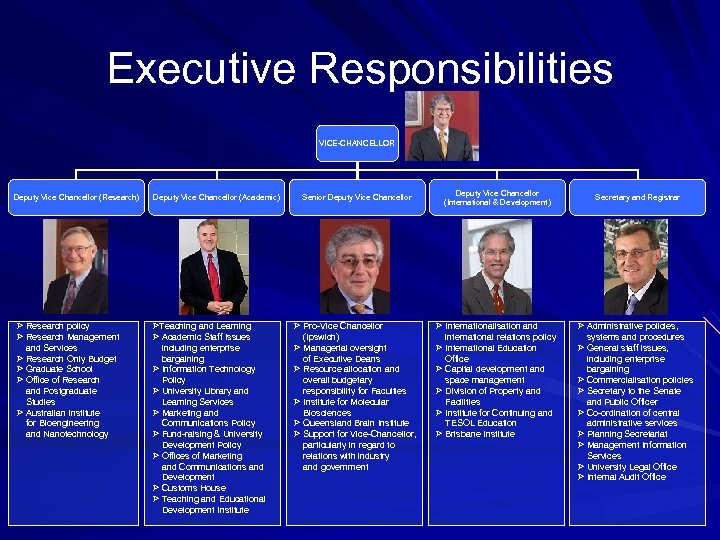 Executive Responsibilities VICE-CHANCELLOR Deputy Vice Chancellor (Research) Deputy Vice Chancellor (Academic) Ø Research policy Ø Research Management ØTeaching and Learning Ø Academic Staff Issues and Services Ø Research Only Budget Ø Graduate School Ø Office of Research and Postgraduate Studies Ø Australian Institute for Bioengineering and Nanotechnology including enterprise bargaining Ø Information Technology Policy Ø University Library and Learning Services Ø Marketing and Communications Policy Ø Fund-raising & University Development Policy Ø Offices of Marketing and Communications and Development Ø Customs House Ø Teaching and Educational Development Institute Senior Deputy Vice Chancellor (International & Development) Ø Pro-Vice Chancellor Ø Internationalisation and (Ipswich) Ø Managerial oversight of Executive Deans Ø Resource allocation and overall budgetary responsibility for Faculties Ø Institute for Molecular Biosciences Ø Queensland Brain Institute Ø Support for Vice-Chancellor, particularly in regard to relations with industry and government international relations policy Ø International Education Office Ø Capital development and space management Ø Division of Property and Facilities Ø Institute for Continuing and TESOL Education Ø Brisbane Institute Secretary and Registrar Ø Administrative policies, systems and procedures Ø General staff issues, including enterprise bargaining Ø Commercialisation policies Ø Secretary to the Senate and Public Officer Ø Co-ordination of central administrative services Ø Planning Secretariat Ø Management Information Services Ø University Legal Office Ø Internal Audit Office
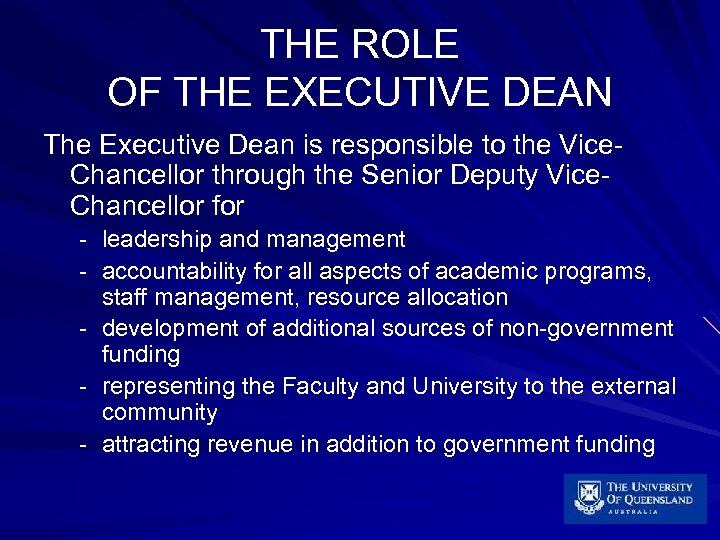 THE ROLE OF THE EXECUTIVE DEAN The Executive Dean is responsible to the Vice. Chancellor through the Senior Deputy Vice. Chancellor for - leadership and management - accountability for all aspects of academic programs, staff management, resource allocation - development of additional sources of non-government funding - representing the Faculty and University to the external community - attracting revenue in addition to government funding
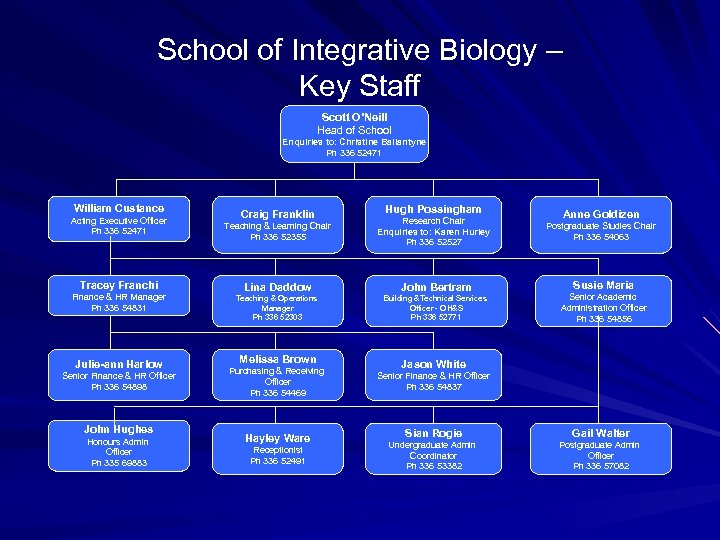 School of Integrative Biology – Key Staff Scott O’Neill Head of School Enquiries to: Christine Ballantyne Ph 336 52471 William Custance Acting Executive Officer Ph 336 52471 Tracey Franchi Finance & HR Manager Ph 336 54831 Julie-ann Harlow Senior Finance & HR Officer Ph 336 54898 John Hughes Honours Admin Officer Ph 335 69883 Hamish Franklin Craig Mc. Callum Teaching & Learning Chair Ph 336 52450 52355 Hugh Possingham Research Chair Enquiries to: Karen Hurley Ph 336 52527 Lina Daddow John Bertram Teaching & Operations Manager Ph 336 52303 Building &Technical Services Officer - OH&S Officer Ph 336 52771 Melissa Brown Purchasing & Receiving Officer Ph 336 54469 Hayley Ware Receptionist Ph 336 52491 Anne Goldizen Postgraduate Studies Chair Ph 336 54063 Susie Maria Iola Ternel Manager, Academic Senior Academic Administration Officer Administration Ph 336 54856 Anna Gallard Jason White Purchasing & Receiving Senior Finance & HR Officer Ph 336 54837 Ph 336 54469 Sian Rogie Gail Walter Undergraduate Admin Coordinator Ph 336 53382 Postgraduate Admin Officer Ph 336 57082
 SETTLING IN AT UQ http: //www. uq. edu. au/new-staff/ Employment Information Career Progress and Appraisal Handbook of University Policies and Procedures (HUPP) Financial Management Practices Manual (FMPM) Code of Conduct Protocol
 Industrial Awards and Agreements General Staff • The University of Queensland General Staff Award 2003 • Enterprise Agreement (General Staff) 2005 Academic & General Staff • Higher Education Contract of Employment Award 1998 Academic Staff • Higher Education Academic Salaries Award 2002 • Enterprise Agreement (Academic Staff) 2005 TESOL Staff • Enterprise Agreement TESOL Language Instructors 2005
 Australian Workplace Agreements (AWA) • New staff offered a choice of Enterprise Agreement or AWA from 29 April 2005 • All staff offered choice from August 2006
 Standard Hours of Work (General Staff: HEW Levels 1 – 7) • Fixed commencing and ceasing times • Can be changed by the employer with one • • • week’s notice 36 ¼ hour week 7 ¼ hour day 45 minute unpaid meal break Within prescribed span of hours 2 x 10 minute paid rest pause
 Flexible Hours Arrangements (General Staff: HEW Levels 1 – 7) • Four and a half day week (4 days x 8 hours and 1 day x 4 ¼ hours) • Nine day fortnight (72 & ½ hours spread over 9 days of the fortnight)
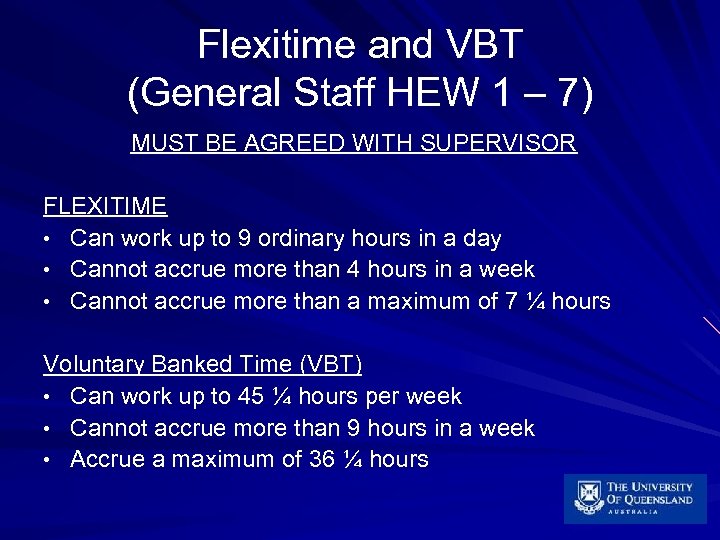 Flexitime and VBT (General Staff HEW 1 – 7) MUST BE AGREED WITH SUPERVISOR FLEXITIME • Can work up to 9 ordinary hours in a day • Cannot accrue more than 4 hours in a week • Cannot accrue more than a maximum of 7 ¼ hours Voluntary Banked Time (VBT) • Can work up to 45 ¼ hours per week • Cannot accrue more than 9 hours in a week • Accrue a maximum of 36 ¼ hours
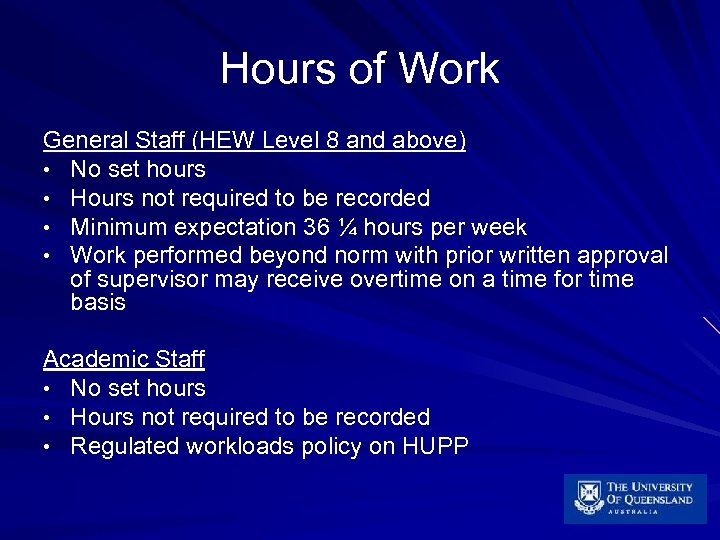 Hours of Work General Staff (HEW Level 8 and above) • No set hours • Hours not required to be recorded • Minimum expectation 36 ¼ hours per week • Work performed beyond norm with prior written approval of supervisor may receive overtime on a time for time basis Academic Staff • No set hours • Hours not required to be recorded • Regulated workloads policy on HUPP
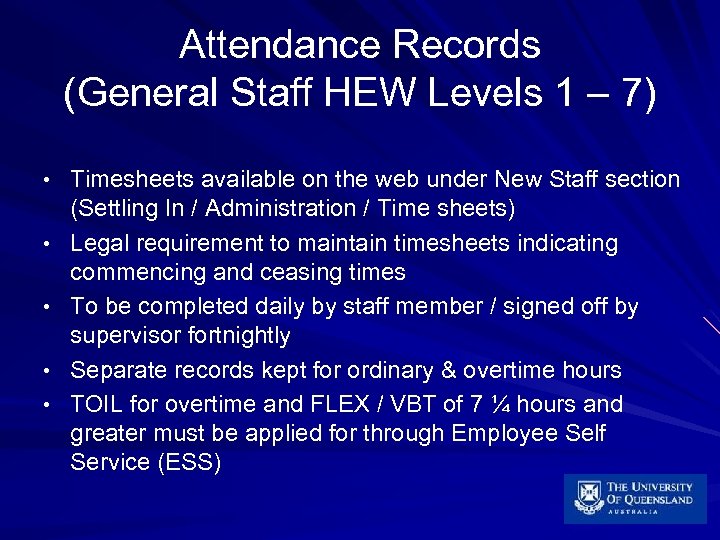 Attendance Records (General Staff HEW Levels 1 – 7) • Timesheets available on the web under New Staff section • • (Settling In / Administration / Time sheets) Legal requirement to maintain timesheets indicating commencing and ceasing times To be completed daily by staff member / signed off by supervisor fortnightly Separate records kept for ordinary & overtime hours TOIL for overtime and FLEX / VBT of 7 ¼ hours and greater must be applied for through Employee Self Service (ESS)
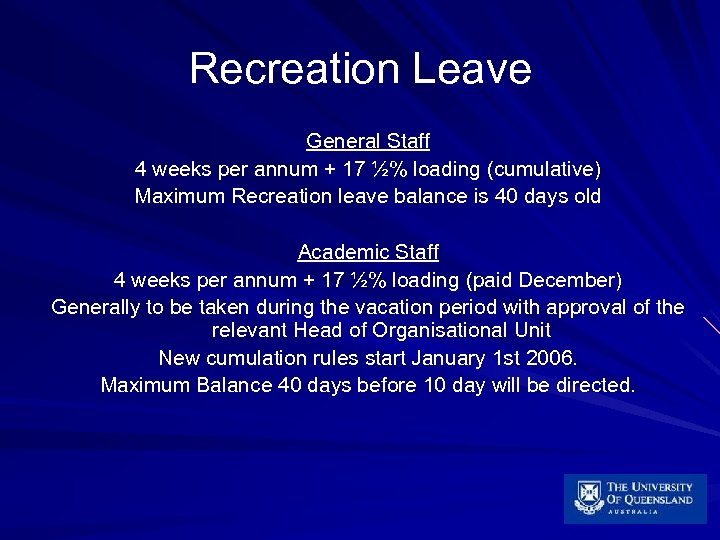 Recreation Leave General Staff 4 weeks per annum + 17 ½% loading (cumulative) Maximum Recreation leave balance is 40 days old Academic Staff 4 weeks per annum + 17 ½% loading (paid December) Generally to be taken during the vacation period with approval of the relevant Head of Organisational Unit New cumulation rules start January 1 st 2006. Maximum Balance 40 days before 10 day will be directed.
 Sick Leave General Staff 10 days Sick Leave (cumulative) Medical certificate required after three days Academic Staff (including Grant appointed) Credited on January 1 st each year 5 days Carers Leave, 30 days Sick Leave (non-cumulative) 10 days Sick Leave (cumulative) Pro rata amount for staff employed after January 1 st Long Service Leave 13 weeks paid leave after 10 years of continuous service Maximum LSL balance is 26 weeks
 Carer’s Leave All Staff After 12 months’ service – 5 days in a calendar year, non-cumulative Up to 12 months’ service – Pro-rata from commencement For over 3 consecutive days, a medical certificate or statutory declaration required
 Superannuation Eligible staff fill in a Uni. Super application form All staff not covered by Uni. Super (Defined Benefit Division/Accumulation 2) (providing 17% employer contributions) are covered by Uni. Super Accumulation 1 (9% employer contributions – when earnings are in excess of $450 per month) Queries to Superannuation Section: 3365 2993
 For more information on Employment Conditions See the UQ web site at http: //www. uq. edu. au/new-staff/
 CAREER PROGRESS & APPRAISAL
 STAFF APPRAISAL Benefits « Confirm what is expected of you « Receive feedback and recognition « Discuss your career goals « Plan personal and professional development
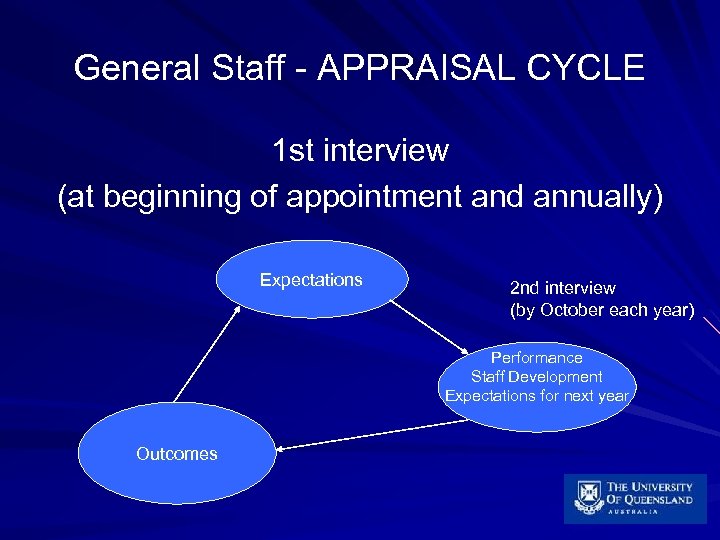 General Staff - APPRAISAL CYCLE 1 st interview (at beginning of appointment and annually) Expectations 2 nd interview (by October each year) Performance Staff Development Expectations for next year Outcomes
 General Staff SETTING EXPECTATIONS 1 st Annual Review meeting (now) Staff member and supervisor - discuss and record: • • • Primary purpose of position Tasks / accountabilities Objectives (HEW levels 5 - 10)
 General Staff - APPRAISAL 2 nd Annual Review meeting (October) Staff member and supervisor - discuss and record: • Assessment of performance against expectations • Skills and knowledge needs • Training and development plan • Recommendation for increment or double increment • Expectations and objectives for next year
 The difference between General Staff Classification and Performance Review • CLASSIFICATION - Evaluation of the work role and responsibilities of the position • PERFORMANCE REVIEW Assessment of the performance of the individual in the position THE RECOGNITION AND DEVELOPMENT PROGRAM COMPLEMENTS THE JOB CLASSIFICATION PROCESS
 Academic Staff - APPRAISAL Academic appraisal will be covered in the course: Developing Your Role as a UQ Academic
 THE STAFF DEVELOPMENT PROGRAM INCLUDES • • • Induction Leadership and Management Finance, Administration and IT Teaching and Learning Academic Career Advancement Internationalisation Researching Skills Occupational Health and Safety Mentoring Equity and Diversity www. tedi. uq. edu. ay/sdh
 Handbook of University Policies and Procedures http: //www. uq. edu. au/hupp 1. 2. 3. 4. 5. 6. 7. 8. University Organisation and Governance Workplace Health and Safety Teaching and Learning Research and Postgraduate Studies Human Resources Information Technology Physical Facilities and Services Community and Development Activities
 Links to Information • Sexual Harassment http: //www. uq. edu. au/hupp/index. html? policy=1. 70. 2 • Discrimination, Harassment and Bullying http: //www. uq. edu. au/hupp/index. html? policy=1. 70. 6 • Opposing Racism - http: //www. uq. edu. au/about/valuing-diversityopposing-racism • Guide to using Inclusive Language http: //www. uq. edu. au/equity/docs/inclusive_language 05. pdf
 Links to Information - (continued) • Unisafe: Personal Safety on Campus http: //www. uq. edu. au/unisafe/p ersonal-safety. html • Parking at UQ http: //www. uq. edu. au/parking/ • Balancing work and family http: //www. uq. edu. au/equity/? p age=11661 • Smoking on campus http: //www. uq. edu. au/hupp/? pa ge=25058&pid=25015
 Financial Management Practices Manual http: //www. bs. uq. edu. au/FMPM 1. 2. 3. 4. 5. 6. 7. University Budget Financial Delegations Revenue Expenditure Salaries Assets, Liabilities and Equity Financial Systems
 Code of Conduct http: //www. uq. edu. au/new-staff/ (under Settling In / Policies and Procedures) 1. Respect for the law and system of University 2. 3. 4. 5. Governance Respect for persons Integrity Dilligence Economy and efficiency
 Office of Marketing and Communications Protocol and Ceremonies • Provide advice and management expertise to the Senior Executive in relation to the staging of major university events
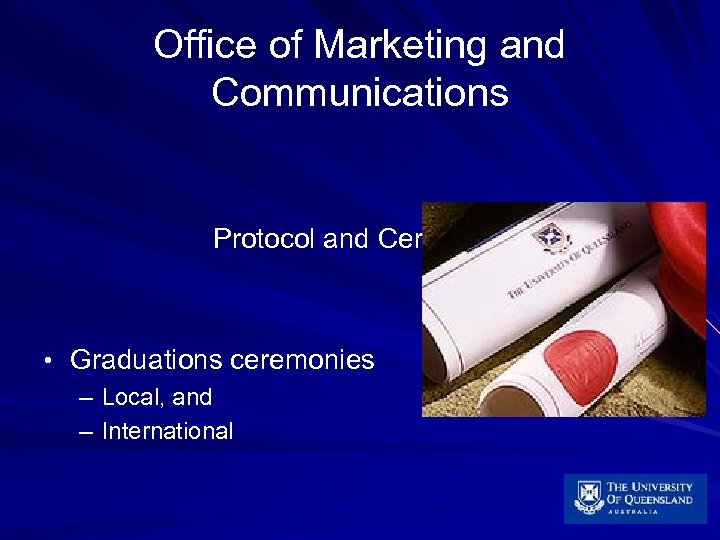 Office of Marketing and Communications Protocol and Ceremonies • Graduations ceremonies – Local, and – International
 Office of Marketing and Communications Protocol and Ceremonies • Co-ordinate invitations to and oversee events attended by • • • Regal, Vice-Regal representatives, Federal and State Government Ministers, Members of the diplomatic Corps, foreign government and dignitaries, and Presidents of leading international universities See Vice-Chancellor’s Protocol Guidelines at: www. uq. edu. au/omc/docs/protocol_guidelines. pdf
 Office of Marketing and Communications Protocol and Ceremonies • Provide support for internal and external community relations activities
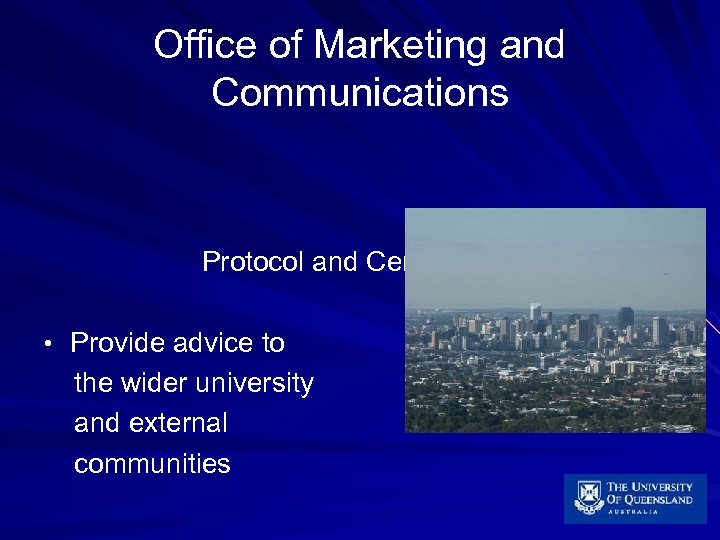 Office of Marketing and Communications Protocol and Ceremonies • Provide advice to the wider university and external communities
 Office of Marketing and Communications Protocol and Ceremonies Contacts Manager • John Moller • • • Ph: 3365 2737 Protocol Officers Anna Roberts Ph: 3365 3159 Helen Bourke Ph: 3365 1596 Protocol Assistant Jasmin Haddadi Ph: 3365 7045
 Office of Marketing and Communications Overseas Visitors to UQ • Co-ordinated by International Education Directorate (IED) • Contact: Ms Elizabeth Pitts 3365 1978
 The cost of workplace injuries Components of cost of workplace injuries – Workers’ Compensation and rehabilitation – Related health and social service costs – Property damage (insurance costs) – Disruption to production and lost business opportunity – Legislative and administrative costs Total cost > $33 billion / year (Australia, 2004)
 Queensland Workplace Health and Safety Act 1995 • New legislation in 1989 to replace a wide range of prescriptive OH&S Acts and Regulations • Revised in 2002
 OH&S Responsibilities Individual Staff • Compliance with safe working procedures • Use of appropriate personal protective equipment and safety systems • Participating in risk assessments • Reporting of OH&S problems
 OH&S Responsibilities Supervisors • Provision of information, training and • • • supervision Undertake risk assessments Ensure application of appropriate risk control measures Undertake accident investigations
 Worker’s Compensation • • • License Approved Commenced 1 April 2001 Conditions for access the compensation remain the same Administered by the Work Injury Management team Notional Premium Rehabilitation - suitable duties will be critical for success
 Occupational Health and Safety For further information please visit our website www. uq. edu. au/ohs Or call 3365 2365
 The Equity Office Equity and Diversity Make a Difference
 Why Equity? • Legislative requirements • Reporting requirements • Business imperatives • Community Values • Social Justice
 The role of The Equity Office • Effect cultural change - embed equity • Drive improved performance Internal consultancy to the University Community
 Issues of particular importance http: //eoonline. uow. edu. au • Mandatory for all new staff • Overview of legislation, policy and procedures - Discrimination and Harassment • Direct links to all relevant policies at UQ • Designed for University context
 Issues - (continued) • Staff and students knowing rights and responsibilities • • first steps in addressing an issue Sexual harassment awareness training - an EOWA requirement Managing family friendly policies - eg parental leave, carer’s leave University Equity & Diversity Plan Disability Action Plan - procedures for students with a disability - Student Support Services
 What does this mean for you? • Model appropriate behavior and language use • Demonstrate respect and sensitivity to others • Practice inclusive teaching • Become familiar with policies & procedures • Proactive prevention, Early intervention, Accurate information
 The Equity Office is here to assist you! Call us – to talk over plans, issues, seek advice, give feedback… www. uq. edu. au/equity Equity and Diversity – Make a Difference
 The UQ Library www. library. uq. edu. au We link people with information
 The UQ Library • The University of Queensland Library (Cybrary) combines physical space and cyberspace, real and virtual information resources and in-person and online assistance – One of the largest collections amongst academic libraries in Australia and by far the largest in Queensland – A gateway for users located anywhere to access POP (print on paper) and WOW (words on the web) everywhere – Window on the world of knowledge – Virtual library in a wired university – Springboard to learning
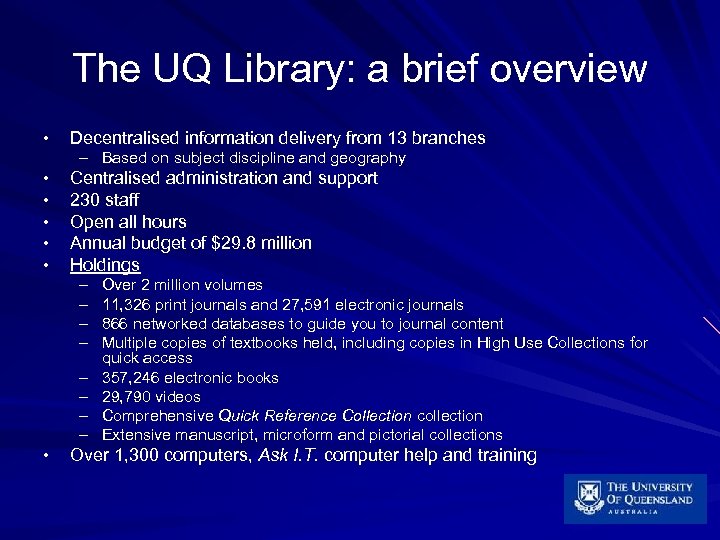 The UQ Library: a brief overview • Decentralised information delivery from 13 branches – Based on subject discipline and geography • • • Centralised administration and support 230 staff Open all hours Annual budget of $29. 8 million Holdings – – – – • Over 2 million volumes 11, 326 print journals and 27, 591 electronic journals 866 networked databases to guide you to journal content Multiple copies of textbooks held, including copies in High Use Collections for quick access 357, 246 electronic books 29, 790 videos Comprehensive Quick Reference Collection collection Extensive manuscript, microform and pictorial collections Over 1, 300 computers, Ask I. T. computer help and training
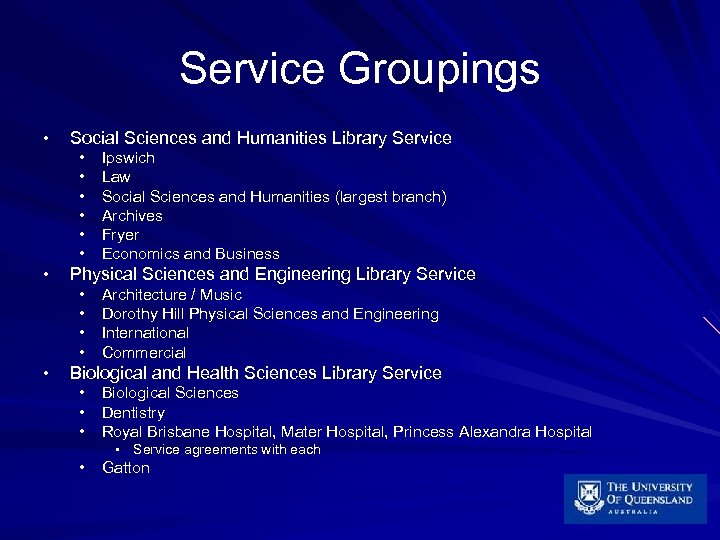 Service Groupings • Social Sciences and Humanities Library Service • • Physical Sciences and Engineering Library Service • • • Ipswich Law Social Sciences and Humanities (largest branch) Archives Fryer Economics and Business Architecture / Music Dorothy Hill Physical Sciences and Engineering International Commercial Biological and Health Sciences Library Service • Biological Sciences • Dentistry • Royal Brisbane Hospital, Mater Hospital, Princess Alexandra Hospital • Service agreements with each • Gatton
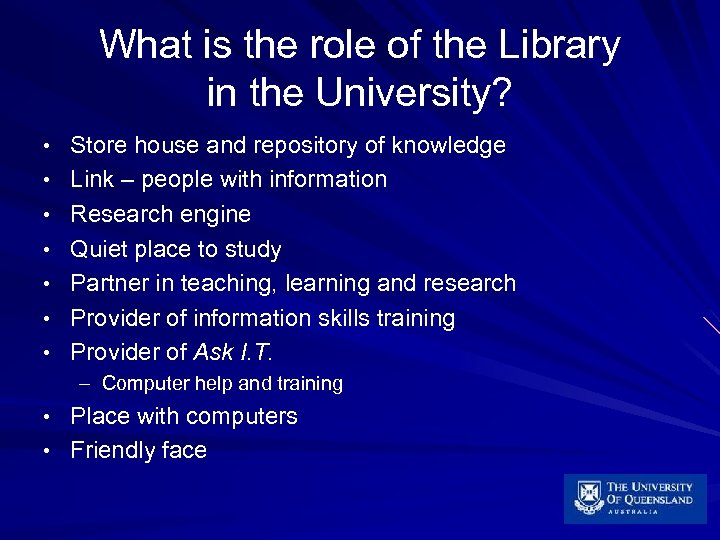 What is the role of the Library in the University? • Store house and repository of knowledge • Link – people with information • Research engine • Quiet place to study • Partner in teaching, learning and research • Provider of information skills training • Provider of Ask I. T. – Computer help and training • Place with computers • Friendly face
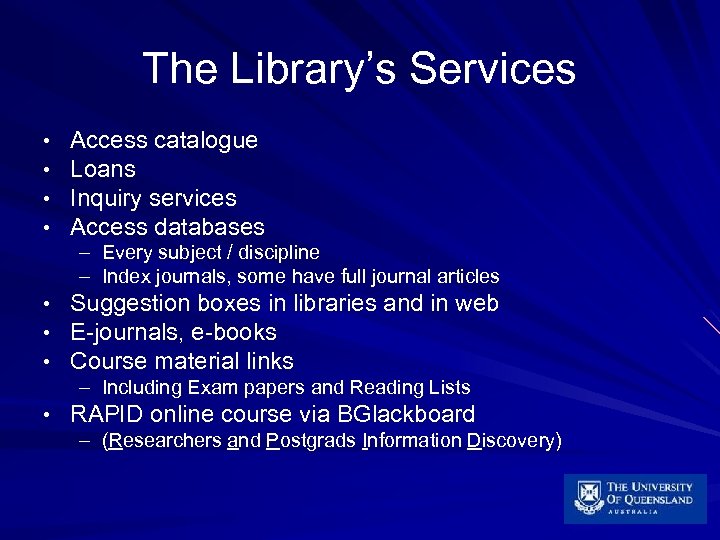 The Library’s Services • • Access catalogue Loans Inquiry services Access databases – – • • • Every subject / discipline Index journals, some have full journal articles Suggestion boxes in libraries and in web E-journals, e-books Course material links – Including Exam papers and Reading Lists • RAPID online course via BGlackboard – (Researchers and Postgrads Information Discovery)
 More Library Services • Theses in digital form – Australian Digital Theses • UQ Research Finder – A one-stop shop for finding about University of Queensland research output from 1999 to-date • Eprints UQ – Deposit collection of papers of the research output of UQ academic staff and postgrads • • • Internet and subject gateways – Agrigate, Weblaw etc. Identification of teaching / learning materials Guides to use – Subject guides [Find. Its] – Resources to get you started – “How-to” guides [Use. Its] – Citing references, research skills
 And still more… • Photocopying / printing • Printed guides • Displays of new materials • Liaison librarians – http: //www. library. uq. edu. au/about/liason. phtml • Ask a Librarian • Ask I. T. – Computer help and training for students • Information skills training • Email of library notices
 Facilities in each branch library • • • Inquiry desk Loans (including auto-loan) High Use Area (textbooks and reading) Photocopying / Printing e. Zones Ask I. T. (at each campus) Training rooms Security Study spaces
 Study Spaces • Quiet – individual carrels / desks • Open tables – group work • Comfortable chairs / Floor • Graduate Study Centres • Conference Room • Computer training Rooms • Air conditioned • Café
 The University of Queensland Library We link people with information www. library. uq. edu. au