 Скачать презентацию Introducing the Next-Generation Performance and More Capabilities corbett
ebf62a1c29a6abbc7b258af054907f57.ppt
- Количество слайдов: 49



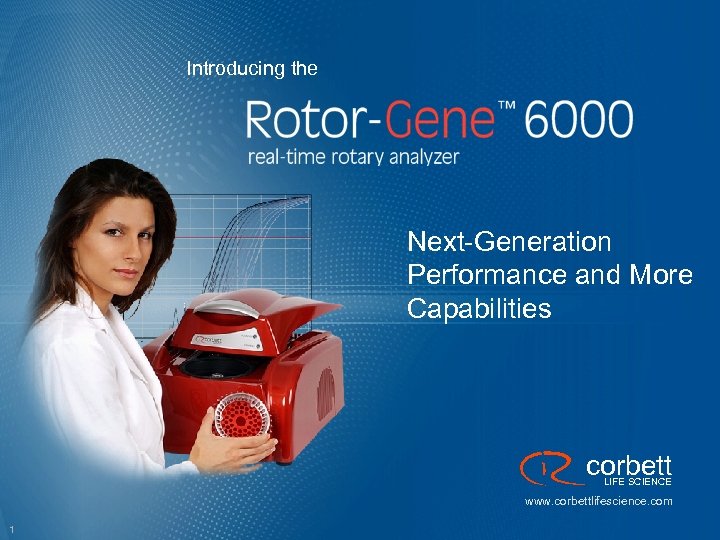
Introducing the Next-Generation Performance and More Capabilities corbett LIFE SCIENCE www. corbettlifescience. com 1
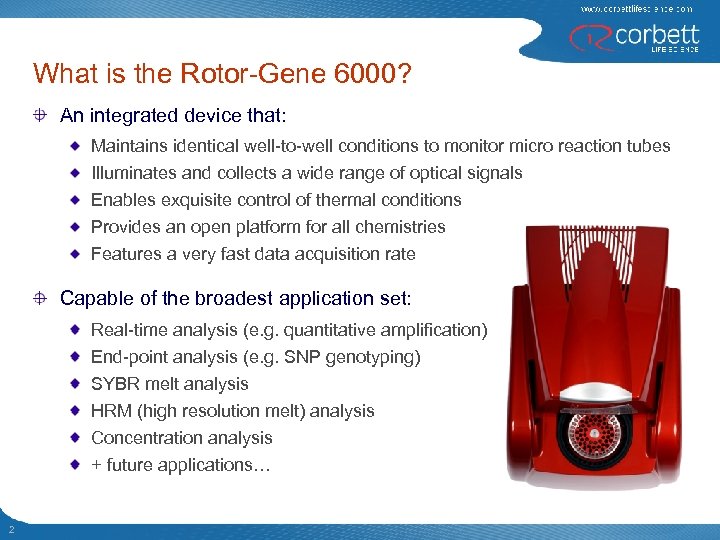
What is the Rotor-Gene 6000? An integrated device that: Maintains identical well-to-well conditions to monitor micro reaction tubes Illuminates and collects a wide range of optical signals Enables exquisite control of thermal conditions Provides an open platform for all chemistries Features a very fast data acquisition rate Capable of the broadest application set: Real-time analysis (e. g. quantitative amplification) End-point analysis (e. g. SNP genotyping) SYBR melt analysis HRM (high resolution melt) analysis Concentration analysis + future applications… 2
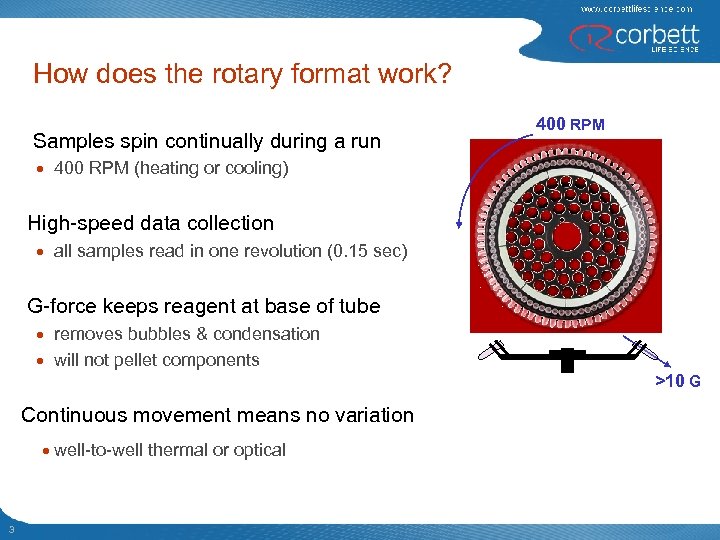
How does the rotary format work? Samples spin continually during a run 400 RPM (heating or cooling) High-speed data collection all samples read in one revolution (0. 15 sec) G-force keeps reagent at base of tube removes bubbles & condensation will not pellet components >10 G Continuous movement means no variation well-to-well thermal or optical 3
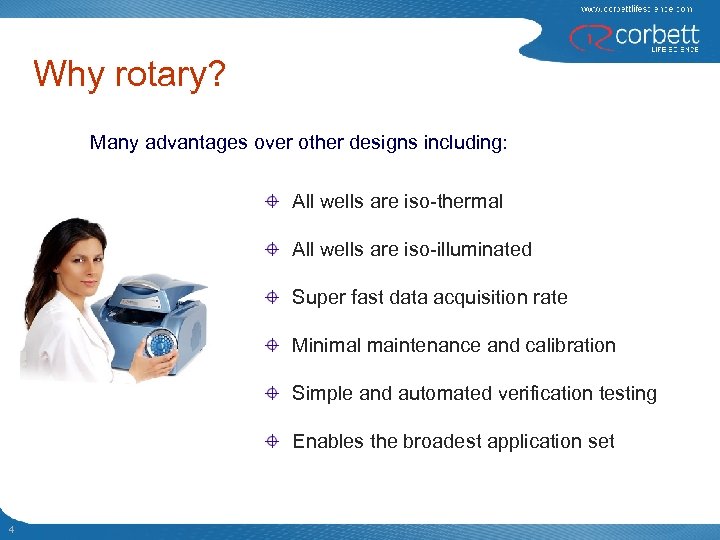
Why rotary? Many advantages over other designs including: All wells are iso-thermal All wells are iso-illuminated Super fast data acquisition rate Minimal maintenance and calibration Simple and automated verification testing Enables the broadest application set 4
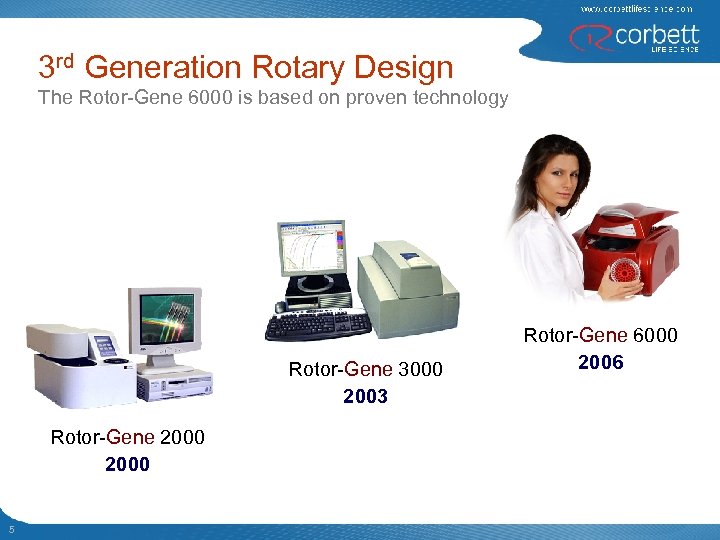
3 rd Generation Rotary Design The Rotor-Gene 6000 is based on proven technology Rotor-Gene 3000 2003 Rotor-Gene 2000 5 Rotor-Gene 6000 2006
6
Optics 7
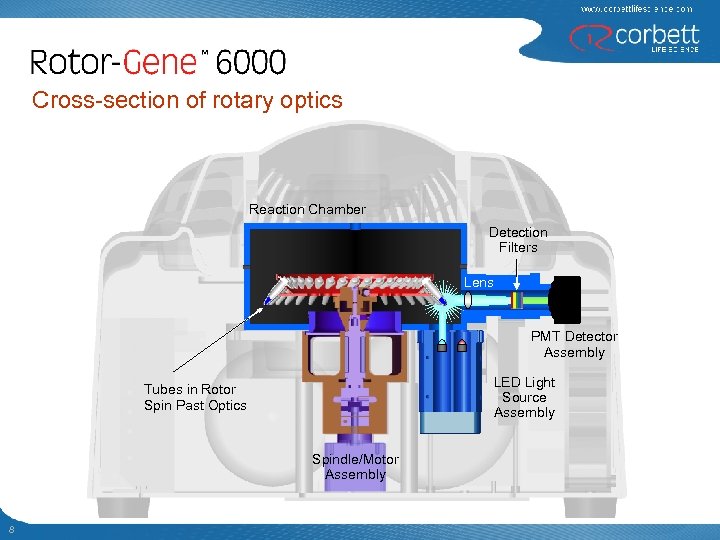
Cross-section of rotary optics Reaction Chamber Detection Filters Lens PMT Detector Assembly LED Light Source Assembly Tubes in Rotor Spin Past Optics Spindle/Motor Assembly 8
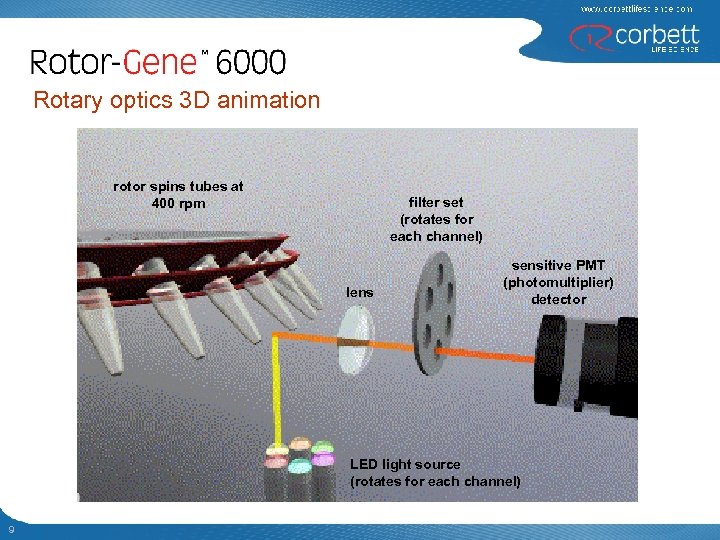
Rotary optics 3 D animation rotor spins tubes at 400 rpm filter set (rotates for each channel) lens sensitive PMT (photomultiplier) detector LED light source (rotates for each channel) 9
Rotary Design means: low maintenance & maximum convenience No optical normalization needed (thus no special reagents either) No passive reference dye needed (e. g. ROX™) No lamp replacement or maintenance (lifetime guarantee on lightsource) No block to clean (because tubes hang in mid air) No bubbles in reaction (automatically removed by centrifugal rotor) Tube caps can be labeled (not possible with 96 -well systems) Supports several tube formats (by simply swapping rotors) 10
Light-Emitting Diode (LED) Light Source LEDs last >100, 000 hrs Low-power, low-temperature device LEDs have a focussed light-emitting area Separate LED used for each channel from infra-red (IR) to ultra-violet (UV) Estimated lifespan ~40 years (assuming 4 runs every working day) Rotor-Gene LEDs are guaranteed for the life of the instrument! 11
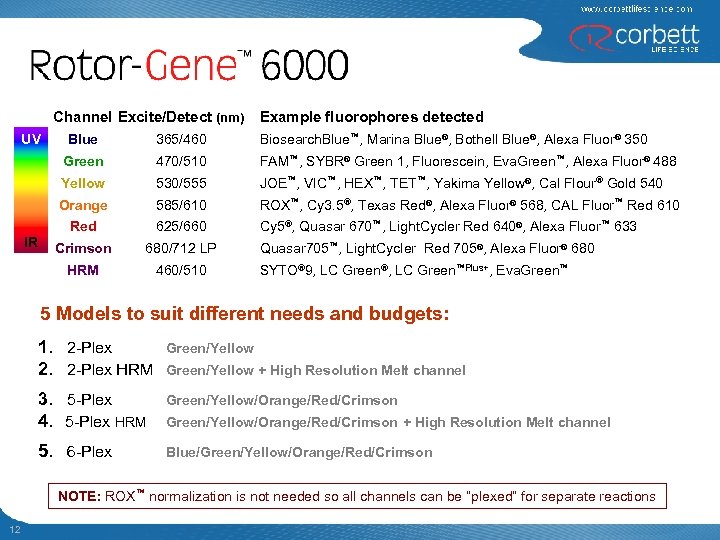
Channel Excite/Detect (nm) UV Example fluorophores detected 365/460 Biosearch. Blue™, Marina Blue®, Bothell Blue®, Alexa Fluor® 350 Green 470/510 FAM™, SYBR® Green 1, Fluorescein, Eva. Green™, Alexa Fluor® 488 Yellow 530/555 JOE™, VIC™, HEX™, TET™, Yakima Yellow®, Cal Flour® Gold 540 Orange 585/610 ROX™, Cy 3. 5®, Texas Red®, Alexa Fluor® 568, CAL Fluor™ Red 610 Red 625/660 Cy 5®, Quasar 670™, Light. Cycler Red 640®, Alexa Fluor™ 633 Crimson 680/712 LP HRM IR Blue 460/510 Quasar 705™, Light. Cycler Red 705®, Alexa Fluor® 680 SYTO® 9, LC Green®, LC Green™Plus+, Eva. Green™ 5 Models to suit different needs and budgets: 1. 2 -Plex 2. 2 -Plex HRM Green/Yellow 3. 5 -Plex 4. 5 -Plex HRM Green/Yellow/Orange/Red/Crimson 5. 6 -Plex Blue/Green/Yellow/Orange/Red/Crimson Green/Yellow + High Resolution Melt channel Green/Yellow/Orange/Red/Crimson + High Resolution Melt channel NOTE: ROX™ normalization is not needed so all channels can be “plexed” for separate reactions 12
Thermal Control 13
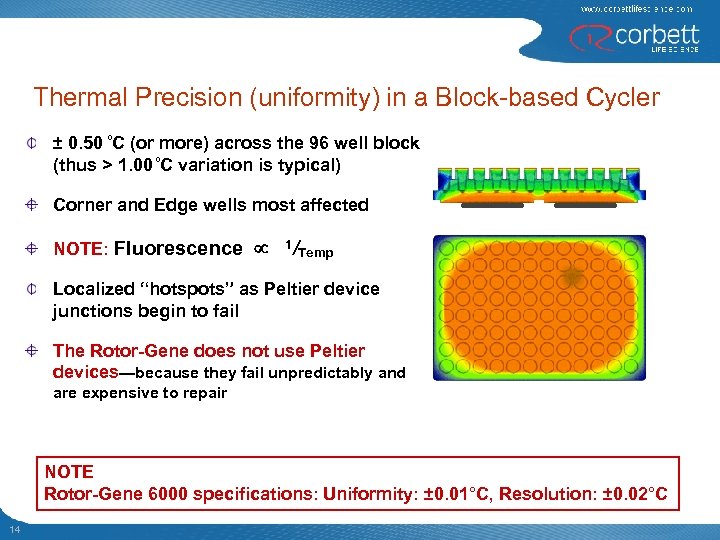
Thermal Precision (uniformity) in a Block-based Cycler ± 0. 50 ºC (or more) across the 96 well block (thus > 1. 00 ºC variation is typical) Corner and Edge wells most affected NOTE: Fluorescence 1/ Temp Localized “hotspots” as Peltier device junctions begin to fail The Rotor-Gene does not use Peltier devices—because they fail unpredictably and are expensive to repair NOTE Rotor-Gene 6000 specifications: Uniformity: ± 0. 01°C, Resolution: ± 0. 02°C 14
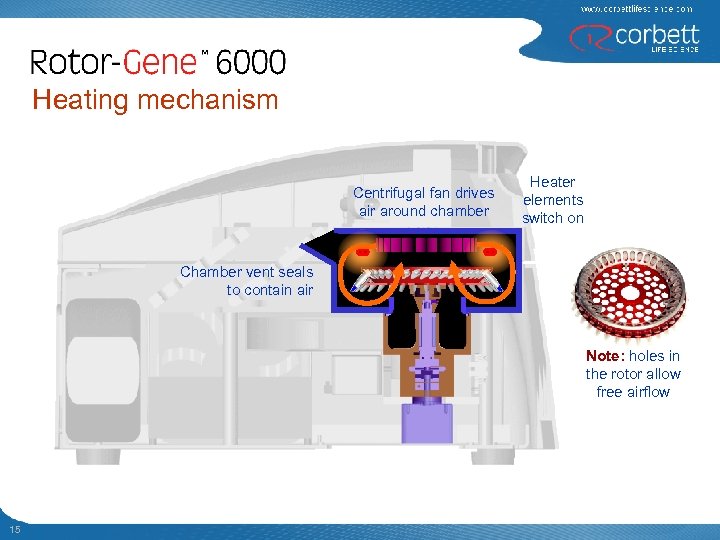
Heating mechanism Centrifugal fan drives air around chamber Heater elements switch on Chamber vent seals to contain air Note: holes in the rotor allow free airflow 15
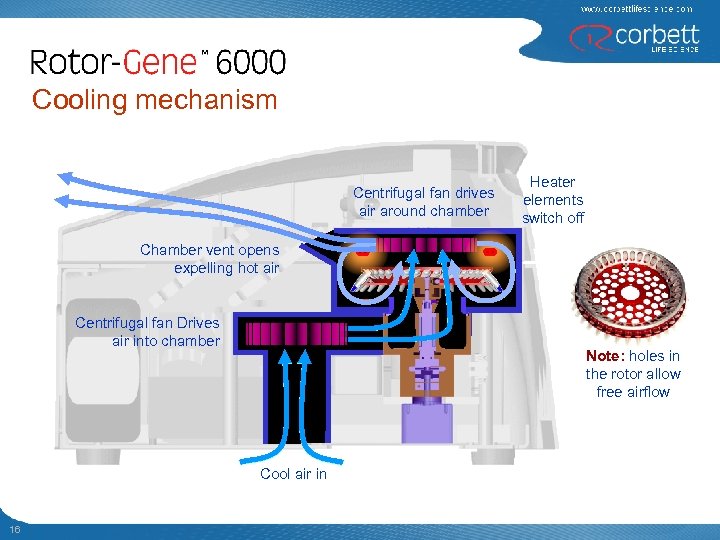
Cooling mechanism Centrifugal fan drives air around chamber Heater elements switch off Chamber vent opens expelling hot air Centrifugal fan Drives air into chamber Note: holes in the rotor allow free airflow Cool air in 16
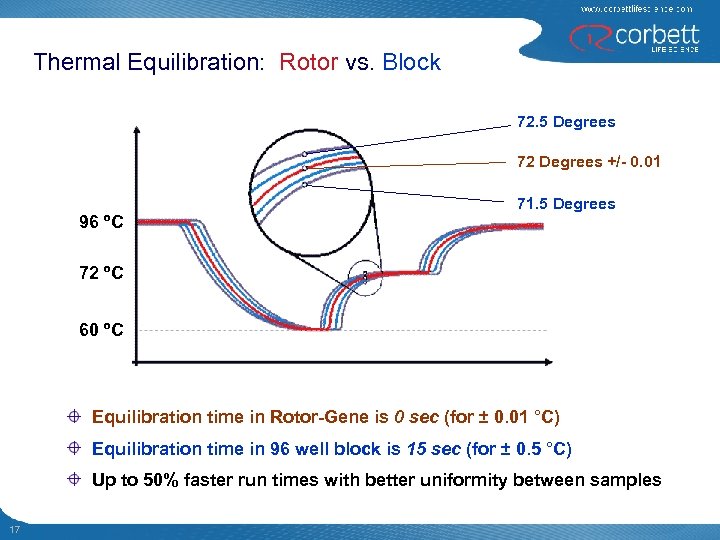
Thermal Equilibration: Rotor vs. Block 72. 5 Degrees 72 Degrees +/- 0. 01 96 ºC 71. 5 Degrees 72 ºC 60 ºC Equilibration time in Rotor-Gene is 0 sec (for ± 0. 01 °C) Equilibration time. TIME well block is 15 sec (for ± 0. 5 °C) in 96 Up to 50% faster run times with better uniformity between samples 17
Thermal Accuracy Instrument Calibration and Performance Verification 18
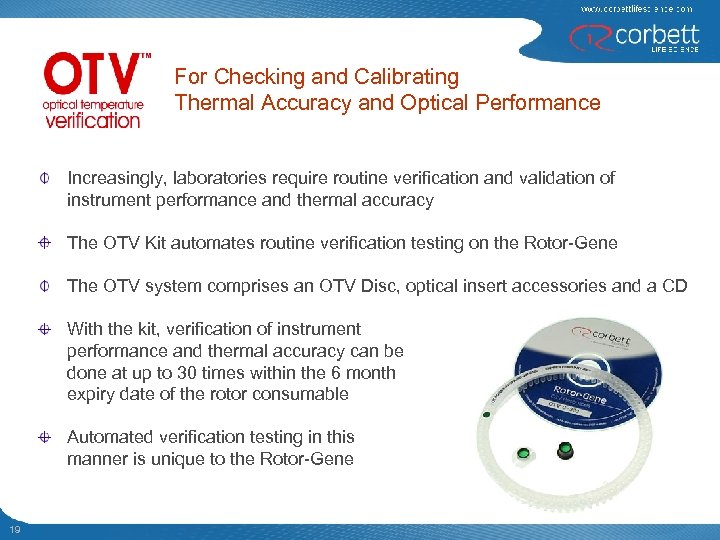
For Checking and Calibrating Thermal Accuracy and Optical Performance Increasingly, laboratories require routine verification and validation of instrument performance and thermal accuracy The OTV Kit automates routine verification testing on the Rotor-Gene The OTV system comprises an OTV Disc, optical insert accessories and a CD With the kit, verification of instrument performance and thermal accuracy can be done at up to 30 times within the 6 month expiry date of the rotor consumable Automated verification testing in this manner is unique to the Rotor-Gene 19
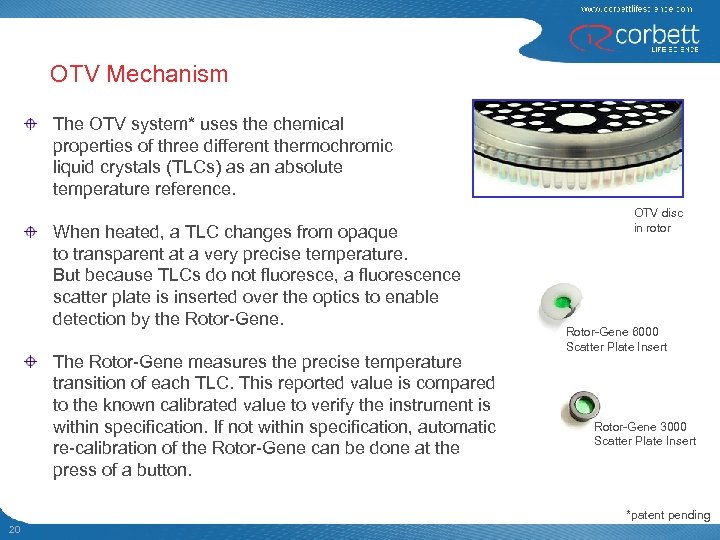
OTV Mechanism The OTV system* uses the chemical properties of three different thermochromic liquid crystals (TLCs) as an absolute temperature reference. When heated, a TLC changes from opaque to transparent at a very precise temperature. But because TLCs do not fluoresce, a fluorescence scatter plate is inserted over the optics to enable detection by the Rotor-Gene. The Rotor-Gene measures the precise temperature transition of each TLC. This reported value is compared to the known calibrated value to verify the instrument is within specification. If not within specification, automatic re-calibration of the Rotor-Gene can be done at the press of a button. OTV disc in rotor Rotor-Gene 6000 Scatter Plate Insert Rotor-Gene 3000 Scatter Plate Insert *patent pending 20
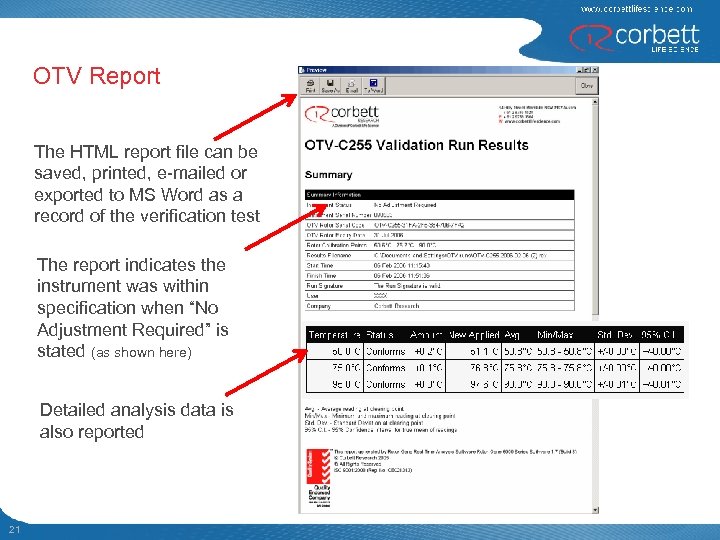
OTV Report The HTML report file can be saved, printed, e-mailed or exported to MS Word as a record of the verification test The report indicates the instrument was within specification when “No Adjustment Required” is stated (as shown here) Detailed analysis data is also reported 21
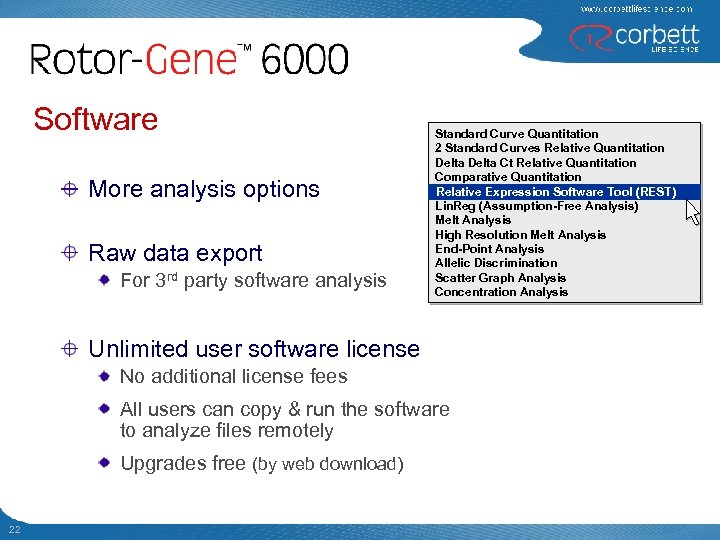
Software More analysis options Raw data export For 3 rd party software analysis Standard Curve Quantitation 2 Standard Curves Relative Quantitation Delta Ct Relative Quantitation Comparative Quantitation Relative Expression Software Tool (REST) Lin. Reg (Assumption-Free Analysis) Melt Analysis High Resolution Melt Analysis End-Point Analysis Allelic Discrimination Scatter Graph Analysis Concentration Analysis Unlimited user software license No additional license fees All users can copy & run the software to analyze files remotely Upgrades free (by web download) 22
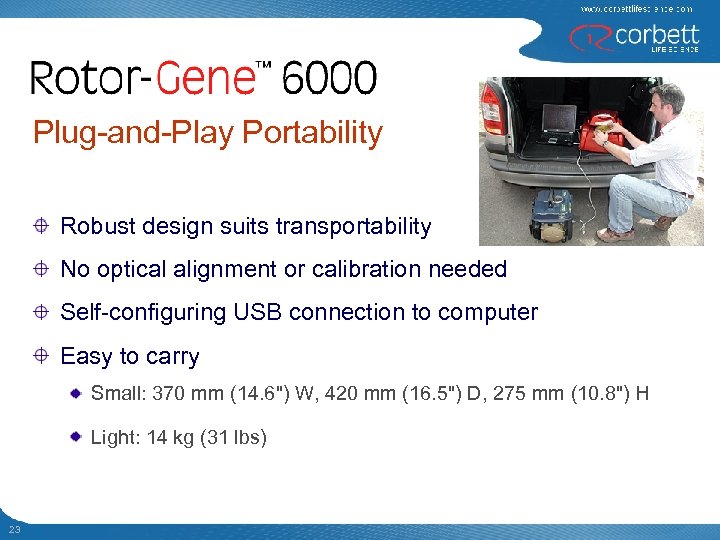
Plug-and-Play Portability Robust design suits transportability No optical alignment or calibration needed Self-configuring USB connection to computer Easy to carry Small: 370 mm (14. 6") W, 420 mm (16. 5") D, 275 mm (10. 8") H Light: 14 kg (31 lbs) 23

Tube Formats and Sample Handling 24
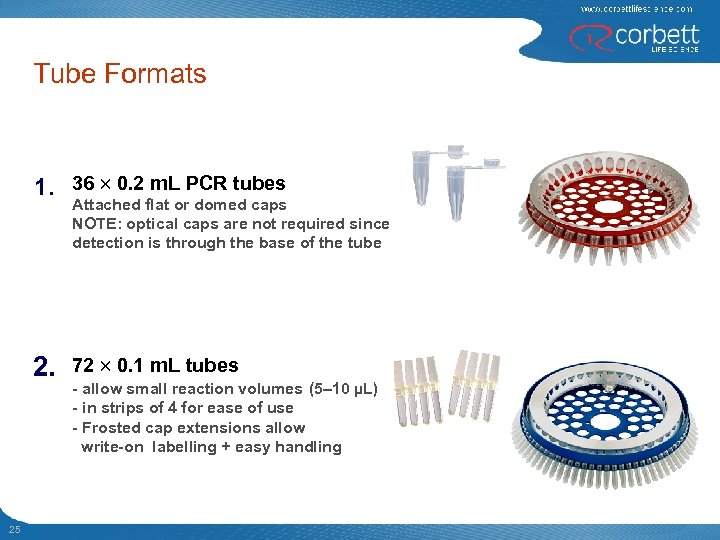
Tube Formats 1. 36 0. 2 m. L PCR tubes Attached flat or domed caps NOTE: optical caps are not required since detection is through the base of the tube 2. 25 72 0. 1 m. L tubes - allow small reaction volumes (5– 10 µL) - in strips of 4 for ease of use - Frosted cap extensions allow write-on labelling + easy handling
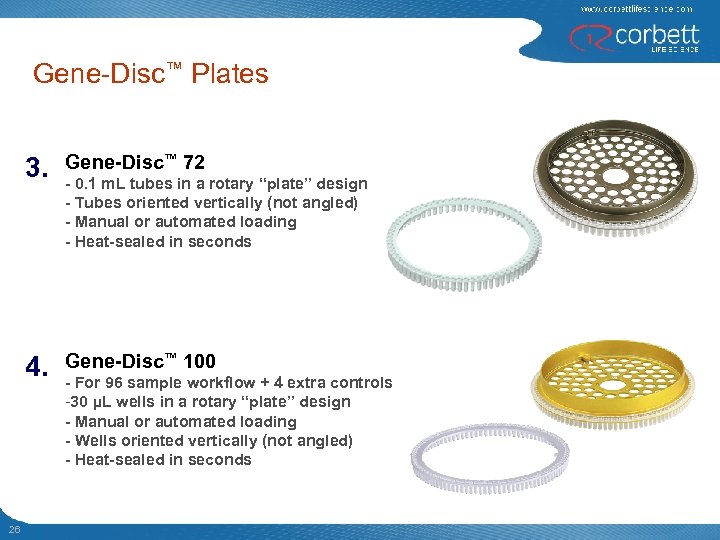
Gene-Disc™ Plates 3. 4. 26 Gene-Disc™ 72 Gene-Disc™ 100 - 0. 1 m. L tubes in a rotary “plate” design - Tubes oriented vertically (not angled) - Manual or automated loading - Heat-sealed in seconds - For 96 sample workflow + 4 extra controls -30 µL wells in a rotary “plate” design - Manual or automated loading - Wells oriented vertically (not angled) - Heat-sealed in seconds
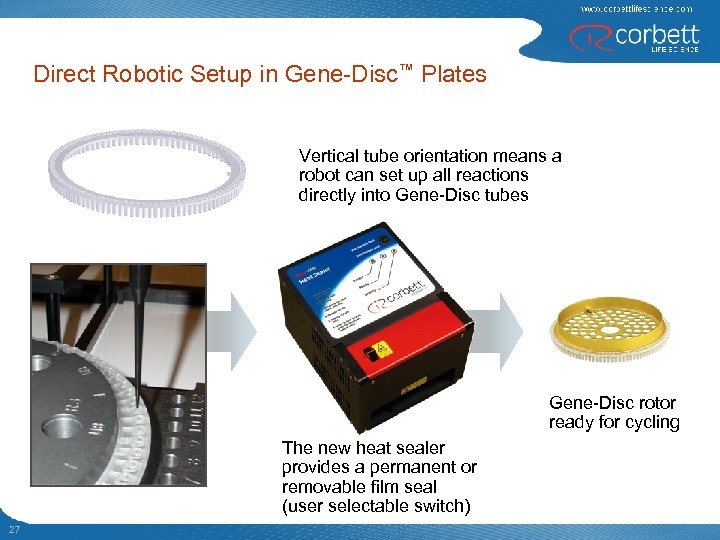
Direct Robotic Setup in Gene-Disc™ Plates Vertical tube orientation means a robot can set up all reactions directly into Gene-Disc tubes Gene-Disc rotor ready for cycling The new heat sealer provides a permanent or removable film seal (user selectable switch) 27

Amplification Performance 28
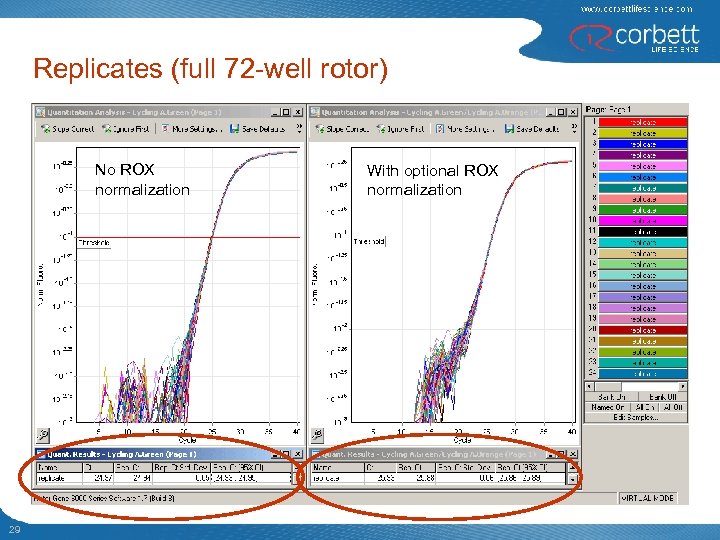
Replicates (full 72 -well rotor) No ROX normalization 29 With optional ROX normalization
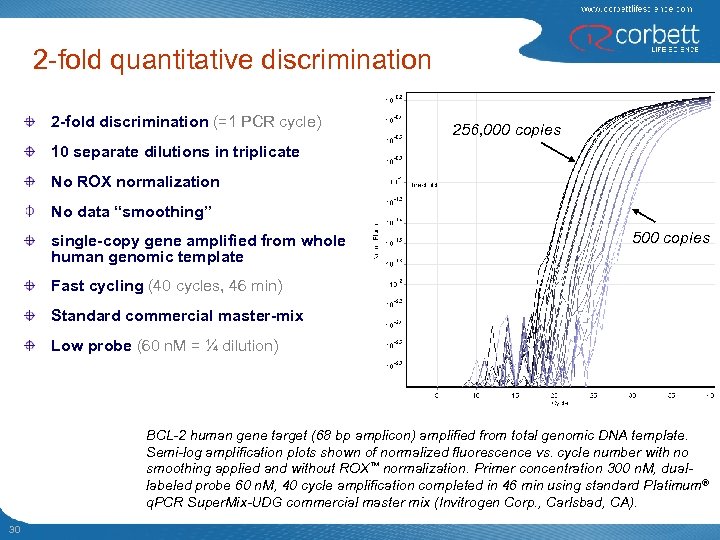
2 -fold quantitative discrimination 2 -fold discrimination (=1 PCR cycle) 256, 000 copies 10 separate dilutions in triplicate No ROX normalization No data “smoothing” single-copy gene amplified from whole human genomic template 500 copies Fast cycling (40 cycles, 46 min) Standard commercial master-mix Low probe (60 n. M = ¼ dilution) BCL-2 human gene target (68 bp amplicon) amplified from total genomic DNA template. Semi-log amplification plots shown of normalized fluorescence vs. cycle number with no smoothing applied and without ROX™ normalization. Primer concentration 300 n. M, duallabeled probe 60 n. M, 40 cycle amplification completed in 46 min using standard Platimum® q. PCR Super. Mix-UDG commercial master mix (Invitrogen Corp. , Carlsbad, CA). 30
Concentration Measurement 31
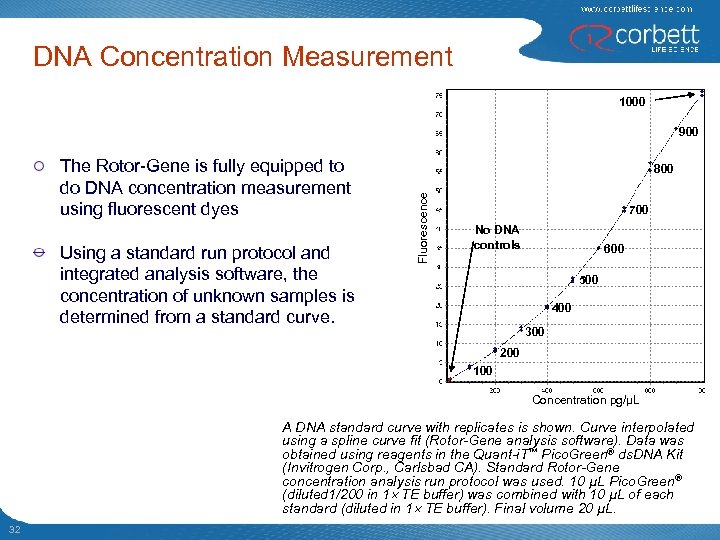
DNA Concentration Measurement 1000 900 Using a standard run protocol and integrated analysis software, the concentration of unknown samples is determined from a standard curve. 800 Fluorescence The Rotor-Gene is fully equipped to do DNA concentration measurement using fluorescent dyes 700 No DNA controls 600 500 400 300 200 100 Concentration pg/µL A DNA standard curve with replicates is shown. Curve interpolated using a spline curve fit (Rotor-Gene analysis software). Data was obtained using reagents in the Quant-i. T™ Pico. Green® ds. DNA Kit (Invitrogen Corp. , Carlsbad CA). Standard Rotor-Gene concentration analysis run protocol was used. 10 µL Pico. Green® (diluted 1/200 in 1 TE buffer) was combined with 10 µL of each standard (diluted in 1 TE buffer). Final volume 20 µL. 32
SYBR Melt Analysis and HRM (high resolution melt) ™ a new application for a new type of instrument 33
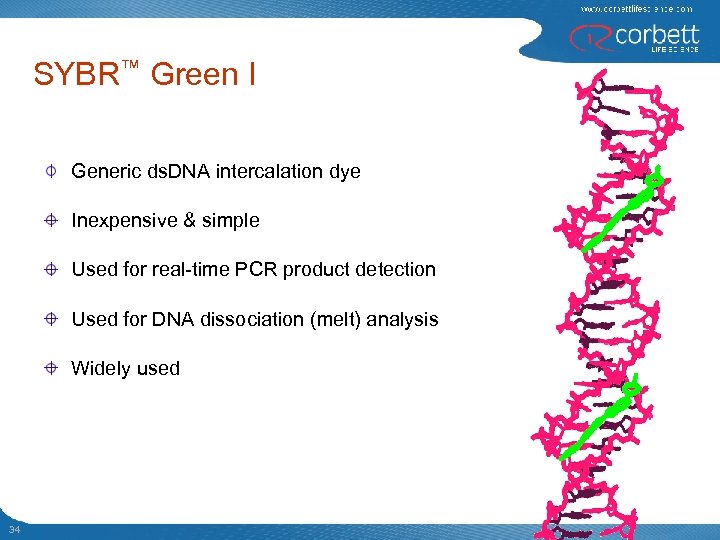
SYBR™ Green I Generic ds. DNA intercalation dye Inexpensive & simple Used for real-time PCR product detection Used for DNA dissociation (melt) analysis Widely used 34
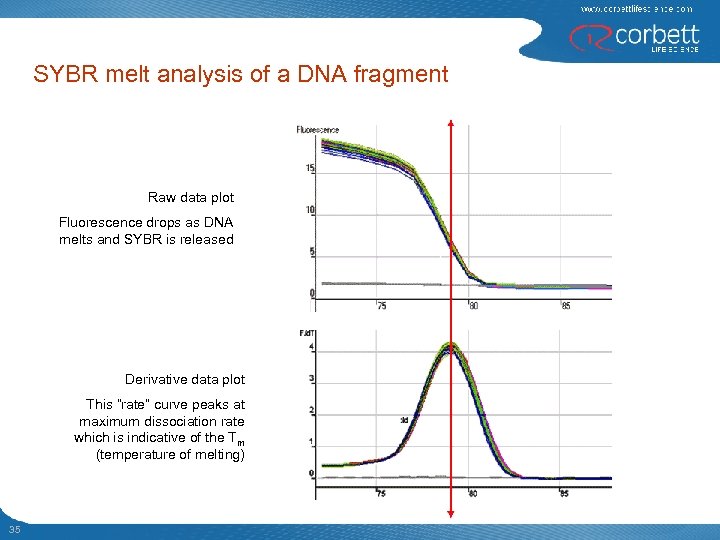
SYBR melt analysis of a DNA fragment Raw data plot Fluorescence drops as DNA melts and SYBR is released Derivative data plot This “rate” curve peaks at maximum dissociation rate which is indicative of the Tm (temperature of melting) 35
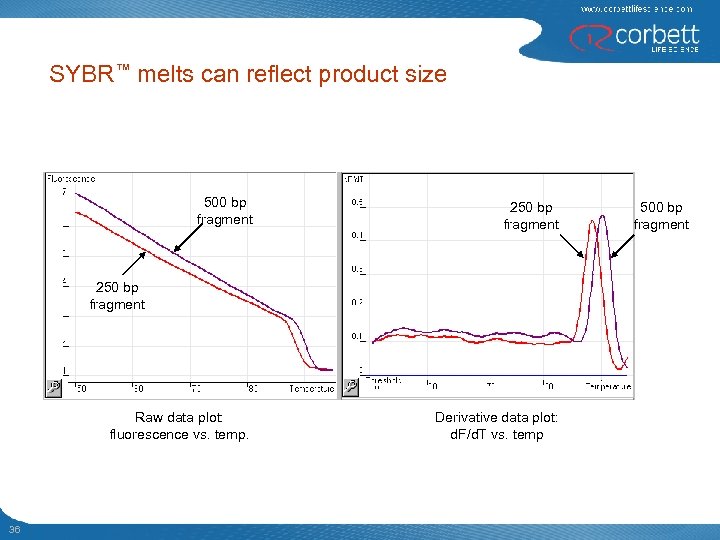
SYBR™ melts can reflect product size 500 bp fragment 250 bp fragment Raw data plot: fluorescence vs. temp. Derivative data plot: d. F/d. T vs. temp 250 bp fragment 36 500 bp fragment
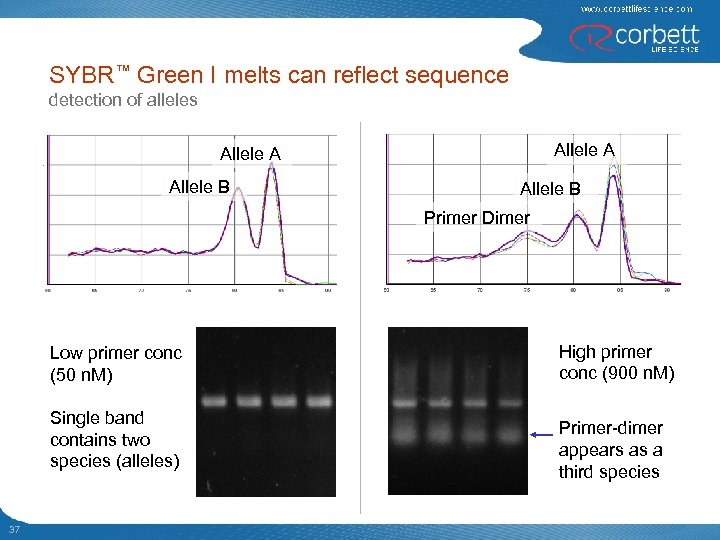
SYBR™ Green I melts can reflect sequence detection of alleles Allele A Allele B Primer Dimer Low primer conc (50 n. M) Single band contains two species (alleles) 37 High primer conc (900 n. M) Primer-dimer appears as a third species
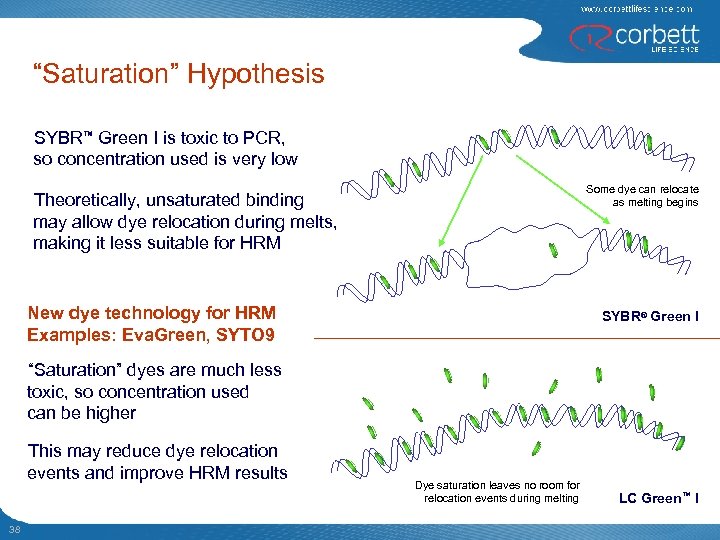
“Saturation” Hypothesis SYBR™ Green I is toxic to PCR, so concentration used is very low Some dye can relocate as melting begins Theoretically, unsaturated binding may allow dye relocation during melts, making it less suitable for HRM New dye technology for HRM Examples: Eva. Green, SYTO 9 SYBR® Green I “Saturation” dyes are much less toxic, so concentration used can be higher This may reduce dye relocation events and improve HRM results 38 Dye saturation leaves no room for relocation events during melting LC Green™ I
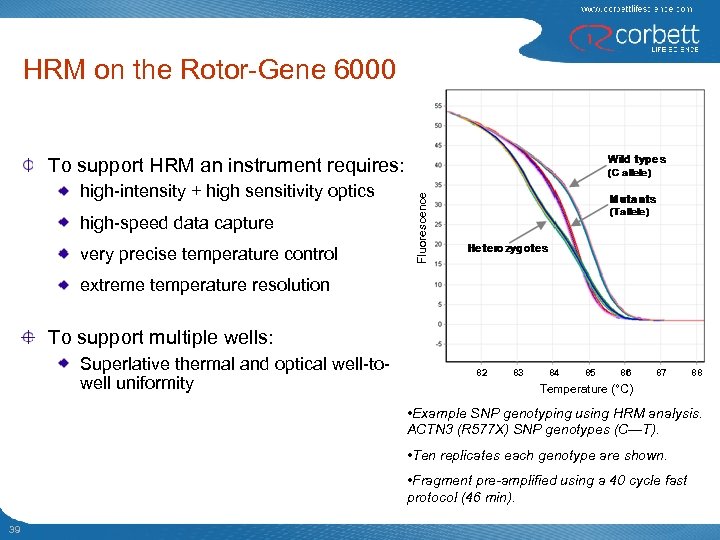
HRM on the Rotor-Gene 6000 high-intensity + high sensitivity optics high-speed data capture very precise temperature control Fluorescence To support HRM an instrument requires: extreme temperature resolution To support multiple wells: Superlative thermal and optical well-towell uniformity 82 83 84 85 86 87 88 Temperature (°C) • Example SNP genotyping using HRM analysis. ACTN 3 (R 577 X) SNP genotypes (C—T). • Ten replicates each genotype are shown. • Fragment pre-amplified using a 40 cycle fast protocol (46 min). 39
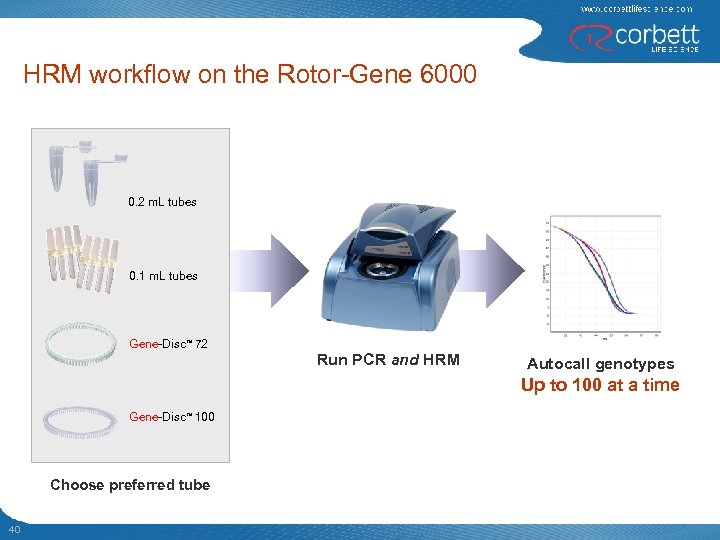
HRM workflow on the Rotor-Gene 6000 0. 2 m. L tubes 0. 1 m. L tubes Gene-Disc™ 72 Run PCR and HRM Autocall genotypes Up to 100 at a time Gene-Disc™ 100 Choose preferred tube 40
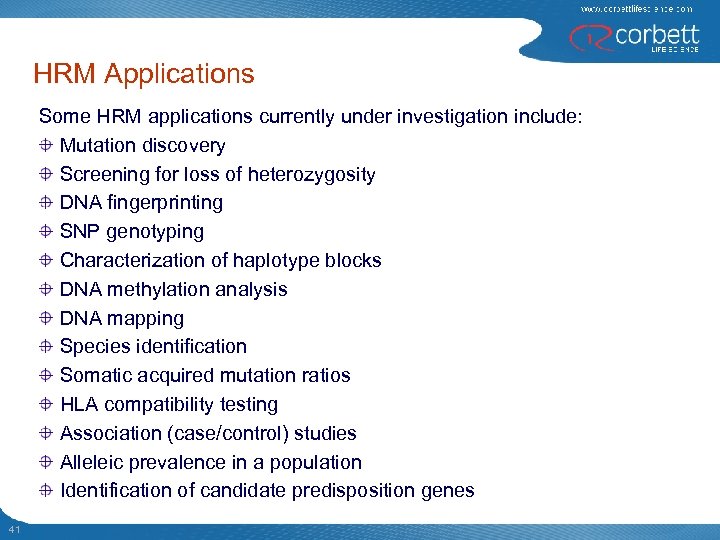
HRM Applications Some HRM applications currently under investigation include: Mutation discovery Screening for loss of heterozygosity DNA fingerprinting SNP genotyping Characterization of haplotype blocks DNA methylation analysis DNA mapping Species identification Somatic acquired mutation ratios HLA compatibility testing Association (case/control) studies Alleleic prevalence in a population Identification of candidate predisposition genes 41

Automation 42
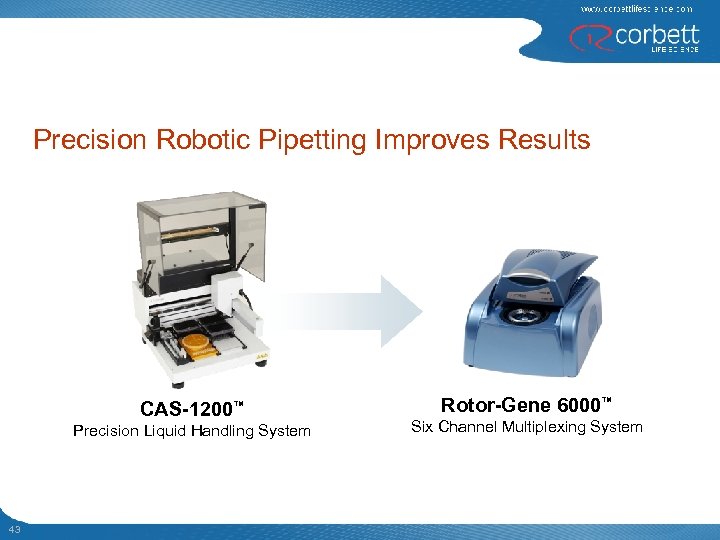
Precision Robotic Pipetting Improves Results CAS-1200™ Precision Liquid Handling System 43 Rotor-Gene 6000™ Six Channel Multiplexing System
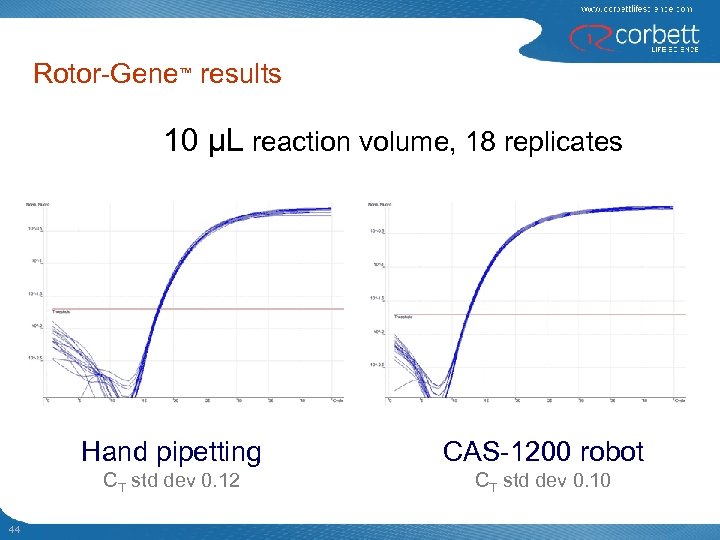
Rotor-Gene™ results 10 µL reaction volume, 18 replicates Hand pipetting CT std dev 0. 12 44 CAS-1200 robot CT std dev 0. 10
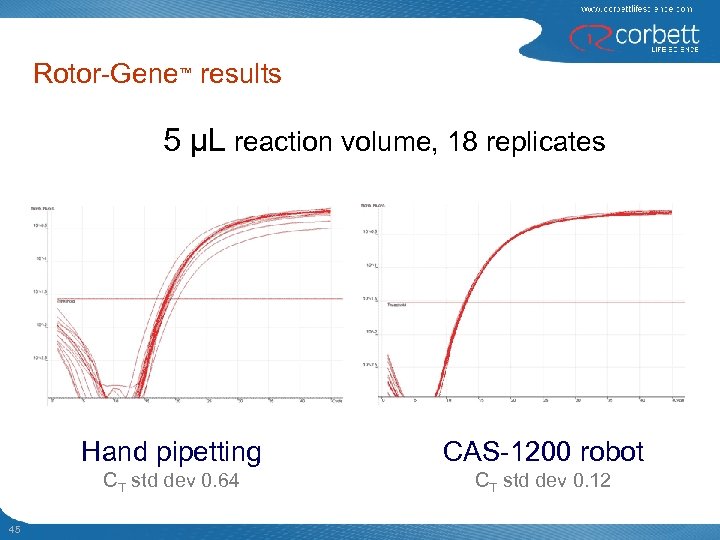
Rotor-Gene™ results 5 µL reaction volume, 18 replicates Hand pipetting CT std dev 0. 64 45 CAS-1200 robot CT std dev 0. 12
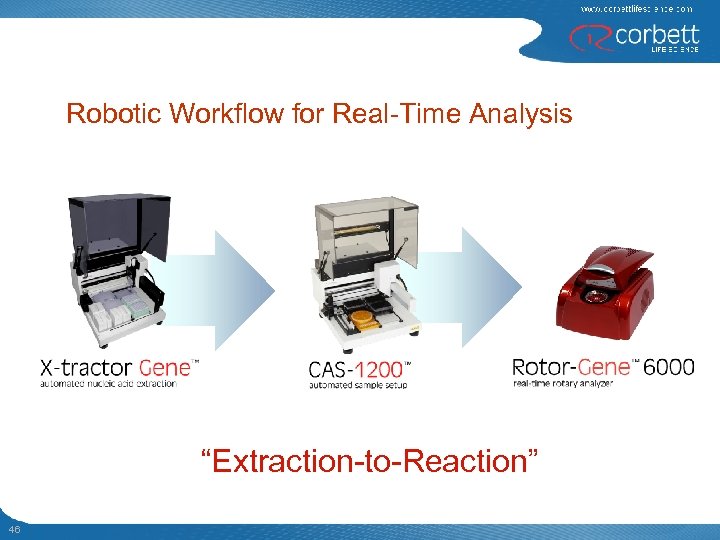
Robotic Workflow for Real-Time Analysis “Extraction-to-Reaction” 46
Summary Real-Time analysis is an exact science with many variables Through good design, the rotary format best minimizes these variables Precise and reproducible data is easier to achieve with the Rotor-Gene Future applications such as HRM and concentration measurement can only be achieved on the Rotor-Gene, underlining it’s superior design Choose from more tube formats and data analysis options Verification testing and calibration is automated by the OTV system The robust design delivers minimum maintenance, lowest operating costs and maximum convenience 47
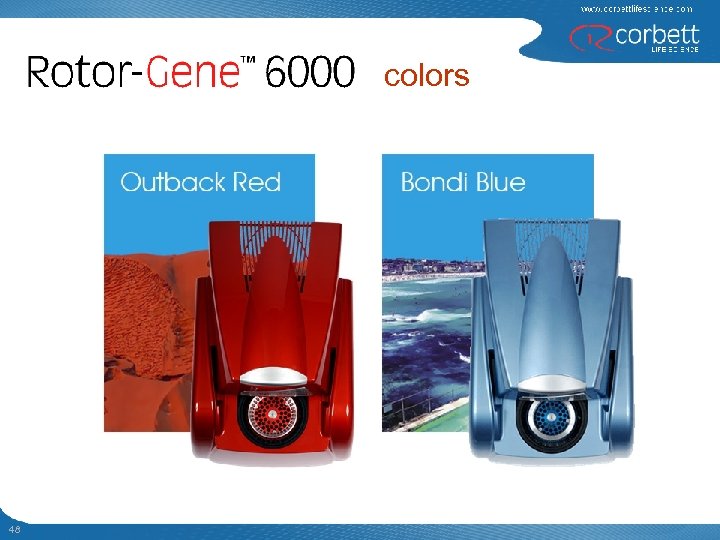
colors 48
Offices Brisbane Australia Corbett Robotics Pty Ltd 42 Mc. Kechnie Drive Eight Mile Plains, QLD 4113 T +61 7 3841 7077 F +61 7 3841 6077 Sydney Australia Corbett Research Pty Ltd 14 Hilly Street Mortlake, NSW 2137 T 1 800 803 915 (Toll free) T +61 2 9736 1320 F +61 2 9736 1364 E-mail info@corbettlifescience. com 49 United Kingdom Corbett Research UK Limited Unit 296 Cambridge Science Park Milton Road, Cambridge CB 4 0 WD T +44 (0)1223 424 288 F +44 (0)1223 424 144 USA Corbett Robotics Inc 185 Berry Street, Suite 5200 San Francisco, CA 94107 T +1 866 380 1166 (Toll free) T +1 415 348 1166 F +1 415 348 1177 Web www. corbettlifescience. com All slides 2006 Corbett Life Science. All rights reserved
Скачать презентацию Introducing the Next-Generation Performance and More Capabilities corbett
ebf62a1c29a6abbc7b258af054907f57.ppt