


 Скачать презентацию Introducing Gail C Rodin Ph D Assessment Consultant
fc046ca1e276004b64431663d7154bdf.ppt
- Количество слайдов: 103
 Introducing Gail C. Rodin, Ph. D Assessment Consultant Pearson/Psych. Corp
 TODAY’S AGENDA • Review of adaptive behavior • Overview of Vineland-3 – Changes from Vineland-II • • General administration guidelines The semi-structured interview Administration/scoring/reporting using Q-global Q&A
 Review of Adaptive Behavior
 What is Adaptive Behavior? Definition: The performance of daily activities required for personal and social sufficiency Two major facets: 1. The degree to which the individual is able to function and maintain him-/herself independently 2. The degree to which he/she satisfactorily meets the culturally imposed demands of personal and social responsibility
 What is Adaptive Behavior? Definition implies that adaptive behavior is: 1. Age-related • Important activities differ by age 2. Evaluated in a social context • In reference to expectations and standards of others 3. Modifiable • In contrast to cognitive ability 4. Defined by typical performance • Not by ability – Ability is necessary, but not sufficient
 Adaptive Behavior = Typical Performance • Ability is necessary for performance of daily activities BUT. . . • An individual’s adaptive behavior is inadequate if the ability is not demonstrated when required Examples?
 Role of Adaptive Behavior in Defining Intellectual Disability Intellectual disability is a disability characterized by significant limitations in both intellectual functioning and in adaptive behavior, which covers many everyday social and practical skills. This disability originates before the age of 18. American Association on Intellectual and Developmental Disabilities (AAIDD) [formerly: American Association on Mental Retardation (AAMR)], 2010.
 Operationalizing “Significant Limitations” • Typically defined as scores that are 2 or more standard deviations below the mean (SS < 70) on measures of: – Cognitive ability (IQ) -and- – Adaptive behavior
 Measuring Adaptive Behavior • Most common method is via reporting by informant(s) familiar with adaptive behavior of individual being assessed “Using standardized adaptive behavior measures to determine significant limitations in adaptive behavior usually involves obtaining information regarding the individual’s adaptive behavior from a person or persons who know the individual well. ” (AAIDD, 2010) – I. e. , the individual being evaluated does not participate in the adaptive behavior assessment
 Measuring Adaptive Behavior (cont. ) • Why not measure adaptive behavior directly (the way we measure cognitive ability)? – Direct administration of tasks determine maximum performance in a contrived situation – We want to measure typical performance in an everyday situation
 Measuring Adaptive Behavior (cont. ) • Why not measure adaptive behavior via direct behavioral observation (the way we sometimes measure other types of behavior – e. g. , using BASC-3 Student Observation System)? – This does allow us to assess in naturalistic setting(s) – However, adaptive behavior includes too broad an array of behaviors to make such observation feasible
 Overview of Vineland-3
 Vineland-3 – The Basics • An individually administered measure of adaptive behavior • Available in three administration forms: 1. Interview Form • Comprehensive – With or without item-level probes • Domain-Level 2. Parent/Caregiver Form • Comprehensive • Domain-Level 3. Teacher Form • Comprehensive • Domain-Level
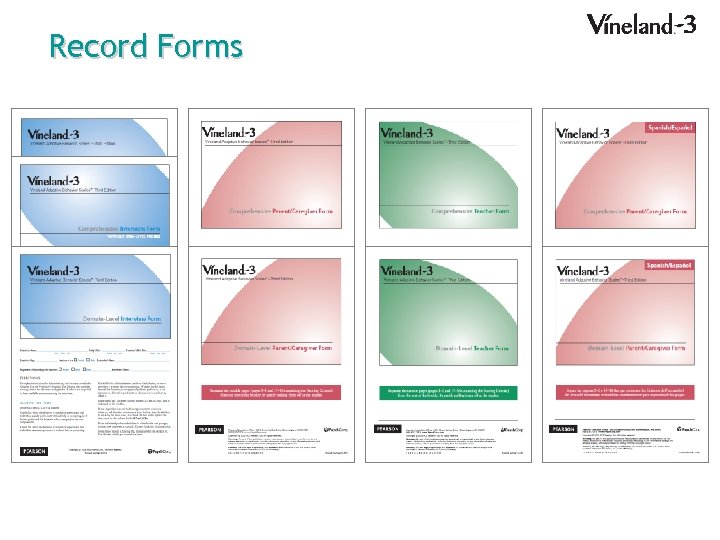 Record Forms
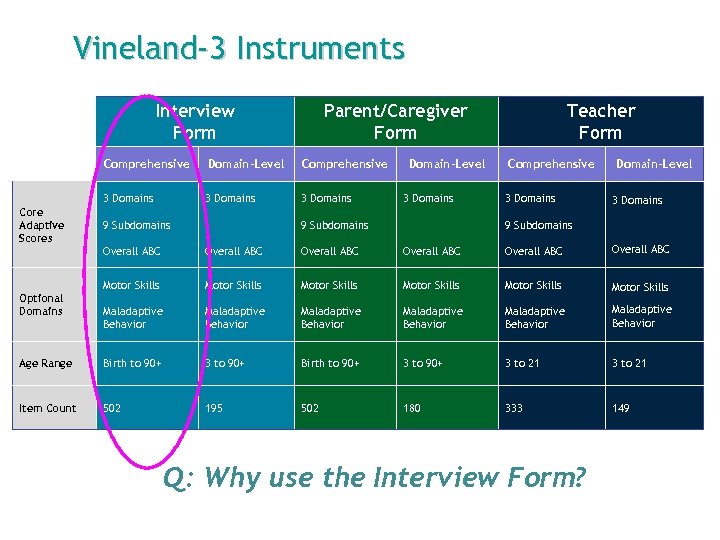 Vineland-3 Instruments Interview Form Parent/Caregiver Form Comprehensive 3 Domains Core Adaptive Scores Domain-Level 3 Domains 9 Subdomains Teacher Form Comprehensive 3 Domains Domain-Level 3 Domains 9 Subdomains Overall ABC Overall ABC Motor Skills Motor Skills Maladaptive Behavior Maladaptive Behavior Age Range Birth to 90+ 3 to 21 Item Count 502 195 502 180 333 149 Optional Domains Q: Why use the Interview Form?
 Vineland-3 Interview Form • Weakness of third-party reporting is greater susceptibility to inaccuracy – E. g. , parent’s faulty memory or biased perception • Interview Form counters this potential inaccuracy
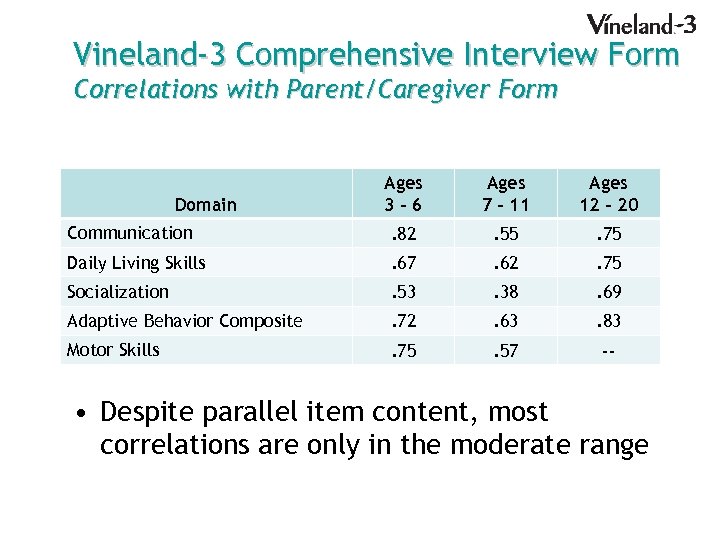 Vineland-3 Comprehensive Interview Form Correlations with Parent/Caregiver Form Ages 3– 6 Ages 7 – 11 Ages 12 – 20 Communication . 82 . 55 . 75 Daily Living Skills . 67 . 62 . 75 Socialization . 53 . 38 . 69 Adaptive Behavior Composite . 72 . 63 . 83 Motor Skills . 75 . 57 -- Domain • Despite parallel item content, most correlations are only in the moderate range
 Why Conduct an Interview? Wouldn’t a Parent Rating Scale be Easier? • Reduces likelihood of “response bias” A respondent may be motivated to: – Provide an unrealistically positive picture of an individual’s functioning -or- – Exaggerate an individual’s deficits Why?
 Why Conduct an Interview? Wouldn’t a Parent Rating Scale be Easier? • Much easer to give biased answers if the respondent knows the items that are being scored – Why we don’t ask specific item questions or allow respondent to read items during interview • Also, the rapport created by the interview format encourages greater candor in respondents – Warm, human interaction helps develop respondent trust, which improves accuracy of descriptions of functioning
 Why Conduct an Interview? Wouldn’t a Parent Rating Scale be Easier? • Be on the lookout for positive or negative response bias – Respond by asking for additional details and specific examples that explore the individual’s behavior in detail • Often clarifies how behavior should be scored
 Why Conduct an Interview? Wouldn’t a Parent Rating Scale be Easier? • Other advantages of semistructured interview: – A positive testing environment that emphasizes what individual does do • Rather than focusing on what they don’t do – Provides far richer, more in-depth information about an individual’s functioning – Ensures more accurate scoring • As scoring done by professional rather than respondent
 Semistructured Interview • Focus of interview decided by interviewer • Idea is to understand respondent’s point of view, not to judge • Questions are open-ended • No two interviews ever the same
 Summary: Interview vs. Parent/Caregiver Form • Both forms: – Cover same adaptive behavior areas – Require adult informant familiar with examinee’s everyday functioning • Parent/Caregiver form can be a source of under- or over-reporting, either deliberately or unintentionally • Interview format allows clinician to correct this, and to probe more deeply for understanding Interview form is the “gold standard” but not always feasible due to time, location, etc.
 Teacher Form in Combination with Interview Form or Parent/Caregiver Form • Complements Interview Form or Parent/Caregiver Form • Best practice to obtain input from different informants • Some jurisdictions require both parent/caregiver and teacher reports for adaptive behavior assessments under IDEA 24
 Vineland-3 Comprehensive Interview Form • Includes 502 items – Core items: 381 – Optional items: 121 • Motor Skills: 77 • Maladaptive Behavior: 44 • Most domains/subdomains have more items: For example: – Communication: 99 (V-II) 126 (V-3) – Daily Living Skills: 109 (V-II) 143 (V-3) – Socialization: 99 (V-II) 169 (V-3)
 Vineland-3 Comprehensive Interview Form • Completed by a professional who interviews respondent who can report knowledgably on adaptive behavior of examinee – Typically, but not necessarily, a parent
 Vineland-3 Comprehensive Interview Form • May be administered in two ways: – Digital administration using Q-global • No record form required • Enter responses directly into Q-global • Q-global automatically scores and generates report – Using paper record form • Record responses on record form • Then enter responses into Q-global for automated scoring and reporting
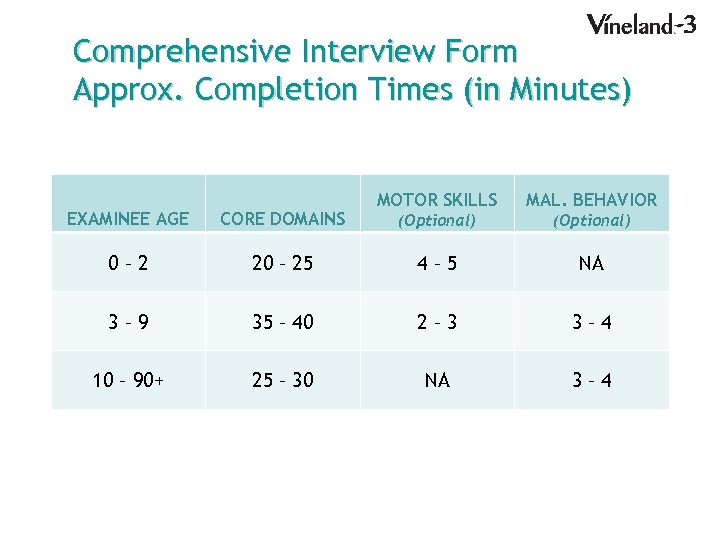 Comprehensive Interview Form Approx. Completion Times (in Minutes) MOTOR SKILLS MAL. BEHAVIOR (Optional) EXAMINEE AGE CORE DOMAINS 0– 2 20 – 25 4– 5 NA 3– 9 35 – 40 2– 3 3– 4 10 – 90+ 25 – 30 NA 3– 4
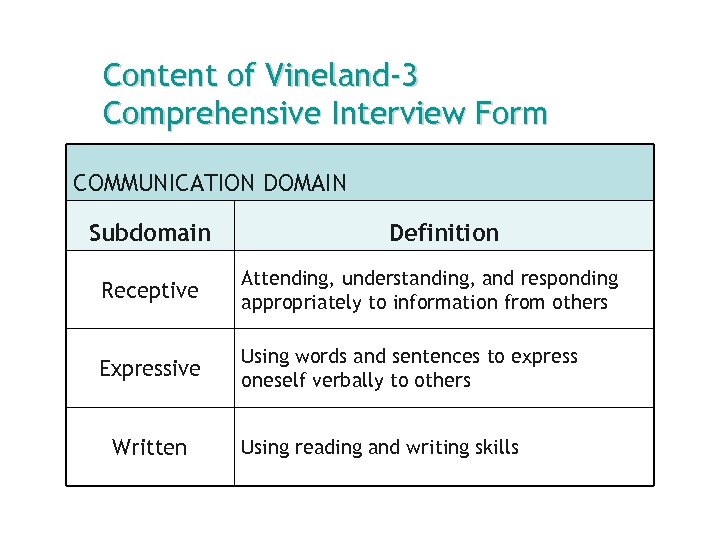 Content of Vineland-3 Comprehensive Interview Form COMMUNICATION DOMAIN Subdomain Definition Receptive Attending, understanding, and responding appropriately to information from others Expressive Using words and sentences to express oneself verbally to others Written Using reading and writing skills
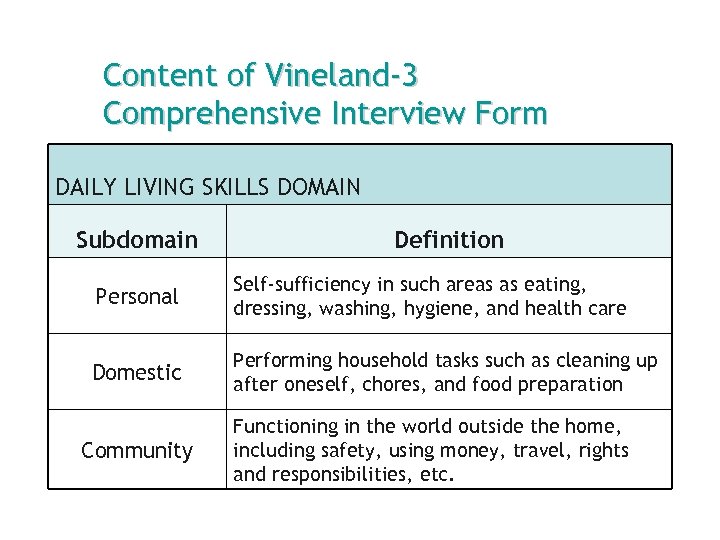 Content of Vineland-3 Comprehensive Interview Form DAILY LIVING SKILLS DOMAIN Subdomain Definition Personal Self-sufficiency in such areas as eating, dressing, washing, hygiene, and health care Domestic Performing household tasks such as cleaning up after oneself, chores, and food preparation Community Functioning in the world outside the home, including safety, using money, travel, rights and responsibilities, etc.
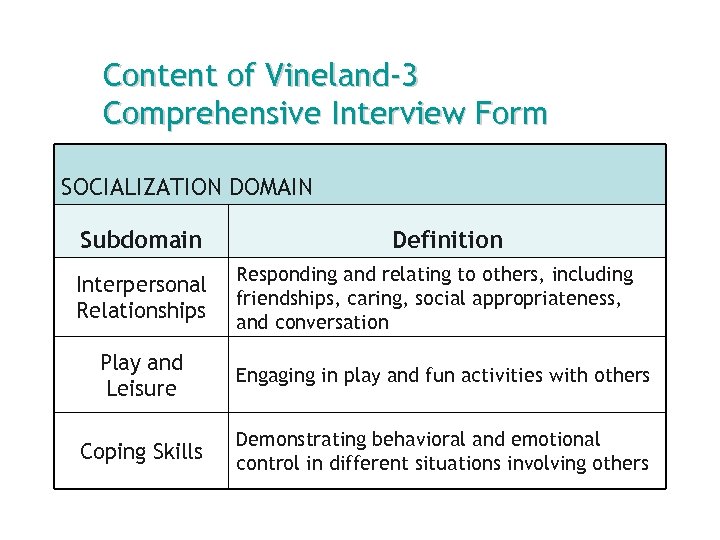 Content of Vineland-3 Comprehensive Interview Form SOCIALIZATION DOMAIN Subdomain Interpersonal Relationships Definition Responding and relating to others, including friendships, caring, social appropriateness, and conversation Play and Leisure Engaging in play and fun activities with others Coping Skills Demonstrating behavioral and emotional control in different situations involving others
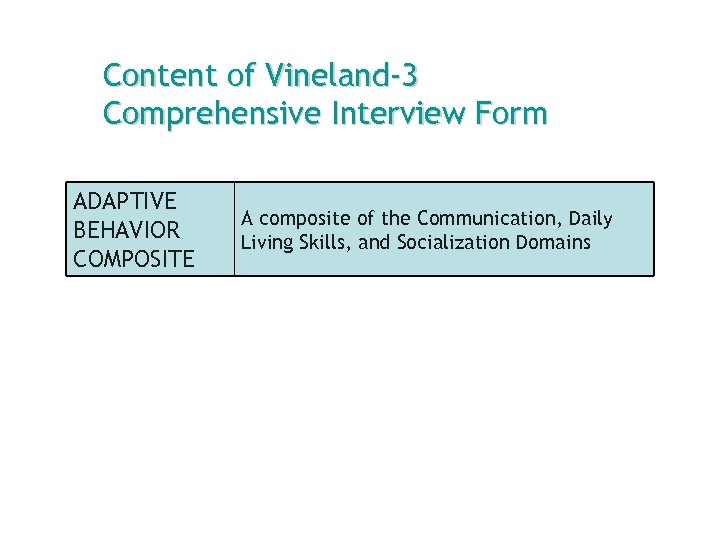 Content of Vineland-3 Comprehensive Interview Form ADAPTIVE BEHAVIOR COMPOSITE A composite of the Communication, Daily Living Skills, and Socialization Domains
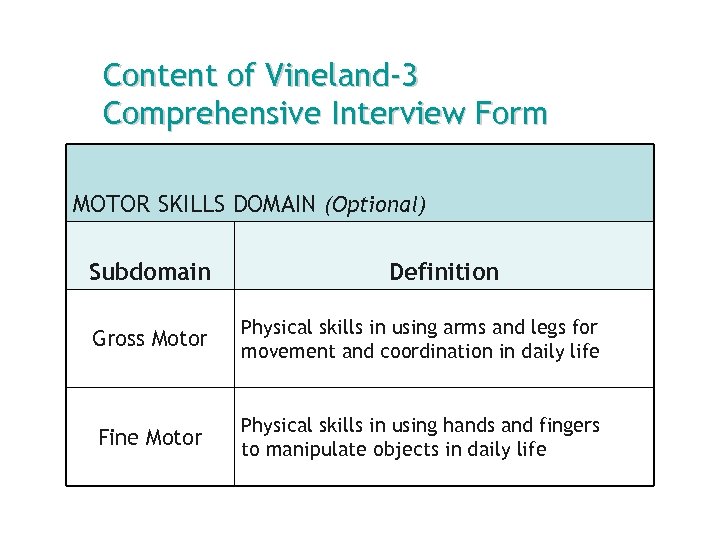 Content of Vineland-3 Comprehensive Interview Form MOTOR SKILLS DOMAIN (Optional) Subdomain Definition Gross Motor Physical skills in using arms and legs for movement and coordination in daily life Fine Motor Physical skills in using hands and fingers to manipulate objects in daily life
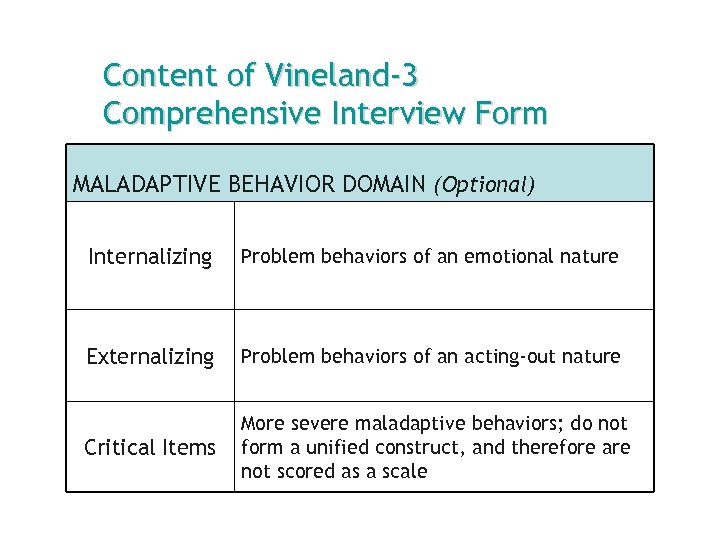 Content of Vineland-3 Comprehensive Interview Form MALADAPTIVE BEHAVIOR DOMAIN (Optional) Internalizing Problem behaviors of an emotional nature Externalizing Problem behaviors of an acting-out nature Critical Items More severe maladaptive behaviors; do not form a unified construct, and therefore are not scored as a scale
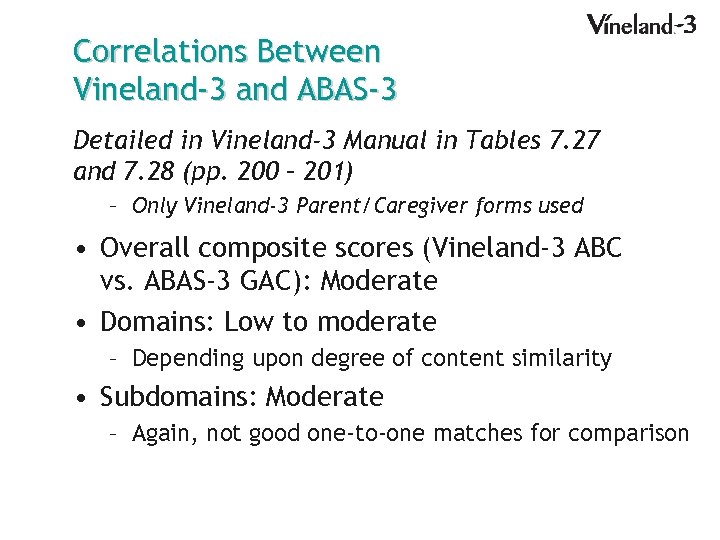 Correlations Between Vineland-3 and ABAS-3 Detailed in Vineland-3 Manual in Tables 7. 27 and 7. 28 (pp. 200 – 201) – Only Vineland-3 Parent/Caregiver forms used • Overall composite scores (Vineland-3 ABC vs. ABAS-3 GAC): Moderate • Domains: Low to moderate – Depending upon degree of content similarity • Subdomains: Moderate – Again, not good one-to-one matches for comparison
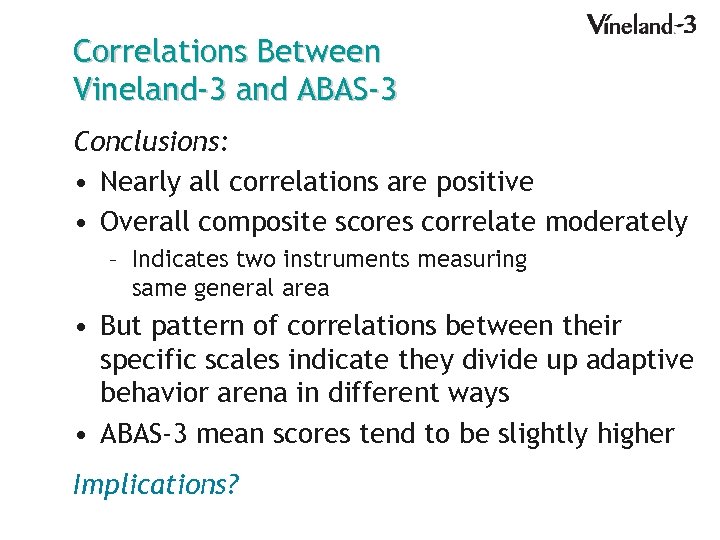 Correlations Between Vineland-3 and ABAS-3 Conclusions: • Nearly all correlations are positive • Overall composite scores correlate moderately – Indicates two instruments measuring same general area • But pattern of correlations between their specific scales indicate they divide up adaptive behavior arena in different ways • ABAS-3 mean scores tend to be slightly higher Implications?
 Vineland-II Vineland-3 Updates and Changes
 What Hasn’t Changed • Three basic administrations: – Interview – Parent/Caregiver – Teacher • Domain and subdomain structure
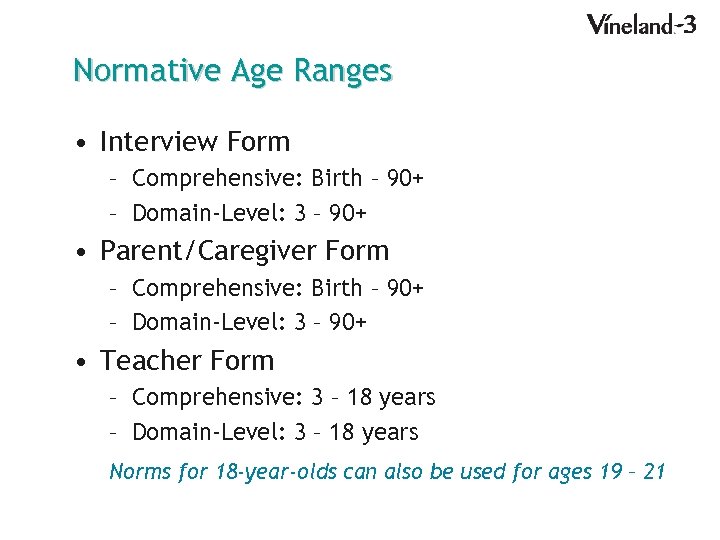 Normative Age Ranges • Interview Form – Comprehensive: Birth – 90+ – Domain-Level: 3 – 90+ • Parent/Caregiver Form – Comprehensive: Birth – 90+ – Domain-Level: 3 – 90+ • Teacher Form – Comprehensive: 3 – 18 years – Domain-Level: 3 – 18 years Norms for 18 -year-olds can also be used for ages 19 – 21
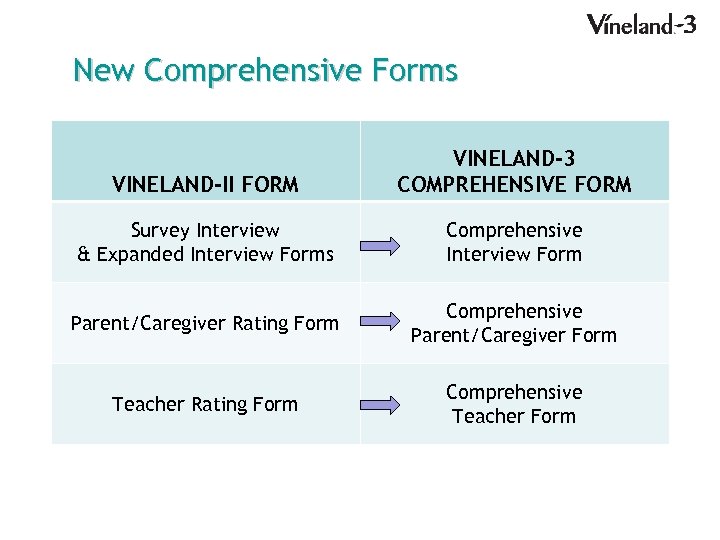 New Comprehensive Forms VINELAND-II FORM VINELAND-3 COMPREHENSIVE FORM Survey Interview & Expanded Interview Forms Comprehensive Interview Form Parent/Caregiver Rating Form Comprehensive Parent/Caregiver Form Teacher Rating Form Comprehensive Teacher Form
 Vineland-3 Domain-Level Forms • Brief versions of the Comprehensive forms – Available for ages 3 years and older • Provide reliable, valid domain-level scores • Appropriate for: – Diagnosis – Determining eligibility for services
 Interview vs. Parent/Caregiver Forms • In Vineland-II, these contained same item wording and used same norms • User feedback indicated that item wording was well-suited for use and interpretation by professional interviewers – But could pose challenges for parents/caregivers completing forms on their own • Interview and Parent/Caregiver Forms still cover same adaptive behavior areas – But wording of Parent/Caregiver items now much simpler (~5 th-grade reading level) – Different wording requires different norms
 Updated Item Content • Content updated to reflect changes in: – Nature of everyday life • E. g. , advances in technology and its increased use – Conceptions of developmental disabilities • E. g. , autism spectrum disorders • You will see items that are: – Retained without changes – Revisions of Vineland-II items – New to Vineland-3
 Changes to Motor Skills Domain • Vineland-II Motor Skills Domain – Normed for ages birth – 6 years – Included in Adaptive Behavior Composite (ABC) • Vineland-3 Motor Skills Domain – Now normed up to age 9 – No longer included in ABC • Domain is now optional – Adult Motor Skills norms no longer provided
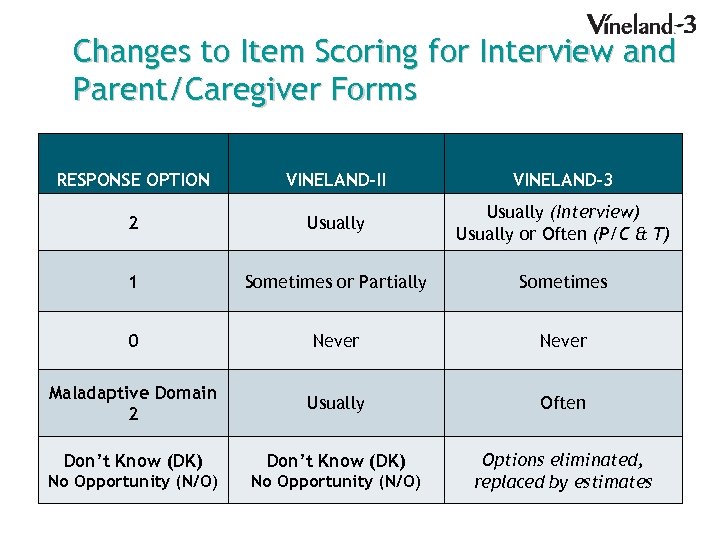 Changes to Item Scoring for Interview and Parent/Caregiver Forms RESPONSE OPTION VINELAND-3 2 Usually (Interview) Usually or Often (P/C & T) 1 Sometimes or Partially Sometimes 0 Never Maladaptive Domain 2 Usually Often Don’t Know (DK) No Opportunity (N/O) 45 VINELAND-II No Opportunity (N/O) Options eliminated, replaced by estimates
 Introduction of Estimated Item Responses • When respondent indicates they’ve had no opportunity to observe a behavior: 1. Ask them to estimate frequency of the behavior 2. Record this estimated item score 3. Check the Estimated checkbox for that item • In Vineland-II was on Teacher Form only • Rationale is that a very familiar respondent’s “educated guess” will be more accurate than an assignment of DK or N/O, which were given partial credit (i. e. , a score of 1) in Vineland-II
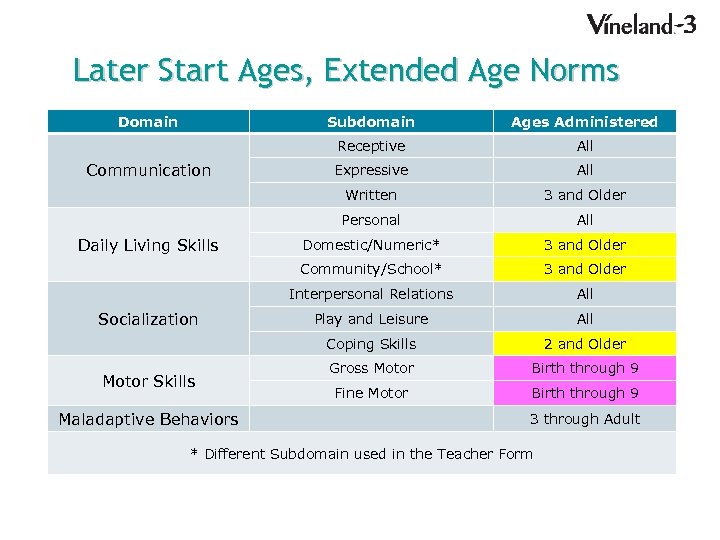 Later Start Ages, Extended Age Norms Domain Subdomain Receptive All Domestic/Numeric* 3 and Older All Play and Leisure All Coping Skills Maladaptive Behaviors 3 and Older Interpersonal Relations Motor Skills All Community/School* Socialization Expressive Personal Daily Living Skills All Written Communication Ages Administered 2 and Older Gross Motor Birth through 9 Fine Motor Birth through 9 3 through Adult * Different Subdomain used in the Teacher Form
 Addition of Spanish Translation of Parent/Caregiver Form • Available for both Comprehensive and Domain-Level versions • Note, however, that none of Vineland-3 research data were collected using these Spanish forms – This includes data used to generate norms
 Vineland-3 Report Updates • Reports may now include: – Item-level comparisons – Intervention guidance
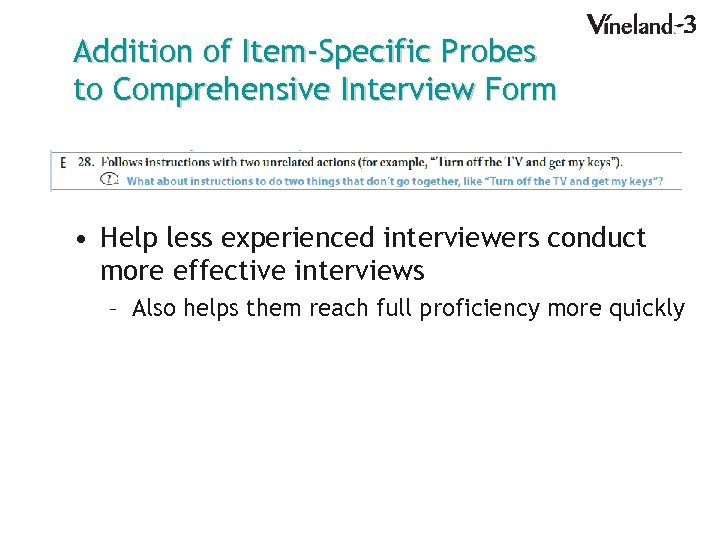 Addition of Item-Specific Probes to Comprehensive Interview Form • Help less experienced interviewers conduct more effective interviews – Also helps them reach full proficiency more quickly
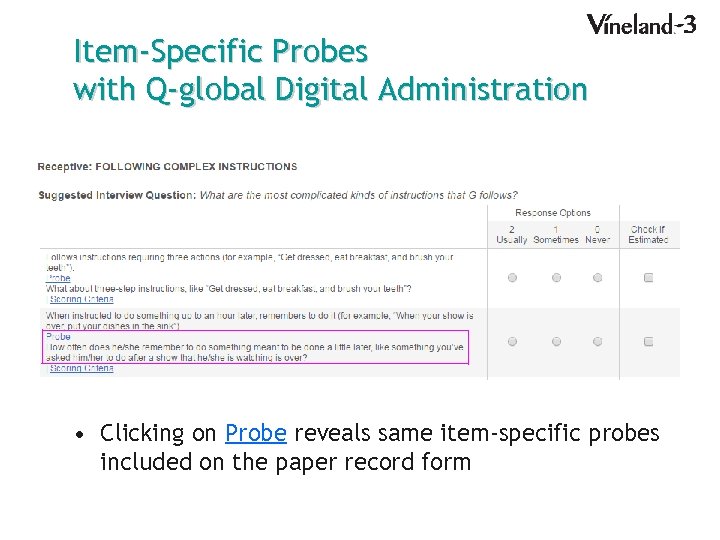 Item-Specific Probes with Q-global Digital Administration • Clicking on Probe reveals same item-specific probes included on the paper record form
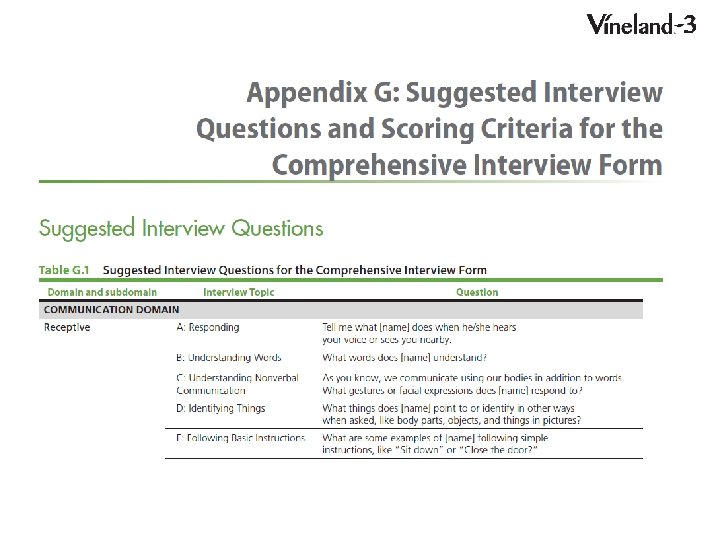
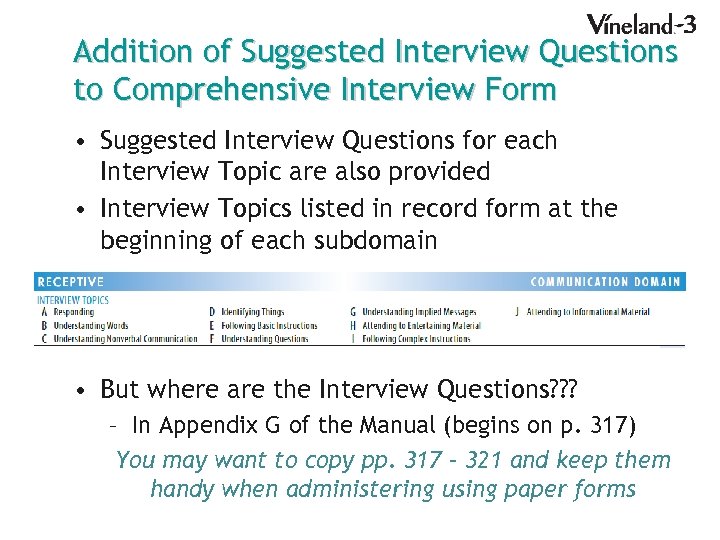 Addition of Suggested Interview Questions to Comprehensive Interview Form • Suggested Interview Questions for each Interview Topic are also provided • Interview Topics listed in record form at the beginning of each subdomain • But where are the Interview Questions? ? ? – In Appendix G of the Manual (begins on p. 317) You may want to copy pp. 317 – 321 and keep them handy when administering using paper forms
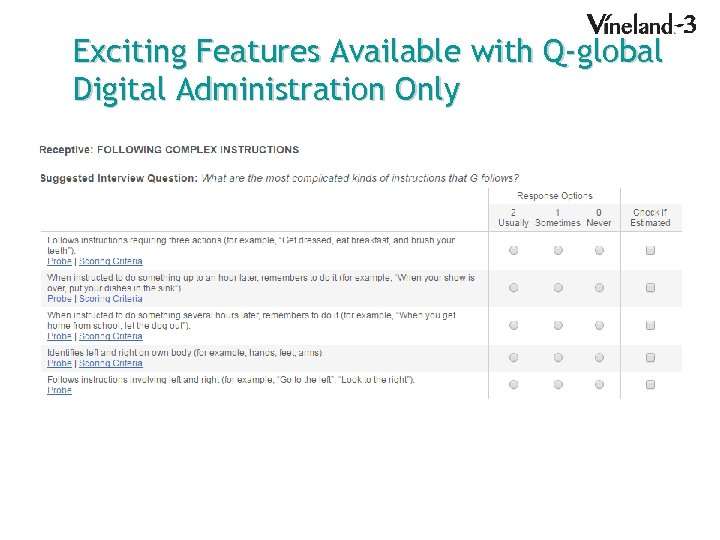
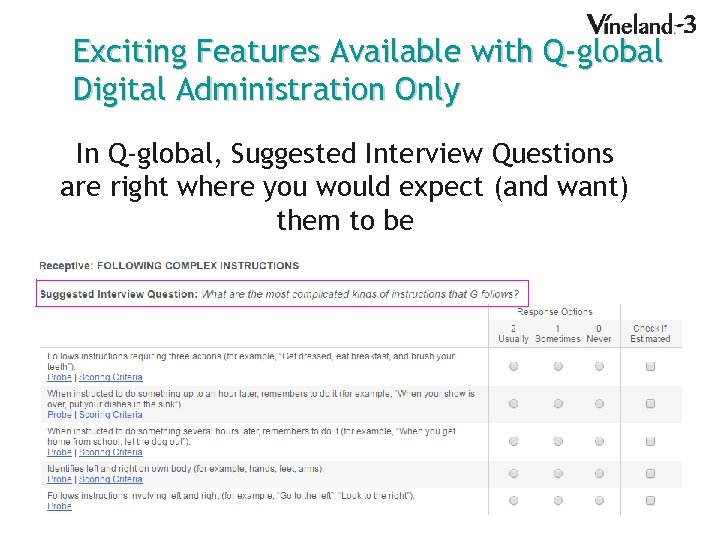 Exciting Features Available with Q-global Digital Administration Only In Q-global, Suggested Interview Questions are right where you would expect (and want) them to be
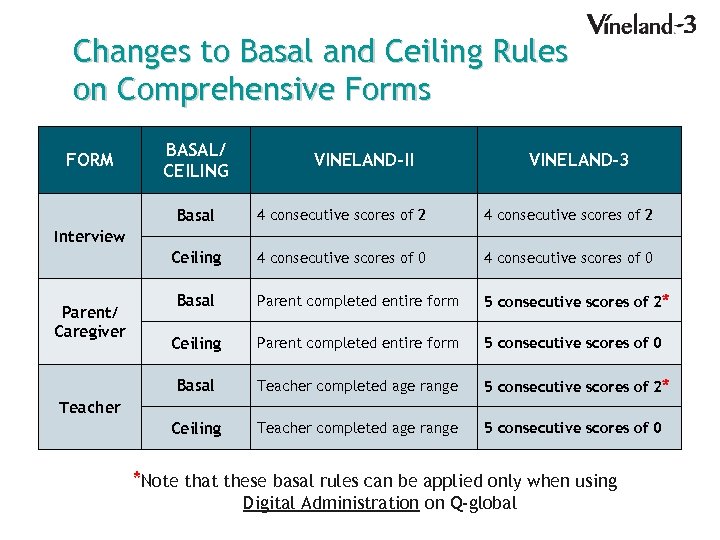 Changes to Basal and Ceiling Rules on Comprehensive Forms FORM BASAL/ CEILING VINELAND-II VINELAND-3 Basal 4 consecutive scores of 2 Ceiling 4 consecutive scores of 0 Basal Parent completed entire form 5 consecutive scores of 2* Ceiling Parent completed entire form 5 consecutive scores of 0 Basal Teacher completed age range 5 consecutive scores of 2* Ceiling Teacher completed age range 5 consecutive scores of 0 Interview Parent/ Caregiver Teacher *Note that these basal rules can be applied only when using Digital Administration on Q-global
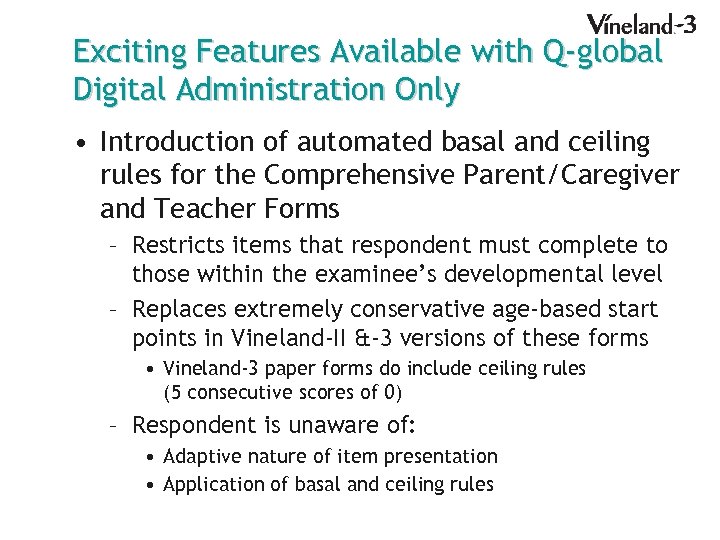 Exciting Features Available with Q-global Digital Administration Only • Introduction of automated basal and ceiling rules for the Comprehensive Parent/Caregiver and Teacher Forms – Restricts items that respondent must complete to those within the examinee’s developmental level – Replaces extremely conservative age-based start points in Vineland-II &-3 versions of these forms • Vineland-3 paper forms do include ceiling rules (5 consecutive scores of 0) – Respondent is unaware of: • Adaptive nature of item presentation • Application of basal and ceiling rules
 Exciting Features Available with Q-global Digital Administration Only
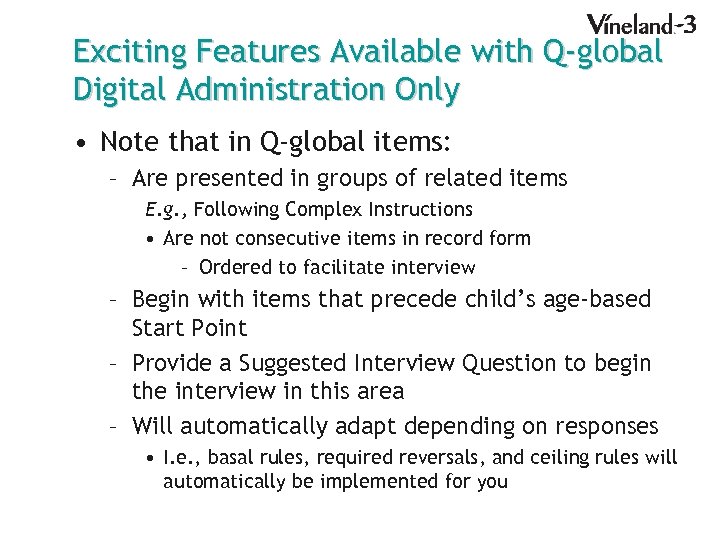 Exciting Features Available with Q-global Digital Administration Only • Note that in Q-global items: – Are presented in groups of related items E. g. , Following Complex Instructions • Are not consecutive items in record form – Ordered to facilitate interview – Begin with items that precede child’s age-based Start Point – Provide a Suggested Interview Question to begin the interview in this area – Will automatically adapt depending on responses • I. e. , basal rules, required reversals, and ceiling rules will automatically be implemented for you
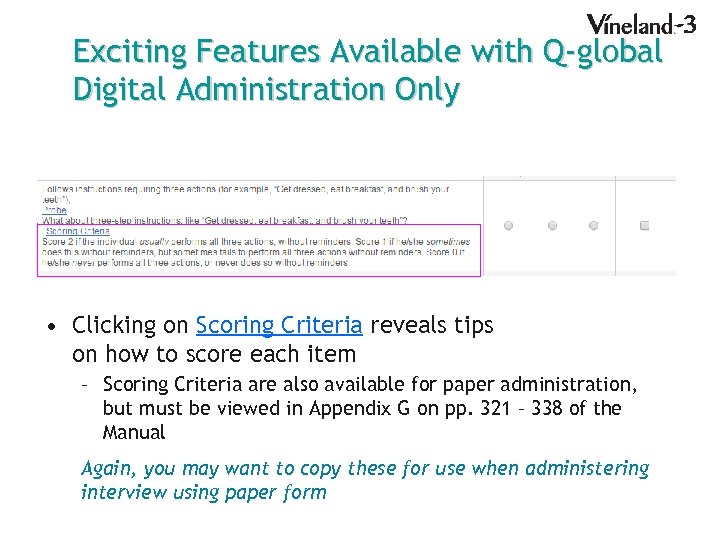 Exciting Features Available with Q-global Digital Administration Only • Clicking on Scoring Criteria reveals tips on how to score each item – Scoring Criteria are also available for paper administration, but must be viewed in Appendix G on pp. 321 – 338 of the Manual Again, you may want to copy these for use when administering interview using paper form
 Summary: Why Q-global is Easier Than Paper • Automatically keeps track of basal, ceiling, and subdomain completion rules • INTERVIEW FORM: • Q-global conveniently organizes items with related content by topic • Interview Topics include 2 to 6 items • All information for the items within an Interview Topic is displayed on a single screen • Both Suggested Interview Questions and Item-Level Probes are easily viewed
 General Preparation and Administration Guidelines
 Preparing to Administer the Vineland-3 Interview Form 1. Decide which form(s) to administer 2. Select the respondent(s) 3. Decide between online and paper administration 4. Decide whether or not to include the optional Motor Skills and Maladaptive Behavior domains
 Selecting the Respondent • Should be someone very knowledgeable about examinee’s everyday behavior • Should be someone living in the same home as the examinee – If examinee is in a residential care setting, select someone who provides care in that setting • For children, best respondent is usually the primary caregiver
 Establishing Rapport • Important for obtaining valid results • Take time at beginning of interview to establish a warm, conversational tone – Introduce yourself and use your first name • If comfortable doing so – – Maintain good eye contact Smile often to express understanding, reassurance Be sincerely interested, supportive, nonjudgmental Encourage respondent to ask questions at any time during interview Do not conduct the interview over the phone
 Introducing the Interview Explain. . . Purpose of the overall evaluation The role of adaptive behavior assessment as part of the evaluation How the Vineland-3 interview will be used to evaluate examinee’s adaptive behavior Emphasize the importance of providing the most accurate information possible
 Structuring the Interview • Points to emphasize to respondent: – No right or wrong answers – Describe what the individual actually does • Not what they might be capable of doing – Not all individuals perform the same activities at the same age
 Establishing Rapport - Video • “Michael” is 8 years old and in the 2 nd grade • He’s having academic and behavior problems at school • Respondent is Michael’s mother, Maria 3: 34
 Deciding Whether to Administer Motor Skills Domain • Norms available for Birth – 9 only Useful for evaluating: • Children with suspected or known motor deficit • Children with disabilities that may affect motor functioning – E. g. , vision impairment, spinal cord injury
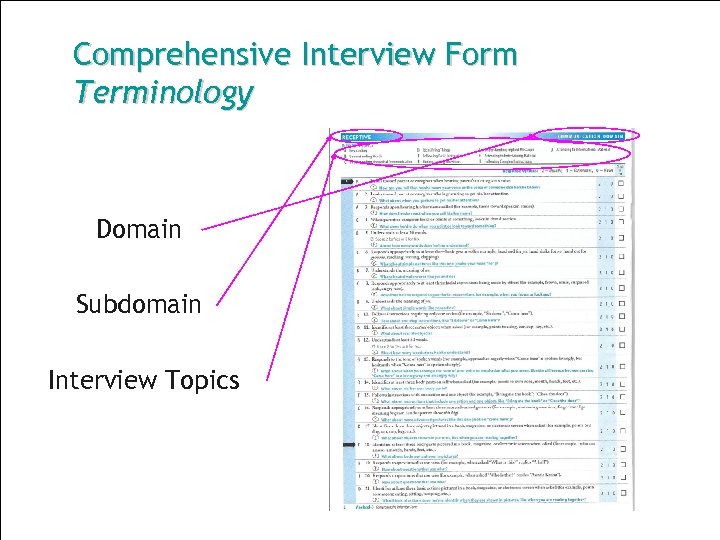 Comprehensive Interview Form Terminology Domain Subdomain Interview Topics
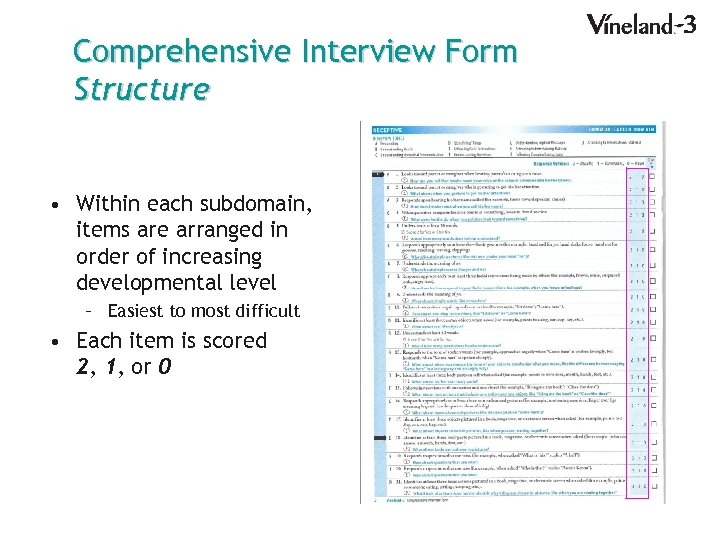 Comprehensive Interview Form Structure • Within each subdomain, items are arranged in order of increasing developmental level – Easiest to most difficult • Each item is scored 2, 1, or 0
 Determining Start Point • Select start point based on estimate of child’s developmental age – May require use of your clinical judgment and experience • OK to use low start points – Basal rule will later be used to determine scoring – If items below basal completed, they will provide you with additional information for treatment planning • Use same start point for all subdomains administered
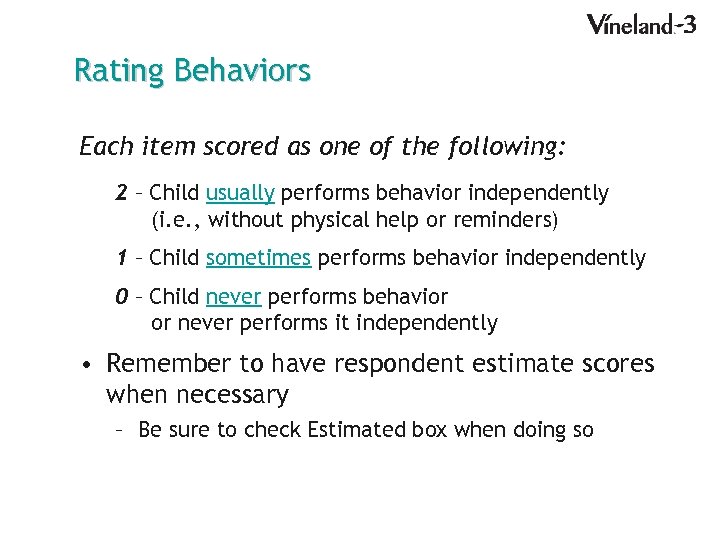 Rating Behaviors Each item scored as one of the following: 2 – Child usually performs behavior independently (i. e. , without physical help or reminders) 1 – Child sometimes performs behavior independently 0 – Child never performs behavior or never performs it independently • Remember to have respondent estimate scores when necessary – Be sure to check Estimated box when doing so
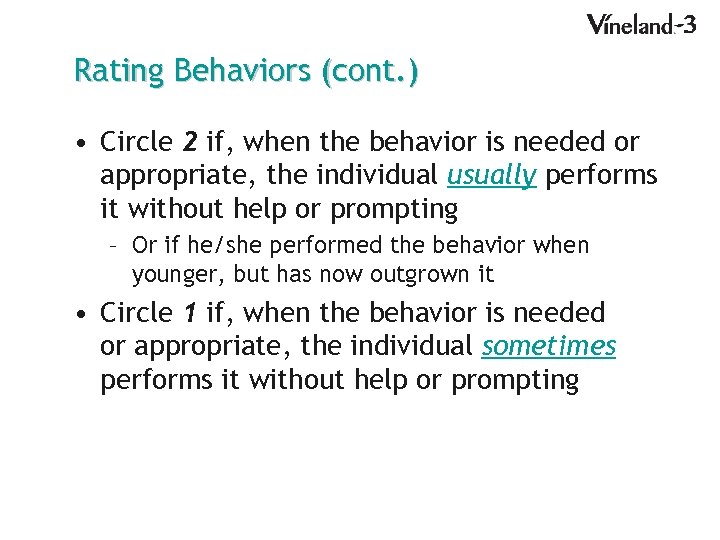 Rating Behaviors (cont. ) • Circle 2 if, when the behavior is needed or appropriate, the individual usually performs it without help or prompting – Or if he/she performed the behavior when younger, but has now outgrown it • Circle 1 if, when the behavior is needed or appropriate, the individual sometimes performs it without help or prompting
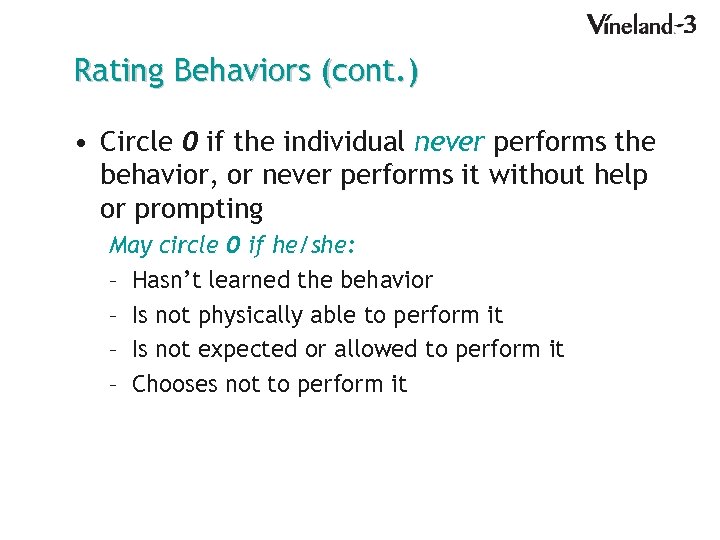 Rating Behaviors (cont. ) • Circle 0 if the individual never performs the behavior, or never performs it without help or prompting May circle 0 if he/she: – Hasn’t learned the behavior – Is not physically able to perform it – Is not expected or allowed to perform it – Chooses not to perform it
 Rating Behaviors (cont. ) • Remember to consult detailed Scoring Criteria – By clicking on Scoring Criteria in Q-global – By consulting Appendix G in Manual when completing paper record form • Read over these criteria and become familiar with them to speed administration and improve scoring accuracy
 Remember when rating behaviors. . . The criterion for rating adaptive behaviors is the child’s usual behavior. It is not whether he/she can or cannot perform the skill.
 Vineland-3 Semistructured Interview
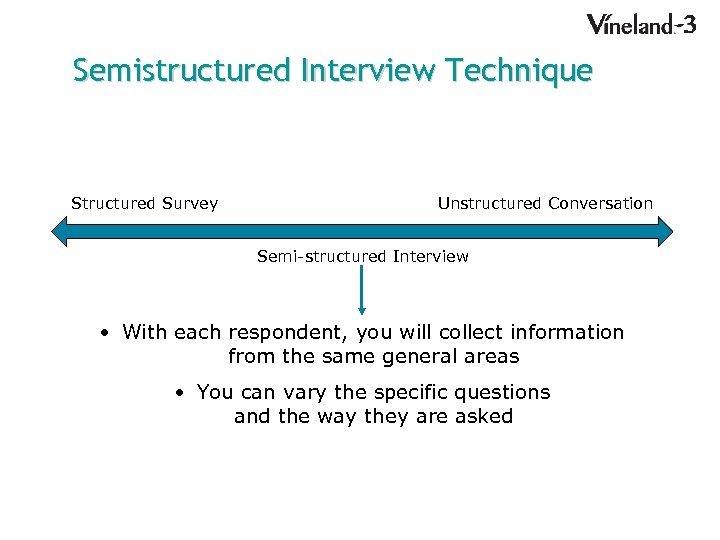 Semistructured Interview Technique Structured Survey Unstructured Conversation Semi-structured Interview • With each respondent, you will collect information from the same general areas • You can vary the specific questions and the way they are asked
 When using the semistructured interview technique. . . DO Use openended questioning Use information from respondent to score items DO NOT Read items to respondent Ask respondent to provide item scores
 Semi-Structured Interview Procedures • Ask broad, open-ended questions that allow respondent latitude to answer • Follow open-ended questions with probes – These allow you to score items (Remember, Vineland-3 provides these!) • • Ask for examples of behaviors Save direct, targeted questions for the end Think about how to re-direct Think about how to end interview
 Administering the Comprehensive Interview Form Using a Paper Booklet • Pay attention to the order in which to administer Interview Topics • Decide whether or not to include the Motor Skills domain for either the Comprehensive or the Domain-Level version, if the examinee is age 0 to 9 • Decide whether or not to include the Maladaptive Behavior domain if the examinee is age 3 or older
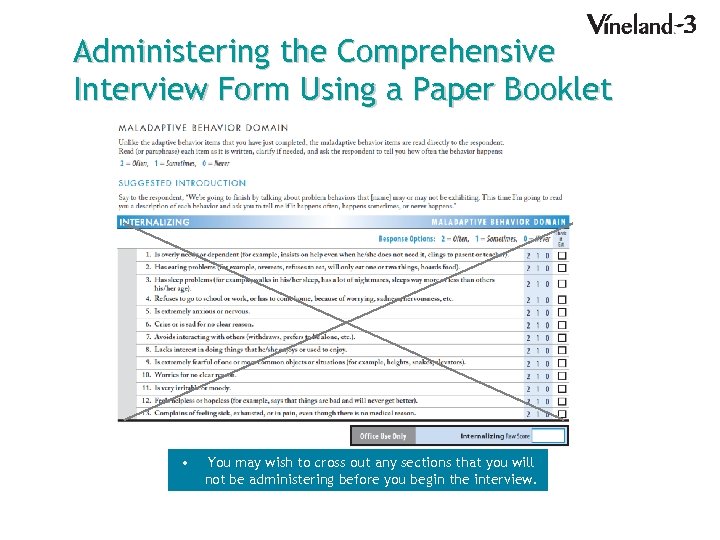 Administering the Comprehensive Interview Form Using a Paper Booklet • You may wish to cross out any sections that you will not be administering before you begin the interview.
 Administering a Subdomain for the Comprehensive Interview Form • Begin a subdomain with an Interview Topic that is at or close to the Start Point Age you determined for the examinee • After completing the starting topic, decide how to sequence subsequent topics efficiently to establish a basal and ceiling
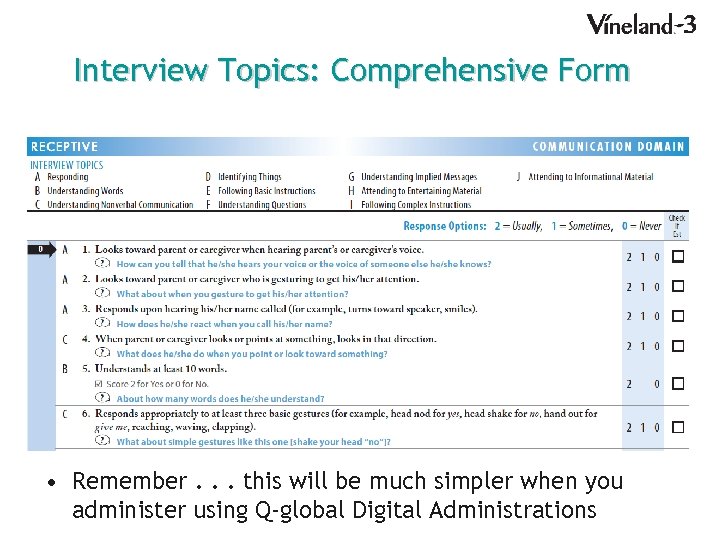 Interview Topics: Comprehensive Form • Remember. . . this will be much simpler when you administer using Q-global Digital Administrations
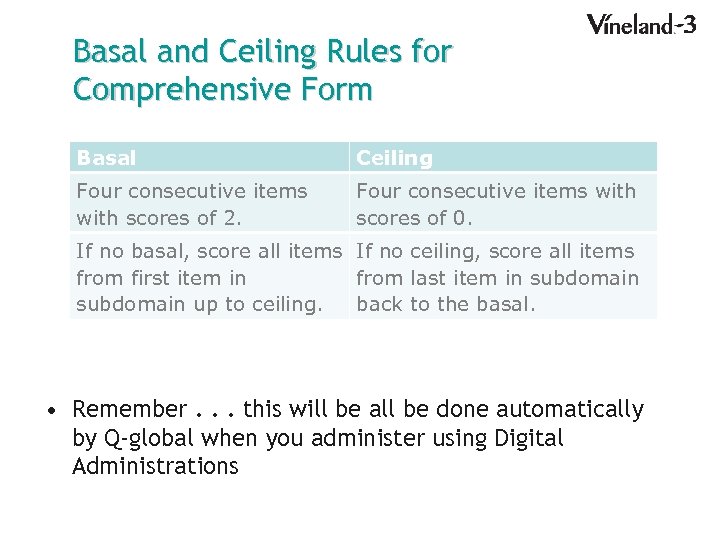 Basal and Ceiling Rules for Comprehensive Form Basal Ceiling Four consecutive items with scores of 2. Four consecutive items with scores of 0. If no basal, score all items If no ceiling, score all items from first item in from last item in subdomain up to ceiling. back to the basal. • Remember. . . this will be all be done automatically by Q-global when you administer using Digital Administrations
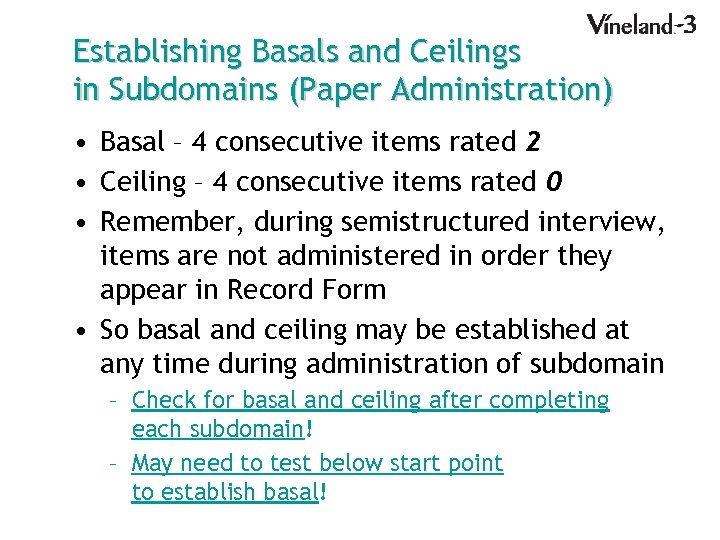 Establishing Basals and Ceilings in Subdomains (Paper Administration) • Basal – 4 consecutive items rated 2 • Ceiling – 4 consecutive items rated 0 • Remember, during semistructured interview, items are not administered in order they appear in Record Form • So basal and ceiling may be established at any time during administration of subdomain – Check for basal and ceiling after completing each subdomain! – May need to test below start point to establish basal!
 Administering Maladaptive Behavior Domain • Semistructured interview technique is not used for optional Maladaptive Behavior domain – In this section only, interviewer reads items directly to respondent • Interviewer reads (or paraphrases) each item as it is written, clarifies if needed, and asks respondent whether the behavior described occurs often, sometimes, or never • There are no basal and ceiling rules, and all items must be administered
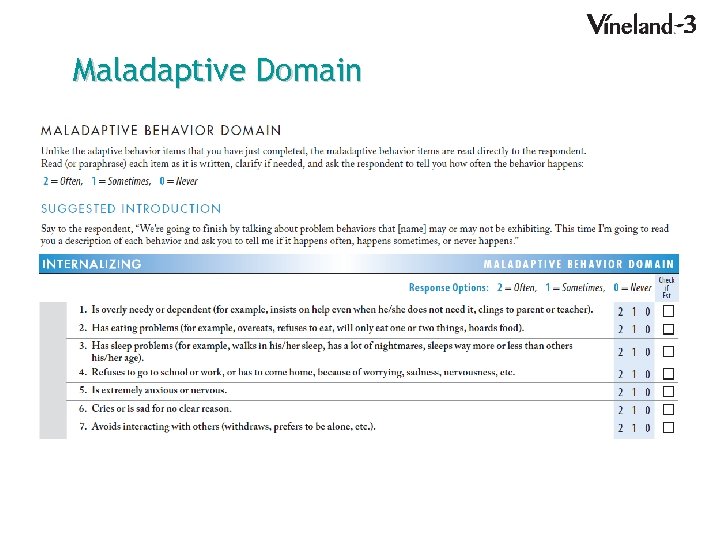 Maladaptive Domain
 Administering Communication Domain (Receptive Subdomain) - Video • “Michael” is 8 years old and in the 2 nd grade • He’s having academic and behavior problems at school • Respondent is Michael’s mother, Maria – Note: Video uses Vineland-II items, so just listen for the basic flow of how a semistructured interview works – Afterward, we’ll look at an example using the Vineland-3 Record Form 3: 34
 Administering Daily Living Skills Domain (Personal Subdomain) - Video • Again, note that these are Vineland-II items, but they are very similar • Afterward, we can review using the Vineland-3 form
 Example of Semistructured Interview Using Vineland-3
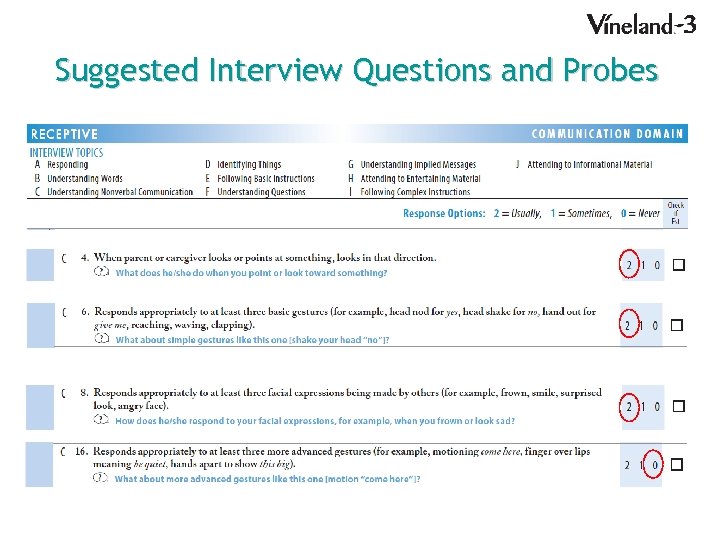
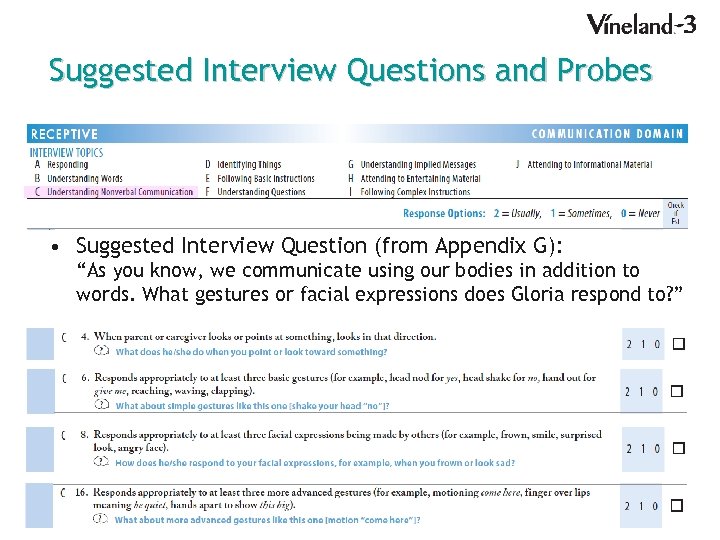 Suggested Interview Questions and Probes • Suggested Interview Question (from Appendix G): “As you know, we communicate using our bodies in addition to words. What gestures or facial expressions does Gloria respond to? ”
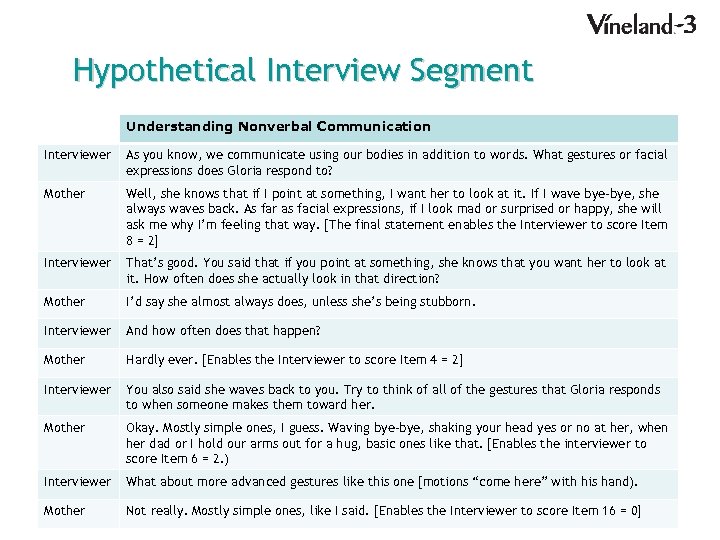 Hypothetical Interview Segment Understanding Nonverbal Communication Interviewer As you know, we communicate using our bodies in addition to words. What gestures or facial expressions does Gloria respond to? Mother Well, she knows that if I point at something, I want her to look at it. If I wave bye-bye, she always waves back. As far as facial expressions, if I look mad or surprised or happy, she will ask me why I’m feeling that way. [The final statement enables the Interviewer to score Item 8 = 2] Interviewer That’s good. You said that if you point at something, she knows that you want her to look at it. How often does she actually look in that direction? Mother I’d say she almost always does, unless she’s being stubborn. Interviewer And how often does that happen? Mother Hardly ever. [Enables the Interviewer to score Item 4 = 2] Interviewer You also said she waves back to you. Try to think of all of the gestures that Gloria responds to when someone makes them toward her. Mother Okay. Mostly simple ones, I guess. Waving bye-bye, shaking your head yes or no at her, when her dad or I hold our arms out for a hug, basic ones like that. [Enables the interviewer to score Item 6 = 2. ) Interviewer What about more advanced gestures like this one [motions “come here” with his hand). Mother Not really. Mostly simple ones, like I said. [Enables the Interviewer to score Item 16 = 0]
 Suggested Interview Questions and Probes
 Administering the Comprehensive Interview Form Online • The Online Interview Form: – Begins with a screen with instructions – Then Interview Topics are presented one at a time to the interviewer Jarett can demonstrate this for you
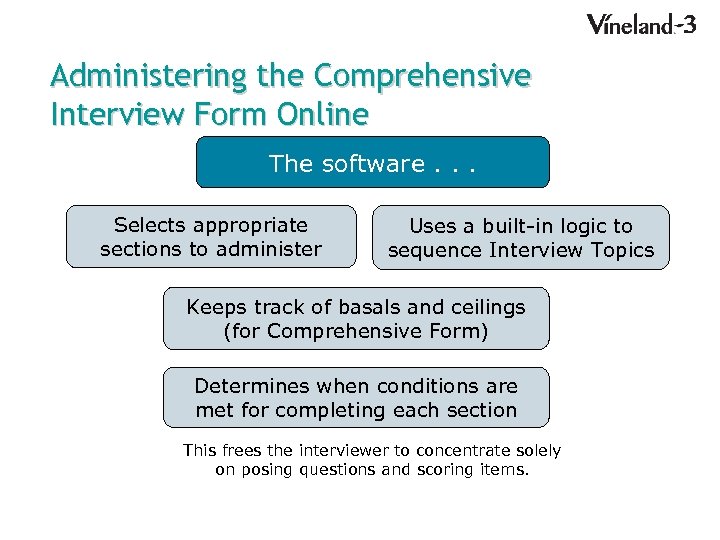 Administering the Comprehensive Interview Form Online The software. . . Selects appropriate sections to administer Uses a built-in logic to sequence Interview Topics Keeps track of basals and ceilings (for Comprehensive Form) Determines when conditions are met for completing each section This frees the interviewer to concentrate solely on posing questions and scoring items.
 Completing the Interview 1. Determine that basal and ceiling have been established for each subdomain 2. Determine that all items between basal item and ceiling item have been scored 3. Obtain any missing information from respondent
 Vineland-3 General Scoring
 Hooray for Q-global! • Even if you have administered Vineland-3 using a paper booklet, you do not have to score by hand • Just enter response scores from the booklet into Q-global – Q-global will score and generate reports
 Vineland-3 Scores • Subdomains – Norm-referenced scores reported as “v-Scale Scores” (Mean = 15, SD = 3) • Domains – Composite scores (Mean = 100, SD = 15) • Adaptive Behavior Composite (ABC) – Composite score (Mean = 100, SD = 15) • Age Equivalents (AE) • Growth Scale Values (GSV)
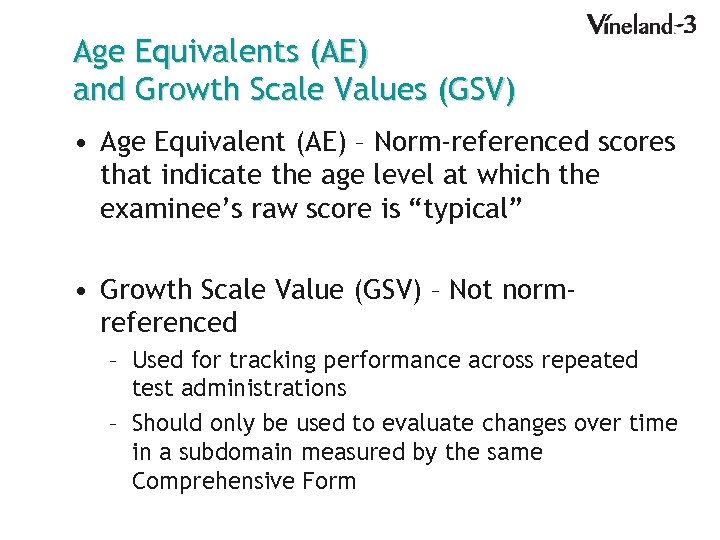 Age Equivalents (AE) and Growth Scale Values (GSV) • Age Equivalent (AE) – Norm-referenced scores that indicate the age level at which the examinee’s raw score is “typical” • Growth Scale Value (GSV) – Not normreferenced – Used for tracking performance across repeated test administrations – Should only be used to evaluate changes over time in a subdomain measured by the same Comprehensive Form
 Vineland-3 Q-global Demonstration
 Questions? Gail C. Rodin, Ph. D. 919 -395 -6333 gail. rodin@pearson. com