Скачать презентацию INTRODUCING AND MOVING TO SCALE WITH FFS ON
640b7ea93fcefb70280f3e3259c8f9b4.ppt
- Количество слайдов: 18
 INTRODUCING AND MOVING TO SCALE WITH FFS ON LAND & WATER MANAGEMENT & CA PROCESS Experiences and Lessons from E. Uganda Paul Nyende Land Management Officer, TCP/UGA/2903 Kagera project development workshops, Entebbe 23 – 30 November 2005
 The Changing Global & National Trends Changing global and national trends demanding for changes in research & extension service delivery. There has been a common need for reforms (PMA, NAADS, ) that; • improve relevance, accountability (extension & research) to farmers; • put in place a demand- and market-driven service provision system; • ensure decentralization of service delivery; and, • promote increased participation of the private sector
 FFS approach: What are the issues? • Does the FFS approach to improving land & water management work? What is the evidence? • What does it take (resources) to introduce and establish FFS on land & water management? • What is the process of establishing FFS on Land & Water Management ? • What are the roles of different stakeholders? • What opportunities exist locally, regionally & globally? • What impact is projected?
 Why the FFS approach to land & water management? • Many technologies are new hence requires a discovery-based learning process, which the FFS provides • Farmers actively participate in formulating interventions through experimentation & innovation • Extension agents act as “facilitators” & NOT “teachers” to stimulate & support the learning process • Knowledge acquired is used to build on existing indigenous knowledge, resident with farmers • Follows a curriculum to facilitate a step by step learning • What then is new? • In built mechanisms for sustainability built through focus on participatory technology development, and gender-sensitive diagnostic strategies, enhancement of farmer innovation, micro-catchment and community level planning with stakeholders and capacity building of extension and technical personnel
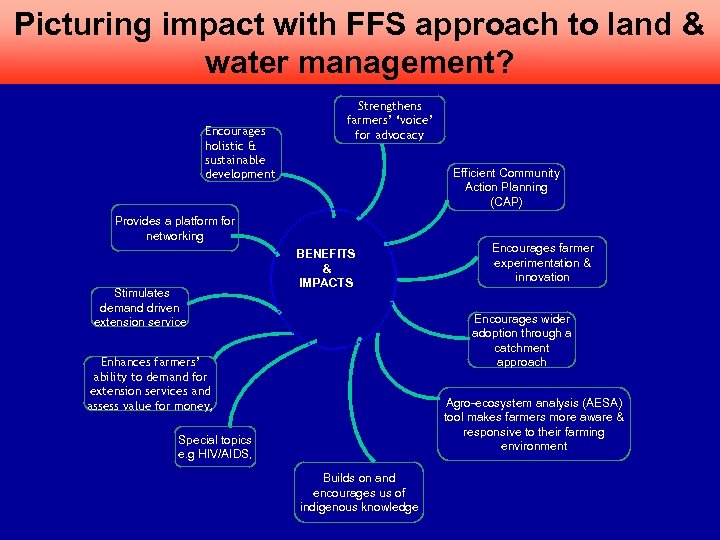 Picturing impact with FFS approach to land & water management? Encourages holistic & sustainable development Strengthens farmers’ ‘voice’ for advocacy Efficient Community Action Planning (CAP) Provides a platform for networking Stimulates demand driven extension service BENEFITS & IMPACTS Encourages farmer experimentation & innovation Encourages wider adoption through a catchment approach Enhances farmers’ ability to demand for extension services and assess value for money, Agro-ecosystem analysis (AESA) tool makes farmers more aware & responsive to their farming environment Special topics e. g HIV/AIDS, Builds on and encourages us of indigenous knowledge
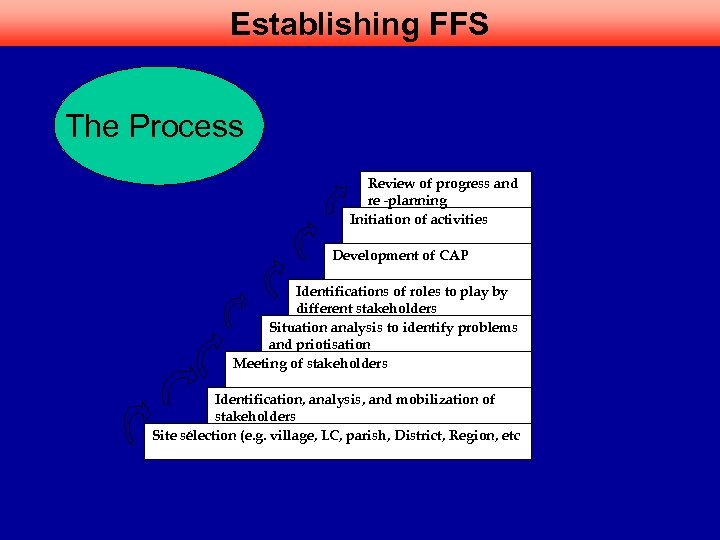 Establishing FFS The Process Review of progress and re -planning Initiation of activities Development of CAP Identifications of roles to play by different stakeholders Situation analysis to identify problems and priotisation Meeting of stakeholders Identification, analysis, and mobilization of stakeholders Site sélection (e. g. village, LC, parish, District, Region, etc
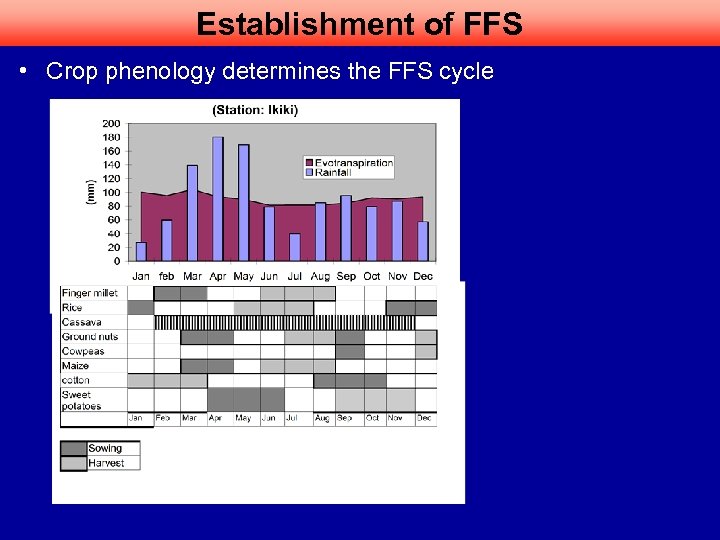 Establishment of FFS • Crop phenology determines the FFS cycle
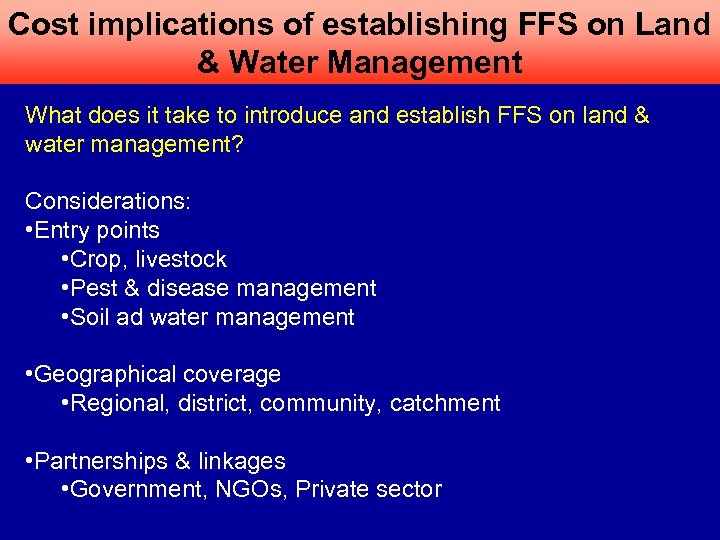 Cost implications of establishing FFS on Land & Water Management What does it take to introduce and establish FFS on land & water management? Considerations: • Entry points • Crop, livestock • Pest & disease management • Soil ad water management • Geographical coverage • Regional, district, community, catchment • Partnerships & linkages • Government, NGOs, Private sector
 Cost implications of establishing FFS on Land Management What does it take to introduce and establish FFS on land management? Resources • Technical expertise • Social capital • Government (policy) support
 Resources - Technical expertise • International experts – for sharing international experience & backstopping • National expertise • Master trainers • Facilitators (both extension and farmers) • Farmer organizations/CBOs
 FFS group capacity development issues • International experts – for sharing international experience & backstopping • National expertise • Master trainers • Facilitators (both extension and farmers) • Farmer organizations/CBOs
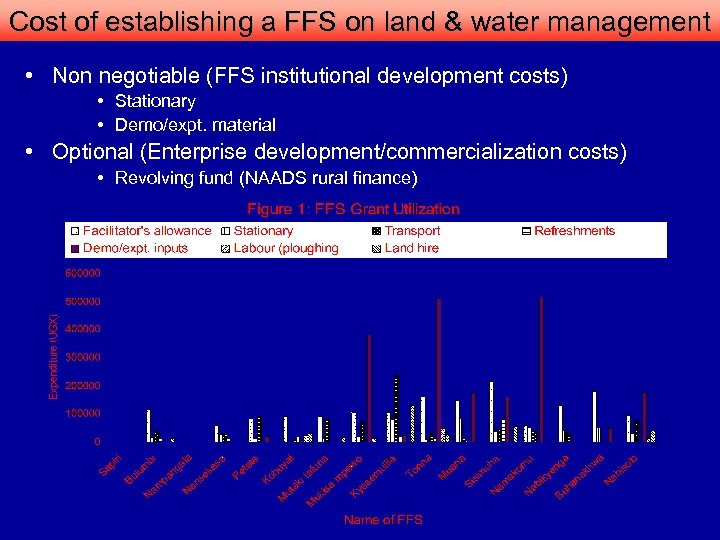 Cost of establishing a FFS on land & water management • Non negotiable (FFS institutional development costs) • Stationary • Demo/expt. material • Optional (Enterprise development/commercialization costs) • Revolving fund (NAADS rural finance)
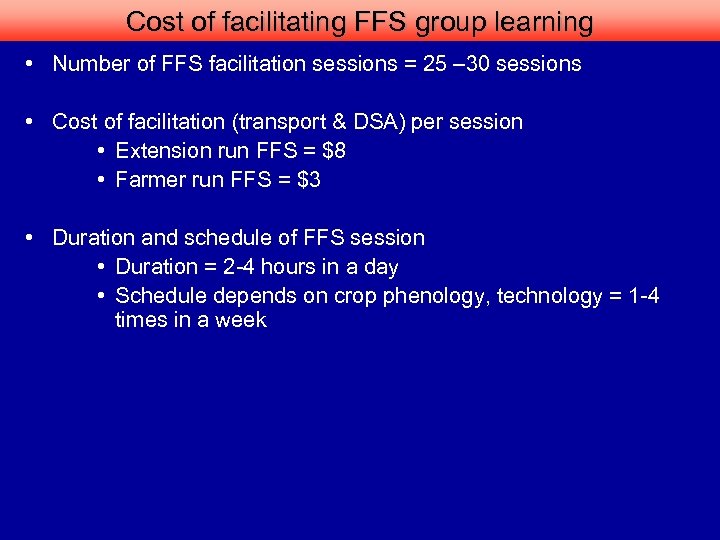 Cost of facilitating FFS group learning • Number of FFS facilitation sessions = 25 – 30 sessions • Cost of facilitation (transport & DSA) per session • Extension run FFS = $8 • Farmer run FFS = $3 • Duration and schedule of FFS session • Duration = 2 -4 hours in a day • Schedule depends on crop phenology, technology = 1 -4 times in a week
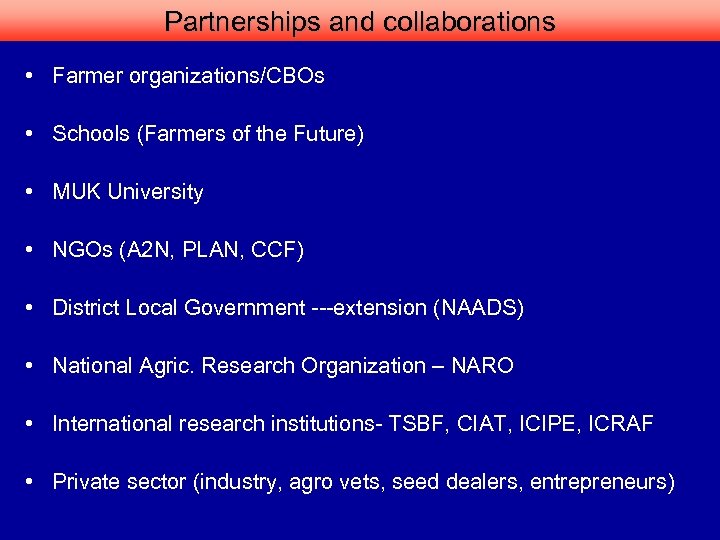 Partnerships and collaborations • Farmer organizations/CBOs • Schools (Farmers of the Future) • MUK University • NGOs (A 2 N, PLAN, CCF) • District Local Government ---extension (NAADS) • National Agric. Research Organization – NARO • International research institutions- TSBF, CIAT, ICIPE, ICRAF • Private sector (industry, agro vets, seed dealers, entrepreneurs)
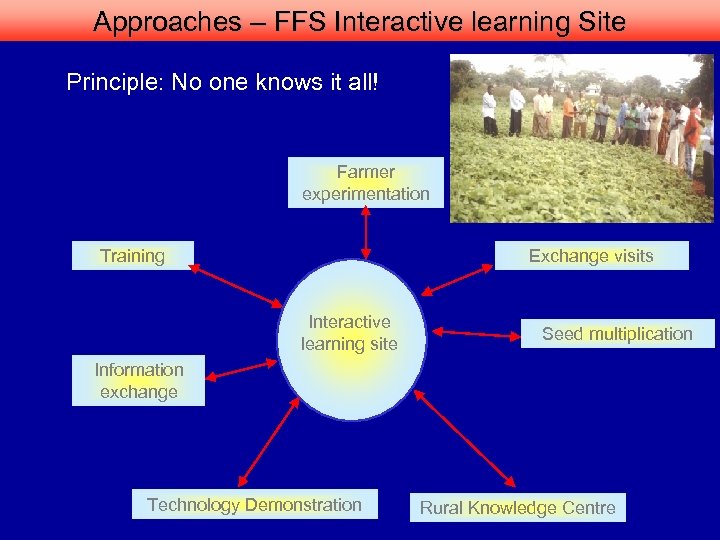 Approaches – FFS Interactive learning Site Principle: No one knows it all! Farmer experimentation Training Exchange visits Interactive learning site Seed multiplication Information exchange Technology Demonstration Rural Knowledge Centre
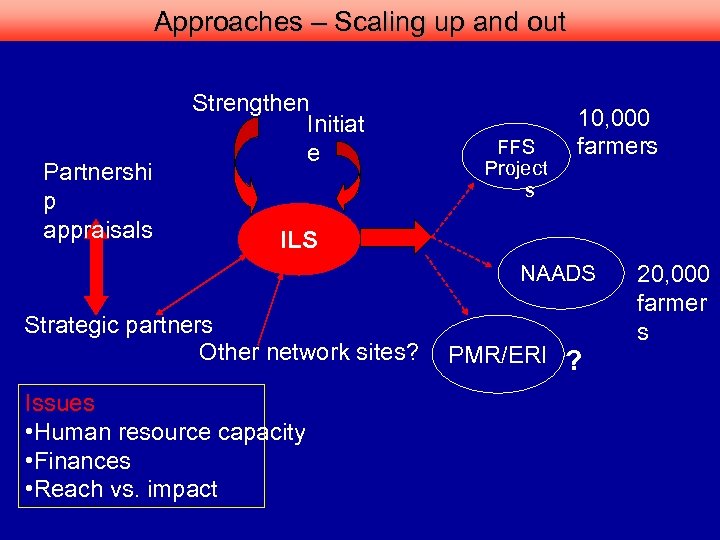 Approaches – Scaling up and out Partnershi p appraisals Strengthen Initiat e FFS Project s 10, 000 farmers ILS NAADS Strategic partners Other network sites? Issues • Human resource capacity • Finances • Reach vs. impact PMR/ERI ? 20, 000 farmer s
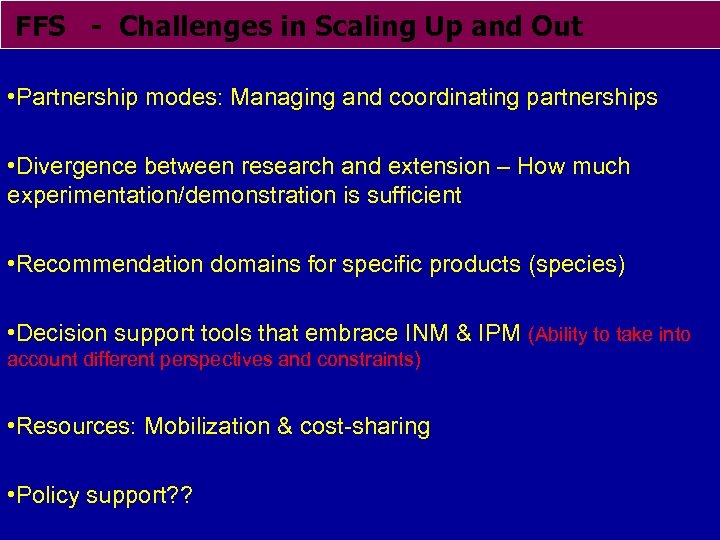 FFS - Challenges in Scaling Up and Out • Partnership modes: Managing and coordinating partnerships • Divergence between research and extension – How much experimentation/demonstration is sufficient • Recommendation domains for specific products (species) • Decision support tools that embrace INM & IPM (Ability to take into account different perspectives and constraints) • Resources: Mobilization & cost-sharing • Policy support? ?