 Скачать презентацию INTRO TO MANAGEMENT SUPPORT SYSTEMS IS 340 BY
5bed8014565f818be6c3ad388b168a2c.ppt
- Количество слайдов: 43



INTRO TO MANAGEMENT SUPPORT SYSTEMS IS 340 BY CHANDRA S. AMARAVADI
IN THIS PRESENTATION. . Introduction to MSS l Decisions & types of decisions l DSS l EIS l GDSS l 2
INTRO TO MSS 3
INTRODUCTION (FYI) l More competition l Globalization l Complexity More decision making (D. M) 4
MANAGEMENT SUPPORT SYSTEMS MSS: collection of tools/systems to support managerial activity. Characteristics (FYI): u Interactive u Customizable u Model based u Support rather than automate 5
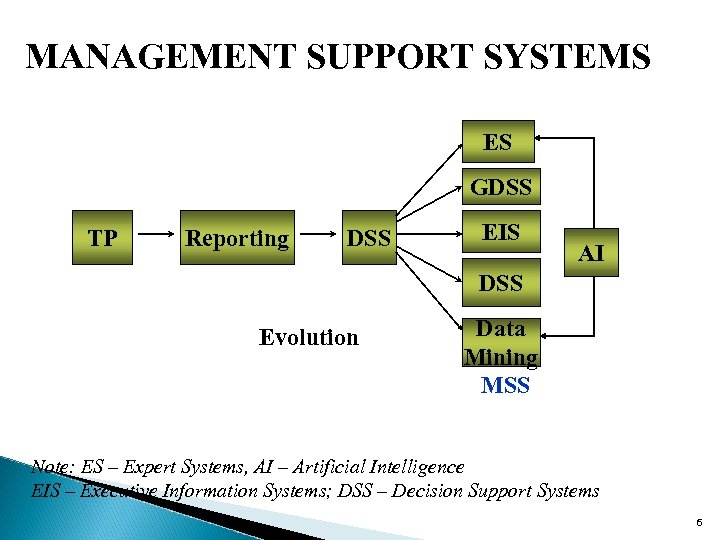
MANAGEMENT SUPPORT SYSTEMS ES GDSS TP Reporting DSS EIS AI DSS Evolution Data Mining MSS Note: ES – Expert Systems, AI – Artificial Intelligence EIS – Executive Information Systems; DSS – Decision Support Systems 6
EXAMPLES OF DECISIONS n. Whether to approve a loan? n. Whether to promote an employee? n. How much of an increase to allocate to employees? n. Where to advertise? Allocation to media? n. How to finance a capital expansion project? n. How much to produce? When to produce? n. What products to produce? What markets? n. What production techniques to use? 7
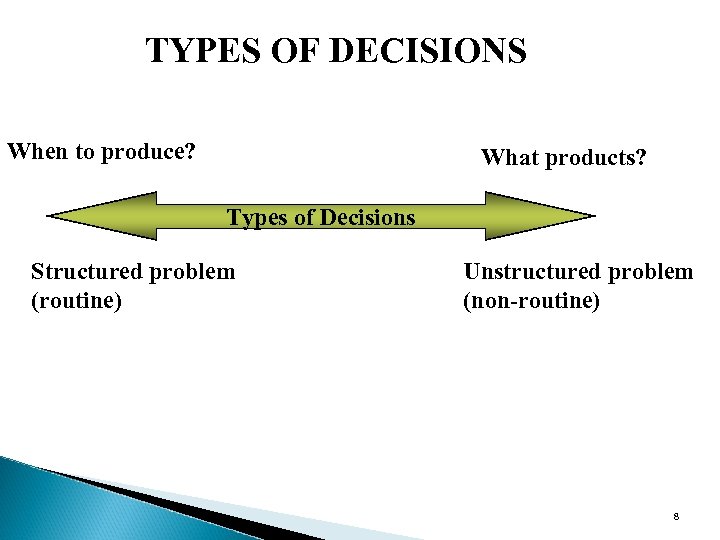
TYPES OF DECISIONS When to produce? What products? Types of Decisions Structured problem (routine) Unstructured problem (non-routine) 8
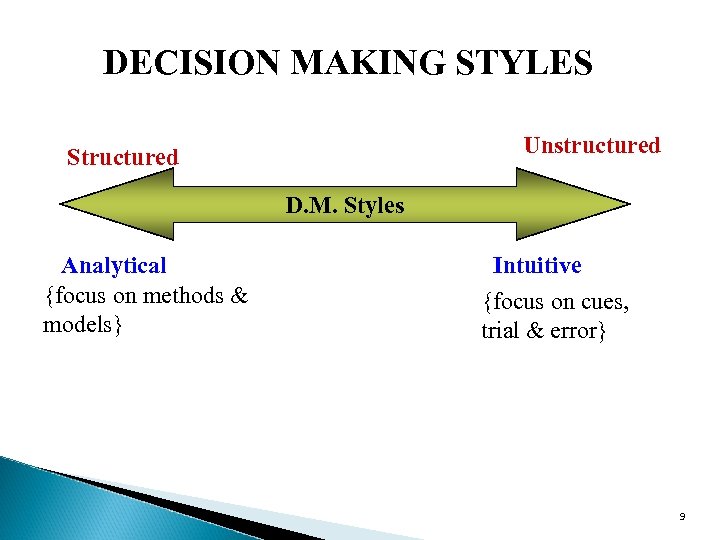
DECISION MAKING STYLES Unstructured Structured D. M. Styles Analytical {focus on methods & models} Intuitive {focus on cues, trial & error} 9
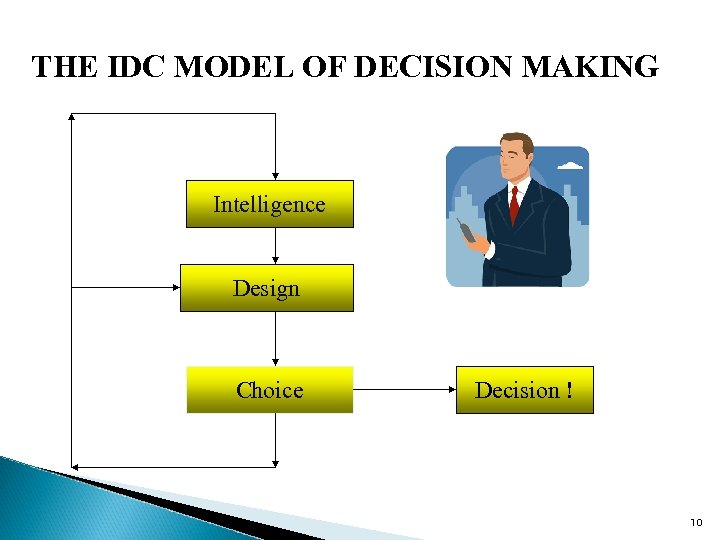
THE IDC MODEL OF DECISION MAKING Intelligence Design Choice Decision ! 10
THE IDC MODEL OF DECISION MAKING Introduced by Herbert Simon, the IDC consists of The following stages: Intelligence -- Identification of problem information Design -- Identification of alternative solutions Choice -- Choosing a solution which optimizes D. M. criteria 11
DECISION SUPPORT SYSTEMS 12
DECISION SUPPORT SYSTEMS A system that supports structured and semistructured decision making by managers in their own personalized way. 13
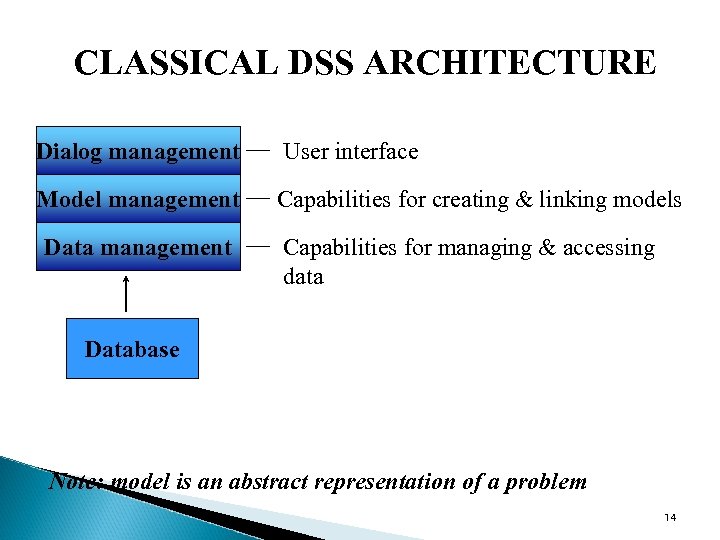
CLASSICAL DSS ARCHITECTURE Dialog management User interface Model management Capabilities for creating & linking models Data management Capabilities for managing & accessing data Database Note: model is an abstract representation of a problem 14
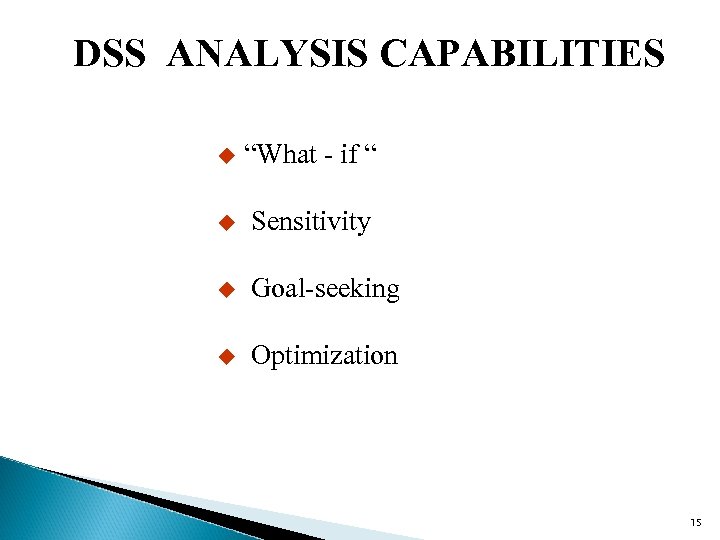
DSS ANALYSIS CAPABILITIES u “What - if “ u Sensitivity u Goal-seeking u Optimization 15
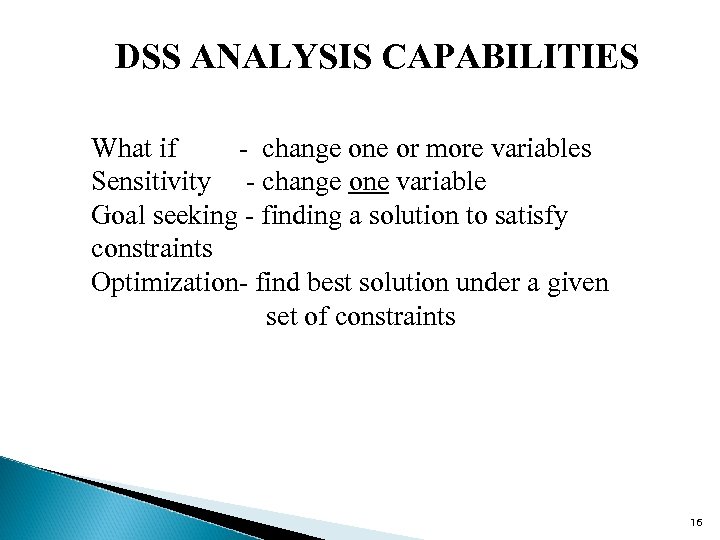
DSS ANALYSIS CAPABILITIES What if - change one or more variables Sensitivity - change one variable Goal seeking - finding a solution to satisfy constraints Optimization- find best solution under a given set of constraints 16
DSS MODELS (FYI) u Financial e. g. portfolio, NPV u Statistical e. g. : forecasting u Marketing e. g. : product mix, advertising u Production e. g. capacity planning, inventory u Simulation e. g. production process, bank tellers etc. 17
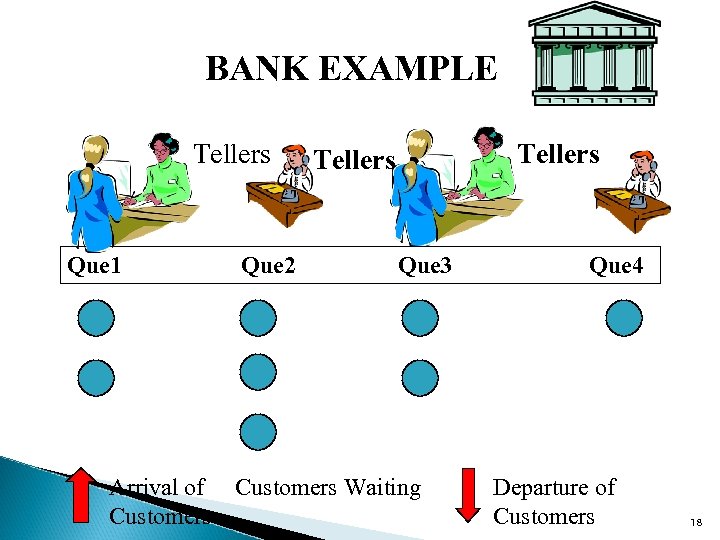
BANK EXAMPLE Tellers Que 1 Que 2 Tellers Que 3 Arrival of Customers Waiting Customers Que 4 Departure of Customers 18
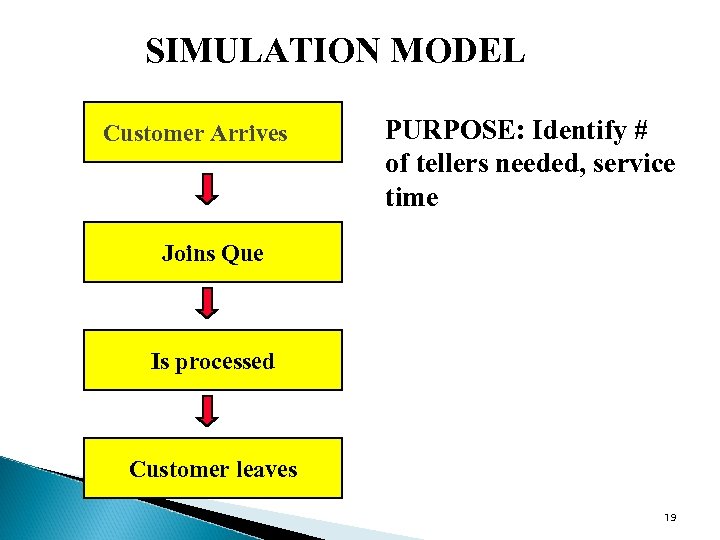
SIMULATION MODEL Customer Arrives PURPOSE: Identify # of tellers needed, service time Joins Que Is processed Customer leaves 19
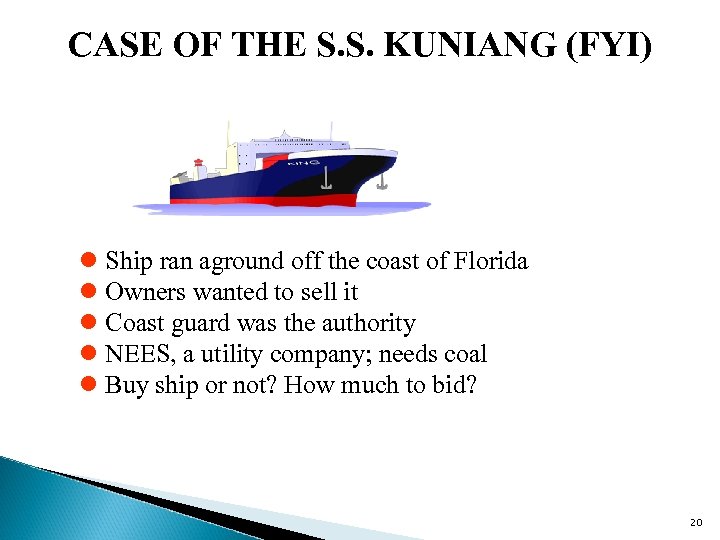
CASE OF THE S. S. KUNIANG (FYI) l Ship ran aground off the coast of Florida l Owners wanted to sell it l Coast guard was the authority l NEES, a utility company; needs coal l Buy ship or not? How much to bid? 20
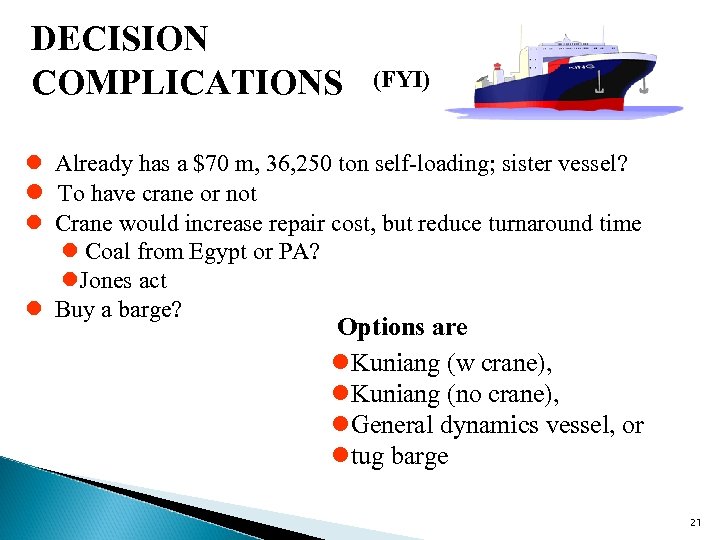
DECISION COMPLICATIONS (FYI) l Already has a $70 m, 36, 250 ton self-loading; sister vessel? l To have crane or not l Crane would increase repair cost, but reduce turnaround time l Coal from Egypt or PA? l. Jones act l Buy a barge? Options are l. Kuniang (w crane), l. Kuniang (no crane), l. General dynamics vessel, or ltug barge 21
DECISION CONSTRAINTS (FYI) l Capacity of General Dynamics 2. 5 m tons/yr Needed capacity: 4 m tons/yr l The Jones Act gave priority to the Kuniang in U. S. ports if repair cost > than 3 times boat’s salvage value l Affects round-trip time l Decision hinges on whether the C. G. would value ship > $ 5 million l If ship valued > $5 million, install crane (+$36 m) l Cargo capacity reduced to 40, 000 tons, but round trip time is decreased l How much to bid? 22
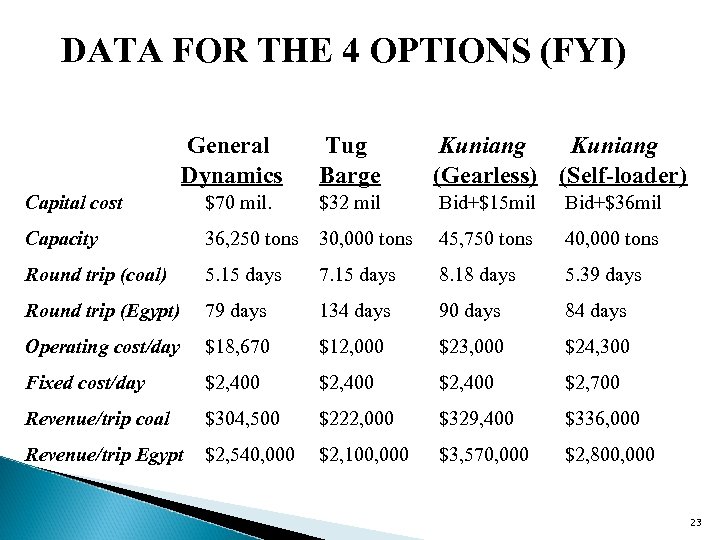
DATA FOR THE 4 OPTIONS (FYI) General Dynamics Tug Barge Kuniang (Gearless) (Self-loader) Capital cost $70 mil. $32 mil Bid+$15 mil Bid+$36 mil Capacity 36, 250 tons 30, 000 tons 45, 750 tons 40, 000 tons Round trip (coal) 5. 15 days 7. 15 days 8. 18 days 5. 39 days Round trip (Egypt) 79 days 134 days 90 days 84 days Operating cost/day $18, 670 $12, 000 $23, 000 $24, 300 Fixed cost/day $2, 400 $2, 700 Revenue/trip coal $304, 500 $222, 000 $329, 400 $336, 000 Revenue/trip Egypt $2, 540, 000 $2, 100, 000 $3, 570, 000 $2, 800, 000 23
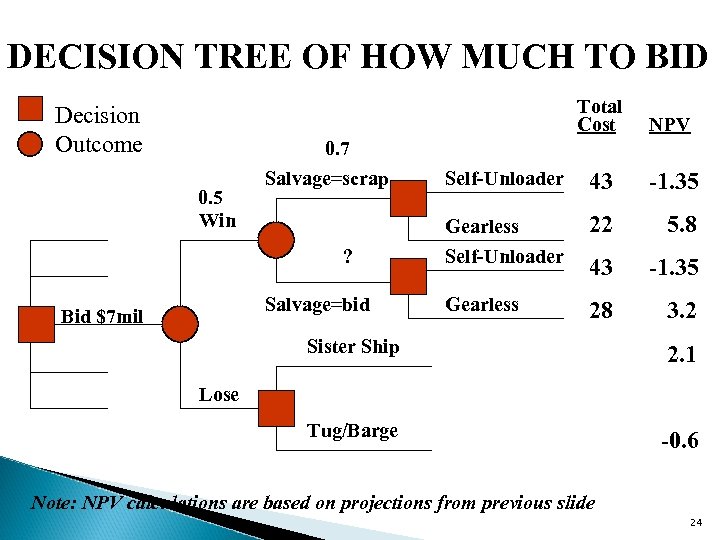
DECISION TREE OF HOW MUCH TO BID Total Cost Decision Outcome NPV Self-Unloader 43 -1. 35 Gearless 22 5. 8 Self-Unloader 43 -1. 35 Gearless 28 3. 2 0. 7 0. 5 Win Salvage=scrap ? Salvage=bid Bid $7 mil Sister Ship 2. 1 Tug/Barge -0. 6 Lose Note: NPV calculations are based on projections from previous slide 24
CONCLUSIONS (FYI) Ø NEES ended up bidding $6. 7 million for the Kuniang, but lost to a bid of $10 million Ø Coast Guard valued ship as scrap metal Ø Decision tree a useful tool; parameters unknown 25
DSS APPLICATIONS l l l l Cash forecasting Fire-fighting Portfolio selection Evaluate lending risk Event scheduling School location Police beat 26
DATA MINING 27
DATA MINING Search for relationships and global patterns that exist in large databases but are hidden in the vast amounts of data. e. g. sequence/association, classification, and clustering 28
SOME DATA MINING APPLICATIONS u Predicting the probability of default for consumer loans u Predicting audience response to TV advertisements u Predicting the probability that a cancer patient will respond to radiation therapy. u Predicting the probability that an offshore well is going to produce oil 29
DATA MINING ANALYSES Sequence Activities which occur after each other e. g. car and loan Associations activities/purchases which occur together e. g. bread and jam. Classification An analysis to group data into classes e. g. pepsi and coke drinkers 30
EXECUTIVE INFORMATION SYSTEMS 31
EXECUTIVE INFORMATION SYSTEMS Systems to support unstructured decision making by executives 32
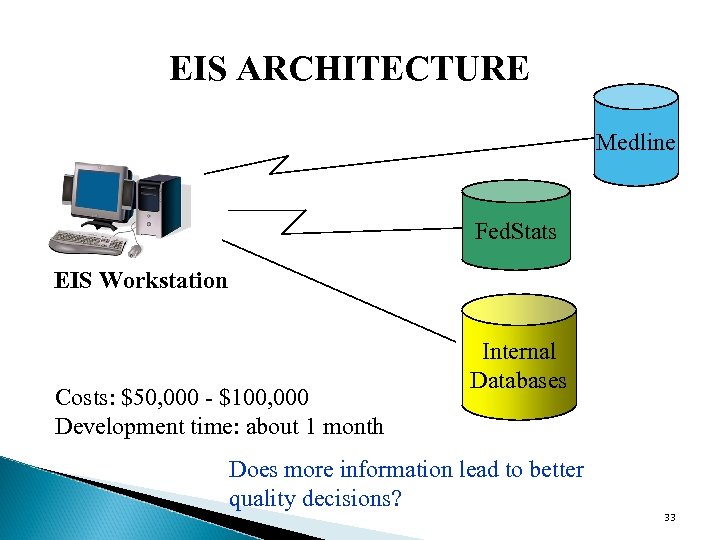
EIS ARCHITECTURE Medline Fed. Stats EIS Workstation Costs: $50, 000 - $100, 000 Development time: about 1 month Internal Databases Does more information lead to better quality decisions? 33
EIS CAPABILITIES üEase of use üDrill down capabilities- view data at increasing levels of detail üFiltering üStatus Monitoring üUser friendliness 34
COLLABORATIVE SYSTEMS (GDSS) 35
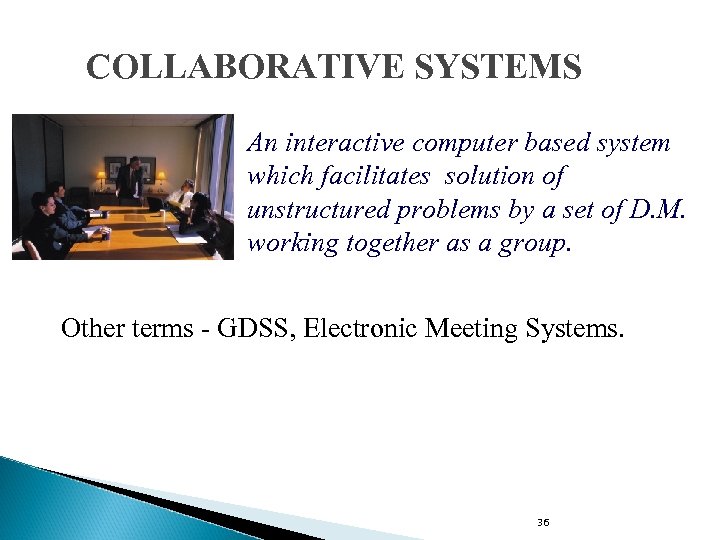
COLLABORATIVE SYSTEMS An interactive computer based system which facilitates solution of unstructured problems by a set of D. M. working together as a group. Other terms - GDSS, Electronic Meeting Systems. 36
CURRENT BUSINESS TRENDS (FYI) l More competition l Shift towards flat/virtual organizations l More mergers [industry consolidations] l Globalization of markets and products l More strategic alliances Group D. M. Is it necessary for org. decisions to be made in groups? Why cannot it be handled by individuals? 37
CHARACTERISTICS OF GROUP D. M. l l Participants of equal rank 5 -20 Time limits Requires knowledge from participants 38
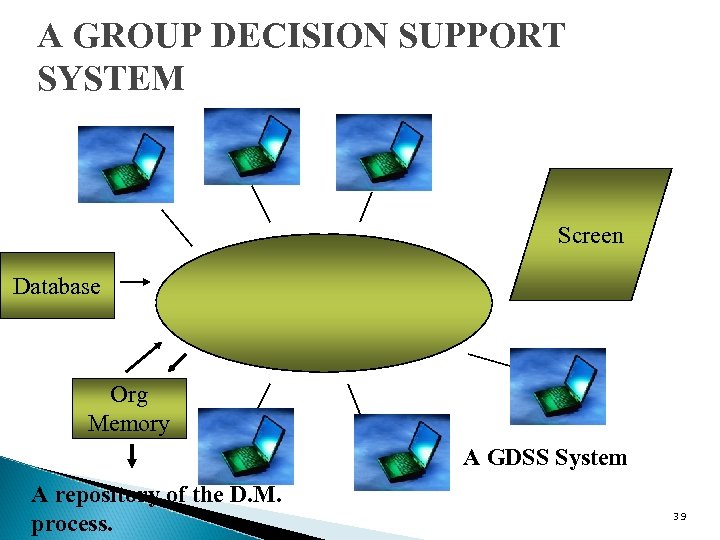
A GROUP DECISION SUPPORT SYSTEM Screen Database Org Memory A GDSS System A repository of the D. M. process. 39
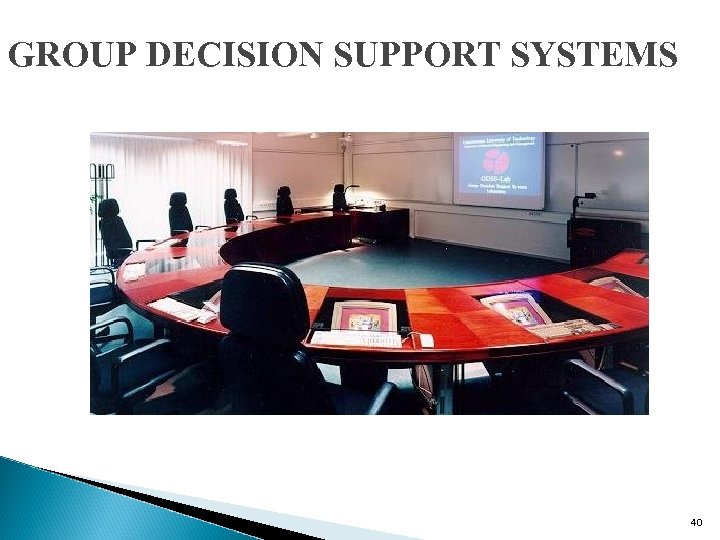
GROUP DECISION SUPPORT SYSTEMS 40
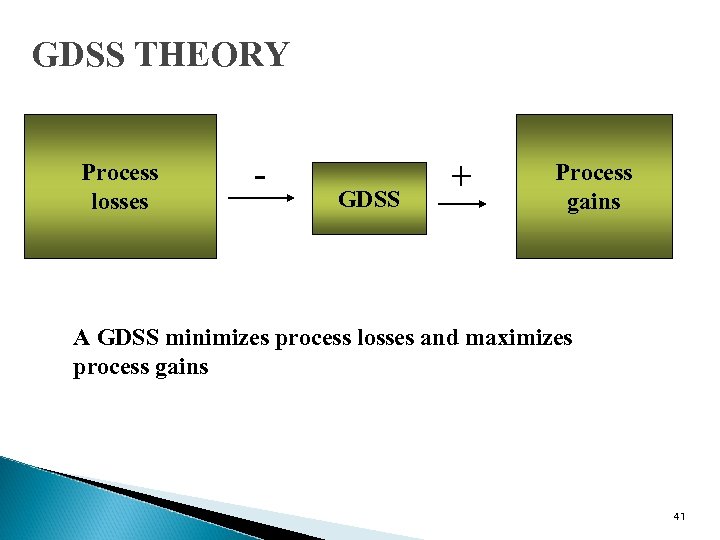
GDSS THEORY Process losses - GDSS + Process gains A GDSS minimizes process losses and maximizes process gains 41
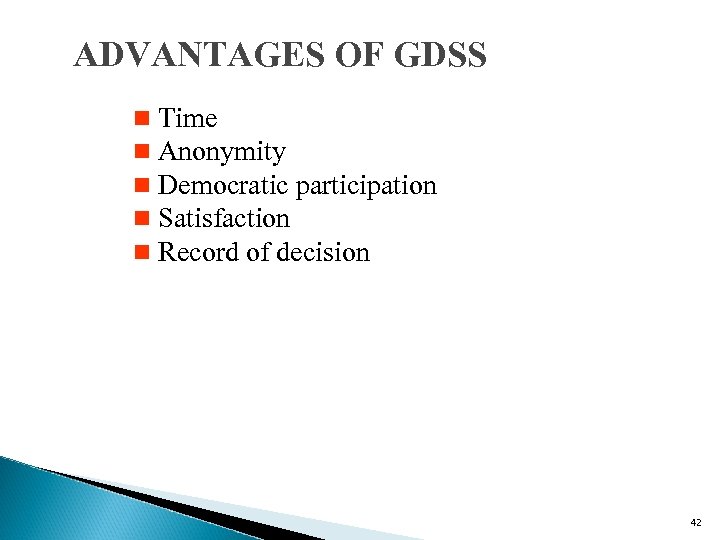
ADVANTAGES OF GDSS n Time n Anonymity n Democratic participation n Satisfaction n Record of decision 42

THE END 43
Скачать презентацию INTRO TO MANAGEMENT SUPPORT SYSTEMS IS 340 BY
5bed8014565f818be6c3ad388b168a2c.ppt