


 Скачать презентацию Intro Getting Over Yourself Theories of Story Rules
fundamentals_storytelling_2014_compact.pptx
- Количество слайдов: 165
 Intro Getting Over Yourself Theories of Story Rules & Tools Storytelling Fundamentals In a Day Characters Dialogue Case Studies Evan Skolnick Writer, Narrative Designer evan@evanskolnick. com
 Intro Getting Over Yourself Theories of Story Rules & Tools Characters Dialogue Case Studies All characters and works in this presentation are trademarks of and/or copyrighted by their respective owners. Except where noted, they are used without permission for educational purposes only, under the Fair Use provision of the United States Copyright Act.
 Tutorial Overview • – Don't try to transcribe the slides. We're going to move fast! – All content slides will be made available to on the GDC Vault site or you can email me: • evan@evanskolnick. com – For your notes, focus on anything I DON'T cover in the slides Intro Getting Over Yourself Theories of Story Rules & Tools • Characters Plugs Dept. – Join the Game Writing SIG! • www. igda. org/writing Dialogue Case Studies Sanity Check Dept. • Friendly Reminders Dept. – Please reply to feedback emails and fill out questionnaires
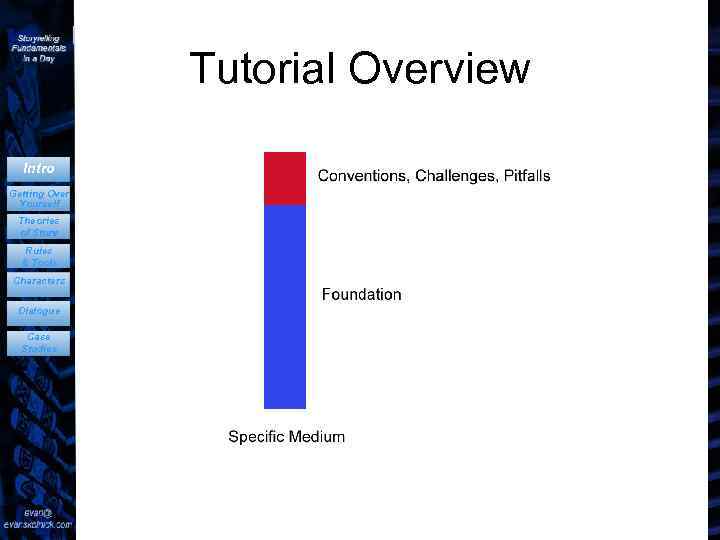
 Tutorial Overview – What This Tutorial Is About Intro Getting Over Yourself Theories of Story Rules & Tools Characters Dialogue Case Studies • Overview of fiction writing as it applies to most game writing situations • 80% general fiction writing theory – Story structure and plotting – Characters and characterization – Rules and tools • 20% video game application – Whom This Tutorial Is For • All game developers who create content for games that include a story • Game developers who hire and/or work with game writers and narrative designers
 Tutorial Overview Intro Getting Over Yourself Theories of Story Rules & Tools Characters Dialogue Case Studies
 Tutorial Overview Intro Getting Over Yourself Theories of Story Rules & Tools Characters Dialogue Case Studies
 Tutorial Overview Intro Getting Over Yourself Theories of Story Rules & Tools Characters Dialogue Case Studies
 Tutorial Overview – Why This Tutorial Exists Intro Getting Over Yourself Theories of Story Rules & Tools Characters • Every bit of content created for a game has a chance to either enhance or clash with the intended story experience • That makes every team member involved in developing and integrating that content, to one degree or another, a storyteller Dialogue Case Studies • Even when guided by a narrative expert, a team that does not share an understanding of storytelling principles will most likely produce incoherent, poor storytelling • This tutorial aims to help provide that common understanding and shared language of story
 Tutorial Overview Takeaways Intro Getting Over Yourself Theories of Story Rules & Tools Characters Dialogue Case Studies – Better appreciation for what goes into making a good story – Some writerly instincts – Better storyteller – Effective collaborator with a narrative expert – Ideas on how to apply proven storytelling principles to your games
 Getting Over Yourself Intro Getting Over Yourself Theories of Story Rules & Tools Characters Dialogue Case Studies • You're not the next Hemingway • Write tight, effective, well-integrated story content • Attempting anything beyond that is a distraction and a disservice • Gameplay is king – Story should always support it, never supplant it
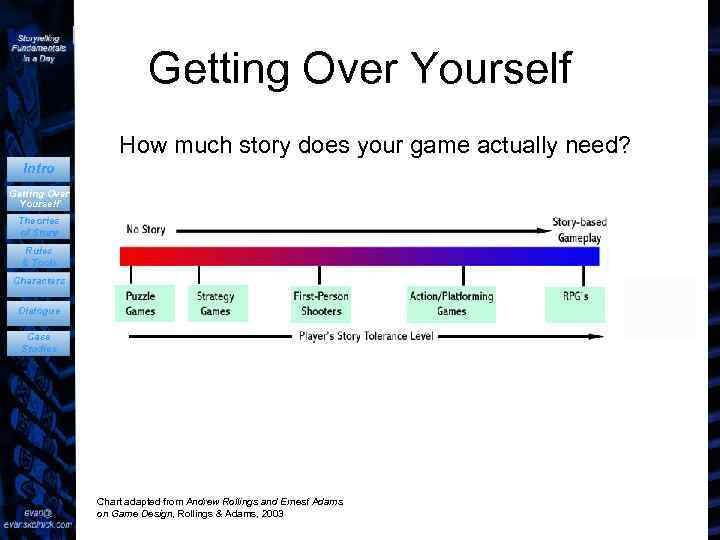 Getting Over Yourself How much story does your game actually need? Intro Getting Over Yourself Theories of Story Rules & Tools Characters Dialogue Case Studies Chart adapted from Andrew Rollings and Ernest Adams on Game Design, Rollings & Adams, 2003
 Theories of Story Intro Getting Over Yourself Theories of Story Rules & Tools Characters Dialogue Case Studies Story is ______
 Theories of Story Intro Getting Over Yourself Theories of Story Rules & Tools Characters Dialogue Case Studies The most essential element of story is ______
 Theories of Story Intro Getting Over Yourself Theories of Story Rules & Tools Characters Dialogue Case Studies The most essential element of story is conflict
 Theories of Story Intro Getting Over Yourself Theories of Story Rules & Tools Characters Dialogue Case Studies Story is conflict
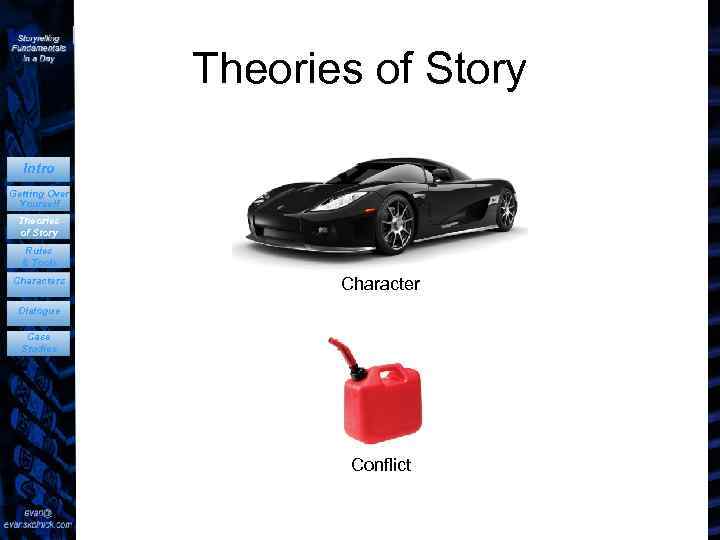 Theories of Story Intro Getting Over Yourself Theories of Story Rules & Tools Character Dialogue Case Studies Conflict
 Theories of Story Intro Getting Over Yourself Theories of Story Rules & Tools Characters Dialogue Conflict • A character wants or needs something, but obstacles stand in the way. Case Studies • Someone wants something but is blocked.
 Theories of Story Intro Getting Over Yourself Theories of Story Rules & Tools Characters Dialogue Case Studies The good news: gameplay is conflict too
 Theories of Story Intro Getting Over Yourself • Three-Act Structure • Aristotle, Syd Field Theories of Story Rules & Tools Characters Dialogue Case Studies • Monomyth (Hero's Journey) • Joseph Campbell, Christopher Vogler
 Three-Act Structure Intro • First described by Aristotle in Poetics Getting Over Yourself Theories of Story Rules & Tools Characters Dialogue Case Studies • Posits that all stories share a common underlying core structure
 Three-Act Structure Intro Getting Over Yourself • Beginning • Setup Theories of Story Rules & Tools Characters Dialogue • Middle • Confrontation Case Studies • End • Resolution
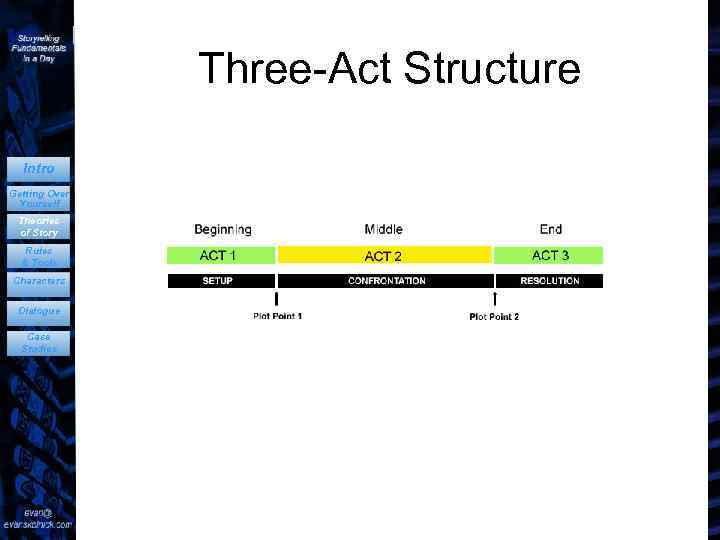 Three-Act Structure Intro Getting Over Yourself Theories of Story Rules & Tools Characters Dialogue Case Studies
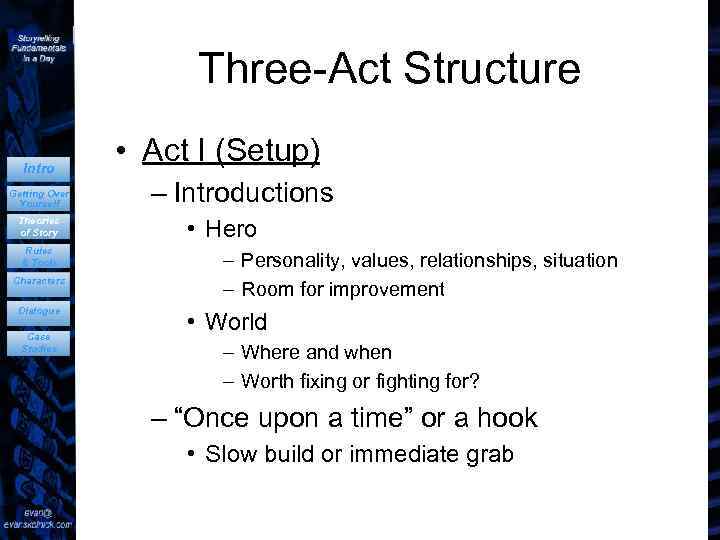 Three-Act Structure Intro Getting Over Yourself Theories of Story Rules & Tools Characters Dialogue Case Studies • Act I (Setup) – Introductions • Hero – Personality, values, relationships, situation – Room for improvement • World – Where and when – Worth fixing or fighting for? – “Once upon a time” or a hook • Slow build or immediate grab
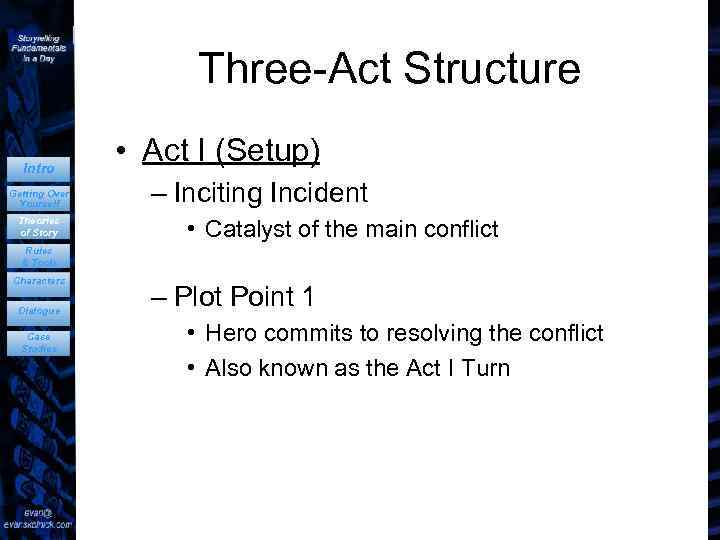 Three-Act Structure Intro Getting Over Yourself Theories of Story • Act I (Setup) – Inciting Incident • Catalyst of the main conflict Rules & Tools Characters Dialogue Case Studies – Plot Point 1 • Hero commits to resolving the conflict • Also known as the Act I Turn
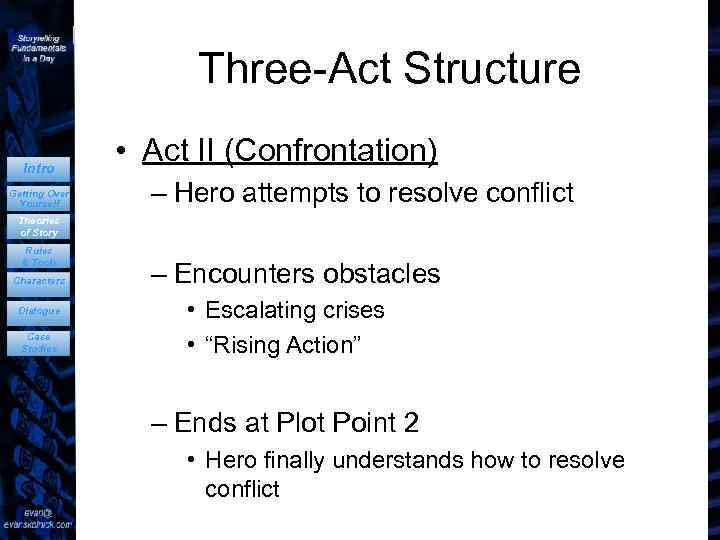 Three-Act Structure Intro Getting Over Yourself • Act II (Confrontation) – Hero attempts to resolve conflict Theories of Story Rules & Tools Characters Dialogue Case Studies – Encounters obstacles • Escalating crises • “Rising Action” – Ends at Plot Point 2 • Hero finally understands how to resolve conflict
 Three-Act Structure Intro Getting Over Yourself Theories of Story Rules & Tools Characters • Act III (Resolution) – Climax • Point of highest tension • Conflict resolved Dialogue Case Studies – Epilogue • Rewards and punishments • Confirmation of Hero growth/change
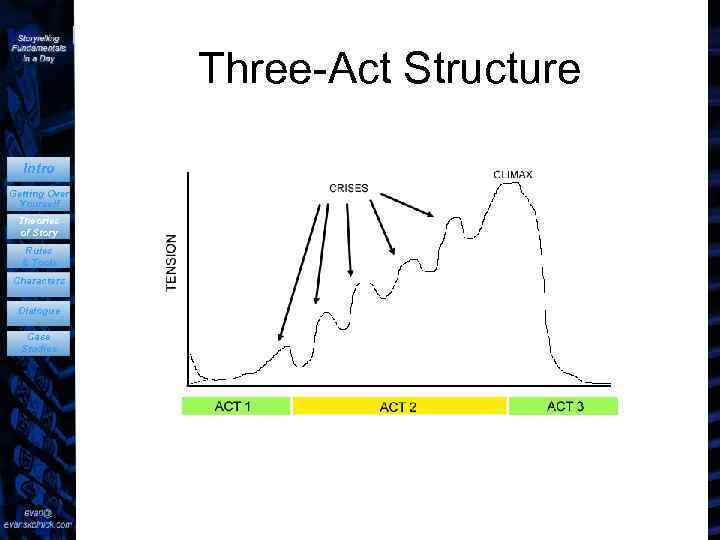 Three-Act Structure Intro Getting Over Yourself Theories of Story Rules & Tools Characters Dialogue Case Studies
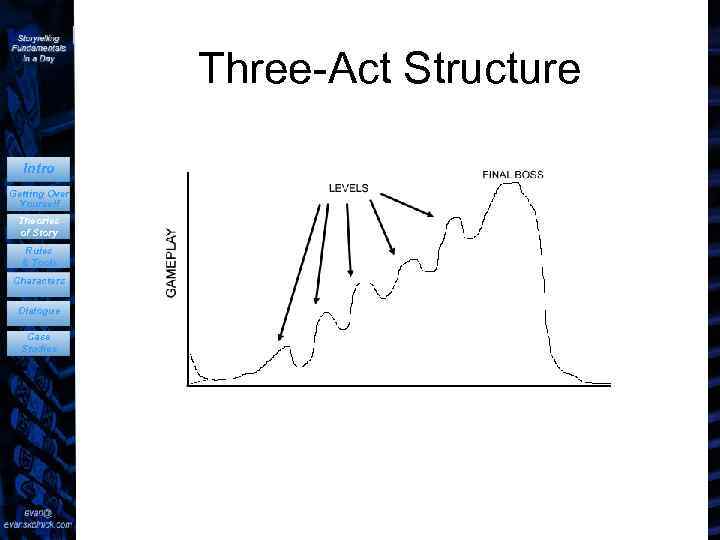 Three-Act Structure Intro Getting Over Yourself Theories of Story Rules & Tools Characters Dialogue Case Studies
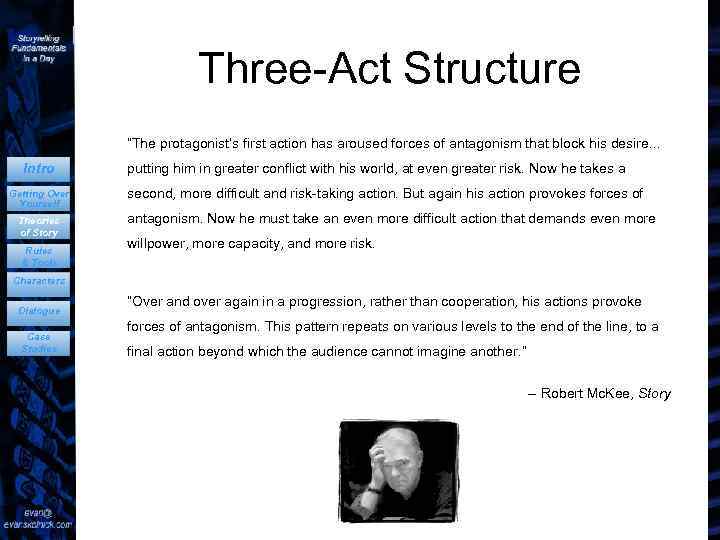 Three-Act Structure “The protagonist’s first action has aroused forces of antagonism that block his desire. . . Intro Getting Over Yourself Theories of Story Rules & Tools putting him in greater conflict with his world, at even greater risk. Now he takes a second, more difficult and risk-taking action. But again his action provokes forces of antagonism. Now he must take an even more difficult action that demands even more willpower, more capacity, and more risk. Characters Dialogue Case Studies “Over and over again in a progression, rather than cooperation, his actions provoke forces of antagonism. This pattern repeats on various levels to the end of the line, to a final action beyond which the audience cannot imagine another. ” -- Robert Mc. Kee, Story
 Three-Act Structure Intro Getting Over Yourself Theories of Story Rules & Tools • Exercise (individual, 5 min. ) – Pick three favorite films and identify the first Plot Point Characters Dialogue Case Studies Plot Point 1: the incident that forces the hero out of his/her normal world and into the adventure
 Three-Act Structure Intro Getting Over Yourself Theories of Story • Still applies to nearly all successful fictional stories today Rules & Tools Characters Dialogue Case Studies • Universal, and therefore almost overly simplistic
 Monomyth Intro Getting Over Yourself • First described by Joseph Campbell in The Hero With a Thousand Faces (1949) Theories of Story Rules & Tools Characters • Partially based on work of psychologist Carl Jung and his concept of archetypes Dialogue Case Studies • Refined and elaborated on by Christopher Vogler in The Writer's Journey (1992)
 Monomyth Intro Getting Over Yourself • Like Three-Act Structure, posits that all successful stories share common structure Theories of Story Rules & Tools Characters • Suggests also that these stories share common character types. . . archetypes Dialogue Case Studies • Archetypes represent various aspects of human personality, personified
 Monomyth Archetypes Intro Getting Over Yourself • Each archetype is a character or energy embodied by multiple characters Theories of Story Rules & Tools Characters • Together, they represent a complete human psychological profile Dialogue Case Studies • By meeting and learning from the various archetypical characters, the Hero learns and borrows along the way, becoming a stronger, more complete person
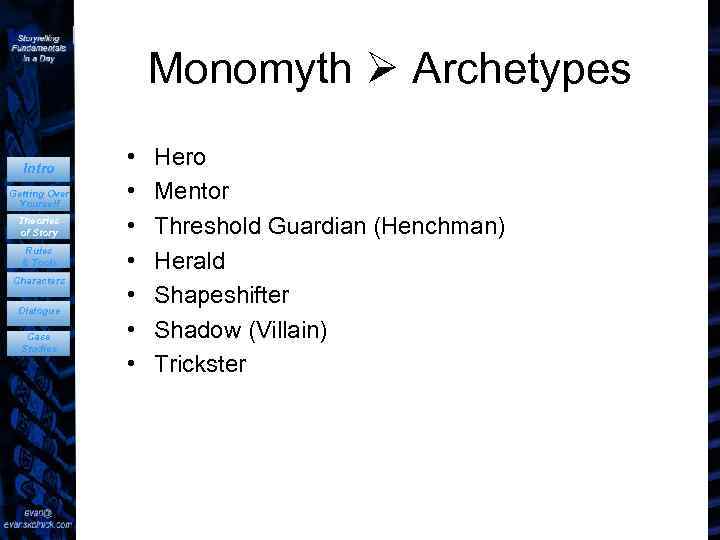 Monomyth Archetypes Intro Getting Over Yourself Theories of Story Rules & Tools Characters Dialogue Case Studies • • Hero Mentor Threshold Guardian (Henchman) Herald Shapeshifter Shadow (Villain) Trickster
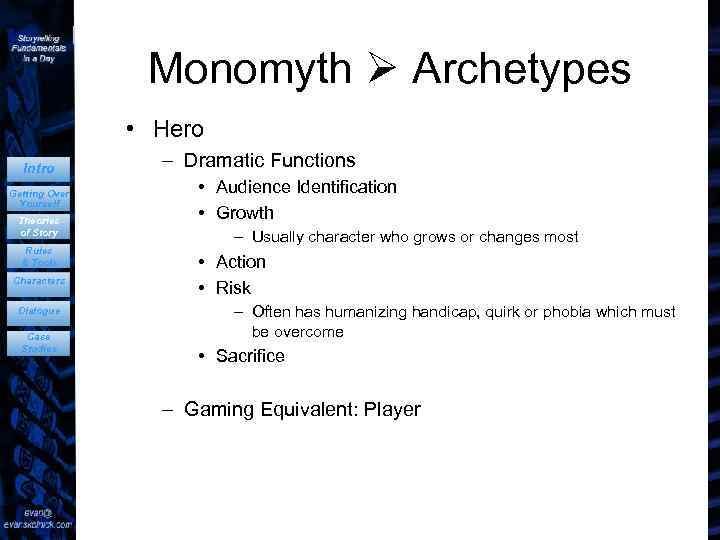 Monomyth Archetypes • Hero Intro Getting Over Yourself Theories of Story Rules & Tools Characters Dialogue Case Studies – Dramatic Functions • Audience Identification • Growth – Usually character who grows or changes most • Action • Risk – Often has humanizing handicap, quirk or phobia which must be overcome • Sacrifice – Gaming Equivalent: Player
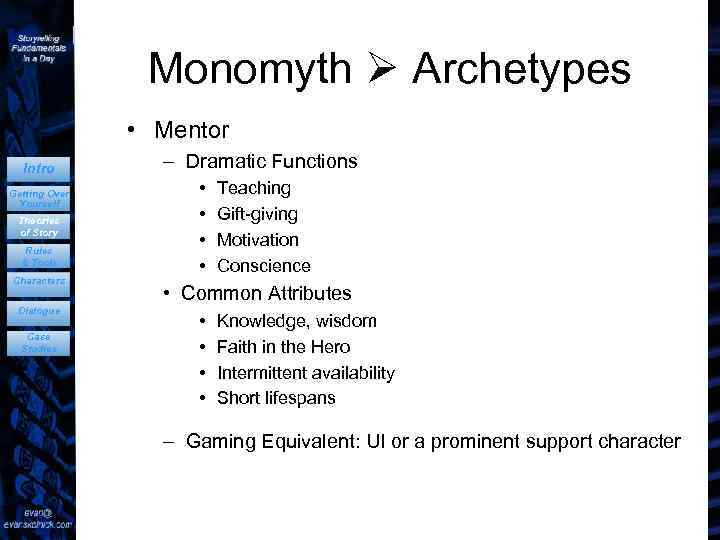 Monomyth Archetypes • Mentor Intro Getting Over Yourself Theories of Story Rules & Tools Characters Dialogue Case Studies – Dramatic Functions • • Teaching Gift-giving Motivation Conscience • Common Attributes • • Knowledge, wisdom Faith in the Hero Intermittent availability Short lifespans – Gaming Equivalent: UI or a prominent support character
 Monomyth Archetypes Intro Getting Over Yourself Theories of Story Rules & Tools Characters • Threshold Guardian (Henchman) – Dramatic Functions • Testing • Blocking • Supporting the Villain’s plans • Not always directly or consciously Dialogue Case Studies – Gaming Equivalent: Generic enemies, Sub-Bosses
 Monomyth Archetypes Intro Getting Over Yourself Theories of Story Rules & Tools Characters Dialogue Case Studies • Herald – Dramatic Functions • Announce the Conflict (or its potential) • Motivation • Offer Hero the Challenge – Gaming Equivalent: Marketing
 Monomyth Archetypes Intro Getting Over Yourself Theories of Story Rules & Tools Characters Dialogue Case Studies • Shapeshifter – Dramatic Functions • Sow suspicion and doubt • Catalysts for surprises and plot twists – Gaming Equivalent: Executive Producers
 Monomyth Archetypes Intro Getting Over Yourself Theories of Story Rules & Tools • Shadow (Villain) – Dramatic Functions • Generate the main conflict • Challenge the Hero Characters Dialogue Case Studies – Gaming Equivalent: Final Boss
 Monomyth Archetypes Intro Getting Over Yourself Theories of Story • Trickster – Dramatic Function • Comic relief Rules & Tools Characters Dialogue Case Studies – Gaming Equivalent: Sidekick (e. g. Daxter)
 Monomyth Archetypes Intro Getting Over Yourself Theories of Story Rules & Tools • Exercise (small group, 10 min. ) – Identify as many archetypical characters as you can in the provided story Characters Dialogue Case Studies Hero Mentor Threshold Guardian (Henchman) Herald Shapeshifter Shadow (Villain) Trickster
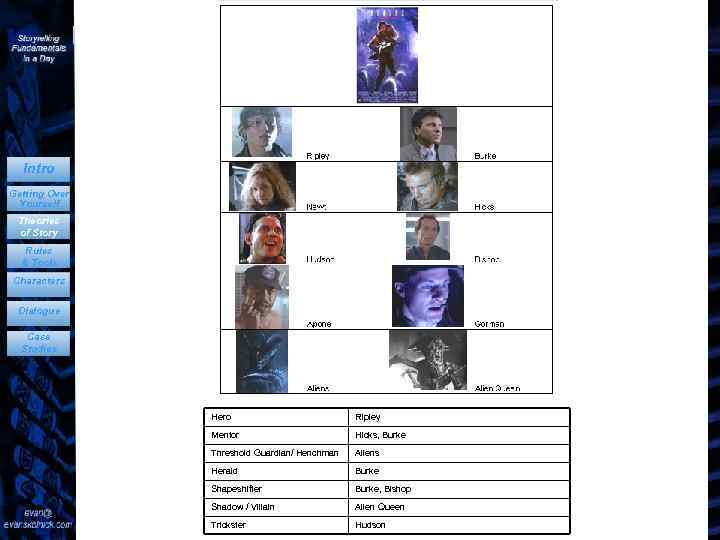 Intro Getting Over Yourself Theories of Story Rules & Tools Characters Dialogue Case Studies Hero Ripley Mentor Hicks, Burke Threshold Guardian/ Henchman Aliens Herald Burke Shapeshifter Burke, Bishop Shadow / Villain Alien Queen Trickster Hudson
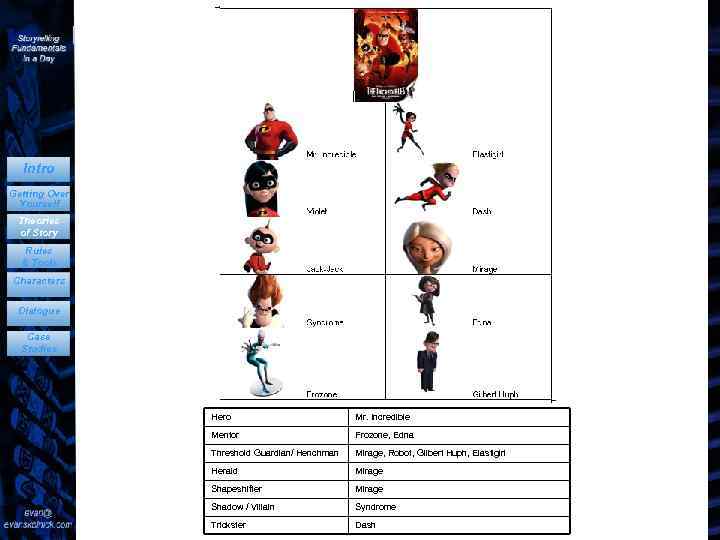 Intro Getting Over Yourself Theories of Story Rules & Tools Characters Dialogue Case Studies Hero Mr. Incredible Mentor Frozone, Edna Threshold Guardian/ Henchman Mirage, Robot, Gilbert Huph, Elastigirl Herald Mirage Shapeshifter Mirage Shadow / Villain Syndrome Trickster Dash
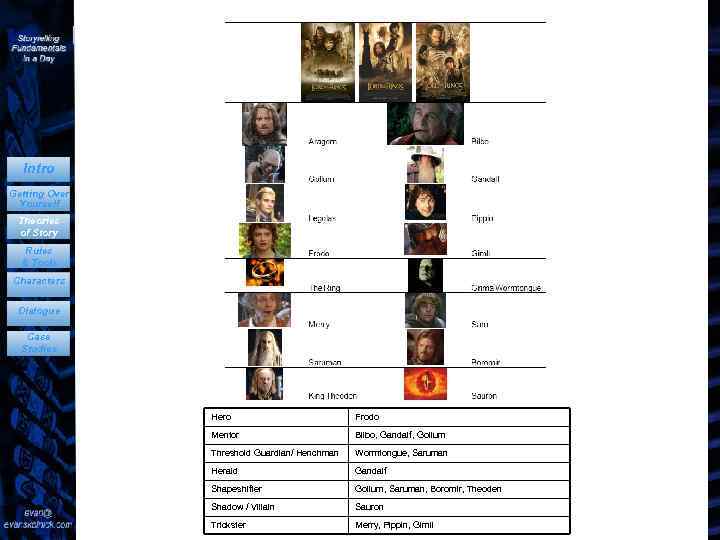 Intro Getting Over Yourself Theories of Story Rules & Tools Characters Dialogue Case Studies Hero Frodo Mentor Bilbo, Gandalf, Gollum Threshold Guardian/ Henchman Wormtongue, Saruman Herald Gandalf Shapeshifter Gollum, Saruman, Boromir, Theoden Shadow / Villain Sauron Trickster Merry, Pippin, Gimli
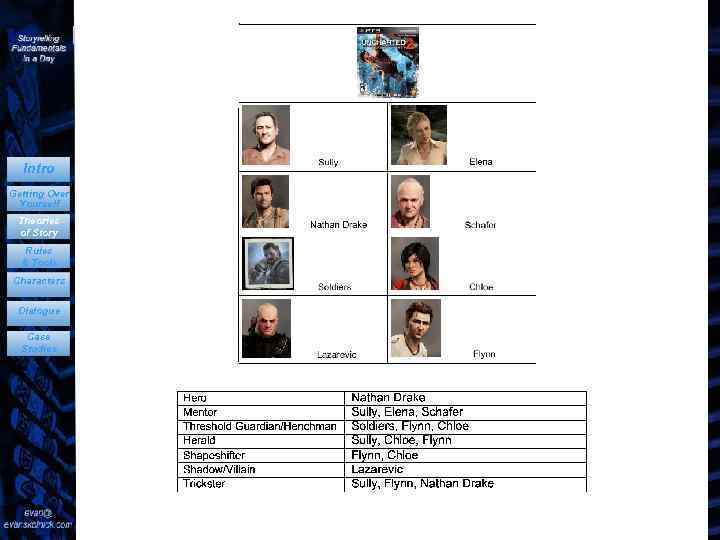 Intro Getting Over Yourself Theories of Story Rules & Tools Characters Dialogue Case Studies
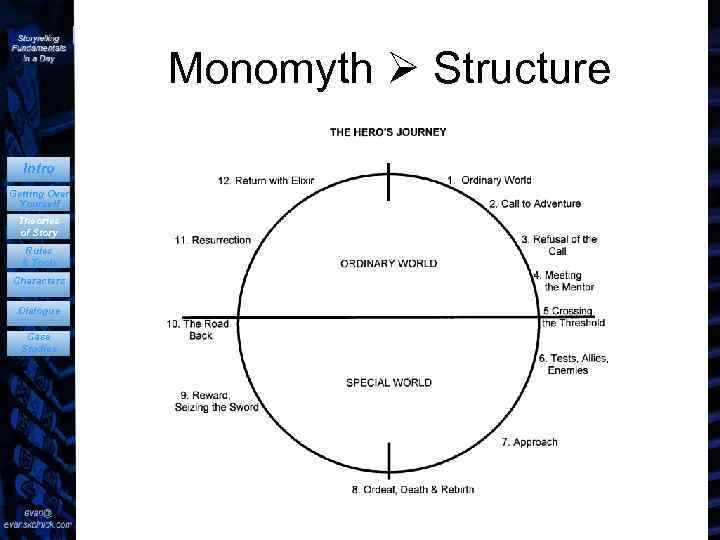
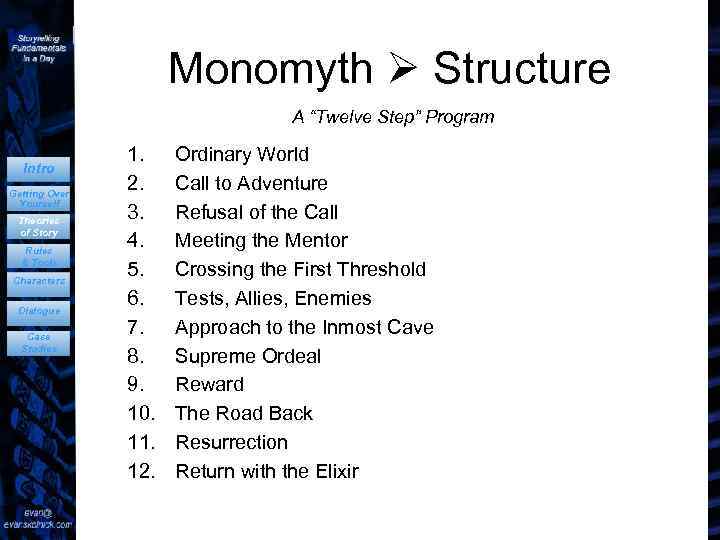 Monomyth Structure A “Twelve Step” Program Intro Getting Over Yourself Theories of Story Rules & Tools Characters Dialogue Case Studies 1. 2. 3. 4. 5. 6. 7. 8. 9. 10. 11. 12. Ordinary World Call to Adventure Refusal of the Call Meeting the Mentor Crossing the First Threshold Tests, Allies, Enemies Approach to the Inmost Cave Supreme Ordeal Reward The Road Back Resurrection Return with the Elixir
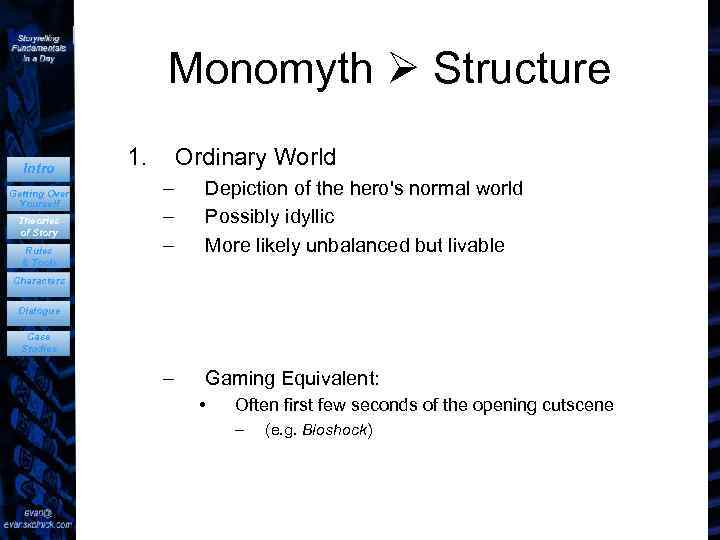 Monomyth Structure Intro Getting Over Yourself Theories of Story Rules & Tools 1. Ordinary World – – – Depiction of the hero's normal world Possibly idyllic More likely unbalanced but livable – Gaming Equivalent: Characters Dialogue Case Studies • Often first few seconds of the opening cutscene – (e. g. Bioshock)
 Monomyth Structure Intro Getting Over Yourself Theories of Story Rules & Tools 2. Call to Adventure – – – First indication that trouble is brewing Problem presented to Hero can no longer stay in comfort of Ordinary World – Gaming Equivalent: Characters Dialogue Case Studies • Often middle part of the opening cutscene
 Monomyth Structure Intro Getting Over Yourself 3. Refusal of the Call – Hero initially refuses to confront the problem – Gaming Equivalent: Theories of Story Rules & Tools Characters Dialogue Case Studies • Rarely seen in video games, for brevity's sake
 Monomyth Structure Intro Getting Over Yourself 4. Meeting with the Mentor – Mentor provides motivation, gifts and encouragement – Gaming Equivalent: Theories of Story Rules & Tools Characters Dialogue Case Studies • Superior officers, Narrators or other characters designed to provide player with briefings and objectives
 Monomyth Structure Intro Getting Over Yourself Theories of Story Rules & Tools 5. Crossing the First Threshold – – – Hero fully commits to the adventure Enters the Special World No turning back – Gaming Equivalent: Characters Dialogue Case Studies • First or early gameplay level
 Monomyth Structure Intro Getting Over Yourself Theories of Story 6. Tests, Allies, Enemies – – Series of sub-adventures related to the overall conflict Challenges increase in drama and stakes – Gaming Equivalent: Rules & Tools Characters Dialogue Case Studies • Levels!
 Monomyth Structure Intro Getting Over Yourself 7. Approach to the Inmost Cave – Danger-filled approach to site of final conflict – Gaming Equivalent: Theories of Story Rules & Tools Characters Dialogue Case Studies • Late levels
 Monomyth Structure Intro Getting Over Yourself Theories of Story 8. The Supreme Ordeal – – In the “belly of the beast” Death faced – Of the Hero or just the dream – Gaming Equivalent: Rules & Tools Characters Dialogue Case Studies • Levels and/or cutscenes leading to a “false” final boss battle
 Monomyth Structure Intro Getting Over Yourself Theories of Story 9. Reward – – Hero survives Supreme Ordeal and “seizes the sword” Reward received for victory – Gaming Equivalent: Rules & Tools Characters Dialogue Case Studies • Cutscene following “false” final boss battle
 Monomyth Structure Intro Getting Over Yourself 10. The Road Back – Hero tries to return to Ordinary World with the Reward, but dark forces are in pursuit – Gaming Equivalent: Theories of Story Rules & Tools Characters Dialogue Case Studies • Late levels or a cutscene following a “false” final boss battle
 Monomyth Structure Intro Getting Over Yourself Theories of Story Rules & Tools Characters 11. Resurrection – – – Hero (or hero's main goal) seemingly dies but somehow survives Transformed by the experience Gains final victory – Gaming Equivalent: Dialogue Case Studies • Final boss battle
 Monomyth Structure Intro Getting Over Yourself Theories of Story Rules & Tools 12. Return with the Elixir – – – Hero returns to Ordinary World with a boon to benefit it Can be a Circular or Open-Ended return Final rewards and punishments doled out – Gaming Equivalent: Characters Dialogue Case Studies • Final cutscene
 Monomyth Structure Intro Getting Over Yourself Theories of Story Rules & Tools Characters Dialogue Case Studies
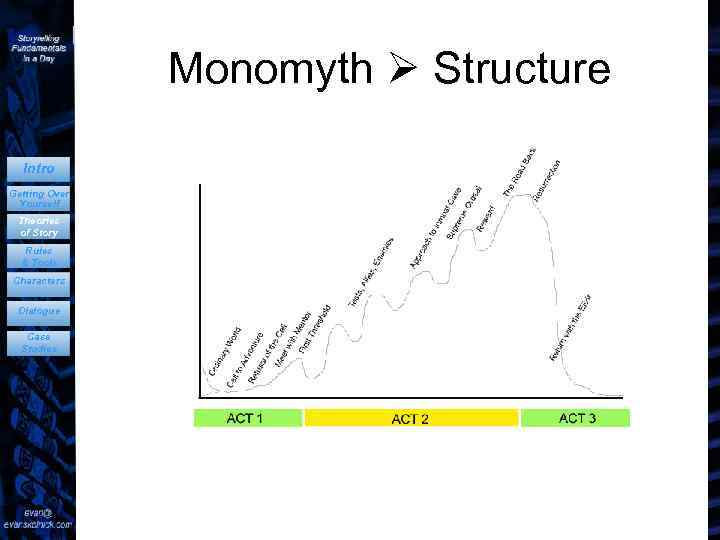 Monomyth Structure Intro Getting Over Yourself Theories of Story Rules & Tools Characters Dialogue Case Studies
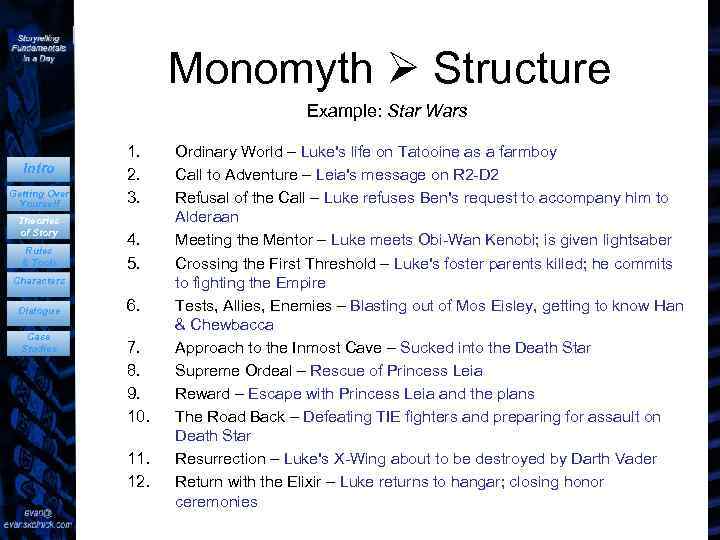 Monomyth Structure Example: Star Wars Intro Getting Over Yourself Theories of Story Rules & Tools 1. 2. 3. 4. 5. Characters Dialogue Case Studies 6. 7. 8. 9. 10. 11. 12. Ordinary World – Luke's life on Tatooine as a farmboy Call to Adventure – Leia's message on R 2 -D 2 Refusal of the Call – Luke refuses Ben's request to accompany him to Alderaan Meeting the Mentor – Luke meets Obi-Wan Kenobi; is given lightsaber Crossing the First Threshold – Luke's foster parents killed; he commits to fighting the Empire Tests, Allies, Enemies – Blasting out of Mos Eisley, getting to know Han & Chewbacca Approach to the Inmost Cave – Sucked into the Death Star Supreme Ordeal – Rescue of Princess Leia Reward – Escape with Princess Leia and the plans The Road Back – Defeating TIE fighters and preparing for assault on Death Star Resurrection – Luke's X-Wing about to be destroyed by Darth Vader Return with the Elixir – Luke returns to hangar; closing honor ceremonies
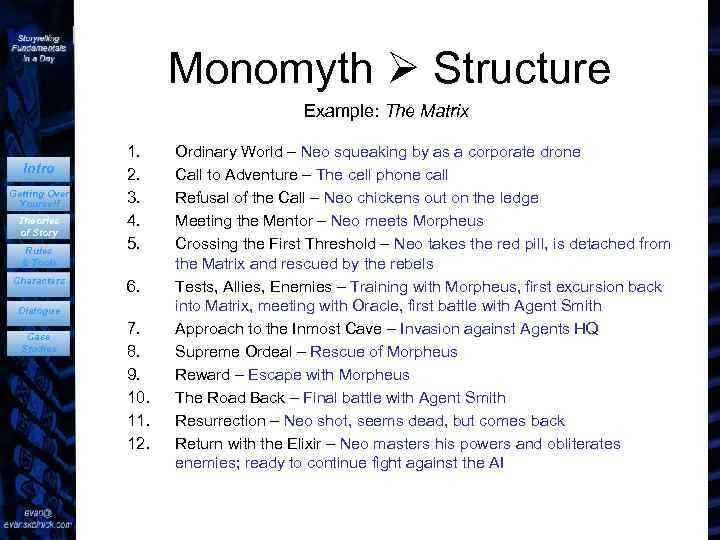 Monomyth Structure Example: The Matrix Intro Getting Over Yourself Theories of Story Rules & Tools Characters 1. 2. 3. 4. 5. 6. Dialogue Case Studies 7. 8. 9. 10. 11. 12. Ordinary World – Neo squeaking by as a corporate drone Call to Adventure – The cell phone call Refusal of the Call – Neo chickens out on the ledge Meeting the Mentor – Neo meets Morpheus Crossing the First Threshold – Neo takes the red pill, is detached from the Matrix and rescued by the rebels Tests, Allies, Enemies – Training with Morpheus, first excursion back into Matrix, meeting with Oracle, first battle with Agent Smith Approach to the Inmost Cave – Invasion against Agents HQ Supreme Ordeal – Rescue of Morpheus Reward – Escape with Morpheus The Road Back – Final battle with Agent Smith Resurrection – Neo shot, seems dead, but comes back Return with the Elixir – Neo masters his powers and obliterates enemies; ready to continue fight against the AI
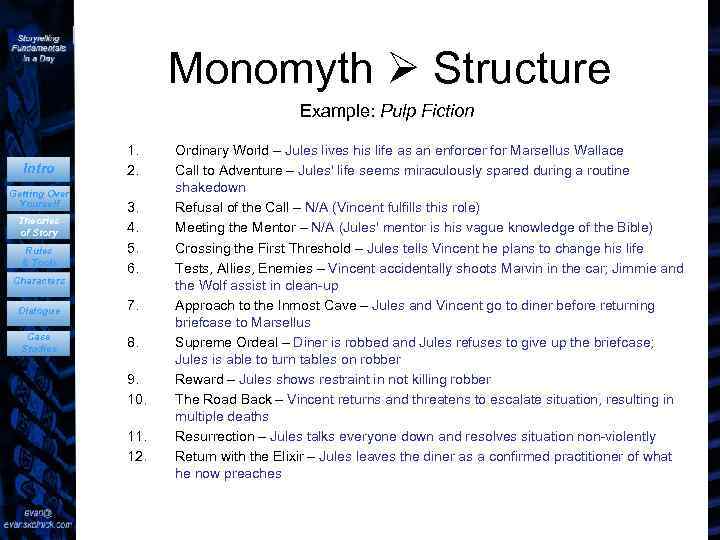 Monomyth Structure Example: Pulp Fiction Intro Getting Over Yourself Theories of Story Rules & Tools Characters 1. 2. 3. 4. 5. 6. Dialogue 7. Case Studies 8. 9. 10. 11. 12. Ordinary World – Jules lives his life as an enforcer for Marsellus Wallace Call to Adventure – Jules' life seems miraculously spared during a routine shakedown Refusal of the Call – N/A (Vincent fulfills this role) Meeting the Mentor – N/A (Jules' mentor is his vague knowledge of the Bible) Crossing the First Threshold – Jules tells Vincent he plans to change his life Tests, Allies, Enemies – Vincent accidentally shoots Marvin in the car; Jimmie and the Wolf assist in clean-up Approach to the Inmost Cave – Jules and Vincent go to diner before returning briefcase to Marsellus Supreme Ordeal – Diner is robbed and Jules refuses to give up the briefcase; Jules is able to turn tables on robber Reward – Jules shows restraint in not killing robber The Road Back – Vincent returns and threatens to escalate situation, resulting in multiple deaths Resurrection – Jules talks everyone down and resolves situation non-violently Return with the Elixir – Jules leaves the diner as a confirmed practitioner of what he now preaches
 Monomyth Q: Do all stories incorporate all elements of the Monomyth? Intro Getting Over Yourself Theories of Story Rules & Tools Characters A: No. Some have all. Dialogue Case Studies Many have most. None have none.
 Monomyth Intro • The monomyth represents a pattern seen in many, many stories, but. . . • Don't follow it slavishly! • Use as a general guide only – take from it what you can use Getting Over Yourself Theories of Story Rules & Tools Characters Dialogue Case Studies
 Story Common Themes Intro Getting Over Yourself Theories of Story Rules & Tools • Beginning, Middle, End – (Setup, Confrontation, Resolution) • Conflict-driven Characters Dialogue Case Studies • Main character action, change and growth
 Storytelling Rules & Tools • Exposition Intro Getting Over Yourself Theories of Story Rules & Tools Characters Dialogue Case Studies – Show, don't tell – Seeding, planting and foreshadowing • Believability – Removing/masking/downplaying coincidences and contrivances – Avoiding deus ex machina – Internal world consistency – Character consistency • Impact – Setting appropriate scope of conflict – The element of surprise
 Exposition Intro Getting Over Yourself Theories of Story Rules & Tools Characters Dialogue Case Studies Information the audience needs in order to understand appreciate the story
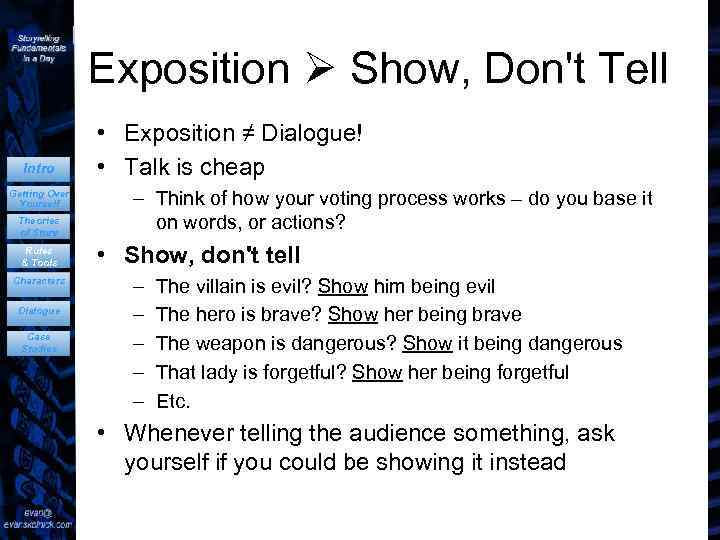 Exposition Show, Don't Tell Intro Getting Over Yourself Theories of Story Rules & Tools Characters Dialogue Case Studies • Exposition ≠ Dialogue! • Talk is cheap – Think of how your voting process works – do you base it on words, or actions? • Show, don't tell – – – The villain is evil? Show him being evil The hero is brave? Show her being brave The weapon is dangerous? Show it being dangerous That lady is forgetful? Show her being forgetful Etc. • Whenever telling the audience something, ask yourself if you could be showing it instead
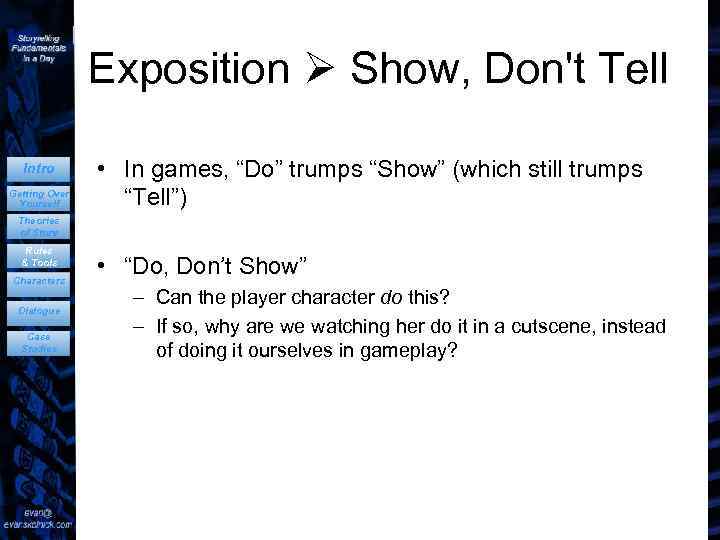 Exposition Show, Don't Tell Intro Getting Over Yourself • In games, “Do” trumps “Show” (which still trumps “Tell”) Theories of Story Rules & Tools Characters Dialogue Case Studies • “Do, Don’t Show” – Can the player character do this? – If so, why are we watching her do it in a cutscene, instead of doing it ourselves in gameplay?
 Exposition Show, Don't Tell Intro If we are telling it, can we show it? Getting Over Yourself Theories of Story Rules & Tools Characters Dialogue Case Studies If we are showing it, can the player do it?
 Exposition Seeding Intro Getting Over Yourself Theories of Story • Exposition is something you “seed” throughout the story • Not all dumped on the audience at the beginning Rules & Tools Characters Dialogue “A beginning is a very delicate time. ” Case Studies Frank Herbert, Dune
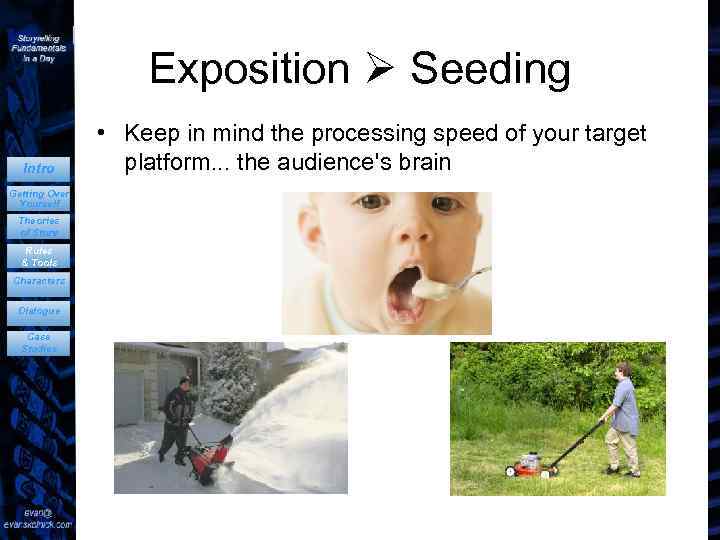 Exposition Seeding Intro Getting Over Yourself Theories of Story Rules & Tools Characters Dialogue Case Studies • Keep in mind the processing speed of your target platform. . . the audience's brain
 Exposition Seeding Intro Getting Over Yourself Theories of Story Rules & Tools Characters Dialogue Case Studies • In games, first cutscene is often the longest • Writer struggles to establish world, characters and conflict all at once • Common area of overwriting • Generally the viewer needs much less exposition at the outset than you'd think • Focus on providing only “need to know” info, especially up front • Providing barely enough information can actually increase drama and viewer interest
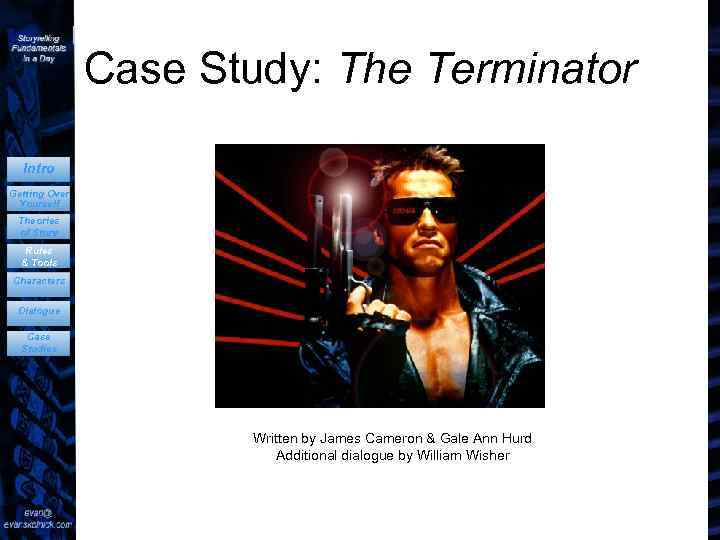 Case Study: The Terminator Intro Getting Over Yourself Theories of Story Rules & Tools Characters Dialogue Case Studies Written by James Cameron & Gale Ann Hurd Additional dialogue by William Wisher
 Case Study: The Terminator Intro Getting Over Yourself Theories of Story Rules & Tools Characters Dialogue Case Studies The Terminator's plot: An unstoppable murderous cyborg has traveled back in time to 1984 to kill Sarah Connor, the mother of the man who will lead humankind's resistance against the machines that rule the world in 2029.
 Case Study: The Terminator Intro Getting Over Yourself Theories of Story Rules & Tools Characters Dialogue Case Studies The Terminator's plot: An unstoppable murderous cyborg has traveled back in time to 1984 to kill Sarah Connor, the mother of the man who will lead humankind's resistance against the machines that rule the world in 2029.
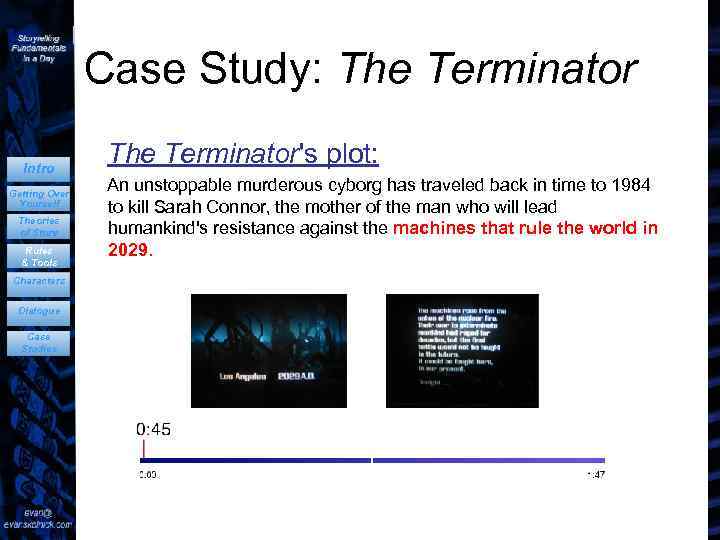 Case Study: The Terminator Intro Getting Over Yourself Theories of Story Rules & Tools Characters Dialogue Case Studies The Terminator's plot: An unstoppable murderous cyborg has traveled back in time to 1984 to kill Sarah Connor, the mother of the man who will lead humankind's resistance against the machines that rule the world in 2029.
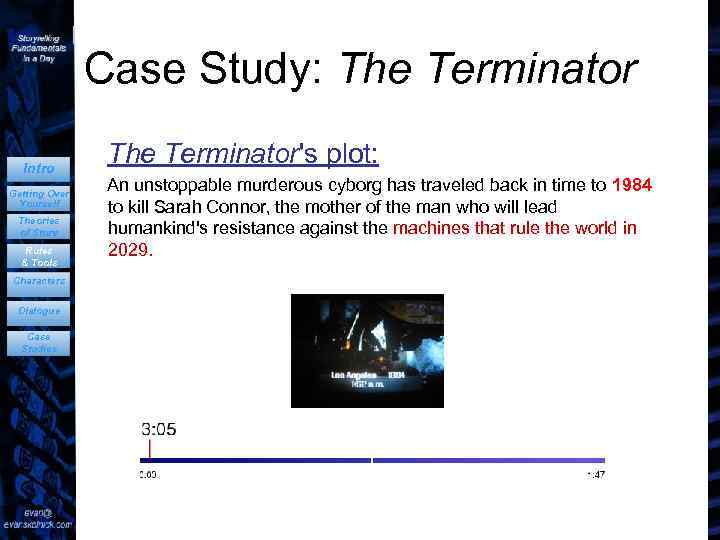 Case Study: The Terminator Intro Getting Over Yourself Theories of Story Rules & Tools Characters Dialogue Case Studies The Terminator's plot: An unstoppable murderous cyborg has traveled back in time to 1984 to kill Sarah Connor, the mother of the man who will lead humankind's resistance against the machines that rule the world in 2029.
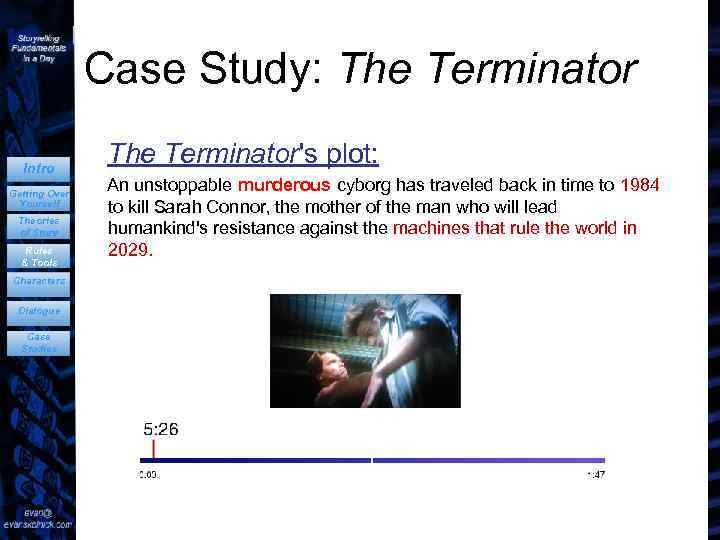 Case Study: The Terminator Intro Getting Over Yourself Theories of Story Rules & Tools Characters Dialogue Case Studies The Terminator's plot: An unstoppable murderous cyborg has traveled back in time to 1984 to kill Sarah Connor, the mother of the man who will lead humankind's resistance against the machines that rule the world in 2029.
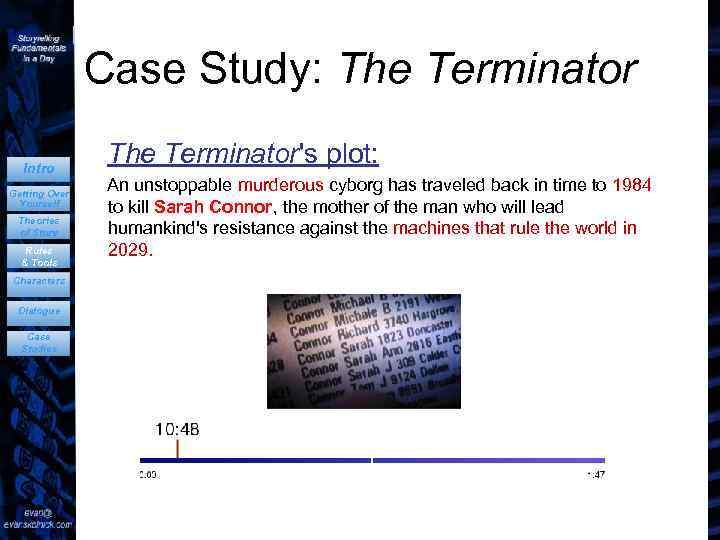 Case Study: The Terminator Intro Getting Over Yourself Theories of Story Rules & Tools Characters Dialogue Case Studies The Terminator's plot: An unstoppable murderous cyborg has traveled back in time to 1984 to kill Sarah Connor, the mother of the man who will lead humankind's resistance against the machines that rule the world in 2029.
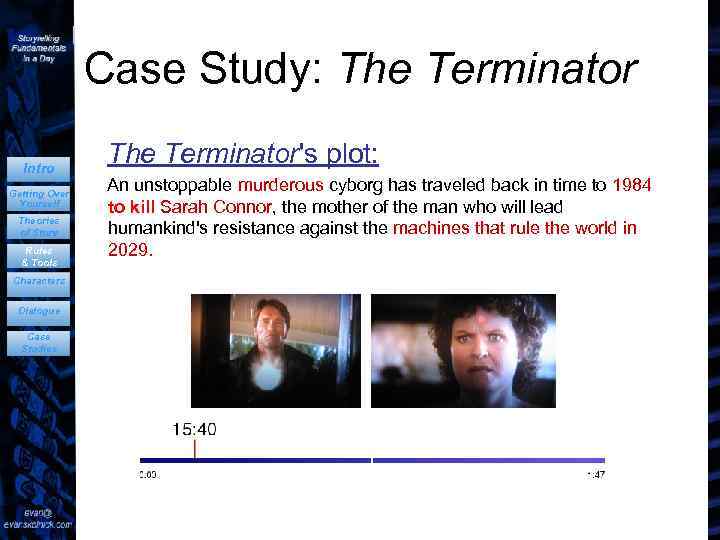 Case Study: The Terminator Intro Getting Over Yourself Theories of Story Rules & Tools Characters Dialogue Case Studies The Terminator's plot: An unstoppable murderous cyborg has traveled back in time to 1984 to kill Sarah Connor, the mother of the man who will lead humankind's resistance against the machines that rule the world in 2029.
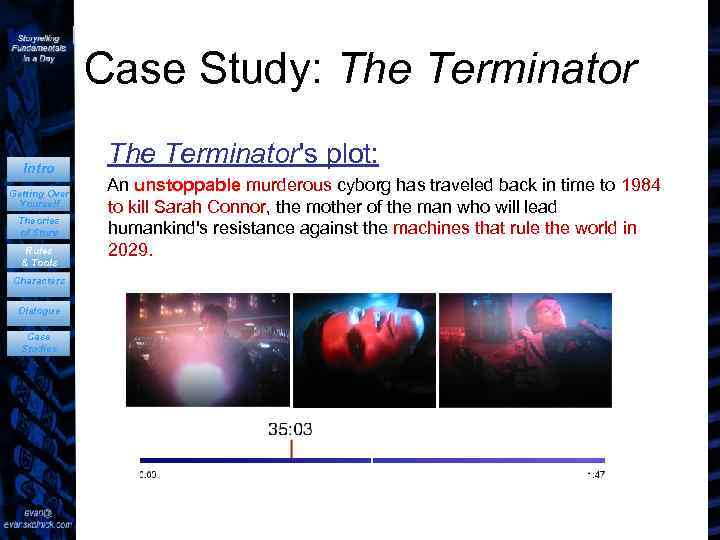 Case Study: The Terminator Intro Getting Over Yourself Theories of Story Rules & Tools Characters Dialogue Case Studies The Terminator's plot: An unstoppable murderous cyborg has traveled back in time to 1984 to kill Sarah Connor, the mother of the man who will lead humankind's resistance against the machines that rule the world in 2029.
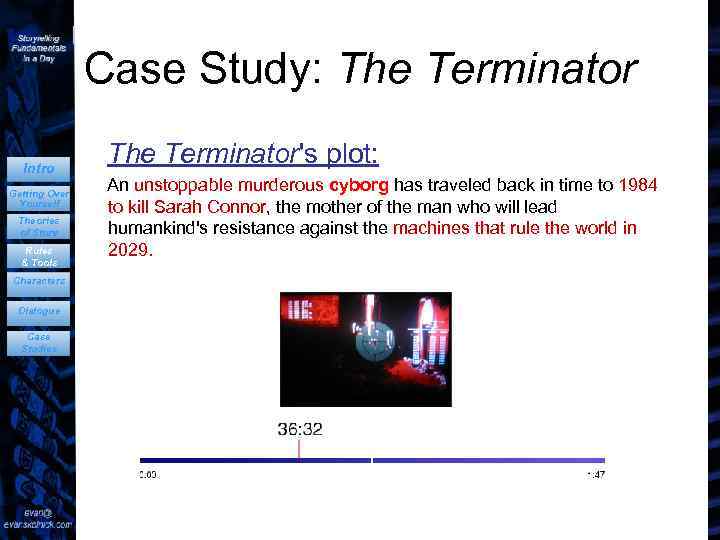 Case Study: The Terminator Intro Getting Over Yourself Theories of Story Rules & Tools Characters Dialogue Case Studies The Terminator's plot: An unstoppable murderous cyborg has traveled back in time to 1984 to kill Sarah Connor, the mother of the man who will lead humankind's resistance against the machines that rule the world in 2029.
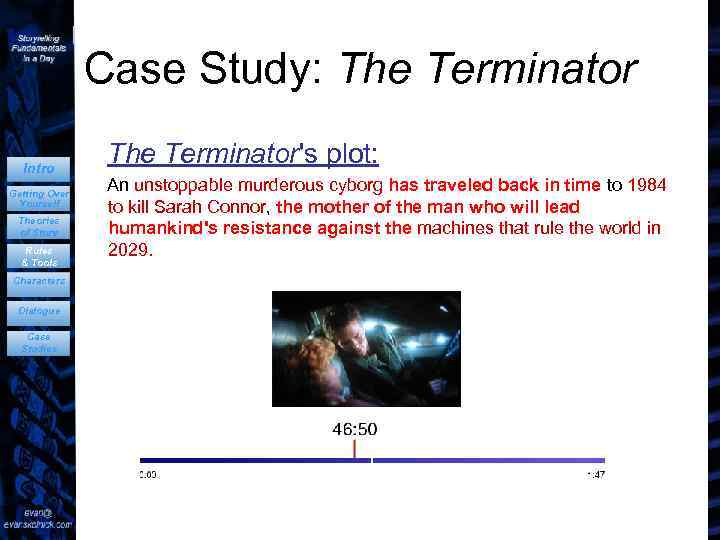 Case Study: The Terminator Intro Getting Over Yourself Theories of Story Rules & Tools Characters Dialogue Case Studies The Terminator's plot: An unstoppable murderous cyborg has traveled back in time to 1984 to kill Sarah Connor, the mother of the man who will lead humankind's resistance against the machines that rule the world in 2029.
 Exposition Seeding Three Classes of Exposition Intro Getting Over Yourself Theories of Story Rules & Tools Characters Dialogue Case Studies • Need to Know – The audience must have this information right now in order to appreciate what is happening (or about to) • Could Wait – Potentially important information, but not “need to know” just yet • Trivial – – May enhance but not essential to appreciation of the story Can be cut, or pushed off the main path
 Exposition Seeding Intro Getting Over Yourself Theories of Story Rules & Tools Characters Dialogue Case Studies Plot Exposition: • It's OK to delay • Focus on “Need to Know”
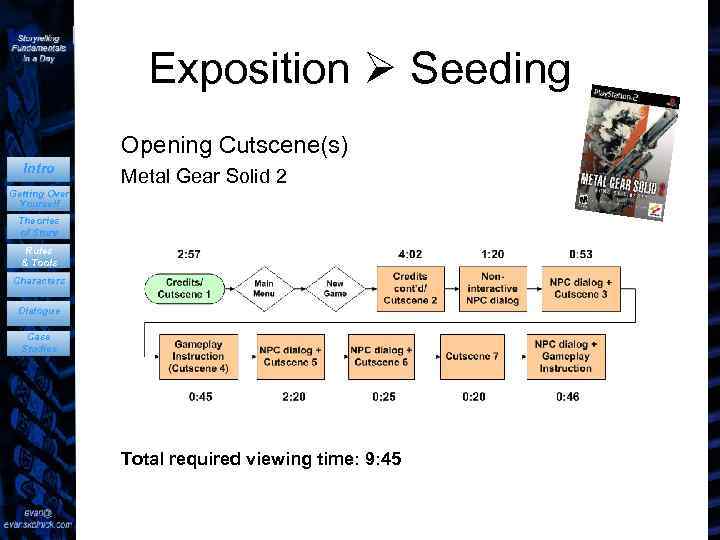 Exposition Seeding Opening Cutscene(s) Intro Metal Gear Solid 2 Getting Over Yourself Theories of Story Rules & Tools Characters Dialogue Case Studies Total required viewing time: 9: 45
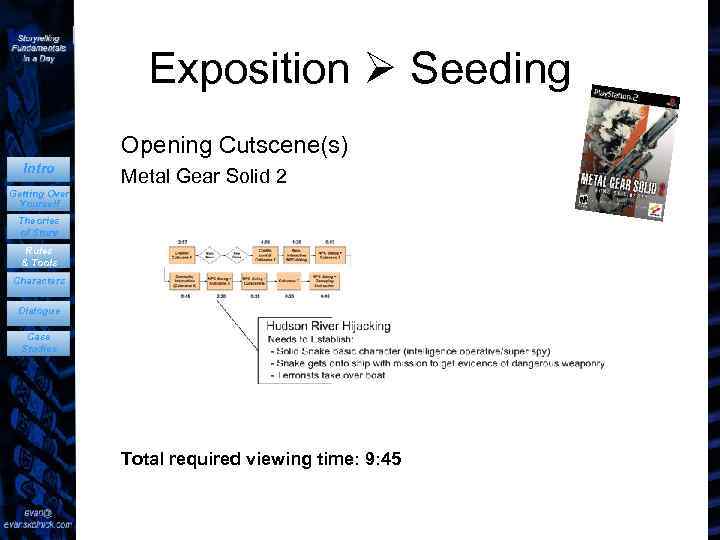 Exposition Seeding Opening Cutscene(s) Intro Metal Gear Solid 2 Getting Over Yourself Theories of Story Rules & Tools Characters Dialogue Case Studies Total required viewing time: 9: 45
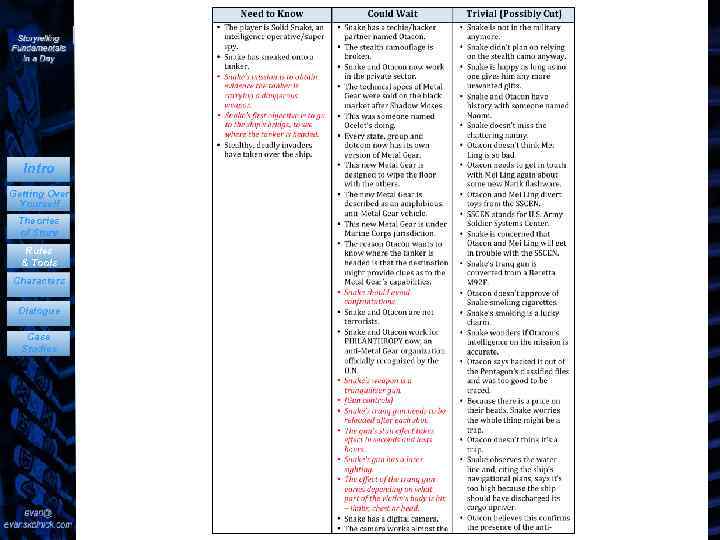 Intro Getting Over Yourself Theories of Story Rules & Tools Characters Dialogue Case Studies
 Exposition Planting Intro Getting Over Yourself • If seeding is like spreading seed evenly to grow a lawn. . . Theories of Story Rules & Tools Characters Dialogue • Planting is choosing a spot for a tree, and placing it right there, for a reason Case Studies • It grows slowly and provides its benefit much later
 Exposition Planting Intro Getting Over Yourself Theories of Story Rules & Tools Characters Dialogue Case Studies Chekhov's Law • If Act I opens with a gun hanging over the mantel, that gun must be fired by the end of the story.
 Exposition Planting Intro Getting Over Yourself Theories of Story Rules & Tools Characters Dialogue Case Studies • Planting is establishing something specific that will be important later in the story – – A machine or gadget Knowledge or expertise A skill, gift or power An object or item's properties • It is often established in as innocuous a way as possible, so that it: – Does not telegraph what's to come – Is half-forgotten later and so still surprises the audience
 Exposition Planting Intro Getting Over Yourself Theories of Story Rules & Tools Characters Dialogue Case Studies • Memorable movie plants – James Bond's weapons, vehicles and gadgets (planted by Q) – Robo. Cop's interface spike – Woody's matchstick in Toy Story – Hannibal Lecter's paper clip – Bud's titanium wedding ring in The Abyss
 Exposition Planting Intro Getting Over Yourself Theories of Story Rules & Tools Characters Dialogue Case Studies • Planting opportunities in games – Show item in cutscene that player later can find/acquire
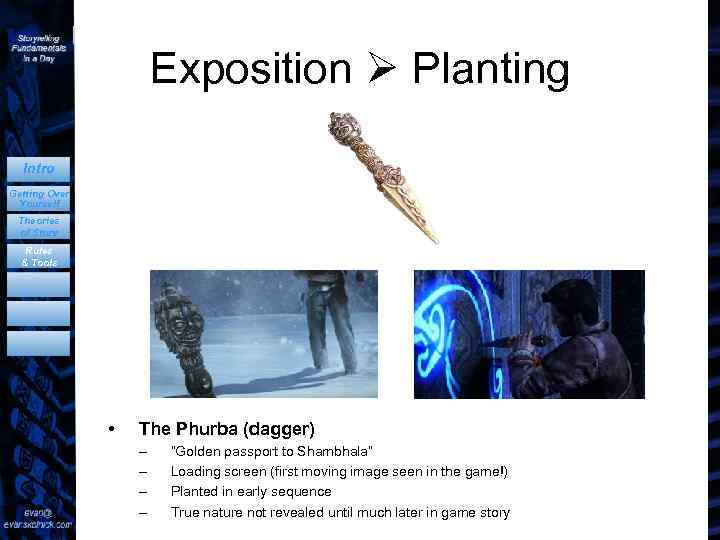 Exposition Planting Intro Getting Over Yourself Theories of Story Rules & Tools • The Phurba (dagger) – – “Golden passport to Shambhala” Loading screen (first moving image seen in the game!) Planted in early sequence True nature not revealed until much later in game story
 Exposition Planting Intro Getting Over Yourself Theories of Story Rules & Tools Characters Dialogue Case Studies • Planting opportunities in games – Show item in cutscene that player later can find/acquire – Establish enemy's ability in cutscene that player must contend with in gameplay
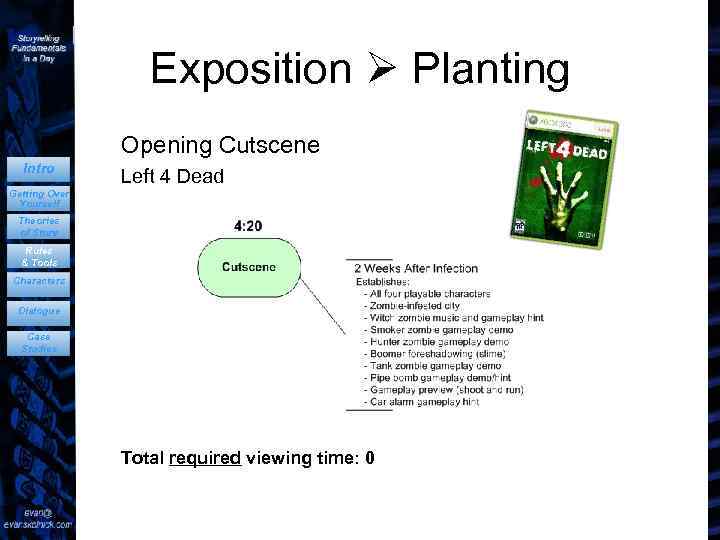 Exposition Planting Opening Cutscene Intro Left 4 Dead Getting Over Yourself Theories of Story Rules & Tools Characters Dialogue Case Studies Total required viewing time: 0
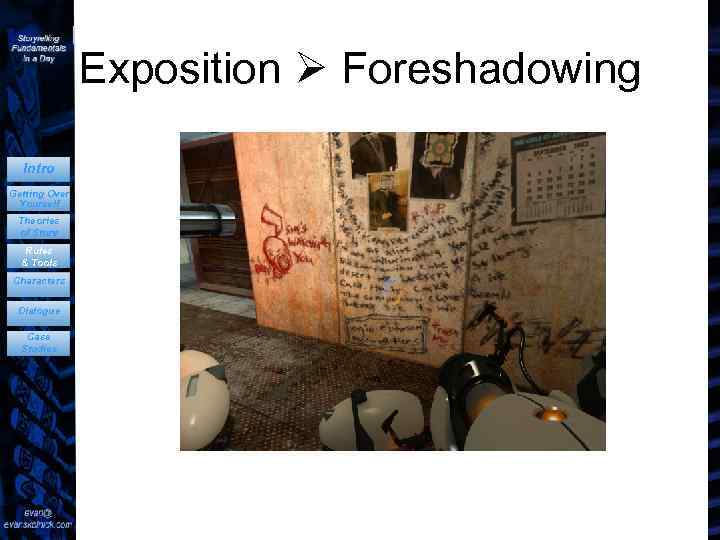
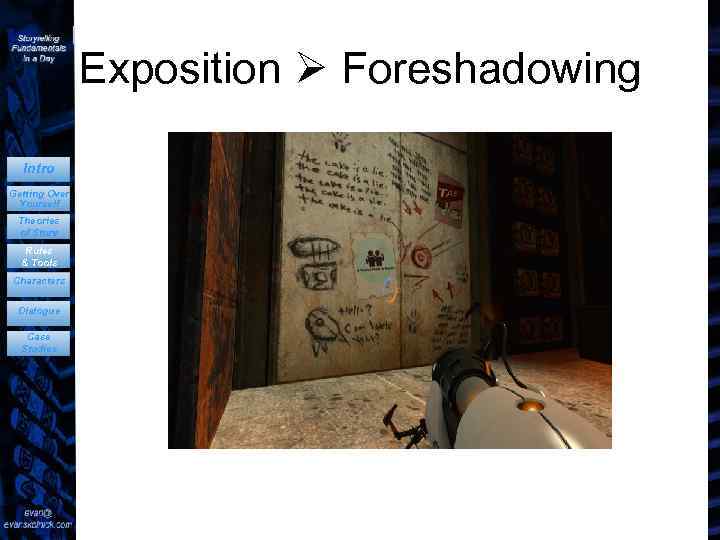
 Exposition Foreshadowing Intro Getting Over Yourself Theories of Story Rules & Tools Characters Dialogue Case Studies • Related to planting but softer focus • Hints at what may come ahead • Like planting, can lay the groundwork and increase believability • Often takes form of warnings, theories, images, dreams, feelings • Usually delivered subtly as possible to avoid complete telegraphing • Often only makes sense or seems relevant later
 Exposition Foreshadowing Intro Getting Over Yourself Theories of Story Rules & Tools Characters Dialogue Case Studies • Memorable movie foreshadowing – Robo. Cop's secret fourth directive – Doc Brown's warnings to Marty Mc. Fly about his actions possibly impacting the future – Incredi-Boy sequence in The Incredibles – Rex's “Have you been replaced? ” line in Toy Story – T-1000 staring oddly at silver mannequin in shopping mall, in Terminator 2
 Exposition Foreshadowing Intro Getting Over Yourself Theories of Story Rules & Tools Characters Dialogue Case Studies • Foreshadowing usage in games
 Exposition Foreshadowing Intro Getting Over Yourself Theories of Story Rules & Tools Characters Dialogue Case Studies
 Exposition Foreshadowing Intro Getting Over Yourself Theories of Story Rules & Tools Characters Dialogue Case Studies
 Exposition Foreshadowing Intro Getting Over Yourself Theories of Story Rules & Tools Characters Dialogue Case Studies • Foreshadowing usage in games – Dialogue or imagery in cutscene foreshadows what's coming next in gameplay, or vice versa
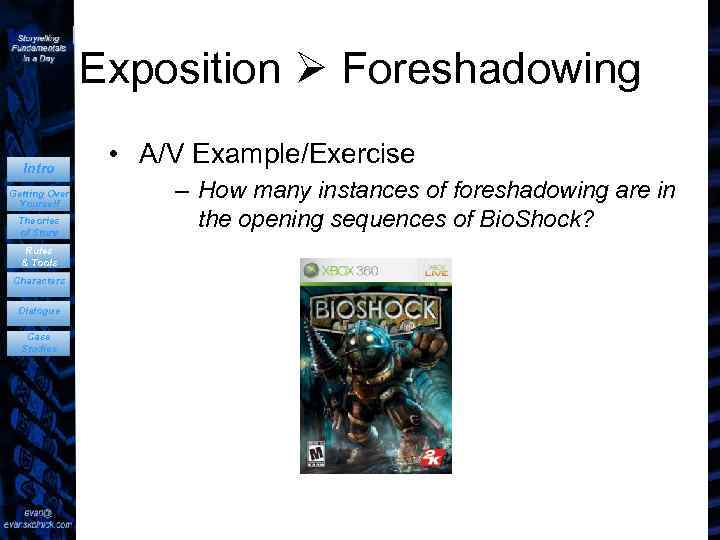 Exposition Foreshadowing Intro Getting Over Yourself Theories of Story Rules & Tools Characters Dialogue Case Studies • A/V Example/Exercise – How many instances of foreshadowing are in the opening sequences of Bio. Shock?
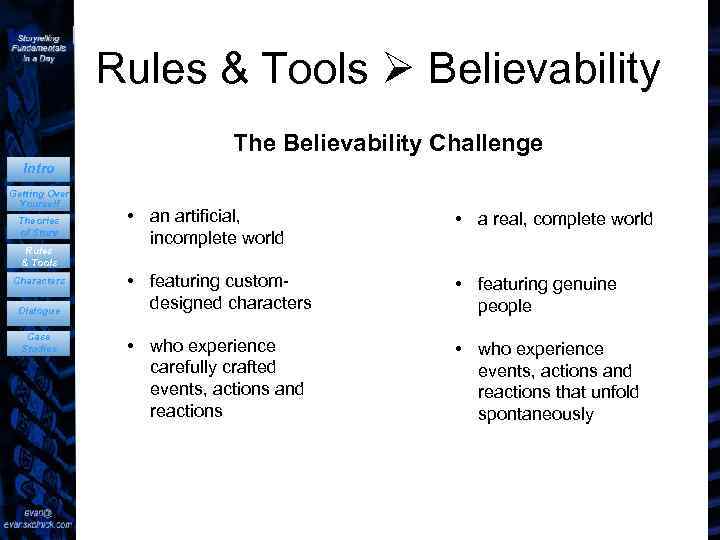 Rules & Tools Believability The Believability Challenge Intro Getting Over Yourself Theories of Story Rules & Tools Characters Dialogue Case Studies • an artificial, incomplete world • a real, complete world • featuring customdesigned characters • featuring genuine people • who experience carefully crafted events, actions and reactions • who experience events, actions and reactions that unfold spontaneously
 Rules & Tools Believability Intro Getting Over Yourself Theories of Story Rules & Tools Characters Dialogue Case Studies • Suspension of disbelief • Your job: keep the fictional world feeling as real as possible • Audience expects and wants: – A world that is fully realized and internally consistent – Events that don't test their gullibility – Characters that determine outcome of story – Characters that are consistent
 Believability Coincidences Intro Getting Over Yourself Theories of Story Rules & Tools Characters Dialogue Case Studies • Coincidences can hurt your story's credibility and believability • But nearly all stories have some! • Many story coincidences are due to the writer trying to solve other problems – Ex. hero's love interest is the one who gets kidnapped – Ex. hero must be resurrected in Act 3 and so someone/something comes out of left field to do so
 Believability Coincidences Intro Getting Over Yourself Theories of Story Rules & Tools Characters Dialogue Case Studies • Two different types – Seemingly small coincidences or contrivances that ultimately have huge and necessary story impact (“way-homer”) • Ex. Star Wars (droid blows up) – Larger, more obvious coincidences that can bounce the audience out of the experience
 Believability Coincidences Hallmarks of a “bad” coincidence Intro Getting Over Yourself Theories of Story Rules & Tools Characters Dialogue Case Studies 1. 2. 3. 4. 5. 6. Significantly benefits Hero and/or allies Result of dumb luck vs. effective planning or action Unlikely, based on what the audience knows at the time Little or no warning; not set up Noticed as coincidental by the audience Doubted, questioned, and/or mocked by the audience
 Believability Coincidences Deus ex machina Intro Getting Over Yourself Theories of Story Rules & Tools Characters Dialogue Case Studies • • “God from the machine” Writer’s hand is felt manipulating events/characters – – – Writer is constantly manipulating what happens in his/her story But should be invisible, unnoticed Deus ex machina is when it’s obvious, clumsy, convenient, contrived and the audience feels the writer’s hand at work
 Believability Coincidences Intro Getting Over Yourself Theories of Story Rules & Tools Characters Dialogue Case Studies • Three tactics to deal with coincidences – Change plot – Retrofit – Mask or downplay
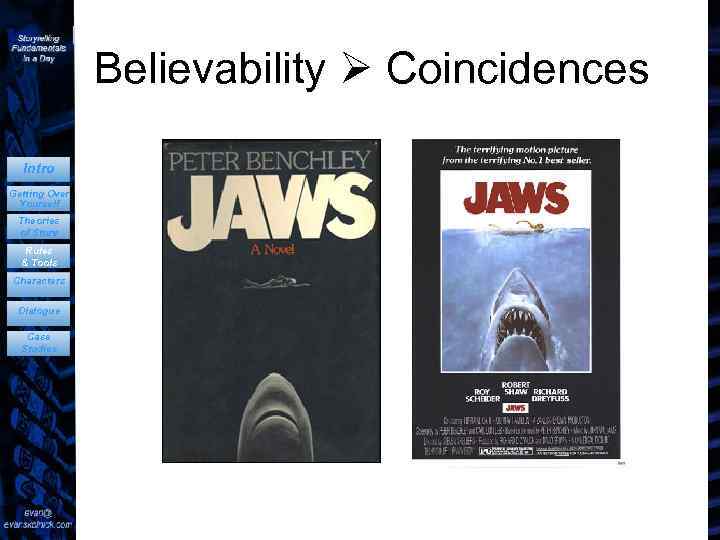
 Believability Coincidences Intro Getting Over Yourself Theories of Story Rules & Tools Characters Dialogue Case Studies • Change plot to remove coincidence
 Believability Coincidences Intro Getting Over Yourself Theories of Story Rules & Tools Characters Dialogue Case Studies • Change plot to remove coincidence – Can something different happen here that flows more organically?
 Believability Coincidences Intro Getting Over Yourself Theories of Story Rules & Tools Characters Dialogue Case Studies
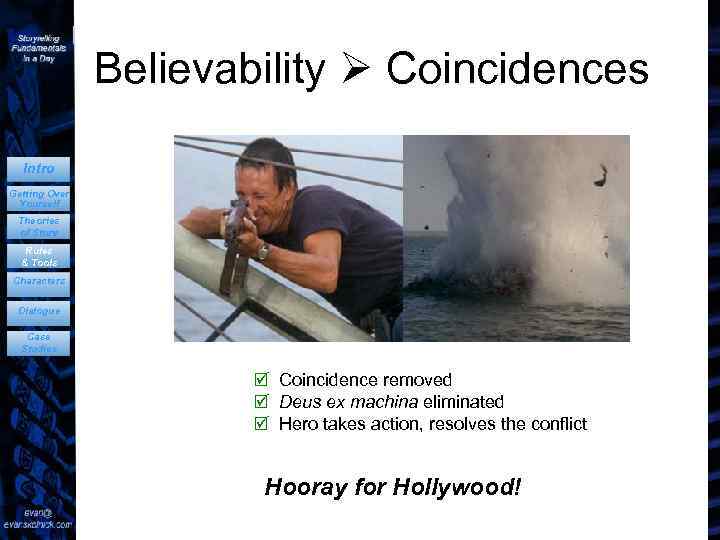 Believability Coincidences Intro Getting Over Yourself Theories of Story Rules & Tools Characters Dialogue Case Studies Coincidence removed Deus ex machina eliminated Hero takes action, resolves the conflict Hooray for Hollywood!
 Believability Coincidences Intro Getting Over Yourself Theories of Story Rules & Tools Characters Dialogue Case Studies • Change plot to remove coincidence – Can something different happen here that flows more organically? – Can the character’s actions, position, relationships or role help justify/cause situation?
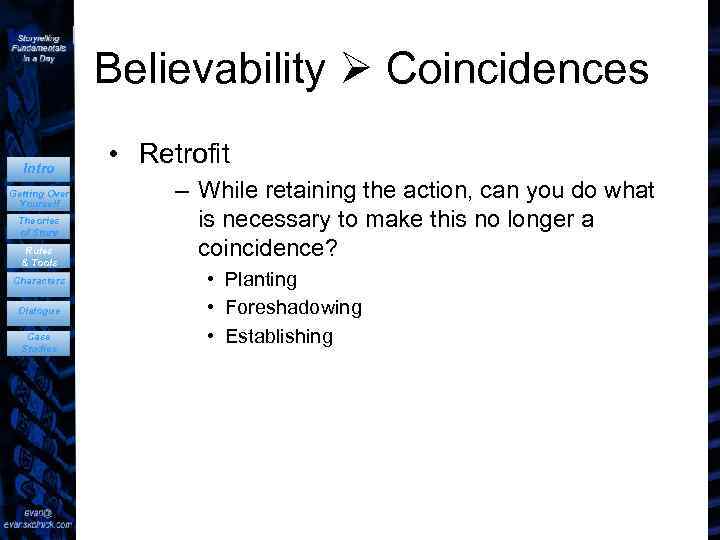 Believability Coincidences Intro Getting Over Yourself Theories of Story Rules & Tools Characters Dialogue Case Studies • Retrofit – While retaining the action, can you do what is necessary to make this no longer a coincidence? • Planting • Foreshadowing • Establishing
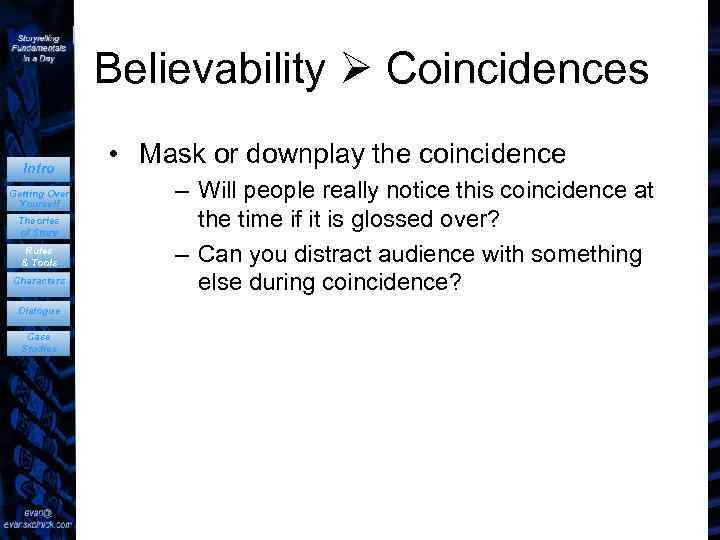 Believability Coincidences Intro Getting Over Yourself Theories of Story Rules & Tools Characters Dialogue Case Studies • Mask or downplay the coincidence – Will people really notice this coincidence at the time if it is glossed over? – Can you distract audience with something else during coincidence?
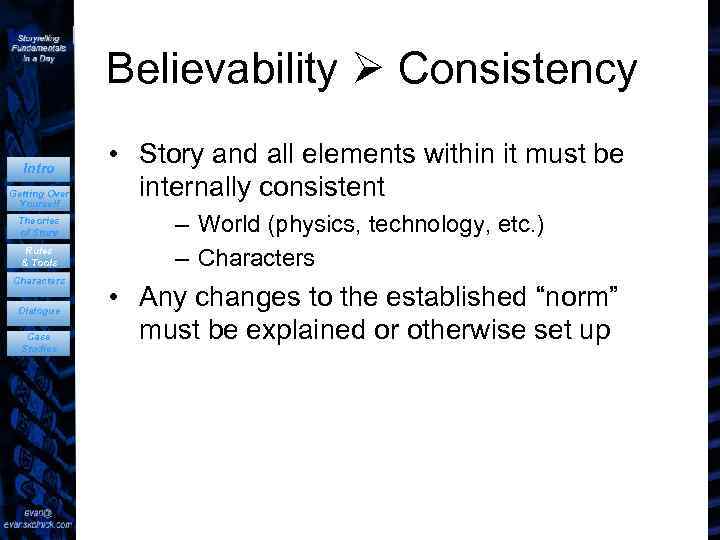 Believability Consistency Intro Getting Over Yourself Theories of Story Rules & Tools Characters Dialogue Case Studies • Story and all elements within it must be internally consistent – World (physics, technology, etc. ) – Characters • Any changes to the established “norm” must be explained or otherwise set up
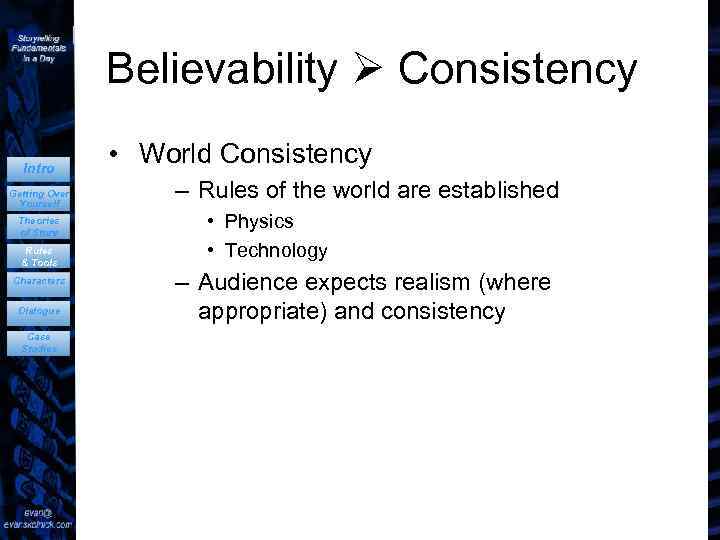 Believability Consistency Intro Getting Over Yourself Theories of Story Rules & Tools Characters Dialogue Case Studies • World Consistency – Rules of the world are established • Physics • Technology – Audience expects realism (where appropriate) and consistency
 Believability Consistency Intro Getting Over Yourself Theories of Story Rules & Tools Characters Dialogue Case Studies • World Consistency – In games, this is taken a step further – Actions and abilities seen in cutscenes must be consistent with gameplay • A character in a cutscene with abilities they can't exhibit in gameplay will cause player frustration • A character in a cutscene without abilities that do exist in gameplay will cause player derision – Gameplay abilities, physics, etc. expected to remain internally consistent
 Believability Consistency Intro Getting Over Yourself Theories of Story Rules & Tools Characters Dialogue Case Studies • Character Consistency – Character motivations and actions must remain consistent within story • Exception: character growth which has been properly established – In games, character motivations and actions must also be consistent between: – Cutscenes – Mission objectives – In-game abilities
 Impact Scope of Conflict Intro Getting Over Yourself Theories of Story Rules & Tools Characters Dialogue Case Studies • Scope of conflict – What is at stake? – Too easy to make this overly large • • The USA All life on Earth Our galaxy The entire universe – Any conflict can feel huge if it means a lot to a sympathetic character • Ex. Fatal Attraction
 Impact Scope of Conflict Intro Getting Over Yourself Theories of Story Rules & Tools Characters Dialogue Case Studies • Good game examples – Grand Theft Auto series (one thug’s criminal career) – Sly Cooper (family birthright) – Diner Dash (keeping one’s job) – Mr. Mosquito (keeping a mosquito fed) – The Walking Dead: Season One (one little girl’s life)
 Impact Scope of Conflict Intro Getting Over Yourself Theories of Story Rules & Tools Characters Dialogue Case Studies • Scope of conflict – What is at stake? – Too easy to make this overly large • • The USA All life on Earth Our galaxy The entire universe – Any conflict can feel huge if it means a lot to a sympathetic character • Ex. Fatal Attraction – Make scope of conflict only as large as it needs to be
 Impact Surprise Intro Getting Over Yourself Theories of Story Rules & Tools Characters Dialogue Case Studies • Best stories regularly surprise audience • Best games regularly surprise players • Avoid a plodding series of missions that lead to a long-expected showdown – Audiences are well-versed in story – Able to anticipate even more than you'd expect
 Impact Surprise Intro Getting Over Yourself Theories of Story Rules & Tools Characters Dialogue Case Studies • Plot twists – Vital to maintaining interest
 Impact Surprise Intro Getting Over Yourself Theories of Story Rules & Tools Characters Dialogue Case Studies Surprise Coincidence Believability
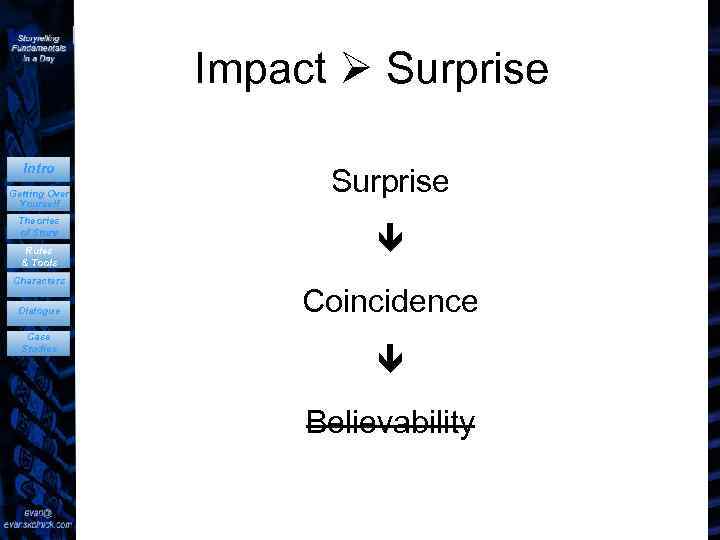
 Impact Surprise Intro Getting Over Yourself Theories of Story Rules & Tools Characters Dialogue Case Studies • Plot twists – Vital to maintaining interest – Easy to do badly, unless properly set up (can also feel like deus ex machina) – In a game, poorly set up plot twist can feel unfair to player – Seed subtle exposition that increases believability of your twists – Include red herrings to throw clever viewers off the path
 Characters Overview Intro Getting Over Yourself Theories of Story Rules & Tools Characters Dialogue Case Studies • Most important characters – Hero – Villain • Character arcs
 Characters Hero Intro Getting Over Yourself Theories of Story Rules & Tools Characters Dialogue Case Studies • Hero starts in a stable if not balanced state • Often: – – – – Wrong career Wrong position Divorced Single/lonely In a rut Trapped Underachieving Otherwise incomplete/unfulfilled
 Characters Hero Intro Getting Over Yourself Theories of Story Rules & Tools Characters Dialogue Case Studies • Hero starts in a stable if not balanced state • Often: – – – – Wrong career – Changes to right career Wrong position – Changes to right position Divorced – Reunites with ex, or finds someone new Single/lonely – Finds true love In a rut – Gets out of rut Trapped – Breaks free Underachieving - Overachieves Otherwise incomplete/unfulfilled – Becomes complete and fulfilled
 Characters Hero Intro Getting Over Yourself Theories of Story Rules & Tools Characters Dialogue Case Studies • Hero changes/grows the most – In well-constructed story, this is its most dramatic aspect – Can be difficult to establish in a game story – Can be almost impossible to accomplish in a licensed game story
 Characters Hero Intro Getting Over Yourself Theories of Story Rules & Tools Characters Dialogue Case Studies • Stakes of conflict must be intensely personal to Hero • Not enough to save world – must save someone with emotional bond • Otherwise audience indifference will result – Star Trek II – Superman 1 and 2 – Spider-Man 1, 2, 3 and reboot
 Characters Hero Intro Getting Over Yourself Theories of Story Rules & Tools Characters Dialogue Case Studies • What drives the hero to overcome the conflict? • How badly do they want it? And why? – Ex. Fatal Attraction (Oscar-nominated screenplay) • Dan Gallagher driven by happiness in his marriage and love for his young daughter • That's all that's at stake through most of the story • Love for his wife and daughter emphasized again and again to reinforce his personal stakes
 Characters Hero Intro Getting Over Yourself Theories of Story Rules & Tools Characters Dialogue Case Studies • Being the Hero must include: – Risk – Sacrifice – Reward • In stories, these can be physical or emotional elements • In games, they are most likely physical
 Characters Hero Intro Getting Over Yourself Theories of Story Rules & Tools Characters Dialogue Case Studies • Hero must be active driver of the story – Decision – Action • Hero must not be forced or “have no choice” • Hero must actively and directly resolve conflict – No deus ex machina
 Characters Villain Intro Getting Over Yourself Theories of Story Rules & Tools Characters Dialogue Case Studies • Villain is the source of the main conflict • Must be more than a match for Hero – Viable threat – Shown, not told • Cannot be approached without getting past henchmen – Henchmen can be defeated or turned to hero's side
 Characters Villain Intro Getting Over Yourself Theories of Story Rules & Tools Characters Dialogue Case Studies • Doesn't consider himself a Villain – Thinks he's right
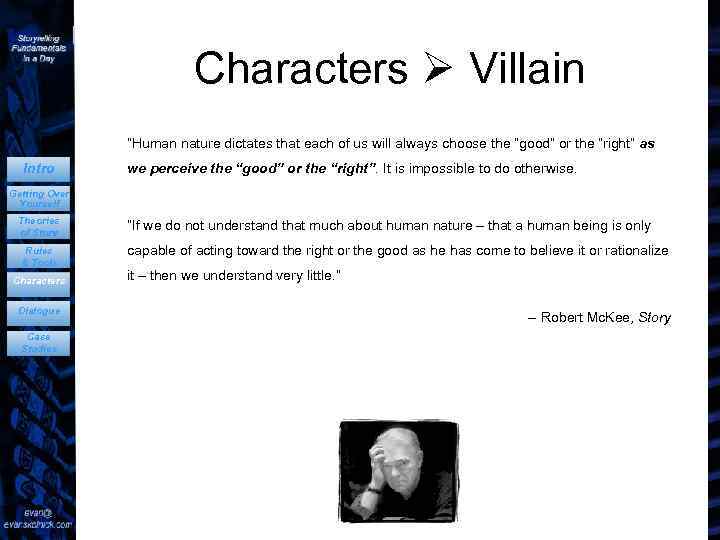 Characters Villain “Human nature dictates that each of us will always choose the “good” or the “right” as Intro we perceive the “good” or the “right”. It is impossible to do otherwise. Getting Over Yourself Theories of Story “If we do not understand that much about human nature – that a human being is only Rules & Tools capable of acting toward the right or the good as he has come to believe it or rationalize Characters Dialogue Case Studies it – then we understand very little. ” -- Robert Mc. Kee, Story
 Characters Villain Intro Getting Over Yourself Theories of Story Rules & Tools Characters Dialogue Case Studies • Doesn't consider himself a Villain – Thinks he's right – Is the Hero in his version of the story • Has clear, believable motivation – Can be understood/appreciated by audience at some level – No black and white; shades of gray – Answer to “why's he doing that? ” cannot be “because he's evil” – “Because he’s crazy” is almost as weak
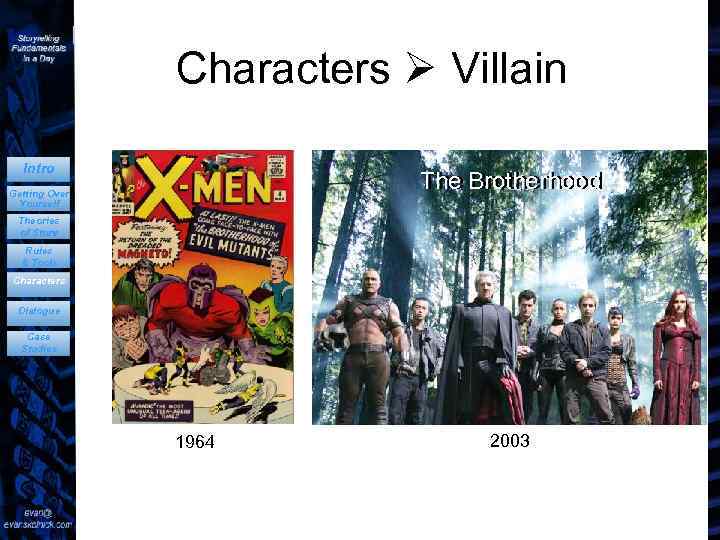 Characters Villain Intro The Brotherhood Getting Over Yourself Theories of Story Rules & Tools Characters Dialogue Case Studies 1964 2003
 Characters Villain Intro Getting Over Yourself Theories of Story Rules & Tools Characters Dialogue Case Studies • Exercise (individual, 10 min. ) – Pick the villain from one of your favorite movies and summarize the story from his/her POV (2 – 3 paragraphs) – He/she is the Hero in this version – Story itself is identical • Change climax outcome if you must
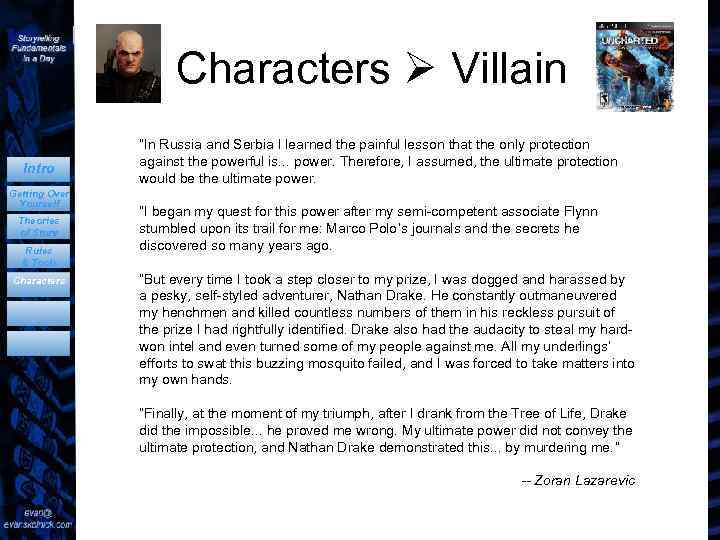 Characters Villain Intro Getting Over Yourself Theories of Story Rules & Tools Characters “In Russia and Serbia I learned the painful lesson that the only protection against the powerful is. . . power. Therefore, I assumed, the ultimate protection would be the ultimate power. “I began my quest for this power after my semi-competent associate Flynn stumbled upon its trail for me: Marco Polo’s journals and the secrets he discovered so many years ago. “But every time I took a step closer to my prize, I was dogged and harassed by a pesky, self-styled adventurer, Nathan Drake. He constantly outmaneuvered my henchmen and killed countless numbers of them in his reckless pursuit of the prize I had rightfully identified. Drake also had the audacity to steal my hardwon intel and even turned some of my people against me. All my underlings’ efforts to swat this buzzing mosquito failed, and I was forced to take matters into my own hands. “Finally, at the moment of my triumph, after I drank from the Tree of Life, Drake did the impossible. . . he proved me wrong. My ultimate power did not convey the ultimate protection, and Nathan Drake demonstrated this. . . by murdering me. ” -- Zoran Lazarevic
 Characters Villain • May or may not grow/change Intro Getting Over Yourself Theories of Story Rules & Tools Characters Dialogue Case Studies – Often refusal to change is what makes them a Villain • Must be directly confronted by Hero – Otherwise resolution is unsatisfying – Memorable exception: Star Trek II • Kirk and Khan never physically meet – Final boss battle! • In non-adventure stories, villain may be: – Boss, supervisor or work rival – Hero's own destructive personality – Nature/The World
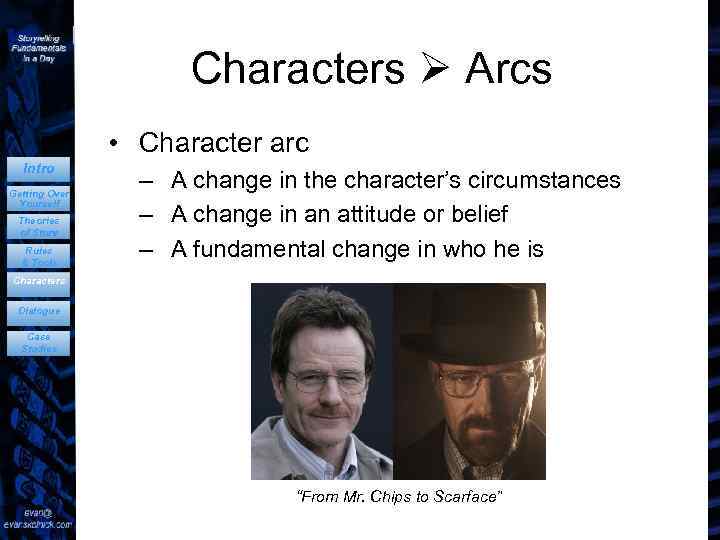 Characters Arcs • Character arc Intro Getting Over Yourself Theories of Story Rules & Tools – A change in the character’s circumstances – A change in an attitude or belief – A fundamental change in who he is Characters Dialogue Case Studies “From Mr. Chips to Scarface”
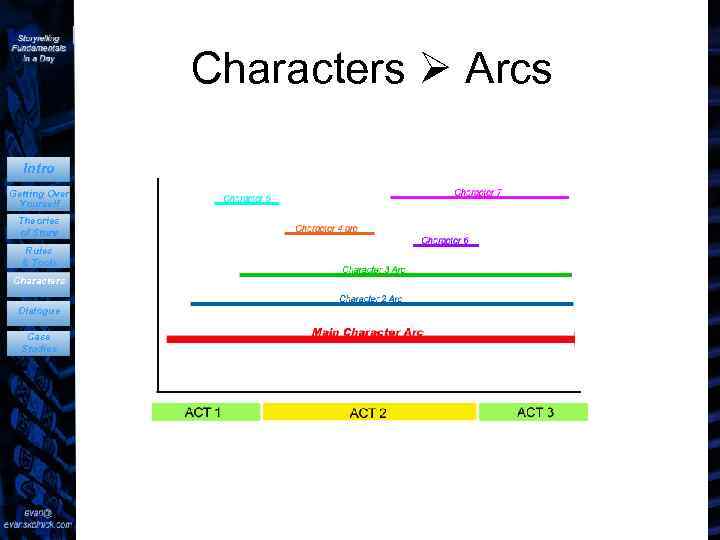
 Characters Arcs Intro Getting Over Yourself Theories of Story Rules & Tools Characters Dialogue Case Studies • Character arc – Each significant character has his own arc, with: • Its own conflict • Its own three-act structure (beginning, middle, end)
 Characters Arcs Intro Getting Over Yourself Theories of Story Rules & Tools Characters Dialogue Case Studies
 Characters Arcs Intro Getting Over Yourself Theories of Story Rules & Tools Characters Dialogue Case Studies • Simpler than overall story structure • Should be expressed in three-act terms: – Setup – Confrontation – Resolution
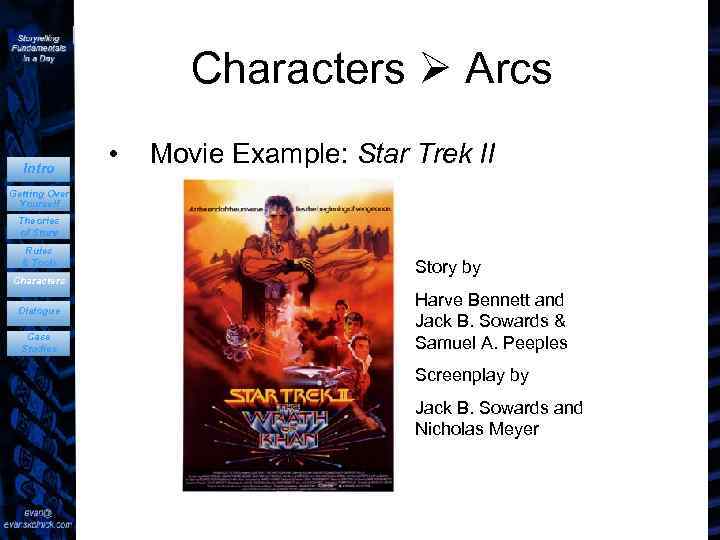 Characters Arcs Intro • Movie Example: Star Trek II Getting Over Yourself Theories of Story Rules & Tools Characters Dialogue Case Studies Story by Harve Bennett and Jack B. Sowards & Samuel A. Peeples Screenplay by Jack B. Sowards and Nicholas Meyer
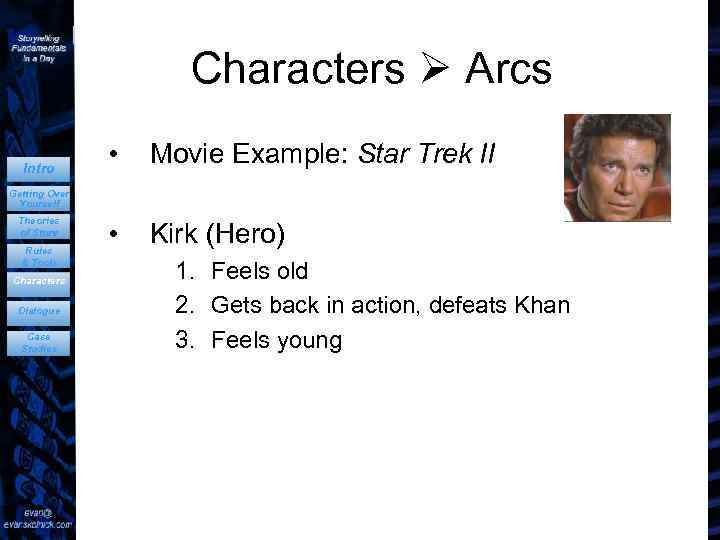 Characters Arcs Intro • Movie Example: Star Trek II • Kirk (Hero) Getting Over Yourself Theories of Story Rules & Tools Characters Dialogue Case Studies 1. Feels old 2. Gets back in action, defeats Khan 3. Feels young
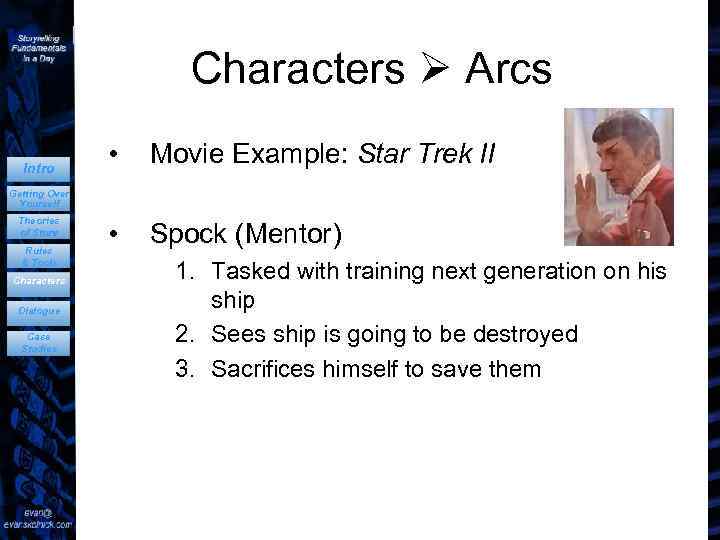 Characters Arcs Intro • Movie Example: Star Trek II • Spock (Mentor) Getting Over Yourself Theories of Story Rules & Tools Characters Dialogue Case Studies 1. Tasked with training next generation on his ship 2. Sees ship is going to be destroyed 3. Sacrifices himself to save them
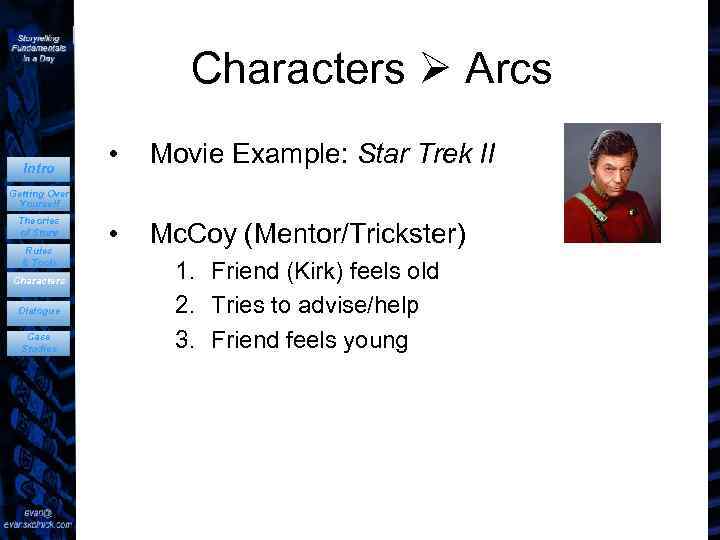 Characters Arcs Intro • Movie Example: Star Trek II • Mc. Coy (Mentor/Trickster) Getting Over Yourself Theories of Story Rules & Tools Characters Dialogue Case Studies 1. Friend (Kirk) feels old 2. Tries to advise/help 3. Friend feels young
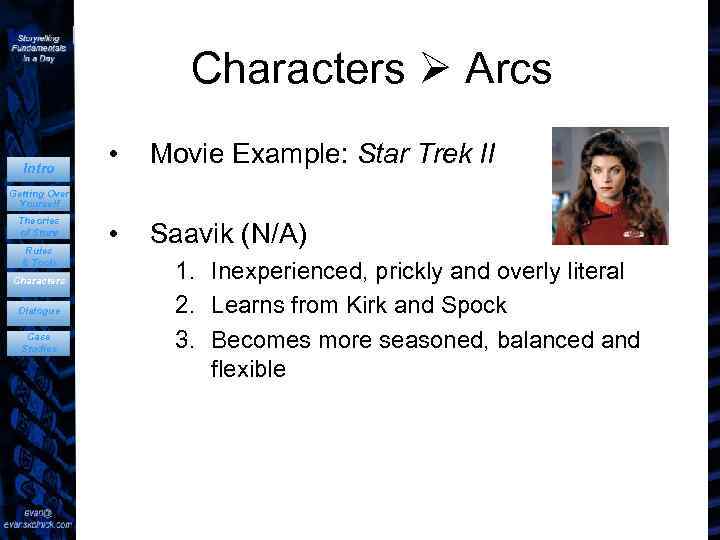 Characters Arcs Intro • Movie Example: Star Trek II • Saavik (N/A) Getting Over Yourself Theories of Story Rules & Tools Characters Dialogue Case Studies 1. Inexperienced, prickly and overly literal 2. Learns from Kirk and Spock 3. Becomes more seasoned, balanced and flexible
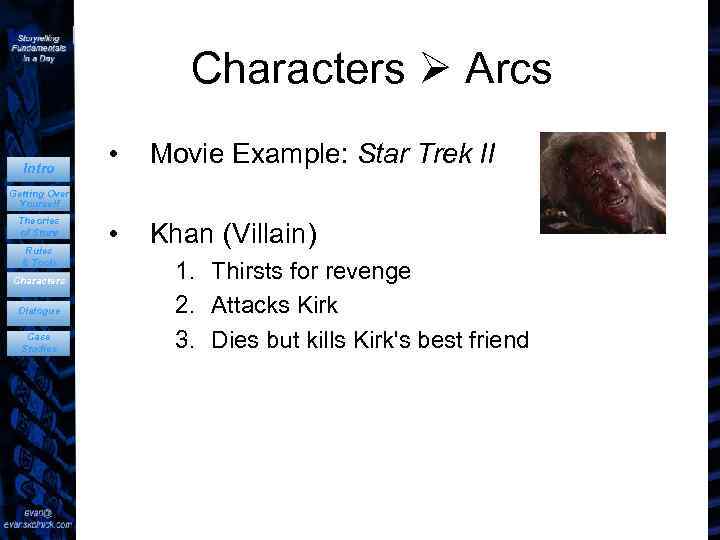 Characters Arcs Intro • Movie Example: Star Trek II • Khan (Villain) Getting Over Yourself Theories of Story Rules & Tools Characters Dialogue Case Studies 1. Thirsts for revenge 2. Attacks Kirk 3. Dies but kills Kirk's best friend
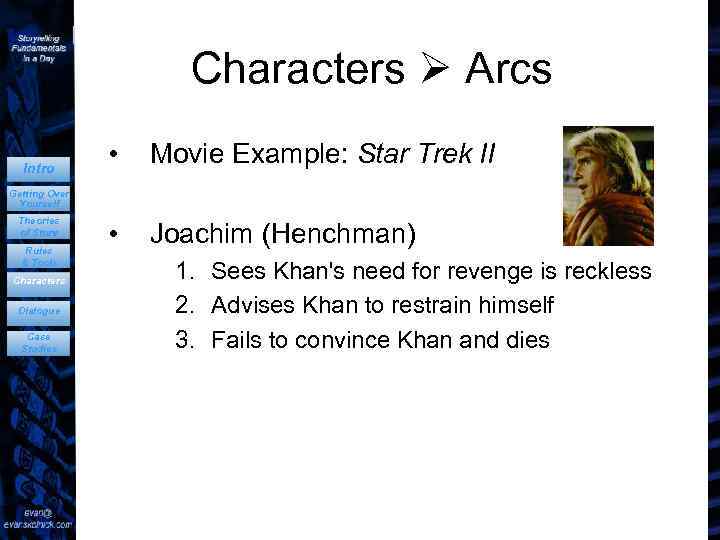 Characters Arcs Intro • Movie Example: Star Trek II • Joachim (Henchman) Getting Over Yourself Theories of Story Rules & Tools Characters Dialogue Case Studies 1. Sees Khan's need for revenge is reckless 2. Advises Khan to restrain himself 3. Fails to convince Khan and dies
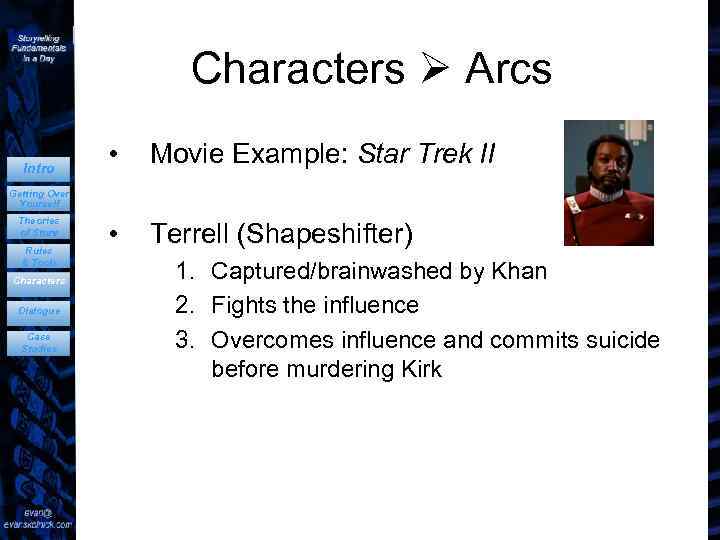 Characters Arcs Intro • Movie Example: Star Trek II • Terrell (Shapeshifter) Getting Over Yourself Theories of Story Rules & Tools Characters Dialogue Case Studies 1. Captured/brainwashed by Khan 2. Fights the influence 3. Overcomes influence and commits suicide before murdering Kirk
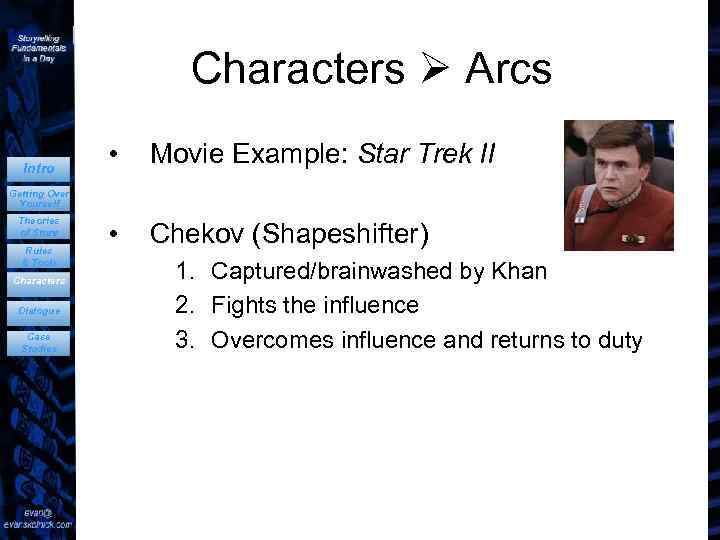 Characters Arcs Intro • Movie Example: Star Trek II • Chekov (Shapeshifter) Getting Over Yourself Theories of Story Rules & Tools Characters Dialogue Case Studies 1. Captured/brainwashed by Khan 2. Fights the influence 3. Overcomes influence and returns to duty
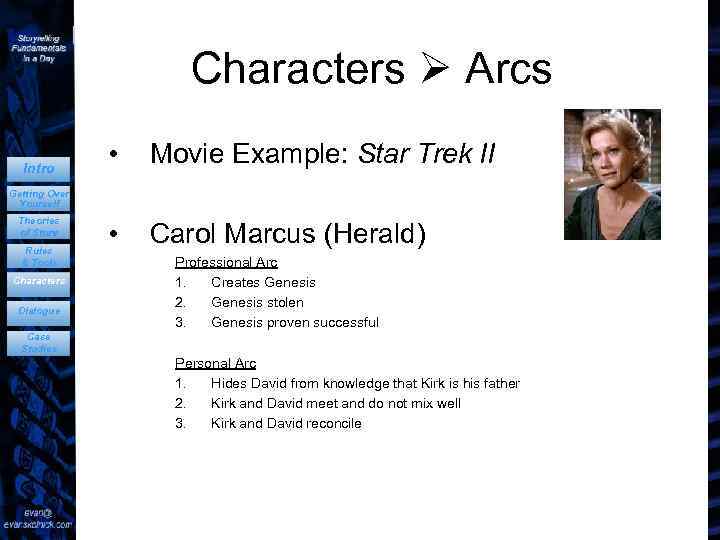 Characters Arcs Intro • Movie Example: Star Trek II • Carol Marcus (Herald) Getting Over Yourself Theories of Story Rules & Tools Characters Dialogue Professional Arc 1. Creates Genesis 2. Genesis stolen 3. Genesis proven successful Case Studies Personal Arc 1. Hides David from knowledge that Kirk is his father 2. Kirk and David meet and do not mix well 3. Kirk and David reconcile
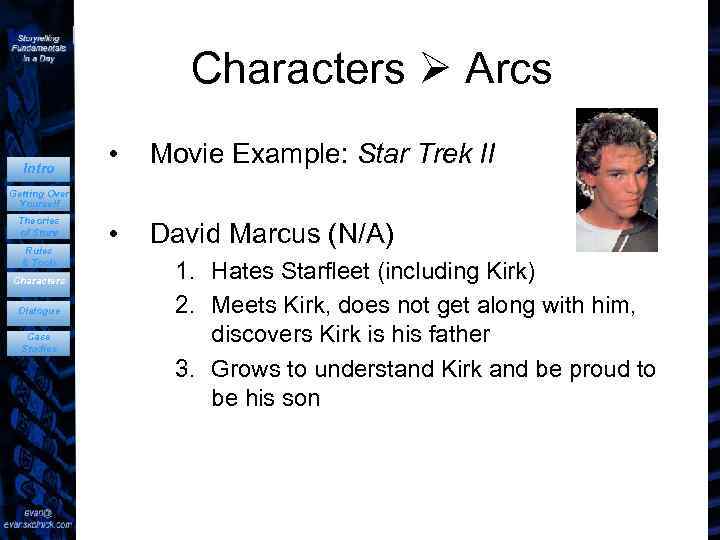 Characters Arcs Intro • Movie Example: Star Trek II • David Marcus (N/A) Getting Over Yourself Theories of Story Rules & Tools Characters Dialogue Case Studies 1. Hates Starfleet (including Kirk) 2. Meets Kirk, does not get along with him, discovers Kirk is his father 3. Grows to understand Kirk and be proud to be his son
 Characters Arcs Intro Getting Over Yourself Theories of Story Rules & Tools Characters Dialogue Case Studies • • Do all your major characters have arcs? Have you paid off on them all?
 Reference / Reading • Aristotle. Poetics – • Getting Over Yourself • • Rules & Tools • • New Rider Games, 2003 Strunk, William and E. B. White. The Elements of Style – • Write Brothers, 2004 Rollings, Andrew and Ernest Adams. Andrew Rollings and Ernest Adams on Game Design – • Regan Books, 1997 Phillips, Melanie and Chris Huntley. Dramatica: A New Theory of Story – • Atheneum, 1986 Mc. Kee, Robert. Story – Dialogue Dell Books, 1987 Franklin, Jon. Writing For Story – Characters Princeton University Press (reprint), 1972 Field, Syd. Screenplay: The Foundations of Screenwriting – Theories of Story Case Studies Campbell, Joseph. The Hero with a Thousand Faces – Intro Public domain Longman (4 th edition), 1999 Vogler, Christopher. The Writer's Journey: Mythic Structure for Writers – Michael Wiese Productions, 1998 evan@evanskolnick. com