


 Скачать презентацию Intra-cavity Pulse Shaping of Mode-locked Oscillators Shai Yefet
c6c039dd1bd2774051ba7d60f90b6df9.ppt
- Количество слайдов: 1
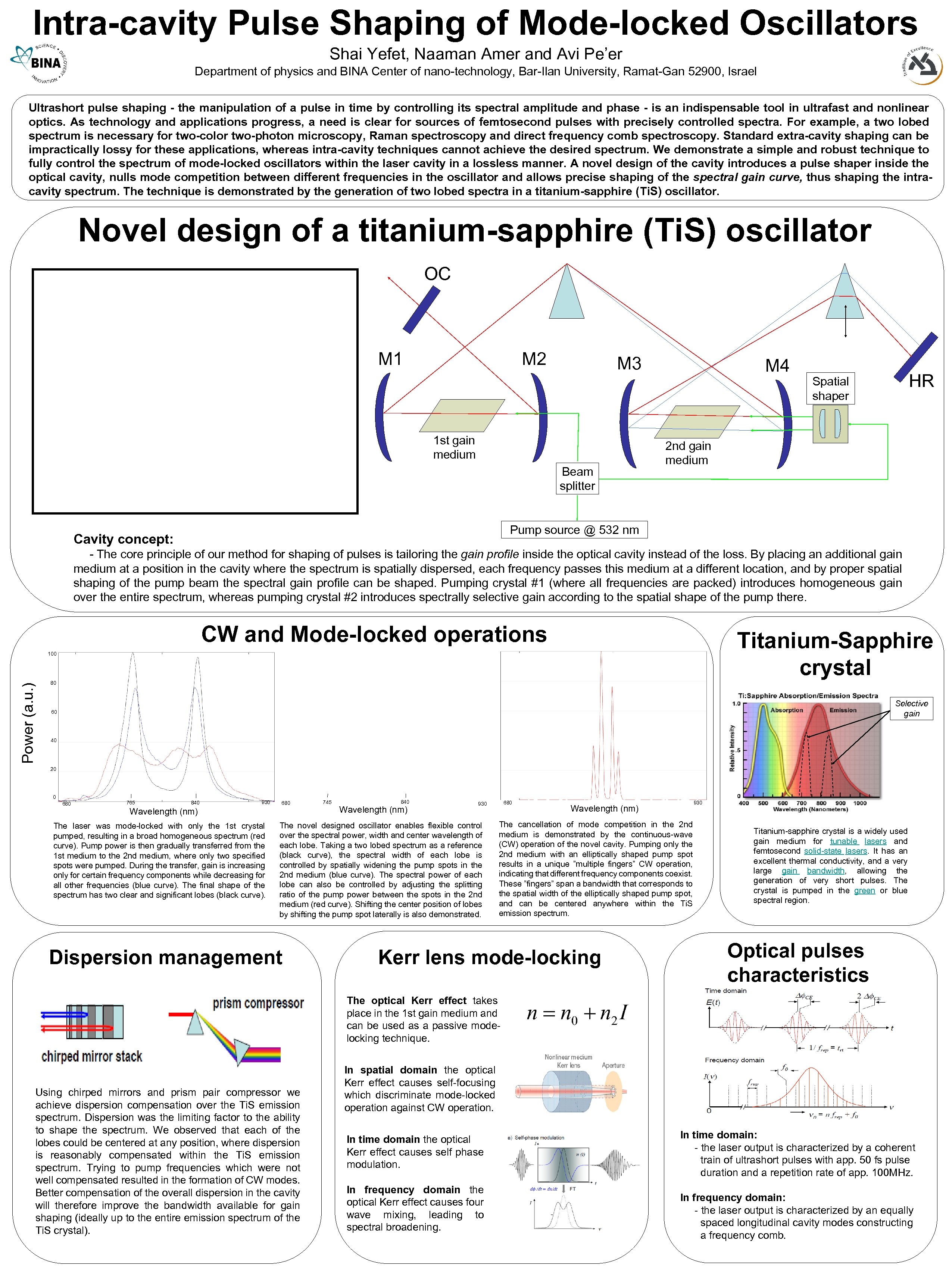 Intra-cavity Pulse Shaping of Mode-locked Oscillators Shai Yefet, Naaman Amer and Avi Pe’er Department of physics and BINA Center of nano-technology, Bar-Ilan University, Ramat-Gan 52900, Israel Ultrashort pulse shaping - the manipulation of a pulse in time by controlling its spectral amplitude and phase - is an indispensable tool in ultrafast and nonlinear optics. As technology and applications progress, a need is clear for sources of femtosecond pulses with precisely controlled spectra. For example, a two lobed spectrum is necessary for two-color two-photon microscopy, Raman spectroscopy and direct frequency comb spectroscopy. Standard extra-cavity shaping can be impractically lossy for these applications, whereas intra-cavity techniques cannot achieve the desired spectrum. We demonstrate a simple and robust technique to fully control the spectrum of mode-locked oscillators within the laser cavity in a lossless manner. A novel design of the cavity introduces a pulse shaper inside the optical cavity, nulls mode competition between different frequencies in the oscillator and allows precise shaping of the spectral gain curve, thus shaping the intracavity spectrum. The technique is demonstrated by the generation of two lobed spectra in a titanium-sapphire (Ti. S) oscillator. Novel design of a titanium-sapphire (Ti. S) oscillator OC M 1 M 2 M 3 1 st gain medium Beam splitter M 4 HR Spatial shaper 2 nd gain medium Pump source @ 532 nm Cavity concept: - The core principle of our method for shaping of pulses is tailoring the gain profile inside the optical cavity instead of the loss. By placing an additional gain medium at a position in the cavity where the spectrum is spatially dispersed, each frequency passes this medium at a different location, and by proper spatial shaping of the pump beam the spectral gain profile can be shaped. Pumping crystal #1 (where all frequencies are packed) introduces homogeneous gain over the entire spectrum, whereas pumping crystal #2 introduces spectrally selective gain according to the spatial shape of the pump there. CW and Mode-locked operations Titanium-Sapphire crystal Power (a. u. ) 100 80 Selective gain 60 40 20 0 680 765 840 930 680 Wavelength (nm) The laser was mode-locked with only the 1 st crystal pumped, resulting in a broad homogeneous spectrum (red curve). Pump power is then gradually transferred from the 1 st medium to the 2 nd medium, where only two specified spots were pumped. During the transfer, gain is increasing only for certain frequency components while decreasing for all other frequencies (blue curve). The final shape of the spectrum has two clear and significant lobes (black curve). 745 840 Wavelength (nm) The novel designed oscillator enables flexible control over the spectral power, width and center wavelength of each lobe. Taking a two lobed spectrum as a reference (black curve), the spectral width of each lobe is controlled by spatially widening the pump spots in the 2 nd medium (blue curve). The spectral power of each lobe can also be controlled by adjusting the splitting ratio of the pump power between the spots in the 2 nd medium (red curve). Shifting the center position of lobes by shifting the pump spot laterally is also demonstrated. Dispersion management 680 930 Wavelength (nm) The cancellation of mode competition in the 2 nd medium is demonstrated by the continuous-wave (CW) operation of the novel cavity. Pumping only the 2 nd medium with an elliptically shaped pump spot results in a unique ”multiple fingers” CW operation, indicating that different frequency components coexist. These ”fingers” span a bandwidth that corresponds to the spatial width of the elliptically shaped pump spot, and can be centered anywhere within the Ti. S emission spectrum. Kerr lens mode-locking Titanium-sapphire crystal is a widely used gain medium for tunable lasers and femtosecond solid-state lasers. It has an excellent thermal conductivity, and a very large gain bandwidth, allowing the generation of very short pulses. The crystal is pumped in the green or blue spectral region. Optical pulses characteristics The optical Kerr effect takes place in the 1 st gain medium and can be used as a passive modelocking technique. Using chirped mirrors and prism pair compressor we achieve dispersion compensation over the Ti. S emission spectrum. Dispersion was the limiting factor to the ability to shape the spectrum. We observed that each of the lobes could be centered at any position, where dispersion is reasonably compensated within the Ti. S emission spectrum. Trying to pump frequencies which were not well compensated resulted in the formation of CW modes. Better compensation of the overall dispersion in the cavity will therefore improve the bandwidth available for gain shaping (ideally up to the entire emission spectrum of the Ti. S crystal). In spatial domain the optical Kerr effect causes self-focusing which discriminate mode-locked operation against CW operation. In time domain the optical Kerr effect causes self phase modulation. In frequency domain the optical Kerr effect causes four wave mixing, leading to spectral broadening. In time domain: - the laser output is characterized by a coherent train of ultrashort pulses with app. 50 fs pulse duration and a repetition rate of app. 100 MHz. In frequency domain: - the laser output is characterized by an equally spaced longitudinal cavity modes constructing a frequency comb.