


 Скачать презентацию INTERTANKO Seminar 8 th April 2011 INTERTANKO
935855bde30c72c39c4386be3d99e8bb.ppt
- Количество слайдов: 54
 INTERTANKO Seminar 8 th April 2011
 INTERTANKO Seminar Schedule Friday 8 th April 2011 0930 Welcome and introduction INTERTANKO Overview Vetting and Benchmarking Piracy Environmental Issues Regional Issues INTERTANKO Work Plan Open discussion on all issues 1200 -1300 Lunch
 Anti-Trust/Competition Law Compliance Statement INTERTANKO’s policy is to be firmly committed to maintaining a fair and competitive environment in the world tanker trade, and to adhering to all applicable laws which regulate INTERTANKO’s and its members’ activities in these markets. These laws include the anti-trust/competition laws which the United States, the European Union and many nations of the world have adopted to preserve the free enterprise system, promote competition and protect the public from monopolistic and other restrictive trade practices. INTERTANKO’s activities will be conducted in compliance with its Antitrust/Competition Law Guidelines.
 Tanker Market Overview
 The state of the Tanker Industry • Uncertainty, fundamentals still strong but high oil price a threat • Slack in supply of tankers – slow steaming (ballast) – Lowering of C/P speed – Suez Canal less used – Piracy effect – longer routes/inefficiency • Reduced Libyan export, increased Middle East export
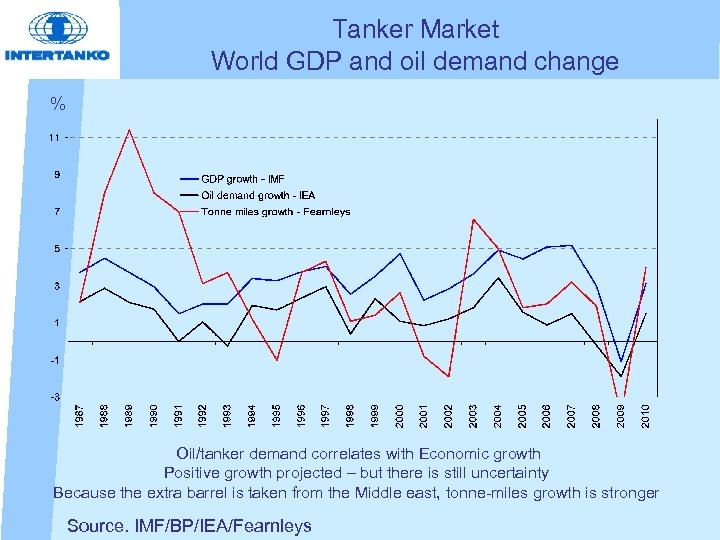 Tanker Market World GDP and oil demand change % Oil/tanker demand correlates with Economic growth Positive growth projected – but there is still uncertainty Because the extra barrel is taken from the Middle east, tonne-miles growth is stronger Source. IMF/BP/IEA/Fearnleys
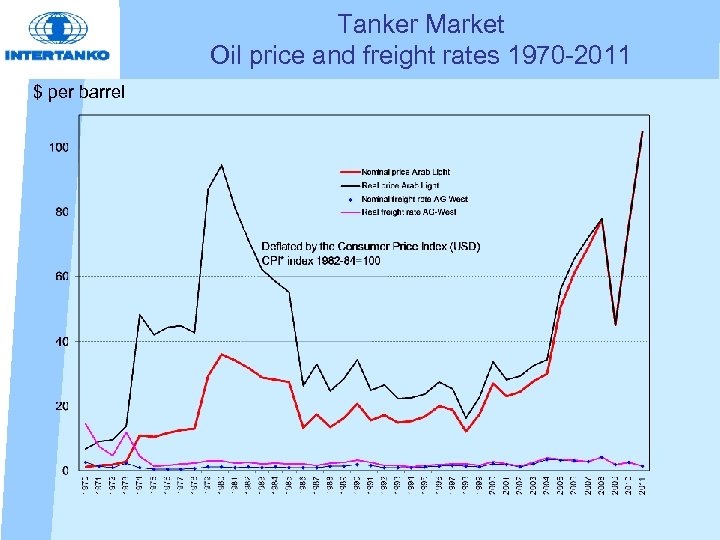 Tanker Market Oil price and freight rates 1970 -2011 $ per barrel
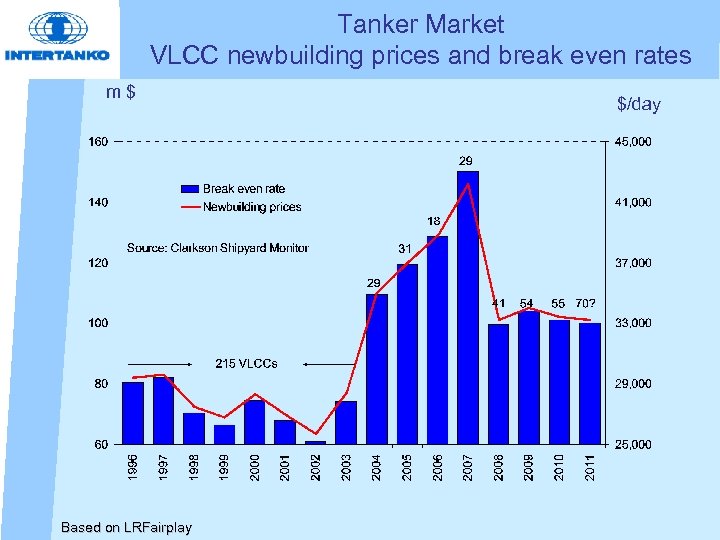 Tanker Market VLCC newbuilding prices and break even rates m $ Based on LRFairplay $/day
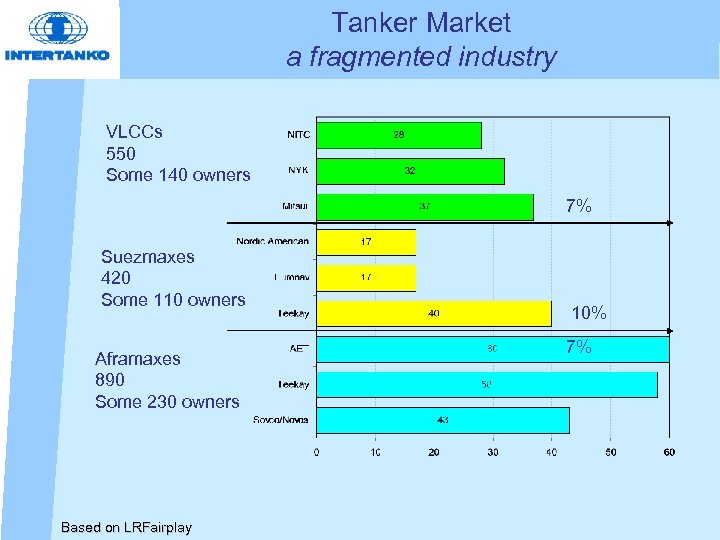 Tanker Market a fragmented industry VLCCs 550 Some 140 owners 7% Suezmaxes 420 Some 110 owners Aframaxes 890 Some 230 owners Based on LRFairplay 10% 7%
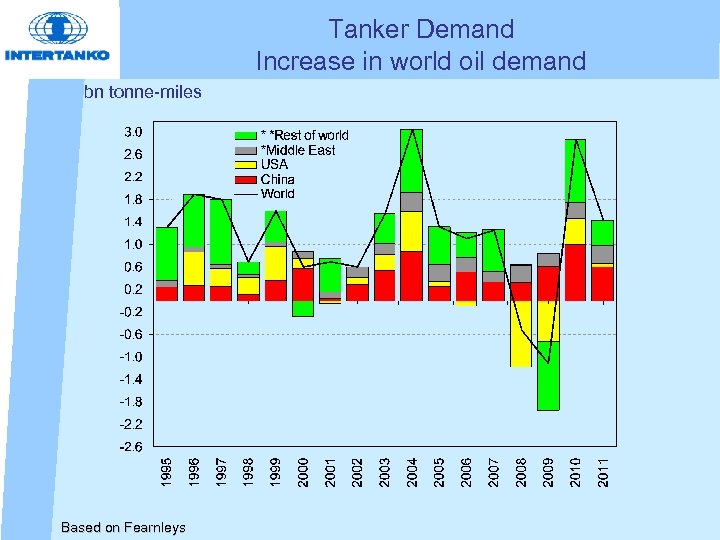 Tanker Demand Increase in world oil demand bn tonne-miles Based on Fearnleys
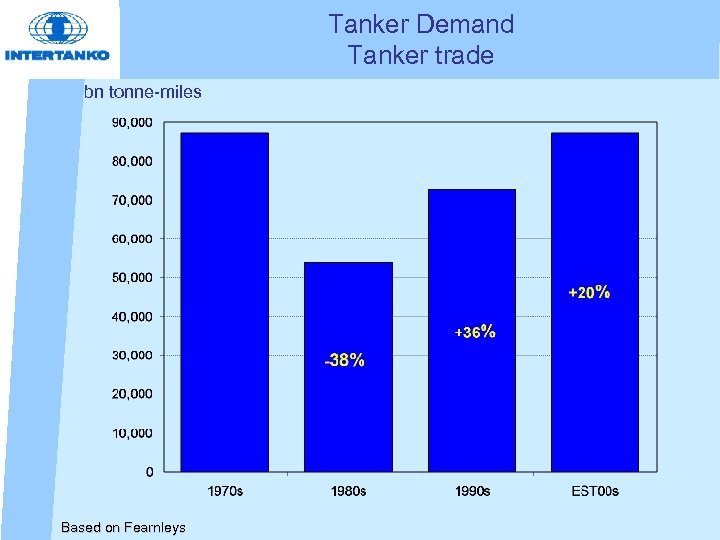 Tanker Demand Tanker trade bn tonne-miles Based on Fearnleys
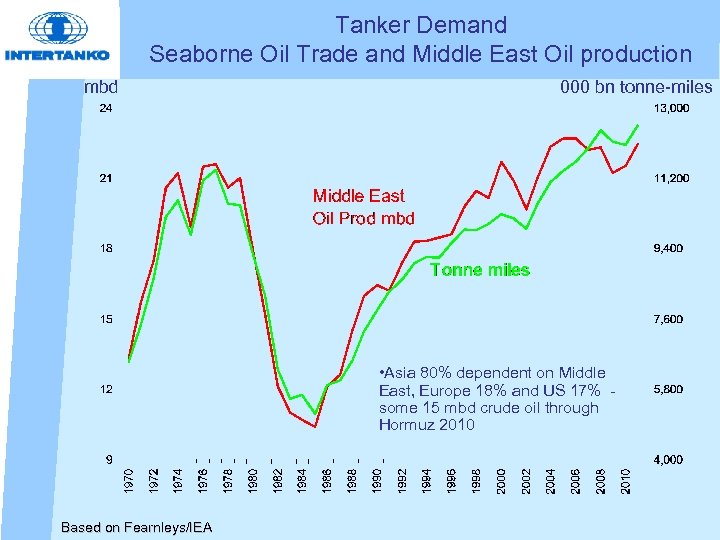 Tanker Demand Seaborne Oil Trade and Middle East Oil production mbd 000 bn tonne-miles • Asia 80% dependent on Middle East, Europe 18% and US 17% - some 15 mbd crude oil through Hormuz 2010 Based on Fearnleys/IEA
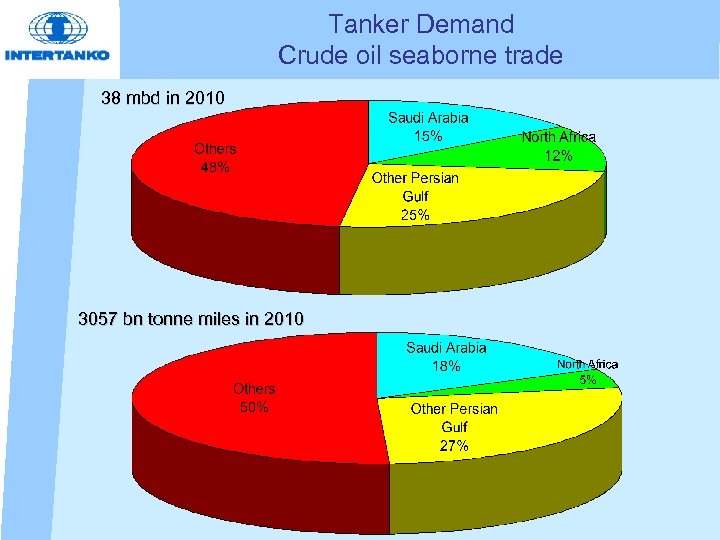 Tanker Demand Crude oil seaborne trade 38 mbd in 2010 3057 bn tonne miles in 2010
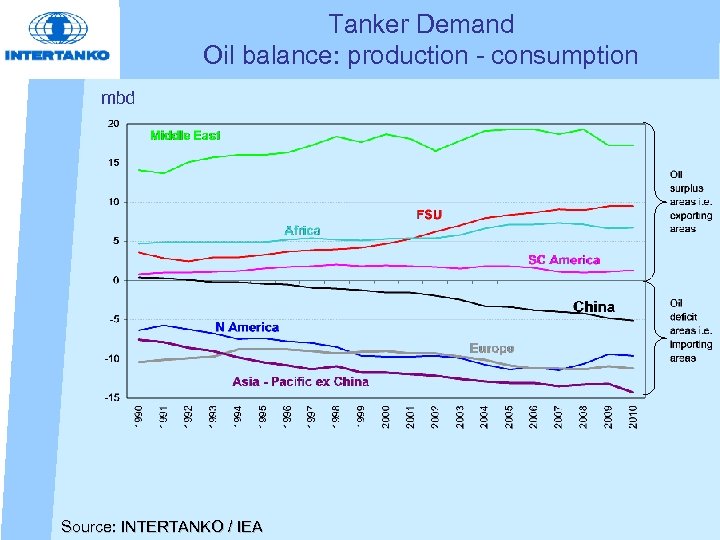 Tanker Demand Oil balance: production - consumption mbd Source: INTERTANKO / IEA
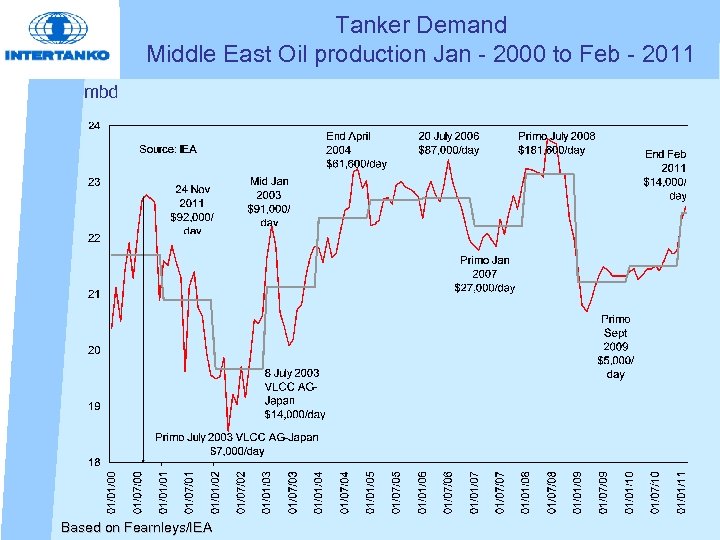 Tanker Demand Middle East Oil production Jan - 2000 to Feb - 2011 mbd Based on Fearnleys/IEA
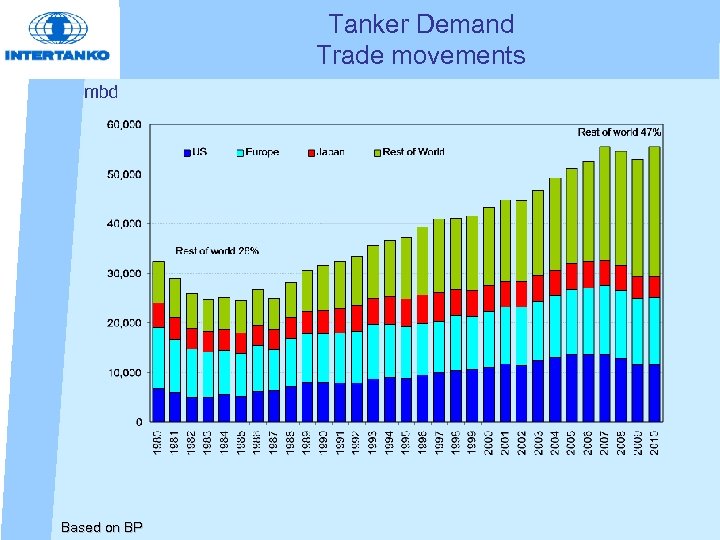 Tanker Demand Trade movements mbd Based on BP
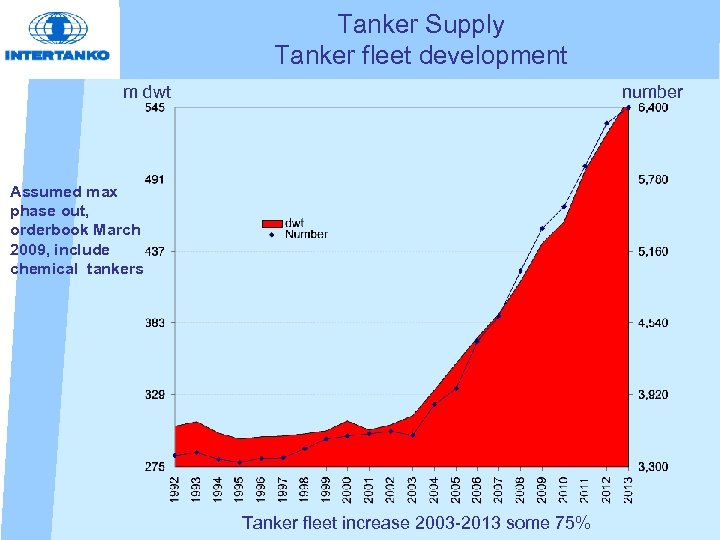 Tanker Supply Tanker fleet development m dwt number Assumed max phase out, orderbook March 2009, include chemical tankers Tanker fleet increase 2003 -2013 some 75%
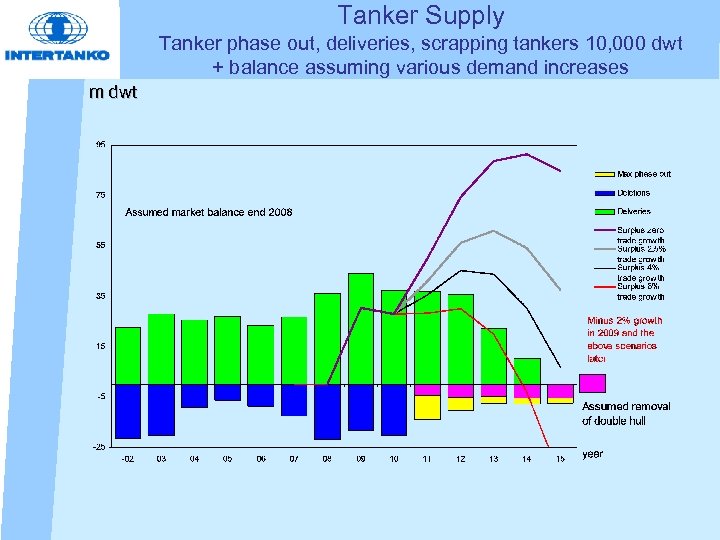 Tanker Supply Tanker phase out, deliveries, scrapping tankers 10, 000 dwt + balance assuming various demand increases m dwt
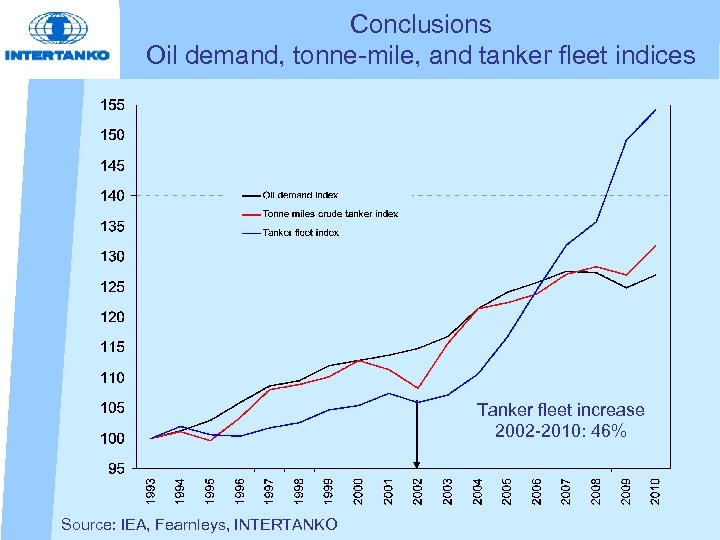 Conclusions Oil demand, tonne-mile, and tanker fleet indices Tanker fleet increase 2002 -2010: 46% Source: IEA, Fearnleys, INTERTANKO
 Conclusions • Despite disruptions, fundamentals still strong, but …. • The dust has not settled neither from the financial crises nor the Japanese earthquake/tsunami, and the Arab insurgency continuous • Tanker deliveries high next two years and the fleet is young
 Conclusions Strategic tanker consideration • China expected drive demand the Middle East has the reserves • Successful Green House Gas reduction will mean reduced oil consumption • Market balance set to weaken the next couple of years • Costs reduction needs carful risk management
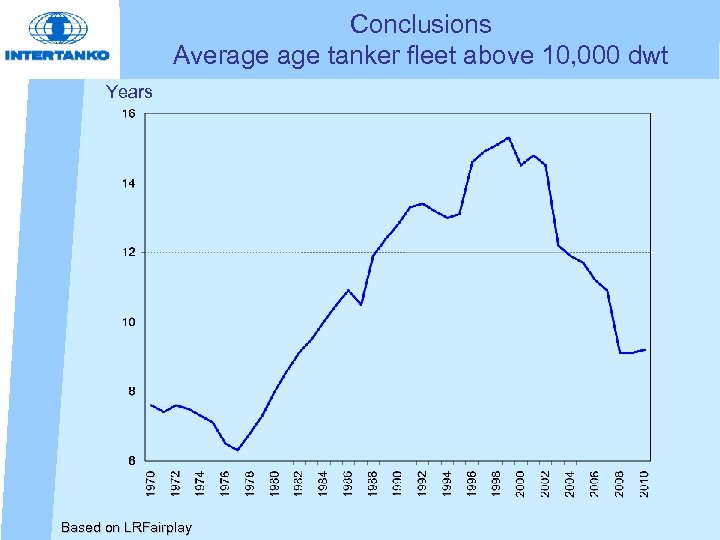 Conclusions Average tanker fleet above 10, 000 dwt Years Based on LRFairplay
 Vetting Issues Update
 Smart Vetting 1 • Vetting Committee objectives & updates: – The One Stop Shop Concept / Terminal Acceptance: We have raised the concept of formation of a common marine assurance “system” (not methodology), which would be accessible and useable by each party concerned in the screening process. – Advising of Non Acceptance: We have raised the issue regarding provision of information to owners to enable them to address what may be identified as outstanding in a prompt manner. – Conditions of Class: - Transparency to report or not to report? Major survey of members 53% response validating concerns (submitted to OCIMF GPC discussions)
 Smart Vetting 2 • Vetting Committee objectives & updates: – Reward Systems to Reduce Inspections: Exploration of establishing further reward systems to benefit good owners. – Linking TMSA and the VIQ: Gap analysis undertaken by the vetting committee: Potential benefits from linking TMSA with the VIQ could result in a further shift to more self assessment. – SIRE/CDI HVIQ: We have requested SIRE to re-assess the possibilities of harmonising the SIRE & CDI VIQ into a harmonised VIQ.
 Smart Vetting 3 • Vetting Committee objectives & updates: – Officer Matrix Requirements: SIRE and CDI have advised that they are planning to seek information from owners regarding officer training systems in their respective forthcoming revised VIQ’s – Port State Use of SIRE & CDI reports: We are reviewing the development of systems to increase the current low usage of SIRE and CDI reports by the Port State Control Authorities (Reduce the number of inspections and better target substandard ship)
 Smart Vetting 4 • Vetting Committee objectives & updates: – INTERTANKO Guide for Engaging Independent Ship Inspectors: Raised with SIRE: Potential for greater usage of standard set of guidelines when engaging independent ship inspectors – Reporting to Oil/Chemical Companies: We have investigated and provided information to members regarding advice pertaining to “discoverability” in association with reporting incidents to oil and chemical companies and we are in discussion with OCIMF on this subject
 INTERTANKO Benchmarking and Databases
 Terminal Vetting Database (TVD) Quick recap. . . What • Terminal Vetting – Tankers are vetted but are sometimes asked to make fast to poor quality berths – The vetting process works for ships, so why not for terminals? Why • enhance safety at the terminals • improve member efficiency by influencing terminals to ‘fix’ problems • maintain industry safety record Who • Access to the system is controlled by INTERTANKO and was strictly limited to INTERTANKO Members and Associate Members • As of 2010, access granted to all interested parties • The Terminal Vetting Database is hosted by www. Q 88. com in partnership with INTERTANKO • Access is usually set up within one business day
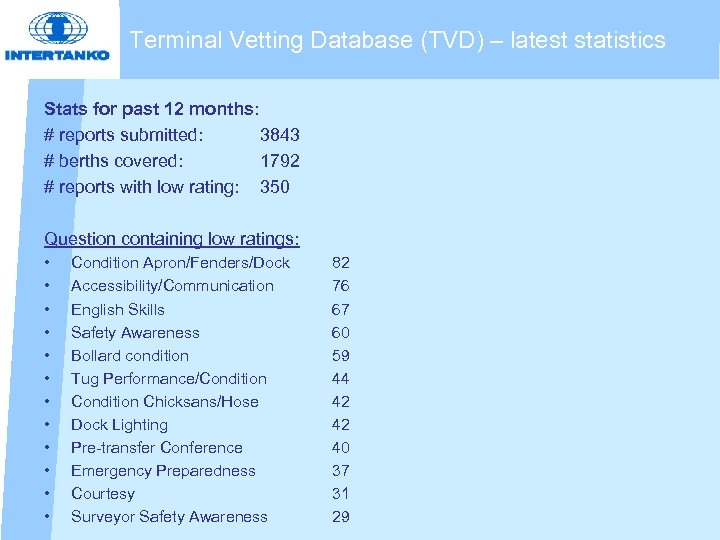 Terminal Vetting Database (TVD) – latest statistics Stats for past 12 months: # reports submitted: 3843 # berths covered: 1792 # reports with low rating: 350 Question containing low ratings: • • • Condition Apron/Fenders/Dock Accessibility/Communication English Skills Safety Awareness Bollard condition Tug Performance/Condition Chicksans/Hose Dock Lighting Pre-transfer Conference Emergency Preparedness Courtesy Surveyor Safety Awareness 82 76 67 60 59 44 42 42 40 37 31 29
 TMSA related • TMSA 2 Gap Analysis Document http: //www. intertanko. com/templates/intertanko/issue. aspx? id=44647 • TMSA 2 Benchmarking database http: //www. intertanko. com/templates/Page. aspx? id=46718 • Guidance on Change management http: //www. intertanko. com/templates/intertanko/issue. aspx? id=41452
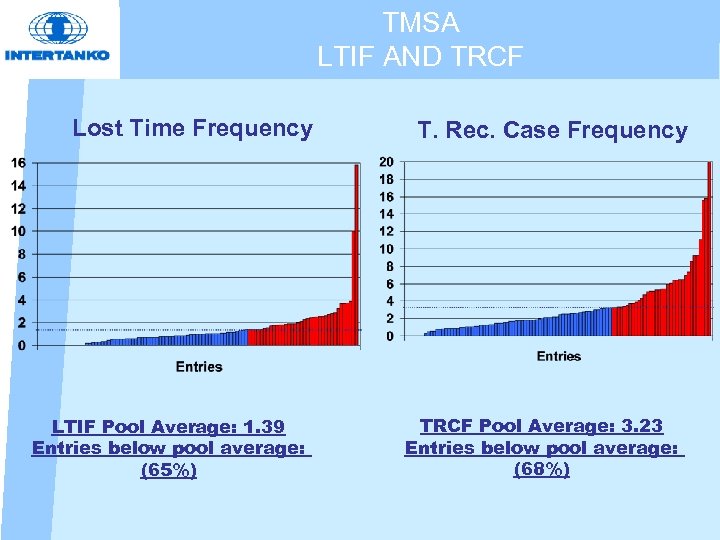 TMSA LTIF AND TRCF Lost Time Frequency LTIF Pool Average: 1. 39 Entries below pool average: (65%) T. Rec. Case Frequency TRCF Pool Average: 3. 23 Entries below pool average: (68%)
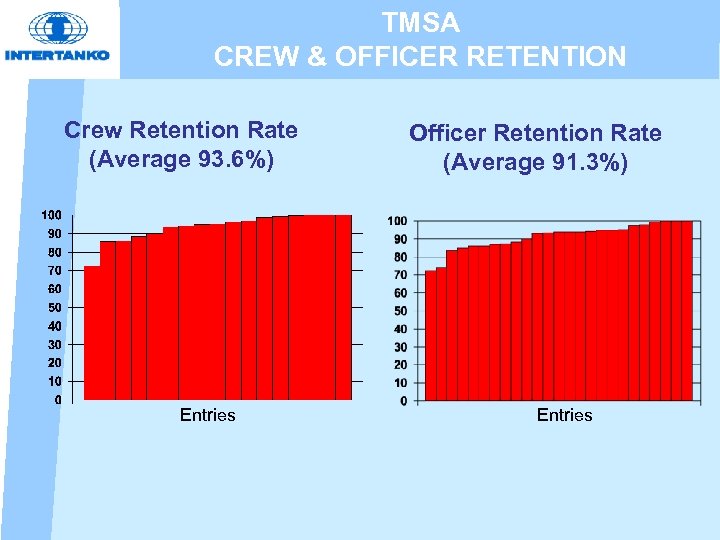 TMSA CREW & OFFICER RETENTION Crew Retention Rate (Average 93. 6%) Entries Officer Retention Rate (Average 91. 3%) Entries
 VIQ Benchmarking • Traffic Light System, incorporating either Red or Green, to indicate if the number of SIRE VIQ observations for your fleet are either above or below the number of SIRE VIQ observations for the collective of the INTERTANKO fleet. Red = above INTERTANKO fleet average Green = below INTERTANKO fleet average • Fleet Average Deficiency: "Total number of deficiencies per SIRE VIQ chapter, divided by Total number of inspections“ • 12 month rolling period • Confidential http: //www. intertanko. com/templates/intertanko/issue. aspx? id=4 7207
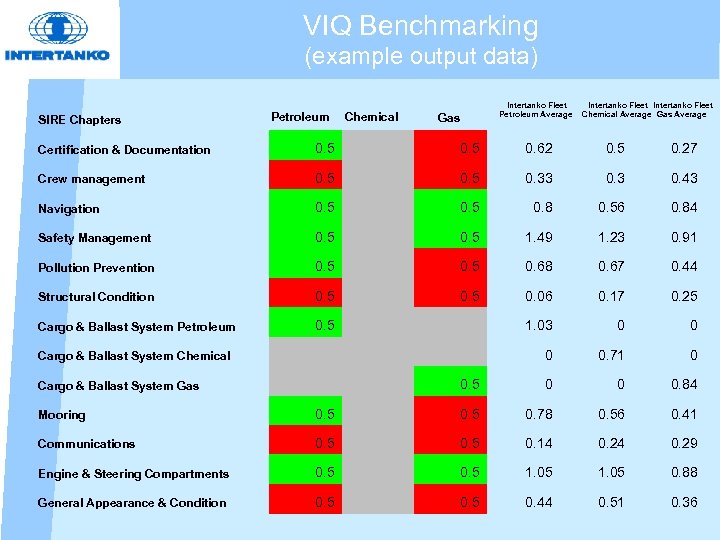 VIQ Benchmarking (example output data) SIRE Chapters Petroleum Chemical Gas Intertanko Fleet Petroleum Average Intertanko Fleet Chemical Average Gas Average Certification & Documentation 0. 5 0. 62 0. 5 0. 27 Crew management 0. 5 0. 33 0. 43 Navigation 0. 5 0. 8 0. 56 0. 84 Safety Management 0. 5 1. 49 1. 23 0. 91 Pollution Prevention 0. 5 0. 68 0. 67 0. 44 Structural Condition 0. 5 0. 06 0. 17 0. 25 Cargo & Ballast System Petroleum 0. 5 1. 03 0 0. 71 0 Cargo & Ballast System Chemical Cargo & Ballast System Gas 0. 5 0 0 0. 84 Mooring 0. 5 0. 78 0. 56 0. 41 Communications 0. 5 0. 14 0. 29 Engine & Steering Compartments 0. 5 1. 05 0. 88 General Appearance & Condition 0. 5 0. 44 0. 51 0. 36
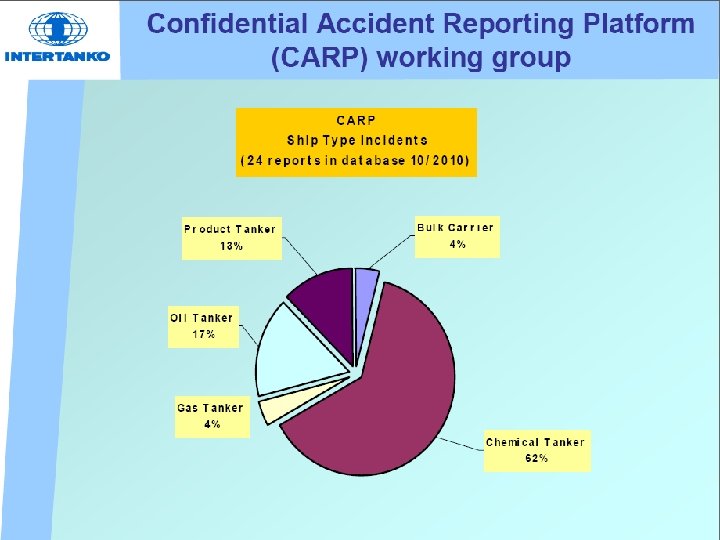
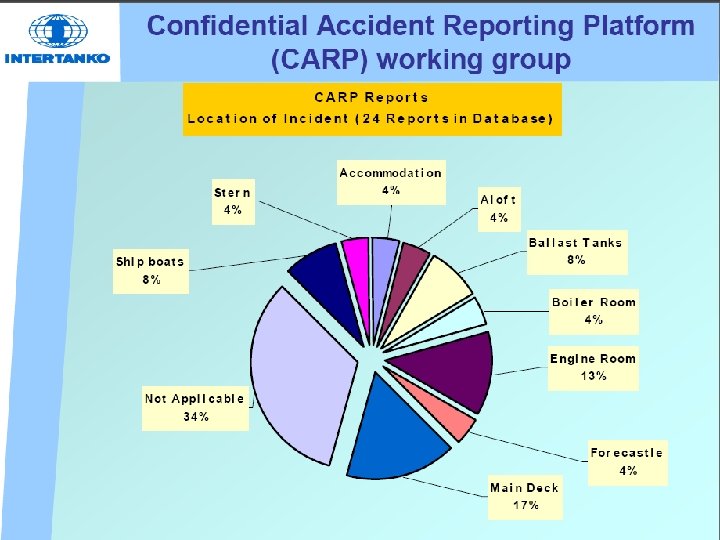
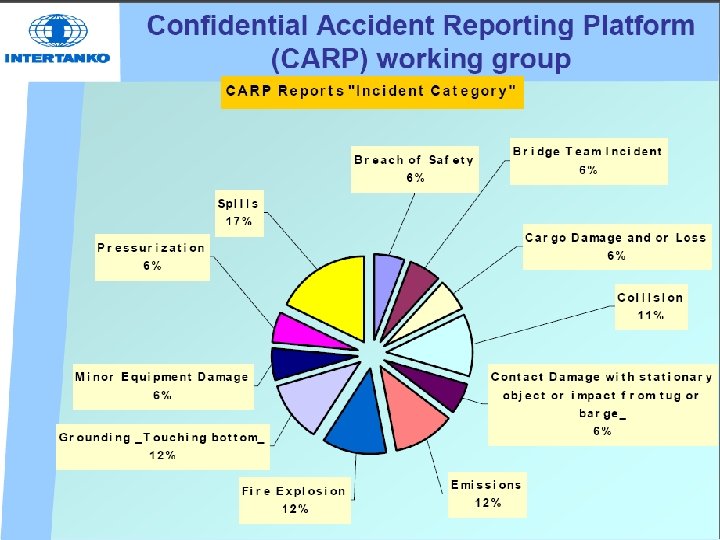
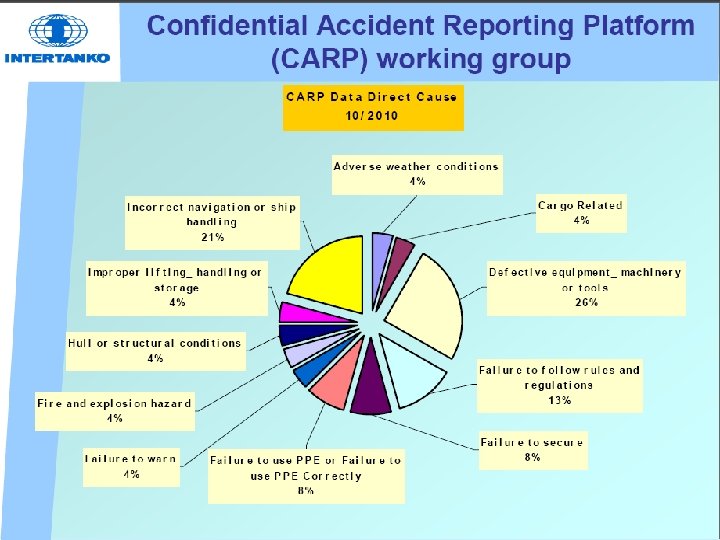
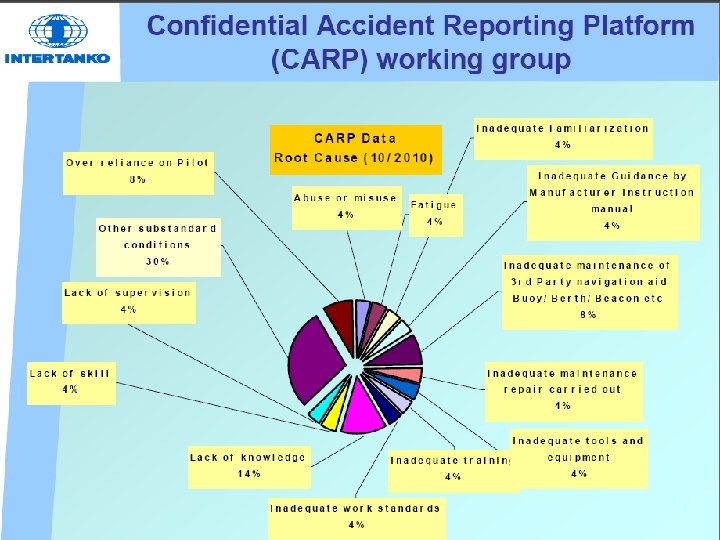
 Confidential Accident Reporting Platform CARP database provides a simple functionality allowing the quick & easy updating of accident data. Enable members to input their own incident data in a fully confidential basis whilst allowing INTERTANKO to use the information entered so that: • • Lessons can be learned and shared. Similar accidents prevented. Standardise accident data and categorisation. Standardise simple accident analysis, root cause, direct cause and corrective actions. Platform Now Available http: //www. intertanko. com/templates/Page. aspx? id=47899
 VIFF and PSCIFF • “Vetting Inspection Feedback Forms” (VIFF) – meets SIRE Inspector Compliance Requirements – Launched May 2010 • “PSC Inspection Feedback Form” (PSCIFF) – meets IMO PSCO code of conduct guidelines – Launched October 2010 Both provide a means of confidential feedback to INTERTANKO which can then be shared, confidentially, with SIRE or relevant Port State Mo. U
 Environmental Issues
 Environmental Issues 1. GHGs - Ship Energy Efficiency Management Plan • • Mandatory application after MEPC 62 (July 2011) Charterers already referencing SEEMP (IMT MESQAC) 2. Biofouling • Voluntary Guidelines to be adopted MEPC 62 3. Ballast Water Management • . . . !!
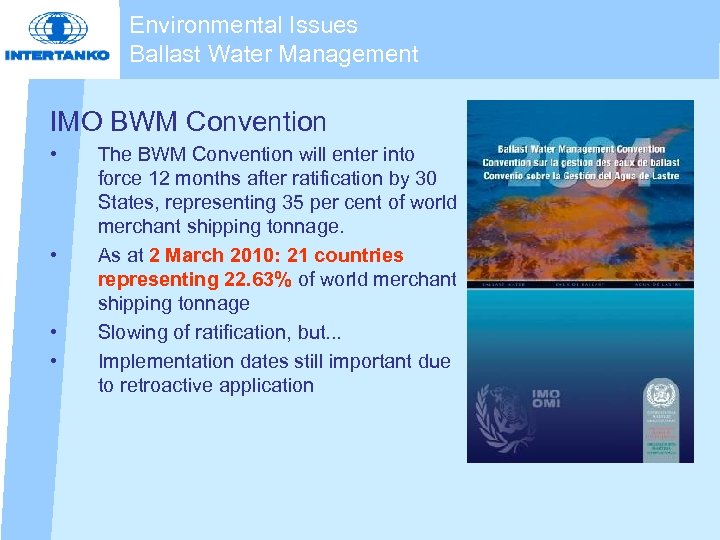 Environmental Issues Ballast Water Management IMO BWM Convention • • The BWM Convention will enter into force 12 months after ratification by 30 States, representing 35 per cent of world merchant shipping tonnage. As at 2 March 2010: 21 countries representing 22. 63% of world merchant shipping tonnage Slowing of ratification, but. . . Implementation dates still important due to retroactive application
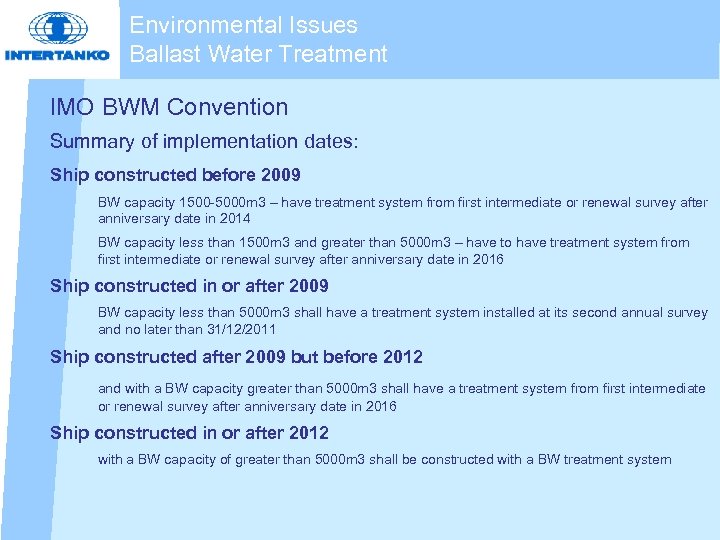 Environmental Issues Ballast Water Treatment IMO BWM Convention Summary of implementation dates: Ship constructed before 2009 BW capacity 1500 -5000 m 3 – have treatment system from first intermediate or renewal survey after anniversary date in 2014 BW capacity less than 1500 m 3 and greater than 5000 m 3 – have to have treatment system from first intermediate or renewal survey after anniversary date in 2016 Ship constructed in or after 2009 BW capacity less than 5000 m 3 shall have a treatment system installed at its second annual survey and no later than 31/12/2011 Ship constructed after 2009 but before 2012 and with a BW capacity greater than 5000 m 3 shall have a treatment system from first intermediate or renewal survey after anniversary date in 2016 Ship constructed in or after 2012 with a BW capacity of greater than 5000 m 3 shall be constructed with a BW treatment system
 Environmental Issues Ballast Water Treatment Concern expressed over treatment systems to meet 2012 deadline INTERTANKO Environmental Committee & ISTEC need to find solutions to assist members and seek evidence that systems will work in practice
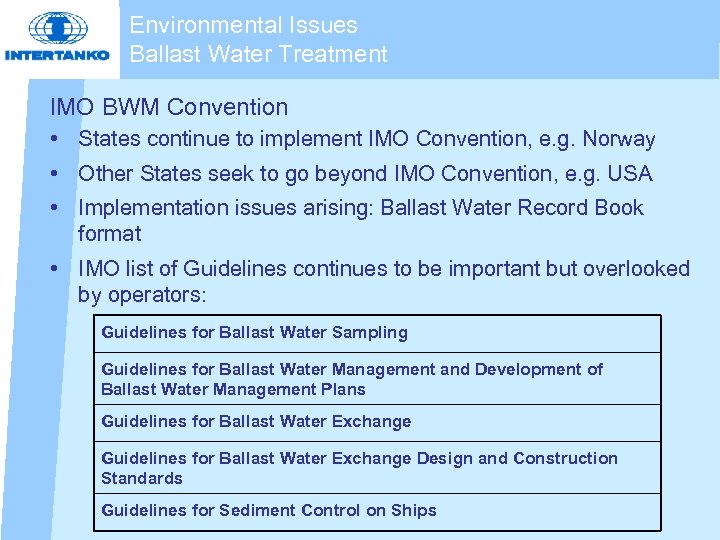 Environmental Issues Ballast Water Treatment IMO BWM Convention • States continue to implement IMO Convention, e. g. Norway • Other States seek to go beyond IMO Convention, e. g. USA • Implementation issues arising: Ballast Water Record Book format • IMO list of Guidelines continues to be important but overlooked by operators: Guidelines for Ballast Water Sampling Guidelines for Ballast Water Management and Development of Ballast Water Management Plans Guidelines for Ballast Water Exchange Design and Construction Standards Guidelines for Sediment Control on Ships
 Regional Issues
 Regional Issues China Oil Pollution Regulations on the Prevention and Control of Ship-Induced Pollution of the Marine Environment • Latest requirements effective 1 st February 2011 • Relating to discharge of ship and cargo generated wastes as well as the use of port reception facilities – Compulsory Discharge (as per European Directive – no exemption? ) – Pollutant receiving certificate required before ship is allowed to clear port – Administration:
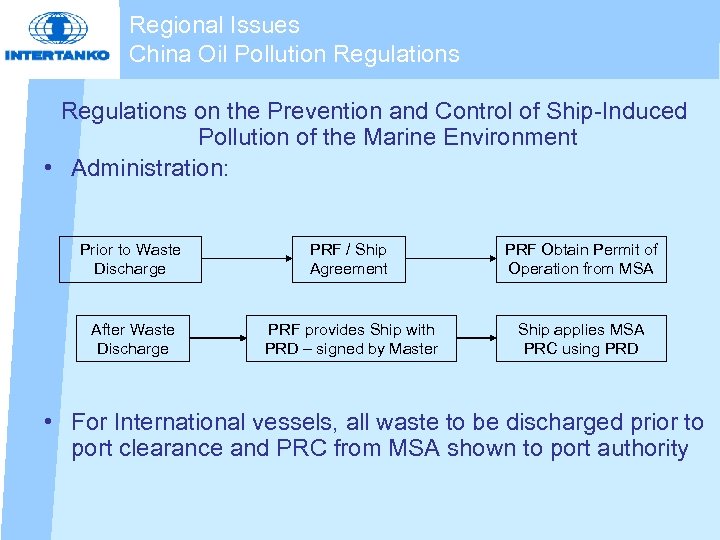 Regional Issues China Oil Pollution Regulations on the Prevention and Control of Ship-Induced Pollution of the Marine Environment • Administration: Prior to Waste Discharge PRF / Ship Agreement PRF Obtain Permit of Operation from MSA After Waste Discharge PRF provides Ship with PRD – signed by Master Ship applies MSA PRC using PRD • For International vessels, all waste to be discharged prior to port clearance and PRC from MSA shown to port authority
 Regional Issues China Oil Pollution Regulations on the Prevention and Control of Ship-Induced Pollution of the Marine Environment INTERTANKO Observations and Queries • Does the ship operator have to gain a Pollution Receiving Certificate each time the ship leaves port or on a periodic basis (annually)? • Does the contract have to be with one reception facility (contractor) or can it be more than one? • What are the limits of fees? • Is there a threshold at which compulsory discharge does not apply? e. g. if waste quantities minimal as per EU Directive?
 Regional Issues Japan Earthquake and Tsunami • Precautions for vessels trading into Japan ports? – Information gathering on radiation levels – Crew protection and precautions? – Equipment required? – Ship/port interface? • Inspections and analysis by ports after vessel has traded to a Japanese port? – Which ports? – What level of radiation is being deemed abnormal?
 thank you For more information please visit www. intertanko. com tim. wilkins@intertanko. com