 Скачать презентацию INTERTANKO Asian Member s Seminar Singapore 23 rd April
035c727ca9115d694bddc3d319490f28.ppt
- Количество слайдов: 74



INTERTANKO Asian Member’s Seminar Singapore 23 rd April 2009
Anti-Trust/Competition Law Compliance Statement INTERTANKO’s policy is to be firmly committed to maintaining a fair and competitive environment in the world tanker trade, and to adhering to all applicable laws which regulate INTERTANKO’s and its members’ activities in these markets. These laws include the anti-trust/competition laws which the United States, the European Union and many nations of the world have adopted to preserve the free enterprise system, promote competition and protect the public from monopolistic and other restrictive trade practices. INTERTANKO’s activities will be conducted in compliance with its Antitrust/Competition Law Guidelines.
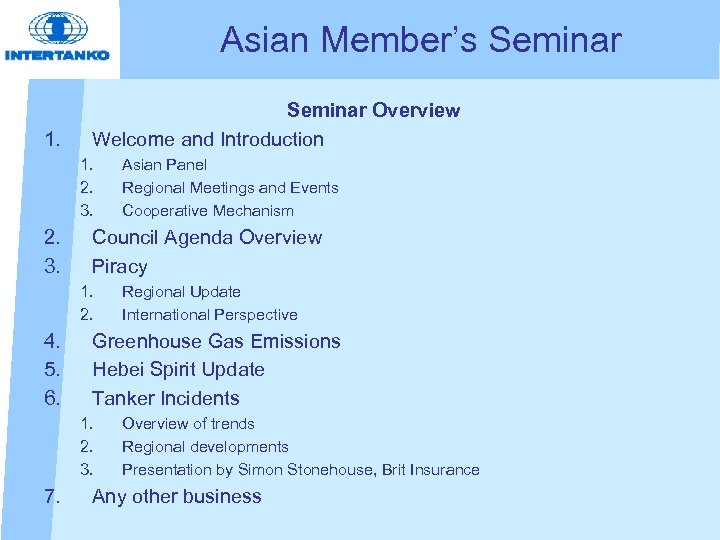
Asian Member’s Seminar 1. Seminar Overview Welcome and Introduction 1. 2. 3. Council Agenda Overview Piracy 1. 2. 4. 5. 6. Regional Update International Perspective Greenhouse Gas Emissions Hebei Spirit Update Tanker Incidents 1. 2. 3. 7. Asian Panel Regional Meetings and Events Cooperative Mechanism Overview of trends Regional developments Presentation by Simon Stonehouse, Brit Insurance Any other business
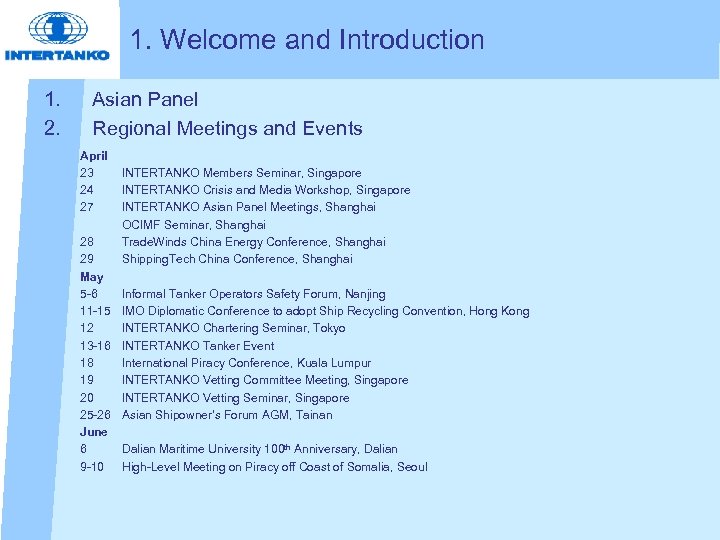
1. Welcome and Introduction 1. 2. Asian Panel Regional Meetings and Events April 23 24 27 28 29 May 5 -6 11 -15 12 13 -16 18 19 20 25 -26 June 6 9 -10 INTERTANKO Members Seminar, Singapore INTERTANKO Crisis and Media Workshop, Singapore INTERTANKO Asian Panel Meetings, Shanghai OCIMF Seminar, Shanghai Trade. Winds China Energy Conference, Shanghai Shipping. Tech China Conference, Shanghai Informal Tanker Operators Safety Forum, Nanjing IMO Diplomatic Conference to adopt Ship Recycling Convention, Hong Kong INTERTANKO Chartering Seminar, Tokyo INTERTANKO Tanker Event International Piracy Conference, Kuala Lumpur INTERTANKO Vetting Committee Meeting, Singapore INTERTANKO Vetting Seminar, Singapore Asian Shipowner’s Forum AGM, Tainan Dalian Maritime University 100 th Anniversary, Dalian High-Level Meeting on Piracy off Coast of Somalia, Seoul
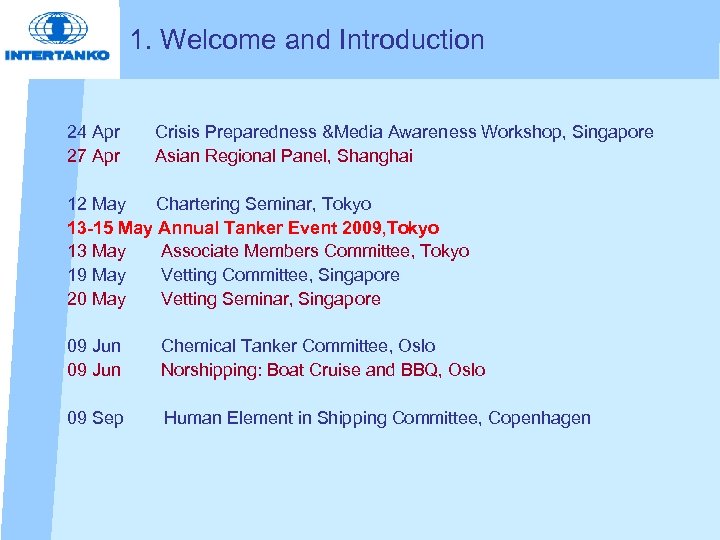
1. Welcome and Introduction 24 Apr Crisis Preparedness &Media Awareness Workshop, Singapore 27 Apr Asian Regional Panel, Shanghai 12 May Chartering Seminar, Tokyo 13 -15 May Annual Tanker Event 2009, Tokyo 13 May Associate Members Committee, Tokyo 19 May Vetting Committee, Singapore 20 May Vetting Seminar, Singapore 09 Jun Chemical Tanker Committee, Oslo 09 Jun Norshipping: Boat Cruise and BBQ, Oslo 09 Sep Human Element in Shipping Committee, Copenhagen
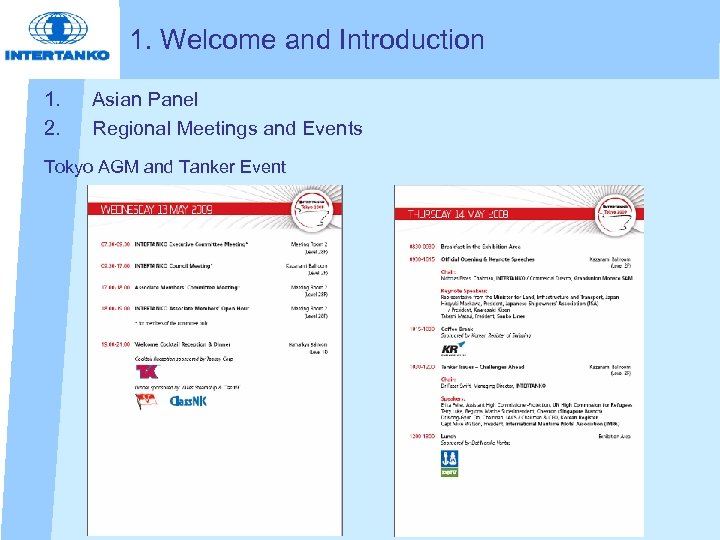
1. Welcome and Introduction 1. 2. Asian Panel Regional Meetings and Events Tokyo AGM and Tanker Event
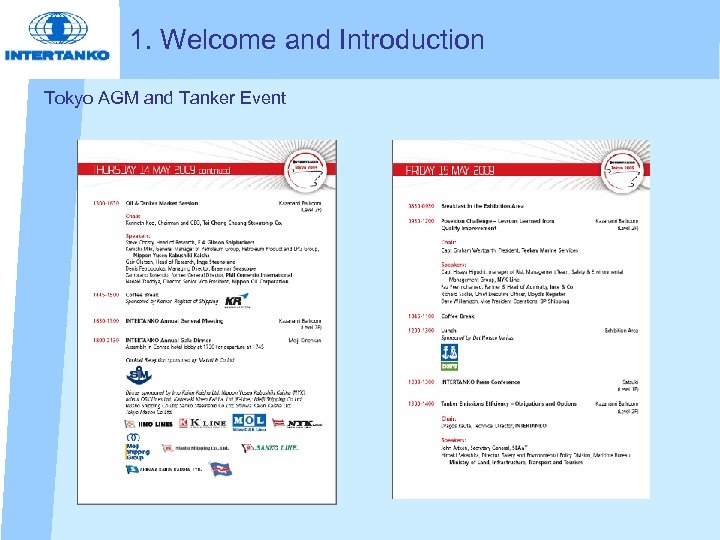
1. Welcome and Introduction Tokyo AGM and Tanker Event
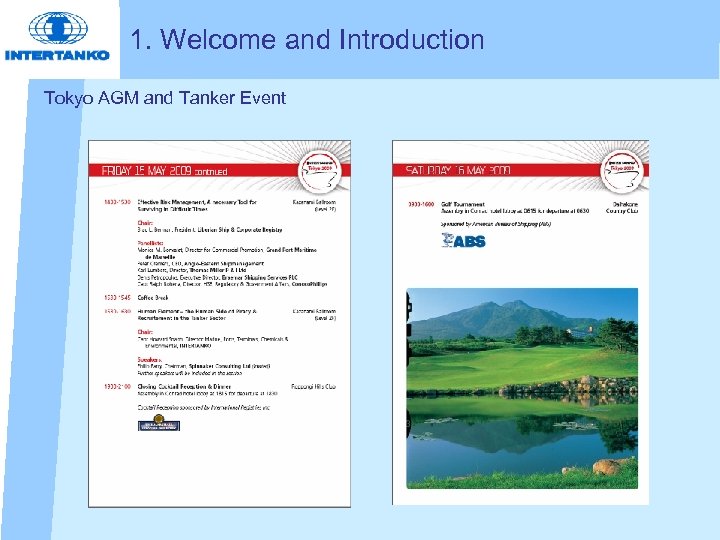
1. Welcome and Introduction Tokyo AGM and Tanker Event
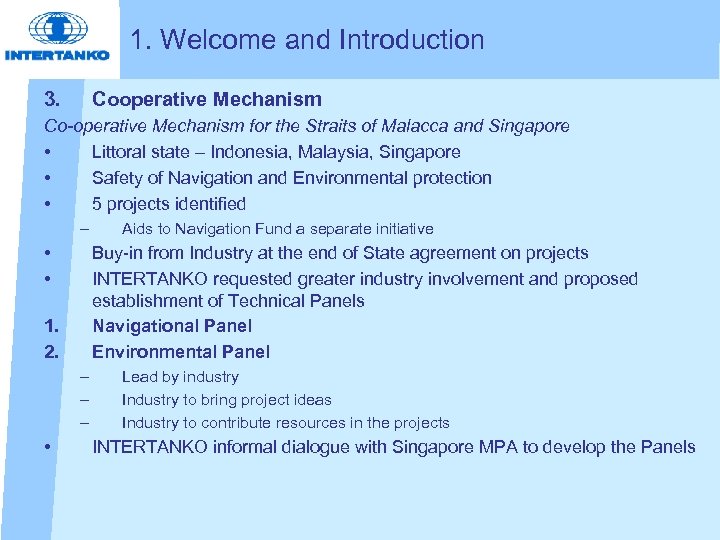
1. Welcome and Introduction 3. Cooperative Mechanism Co-operative Mechanism for the Straits of Malacca and Singapore • Littoral state – Indonesia, Malaysia, Singapore • Safety of Navigation and Environmental protection • 5 projects identified – • • Buy-in from Industry at the end of State agreement on projects INTERTANKO requested greater industry involvement and proposed establishment of Technical Panels Navigational Panel Environmental Panel 1. 2. – – – • Aids to Navigation Fund a separate initiative Lead by industry Industry to bring project ideas Industry to contribute resources in the projects INTERTANKO informal dialogue with Singapore MPA to develop the Panels
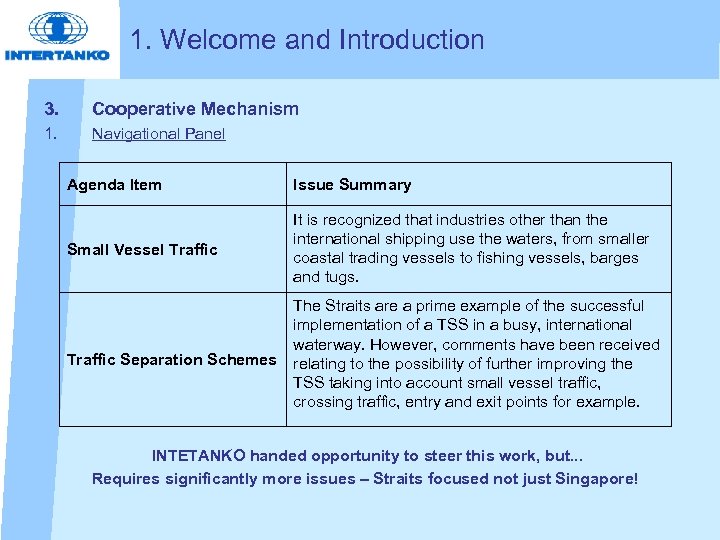
1. Welcome and Introduction 3. Cooperative Mechanism 1. Navigational Panel Agenda Item Issue Summary Small Vessel Traffic It is recognized that industries other than the international shipping use the waters, from smaller coastal trading vessels to fishing vessels, barges and tugs. Traffic Separation Schemes The Straits are a prime example of the successful implementation of a TSS in a busy, international waterway. However, comments have been received relating to the possibility of further improving the TSS taking into account small vessel traffic, crossing traffic, entry and exit points for example. INTETANKO handed opportunity to steer this work, but. . . Requires significantly more issues – Straits focused not just Singapore!
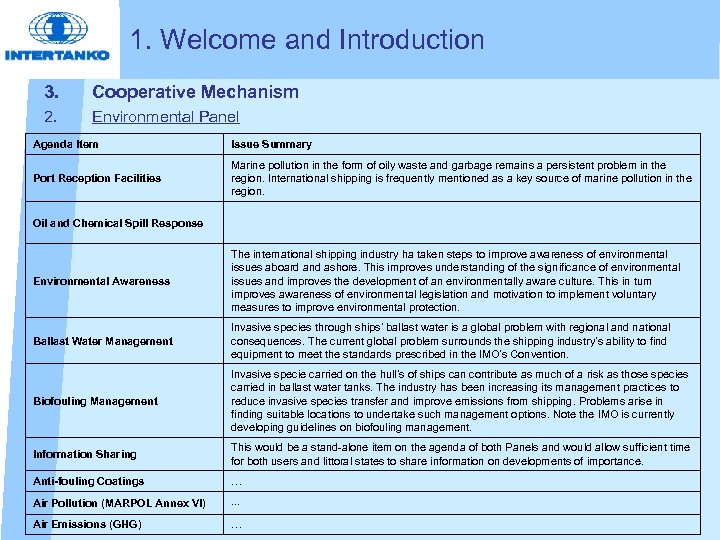
1. Welcome and Introduction 3. Cooperative Mechanism 2. Environmental Panel Agenda Item Issue Summary Port Reception Facilities Marine pollution in the form of oily waste and garbage remains a persistent problem in the region. International shipping is frequently mentioned as a key source of marine pollution in the region. Oil and Chemical Spill Response Environmental Awareness The international shipping industry ha taken steps to improve awareness of environmental issues aboard and ashore. This improves understanding of the significance of environmental issues and improves the development of an environmentally aware culture. This in turn improves awareness of environmental legislation and motivation to implement voluntary measures to improve environmental protection. Ballast Water Management Invasive species through ships’ ballast water is a global problem with regional and national consequences. The current global problem surrounds the shipping industry’s ability to find equipment to meet the standards prescribed in the IMO’s Convention. Biofouling Management Invasive specie carried on the hull’s of ships can contribute as much of a risk as those species carried in ballast water tanks. The industry has been increasing its management practices to reduce invasive species transfer and improve emissions from shipping. Problems arise in finding suitable locations to undertake such management options. Note the IMO is currently developing guidelines on biofouling management. Information Sharing This would be a stand-alone item on the agenda of both Panels and would allow sufficient time for both users and littoral states to share information on developments of importance. Anti-fouling Coatings … Air Pollution (MARPOL Annex VI) . . . Air Emissions (GHG) …
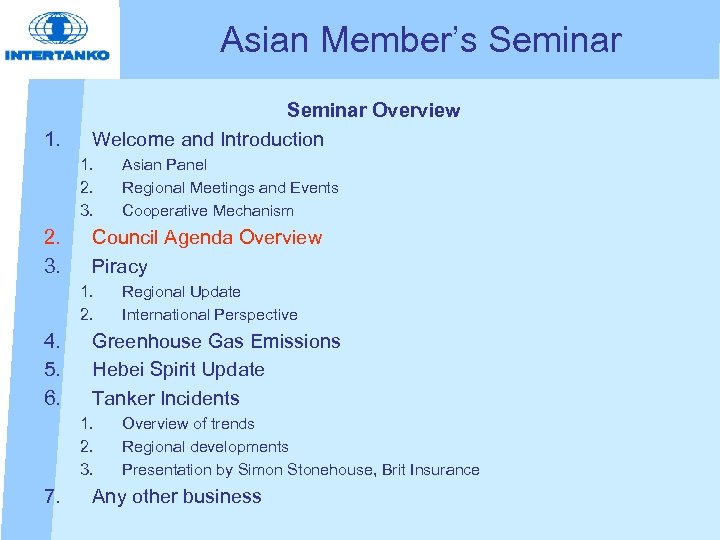
Asian Member’s Seminar 1. Seminar Overview Welcome and Introduction 1. 2. 3. Council Agenda Overview Piracy 1. 2. 4. 5. 6. Regional Update International Perspective Greenhouse Gas Emissions Hebei Spirit Update Tanker Incidents 1. 2. 3. 7. Asian Panel Regional Meetings and Events Cooperative Mechanism Overview of trends Regional developments Presentation by Simon Stonehouse, Brit Insurance Any other business
2. Council Agenda Overview Council Agenda – 13 May 2009, Tokyo • Corporate Affairs • Piracy status report * • Greenhouse Gas Emissions * • Report items - Chemical items - Load Line Zones – Off South Africa - Criminalisation of Seafarers – update * - Paris Mo. U – New Inspection Regime * - Human Element – Roll out of TOTS - EU and US Issues – EU Sulphur Directive, EU Mutual Recognition of Certificates by ROs
2. Council Agenda Overview New Inspection Regime – Paris Mo. U Better targeting !!! “ Every ship eligible for a periodic inspection as follows: • High Risk Ship (HRS) every 5 -6 months • Standard Risk Ship (SRS) every 10 -12 months • Low Risk Ship (LRS) every 24 -36 months ”
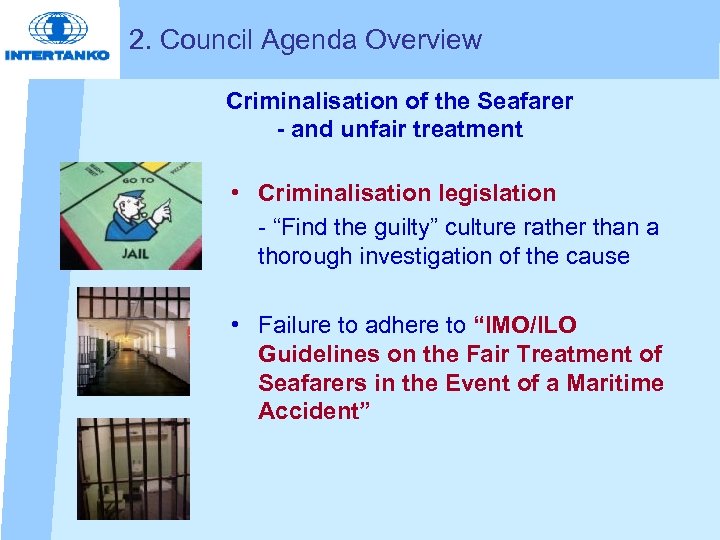
2. Council Agenda Overview Criminalisation of the Seafarer - and unfair treatment • Criminalisation legislation - “Find the guilty” culture rather than a thorough investigation of the cause • Failure to adhere to “IMO/ILO Guidelines on the Fair Treatment of Seafarers in the Event of a Maritime Accident”
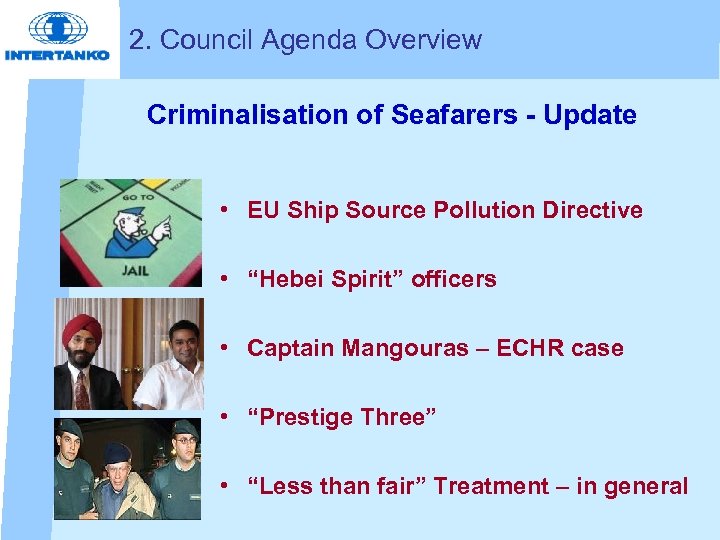
2. Council Agenda Overview Criminalisation of Seafarers - Update • EU Ship Source Pollution Directive • “Hebei Spirit” officers • Captain Mangouras – ECHR case • “Prestige Three” • “Less than fair” Treatment – in general
2. Council Agenda Overview EU Ship Source Pollution Directive “Criminalises accidental pollution” • • Review of the legality of the EU Ship Source Pollution Directive was brought in December 2005 by an industry coalition led by INTERTANKO. June 2006, the English High Court remitted the case to Luxembourg. Case heard before the Grand Chamber of the European Court of Justice (ECJ) September 2007. Opinion of Advocate General Kokott published November 2007. ECJ delivered judgment June 2008. In brief, the ECJ ruled that the Directive: - cannot be assessed by reference to MARPOL as the Community itself (unlike its Member States) is not a party to MARPOL. - cannot be assessed by reference to UNCLOS as, although the Community is a party to UNCLOS, that Convention does not give individuals rights or freedoms on which they can rely against States. The Court has held that the use of the term ‘serious negligence’ does not infringe the requirement of certainty in Community legislation. This departs from the opinion of Advocat General Kokott, who concluded that the validity of the Directive should be tested by reference to MARPOL and UNCLOS, and that it exceeds Community powers unless ‘serious negligence’ is construed to have different meanings inside and outside territorial waters. [This leaves the Member State legislators in some difficulty, having to use the same terminology whilst interpreting it differently depending on where the incident takes place. ]
2. Council Agenda Overview Piracy • Malacca Straits • Nigeria / Gulf of Guinea • Somalia – Gulf of Aden / W Indian Ocean
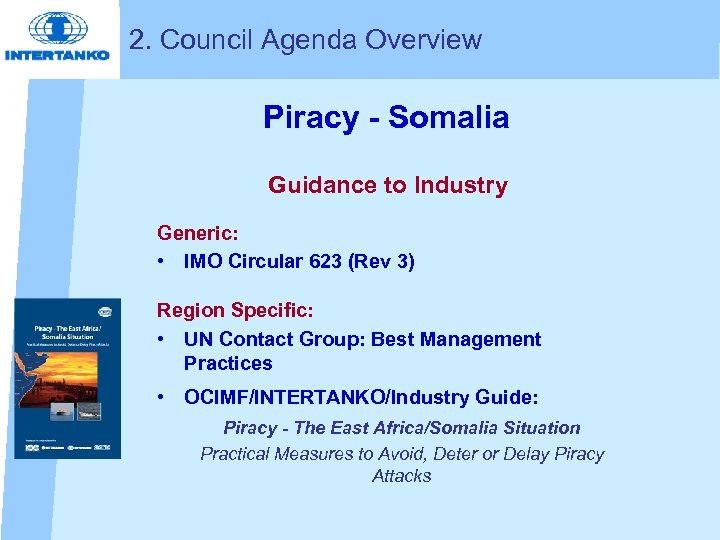
2. Council Agenda Overview Piracy - Somalia Guidance to Industry Generic: • IMO Circular 623 (Rev 3) Region Specific: • UN Contact Group: Best Management Practices • OCIMF/INTERTANKO/Industry Guide: Piracy - The East Africa/Somalia Situation Practical Measures to Avoid, Deter or Delay Piracy Attacks
2. Council Agenda Overview Piracy Guidance for Gulf of Aden / Somalia • Pre-transit: Assess Risk Plan self-defensive measures Register with MSCHOA IF appropriate, join Group Transit • During transit: Stay alert Report to UKMTO Follow “best practices”
2. Council Agenda Overview United Nations Contact Group • WG 1 : measures to improve the coordination of, and information sharing between, the various naval forces present in the region and their interfacing with civilian shipping • WG 2 : programmes to facilitate the prosecution of those caught and suspected of piracy • WG 3: facilitates development of industry “Best Management Practices” to counter piracy and their application within the international shipping community • • WG 4 : communications and outreach strategies for use within Somalia and to the wider international community as part of capacity building programmes - this latter to be in conjunction with other UN programmes already on the ground within the region
Asian Member’s Seminar 1. Seminar Overview Welcome and Introduction 1. 2. 3. Council Agenda Overview Piracy 1. 2. 4. 5. 6. Regional Update International Perspective Greenhouse Gas Emissions Hebei Spirit Update Tanker Incidents 1. 2. 3. 7. Asian Panel Regional Meetings and Events Cooperative Mechanism Overview of trends Regional developments Presentation by Simon Stonehouse, Brit Insurance Any other business
3. Piracy 1. Regional Update RECAAP Statistics • • Increase in successful incidents between 2007 and 2008 (77 to 83) Increase generally around Straits of Malacca and Singapore, South China Sea and off Malaysia Reductions seen at the anchorages of Indonesia and around the port of Chittagong, Bangladesh Tankers appeared to have been targeted on more occasions than other ship types Significant proportion of attacks continues to take place at anchor and in hours of darkness Use of guns reducing Possible escalations? – Market downturn – International coverage – new models developing
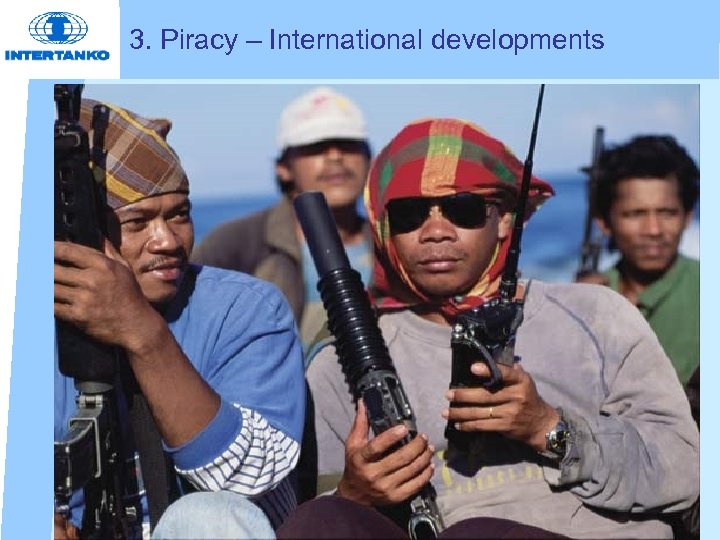
3. Piracy – International developments
3. Piracy – International developments Excellent work being done by EUNAVFOR (EU Naval Forces) MSCHOA (Maritime Security Centre (Horn of Africa) INTERTANKO providing Merchant Navy Liaison Officer (Howard Snaith)
3. Piracy The Group Transit system is working Vessels should Register Report The group transit is NOT a convoy Do not slow down, stop or wait
3. Piracy Group Transit system
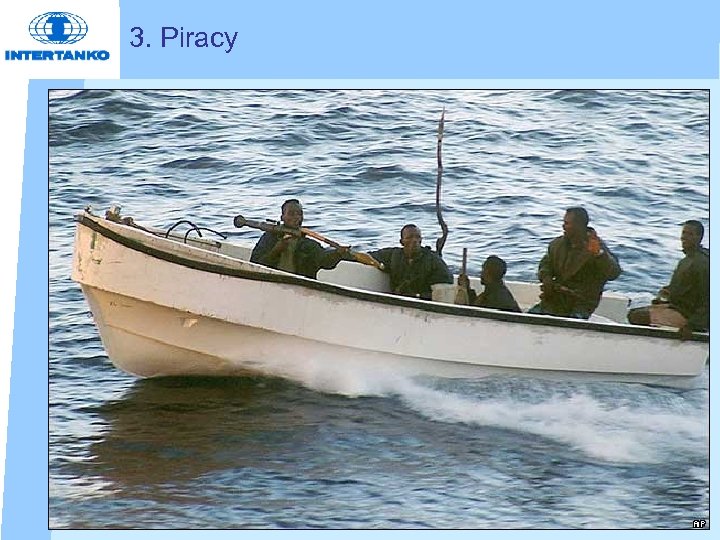
3. Piracy • 2009 Go. A + EC Somalia statistics (first quarter): • • 50 approaches/attacks (4 a week) 8 hijackings (0. 7 a week) (Feb/Mar down to 0. 5 a week) April hijackings up again (figures tbc) Confirmed attacks on vessels using GT: 2 Hijackings of vessels following GT: 1 8 captive vessels (as of 3. 09) 94 captive crew • 2008 Go. A + EC Somalia statistics (full year): • • 111 approaches/attacks (2 a week) 42 hijackings (0. 8 a week) 14 captive vessels (as of end Nov) 680+ taken hostage over the year.
3. Piracy Summary of 1 q 09 versus 2008 Approaches/attacks UP Hijackings DOWN BUT MOST IMPORTANTLY Only 2 attacks in 3 months on ships - Staying more than 600 miles from the coast - Making use of Group Transit - Following industry guidelines
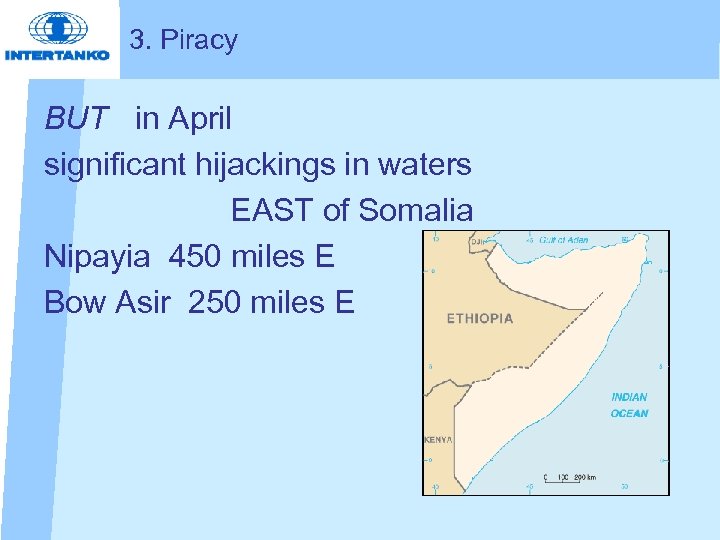
3. Piracy BUT in April significant hijackings in waters EAST of Somalia Nipayia 450 miles E Bow Asir 250 miles E
3. Piracy
3. Piracy Somali pirate faces trial in U. S. FBI says Abduwali Abdukhadir Muse is in New York on charges related to April 8 hijacking of the container ship Maersk Alabama in the Indian Ocean (master taken hostage and then rescued). The charge? • piracy under the law of nations • conspiracy to seize a ship by force • discharging a firearm during the seizure • conspiracy to commit hostage taking • brandishing a firearm during the hostage-taking
3. Piracy INTERTANKO activities Documentary Committee: Developed Piracy Model Clauses (VC, TC) Information: Piracy information alerts and security bulletins Joint industry booklet "Practical Measures to Avoid, Deter, and Delay Piracy Attacks” IMO: Member of Correspondence Group revising MSC Guidance Circular Industry spokesperson at Djibouti meeting finalising regional code UN: Member of Best Practices Working Group; observer at UN Contact Group EU Naval Coordination: Part-time secondee as Merchant Navy Liaison Officer US Congress: Testimony on International Piracy
3. Piracy U. S. Congress hearing on international piracy INTERTANKO emphasised that governments must take appropriate action to - • provide/maintain sufficient military assets • ensure coordinated approach among military assets for effective protection and response • ensure single/compatible rules of engagement • develop legal authority to prosecute captive pirates • develop long-term solution on land - solve problem at root not just fight symptoms
3. Piracy • Follow official advice and guidance • Keep authorities and naval forces advised • Distribute and follow best practices "Practical Measures to Avoid, Deter, and Delay Piracy Attacks” (OCIMF+INTERTANKO+SIGTTO)
3. Piracy Don’t forget other piracy areas SE Asia, Nigeria … Aramis off Brass River Vicious, sustained, repeated attacks
Asian Member’s Seminar 1. Seminar Overview Welcome and Introduction 1. 2. 3. Council Agenda Overview Piracy 1. 2. 4. 5. 6. Regional Update International Perspective Greenhouse Gas Emissions Hebei Spirit Update Tanker Incidents 1. 2. 3. 7. Asian Panel Regional Meetings and Events Cooperative Mechanism Overview of trends Regional developments Presentation by Simon Stonehouse, Brit Insurance Any other business
![4. Greenhouse Gas Emissions [ Initiatives to Reduce ] Greenhouse Gas Emissions Shipping has](https://present5.com/presentation/035c727ca9115d694bddc3d319490f28/image-38.jpg "4. Greenhouse Gas Emissions [ Initiatives to Reduce ] Greenhouse Gas Emissions Shipping has")
4. Greenhouse Gas Emissions [ Initiatives to Reduce ] Greenhouse Gas Emissions Shipping has a head start as the most energy efficient means of transport
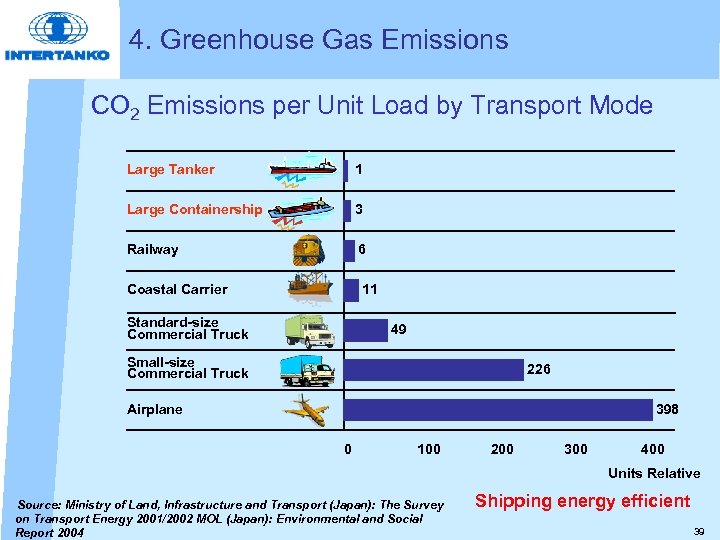
4. Greenhouse Gas Emissions CO 2 Emissions per Unit Load by Transport Mode Large Tanker 1 Large Containership 3 Railway 6 Coastal Carrier 11 Standard-size Commercial Truck 49 Small-size Commercial Truck 226 Airplane 398 0 100 200 300 400 Units Relative Source: Ministry of Land, Infrastructure and Transport (Japan): The Survey on Transport Energy 2001/2002 MOL (Japan): Environmental and Social Report 2004 Shipping energy efficient 39
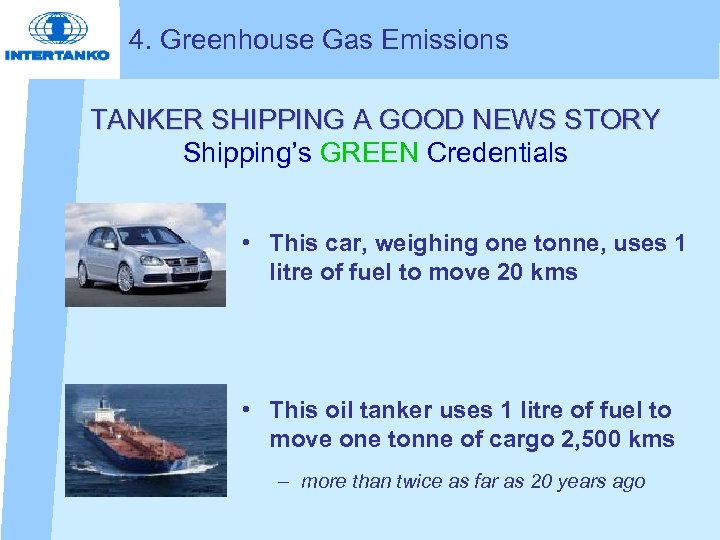
4. Greenhouse Gas Emissions TANKER SHIPPING A GOOD NEWS STORY Shipping’s GREEN Credentials • This car, weighing one tonne, uses 1 litre of fuel to move 20 kms • This oil tanker uses 1 litre of fuel to move one tonne of cargo 2, 500 kms – more than twice as far as 20 years ago
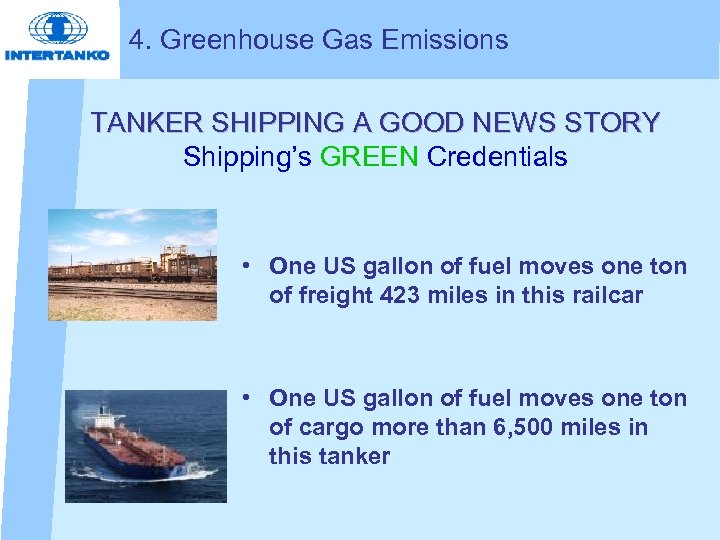
4. Greenhouse Gas Emissions TANKER SHIPPING A GOOD NEWS STORY Shipping’s GREEN Credentials • One US gallon of fuel moves one ton of freight 423 miles in this railcar • One US gallon of fuel moves one ton of cargo more than 6, 500 miles in this tanker
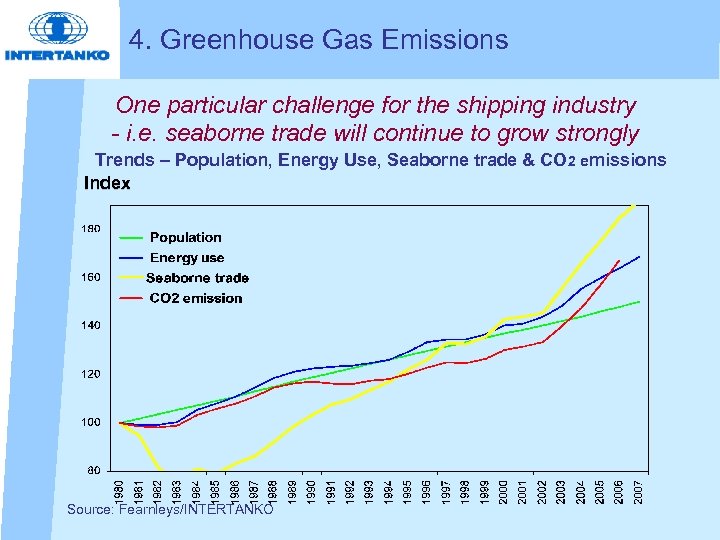
4. Greenhouse Gas Emissions One particular challenge for the shipping industry - i. e. seaborne trade will continue to grow strongly Trends – Population, Energy Use, Seaborne trade & CO 2 emissions Index Source: Fearnleys/INTERTANKO
4. Greenhouse Gas Emissions Drivers for Change • Driven hardest by a limited number of governments – Supported mostly by EU governments, plus Japan, Australia, Canada and a few others – Until recently only limited support in US (mostly environmental interests) – Relatively little enthusiasm in much of the developing world, but now changing ? • Environmental Lobby growing – And becoming more coordinated • Maritime industries showing considerable support – Proactive involvement – Although “hesitant” on market based instruments • Economic incentives strong – Fuel savings translate into potentially significant cost savings; plus incentives for innovation & new technologies
4. Greenhouse Gas Emissions Kyoto Protocol • Established under UN Framework Convention on Climate Change (UNFCCC) and adopted in 1997 • Ratified by 181 countries – not the USA • Categorises Annex 1 (Developed) Countries and Non. Annex 1 (Developing) Countries • Annex 1 are committed to make GHG reductions with set targets, but also flexible mechanisms • Runs through to 2012, with Conference of Parties (COP 15) to meet in Copenhagen in Dec 2009 to develop successor • Kyoto recognises “common but differentiated responsibilities”, i. e. developed countries produce more GHGs and should be “responsible” for reductions • Kyoto looks to IMO to address Shipping and ICAO to address Aviation, and as such these emissions are currently excluded from Kyoto targets
4. Greenhouse Gas Emissions Initiatives underway at the IMO 1998: IMO initiated work on Green House Gas emissions 2003: IMO Assembly adopted Resolution A. 963(23): Policies and Practices Related to the Reduction of GHG from Ships Today: Work continues through the MEPC This year: we can expect MEPC 59 to adopt Mandatory Energy Efficiency Design Index for new ships Ship Energy Management Plan – existing ships: - Best practices to save energy used by the ship - Use of voluntary Energy Efficiency Operational Indicator In December: the outcome(s) of MEPC 59 will be presented to UNFCCC COP 15 meeting in Copenhagen
4. Greenhouse Gas Emissions Initiatives underway at the IMO Ship Performance Index: CO 2 / work done e. g. tonnes of CO 2 produced per tonne mile of cargo • Energy efficiency design index mandatory for new ships incentivises designers and builders. At the next stage: The ship’s design index should be less than a maximum limit to be set by regulations. The maximum value will then be lowered over time. • Voluntary energy efficiency operational indicator measures efficiency of ship in service. A management tool for owners and charterers to measure energy efficiency on a voyage. Incentivises the owner to keep hull and machinery “clean” and charterer to use the ship efficiently – capacity, routing and speed.
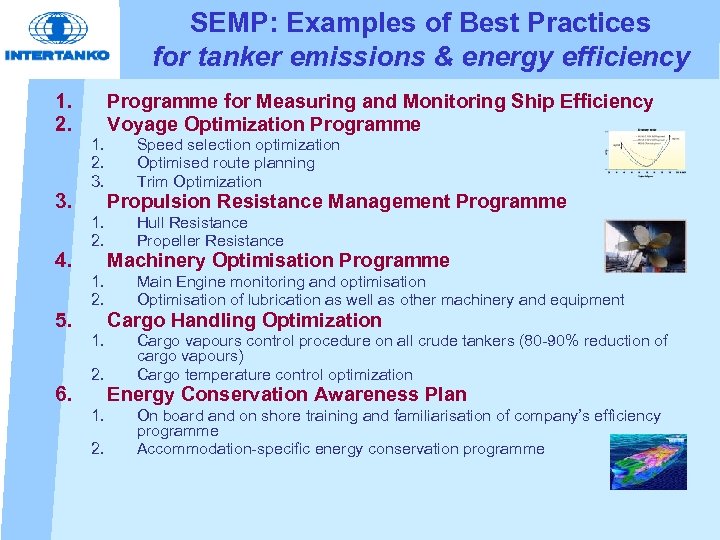
SEMP: Examples of Best Practices for tanker emissions & energy efficiency 1. 2. 3. 4. 5. Programme for Measuring and Monitoring Ship Efficiency Voyage Optimization Programme 1. 2. 3. Propulsion Resistance Management Programme 1. 2. Hull Resistance Propeller Resistance Machinery Optimisation Programme 1. 2. Main Engine monitoring and optimisation Optimisation of lubrication as well as other machinery and equipment Cargo Handling Optimization 1. 6. Speed selection optimization Optimised route planning Trim Optimization 2. Cargo vapours control procedure on all crude tankers (80 -90% reduction of cargo vapours) Cargo temperature control optimization Energy Conservation Awareness Plan 1. 2. On board and on shore training and familiarisation of company’s efficiency programme Accommodation-specific energy conservation programme
IMO is also reviewing possible economic measures (instruments) to reduce CO 2 emissions • • • Emissions Trading Scheme Bunker Levy GHG Compensation Scheme Hybrids of above Other, e. g. differentiated charges Industry has established Guiding principles and believe any measure should: • Be effective in reducing global GHG emissions • Be binding on and applicable to all ships • Be cost effective • Not distort competition • Support sustainable environmental development without penalising trade growth • Promote technical innovation and leading technologies • Be practical, transparent, fraud-free, easy to administer
4. Greenhouse Gas Emissions Market Based Instruments Key issues: • • • Global versus regional ? Who administers ? Still needed – if other industry initiatives in place ? ETS • Sets Cap – reduces over time • Open versus Closed system ? • Value of carbon – different schemes Levy • Does not set cap • A tax on fuel (used) GHG Compensation scheme • Does not set cap • A tax for a good cause – i. e. a charity !
Initiatives already under way - parallel voluntary measures For most ship types, some form of : • Speed optimisation • Voyage optimisation • Capacity optimisation is already in hand. For Tankers: • Liaison is encouraged between owners and charterers to optimise vessel speed and voyage schedules http: //www. ocimf. com/view_document. cfm? id=1147
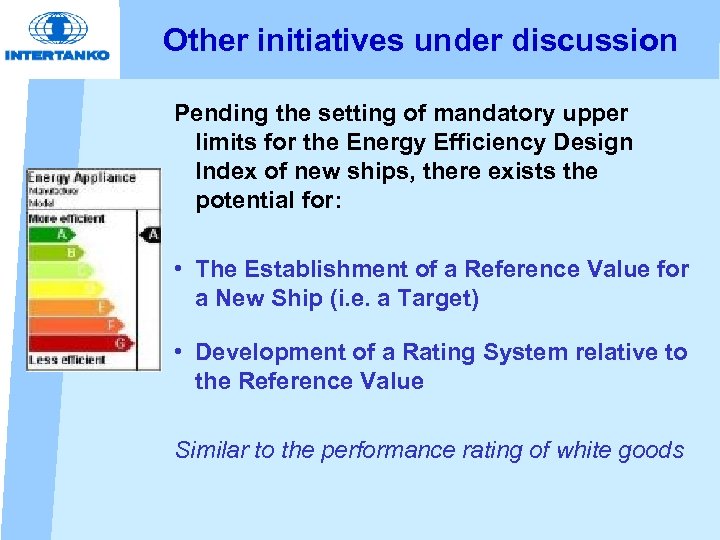
Other initiatives under discussion Pending the setting of mandatory upper limits for the Energy Efficiency Design Index of new ships, there exists the potential for: • The Establishment of a Reference Value for a New Ship (i. e. a Target) • Development of a Rating System relative to the Reference Value Similar to the performance rating of white goods
Other initiatives already under way - parallel voluntary measures Ports / terminals • Ports developing Environmental Ship Index (for pollutants and GHGs) • Incentives to improve port efficiency • Reward environmentally friendly ships with lower port dues
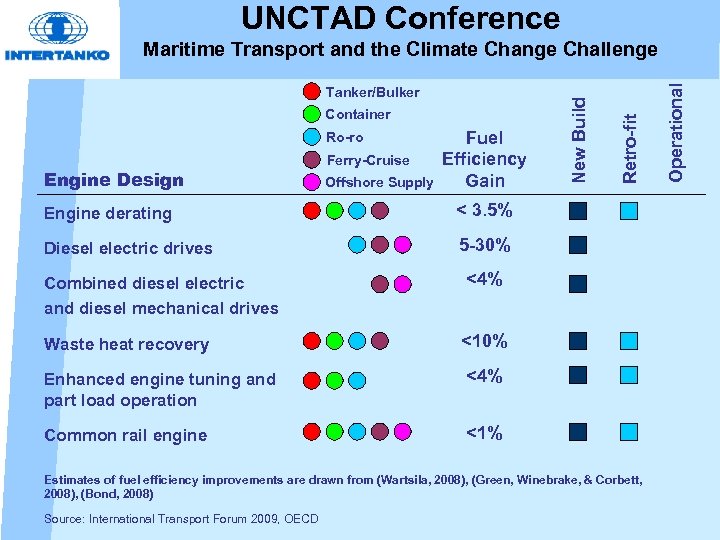
UNCTAD Conference Ro-ro Engine Design Ferry-Cruise Offshore Supply Fuel Efficiency Gain Engine derating < 3. 5% Diesel electric drives 5 -30% Combined diesel electric and diesel mechanical drives <4% Waste heat recovery <10% Enhanced engine tuning and part load operation <4% Common rail engine <1% Estimates of fuel efficiency improvements are drawn from (Wartsila, 2008), (Green, Winebrake, & Corbett, 2008), (Bond, 2008) Source: International Transport Forum 2009, OECD Operational Container Retro-fit Tanker/Bulker New Build Maritime Transport and the Climate Change Challenge
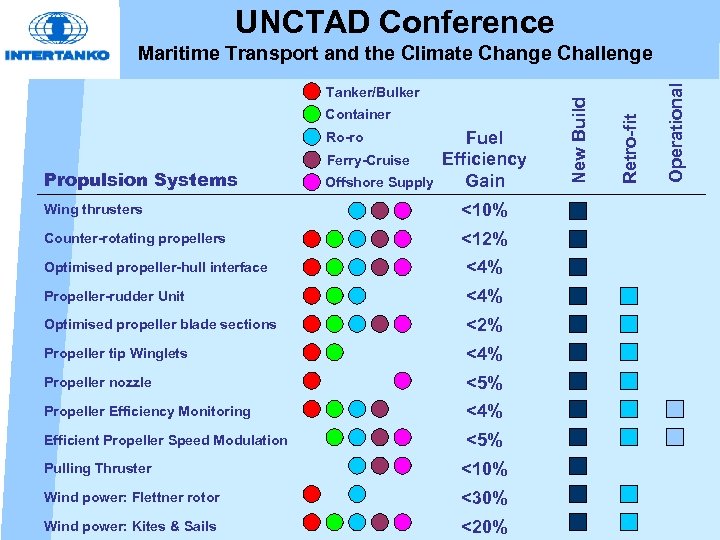
UNCTAD Conference Ro-ro Propulsion Systems Ferry-Cruise Offshore Supply Fuel Efficiency Gain Wing thrusters <10% Counter-rotating propellers <12% Optimised propeller-hull interface <4% Propeller-rudder Unit <4% Optimised propeller blade sections <2% Propeller tip Winglets <4% Propeller nozzle <5% Propeller Efficiency Monitoring <4% Efficient Propeller Speed Modulation <5% Pulling Thruster <10% Wind power: Flettner rotor <30% Wind power: Kites & Sails <20% Operational Container Retro-fit Tanker/Bulker New Build Maritime Transport and the Climate Change Challenge
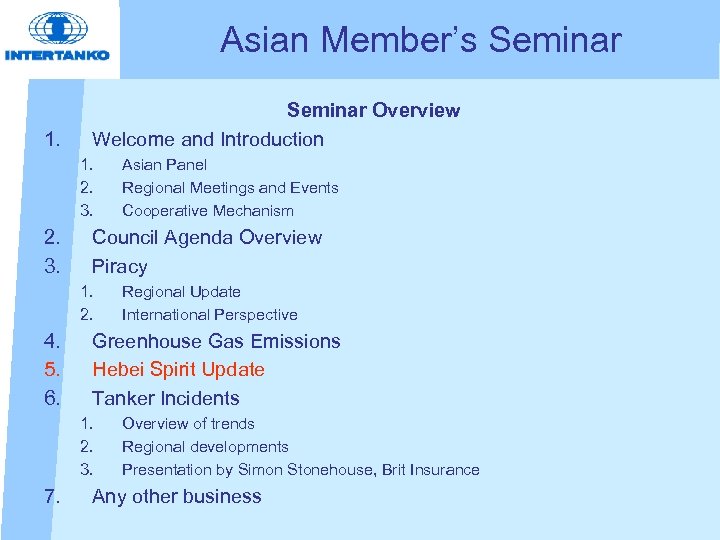
Asian Member’s Seminar 1. Seminar Overview Welcome and Introduction 1. 2. 3. Council Agenda Overview Piracy 1. 2. 4. 5. 6. Regional Update International Perspective Greenhouse Gas Emissions Hebei Spirit Update Tanker Incidents 1. 2. 3. 7. Asian Panel Regional Meetings and Events Cooperative Mechanism Overview of trends Regional developments Presentation by Simon Stonehouse, Brit Insurance Any other business
5. Hebei Spirit Update
5. Hebei Spirit Update
5. Hebei Spirit Update
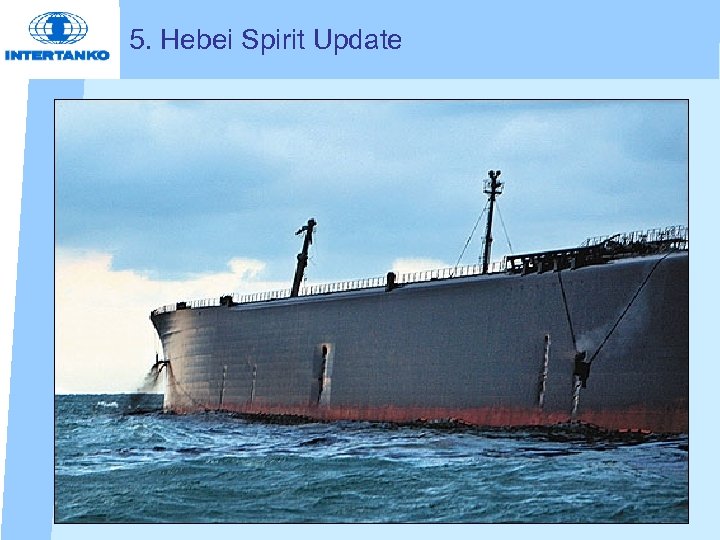
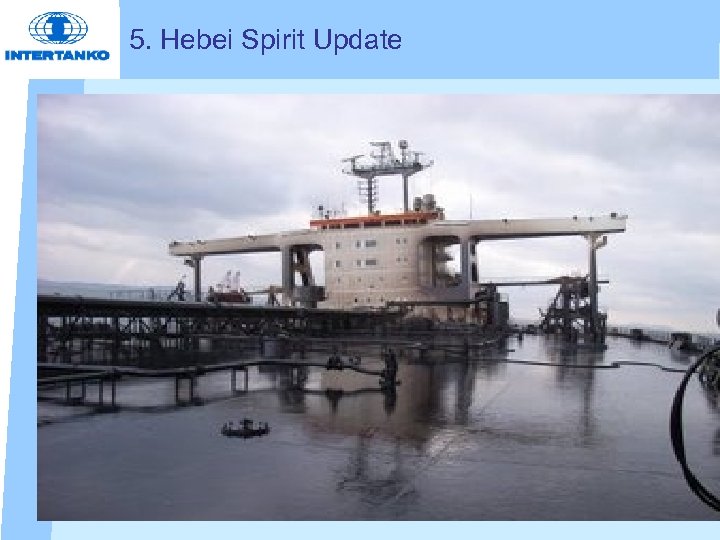
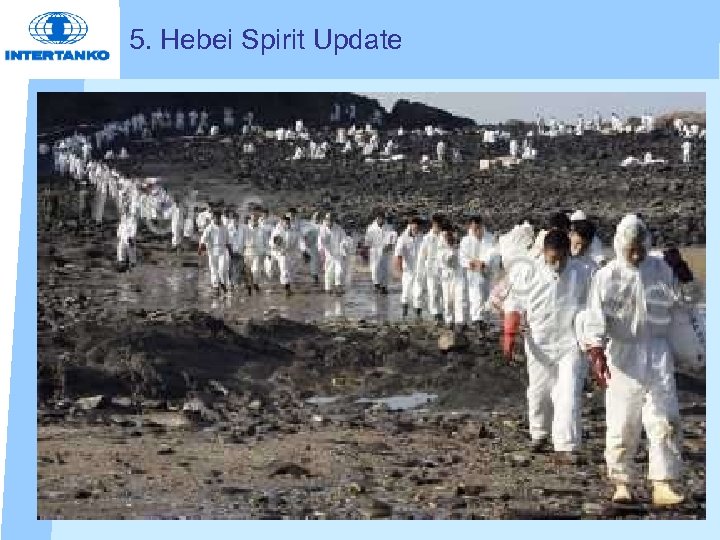
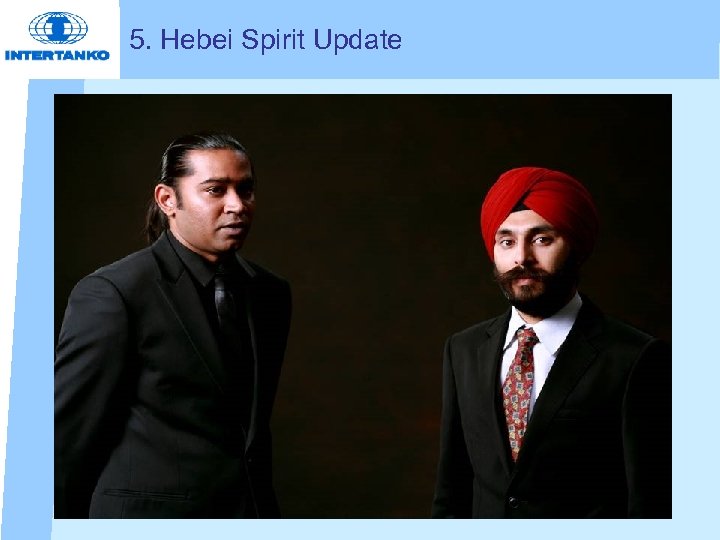
5. Hebei Spirit Update Dec 07 - Anchored VLCC hit by crane barge Jun 08 - Hebei Two (Master and C/O) found innocent But prosecutors lodged appeal preventing Hebei Two’s release Dec 08 - INTERTANKO published open letter to the President of Korea in the Korean Times, expressing the hope that Hebei Two cleared. Dec 08 - Korean Appeal Court concluded Samsung only partially responsible for the allision, and only responsible for 10% of the oil spilled. Hebei Two considered a "flight risk" and ordered straight to prison in handcuffs - media spectacle to calm public feelings over the pollution.
5. Hebei Spirit Update
5. Hebei Spirit Update This is relevant to you Because it could have been your tanker involved your seafarers criminalised and jailed
5. Hebei Spirit Update Jan 09 - Plans set in motion for protest rally with the ITF, IMEC and V. Ships on 23 January outside Korean Embassy in London to draw international media attention to this case Rare unanimity in statements and determined action from Round Table, ITF, IG, IMEC Jan 09 - V. Ships representatives organised London meeting with Korean Ambassador Chun Yungwoo; Ki-tack Lim, Maritime Counsellor; and Jung Hyung Taek, Marine Judge of the Korean Maritime Safety Tribunal.
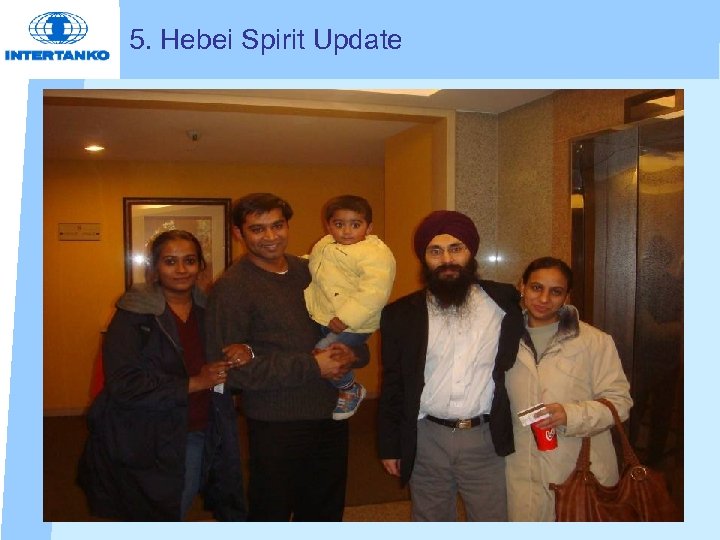
5. Hebei Spirit Update 15 Jan 09 - Hebei Two bailed by Supreme Court in Seoul (USD 7, 500 each). However they must stay at Seoul hotel - not allowed to leave Korea without Supreme Court permission Supreme Court said that, in granting bail, it took into account international opinion and the special characteristics of the case Protest rally deferred but not cancelled
5. Hebei Spirit Update
5. Hebei Spirit Update Supreme Court verdict due Thursday 23 April INTERTANKO’s Chairman invited top execs of Members to sign strong open letter – • deep regret and disappointment at sentencing and criminalisation of Hebei Two • Supreme Court to restore lower court's ‘innocent’ decision • Korea to release and repatriate Hebei Two immediately Letter signed by 118 CEOs/Chairmen/MDs, mostly from among our Members (+ a few from INTERCARGO, BIMCO, Inter. Manager) We want exoneration and repatriation
5. Hebei Spirit Update INTERTANKO statement in Korea’s Supreme Court Appeal against criminal convictions of Hebei Two Addresses accepted industry good practice, good seamanship and tanker safety. Highlights absolute priority to ensure safety of crew and ship
5. Hebei Spirit Update http: //justiceforhebeispirit. blogspot. com/ http: //www. youtube. com/watch? v=66 J_Mazb. A f. E
Asian Member’s Seminar 1. Seminar Overview Welcome and Introduction 1. 2. 3. Council Agenda Overview Piracy 1. 2. 4. 5. 6. Regional Update International Perspective Greenhouse Gas Emissions Hebei Spirit Update Tanker Incidents 1. 2. 3. 7. Asian Panel Regional Meetings and Events Cooperative Mechanism Overview of trends Regional developments Presentation by Simon Stonehouse, Brit Insurance Any other business
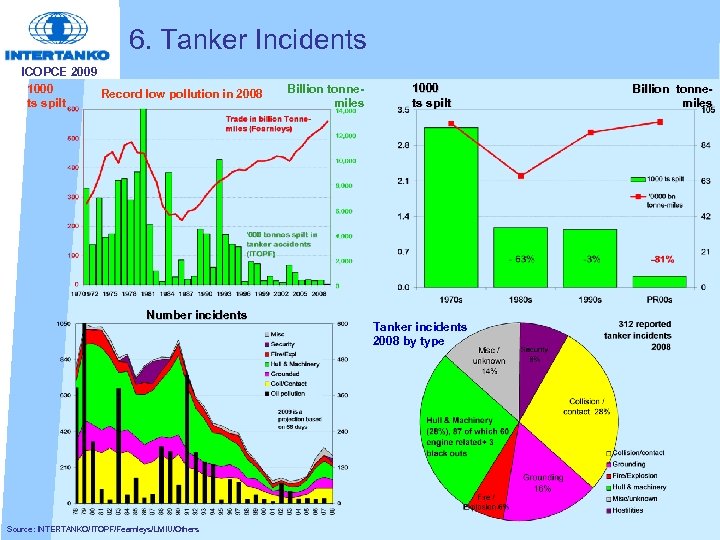
6. Tanker Incidents ICOPCE 2009 1000 Record low pollution in 2008 ts spilt Number incidents Source: INTERTANKO/ITOPF/Fearnleys/LMIU/Others Billion tonnemiles 1000 ts spilt Tanker incidents 2008 by type Billion tonnemiles
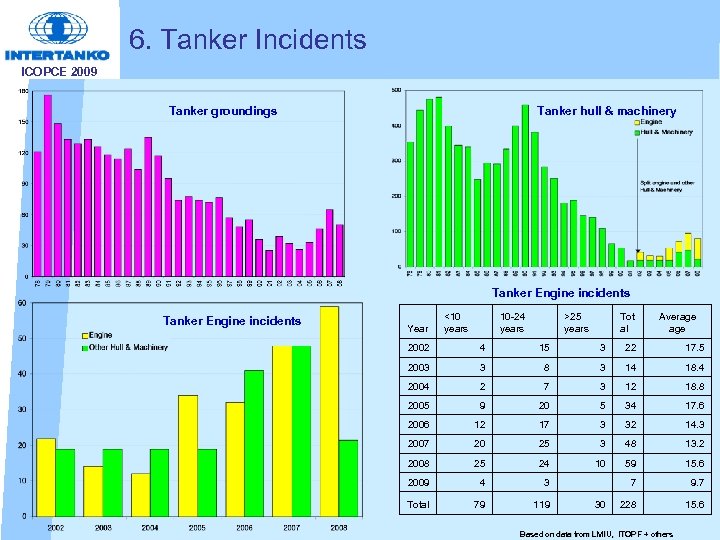
6. Tanker Incidents ICOPCE 2009 Tanker groundings Tanker hull & machinery Tanker Engine incidents Year <10 years 10 -24 years >25 years Tot al Average 2002 4 15 3 22 17. 5 2003 3 8 3 14 18. 4 2004 2 7 3 12 18. 8 2005 9 20 5 34 17. 6 2006 12 17 3 32 14. 3 2007 20 25 3 48 13. 2 2008 25 24 10 59 15. 6 2009 4 3 7 9. 7 Total 79 119 228 15. 6 30 Based on data from LMIU, ITOPF + others
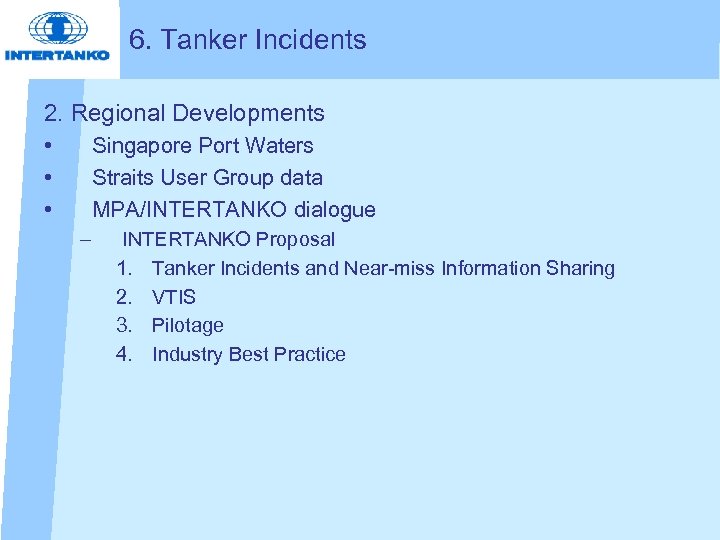
6. Tanker Incidents 2. Regional Developments • • • Singapore Port Waters Straits User Group data MPA/INTERTANKO dialogue – INTERTANKO Proposal 1. Tanker Incidents and Near-miss Information Sharing 2. VTIS 3. Pilotage 4. Industry Best Practice
6. Tanker Incidents 3. Brit Insurance – Simon Stonehouse
Asian Member’s Seminar 1. Seminar Overview Welcome and Introduction 1. 2. 3. Council Agenda Overview Piracy 1. 2. 4. 5. 6. Regional Update International Perspective Greenhouse Gas Emissions Hebei Spirit Update Tanker Incidents 1. 2. 3. 7. Asian Panel Regional Meetings and Events Cooperative Mechanism Overview of trends Regional developments Presentation by Simon Stonehouse, Brit Insurance Any other business
7. Any other business • • • Singapore Vetting - singaporeinspection@intertanko. com Maritime Industry Foundation. . .
Скачать презентацию INTERTANKO Asian Member s Seminar Singapore 23 rd April
035c727ca9115d694bddc3d319490f28.ppt