


 Скачать презентацию Interstate 15 North Phase 4 9 01 2015 VE Class
bfb16ad9638cf7e6490f232969f904b1.ppt
- Количество слайдов: 39
 Interstate 15 North Phase 4 9/01/2015 VE Class
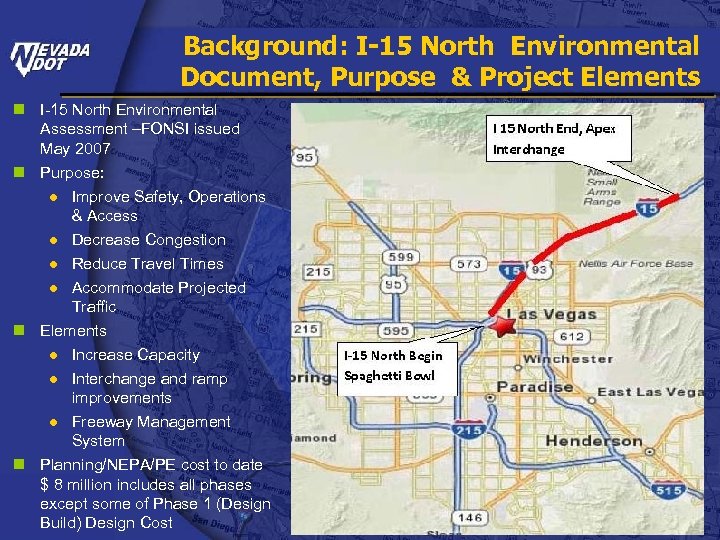 Background: I-15 North Environmental Document, Purpose & Project Elements n I-15 North Environmental Assessment –FONSI issued May 2007 n Purpose: ● Improve Safety, Operations & Access ● Decrease Congestion ● Reduce Travel Times ● Accommodate Projected Traffic n Elements ● Increase Capacity ● Interchange and ramp improvements ● Freeway Management System n Planning/NEPA/PE cost to date $ 8 million includes all phases except some of Phase 1 (Design Build) Design Cost
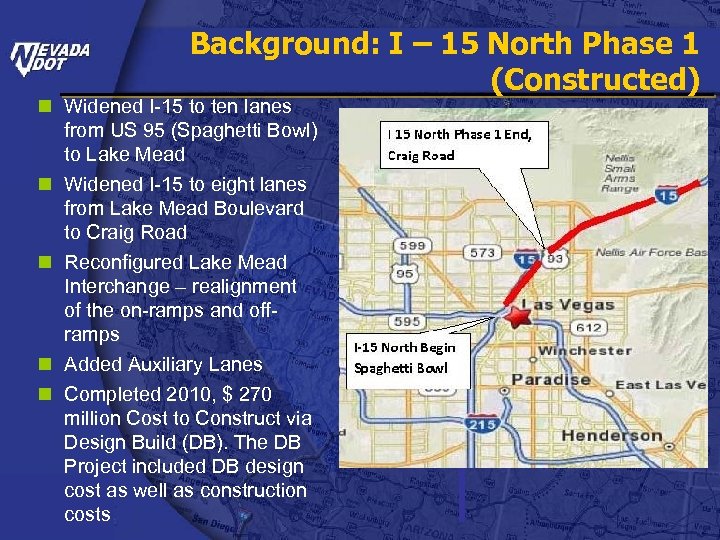 Background: I – 15 North Phase 1 (Constructed) n Widened I-15 to ten lanes from US 95 (Spaghetti Bowl) to Lake Mead n Widened I-15 to eight lanes from Lake Mead Boulevard to Craig Road n Reconfigured Lake Mead Interchange – realignment of the on-ramps and offramps n Added Auxiliary Lanes n Completed 2010, $ 270 million Cost to Construct via Design Build (DB). The DB Project included DB design cost as well as construction costs
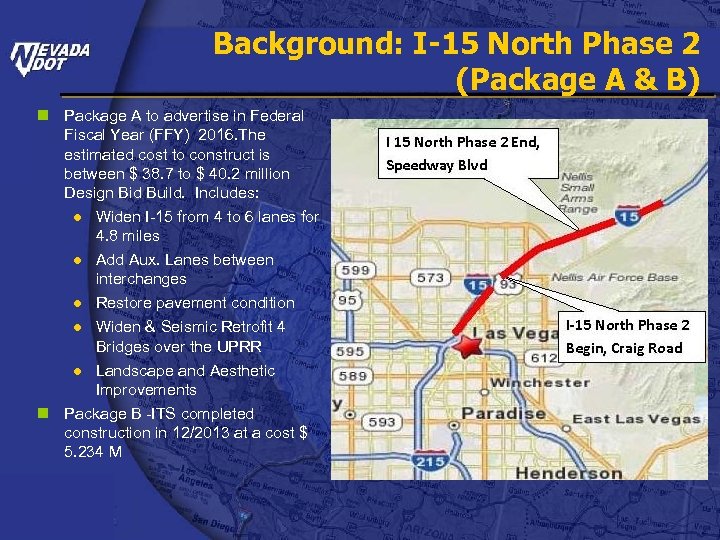 Background: I-15 North Phase 2 (Package A & B) n Package A to advertise in Federal Fiscal Year (FFY) 2016. The estimated cost to construct is between $ 38. 7 to $ 40. 2 million Design Bid Build. Includes: ● Widen I-15 from 4 to 6 lanes for 4. 8 miles ● Add Aux. Lanes between interchanges ● Restore pavement condition ● Widen & Seismic Retrofit 4 Bridges over the UPRR ● Landscape and Aesthetic Improvements n Package B -ITS completed construction in 12/2013 at a cost $ 5. 234 M
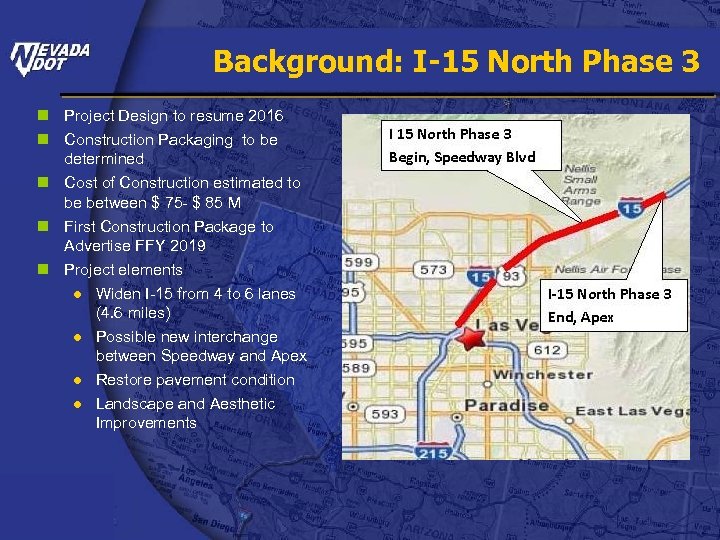 Background: I-15 North Phase 3 n Project Design to resume 2016 n Construction Packaging to be determined n Cost of Construction estimated to be between $ 75 - $ 85 M n First Construction Package to Advertise FFY 2019 n Project elements ● Widen I-15 from 4 to 6 lanes (4. 6 miles) ● Possible new interchange between Speedway and Apex ● Restore pavement condition ● Landscape and Aesthetic Improvements
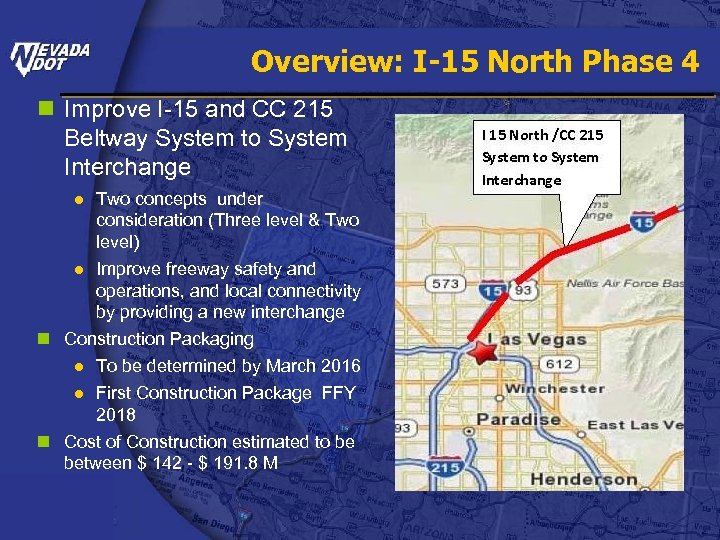 Overview: I-15 North Phase 4 n Improve I-15 and CC 215 Beltway System to System Interchange ● Two concepts under consideration (Three level & Two level) ● Improve freeway safety and operations, and local connectivity by providing a new interchange n Construction Packaging ● To be determined by March 2016 ● First Construction Package FFY 2018 n Cost of Construction estimated to be between $ 142 - $ 191. 8 M
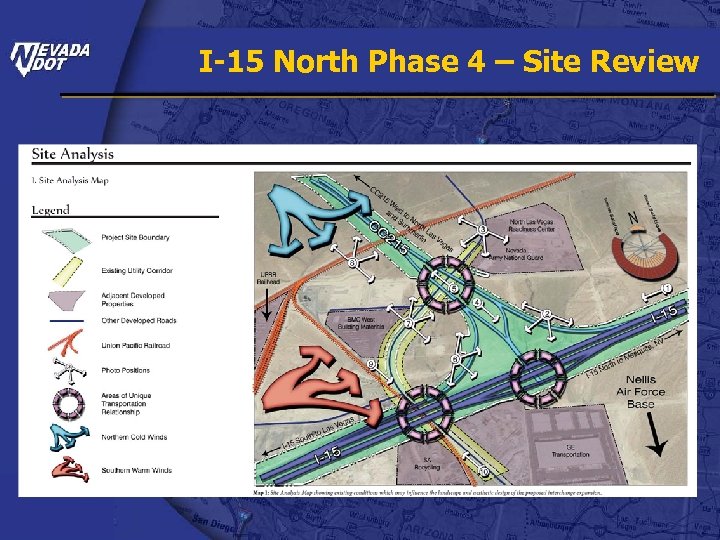 I-15 North Phase 4 – Site Review
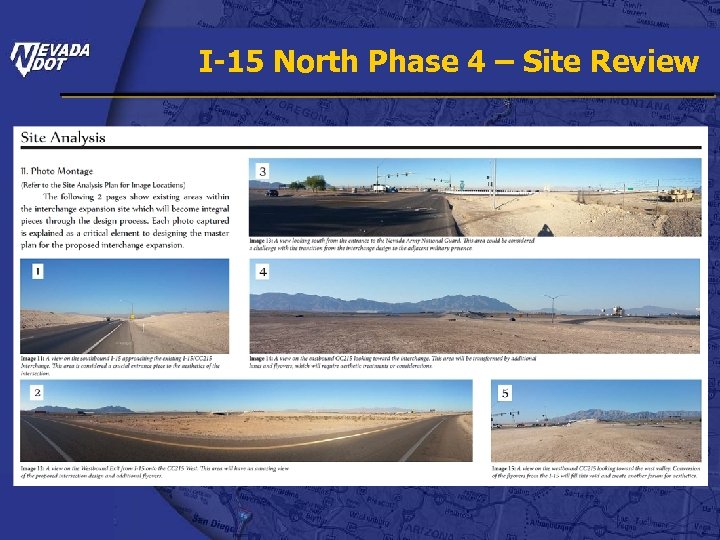 I-15 North Phase 4 – Site Review
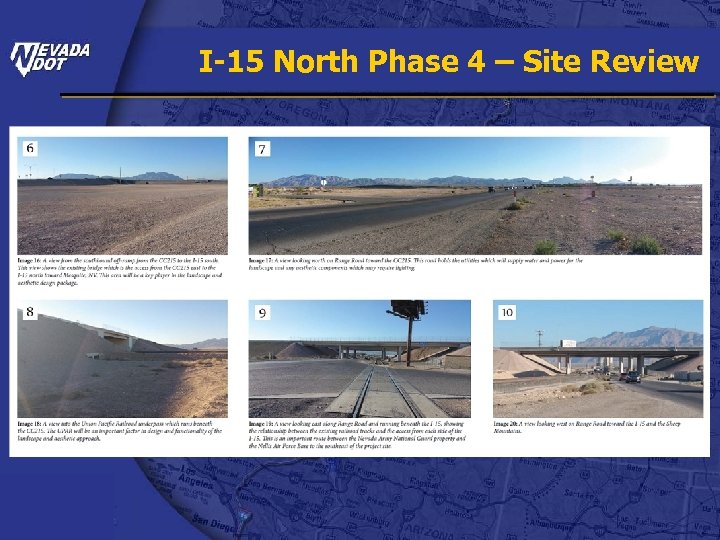 I-15 North Phase 4 – Site Review
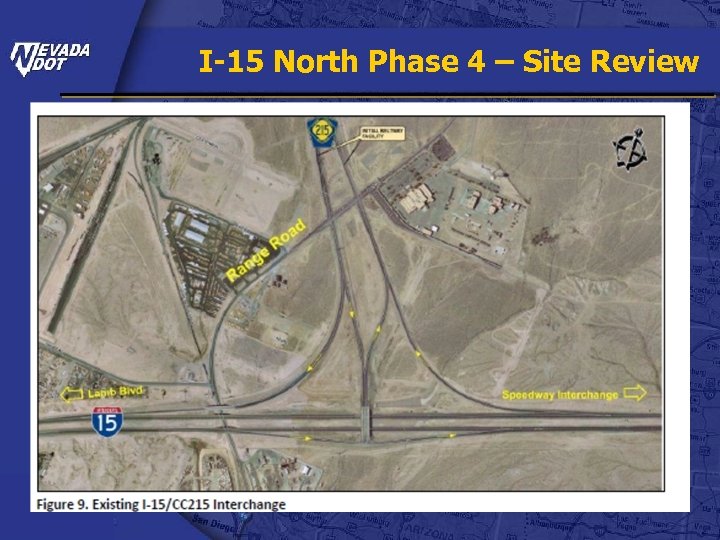 I-15 North Phase 4 – Site Review
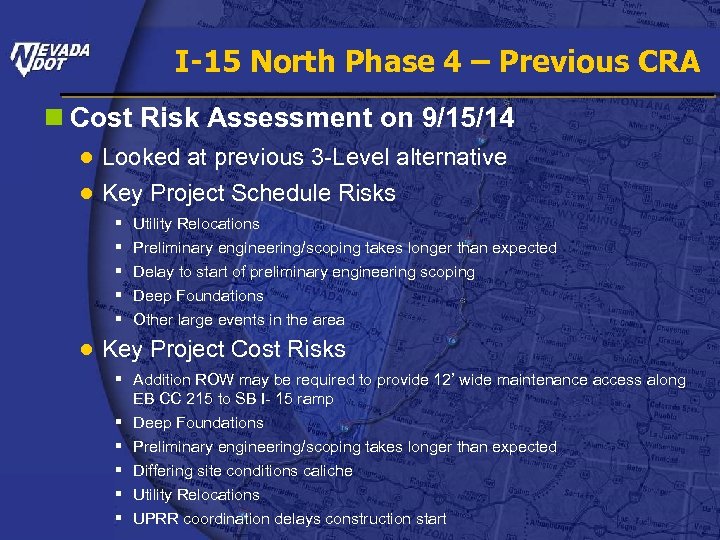 I-15 North Phase 4 – Previous CRA n Cost Risk Assessment on 9/15/14 ● Looked at previous 3 -Level alternative ● Key Project Schedule Risks § § § Utility Relocations Preliminary engineering/scoping takes longer than expected Delay to start of preliminary engineering scoping Deep Foundations Other large events in the area ● Key Project Cost Risks § Addition ROW may be required to provide 12’ wide maintenance access along EB CC 215 to SB I- 15 ramp § Deep Foundations § Preliminary engineering/scoping takes longer than expected § Differing site conditions caliche § Utility Relocations § UPRR coordination delays construction start
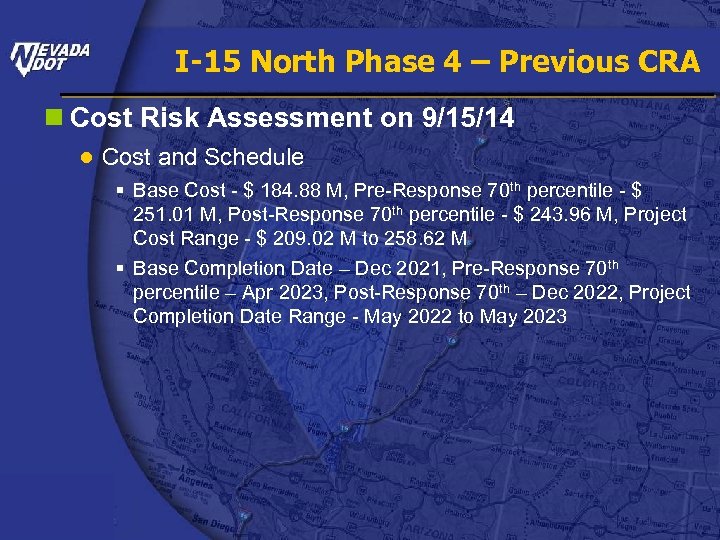 I-15 North Phase 4 – Previous CRA n Cost Risk Assessment on 9/15/14 ● Cost and Schedule § Base Cost - $ 184. 88 M, Pre-Response 70 th percentile - $ 251. 01 M, Post-Response 70 th percentile - $ 243. 96 M, Project Cost Range - $ 209. 02 M to 258. 62 M § Base Completion Date – Dec 2021, Pre-Response 70 th percentile – Apr 2023, Post-Response 70 th – Dec 2022, Project Completion Date Range - May 2022 to May 2023
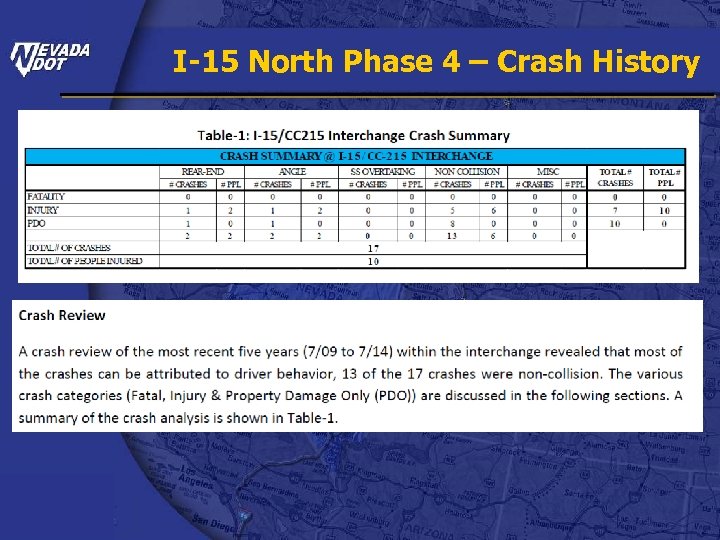 I-15 North Phase 4 – Crash History
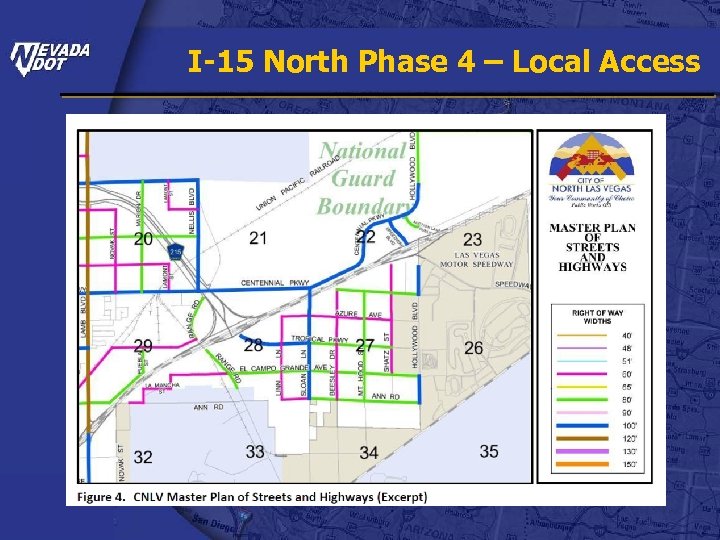 I-15 North Phase 4 – Local Access
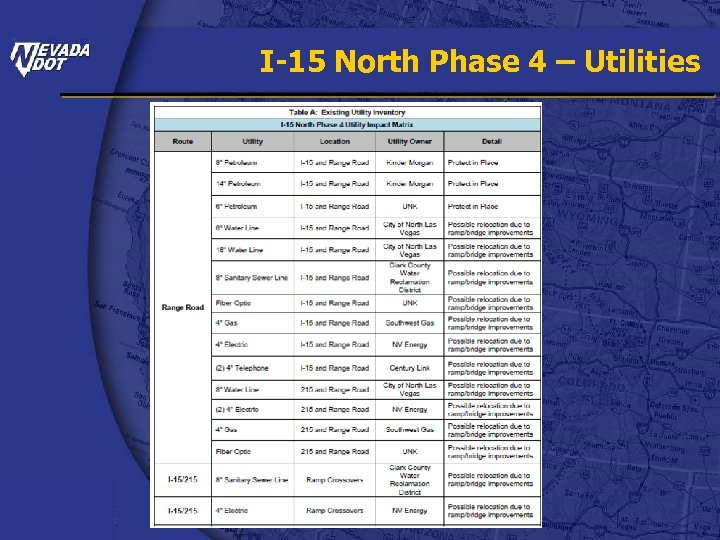 I-15 North Phase 4 – Utilities
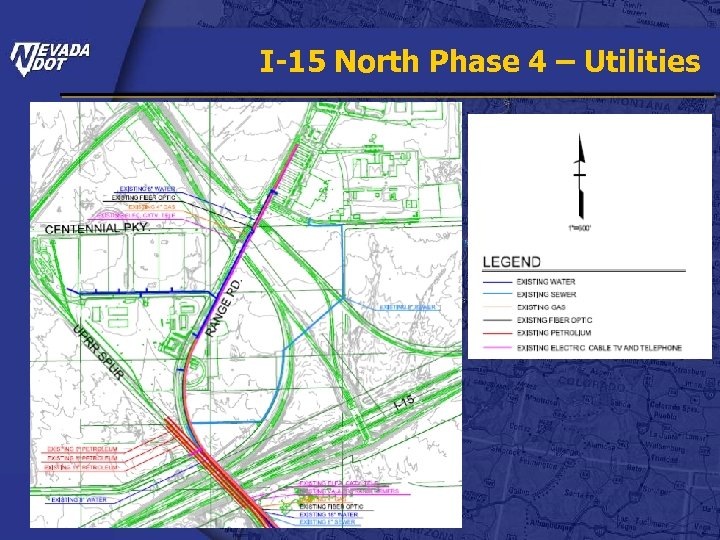 I-15 North Phase 4 – Utilities
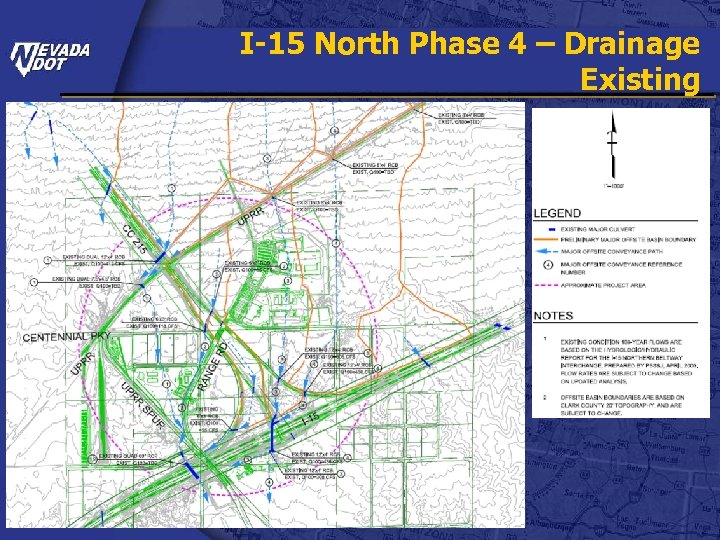 I-15 North Phase 4 – Drainage Existing
 I-15 North Phase 4 – Drainage Future Conditions
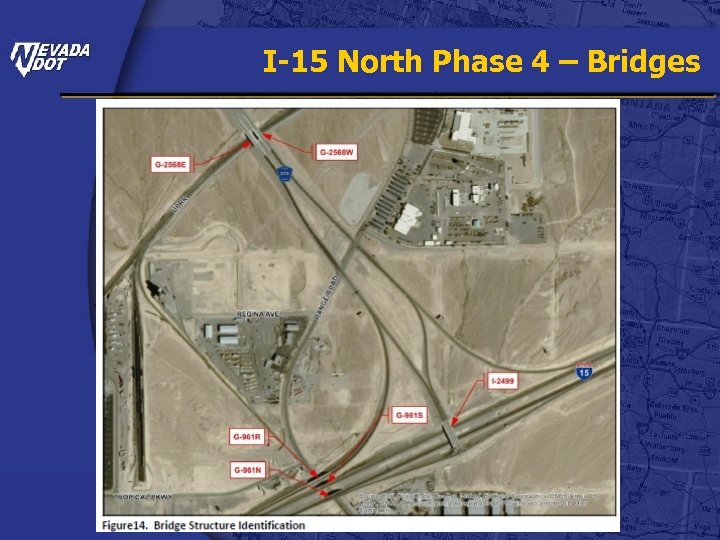 I-15 North Phase 4 – Bridges
 I-15 North Phase 4 – Structures Existing Structures – G-961 S and G-961 N (cast in place box girder structures) will be widened in Phase 2 and it is not presently anticipated that they will need to be widened again in Phase 4. However, there is sufficient width between the two bridges for additional capacity (HOV lanes). G-961 R (cast in place post tensioned box) should widening be required there are no factor that would preclude the use of the same structure at this location. I-2499 (cast in place post tensioned box girder) and it’s present width would accommodate one addition lane. Should additional widening be required, there are no known factors that would preclude the use of the same structure type. G 2568 E and G 2568 W (post tensioned box girder structures). The width of these structures will accommodate an additional lane in each direction. It is not anticipated that they will be modified as part of the Phase 4 project Existing Box Culverts – Local drainage throughout the area of the proposed interchange is accomplished by several large box culverts. The proposed configuration of the interchange may create the need to lengthen some of the culverts and/or provide new ones Proposed Bridges – The possibility of large flyover ramp structures is anticipated to complete the system interchange. Due to the required geometric curvature, structures of this type are most often constructed with steel plate girders. The use of cast-in-place concrete box girders is a possibility; however, the difficulty of providing the needed falsework is generally prohibitive. At the other bridge locations, there are no identifiable conditions that would preclude the use of post-tensioned, cast-in-place concrete box girder bridges, which are NDOT’s preferred structure type
 I-15 North Phase 4 – Pavement n I -15 Pavement ● The I-15 North Phase 2 – Is adding lanes and resurfacing the I-15 pavement § Mill and Overlay with 3” Plantmix Bituminous & ¾” PB Open. Grade § Widening and replacement areas - 10” Plantmix Bituminous & ¾” PB Open-Grade with 16” Type 1 Class B Aggregate Base n CC 215 Pavement ● Most of the facilities on CC 215 will be removed and replaced due to realignment ● Main Beltway was constructed with 11” PCCP n Range Road and directional ramps ● Plantmix Bituminous Surfacing – Typically 6”
 I-15 North Phase 4 – Geotechnical n Native soils ● Surface fill - Sands & gravels of varying depths (1’ to 4’). Removal, testing, and recompaction (if suitable) ● Native clay soils have low to high expansion potential. Highly expansive soils should be removed and replaced n Caliche ● Significant layers of moderately hard caliche were encountered in some borings ● The summaries of caliche indicate a few thin layers near the surface with thickness of one to two feet ● Deeper layers, 30 to 100 feet deep, varied greatly in thickness ● Rock excavation & heavy duty excavation/ripping techniques should be anticipated in areas with appreciable grading or relatively deep excavations n High Sulfate content ● Sulfate resistant cement is recommended ● Corrosion reduction methods should be implemented for buried pipes n Ground Water not reported on any of the boring logs with depths up to 100’ n No know fissures or faults in immediate vicinity of the project n Spread footings and drilled shaft foundations are generally found to be suitable
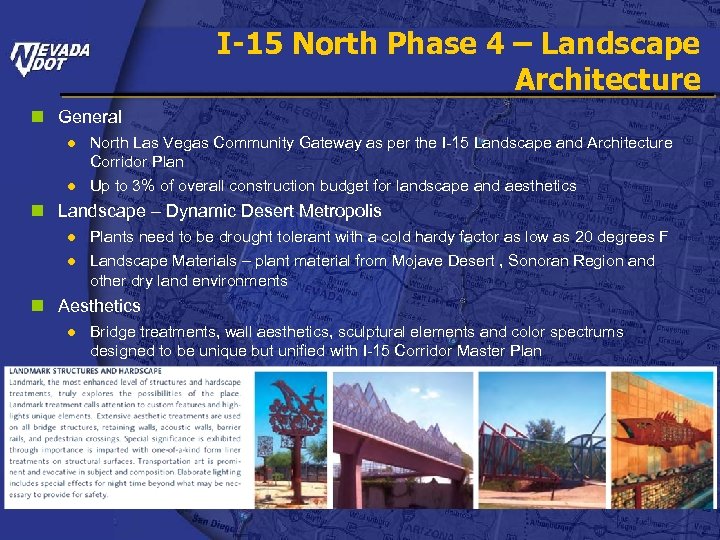 I-15 North Phase 4 – Landscape Architecture n General ● North Las Vegas Community Gateway as per the I-15 Landscape and Architecture Corridor Plan ● Up to 3% of overall construction budget for landscape and aesthetics n Landscape – Dynamic Desert Metropolis ● Plants need to be drought tolerant with a cold hardy factor as low as 20 degrees F ● Landscape Materials – plant material from Mojave Desert , Sonoran Region and other dry land environments n Aesthetics ● Bridge treatments, wall aesthetics, sculptural elements and color spectrums designed to be unique but unified with I-15 Corridor Master Plan
 I-15 North Phase 4 – Environmental n General ● Environmental Assessment (EA) in May 2007 for the I-15 Improvements, US- 95 to Apex (FHWA-NV-EA 06 -01) concluded with a Finding of No Significant Impact (FONSI) n Reevaluation ● Generally required when there has been a time lag or changes ● Changes to: § § Project scope or concept Study area conditions Regulatory requirements Local priorities ● NDOT has implemented a series of questions & established a template to prepare a written reevaluation of a NEPA document ● Why? - Any design alternative developed resulting in improvements to areas outside the 2007 right-of-way or that may result in impacts not studied in the 2007 EA may require a written reevaluation
 I-15 North Phase 4 – Alternatives n Alternatives - # 1(3 -Level) & # 2(2 -Level) n Design is at conceptual level for both alternatives n Common Assumptions ● Tropical Parkway Connector will be constructed ● Range Road is not a thru Street; access is restricted within the National Guard property ● Centennial Parkway will be extended to Speedway n Optimized Layouts ● Intuitive ramp alignments ● Cost effective use of ROW, embankment vs bridge
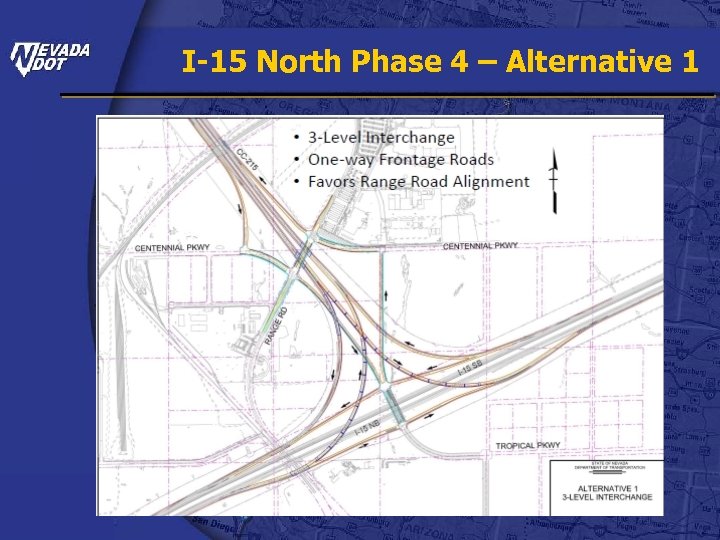 I-15 North Phase 4 – Alternative 1
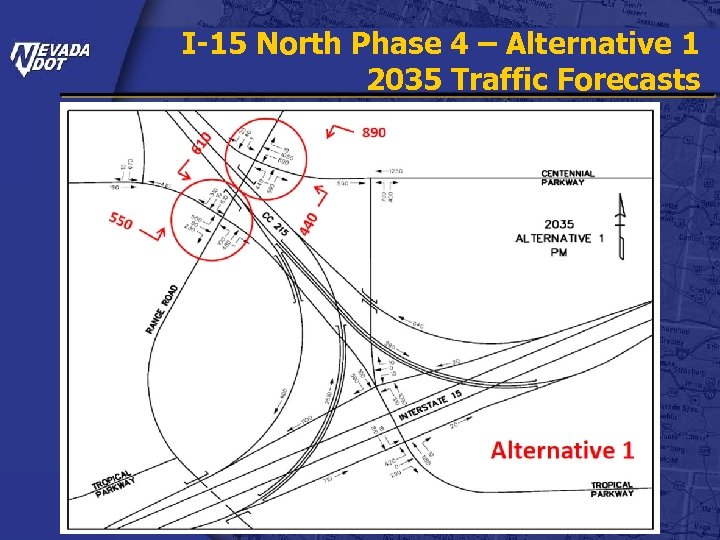 I-15 North Phase 4 – Alternative 1 2035 Traffic Forecasts
 I-15 North Phase 4 – Alternative 1 n Advantages ● Minimal utilities relocation ● Some utilization of existing roadways ● Some ROW acquisition & construction could be deferred until Centennial Pkwy is constructed n Disadvantages ● Higher cost of bridges, embankments & walls due to 3 -level configuration ● Multiple heavy turning movements & diversion of Centennial traffic onto Range
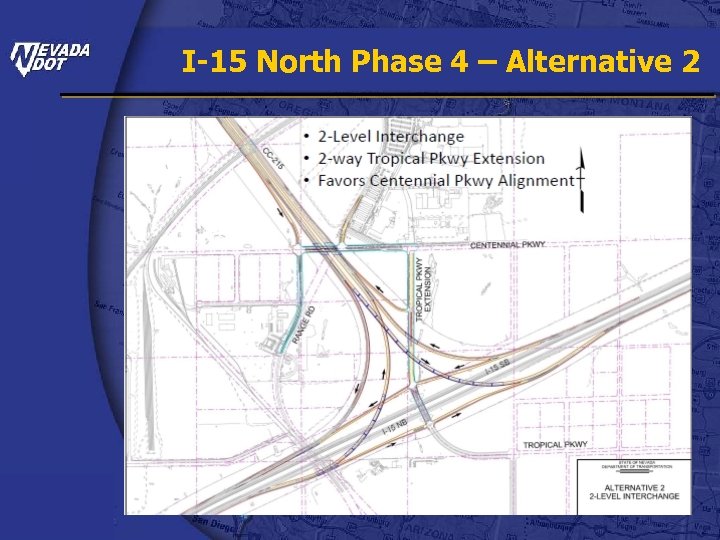 I-15 North Phase 4 – Alternative 2
 I-15 North Phase 4 – Alternative 2 2035 Traffic Forecasts
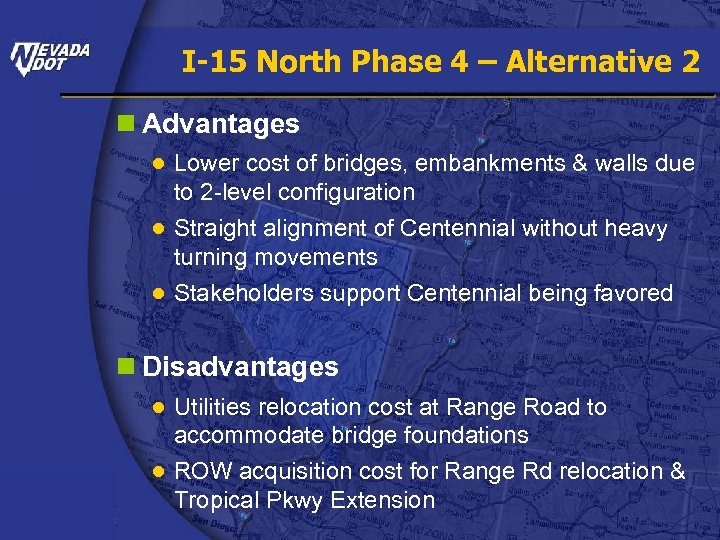 I-15 North Phase 4 – Alternative 2 n Advantages ● Lower cost of bridges, embankments & walls due to 2 -level configuration ● Straight alignment of Centennial without heavy turning movements ● Stakeholders support Centennial being favored n Disadvantages ● Utilities relocation cost at Range Road to accommodate bridge foundations ● ROW acquisition cost for Range Rd relocation & Tropical Pkwy Extension
 I-15 North Phase 4 – Right of Way Existing
 I-15 North Phase 4 – Right of Way Alternative 1
 I-15 North Phase 4 – Right of Way Alternative 2
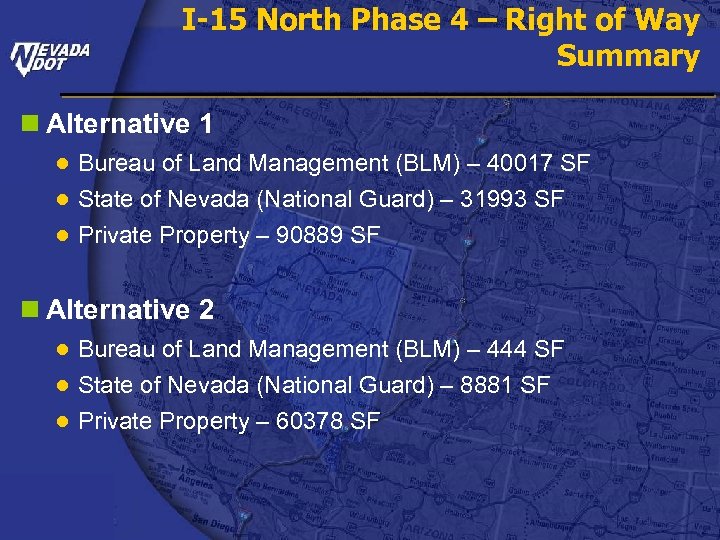 I-15 North Phase 4 – Right of Way Summary n Alternative 1 ● Bureau of Land Management (BLM) – 40017 SF ● State of Nevada (National Guard) – 31993 SF ● Private Property – 90889 SF n Alternative 2 ● Bureau of Land Management (BLM) – 444 SF ● State of Nevada (National Guard) – 8881 SF ● Private Property – 60378 SF
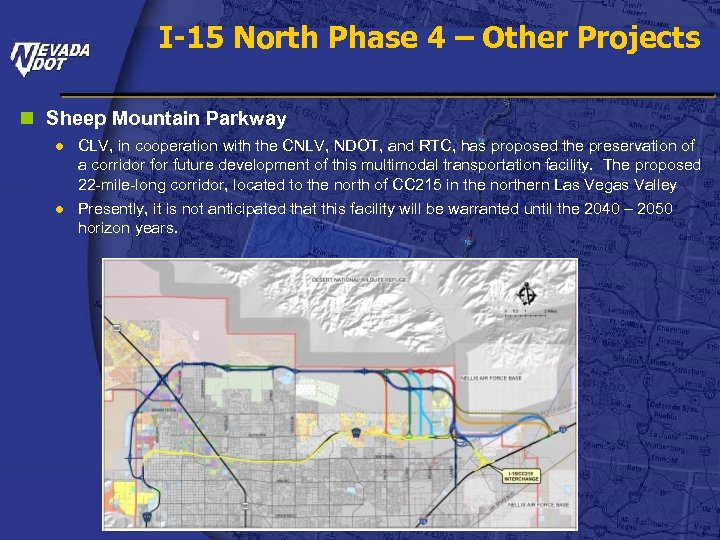 I-15 North Phase 4 – Other Projects n Sheep Mountain Parkway ● CLV, in cooperation with the CNLV, NDOT, and RTC, has proposed the preservation of a corridor future development of this multimodal transportation facility. The proposed 22 -mile-long corridor, located to the north of CC 215 in the northern Las Vegas Valley ● Presently, it is not anticipated that this facility will be warranted until the 2040 – 2050 horizon years.
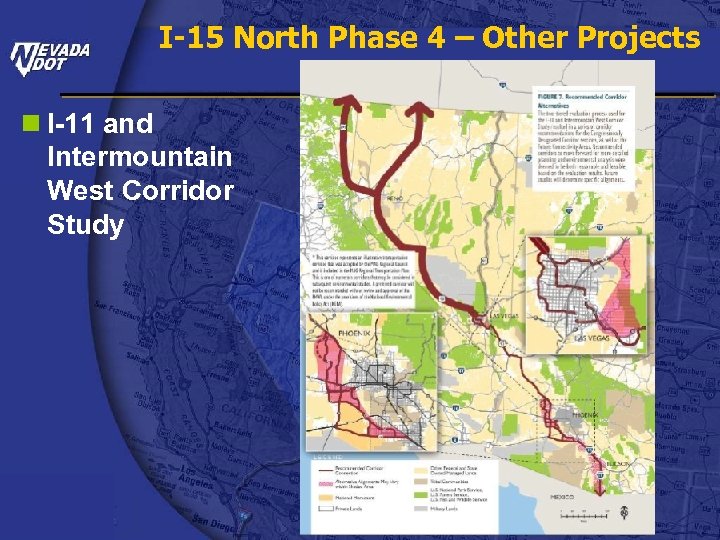 I-15 North Phase 4 – Other Projects n I-11 and Intermountain West Corridor Study
 I-15 North Phase 4 – Other Projects n I-11 and Intermountain West Corridor Study ● Is envisioned to be a continuous high-capacity trade corridor extending from Nogales, Arizona to Las Vegas and potentially on towards Canada ● Alternatives include a south-west route utilizing the I-215 Bruce Woodbury Beltway, a central route utilizing US 95, and an east-north route utilizing I-15, CC 215, and a new alignment to be determined to the east of the valley ● If the east-north route alternative, is determined to be the preferred route, this would redistribute traffic and add a significant new component through the I- 15/CC 215 interchange
 Project Contact & Questions? NDOT Project Management Division: • Assistant Chief – Lynnette Russell • Email – lrussell@dot. state. nv. us • Phone – 702 -671 -6601 • Project Manager – Dwayne Wilkinson • Email – dwilkinson@dot. state. nv. us • Phone – 702 -671 -8879