 Скачать презентацию Interoperable Knowledge Representation for Intelligence Support IKRIS A
3d40d5b7601c9bc495eba5d007e68659.ppt
- Количество слайдов: 32



Interoperable Knowledge Representation for Intelligence Support (IKRIS) A challenge problem project on knowledge representation sponsored by DTO Technical Team Leaders Prof. Richard Fikes. Dr. Christopher Welty Knowledge Structures Group Artificial Intelligence Laboratory (KSL) Stanford University. IBM Corporation Knowledge Systems, T. J. Watson Research Center Northeast Regional Research Center Leaders Dr. Brant Cheikes (MITRE) Dr. Mark Maybury (MITRE) Government Champions Steve Cook (NSA)Jean-Michel Pomarede (CIA) John Donelan (CIA)John Walker (NSA) 2/7/06 1
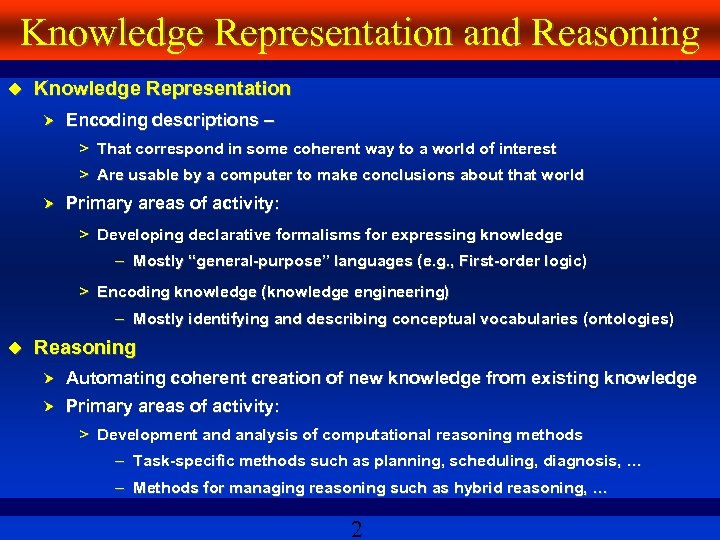
Knowledge Representation and Reasoning Knowledge Representation Encoding descriptions – > That correspond in some coherent way to a world of interest > Are usable by a computer to make conclusions about that world Primary areas of activity: > Developing declarative formalisms for expressing knowledge – Mostly “general-purpose” languages (e. g. , First-order logic) > Encoding knowledge (knowledge engineering) – Mostly identifying and describing conceptual vocabularies (ontologies) Reasoning Automating coherent creation of new knowledge from existing knowledge Primary areas of activity: > Development and analysis of computational reasoning methods – Task-specific methods such as planning, scheduling, diagnosis, … – Methods for managing reasoning such as hybrid reasoning, … 2
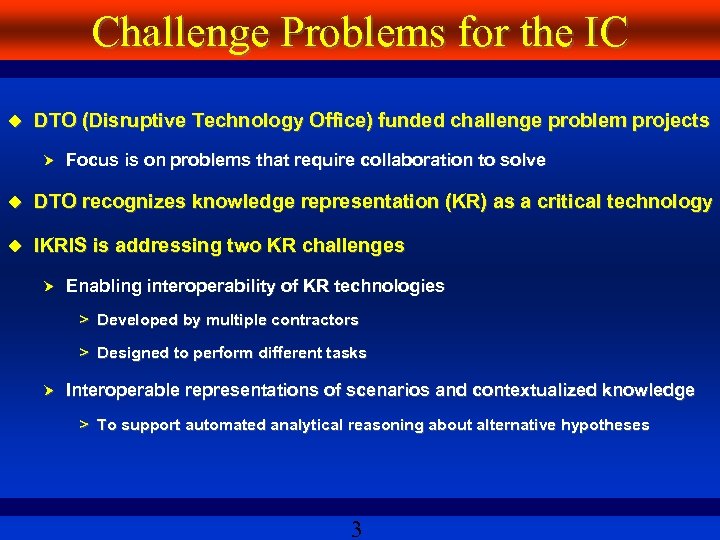
Challenge Problems for the IC DTO (Disruptive Technology Office) funded challenge problem projects Focus is on problems that require collaboration to solve DTO recognizes knowledge representation (KR) as a critical technology IKRIS is addressing two KR challenges Enabling interoperability of KR technologies > Developed by multiple contractors > Designed to perform different tasks Interoperable representations of scenarios and contextualized knowledge > To support automated analytical reasoning about alternative hypotheses 3
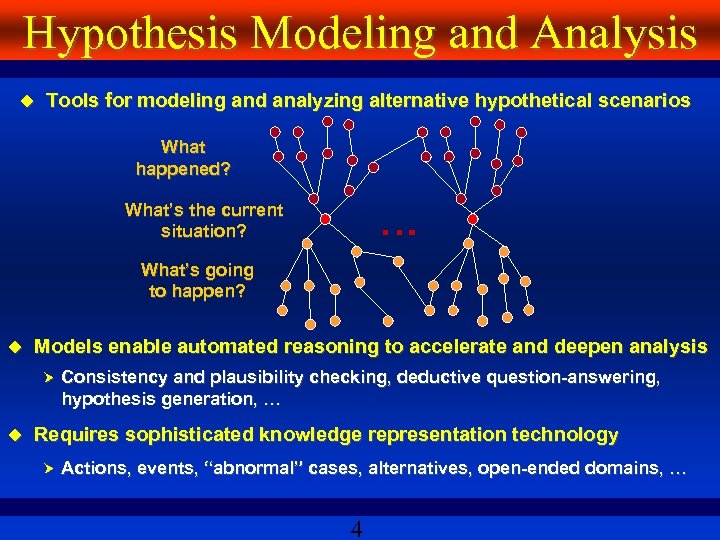
Hypothesis Modeling and Analysis Tools for modeling and analyzing alternative hypothetical scenarios What happened? … What’s the current situation? What’s going to happen? Models enable automated reasoning to accelerate and deepen analysis Consistency and plausibility checking, deductive question-answering, hypothesis generation, … Requires sophisticated knowledge representation technology Actions, events, “abnormal” cases, alternatives, open-ended domains, … 4
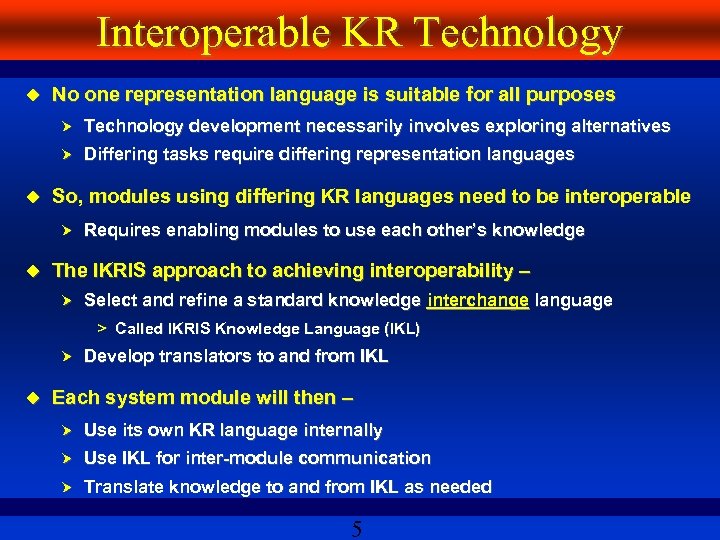
Interoperable KR Technology No one representation language is suitable for all purposes Technology development necessarily involves exploring alternatives Differing tasks require differing representation languages So, modules using differing KR languages need to be interoperable Requires enabling modules to use each other’s knowledge The IKRIS approach to achieving interoperability – Select and refine a standard knowledge interchange language > Called IKRIS Knowledge Language (IKL) Develop translators to and from IKL Each system module will then – Use its own KR language internally Use IKL for inter-module communication Translate knowledge to and from IKL as needed 5
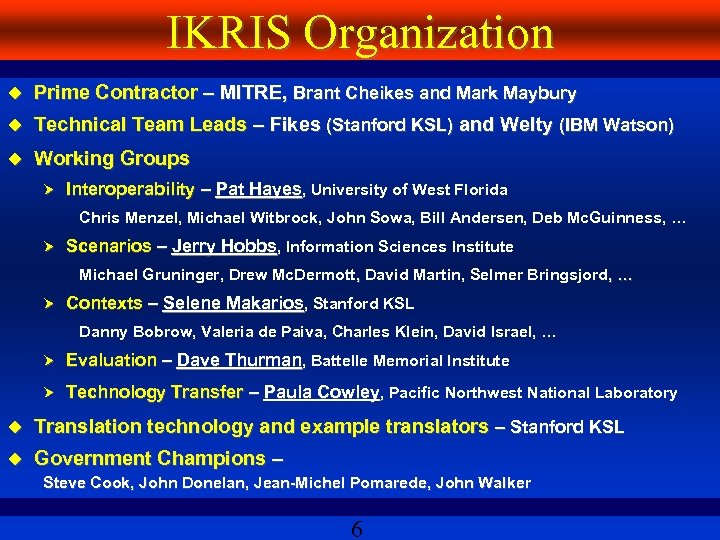
IKRIS Organization Prime Contractor – MITRE, Brant Cheikes and Mark Maybury Technical Team Leads – Fikes (Stanford KSL) and Welty (IBM Watson) Working Groups Interoperability – Pat Hayes, University of West Florida Chris Menzel, Michael Witbrock, John Sowa, Bill Andersen, Deb Mc. Guinness, … Scenarios – Jerry Hobbs, Information Sciences Institute Michael Gruninger, Drew Mc. Dermott, David Martin, Selmer Bringsjord, … Contexts – Selene Makarios, Stanford KSL Danny Bobrow, Valeria de Paiva, Charles Klein, David Israel, … Evaluation – Dave Thurman, Battelle Memorial Institute Technology Transfer – Paula Cowley, Pacific Northwest National Laboratory Translation technology and example translators – Stanford KSL Government Champions – Steve Cook, John Donelan, Jean-Michel Pomarede, John Walker 6
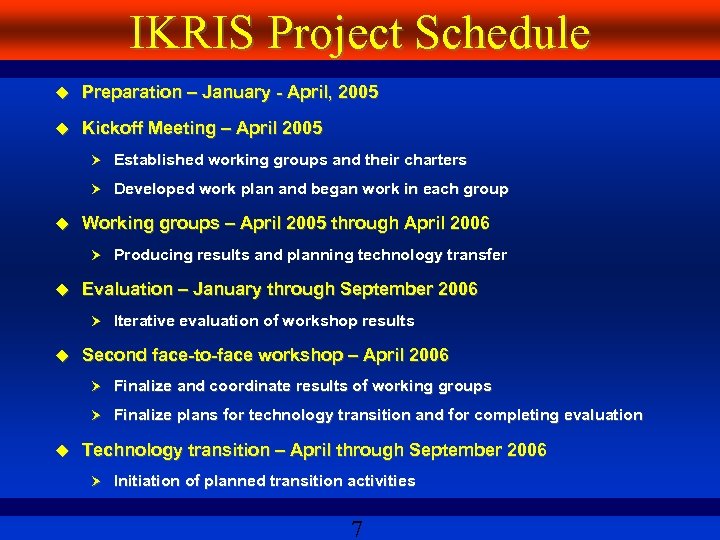
IKRIS Project Schedule Preparation – January - April, 2005 Kickoff Meeting – April 2005 Established working groups and their charters Developed work plan and began work in each group Working groups – April 2005 through April 2006 Evaluation – January through September 2006 Producing results and planning technology transfer Iterative evaluation of workshop results Second face-to-face workshop – April 2006 Finalize and coordinate results of working groups Finalize plans for technology transition and for completing evaluation Technology transition – April through September 2006 Initiation of planned transition activities 7
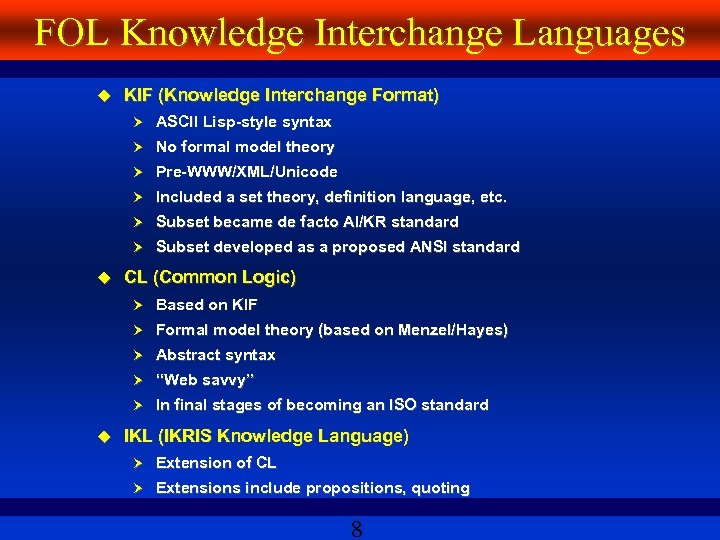
FOL Knowledge Interchange Languages KIF (Knowledge Interchange Format) No formal model theory Pre-WWW/XML/Unicode Included a set theory, definition language, etc. Subset became de facto AI/KR standard ASCII Lisp-style syntax Subset developed as a proposed ANSI standard CL (Common Logic) Formal model theory (based on Menzel/Hayes) Abstract syntax “Web savvy” Based on KIF In final stages of becoming an ISO standard IKL (IKRIS Knowledge Language) Extension of CL Extensions include propositions, quoting 8
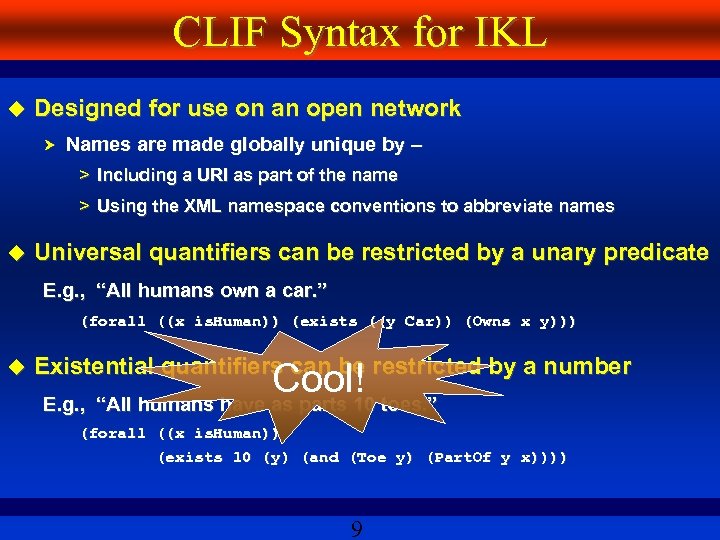
CLIF Syntax for IKL Designed for use on an open network Names are made globally unique by – > Including a URI as part of the name > Using the XML namespace conventions to abbreviate names Universal quantifiers can be restricted by a unary predicate E. g. , “All humans own a car. ” (forall ((x is. Human)) (exists ((y Car)) (Owns x y))) Existential quantifiers can be restricted by a number Cool! toes. ” E. g. , “All humans have as parts 10 (forall ((x is. Human)) (exists 10 (y) (and (Toe y) (Part. Of y x)))) 9
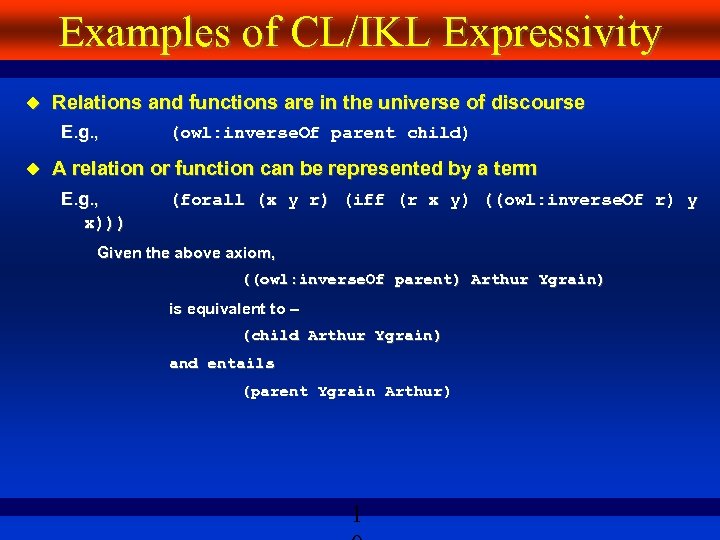
Examples of CL/IKL Expressivity Relations and functions are in the universe of discourse E. g. , (owl: inverse. Of parent child) A relation or function can be represented by a term E. g. , x))) (forall (x y r) (iff (r x y) ((owl: inverse. Of r) y Given the above axiom, ((owl: inverse. Of parent) Arthur Ygrain) is equivalent to – (child Arthur Ygrain) and entails (parent Ygrain Arthur) 1
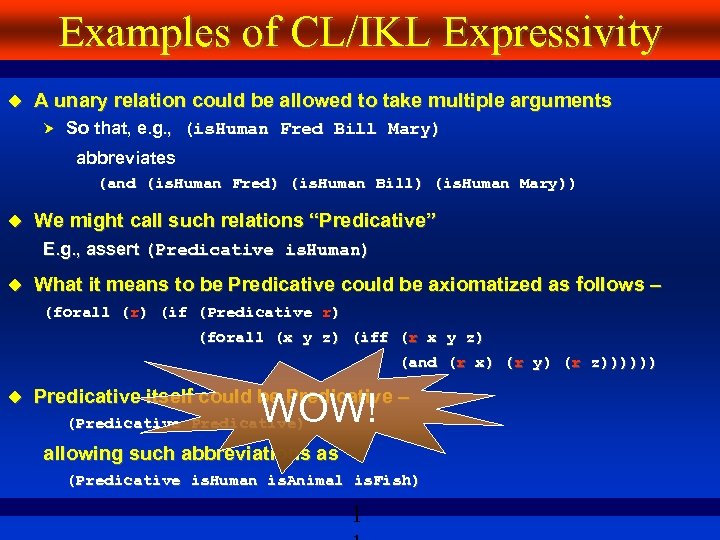
Examples of CL/IKL Expressivity A unary relation could be allowed to take multiple arguments So that, e. g. , (is. Human Fred Bill Mary) abbreviates (and (is. Human Fred) (is. Human Bill) (is. Human Mary)) We might call such relations “Predicative” E. g. , assert (Predicative is. Human) What it means to be Predicative could be axiomatized as follows – (forall (r) (if (Predicative r) (forall (x y z) (iff (r x y z) (and (r x) (r y) (r z)))))) Predicative itself could be Predicative – WOW! (Predicative) allowing such abbreviations as (Predicative is. Human is. Animal is. Fish) 1
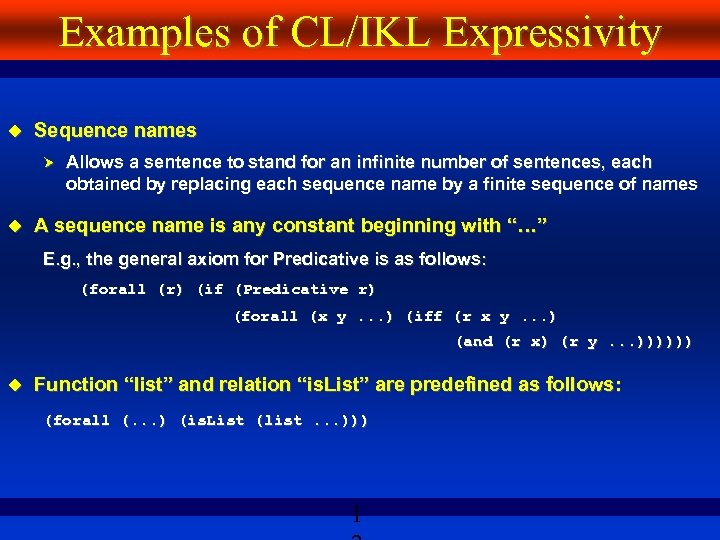
Examples of CL/IKL Expressivity Sequence names Allows a sentence to stand for an infinite number of sentences, each obtained by replacing each sequence name by a finite sequence of names A sequence name is any constant beginning with “…” E. g. , the general axiom for Predicative is as follows: (forall (r) (if (Predicative r) (forall (x y. . . ) (iff (r x y. . . ) (and (r x) (r y. . . )))))) Function “list” and relation “is. List” are predefined as follows: (forall (. . . ) (is. List (list. . . ))) 1
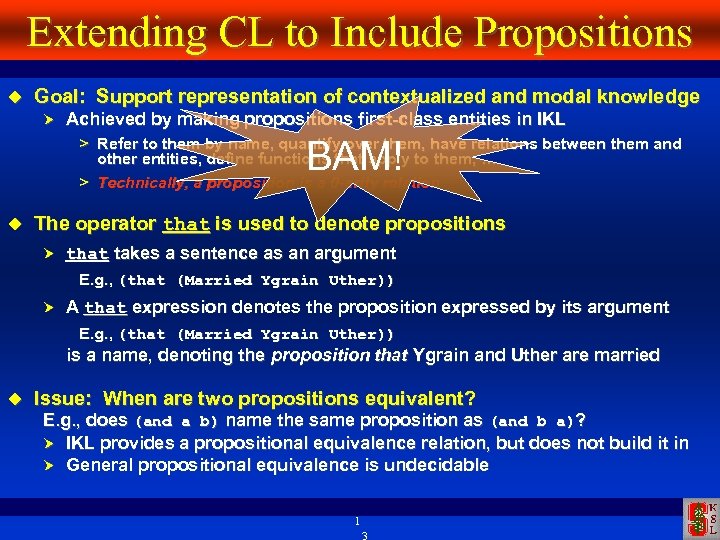
Extending CL to Include Propositions Goal: Support representation of contextualized and modal knowledge Achieved by making propositions first-class entities in IKL BAM! > Refer to them by name, quantify over them, have relations between them and other entities, define functions that apply to them, … > Technically, a proposition is a 0 -arity relation The operator that is used to denote propositions that takes a sentence as an argument E. g. , (that (Married Ygrain Uther)) A that expression denotes the proposition expressed by its argument E. g. , (that (Married Ygrain Uther)) is a name, denoting the proposition that Ygrain and Uther are married Issue: When are two propositions equivalent? E. g. , does (and a b) name the same proposition as (and b a)? IKL provides a propositional equivalence relation, but does not build it in General propositional equivalence is undecidable 1 3
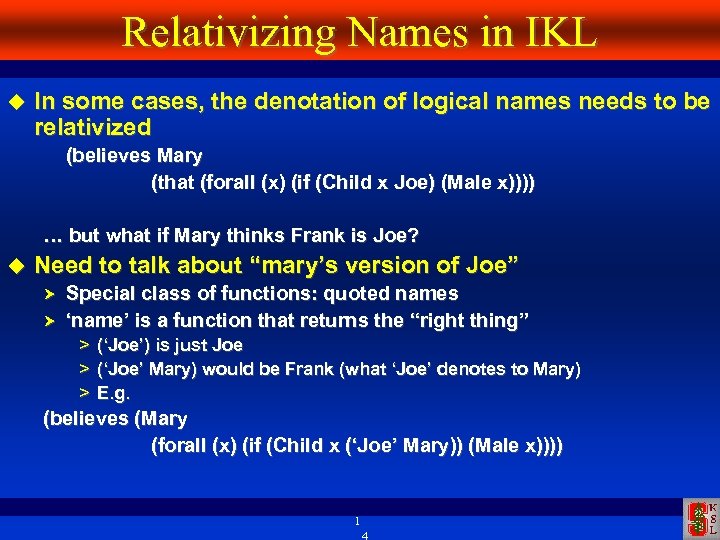
Relativizing Names in IKL In some cases, the denotation of logical names needs to be relativized (believes Mary (that (forall (x) (if (Child x Joe) (Male x)))) … but what if Mary thinks Frank is Joe? Need to talk about “mary’s version of Joe” Special class of functions: quoted names ‘name’ is a function that returns the “right thing” > (‘Joe’) is just Joe > (‘Joe’ Mary) would be Frank (what ‘Joe’ denotes to Mary) > E. g. (believes (Mary (forall (x) (if (Child x (‘Joe’ Mary)) (Male x)))) 1 4
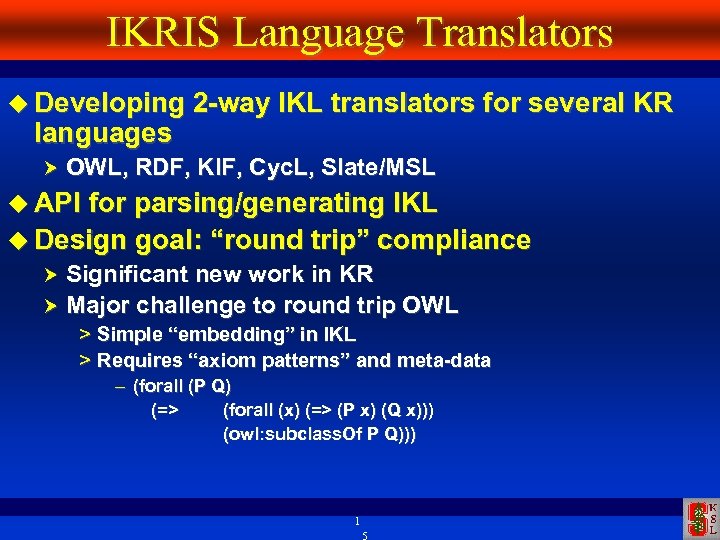
IKRIS Language Translators Developing 2 -way IKL translators for several KR languages OWL, RDF, KIF, Cyc. L, Slate/MSL API for parsing/generating IKL Design goal: “round trip” compliance Significant new work in KR Major challenge to round trip OWL > Simple “embedding” in IKL > Requires “axiom patterns” and meta-data – (forall (P Q) (=> (forall (x) (=> (P x) (Q x))) (owl: subclass. Of P Q))) 1 5
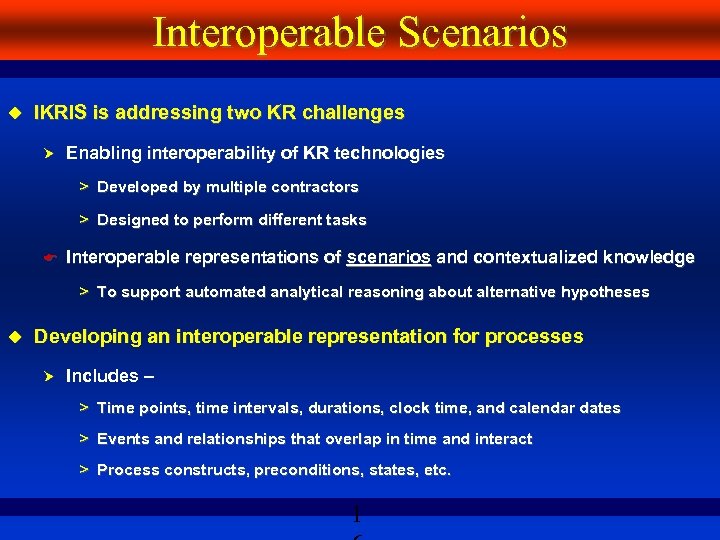
Interoperable Scenarios IKRIS is addressing two KR challenges Enabling interoperability of KR technologies > Developed by multiple contractors > Designed to perform different tasks Interoperable representations of scenarios and contextualized knowledge > To support automated analytical reasoning about alternative hypotheses Developing an interoperable representation for processes Includes – > Time points, time intervals, durations, clock time, and calendar dates > Events and relationships that overlap in time and interact > Process constructs, preconditions, states, etc. 1
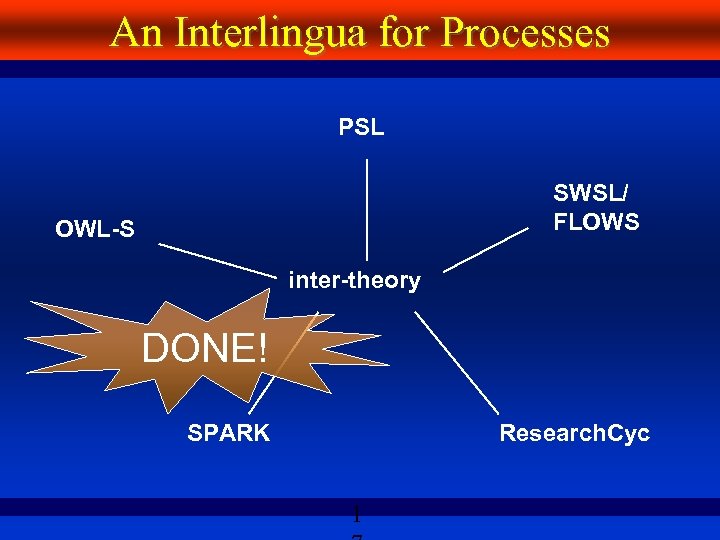
An Interlingua for Processes PSL SWSL/ FLOWS OWL-S inter-theory DONE! SPARK Research. Cyc 1
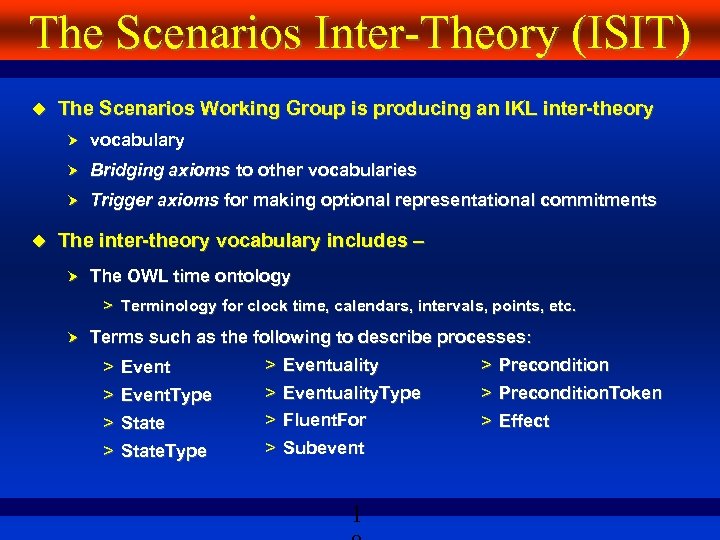
The Scenarios Inter-Theory (ISIT) The Scenarios Working Group is producing an IKL inter-theory Bridging axioms to other vocabularies vocabulary Trigger axioms for making optional representational commitments The inter-theory vocabulary includes – The OWL time ontology > Terminology for clock time, calendars, intervals, points, etc. Terms such as the following to describe processes: > Eventuality > Precondition > Event. Type > State. Type > Eventuality. Type > Fluent. For > Subevent 1 > Precondition. Token > Effect
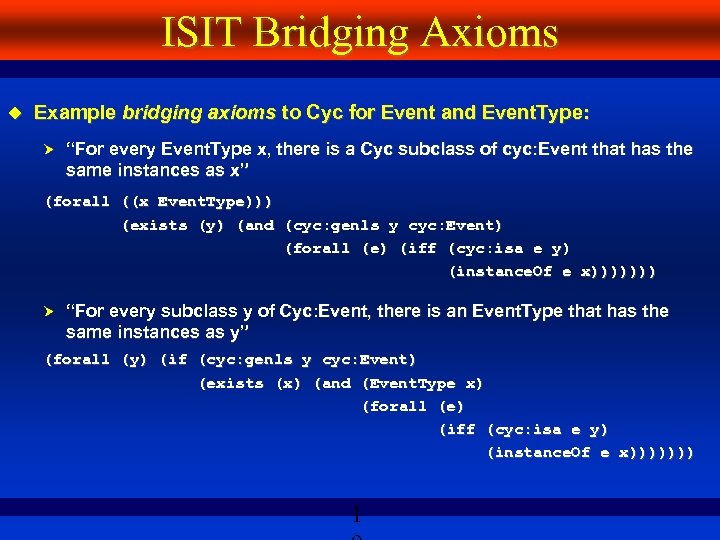
ISIT Bridging Axioms Example bridging axioms to Cyc for Event and Event. Type: “For every Event. Type x, there is a Cyc subclass of cyc: Event that has the same instances as x” (forall ((x Event. Type))) (exists (y) (and (cyc: genls y cyc: Event) (forall (e) (iff (cyc: isa e y) (instance. Of e x))))))) “For every subclass y of Cyc: Event, there is an Event. Type that has the same instances as y” (forall (y) (if (cyc: genls y cyc: Event) (exists (x) (and (Event. Type x) (forall (e) (iff (cyc: isa e y) (instance. Of e x))))))) 1
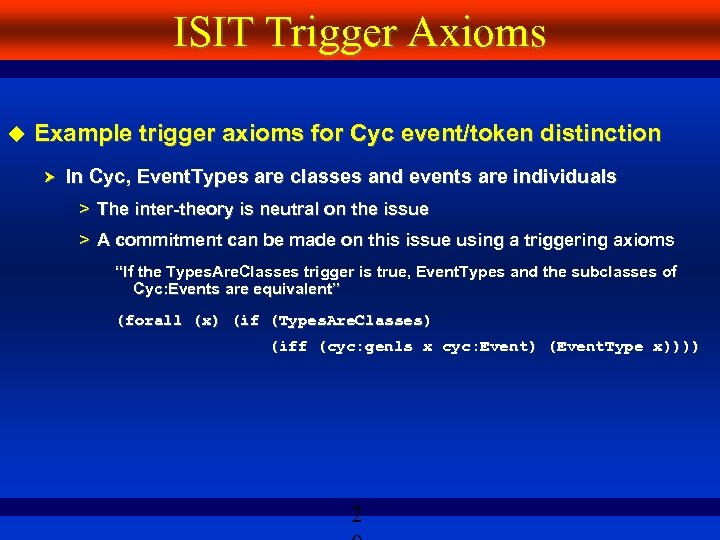
ISIT Trigger Axioms Example trigger axioms for Cyc event/token distinction In Cyc, Event. Types are classes and events are individuals > The inter-theory is neutral on the issue > A commitment can be made on this issue using a triggering axioms “If the Types. Are. Classes trigger is true, Event. Types and the subclasses of Cyc: Events are equivalent” (forall (x) (if (Types. Are. Classes) (iff (cyc: genls x cyc: Event) (Event. Type x)))) 2
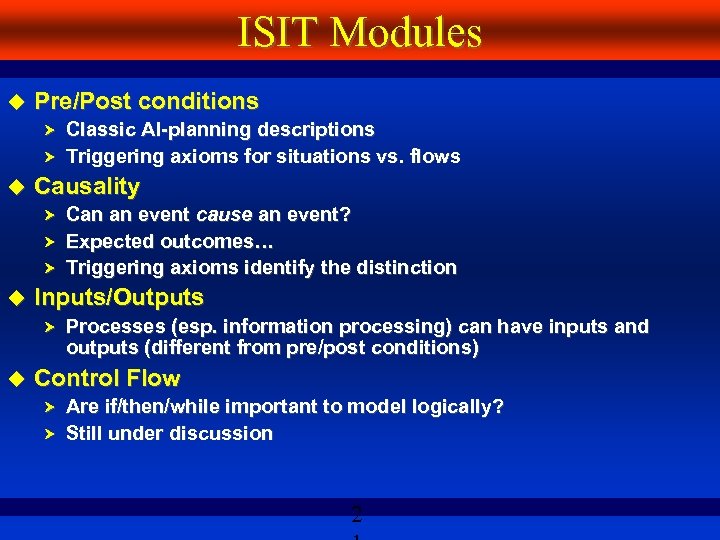
ISIT Modules Pre/Post conditions Classic AI-planning descriptions Triggering axioms for situations vs. flows Causality Can an event cause an event? Expected outcomes… Triggering axioms identify the distinction Inputs/Outputs Processes (esp. information processing) can have inputs and outputs (different from pre/post conditions) Control Flow Are if/then/while important to model logically? Still under discussion 2
IS IT an Ontology? ISIT includes the five ontologies New vocabulary for generalizations of common terms Trigger axioms exclude parts of the Inter Theory under certain conditions In a strict sense, it is not an ontology, but an amalgem of existing ontologies… Pan-ontology? 2
Interoperable Contextualized Knowledge IKRIS is addressing two KR challenges Enabling interoperability of KR technologies > Developed by multiple contractors > Designed to perform different tasks Interoperable representations of scenarios and contextualized knowledge > To support automated analytical reasoning about alternative hypotheses 2
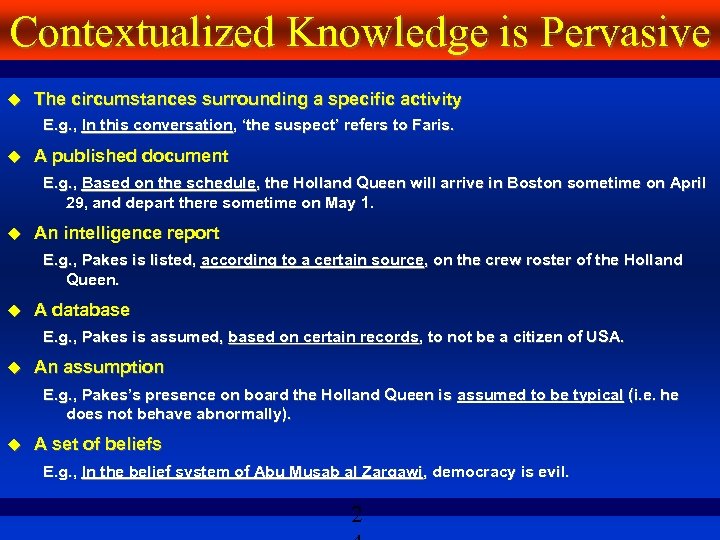
Contextualized Knowledge is Pervasive The circumstances surrounding a specific activity E. g. , In this conversation, ‘the suspect’ refers to Faris. A published document E. g. , Based on the schedule, the Holland Queen will arrive in Boston sometime on April 29, and depart there sometime on May 1. An intelligence report E. g. , Pakes is listed, according to a certain source, on the crew roster of the Holland Queen. A database E. g. , Pakes is assumed, based on certain records, to not be a citizen of USA. An assumption E. g. , Pakes’s presence on board the Holland Queen is assumed to be typical (i. e. he does not behave abnormally). A set of beliefs E. g. , In the belief system of Abu Musab al Zarqawi, democracy is evil. 2
Interoperable Contextualized Knowledge IKRIS is producing – A context logic with a formal model theory > Called IKRIS Context Logic (ICL) Recommended ways of using the logic for IC applications E. g. , to represent alternative hypothetical scenarios Methodology for automated reasoning Methodology for translating into and out of IKL The model theory supports configurable entailments Three immediate customers PARC, Cycorp, KANI 2
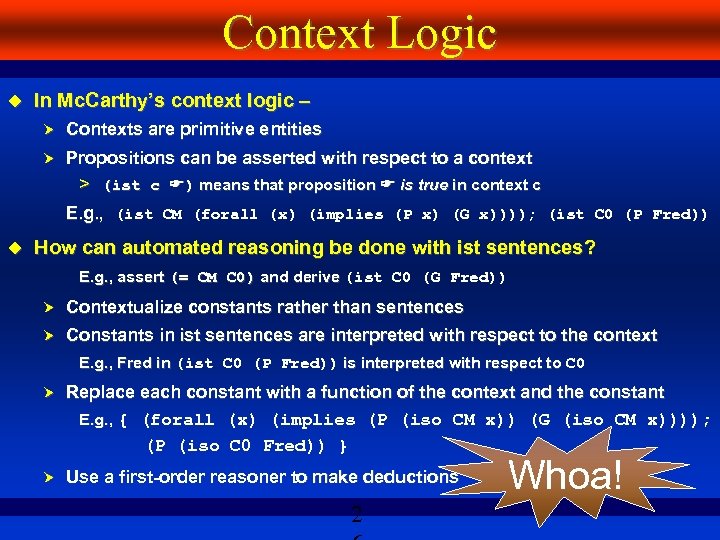
Context Logic In Mc. Carthy’s context logic – Contexts are primitive entities Propositions can be asserted with respect to a context > (ist c ) means that proposition is true in context c E. g. , (ist CM (forall (x) (implies (P x) (G x)))); (ist C 0 (P Fred)) How can automated reasoning be done with ist sentences? E. g. , assert (= CM C 0) and derive (ist C 0 (G Fred)) Contextualize constants rather than sentences Constants in ist sentences are interpreted with respect to the context E. g. , Fred in (ist C 0 (P Fred)) is interpreted with respect to C 0 Replace each constant with a function of the context and the constant E. g. , { (forall (x) (implies (P (iso CM x)) (G (iso CM x)))); (P (iso C 0 Fred)) } Use a first-order reasoner to make deductions 2 Whoa!
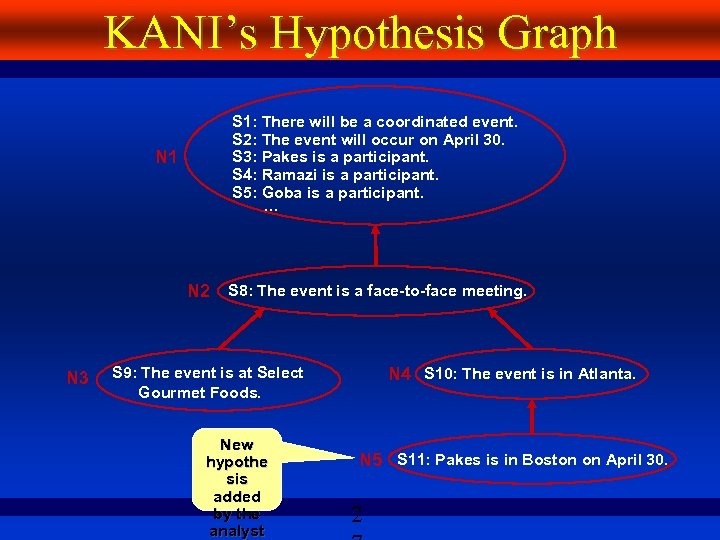
KANI’s Hypothesis Graph N 1 S 1: There will be a coordinated event. S 2: The event will occur on April 30. S 3: Pakes is a participant. S 4: Ramazi is a participant. S 5: Goba is a participant. … N 2 S 8: The event is a face-to-face meeting. N 3 N 4 S 10: The event is in Atlanta. S 9: The event is at Select Gourmet Foods. New hypothe sis added by the analyst N 5 S 11: Pakes is in Boston on April 30. 2
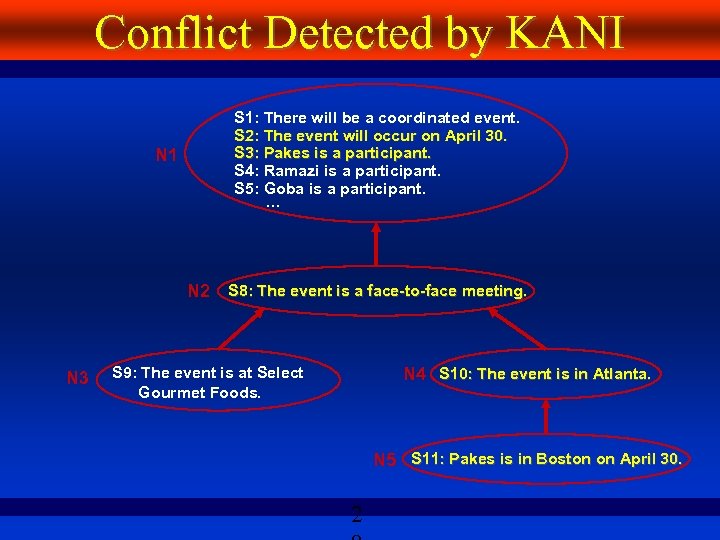
Conflict Detected by KANI N 1 S 1: There will be a coordinated event. S 2: The event will occur on April 30. S 3: Pakes is a participant. S 4: Ramazi is a participant. S 5: Goba is a participant. … N 2 S 8: The event is a face-to-face meeting. N 3 N 4 S 10: The event is in Atlanta. S 9: The event is at Select Gourmet Foods. N 5 S 11: Pakes is in Boston on April 30. 2
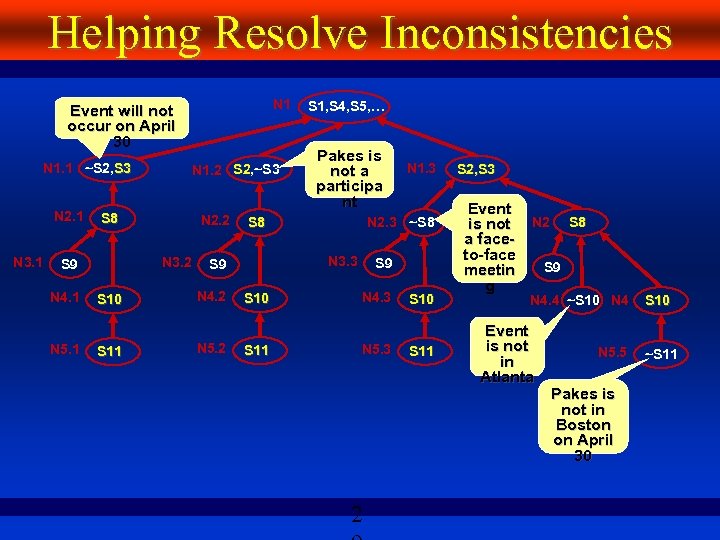
Helping Resolve Inconsistencies N 1 Event will not occur on April 30 N 1. 1 ~S 2, S 3 N 2. 1 N 3. 1 S 8 N 5. 1 N 2. 2 N 3. 2 S 9 N 4. 1 S 2 N 1. 2 S 2, ~S 3 S 10 S 11 N 5. 2 Pakes is not a participa nt N 3. 3 S 10 S 11 N 1. 3 N 2. 3 ~S 8 S 9 N 4. 2 S 1, S 4, S 5, … S 9 N 4. 3 N 5. 3 2 S 10 S 11 S 2, S 3 Event is not N 2 S 8 a faceto-face N 3. 3 S 9 meetin g N 4. 4 ~S 10 N 4 Event is not in Atlanta N 5. 5 Pakes is not in Boston on April 30 S 10 ~S 11
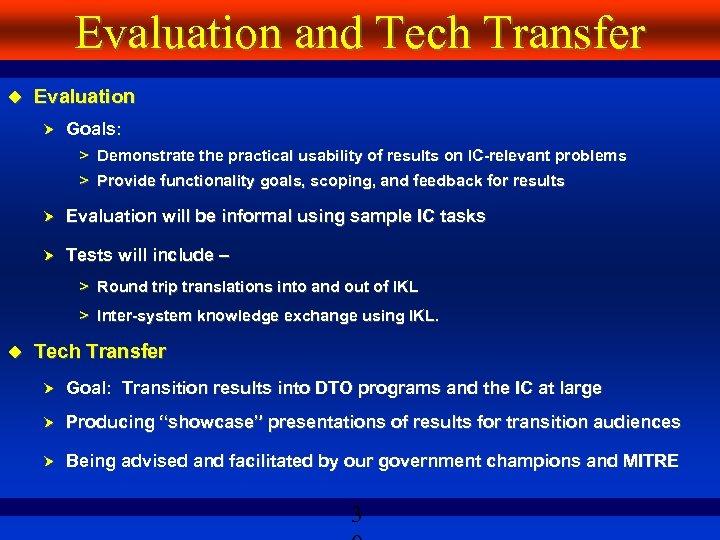
Evaluation and Tech Transfer Evaluation Goals: > Demonstrate the practical usability of results on IC-relevant problems > Provide functionality goals, scoping, and feedback for results Evaluation will be informal using sample IC tasks Tests will include – > Round trip translations into and out of IKL > Inter-system knowledge exchange using IKL. Tech Transfer Goal: Transition results into DTO programs and the IC at large Producing “showcase” presentations of results for transition audiences Being advised and facilitated by our government champions and MITRE 3
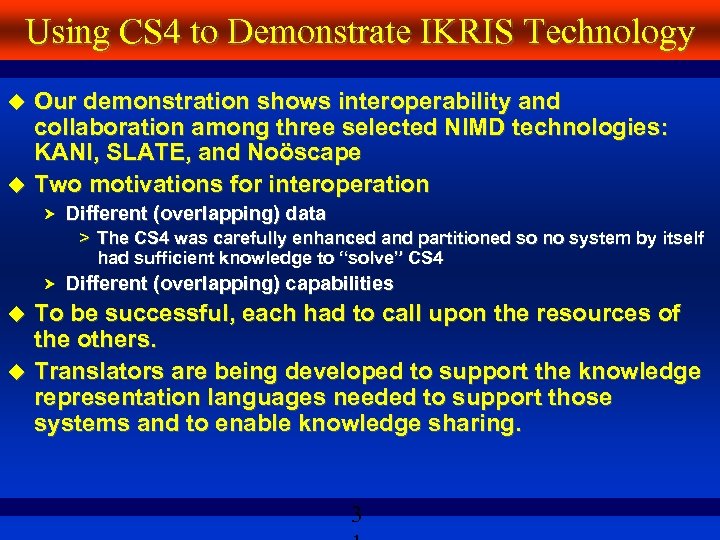
Using CS 4 to Demonstrate IKRIS Technology Our demonstration shows interoperability and collaboration among three selected NIMD technologies: KANI, SLATE, and Noöscape Two motivations for interoperation Different (overlapping) data > The CS 4 was carefully enhanced and partitioned so no system by itself had sufficient knowledge to “solve” CS 4 Different (overlapping) capabilities To be successful, each had to call upon the resources of the others. Translators are being developed to support the knowledge representation languages needed to support those systems and to enable knowledge sharing. 3
Summary IKRIS is enabling progress to be made on significant KR&R problems We are addressing two KR challenges relevant to the IC Enabling interoperability of KR technologies > Developed by multiple contractors > Designed to perform different tasks Interoperable representations of scenarios and contextualized knowledge > To support automated analytical reasoning about alternative hypotheses Initial versions of the technical results have been completed For more information, check out the IKRIS Web site http: //nrrc. mitre. org/NRRC/ikris. htm 3 2
Скачать презентацию Interoperable Knowledge Representation for Intelligence Support IKRIS A
3d40d5b7601c9bc495eba5d007e68659.ppt