 Скачать презентацию Interoperable Architecture in Distributed Data Sharing Settings Louis
f48d821f4812d1b5b2af6bee65bae8d5.ppt
- Количество слайдов: 19



Interoperable Architecture in Distributed Data Sharing Settings Louis Hecht Executive Director Regional Operations and Development lhecht@opengeospatial. org 301 -654 -0698 © 2005, Open Geospatial Consortium, Inc.
Talk Topics • OGC leads the development of web based geospatial standards based on common architecture methods – What is OGC and What do we do, Some of our members – The General Idea Behind Interoperability • Interoperability in the Federal Enterprise Architecture – OGC architecture – OGC specifications and standards • Distributed Data and Services and Government interoperability – Data Harmonization – Protecting value of legacy data and systems – Easing insertion of new technologies and updating old ones • What might COG consider OGC © 2005, Open Geospatial Consortium, Inc. 2
OGC Background • Open Geospatial Consortium (OGC) – Not-for-profit, international voluntary consensus standards organization • Incorporated in US, UK, Australia – 280+ industry, government, and university members – Class A Liaison of ISO TC 211, TC 204 and CEN TC 287 – Founded in 1994 OGC © 2005, Open Geospatial Consortium, Inc. OGC Mission To lead in the development, promotion and harmonization of open spatial standards, to support their effective implementation and ICT infrastructure architectures worldwide, and to advance the formation of new market opportunities for spatial information and processing services. 3
OGC Vision A world in which everyone benefits from geographic information and services made available across any network, application, or platform. OGC © 2005, Open Geospatial Consortium, Inc. 4
Who Belongs to OGC? • Vendors (examples) – Autodesk, Compusult, Cubewerx, ESRI, Galdos, Intergraph, Ionic, Laser Scan Ltd. , Object. FX, Map. Info, NAVTEQ, Tele Atlas • Integrators (examples) – BAE Systems, Boeing S&IS, Booze Allen Hamilton, Harris Corp, ITT Industries, Lockheed Martin, Michael Baker, Jr. , Northrop Grumman – TASC, Parsons-Brinckerhoff, Raytheon, SAIC • Universities (examples) – Alabama – Huntsville, Arkansas, Columbia, MIT, GMU, Harvard, Illinois, Indiana, Penn State, Maine, Maryland, Michigan State, Minnesota, Washington U in St. Louis Full list available at: http: //www. opengeospatial. org/about/? page=members&view=Name OGC © 2005, Open Geospatial Consortium, Inc. 5
Who Belongs to OGC? • U. S. Government Organizations – – – U. S. Defense Modeling & Simulation Office (DMSO) U. S. Naval Research Laboratory Program Executive Office, C 4 I and Space US Army Corps of Engineers (ACE) US Census Bureau US Environmental Protection Agency (EPA) US Federal Emergency Management Agency (FEMA) US Federal Geographic Data Committee (FGDC) US Geological Survey (USGS), National Mapping Division US National Aeronautics and Space Administration (NASA) US National Geospatial-Intelligence Agency (NGA) US National Oceanic and Atmospheric Administration (NOAA/NCDDC) OGC © 2005, Open Geospatial Consortium, Inc. 6
What is OGC Interoperability? - The General Idea • The ability of systems to exchange and use information and services. – By "systems, " we mean software processes, services and other components, the data, hardware, and supporting networks. • This capability comes from open standards. • OGC has developed an open framework that enables geospatial interoperability. – using a global-based voluntary consensus-based process -- specifications that result -- describe open, vendor-neutral, and non-proprietary interfaces, encodings and human to machine vocabularies. OGC © 2005, Open Geospatial Consortium, Inc. 7
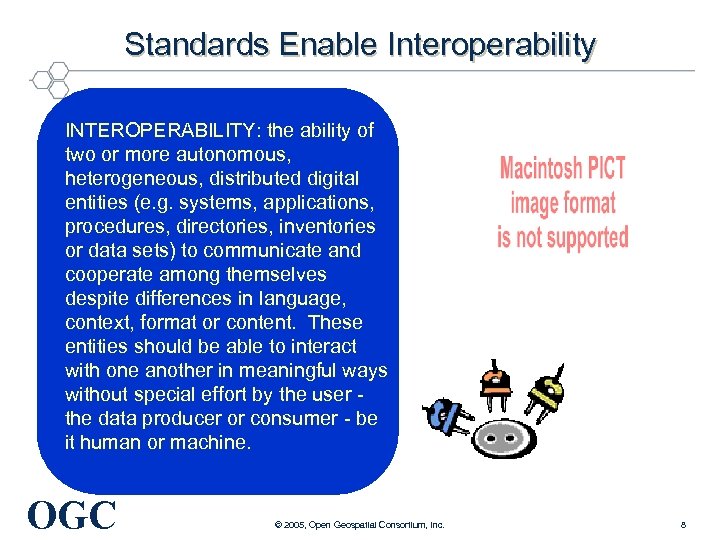
Standards Enable Interoperability INTEROPERABILITY: the ability of two or more autonomous, heterogeneous, distributed digital entities (e. g. systems, applications, procedures, directories, inventories or data sets) to communicate and cooperate among themselves despite differences in language, context, format or content. These entities should be able to interact with one another in meaningful ways without special effort by the user - the data producer or consumer - be it human or machine. OGC © 2005, Open Geospatial Consortium, Inc. 8
OGC’s Place in the Market • To enable interoperability – OGC operates our consensus process with industry, government and academic members to define architectures and interfaces – OGC commercial vendor and integrator members write and sell software that uses our published OGC interfaces – Interface specifications are also made public – Users like yourselves -- employ OGC-based architectures -- to decide what software to buy that satisfies your requirements and operational necessities OGC © 2005, Open Geospatial Consortium, Inc. 9
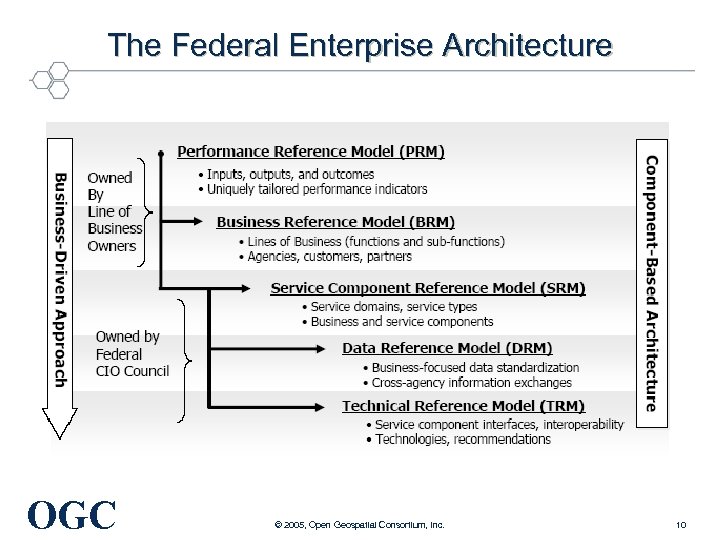
The Federal Enterprise Architecture OGC © 2005, Open Geospatial Consortium, Inc. 10
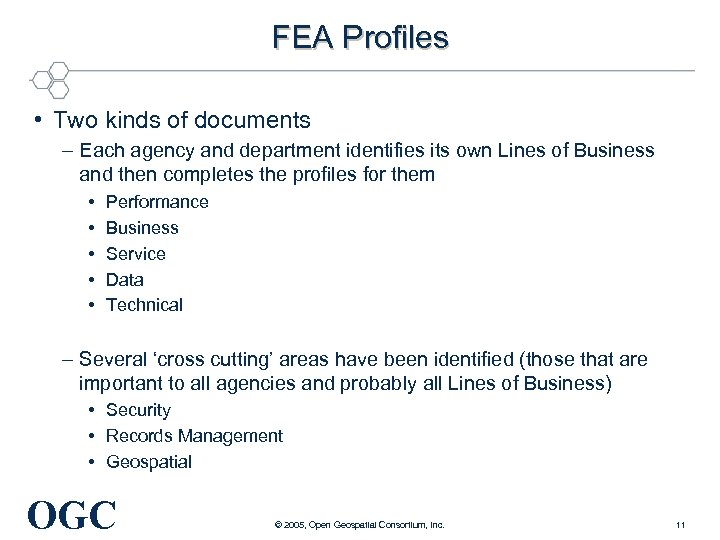
FEA Profiles • Two kinds of documents – Each agency and department identifies its own Lines of Business and then completes the profiles for them • • • Performance Business Service Data Technical – Several ‘cross cutting’ areas have been identified (those that are important to all agencies and probably all Lines of Business) • Security • Records Management • Geospatial OGC © 2005, Open Geospatial Consortium, Inc. 11
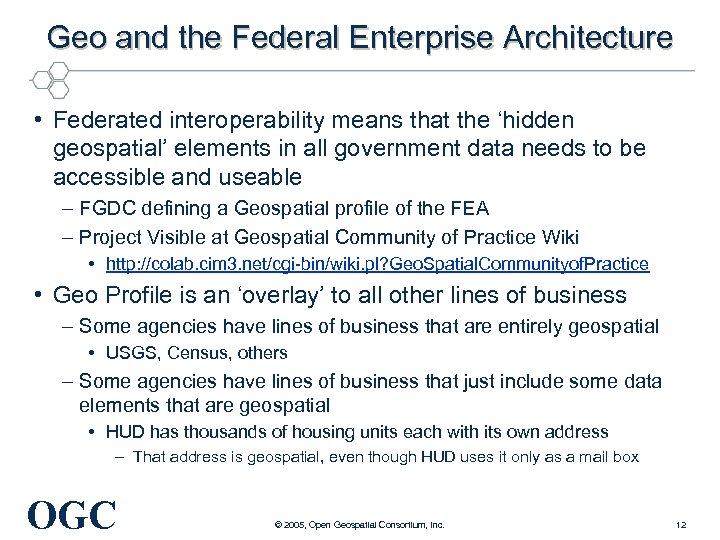
Geo and the Federal Enterprise Architecture • Federated interoperability means that the ‘hidden geospatial’ elements in all government data needs to be accessible and useable – FGDC defining a Geospatial profile of the FEA – Project Visible at Geospatial Community of Practice Wiki • http: //colab. cim 3. net/cgi-bin/wiki. pl? Geo. Spatial. Communityof. Practice • Geo Profile is an ‘overlay’ to all other lines of business – Some agencies have lines of business that are entirely geospatial • USGS, Census, others – Some agencies have lines of business that just include some data elements that are geospatial • HUD has thousands of housing units each with its own address – That address is geospatial, even though HUD uses it only as a mail box OGC © 2005, Open Geospatial Consortium, Inc. 12
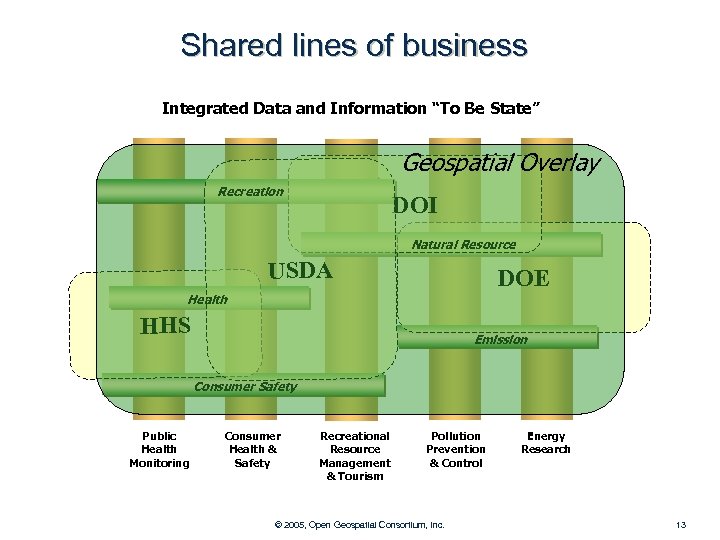
Shared lines of business Integrated Data and Information “To Be State” Recreation Using the FEA-DRM Geospatial Overlay DOI Natural Resource USDA DOE Health HHS Emission Consumer Safety Public Health Monitoring Consumer Health & Safety Recreational Resource Management & Tourism Pollution Prevention & Control © 2005, Open Geospatial Consortium, Inc. Energy Research 13
Geo. COP Plan • 30 September 2005 – Deliver Geospatial Profile document • Overview • Context for all five Reference Models • Geo ‘overlay’ for all five Reference Models – Address geo as line of business – Address geo elements in all other lines of business • Next fiscal year – Demonstrate proof that the proposed profile supports interoperability – OGC specifications will be required OGC © 2005, Open Geospatial Consortium, Inc. 14
The Role of Data for Realizing the FEA Vision • Data needs to discoverable and semantically interoperable – The first barrier to sharing is knowing it exists – The user must know what a ‘road’ is • Services that access data need to automatically useable – User must know what the service is – Chaining is desireable • Architecture into which the services fit to manipulate the data – You plug your new stereo into the wall for power and into the rest of your system to make it work – why not geospatial processing too? • All three rely on open, industry consensus standards to fit the pieces together – multi-jurisdictional payers means multi-vendor software OGC © 2005, Open Geospatial Consortium, Inc. 15
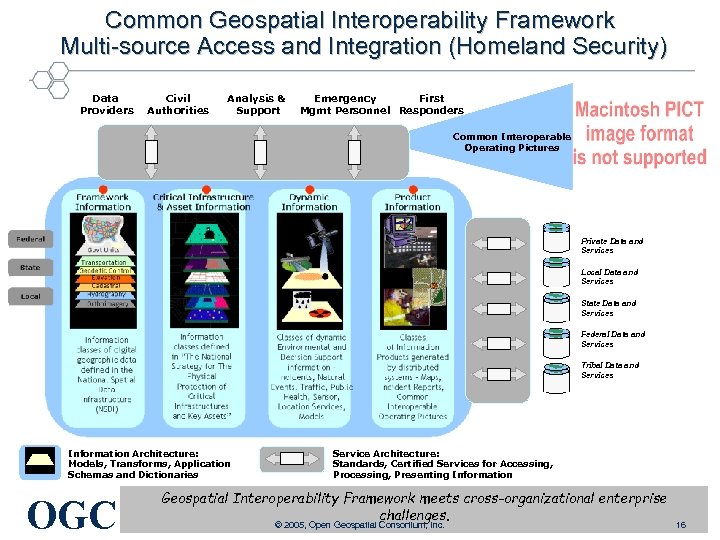
Common Geospatial Interoperability Framework Multi-source Access and Integration (Homeland Security) Data Providers Civil Authorities Analysis & Support Emergency First Mgmt Personnel Responders Common Interoperable Operating Pictures Private Data and Services Local Data and Services State Data and Services Federal Data and Services Tribal Data and Services Information Architecture: Models, Transforms, Application Schemas and Dictionaries OGC Service Architecture: Standards, Certified Services for Accessing, Processing, Presenting Information Geospatial Interoperability Framework meets cross-organizational enterprise challenges. © 2005, Open Geospatial Consortium, Inc. 16
Data Harmonization Approach (1) • A single data model or specification for all domains is extremely unlikely • Traditional bulk transfer of data (sets) is often too inflexible and not meeting user requirements • Approach focussing on providing services to the information gained from different data holdings is required • Application Schema defines content and structure of data but may also specify services for accessing and manipulating data by an application • Services Architecture details the required services and interfaces to implement a solution that serves the user information requirements through automated translation of existing data sources and their existing stovepipe data models into harmonized schemas with resulting output suitable for sharing and human use OGC © 2005, Open Geospatial Consortium, Inc. 17
Data Harmonization Approach (2) • Application Schema specifies the domain specific feature types – describing the specific view of the real world based on the information requirements of that domain – Define the core concepts of the domain in a meaningful way (e. g. “lake”, “parcel”, “road”) along with their attributes, properties, possible constraints, etc. • Proven to be extremely valuable in building geospatial information networks comprising heterogeneous data sources OGC © 2005, Open Geospatial Consortium, Inc. 18
Summary • OGC leads the development of web based geospatial standards based on common architecture methods • U. S. government is defining Federal Enterprise Architecture – OGC architecture fits into FEA • Data and services will move interoperably around the government – – Easing insertion of new technologies and updating old ones – Protecting value of legacy data and systems • COG and member organizations need to share data and use a plethora of sources. . . – COG will need to situate itself within the FEA framework – COG will need to consider an iterative development strategy – Today’s requirements for exchanging geospatial data and the multi jurisdictional nature of those sources requires COG to consider using open, industry standardization for sharing information between jurisdictions OGC © 2005, Open Geospatial Consortium, Inc. 19
Скачать презентацию Interoperable Architecture in Distributed Data Sharing Settings Louis
f48d821f4812d1b5b2af6bee65bae8d5.ppt