 Скачать презентацию Interoperability — is it feasible — Peter Wittenburg
f45d962e03ea09deb6eb2a2c417f905d.ppt
- Количество слайдов: 42



Interoperability - is it feasible - Peter Wittenburg The Language Archive – Max Planck Institute for Psycholinguistics Nijmegen, The Netherlands
Why care about interoperability? • e-Science & e-Humanities • “data is the currency of modern research” • thus need to get integrated access to many data sets • data sets are • scattered across many repositories => (virtual) integration • created by different research teams using different conventions (formats, semantics) • often in bad states and quality => curation • thus interoperability most used word at ICRI conference • Big Questions: • What is meant with interoperability? • How to remove interoperability barriers to analyze large heterogeneous and probably distributed data sets? • Is interoperability something we need/want to achieve?
What is interoperability? 1. Wikipedia: Interoperability is a property of a system, whose interfaces are completely understood, to work with other systems, present or future, without any restricted access or implementation. 2. IEEE: Interoperability is the ability of two or more systems or components to exchange information and to use the information that has been exchanged. 3. O’Brian/Marakas: Being able to accomplish end-user applications using different types of computer system, operating systems, and application software, interconnected by different types of local and wide-area networks. 4. OSLC: To be interoperable one should actively be engaged in the ongoing process of ensuring that the systems, procedures and culture of an organization are managed in such a way as to maximise opportunities for exchange and re-use of information.
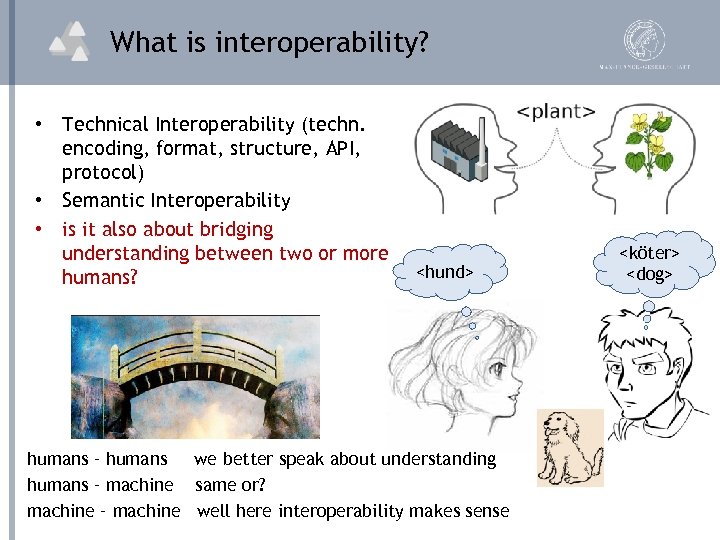
What is interoperability? • Technical Interoperability (techn. encoding, format, structure, API, protocol) • Semantic Interoperability • is it also about bridging understanding between two or more humans? <hund> humans – humans we better speak about understanding humans – machine same or? machine – machine well here interoperability makes sense <köter> <dog>
What is interoperability? • • seems that every one speaks about technical systems when talking about interoperability do we include feeding machines with some mapping rules specified by human users and then carrying out some automatic functions? • when linguists hear about mapping tag sets some immediately say that it is impossible and does not make sense • why: tags are part of a whole theory behind it well if you look to other disciplines (life sciences, earth observation sciences etc. ) that’s exactly what they do why • people want to work across collections and ignore theories • some see tag sets just as first help but want to work on raw data • some see the demand of politicians and society to come up with answers and not with statements about problems • AND there is much money (is it useless? )
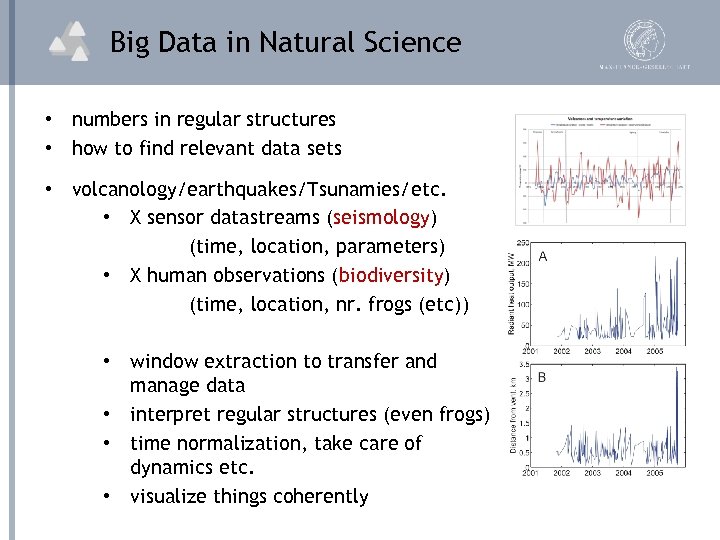
Big Data in Natural Science • numbers in regular structures • how to find relevant data sets • volcanology/earthquakes/Tsunamies/etc. • X sensor datastreams (seismology) (time, location, parameters) • X human observations (biodiversity) (time, location, nr. frogs (etc)) • window extraction to transfer and manage data • interpret regular structures (even frogs) • time normalization, take care of dynamics etc. • visualize things coherently
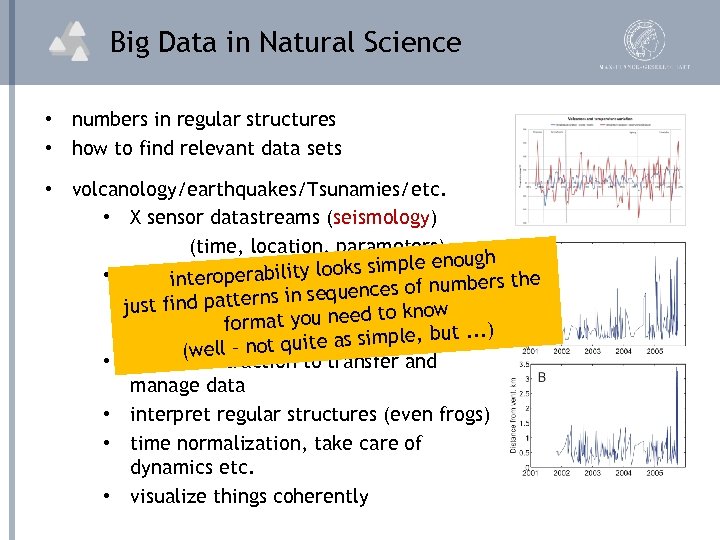
Big Data in Natural Science • numbers in regular structures • how to find relevant data sets • volcanology/earthquakes/Tsunamies/etc. • X sensor datastreams (seismology) (time, location, parameters) h oks simple enoug bility lo(biodiversity) bers the • X humanrobservations inte opera ue ces of num s in seqnr. nfrogs (etc)) (time, rn just find pattelocation, need to know format you , but. . . ) t quite as simple (well – no • window extraction to transfer and manage data • interpret regular structures (even frogs) • time normalization, take care of dynamics etc. • visualize things coherently
Big Data in Environmental Sciences • many different types of observations • climate, weather, etc. • species and populations according to multitude of classification systems and schools • grand challenge • how can all these observations be used to stabilize our environment • how can it all be used to maintain diversity • etc.
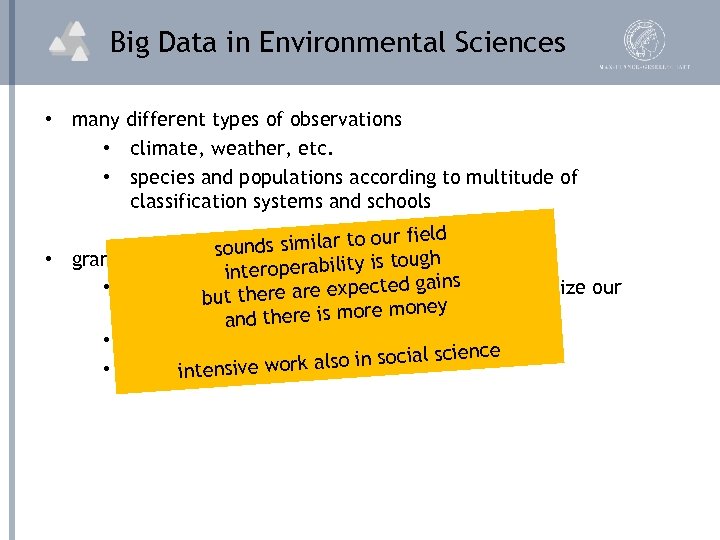
Big Data in Environmental Sciences • many different types of observations • climate, weather, etc. • species and populations according to multitude of classification systems and schools • grand • • • our field sounds similar to challenge is tough interoperability ga used how can all there are expected be ins to stabilize our ut these observations ney b environment d there is more mo an how can it all be used to maintain diversity science ork also in social etc. intensive w
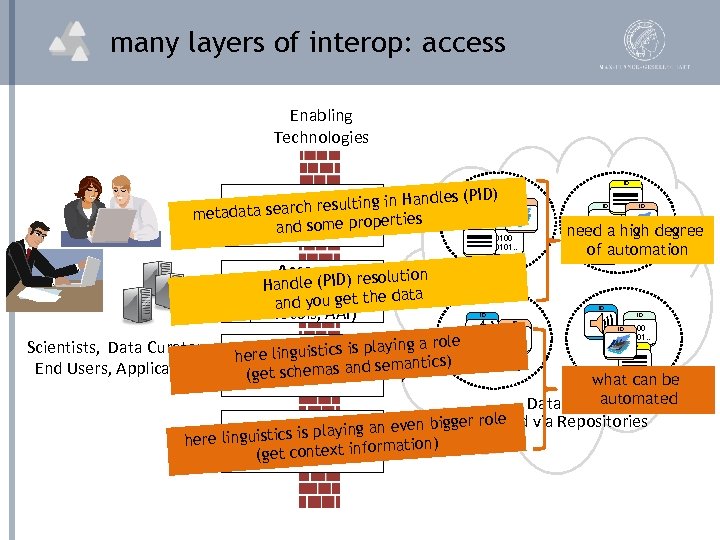
many layers of interop: access Enabling Technologies ID les (PID) resulting in Hand search 0100 metadata Discovery roperties 0101. . 0100 some p and 0101. . ID ID ID 0100 0101. . Access ) resolution H ndle (PID (ref. aresolution, the data and you get protocols, AAI) Scientists, Data Curators, End Users, Applications ing a role linguistics is play here Interpretation d semantics) (get schemas an ID 0100 0101. . ID ID need a high degree of automation ID ID 0100 0101. . ID what can be Datasets automated Accessed via Repositories ven bigger role cs is playing an e here linguisti Reuse ation) et context inform (g
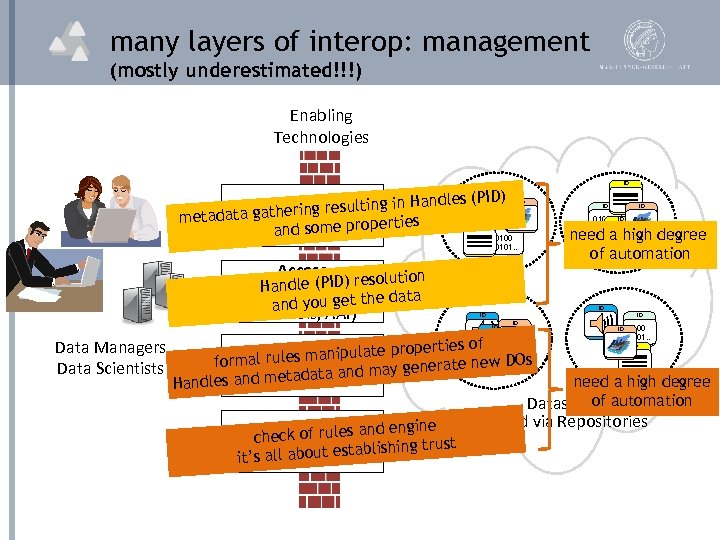
many layers of interop: management (mostly underestimated!!!) Enabling Technologies ) (P Collections sulting in Handles 0100 ID ring re+ metadata gathe 0101. . 0100 Properties properties and some 0101. . 0100 ID ID ID 0100 0101. . ID need a high degree of automation ID 0101. . Access lution Handle (PID) reso (ref. resolution, the data and you get protocols, AAI) Data Managers Data Scientists ID ID ID ies of formalized policieste propert te new DOs rules manipula formal genera workflowata and may d metad engine Handles an ID ID ID 0100 0101. . ID need a high degree Datasets of automation Accessed via Repositories ine of rules and eng check Assessment ablishing trust it’s all about est
simple but essential example: PIDs • it’s similar to TCP/IP with all its core machinery that brought us the Internet and thus interoperability with respect to communication • email system works when we abstract from content and thus the semantics of our human messages and focus on the semantics of attributes, parameters etc. • let’s assume that you want to use a certain file and first want to be sure that the file has not been modified • you look up in metadata • that automatically looks for the PID • the PID is resolved automatically and a checksum is retrieved • the checksum is automatically compared with the checksum of the file accessed • a warning is given automatically if the two don’t match • this would be a great service (and will come)
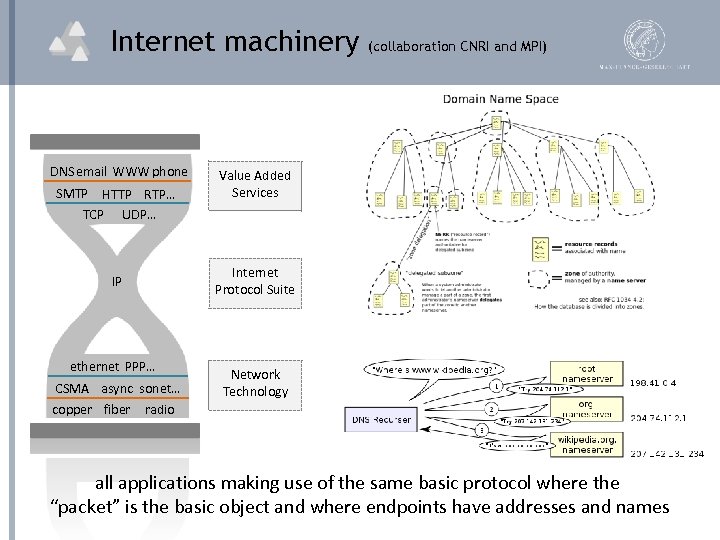
Internet machinery DNS email WWW phone SMTP HTTP RTP… TCP UDP… Value Added Services Internet Protocol Suite IP ethernet PPP… CSMA async sonet… copper fiber (collaboration CNRI and MPI) Network Technology radio all applications making use of the same basic protocol where the “packet” is the basic object and where endpoints have addresses and names
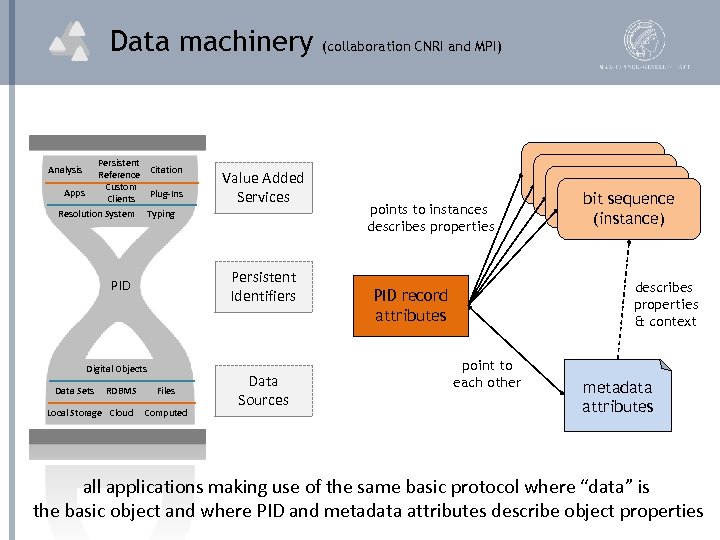
Data machinery Persistent Citation Reference Custom Plug-Ins Clients Analysis Apps Resolution System Typing Persistent Identifiers PID Digital Objects Data Sets RDBMS Local Storage Cloud Value Added Services Files Computed Data Sources (collaboration CNRI and MPI) points to instances describes properties bit sequence (instance) describes properties & context PID record attributes point to each other metadata attributes all applications making use of the same basic protocol where “data” is the basic object and where PID and metadata attributes describe object properties
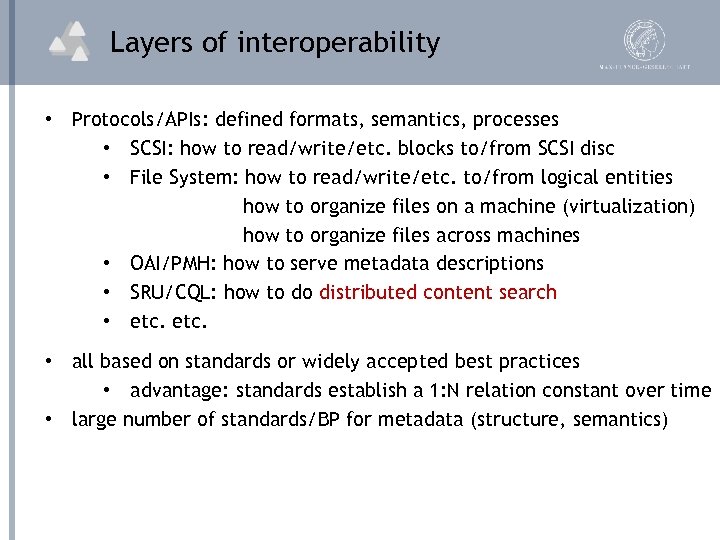
Layers of interoperability • Protocols/APIs: defined formats, semantics, processes • SCSI: how to read/write/etc. blocks to/from SCSI disc • File System: how to read/write/etc. to/from logical entities how to organize files on a machine (virtualization) how to organize files across machines • OAI/PMH: how to serve metadata descriptions • SRU/CQL: how to do distributed content search • etc. • all based on standards or widely accepted best practices • advantage: standards establish a 1: N relation constant over time • large number of standards/BP for metadata (structure, semantics)
back to linguistics • where are we in the linguistics domain? • what happened in some well-known projects • do we miss the big challenges which other disciplines have and that would force us to ignore schools, vainness, etc. • 4 examples • metadata • DOBES • TDS • CLARIN
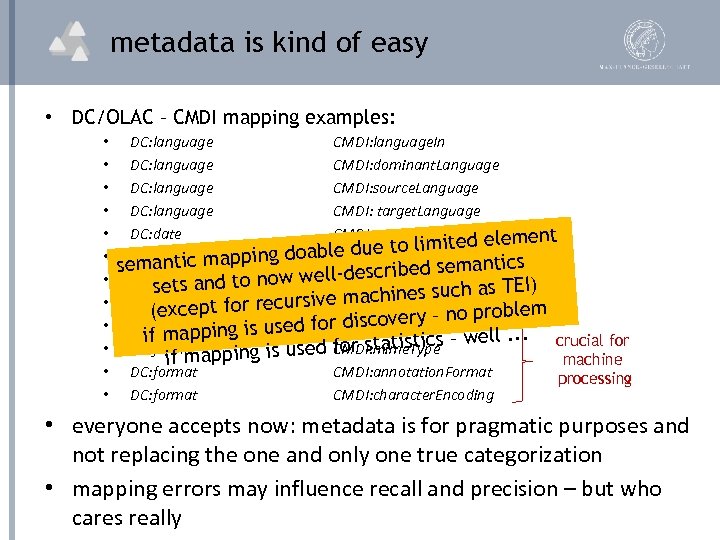
metadata is kind of easy • DC/OLAC – CMDI mapping examples: • • • DC: language CMDI: language. In DC: language CMDI: dominant. Language DC: language CMDI: source. Language DC: language CMDI: target. Language DC: date CMDI: creation. Date lement due to limited e g doable DC: date CMDI: publication. Date tics semantic mappin eman well-described s DC: dates and to now CMDI: start. Year TEI) set achines such as DC: date ept for recursive m CMDI: derivation. Date blem (exc iscovery – no pro DC: format ping is used for d CMDI: media. Type. . . crucial for if map r statistics – well fo DC: format apping is used CMDI: mime. Type if m machine DC: format CMDI: annotation. Format processing DC: format CMDI: character. Encoding • everyone accepts now: metadata is for pragmatic purposes and not replacing the one and only one true categorization • mapping errors may influence recall and precision – but who cares really
truth in metadata usage – still !! Rebecca Koskela: Data. ONE
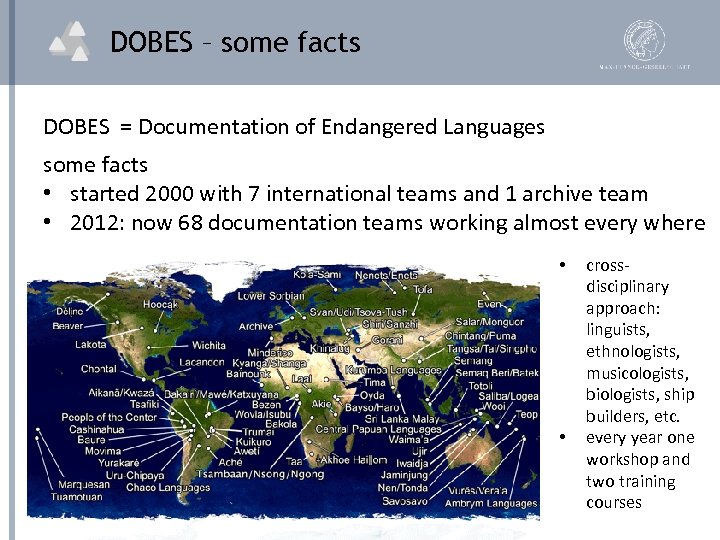
DOBES – some facts DOBES = Documentation of Endangered Languages some facts • started 2000 with 7 international teams and 1 archive team • 2012: now 68 documentation teams working almost every where • • crossdisciplinary approach: linguists, ethnologists, musicologists, biologists, ship builders, etc. every year one workshop and two training courses
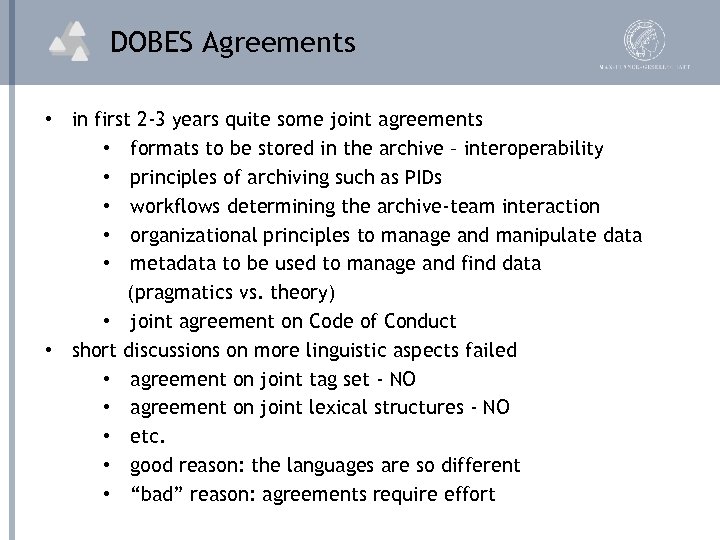
DOBES Agreements • in first 2 -3 years quite some joint agreements • formats to be stored in the archive – interoperability • principles of archiving such as PIDs • workflows determining the archive-team interaction • organizational principles to manage and manipulate data • metadata to be used to manage and find data (pragmatics vs. theory) • joint agreement on Code of Conduct • short discussions on more linguistic aspects failed • agreement on joint tag set - NO • agreement on joint lexical structures - NO • etc. • good reason: the languages are so different • “bad” reason: agreements require effort
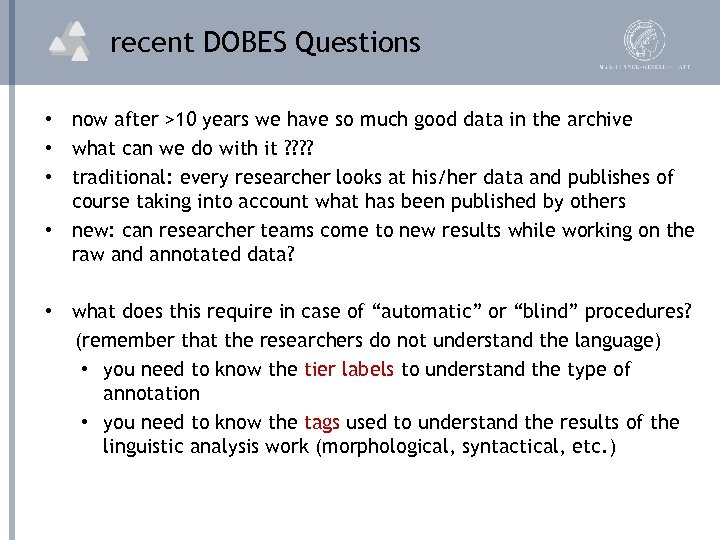
recent DOBES Questions • now after >10 years we have so much good data in the archive • what can we do with it ? ? • traditional: every researcher looks at his/her data and publishes of course taking into account what has been published by others • new: can researcher teams come to new results while working on the raw and annotated data? • what does this require in case of “automatic” or “blind” procedures? (remember that the researchers do not understand the language) • you need to know the tier labels to understand the type of annotation • you need to know the tags used to understand the results of the linguistic analysis work (morphological, syntactical, etc. )
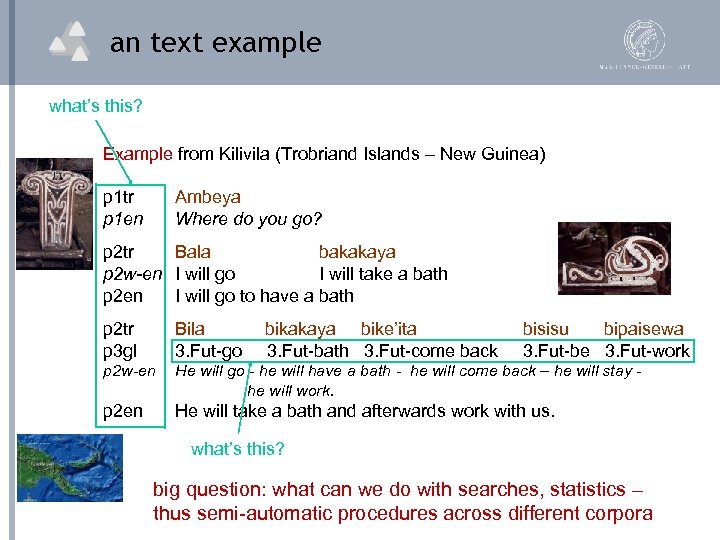
an text example what’s this? Example from Kilivila (Trobriand Islands – New Guinea) p 1 tr p 1 en Ambeya Where do you go? p 2 tr Bala bakakaya p 2 w-en I will go I will take a bath p 2 en I will go to have a bath p 2 tr p 3 gl Bila bikakaya bike’ita bisisu bipaisewa 3. Fut-go 3. Fut-bath 3. Fut-come back 3. Fut-be 3. Fut-work p 2 w-en He will go - he will have a bath - he will come back – he will stay he will work. p 2 en He will take a bath and afterwards work with us. what’s this? big question: what can we do with searches, statistics – thus semi-automatic procedures across different corpora
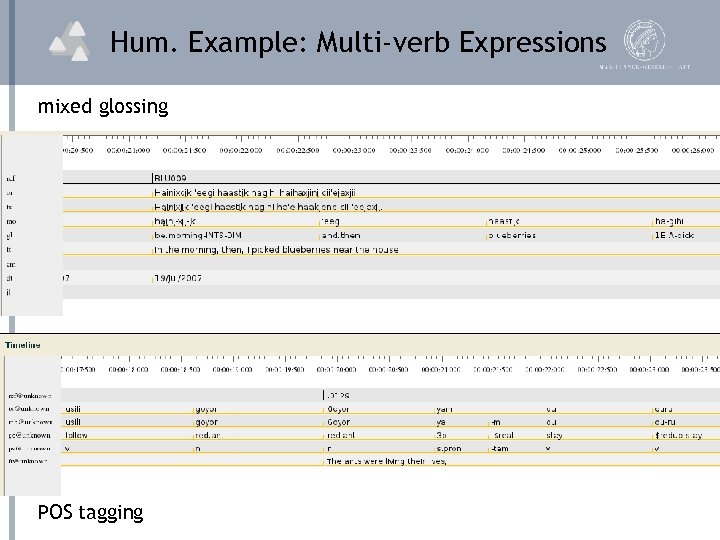
Hum. Example: Multi-verb Expressions mixed glossing POS tagging
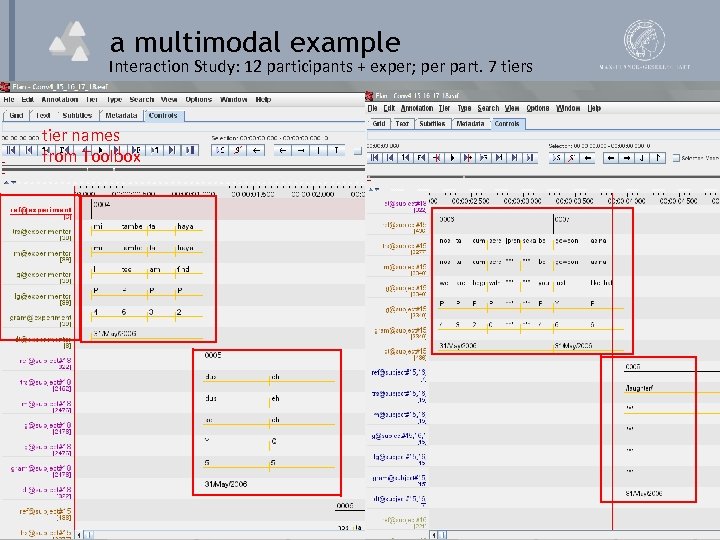
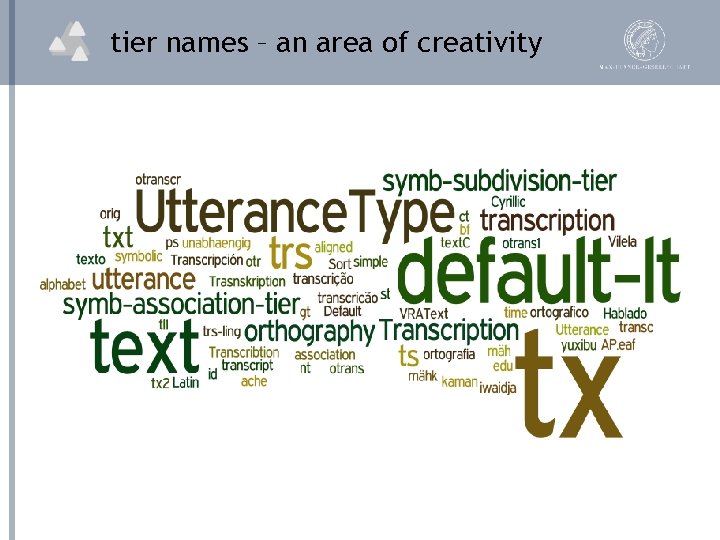
a multimodal example Interaction Study: 12 participants + exper; per part. 7 tiers tier names from Toolbox
tier names – an area of creativity
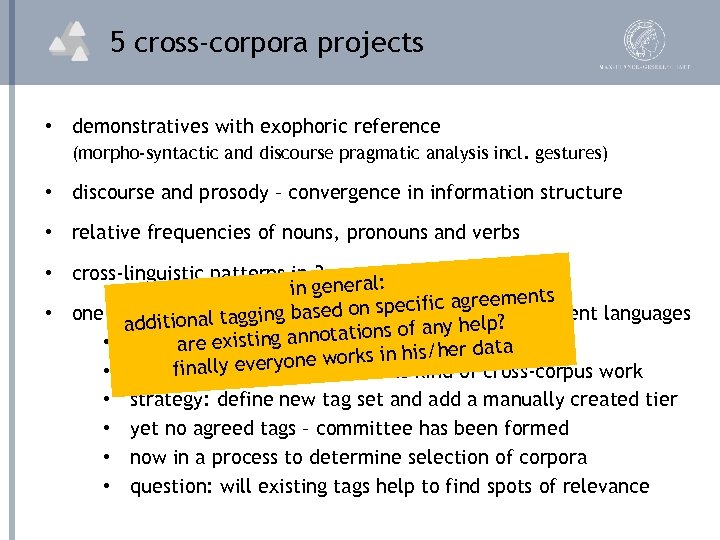
5 cross-corpora projects • demonstratives with exophoric reference (morpho-syntactic and discourse pragmatic analysis incl. gestures) • discourse and prosody – convergence in information structure • relative frequencies of nouns, pronouns and verbs • cross-linguistic patterns in 3 -participant events in general: m nts specif covering e on teamsic agree different languages • one rather ional tagging based 13 large program with addit ny help? annotations of a • primaryetopicting ar exis is “referentiality” /her data one to do in his everyhow works this kind of cross-corpus work finally • bigger question: • strategy: define new tag set and add a manually created tier • yet no agreed tags – committee has been formed • now in a process to determine selection of corpora • question: will existing tags help to find spots of relevance
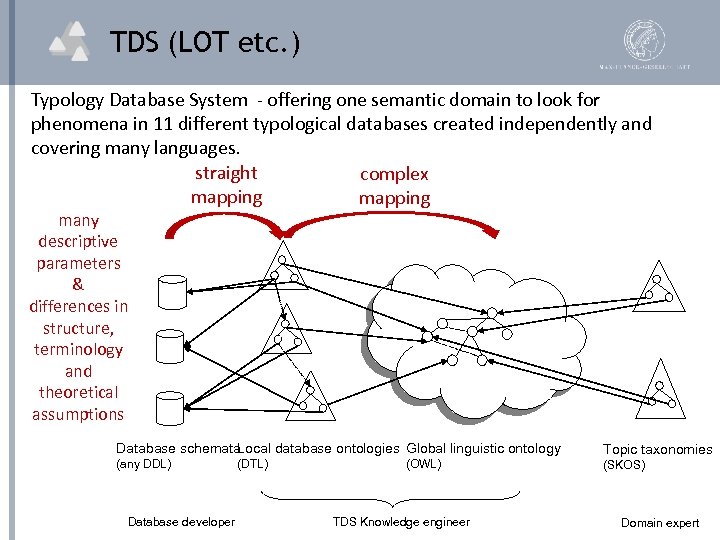
TDS (LOT etc. ) Typology Database System - offering one semantic domain to look for phenomena in 11 different typological databases created independently and covering many languages. straight complex mapping many descriptive parameters & differences in structure, terminology and theoretical assumptions Database schemata Local database ontologies Global linguistic ontology Topic taxonomies (any DDL) (SKOS) Database developer (DTL) (OWL) TDS Knowledge engineer Domain expert
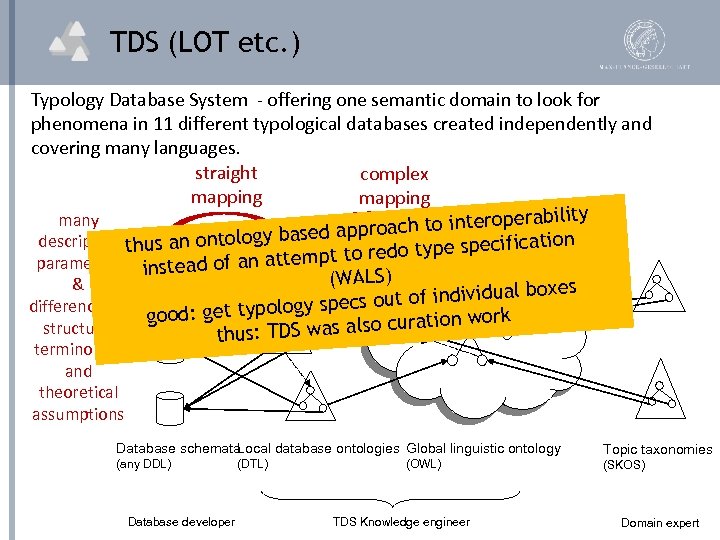
TDS (LOT etc. ) Typology Database System - offering one semantic domain to look for phenomena in 11 different typological databases created independently and covering many languages. straight complex mapping perability many proach to intero ap descriptive thus an ontology based ication redo type specif parameters instead of an attempt to (WALS) & al boxes s out of individu differences in gy spec good: get typolo n work structure, was also curatio thus: TDS terminology and theoretical assumptions Database schemata Local database ontologies Global linguistic ontology Topic taxonomies (any DDL) (SKOS) Database developer (DTL) (OWL) TDS Knowledge engineer Domain expert
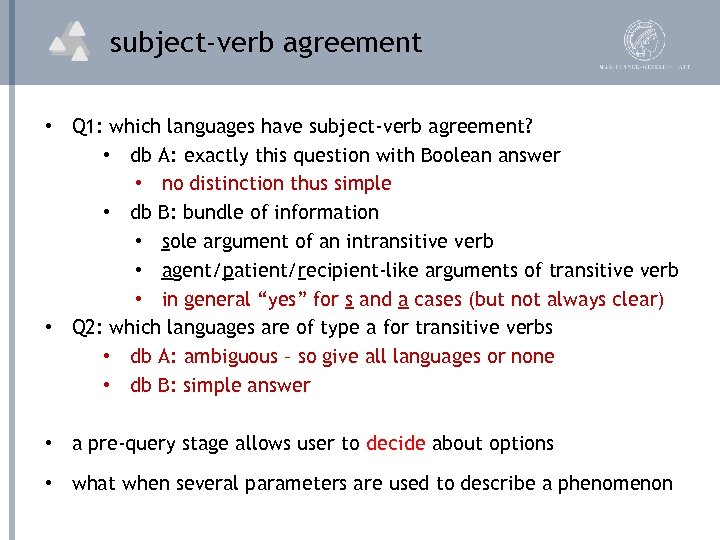
subject-verb agreement • Q 1: which languages have subject-verb agreement? • db A: exactly this question with Boolean answer • no distinction thus simple • db B: bundle of information • sole argument of an intransitive verb • agent/patient/recipient-like arguments of transitive verb • in general “yes” for s and a cases (but not always clear) • Q 2: which languages are of type a for transitive verbs • db A: ambiguous – so give all languages or none • db B: simple answer • a pre-query stage allows user to decide about options • what when several parameters are used to describe a phenomenon
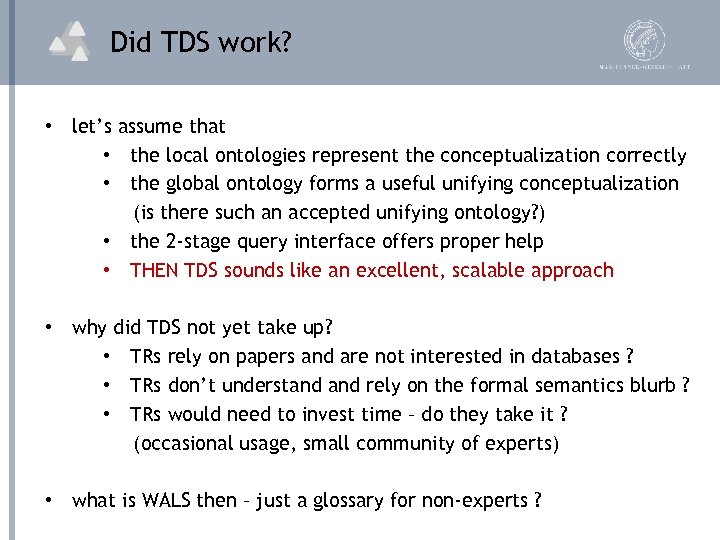
Did TDS work? • let’s assume that • the local ontologies represent the conceptualization correctly • the global ontology forms a useful unifying conceptualization (is there such an accepted unifying ontology? ) • the 2 -stage query interface offers proper help • THEN TDS sounds like an excellent, scalable approach • why did TDS not yet take up? • TRs rely on papers and are not interested in databases ? • TRs don’t understand rely on the formal semantics blurb ? • TRs would need to invest time – do they take it ? (occasional usage, small community of experts) • what is WALS then – just a glossary for non-experts ?
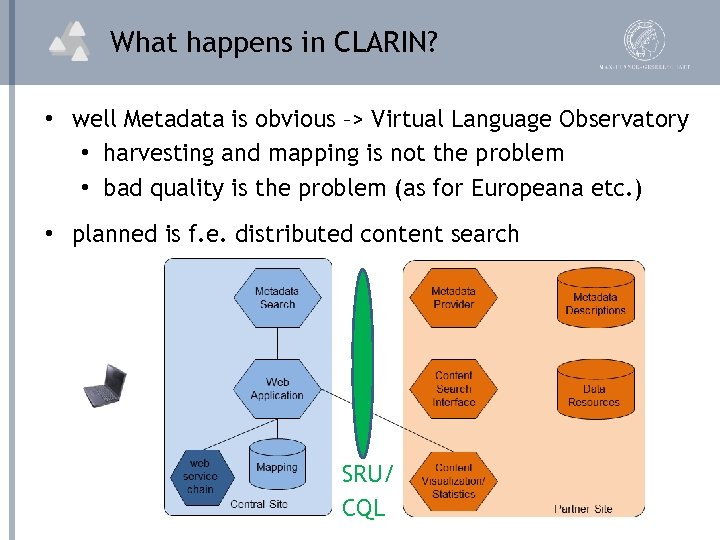
What happens in CLARIN? • well Metadata is obvious –> Virtual Language Observatory • harvesting and mapping is not the problem • bad quality is the problem (as for Europeana etc. ) • planned is f. e. distributed content search SRU/ CQL
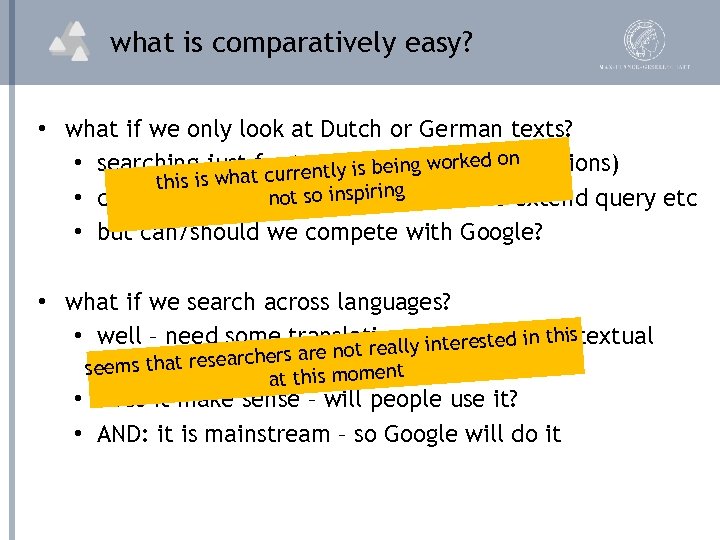
what is comparatively easy? • what if we only look at Dutch or German texts? • searching just tforrtextual being worked on patterns (collocations) a cu rently is this is wh • could make use not SUMO, ir. Wordnets to extend query etc of so insp ing • but can/should we compete with Google? • what if we search across languages? • well – need some translation y interested inforistextual mechanism th reall ot e could rs are n s that r– searchebe trivial ent patterns translation seem at this mom • does it make sense – will people use it? • AND: it is mainstream – so Google will do it
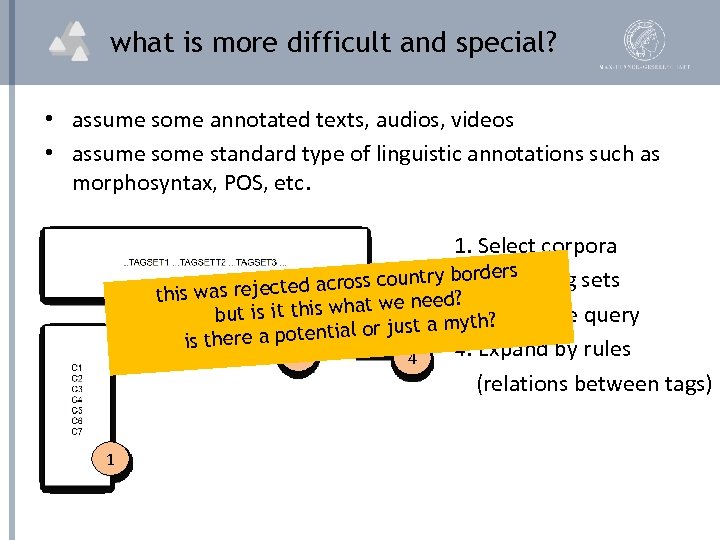
what is more difficult and special? • assume some annotated texts, audios, videos • assume some standard type of linguistic annotations such as morphosyntax, POS, etc. 1. Select corpora borders d across country 2. Select Tag sets this was rejecte 2 need? is it this what we but 3. Formulate query or just a myth? ial is there a potent 4. Expand by rules 3 4 (relations between tags) 1
semantic bridges: how? • assume that we have two corpora: one encoded by STTS and the other one by CGN and assume that they have some linguistic annotation (morphosyntax, POS, etc. ) to be used in a distributed search or statistics (take care: searching != statistics) • what to do now to exploit both collections? 1. do separate searches – well. . . 2. create rich umbrella ontology and complex refs (comparable to TDS) • • well - could become a never ending story. . . people disagree on relations etc. relations partly depend on pragmatic considerations expensive, static, require experts, not understandable, etc.
Are flat category registries ok? 3. flat registries of linguistic categories such as ISOcat (12620) sound like a solution for some tasks • easy mapping between two (or more) categories • users can easily create their own mappings or re-use some • maintenance is more easy and thus allows dynamics • etc. • so it seems that we could overcome the TDS barrier • but we are reducing accuracy and losing much information • too simple for statistics ? ? • sufficient for searches ? ?
What about Jan’s examples? • e 0: annotations are structured: “nps/np” • e 1: “JJR” -> “POS=adjective & degree=comparative” • e 2: “Transitive” -> “thetavp=vp 120 & synvps=[syn. NP] & case. Assigner=True” • e 3: “VVIMP” -> “POS= verb & main verb & mood=imperative” • where to put annotation complexity if “ontology” is simple • complexity needs to be put into schemas • who can do it – is it feasible? • mapping must be between combinations of cats or graphs • who can do it – is it feasible?
are there conclusions? 1. do we want/need cross-corpora operations? • for many other communities this is a MUST • don’t we have “society relevant” challenges? • do they just get more money? • given all regularity finding machines – is linguistic annotation relevant at all? 2. is it for us more difficult to do? • well - that’s what all claim – don’t believe that anymore
are there conclusions? 3. are we interested to try it out? • well – yet there are not so many people committed • is it not of relevance? • is it lack of money? • some are opposing strictly • is it a sense of reality? • is it lack of vision? • is it vainness? 4. if interested, how do we want to tackle things? • pragmatic – stepwise – simple first • will people use it then? • do we have evangelists?
Bedankt voor het luisteren.
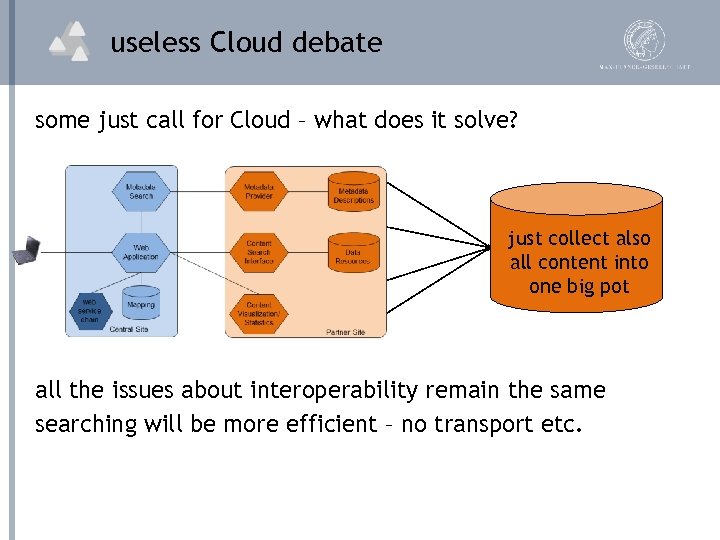
useless Cloud debate some just call for Cloud – what does it solve? just collect also all content into one big pot all the issues about interoperability remain the same searching will be more efficient – no transport etc.
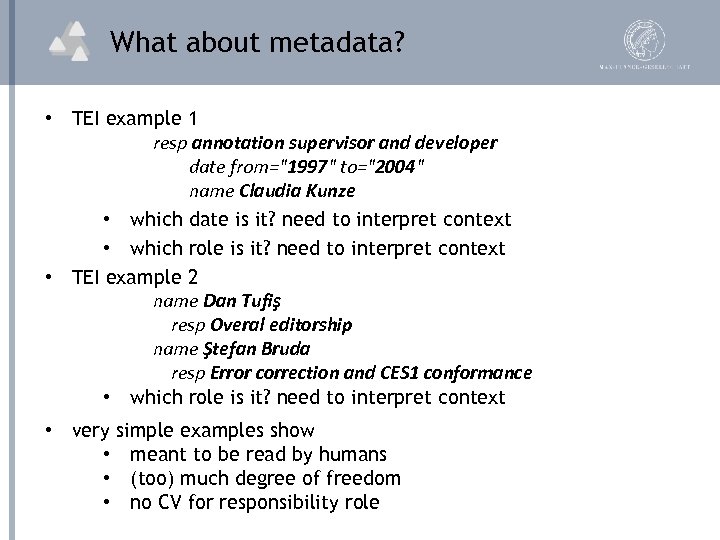
What about metadata? • TEI example 1 resp annotation supervisor and developer date from="1997" to="2004" name Claudia Kunze • which date is it? need to interpret context • which role is it? need to interpret context • TEI example 2 name Dan Tufiş resp Overal editorship name Ştefan Bruda resp Error correction and CES 1 conformance • which role is it? need to interpret context • very simple examples show • meant to be read by humans • (too) much degree of freedom • no CV for responsibility role
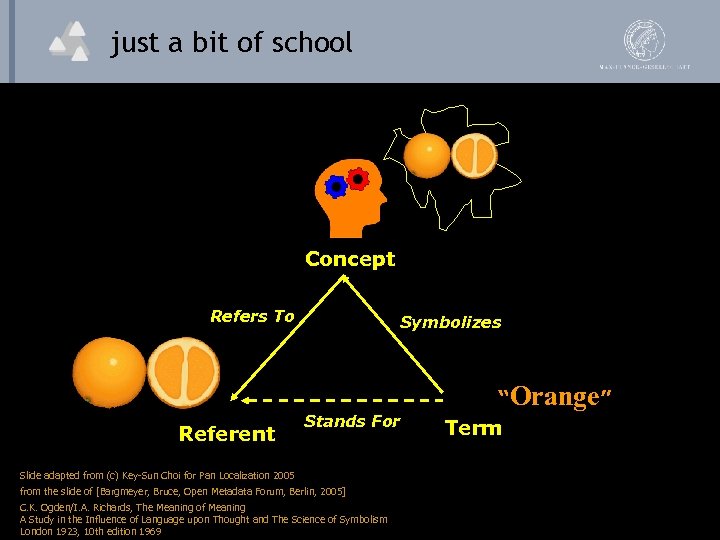
just a bit of school Concept Refers To Referent Symbolizes Stands For Slide adapted from (c) Key-Sun Choi for Pan Localization 2005 from the slide of [Bargmeyer, Bruce, Open Metadata Forum, Berlin, 2005] C. K. Ogden/I. A. Richards, The Meaning of Meaning A Study in the Influence of Language upon Thought and The Science of Symbolism London 1923, 10 th edition 1969 “Orange” Term
Скачать презентацию Interoperability — is it feasible — Peter Wittenburg
f45d962e03ea09deb6eb2a2c417f905d.ppt