 Скачать презентацию Interoperability Drivers and Inhibitors Bernard Barani Attaché —
6b8abd34cb871699a1e98d526a250c8e.ppt
- Количество слайдов: 21



Interoperability, Drivers and Inhibitors Bernard Barani Attaché - DG INFSO-D Bernard. Barani@cec. eu. int ETSI Workshop “S. O. S Interoperability” Sophia Antipolis, 26 May 2005 NB: The views expressed herein are those of the authors and are not necessarily those of the European Commission
Interoperability There is no “One Size fits all” definition for Interoperability q Framework Directive, service focus; q Software Directive, focus on portability of codes across various machines and environments; q Copyright Directive; q EICTA White Paper; q DRM High Level Group q ? ? Þ Not a new notion, but rapidly evolving and acquiring new dimensions
Interoperability What is changing Once, a notion for ICT industry experts, e. g ATM/MPEG/IP/DVB coexistence or compatibility. But: q an exploding number of heterogeneous network infrastructures, context dependent (still); q a plethora of (web) services, with multiple combination/bundling capabilities; q a bombing of (networked) Consumer Electronic devices, with most of the functionalities unknown to the user; q Threats and vulnerability of IP based systems, compared to former TDM based systems Þ With networked ICT becoming more and more pervasive, consumers are becoming intuitively aware of what “interoperability” means (e. g DVD regional codes, fairplay DRM on i_pod…). This may be the real change, i. e where the pressure on interoperable solutions may be expected
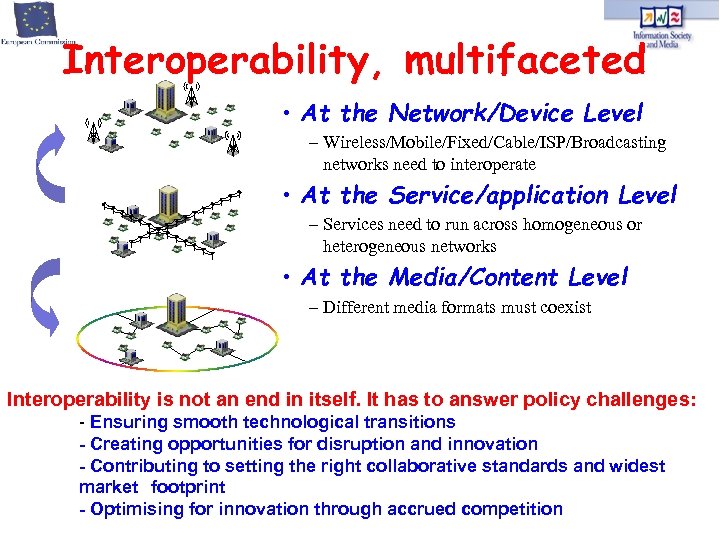
Interoperability, multifaceted • At the Network/Device Level – Wireless/Mobile/Fixed/Cable/ISP/Broadcasting networks need to interoperate • At the Service/application Level – Services need to run across homogeneous or heterogeneous networks • At the Media/Content Level – Different media formats must coexist Interoperability is not an end in itself. It has to answer policy challenges: - Ensuring smooth technological transitions - Creating opportunities for disruption and innovation - Contributing to setting the right collaborative standards and widest market footprint - Optimising for innovation through accrued competition
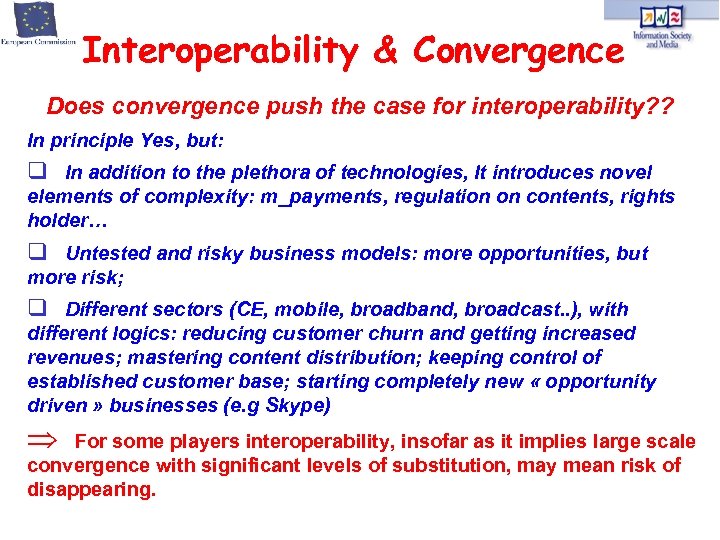
Interoperability & Convergence Does convergence push the case for interoperability? ? In principle Yes, but: q In addition to the plethora of technologies, It introduces novel elements of complexity: m_payments, regulation on contents, rights holder… q Untested and risky business models: more opportunities, but more risk; q Different sectors (CE, mobile, broadband, broadcast. . ), with different logics: reducing customer churn and getting increased revenues; mastering content distribution; keeping control of established customer base; starting completely new « opportunity driven » businesses (e. g Skype) Þ For some players interoperability, insofar as it implies large scale convergence with significant levels of substitution, may mean risk of disappearing.
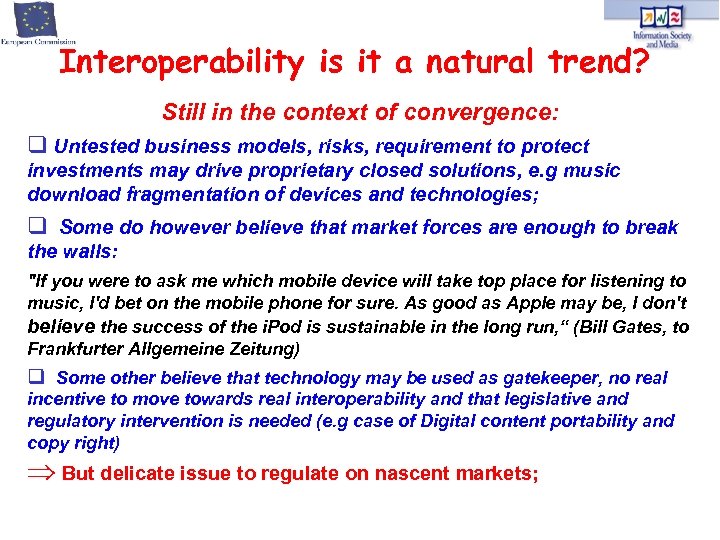
Interoperability is it a natural trend? Still in the context of convergence: q Untested business models, risks, requirement to protect investments may drive proprietary closed solutions, e. g music download fragmentation of devices and technologies; q Some do however believe that market forces are enough to break the walls: "If you were to ask me which mobile device will take top place for listening to music, I'd bet on the mobile phone for sure. As good as Apple may be, I don't believe the success of the i. Pod is sustainable in the long run, “ (Bill Gates, to Frankfurter Allgemeine Zeitung) q Some other believe that technology may be used as gatekeeper, no real incentive to move towards real interoperability and that legislative and regulatory intervention is needed (e. g case of Digital content portability and copy right) Þ But delicate issue to regulate on nascent markets;
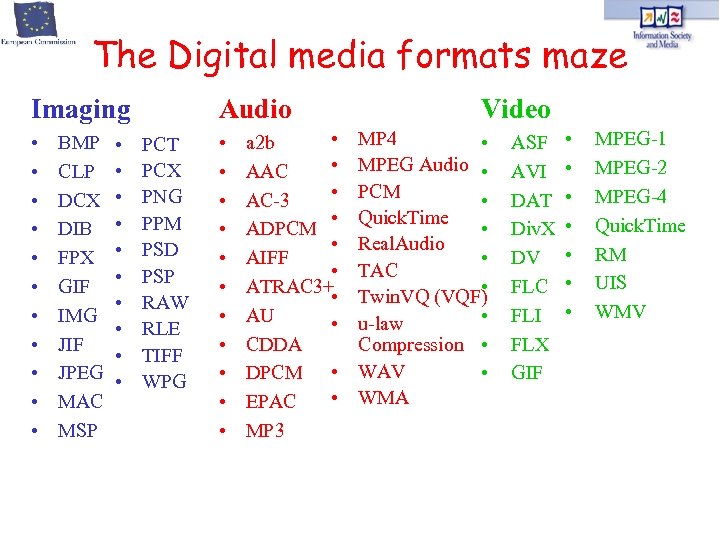
The Digital media formats maze Imaging • • • BMP CLP DCX DIB FPX GIF IMG JIF JPEG MAC MSP • • • Audio PCT PCX PNG PPM PSD PSP RAW RLE TIFF WPG • • • a 2 b • AAC • AC-3 • ADPCM • AIFF • ATRAC 3+ • AU • CDDA DPCM • • EPAC MP 3 Video MP 4 • MPEG Audio • PCM • Quick. Time • Real. Audio • TAC • Twin. VQ (VQF) • u-law Compression • WAV • WMA ASF AVI DAT Div. X DV FLC FLI FLX GIF • • MPEG-1 MPEG-2 MPEG-4 Quick. Time RM UIS WMV
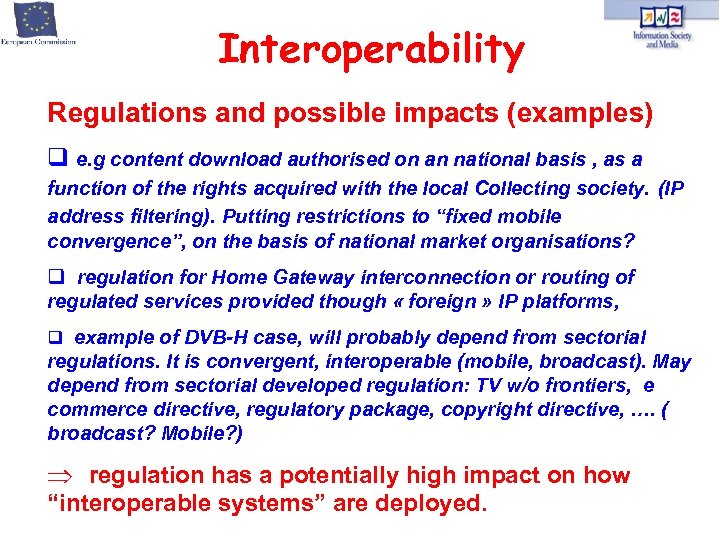
Interoperability Regulations and possible impacts (examples) q e. g content download authorised on an national basis , as a function of the rights acquired with the local Collecting society. (IP address filtering). Putting restrictions to “fixed mobile convergence”, on the basis of national market organisations? q regulation for Home Gateway interconnection or routing of regulated services provided though « foreign » IP platforms, q example of DVB-H case, will probably depend from sectorial regulations. It is convergent, interoperable (mobile, broadcast). May depend from sectorial developed regulation: TV w/o frontiers, e commerce directive, regulatory package, copyright directive, …. ( broadcast? Mobile? ) Þ regulation has a potentially high impact on how “interoperable systems” are deployed.
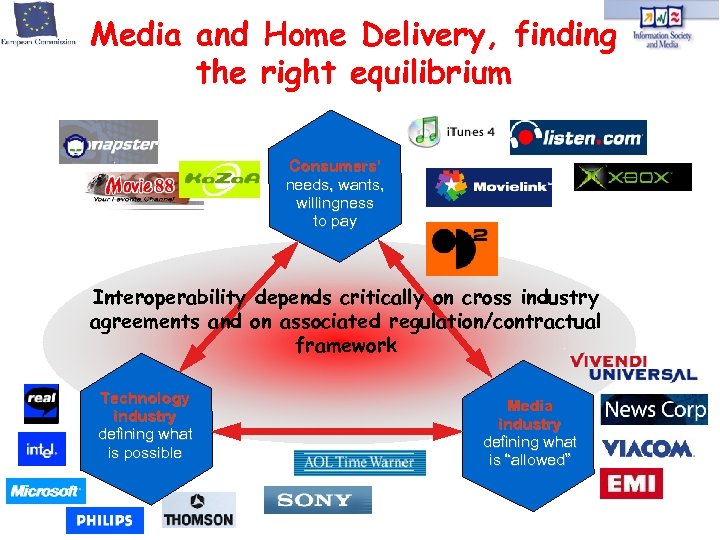
Media and Home Delivery, finding the right equilibrium Consumers’ needs, wants, willingness to pay Interoperability depends critically on cross industry agreements and on associated regulation/contractual framework Technology industry defining what is possible Media industry defining what is “allowed”
Interoperability & Standards There is a wide spread agreement that interoperability critically depends on standards. Yes but: q It can not be the only answer; q Standards and options q Standardise what ? ? Interfaces only or more? API’s? q Standards are not neutral; q Open Source has a role to play, but is more an implementation issue Open std is not ≡ to Open Source Standards form a key part of the picture, not necessarily the complete answer.
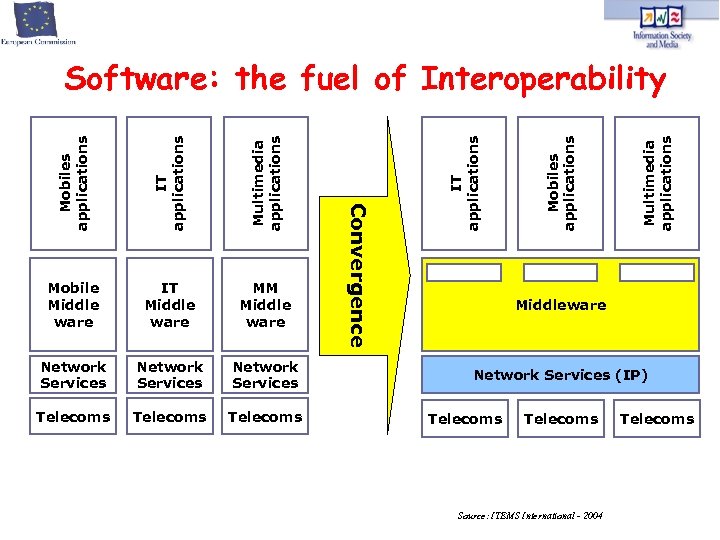
Network Services Telecoms Multimedia applications MM Middle ware Mobiles applications Multimedia applications IT Middle ware IT applications Mobile Middle ware Convergence Mobiles applications Software: the fuel of Interoperability Middleware Network Services (IP) Telecoms Source: ITEMS International - 2004 Telecoms
Turning to Software oriented middleware has implication on standards development process: q Previous typical sequence: ex ante standard development, stable standard, development, product, business development; q “Software” standardisation model: R&D and product development; product launch; ex post standardisation; further business development. q Race for time and being « on time to market » ; Interoperability depends on how easy it is to define ex post interfaces between software modules and components (e. g REL/ODRL trans-coding) Source: ITEMS International - 2004
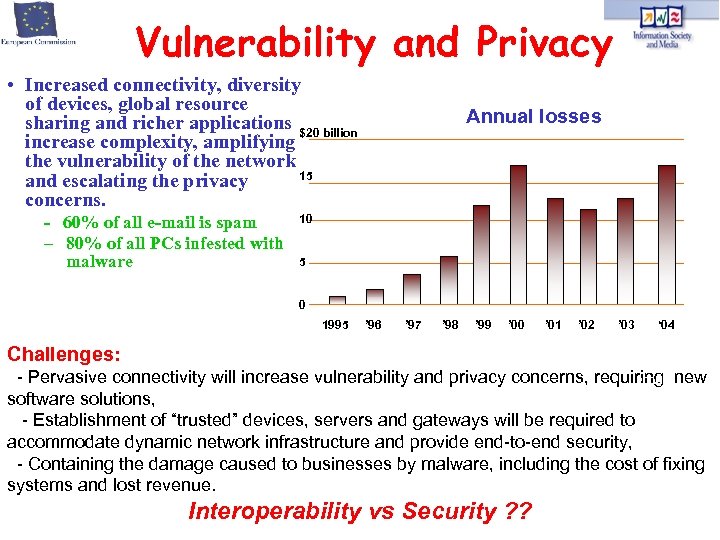
Vulnerability and Privacy • Increased connectivity, diversity of devices, global resource sharing and richer applications $20 billion increase complexity, amplifying the vulnerability of the network 15 and escalating the privacy concerns. - 60% of all e-mail is spam – 80% of all PCs infested with malware Annual losses 10 5 0 1995 ’ 96 ’ 97 ’ 98 ’ 99 ’ 00 ’ 01 ’ 02 ’ 03 ‘ 04 Challenges: - Pervasive connectivity will increase vulnerability and privacy concerns, requiring new 2000 software solutions, - Establishment of “trusted” devices, servers and gateways will be required to accommodate dynamic network infrastructure and provide end-to-end security, - Containing the damage caused to businesses by malware, including the cost of fixing systems and lost revenue. Interoperability vs Security ? ?
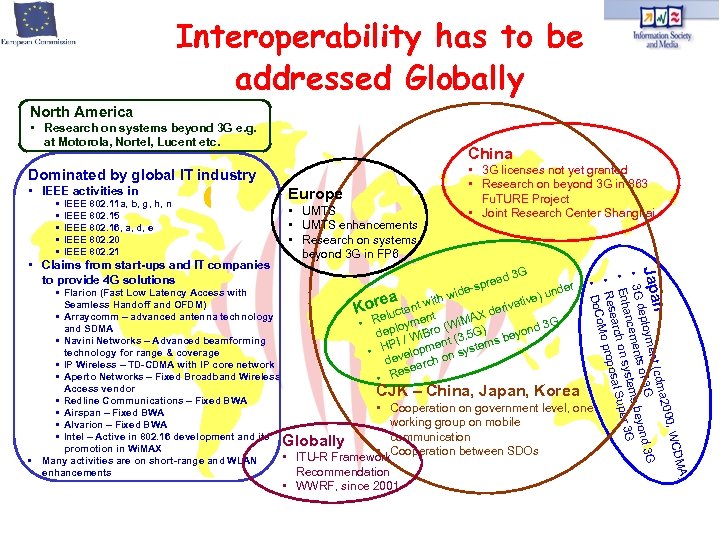
Interoperability has to be addressed Globally North America • Research on systems beyond 3 G e. g. at Motorola, Nortel, Lucent etc. China Dominated by global IT industry • IEEE activities in • • • IEEE 802. 11 a, b, g, h, n IEEE 802. 15 IEEE 802. 16, a, d, e IEEE 802. 20 IEEE 802. 21 Europe Global activities ad 3 spre ide- G r ) DMA 0, WC a 200 (cdm n Japadeployment 3 G yond 3 G ts of • 3 G ancemen ystems be 3 G h s r h on sal Supe • En o searc • Re o. Mo prop C • Do • Claims from start-ups and IT companies to provide 4 G solutions • UMTS enhancements • Research on systems beyond 3 G in FP 6 • 3 G licenses not yet granted • Research on beyond 3 G in 863 Fu. TURE Project • Joint Research Center Shanghai e • Flarion (Fast Low Latency Access with und tive) rea tant with w Seamless Handoff and OFDM) Ko eluc eriva • Arraycomm – advanced antenna technology AX d ent • R ploym o (Wi. M ) d 3 G and SDMA de i. Br. 5 G s beyon W (3 • Navini Networks – Advanced beamforming m PI / ent • H velopm on syste technology for range & coverage e h d • IP Wireless – TD-CDMA with IP core network earc Res • Aperto Networks – Fixed Broadband Wireless • Access vendor CJK – China, Japan, Korea • Redline Communications – Fixed BWA • Cooperation on government level, one • Airspan – Fixed BWA working group on mobile • Alvarion – Fixed BWA • Intel – Active in 802. 16 development and its communication Globally promotion in Wi. MAX • Cooperation between SDOs • ITU-R Framework • Many activities are on short-range and WLAN Recommendation enhancements • WWRF, since 2001
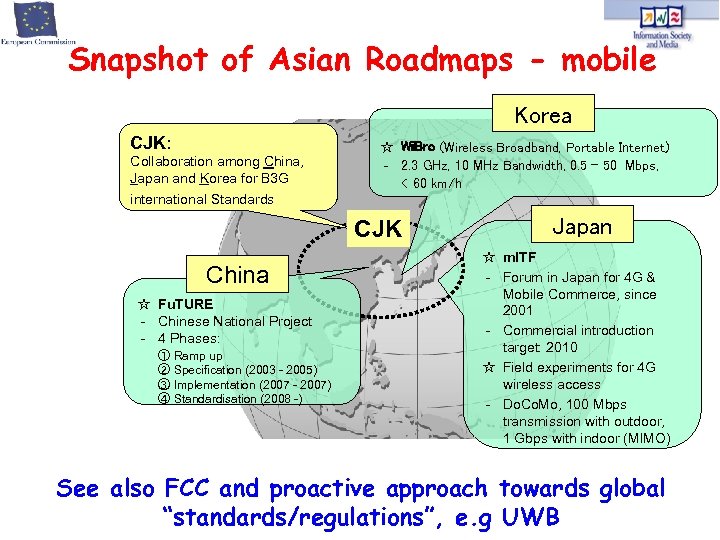
Snapshot of Asian Roadmaps - mobile Korea CJK: Collaboration among China, Japan and Korea for B 3 G international Standards ☆ Wi. Bro (Wireless Broadband, Portable Internet) - 2. 3 GHz, 10 MHz Bandwidth, 0. 5 - 50 Mbps, < 60 km/h CJK China ☆ Fu. TURE - Chinese National Project - 4 Phases: ① Ramp up ② Specification (2003 - 2005) ③ Implementation (2007 - 2007) ④ Standardisation (2008 -) Japan ☆ m. ITF - Forum in Japan for 4 G & Mobile Commerce, since 2001 - Commercial introduction target: 2010 ☆ Field experiments for 4 G wireless access - Do. Co. Mo, 100 Mbps transmission with outdoor, 1 Gbps with indoor (MIMO) See also FCC and proactive approach towards global “standards/regulations”, e. g UWB
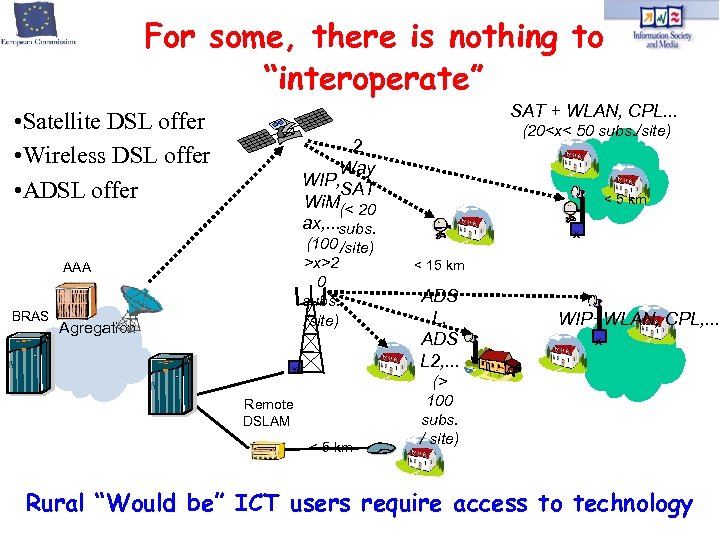
For some, there is nothing to “interoperate” SAT + WLAN, CPL. . . • Satellite DSL offer • Wireless DSL offer • ADSL offer 2 Way WIP, SAT Wi. M(< 20 ax, . . . subs. (100 /site) >x>2 0 subs. /site) AAA BRAS (20<x< 50 subs. /site) Agregation x Remote DSLAM < 5 km x < 15 km ADS L, ADS L 2, . . . WIP+WLAN, CPL, . . . x (> 100 subs. / site) Rural “Would be” ICT users require access to technology
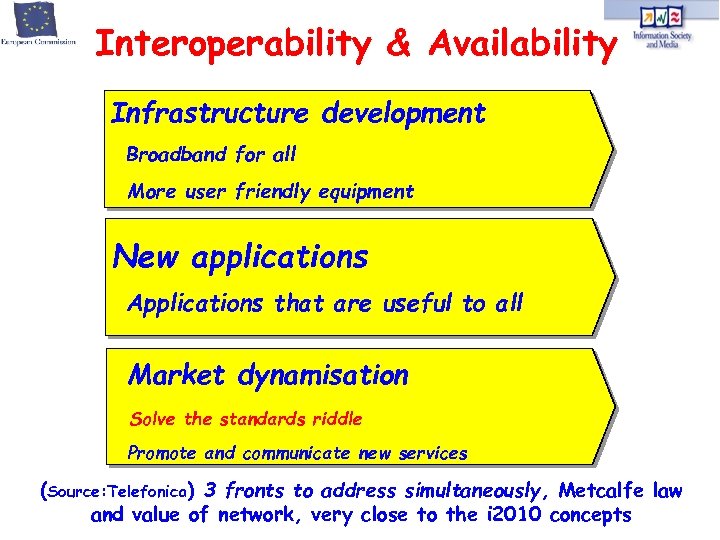
Interoperability & Availability Infrastructure development Broadband for all More user friendly equipment New applications Applications that are useful to all Market dynamisation Solve the standards riddle Promote and communicate new services (Source: Telefonica) 3 fronts to address simultaneously, Metcalfe law and value of network, very close to the i 2010 concepts
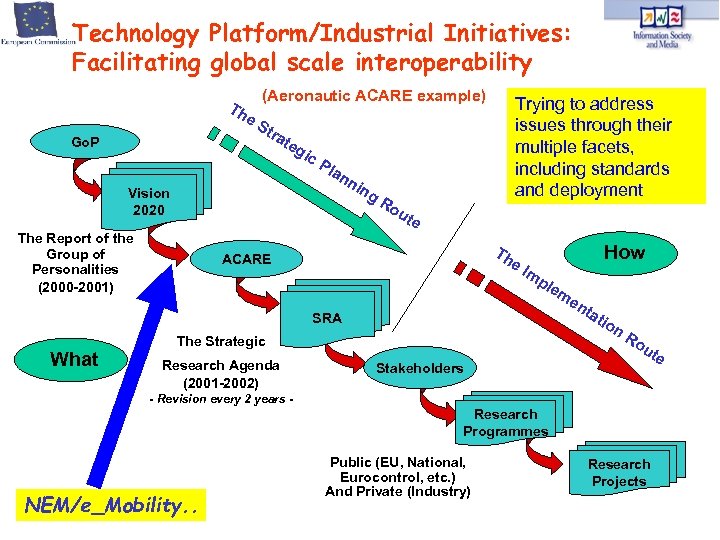
Technology Platform/Industrial Initiatives: Facilitating global scale interoperability (Aeronautic ACARE example) Th e. S tra teg ic Pla nn ing Ro ute Go. P Vision 2020 The Report of the Group of Personalities (2000 -2001) Trying to address issues through their multiple facets, including standards and deployment Th ACARE e. I How mp lem en tat ion SRA What The Strategic Research Agenda (2001 -2002) Stakeholders Ro ut e - Revision every 2 years - Research Programmes NEM/e_Mobility. . Public (EU, National, Eurocontrol, etc. ) And Private (Industry) Research Projects
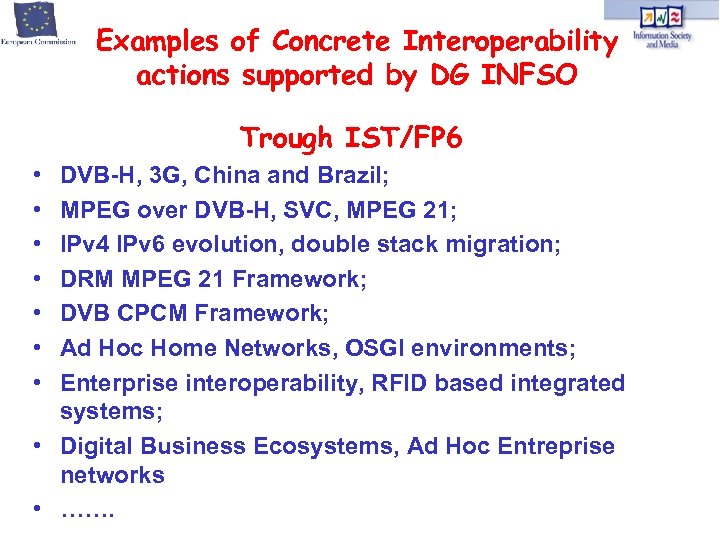
Examples of Concrete Interoperability actions supported by DG INFSO Trough IST/FP 6 • • DVB-H, 3 G, China and Brazil; MPEG over DVB-H, SVC, MPEG 21; IPv 4 IPv 6 evolution, double stack migration; DRM MPEG 21 Framework; DVB CPCM Framework; Ad Hoc Home Networks, OSGI environments; Enterprise interoperability, RFID based integrated systems; • Digital Business Ecosystems, Ad Hoc Entreprise networks • …….
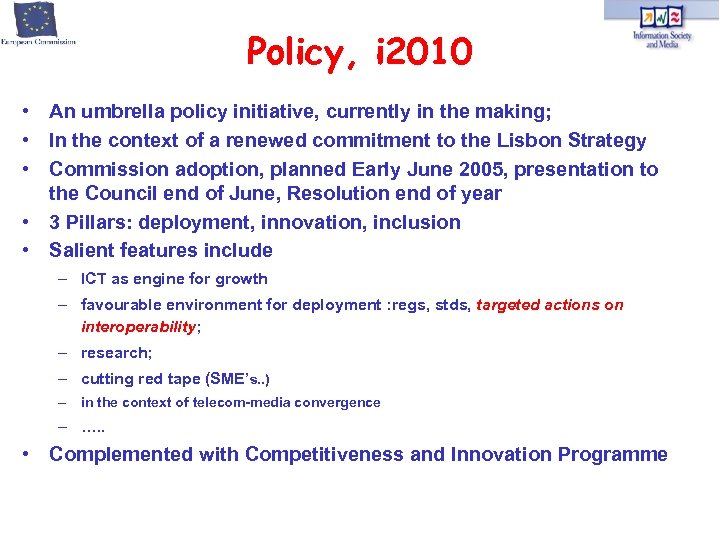
Policy, i 2010 • An umbrella policy initiative, currently in the making; • In the context of a renewed commitment to the Lisbon Strategy • Commission adoption, planned Early June 2005, presentation to the Council end of June, Resolution end of year • 3 Pillars: deployment, innovation, inclusion • Salient features include – ICT as engine for growth – favourable environment for deployment : regs, stds, targeted actions on interoperability; – research; – cutting red tape (SME’s. . ) – in the context of telecom-media convergence – …. . • Complemented with Competitiveness and Innovation Programme
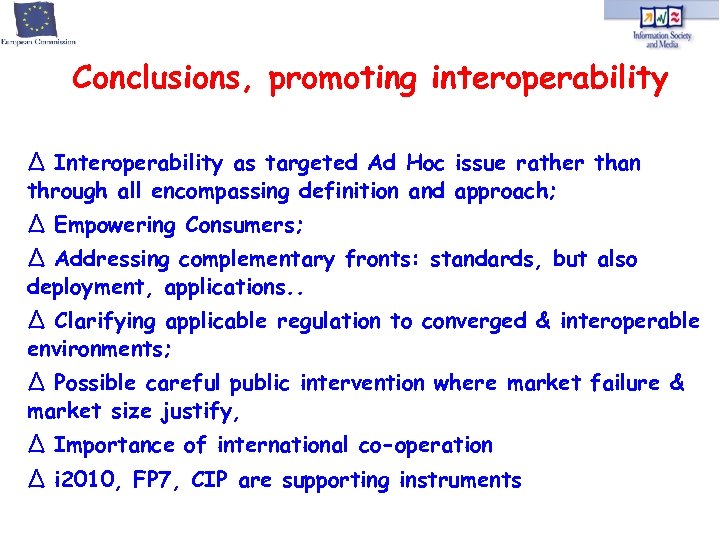
Conclusions, promoting interoperability Δ Interoperability as targeted Ad Hoc issue rather than through all encompassing definition and approach; Δ Empowering Consumers; Δ Addressing complementary fronts: standards, but also deployment, applications. . Δ Clarifying applicable regulation to converged & interoperable environments; Δ Possible careful public intervention where market failure & market size justify, Δ Importance of international co-operation Δ i 2010, FP 7, CIP are supporting instruments
Скачать презентацию Interoperability Drivers and Inhibitors Bernard Barani Attaché —
6b8abd34cb871699a1e98d526a250c8e.ppt