 Скачать презентацию Interoperability Analysis for DIGB 1 By Scott Grimmett
3837bd2496a51087b8f67214d68399da.ppt
- Количество слайдов: 67



Interoperability Analysis for DIGB 1 By Scott Grimmett, BSEE 1
Scope of Work u u Three documented courses of actions (COA) pertaining to public safety voice interoperability communications Between each of the five Northern Idaho Counties and the Tribes • • Kootenai Shoshone Bonner Boundary Benewah Kootenai Tribe Coeur d’Alene Tribe Scott Grimmett, BSEE 2
Data Gathering Data gathering provided by each county and tribes u Data was limited u Most detailed data came from the agencies on the Kootenai and Bonner County border and the Kootenai and Benewah County border. u Scott Grimmett, BSEE 3
Deliverables u u u COA 1 will encompass interoperability between all five northern counties COA 2 will provide one detailed recommendation for interoperability between Kootenai and Bonner Counties COA 3 will provide one detailed recommendation for interoperability between Kootenai and Benewah Counties Scott Grimmett, BSEE 4
COA 1 Interoperability Analysis for DIGB 1 Scott Grimmett, BSEE 5
Goal Long term comprehensive plan for interoperability between the five northern counties, Benewah, Bonner, Boundary, Kootenai, Shoshone, the Kootenai Tribe and the Coeur d’Alene tribe. u 700 MHz P 25 radio system and VHF conventional radio system u Scott Grimmett, BSEE 6
700 MHz P 25 system u u Two channels or talkgroups located at each 700 MHz site One channel or talkgroup at each site will be allocated to Fire/EMS and the other to Law Enforcement Where trunking systems are not available, two 700 MHz conventional repeaters will be needed ISSI connection capable of interfacing to the Statewide 700 MHz system Scott Grimmett, BSEE 7
VHF System Two channels u One channel will be assigned for fire and EMS, and the other channel will be used for law enforcement u Each channel will require a VHF P 25 capable repeater located at every VHF site defined in this study u Scott Grimmett, BSEE 8
Linking u u VHF Fire/EMS channel permanently connected to the 700 MHz Fire/EMS channel or talkgroup VHF Law channel permanently connected to the 700 MHz Law channel or talkgroup VHF and 700 MHz repeater systems should be connected through a P 25 ISSI All sites connected Scott Grimmett, BSEE 9
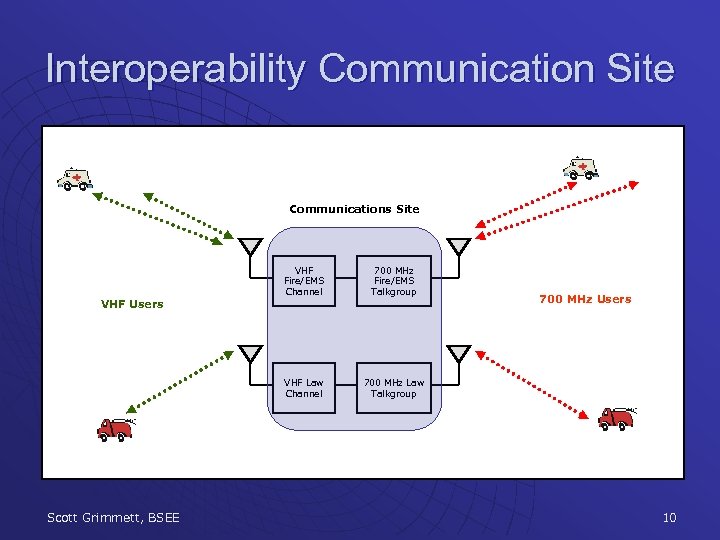
Interoperability Communication Site Communications Site VHF Fire/EMS Channel 700 MHz Fire/EMS Talkgroup VHF Law Channel 700 MHz Law Talkgroup VHF Users Scott Grimmett, BSEE 700 MHz Users 10
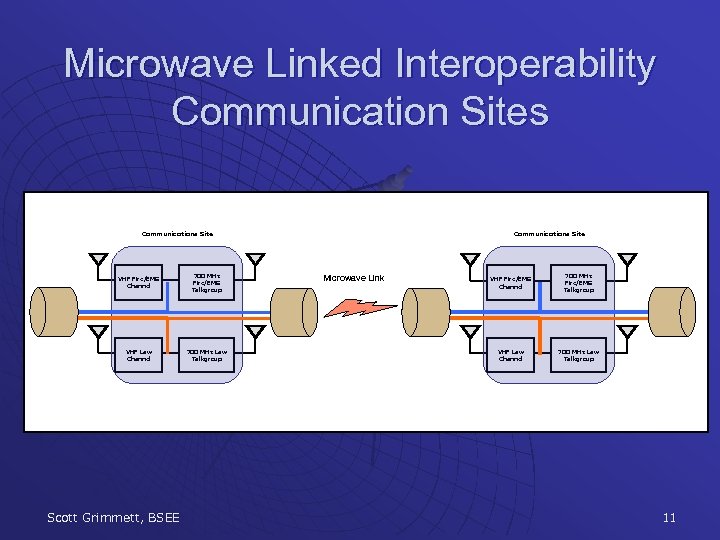
Microwave Linked Interoperability Communication Sites Communications Site VHF Fire/EMS Channel 700 MHz Fire/EMS Talkgroup VHF Law Channel 700 MHz Law Talkgroup Scott Grimmett, BSEE Communications Site Microwave Link VHF Fire/EMS Channel 700 MHz Fire/EMS Talkgroup VHF Law Channel 700 MHz Law Talkgroup 11
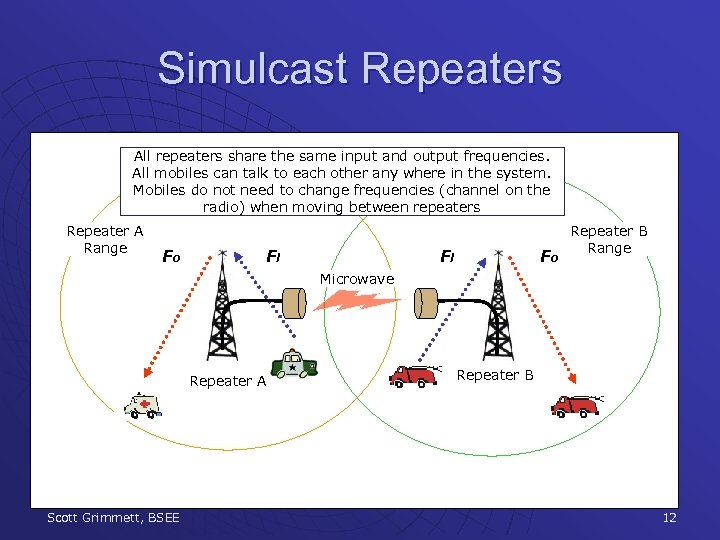
Simulcast Repeaters All repeaters share the same input and output frequencies. All mobiles can talk to each other any where in the system. Mobiles do not need to change frequencies (channel on the radio) when moving between repeaters Repeater A Range Fo Fi Fi Fo Repeater B Range Microwave Repeater A Scott Grimmett, BSEE Repeater B 12
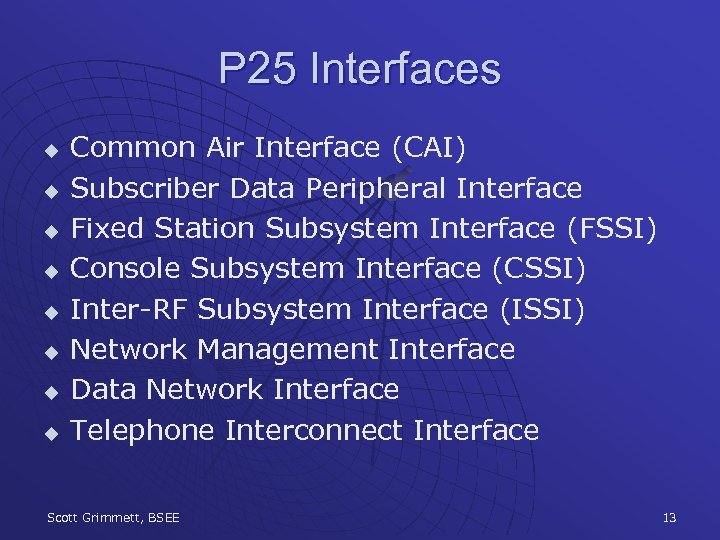
P 25 Interfaces u u u u Common Air Interface (CAI) Subscriber Data Peripheral Interface Fixed Station Subsystem Interface (FSSI) Console Subsystem Interface (CSSI) Inter-RF Subsystem Interface (ISSI) Network Management Interface Data Network Interface Telephone Interconnect Interface Scott Grimmett, BSEE 13
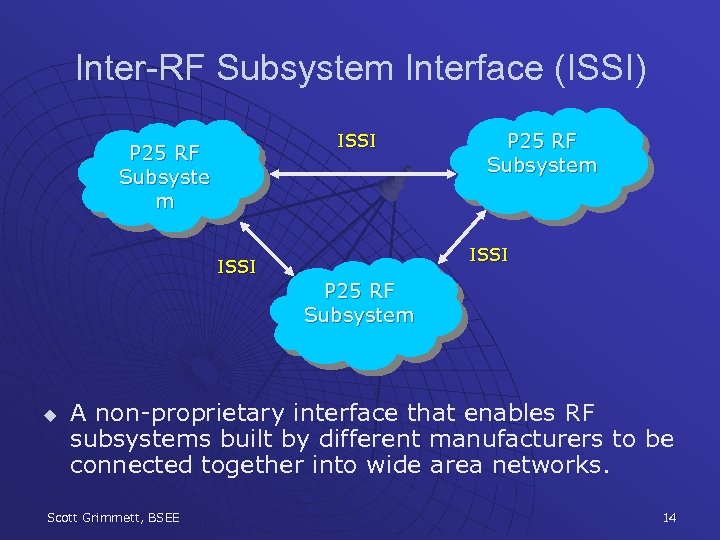
Inter-RF Subsystem Interface (ISSI) ISSI P 25 RF Subsyste m P 25 RF Subsystem ISSI P 25 RF Subsystem u A non-proprietary interface that enables RF subsystems built by different manufacturers to be connected together into wide area networks. Scott Grimmett, BSEE 14
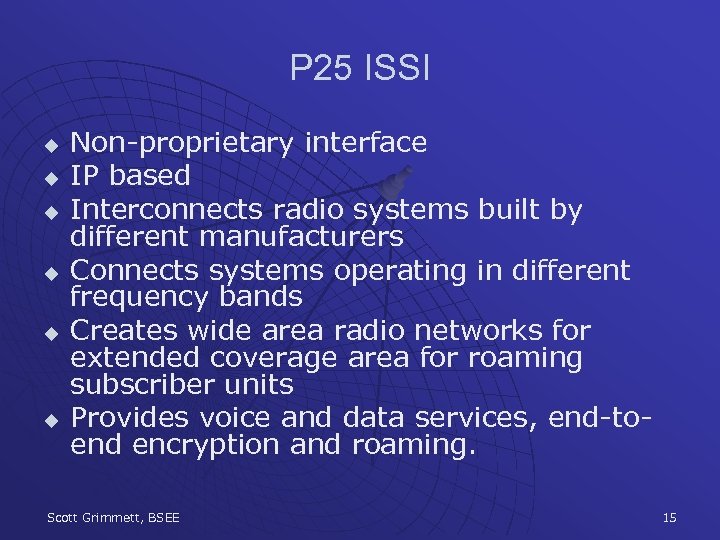
P 25 ISSI u u u Non-proprietary interface IP based Interconnects radio systems built by different manufacturers Connects systems operating in different frequency bands Creates wide area radio networks for extended coverage area for roaming subscriber units Provides voice and data services, end-toend encryption and roaming. Scott Grimmett, BSEE 15
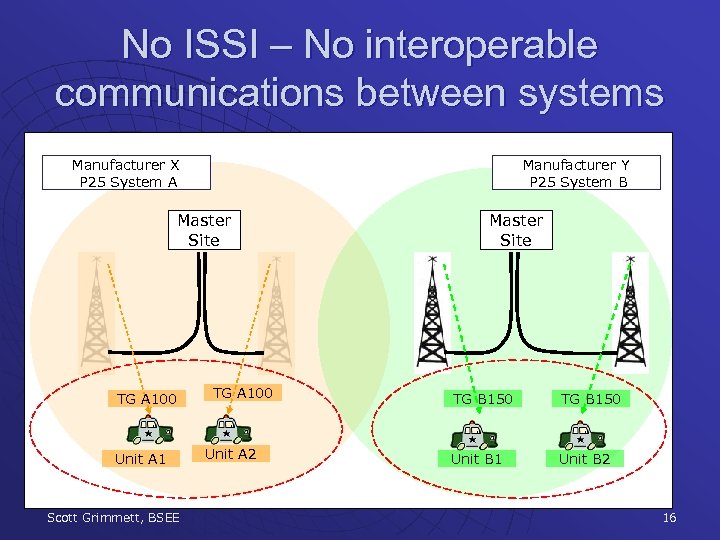
No ISSI – No interoperable communications between systems Manufacturer X P 25 System A Manufacturer Y P 25 System B Master Site TG A 100 Unit A 1 Scott Grimmett, BSEE TG A 100 Unit A 2 Master Site TG B 150 Unit B 1 Unit B 2 16
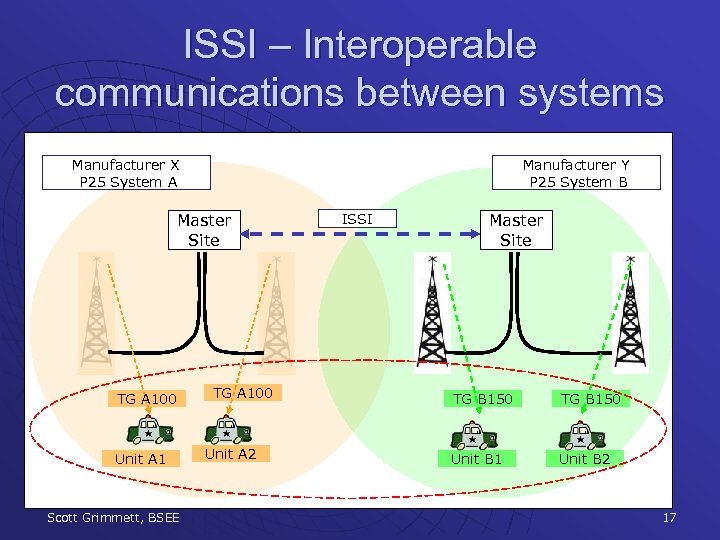
ISSI – Interoperable communications between systems Manufacturer X P 25 System A Manufacturer Y P 25 System B Master Site TG A 100 Unit A 1 Scott Grimmett, BSEE TG A 100 Unit A 2 ISSI Master Site TG B 150 Unit B 1 Unit B 2 17
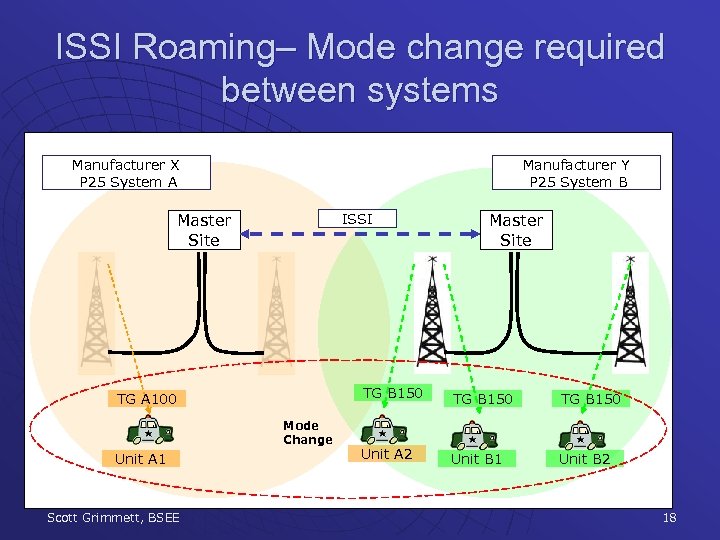
ISSI Roaming– Mode change required between systems Manufacturer X P 25 System A Manufacturer Y P 25 System B ISSI Master Site TG B 150 TG A 100 Mode Change Unit A 1 Scott Grimmett, BSEE Master Site TG B 150 Unit A 2 Unit B 1 Unit B 2 18
Why 700 u u u It will continue to grow as the public safety radio system Recommended by the Idaho Statewide Interoperability Executive Council Kootenai County Spokane County ISP and other state agencies Sandpoint The Coeur d’Alene Tribe plans to migrate 700 MHz Scott Grimmett, BSEE 19
Why VHF u u North Idaho terrain presents propagation challenges for 700 MHz VHF radio signals bend and follow terrain better than do 700 MHz signals Some counties do not plan to use 700 MHz systems The Forest Service, BLM, and Idaho Department of Lands plan to stay with VHF frequencies Scott Grimmett, BSEE 20
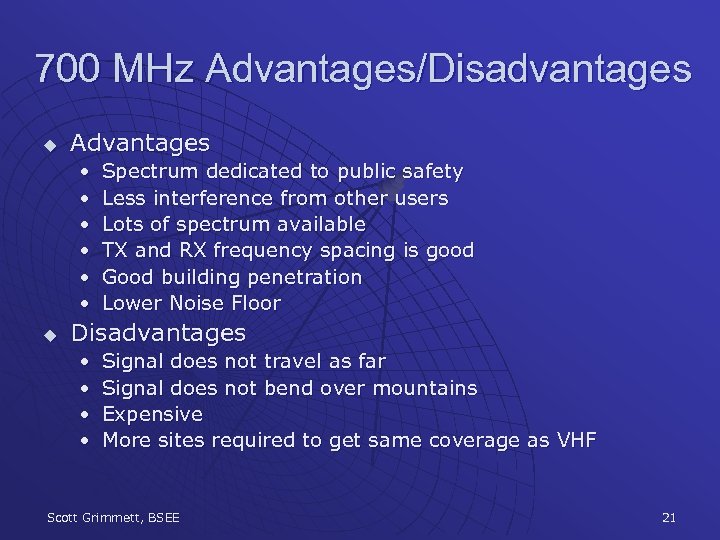
700 MHz Advantages/Disadvantages u Advantages • • • u Spectrum dedicated to public safety Less interference from other users Lots of spectrum available TX and RX frequency spacing is good Good building penetration Lower Noise Floor Disadvantages • • Signal does not travel as far Signal does not bend over mountains Expensive More sites required to get same coverage as VHF Scott Grimmett, BSEE 21
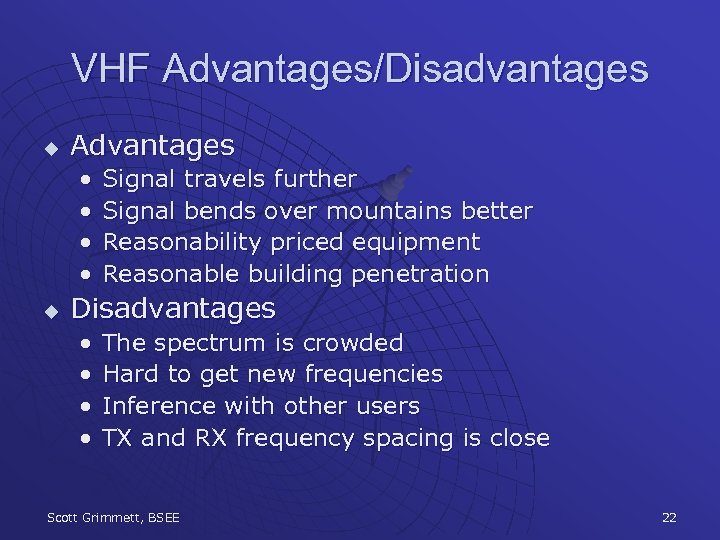
VHF Advantages/Disadvantages u Advantages • • u Signal travels further Signal bends over mountains better Reasonability priced equipment Reasonable building penetration Disadvantages • • The spectrum is crowded Hard to get new frequencies Inference with other users TX and RX frequency spacing is close Scott Grimmett, BSEE 22
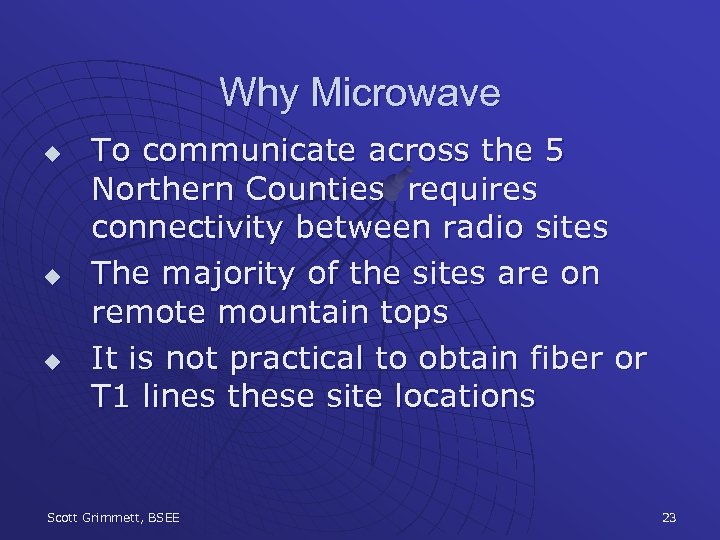
Why Microwave u u u To communicate across the 5 Northern Counties requires connectivity between radio sites The majority of the sites are on remote mountain tops It is not practical to obtain fiber or T 1 lines these site locations Scott Grimmett, BSEE 23
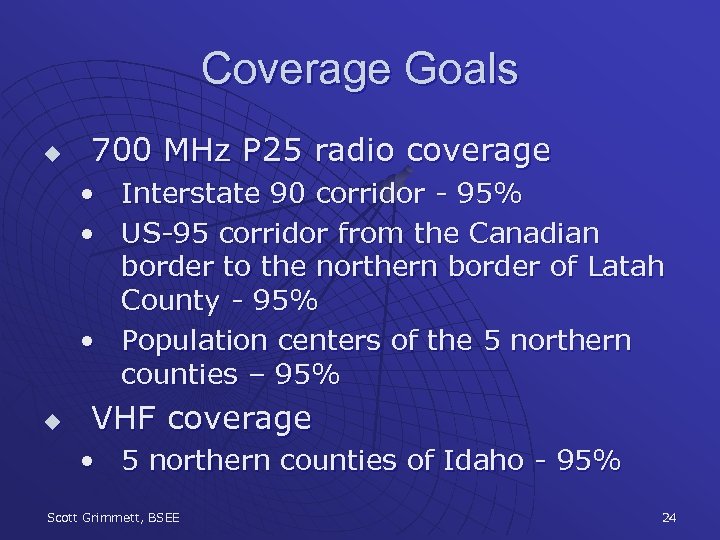
Coverage Goals u 700 MHz P 25 radio coverage • Interstate 90 corridor - 95% • US-95 corridor from the Canadian border to the northern border of Latah County - 95% • Population centers of the 5 northern counties – 95% u VHF coverage • 5 northern counties of Idaho - 95% Scott Grimmett, BSEE 24
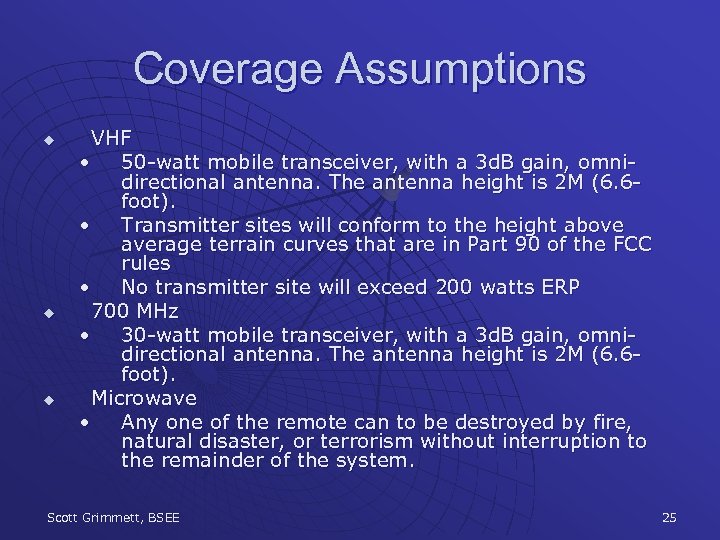
Coverage Assumptions u u u VHF • 50 -watt mobile transceiver, with a 3 d. B gain, omnidirectional antenna. The antenna height is 2 M (6. 6 foot). • Transmitter sites will conform to the height above average terrain curves that are in Part 90 of the FCC rules • No transmitter site will exceed 200 watts ERP 700 MHz • 30 -watt mobile transceiver, with a 3 d. B gain, omnidirectional antenna. The antenna height is 2 M (6. 6 foot). Microwave • Any one of the remote can to be destroyed by fire, natural disaster, or terrorism without interruption to the remainder of the system. Scott Grimmett, BSEE 25
700 MHz Sites u u u u u 1 mi S SE of Border Mtn. Dawson Ridge Black Mtn. Sundance Mtn. Schweitzer Mtn. 4. 7 Mi E of Priest River 1. 7 Mi NW of Gold Mtn. Canfield Mtn. Mica Peak Killarney Mtn. Hoodoo Mtn. Mason Butte Goose Hump Wardner Peak Silverton Lookout Pass Tekoa Mtn. St. Maries Court House Scott Grimmett, BSEE 26
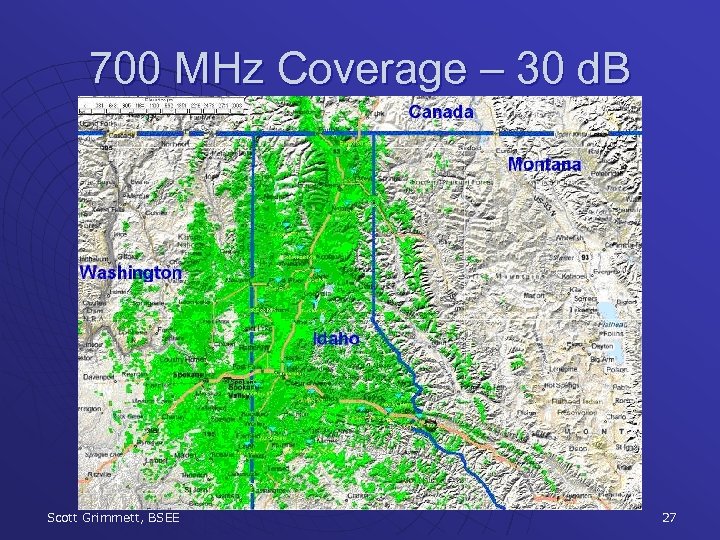
700 MHz Coverage – 30 d. B Scott Grimmett, BSEE 27
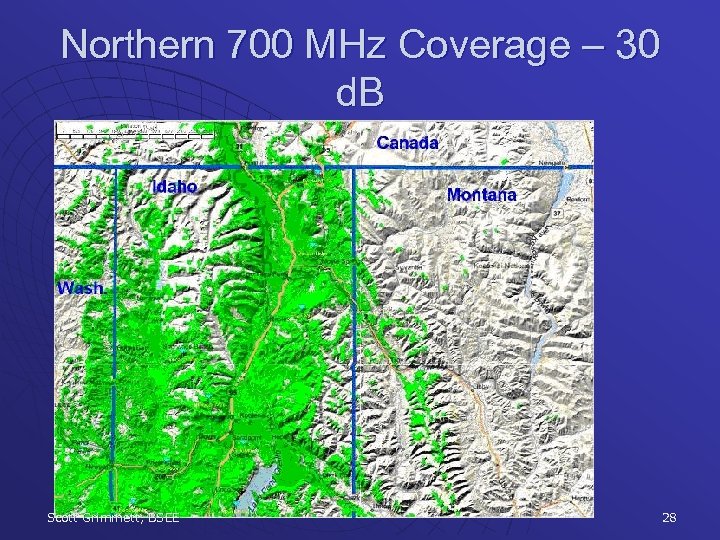
Northern 700 MHz Coverage – 30 d. B Scott Grimmett, BSEE 28
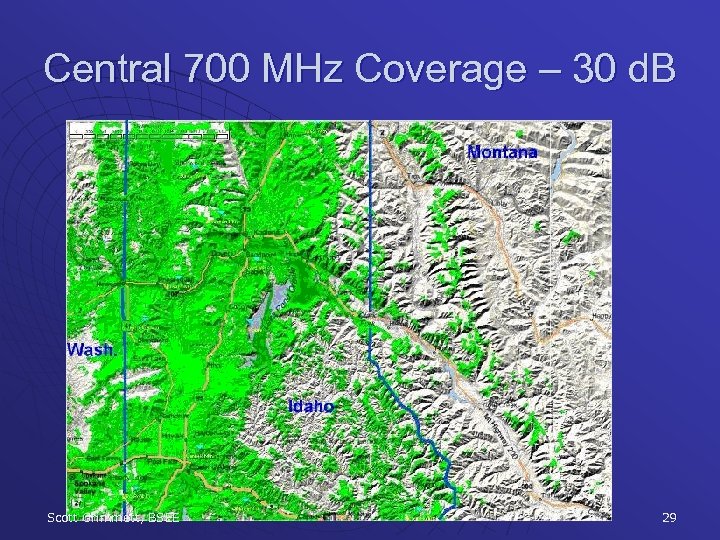
Central 700 MHz Coverage – 30 d. B Scott Grimmett, BSEE 29
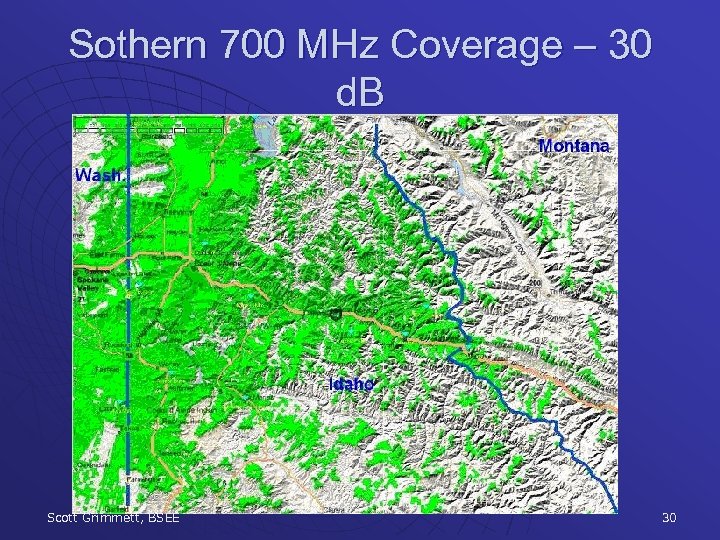
Sothern 700 MHz Coverage – 30 d. B Scott Grimmett, BSEE 30
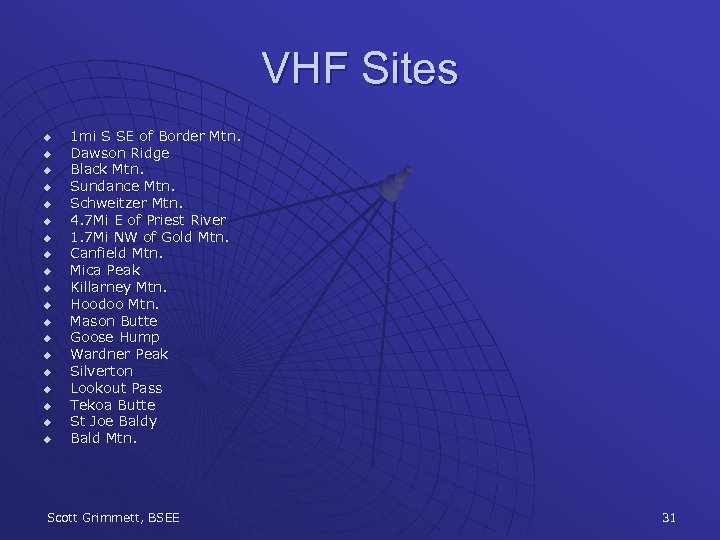
VHF Sites u u u u u 1 mi S SE of Border Mtn. Dawson Ridge Black Mtn. Sundance Mtn. Schweitzer Mtn. 4. 7 Mi E of Priest River 1. 7 Mi NW of Gold Mtn. Canfield Mtn. Mica Peak Killarney Mtn. Hoodoo Mtn. Mason Butte Goose Hump Wardner Peak Silverton Lookout Pass Tekoa Butte St Joe Baldy Bald Mtn. Scott Grimmett, BSEE 31
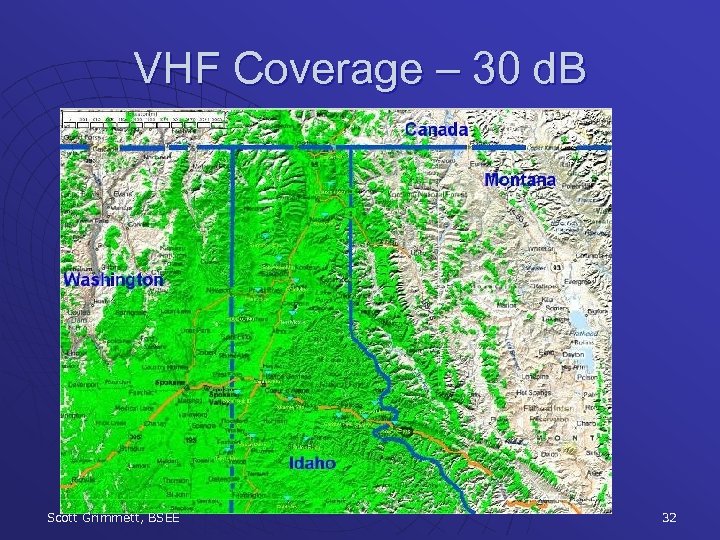
VHF Coverage – 30 d. B Scott Grimmett, BSEE 32
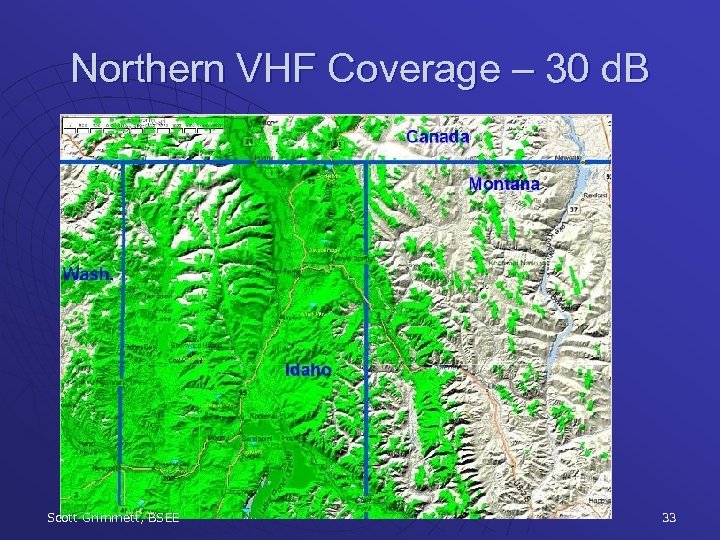
Northern VHF Coverage – 30 d. B Scott Grimmett, BSEE 33
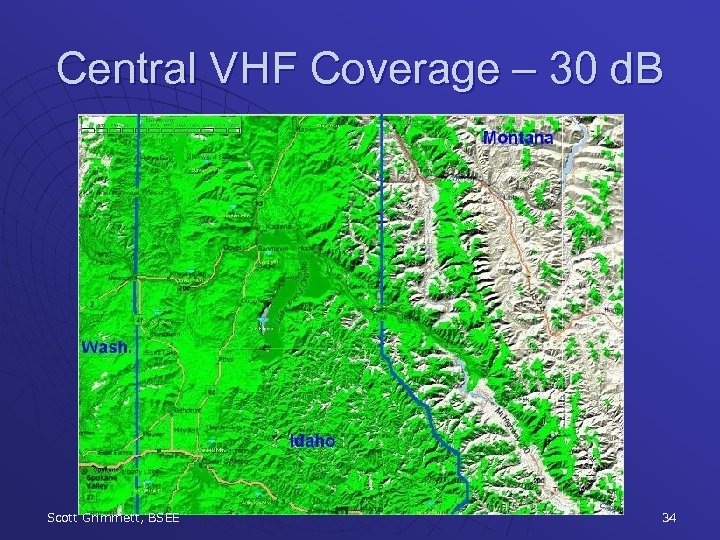
Central VHF Coverage – 30 d. B Scott Grimmett, BSEE 34
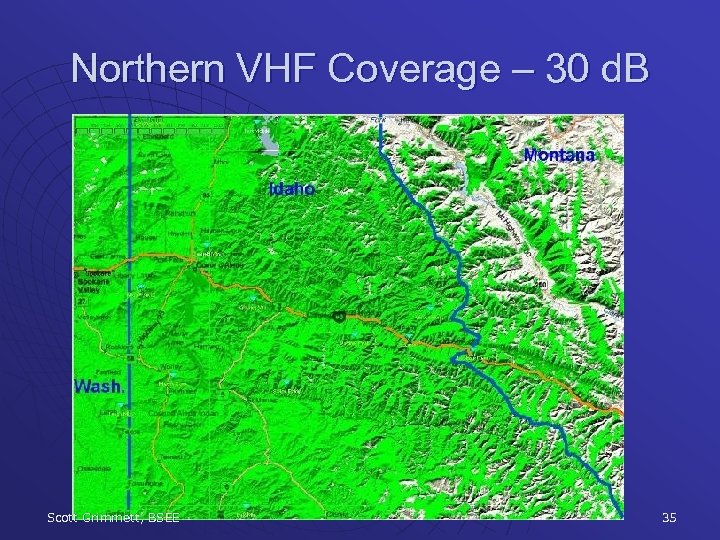
Northern VHF Coverage – 30 d. B Scott Grimmett, BSEE 35
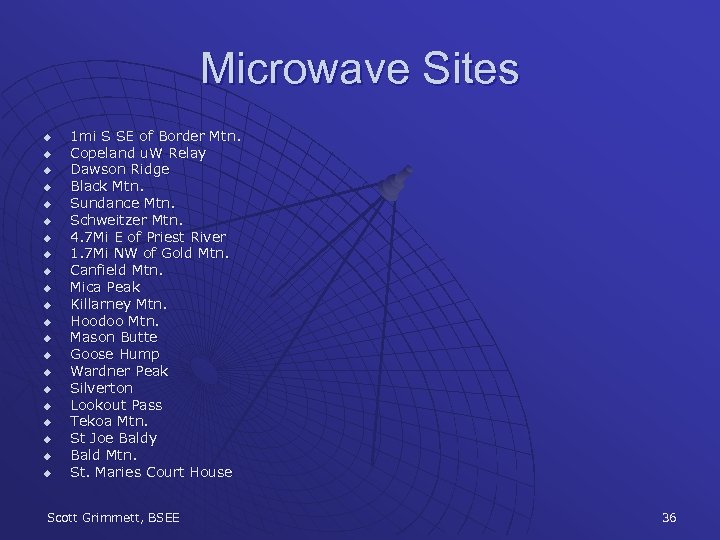
Microwave Sites u u u u u u 1 mi S SE of Border Mtn. Copeland u. W Relay Dawson Ridge Black Mtn. Sundance Mtn. Schweitzer Mtn. 4. 7 Mi E of Priest River 1. 7 Mi NW of Gold Mtn. Canfield Mtn. Mica Peak Killarney Mtn. Hoodoo Mtn. Mason Butte Goose Hump Wardner Peak Silverton Lookout Pass Tekoa Mtn. St Joe Baldy Bald Mtn. St. Maries Court House Scott Grimmett, BSEE 36
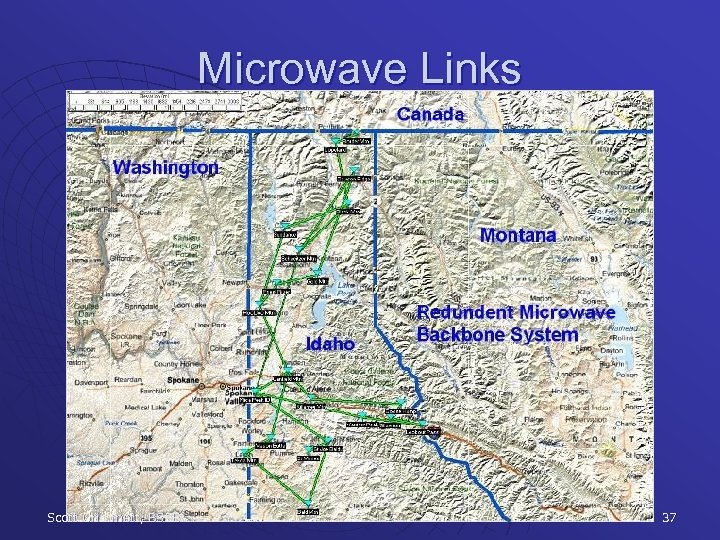
Microwave Links Scott Grimmett, BSEE 37
COA 2 and 3 No changes to the current VHF, UHF, and 700 MHz systems u Based on feedback received from the recent user surveys u May be other areas where interoperable communication may remain an unidentified problem due to limited feedback u Scott Grimmett, BSEE 38
Scott Grimmett, BSEE 39
COA 2 Interoperability Analysis for DIGB 1 Scott Grimmett, BSEE 40
Course of Action 2: Bonner County – Kootenai County Border u u u Regular Mutual Aide Kootenai • Sprit Lake Fire • Timber Lake Fire • Northern Lakes Fire Bonner • Sagle Fire • West Pend Oreille Fire Scott Grimmett, BSEE 41
Assumed requirements u u Each vehicle will carry only one two-way radio. Mutual aid vehicles will move the mutual aid channel as soon as possible after being dispatched. Equipment required to provide the mutual aid on a regular basis will be permanently installed. All on-scene tactical communications will be facilitated through low-power crossband vehicular repeaters installed in the command vehicles and larger fire assets. Scott Grimmett, BSEE 42
Sagle Fire and West Pend Oreille Fire VHF provide aide to Spirit Lake Fire and Timber Lake Fire 700 MHz u Hoodoo Mountain VHF repeater to 700 MHz gateway u Little Blacktail VHF repeater to 700 MHz gateway u Create a Fire Operations South Talkgroup on the 700 MHz system - IK Fire Ops North u Kootenai County agencies use the 700 MHz talkgroup and Bonner County agencies use the VHF repeater for interoperability communications. Scott Grimmett, BSEE 43
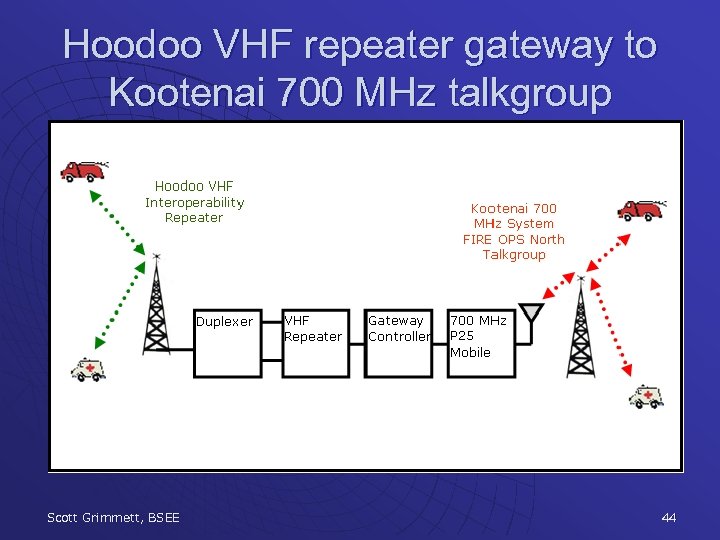
Hoodoo VHF repeater gateway to Kootenai 700 MHz talkgroup Scott Grimmett, BSEE 44
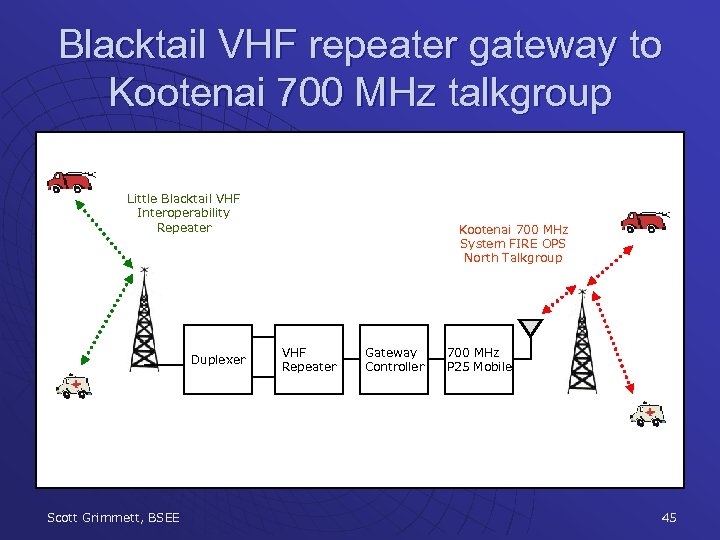
Blacktail VHF repeater gateway to Kootenai 700 MHz talkgroup Little Blacktail VHF Interoperability Repeater Duplexer Scott Grimmett, BSEE Kootenai 700 MHz System FIRE OPS North Talkgroup VHF Repeater Gateway Controller 700 MHz P 25 Mobile 45
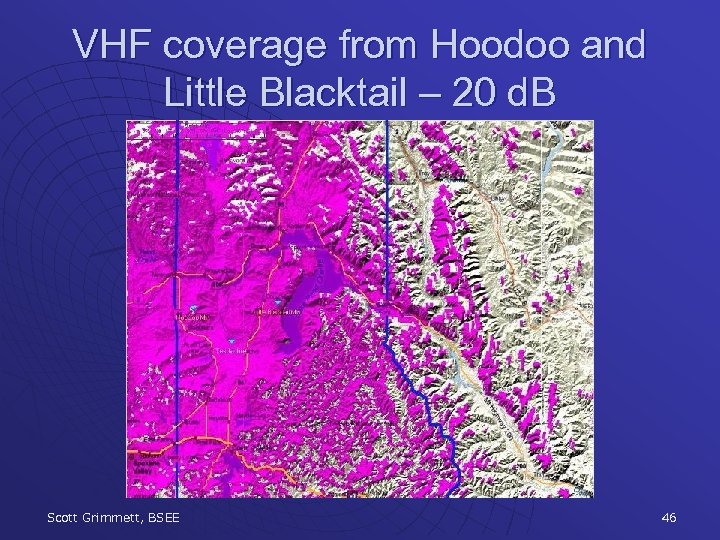
VHF coverage from Hoodoo and Little Blacktail – 20 d. B Scott Grimmett, BSEE 46
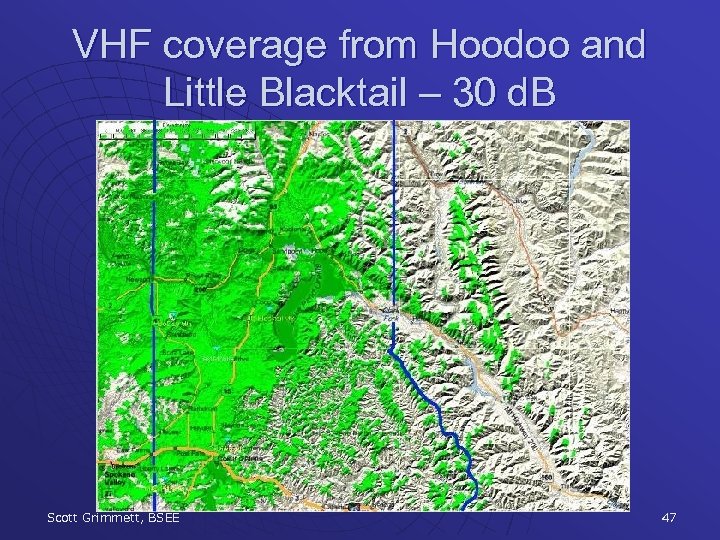
VHF coverage from Hoodoo and Little Blacktail – 30 d. B Scott Grimmett, BSEE 47
Sprit Lake, Timber Lake and Northern Lake Fire 700 MHz aide to Sagle Fire and West Pend Oreille Fire VHF u u u 700 MHz to VHF gateway in Sandpoint 800 MHz repeater to VHF gateway on Little Blacktail 800 MHz repeater to VHF gateway at Stimpson Lumber Create a Fire Operations South Talkgroup on the 700 MHz system - 7 B-Fire-Ops-South Kootenai County Agencies use the 700 MHz talkgroup and 800 MHz repeater while Bonner County agencies use the VHF repeater for interoperability communications. Scott Grimmett, BSEE 48
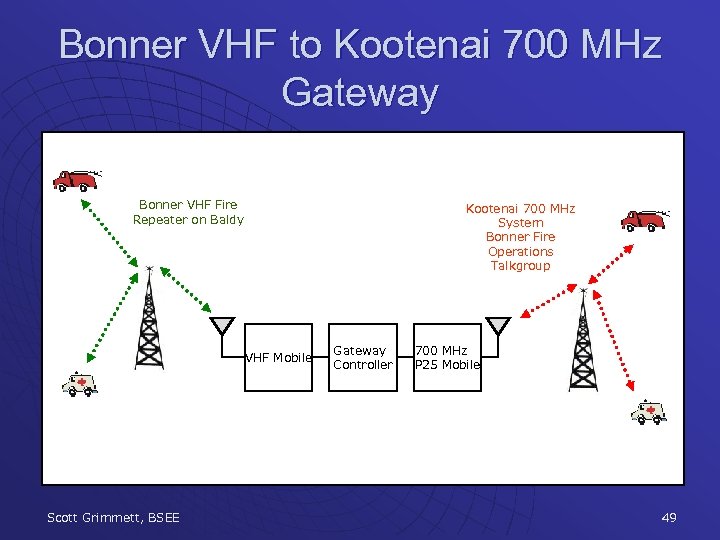
Bonner VHF to Kootenai 700 MHz Gateway Bonner VHF Fire Repeater on Baldy Kootenai 700 MHz System Bonner Fire Operations Talkgroup VHF Mobile Scott Grimmett, BSEE Gateway Controller 700 MHz P 25 Mobile 49
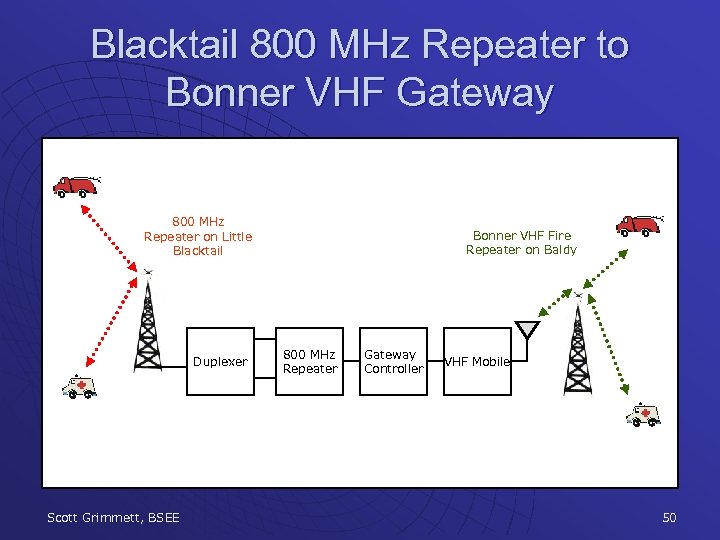
Blacktail 800 MHz Repeater to Bonner VHF Gateway 800 MHz Repeater on Little Blacktail Duplexer Scott Grimmett, BSEE Bonner VHF Fire Repeater on Baldy 800 MHz Repeater Gateway Controller VHF Mobile 50
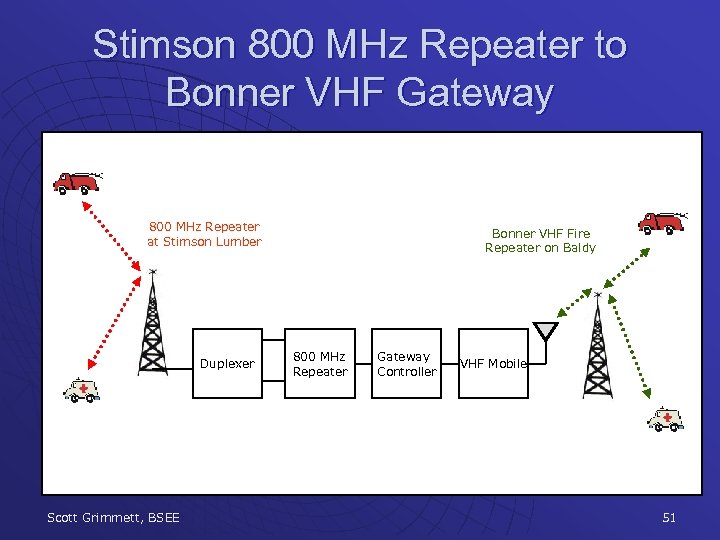
Stimson 800 MHz Repeater to Bonner VHF Gateway 800 MHz Repeater at Stimson Lumber Duplexer Scott Grimmett, BSEE Bonner VHF Fire Repeater on Baldy 800 MHz Repeater Gateway Controller VHF Mobile 51
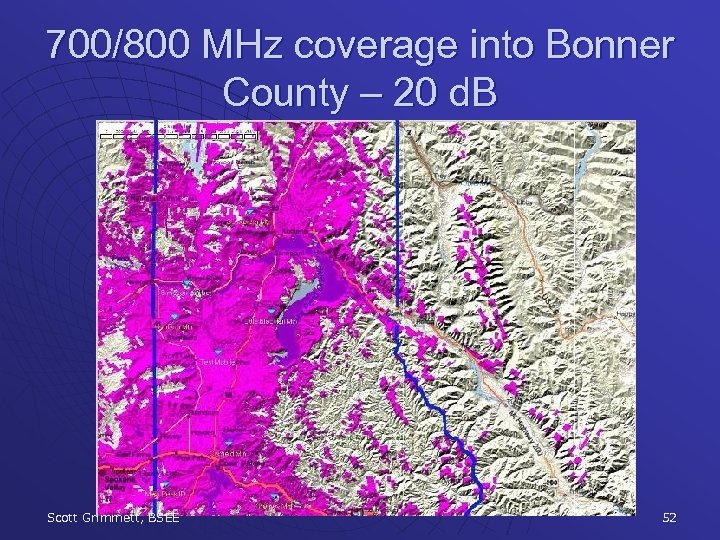
700/800 MHz coverage into Bonner County – 20 d. B Scott Grimmett, BSEE 52
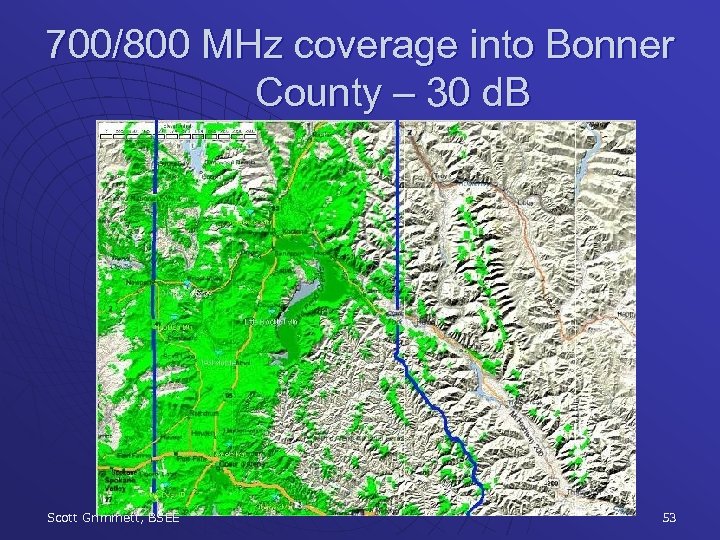
700/800 MHz coverage into Bonner County – 30 d. B Scott Grimmett, BSEE 53
On-Scene Interoperability u u A vehicular repeater provides a local, low power link between VHF portable radios and 700/800 MHz portable radios. Vehicular repeaters in command vehicles and larger fire assets are necessary because they allow handheld radios from different districts with different frequency bands to communicate with one another on site. Scott Grimmett, BSEE 54
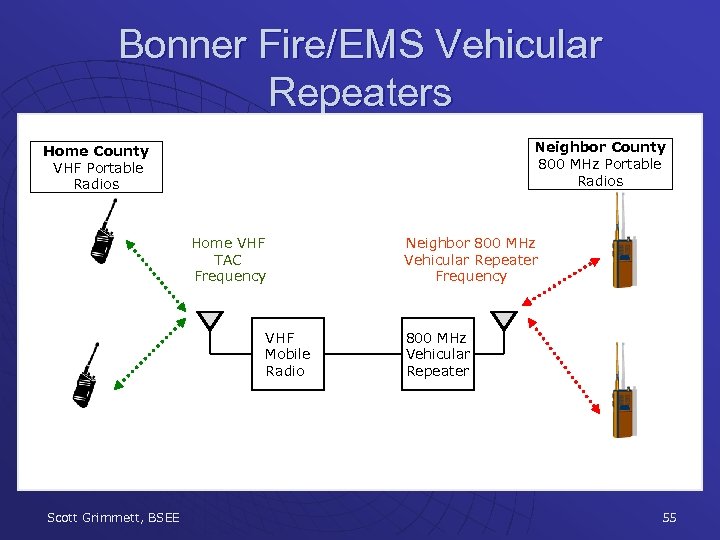
Bonner Fire/EMS Vehicular Repeaters Neighbor County 800 MHz Portable Radios Home County VHF Portable Radios Home VHF TAC Frequency VHF Mobile Radio Scott Grimmett, BSEE Neighbor 800 MHz Vehicular Repeater Frequency 800 MHz Vehicular Repeater 55
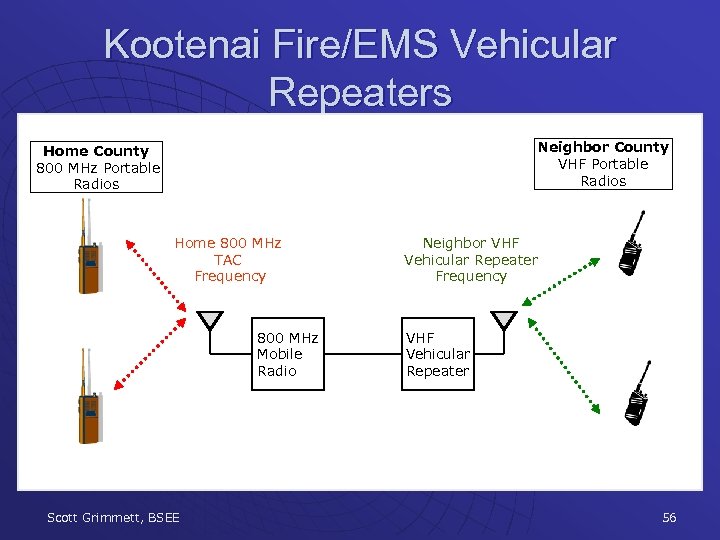
Kootenai Fire/EMS Vehicular Repeaters Neighbor County VHF Portable Radios Home County 800 MHz Portable Radios Home 800 MHz TAC Frequency 800 MHz Mobile Radio Scott Grimmett, BSEE Neighbor VHF Vehicular Repeater Frequency VHF Vehicular Repeater 56
Trunking Repeaters Interoperability Analysis for DIGB 1 Scott Grimmett, BSEE 57
What is trunking? u u u A large group of users sharing a pool of frequencies. The system infrastructure is shared by all the users and for multiple purposes. Unlike conventional radios where each repeater is designated for a separate purpose. Scott Grimmett, BSEE 58
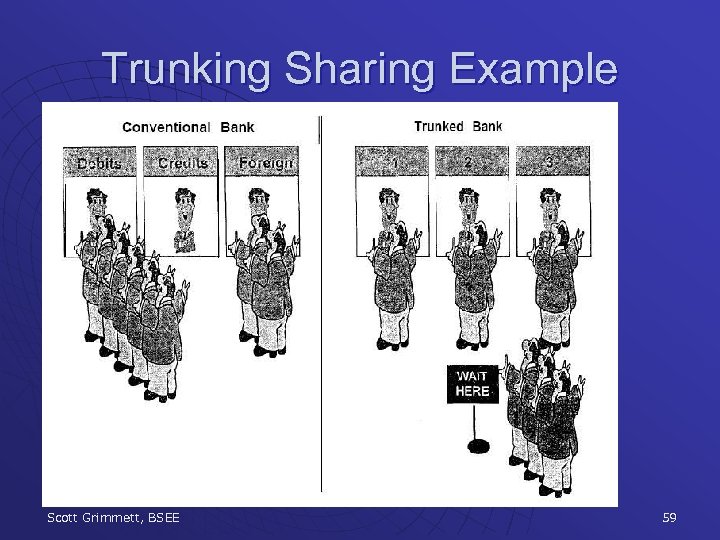
Trunking Sharing Example Scott Grimmett, BSEE 59
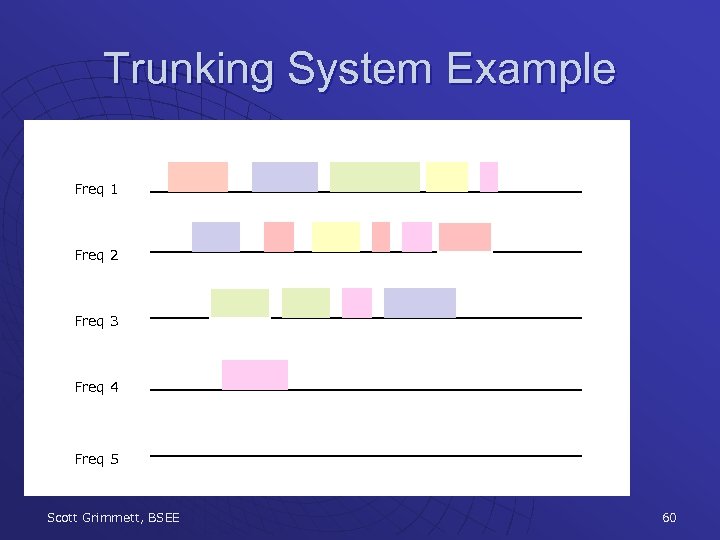
Trunking System Example Freq 1 Freq 2 Freq 3 Freq 4 Freq 5 Scott Grimmett, BSEE 60
Trunking System Example Trunking takes the advantage of the fact that not every agency will need to transmit at exactly the same time. u Statistically, more than 5 agencies can be having a conversation on the 5 channels without interruption of each conversation. u Scott Grimmett, BSEE 61
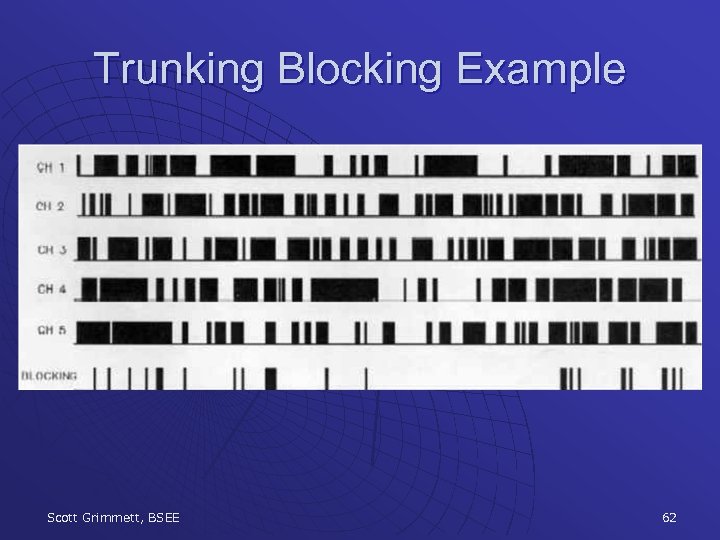
Trunking Blocking Example Scott Grimmett, BSEE 62
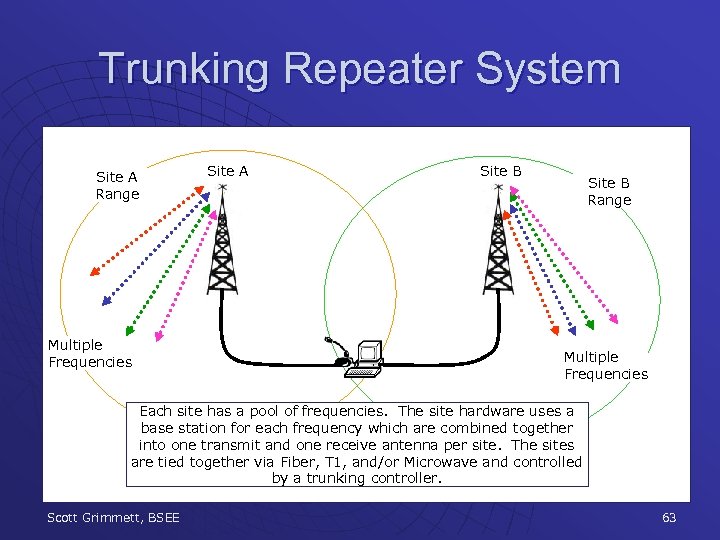
Trunking Repeater System Site A Range Multiple Frequencies Site A Site B Range Multiple Frequencies Each site has a pool of frequencies. The site hardware uses a base station for each frequency which are combined together into one transmit and one receive antenna per site. The sites are tied together via Fiber, T 1, and/or Microwave and controlled by a trunking controller. Scott Grimmett, BSEE 63
Talkgroups not Channels In trunking, do not think of the channels as different frequencies instead think of the channels as different talkgroups. u With trunking you decide who you want to talk with instead of what frequency to use. u Scott Grimmett, BSEE 64
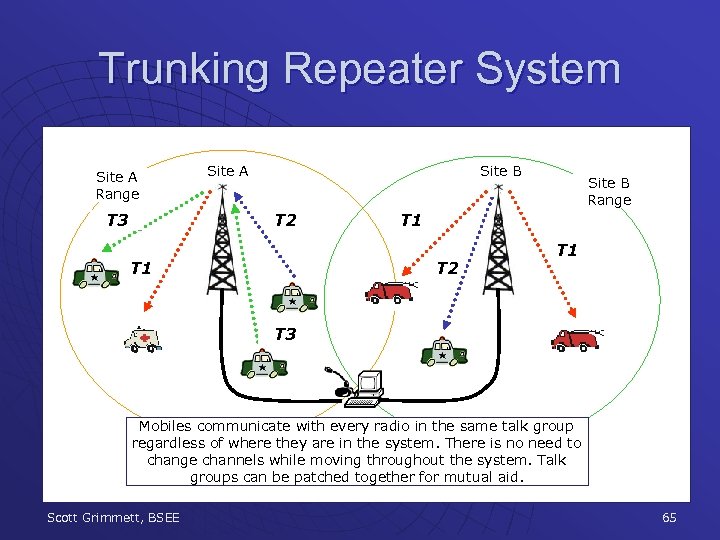
Trunking Repeater System Site A Range T 3 Site A Site B T 2 T 1 Site B Range T 1 T 2 T 1 T 3 Mobiles communicate with every radio in the same talk group regardless of where they are in the system. There is no need to change channels while moving throughout the system. Talk groups can be patched together for mutual aid. Scott Grimmett, BSEE 65
FCC Rule 90. 205 Scott Grimmett, BSEE 66
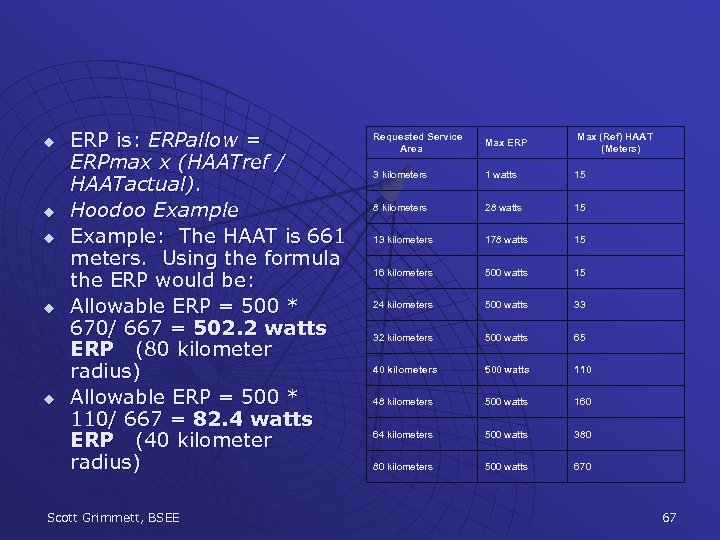
u u u ERP is: ERPallow = ERPmax x (HAATref / HAATactual). Hoodoo Example: The HAAT is 661 meters. Using the formula the ERP would be: Allowable ERP = 500 * 670/ 667 = 502. 2 watts ERP (80 kilometer radius) Allowable ERP = 500 * 110/ 667 = 82. 4 watts ERP (40 kilometer radius) Scott Grimmett, BSEE Requested Service Area Max ERP Max (Ref) HAAT (Meters) 3 kilometers 1 watts 15 8 kilometers 28 watts 15 13 kilometers 178 watts 15 16 kilometers 500 watts 15 24 kilometers 500 watts 33 32 kilometers 500 watts 65 40 kilometers 500 watts 110 48 kilometers 500 watts 160 64 kilometers 500 watts 380 80 kilometers 500 watts 670 67
Скачать презентацию Interoperability Analysis for DIGB 1 By Scott Grimmett
3837bd2496a51087b8f67214d68399da.ppt