 Скачать презентацию Interop Labs Network Access Control Interop Las Vegas
fa5d522df21e6c4fdc8bcdc2a9de8a1d.ppt
- Количество слайдов: 33



Interop Labs Network Access Control Interop Las Vegas 2006 Karen O’Donoghue, May 2006, Page
Interop Labs are: Technology Motivated, Open Standards Based, Vendor neutral, Test and Education focused, Initiatives… With team members from: Industry Academia Government Visit us at Booth 2506! Karen O’Donoghue, May 2006, Page 2 Technical contributions to this presentation include: Steve Hanna, Juniper Networks and TCG TNC Kevin Koster, Cloudpath Networks, Inc. Jan Trumbo, Joel Snyder, and the whole Interop Labs NAC team
Objectives • This presentation will: – Provide a general introduction to the concept of Network Access Control • Highlight the three most well known solutions – Provide a context to allow a network engineer to begin to plan for NAC deployment – Articulate a vision for NAC • This presentation will not: – Provide specifics on any of the three major approaches introduced – Delve into the underlying protocol details Karen O’Donoghue, May 2006, Page 3
Agenda • • • Why NAC? What is a Policy? Generic NAC architecture What is emerging today? What are your first steps? Where can you learn more? Karen O’Donoghue, May 2006, Page 4
Why NAC? • Proliferation of devices requiring network connectivity – Laptops, phones, PDAs • Increasingly mobile workforce – Requiring roughly the same access regardless of where they are connecting from • Mobile workforce is becoming infected – Enormous enterprise resources are wasted to combat an increasing numbers of viruses, worms, and spyware • Logistical difficulties associated with keeping corporate assets monitored and updated Karen O’Donoghue, May 2006, Page 5
Policy Possibilities • Who – Jim (CTO), Steve (Network Admin), Sue (Engineering), Bob (Finance), Brett (Guest) • Location – Secure room versus non-secured room • Connection Method – Wired, wireless, VPN • Time of Day – Limit after hours wireless access – Limit access after hours of employee’s shift • Posture – A/V installed, auto update enabled, firewall turned on, supported versions of software – Realtime traffic analysis feedback (IPS) Karen O’Donoghue, May 2006, Page 6
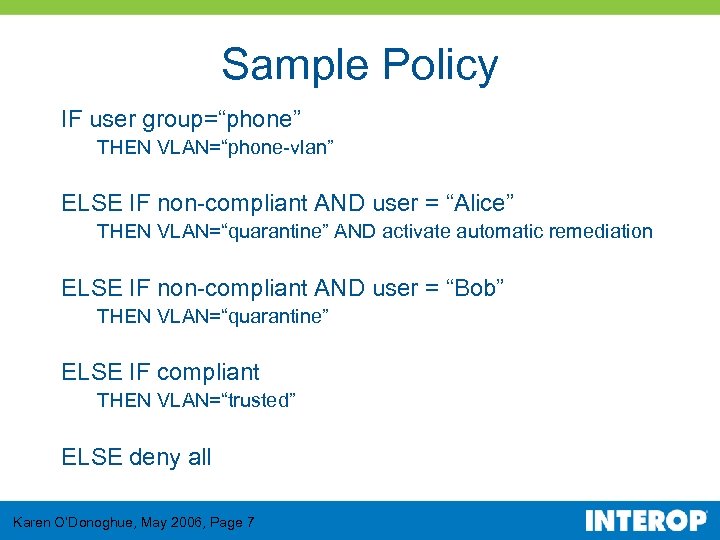
Sample Policy IF user group=“phone” THEN VLAN=“phone-vlan” ELSE IF non-compliant AND user = “Alice” THEN VLAN=“quarantine” AND activate automatic remediation ELSE IF non-compliant AND user = “Bob” THEN VLAN=“quarantine” ELSE IF compliant THEN VLAN=“trusted” ELSE deny all Karen O’Donoghue, May 2006, Page 7
Is NAC only VLANS? • NAC is not limited to dynamic VLAN configuration • Additional access possibilities: – Access Control Lists • Switches • Routers – Firewall rules – Traffic shaping (Qo. S) • Inline enforcement options Karen O’Donoghue, May 2006, Page 8
Agenda • • • Why NAC? What is a Policy? Generic NAC architecture What is emerging today? What are your first steps? Where can you learn more? Karen O’Donoghue, May 2006, Page 9
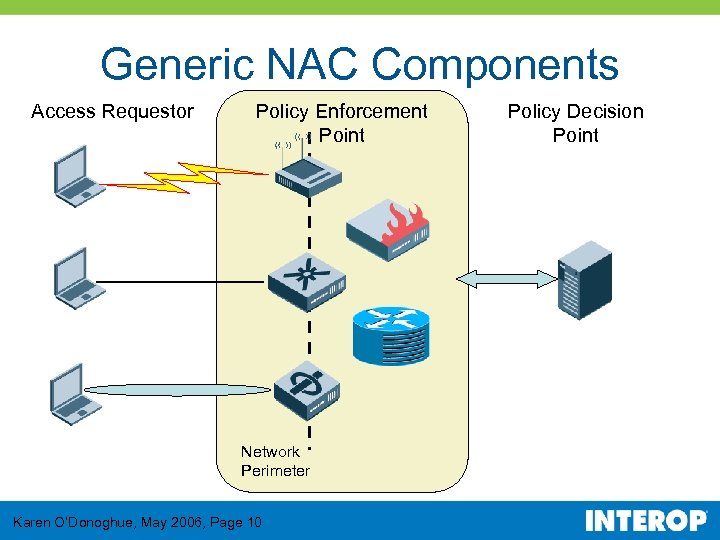
Generic NAC Components Access Requestor Policy Enforcement Point Network Perimeter Karen O’Donoghue, May 2006, Page 10 Policy Decision Point
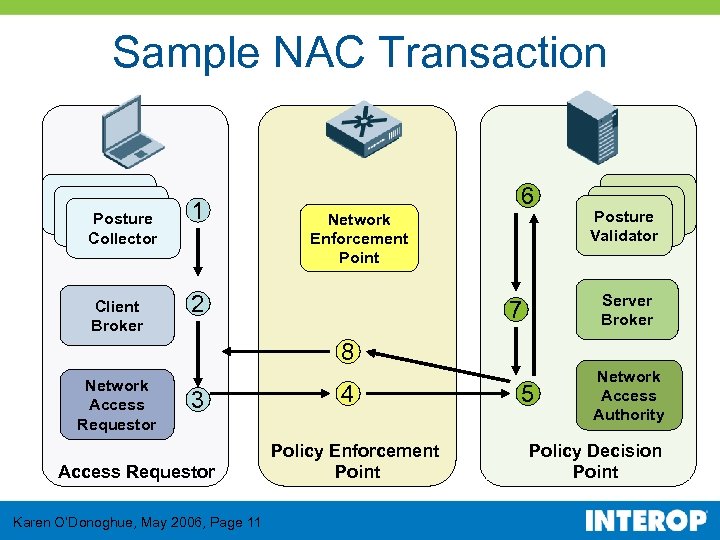
Sample NAC Transaction Posture Collector Client Broker 1 6 Network Enforcement Point 2 Posture Validator Server Broker 7 8 Network Access Requestor 3 Access Requestor Karen O’Donoghue, May 2006, Page 11 4 Policy Enforcement Point 5 Network Access Authority Policy Decision Point
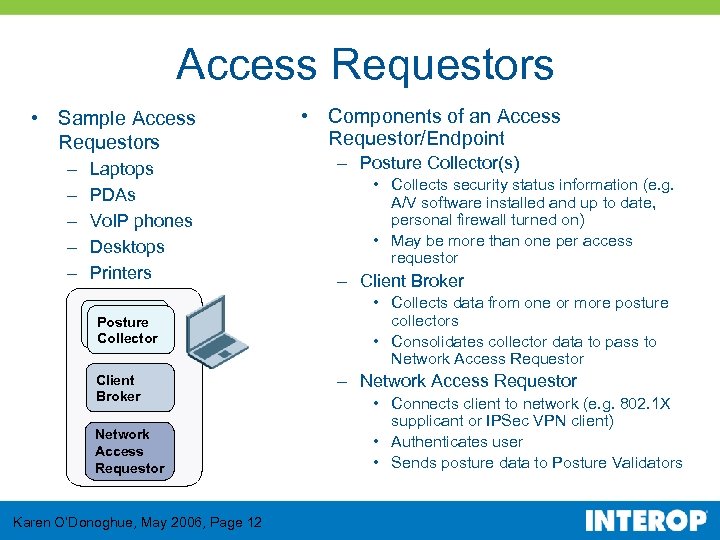
Access Requestors • Sample Access Requestors – – – Laptops PDAs Vo. IP phones Desktops Printers Posture Collector Client Broker Network Access Requestor Karen O’Donoghue, May 2006, Page 12 • Components of an Access Requestor/Endpoint – Posture Collector(s) • Collects security status information (e. g. A/V software installed and up to date, personal firewall turned on) • May be more than one per access requestor – Client Broker • Collects data from one or more posture collectors • Consolidates collector data to pass to Network Access Requestor – Network Access Requestor • Connects client to network (e. g. 802. 1 X supplicant or IPSec VPN client) • Authenticates user • Sends posture data to Posture Validators
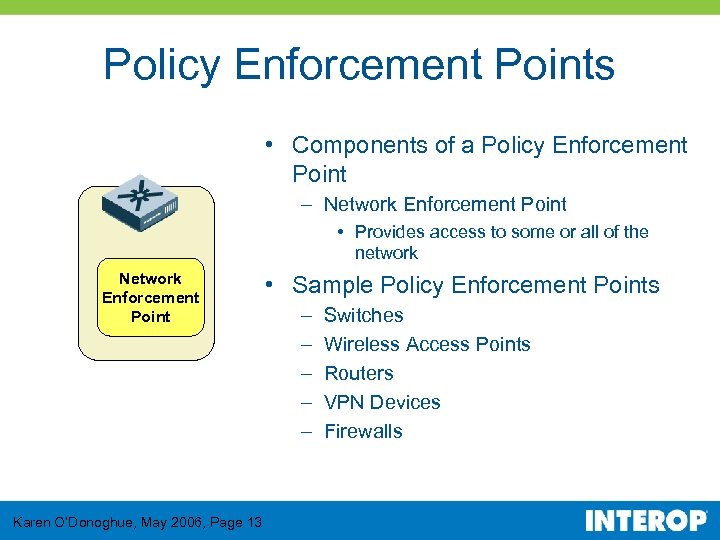
Policy Enforcement Points • Components of a Policy Enforcement Point – Network Enforcement Point • Provides access to some or all of the network Network Enforcement Point Karen O’Donoghue, May 2006, Page 13 • Sample Policy Enforcement Points – – – Switches Wireless Access Points Routers VPN Devices Firewalls
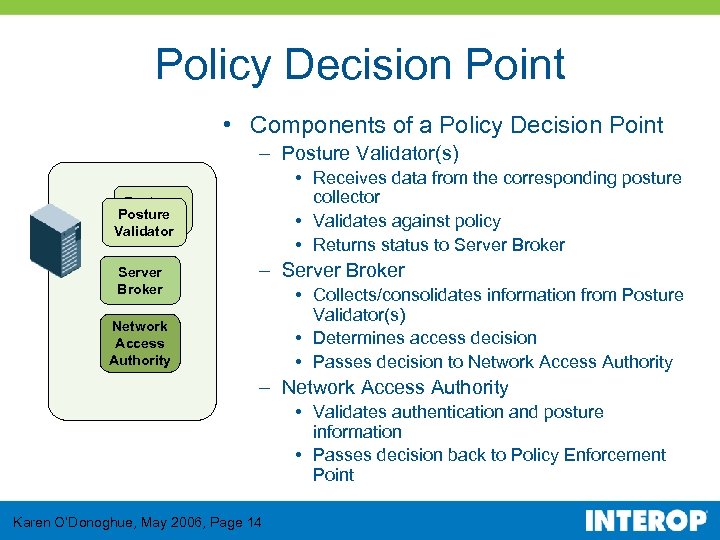
Policy Decision Point • Components of a Policy Decision Point – Posture Validator(s) • Receives data from the corresponding posture collector • Validates against policy • Returns status to Server Broker Posture Validator Server Broker – Server Broker • Collects/consolidates information from Posture Validator(s) • Determines access decision • Passes decision to Network Access Authority – Network Access Authority • Validates authentication and posture information • Passes decision back to Policy Enforcement Point Karen O’Donoghue, May 2006, Page 14
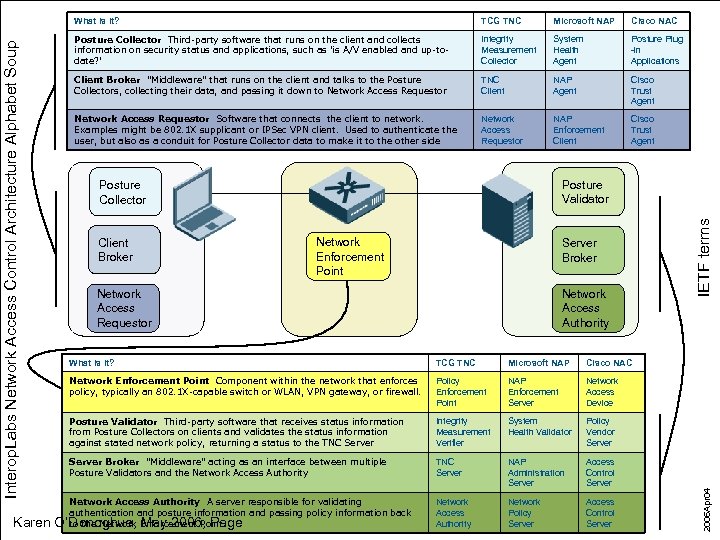
Karen TCG TNC Microsoft NAP Cisco NAC Posture Collector Third-party software that runs on the client and collects information on security status and applications, such as 'is A/V enabled and up-todate? ' Integrity Measurement Collector System Health Agent Posture Plug -in Applications Client Broker "Middleware" that runs on the client and talks to the Posture Collectors, collecting their data, and passing it down to Network Access Requestor TNC Client NAP Agent Cisco Trust Agent Network Access Requestor Software that connects the client to network. Examples might be 802. 1 X supplicant or IPSec VPN client. Used to authenticate the user, but also as a conduit for Posture Collector data to make it to the other side Network Access Requestor NAP Enforcement Client Cisco Trust Agent Client Broker Network Enforcement Point Server Broker Network Access Requestor Network Access Authority What is it? TCG TNC Microsoft NAP Cisco NAC Network Enforcement Point Component within the network that enforces policy, typically an 802. 1 X-capable switch or WLAN, VPN gateway, or firewall. Policy Enforcement Point NAP Enforcement Server Network Access Device Posture Validator Third-party software that receives status information from Posture Collectors on clients and validates the status information against stated network policy, returning a status to the TNC Server Integrity Measurement Verifier System Health Validator Policy Vendor Server Broker "Middleware" acting as an interface between multiple Posture Validators and the Network Access Authority TNC Server NAP Administration Server Access Control Server Network Access Authority Network Policy Server Access Control Server IETF terms Posture Validator Posture Collector Network Access Authority A server responsible for validating authentication and posture information and passing policy information back to the Network May 2006, Page O’Donoghue, Enforcement Point. 2006 Apr 04 Interop. Labs Network Access Control Architecture Alphabet Soup What is it?
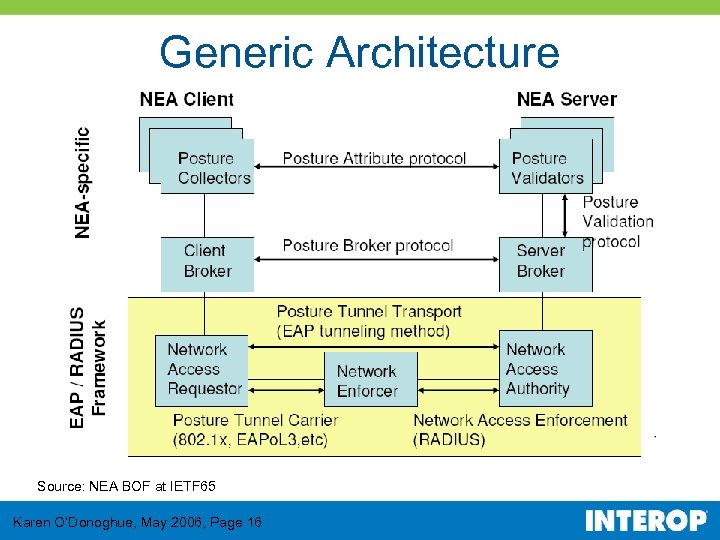
Generic Architecture Source: NEA BOF at IETF 65 Karen O’Donoghue, May 2006, Page 16
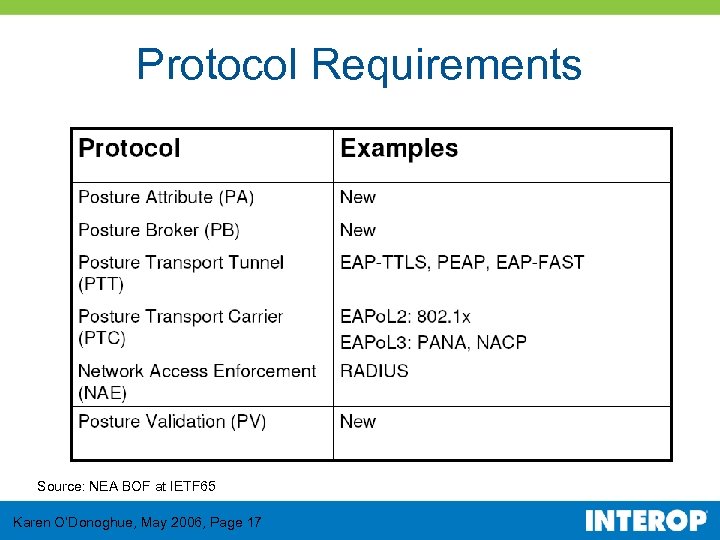
Protocol Requirements Source: NEA BOF at IETF 65 Karen O’Donoghue, May 2006, Page 17
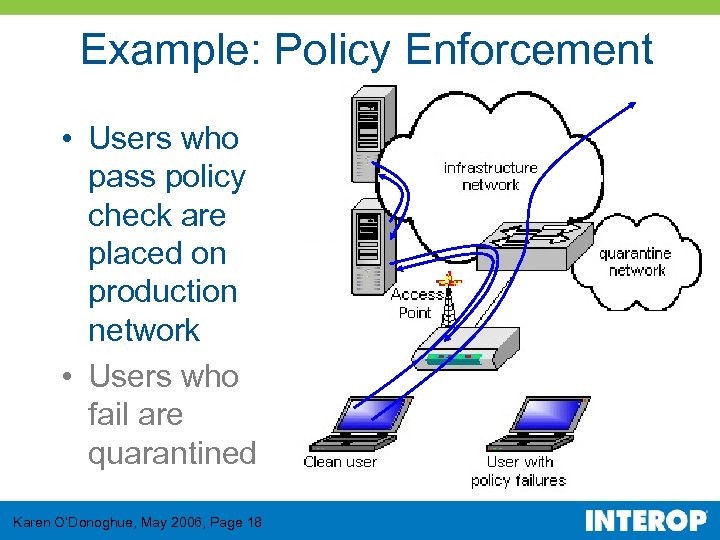
Example: Policy Enforcement • Users who pass policy check are placed on production network • Users who fail are quarantined Karen O’Donoghue, May 2006, Page 18
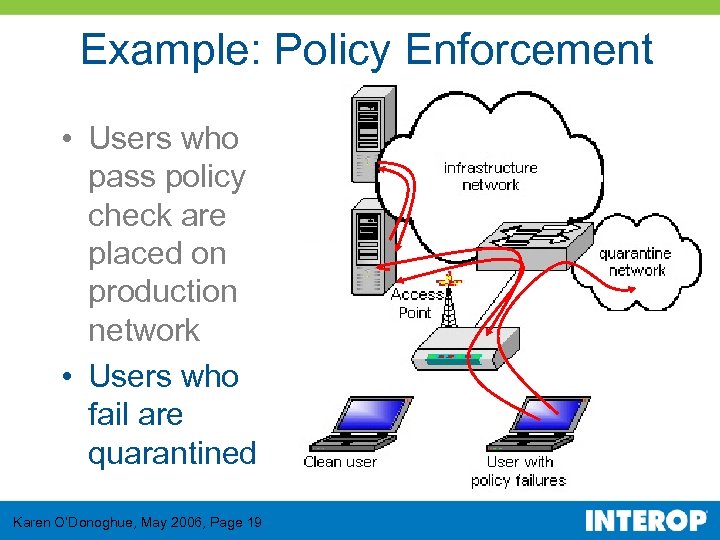
Example: Policy Enforcement • Users who pass policy check are placed on production network • Users who fail are quarantined Karen O’Donoghue, May 2006, Page 19
Agenda • • • Why NAC? What is a Policy? Generic NAC architecture What is emerging today? What are your first steps? Where can you learn more? Karen O’Donoghue, May 2006, Page 20
NAC Solutions • There are three prominent solutions: – Cisco’s Network Admission Control (NAC) – Microsoft’s Network Access Protection (NAP) – Trusted Computer Group’s Trusted Network Connect (TNC) • There are several additional approaches that we did not address. Karen O’Donoghue, May 2006, Page 21
Cisco NAC • Strengths – Third party support for client – Installed base of network devices • Limitations – Tied to Cisco hardware – Not an open standard – Requires third party supplicant for wireless • Status – Product shipping today – Refinement of policy server expected (2007) Karen O’Donoghue, May 2006, Page 22
Microsoft NAP • Strengths – Part of Windows operating system – Supports auto remediation – Network device neutral • Limitations – Part of Windows operating system – Client support limited (only Vista guaranteed) – Not an open standard • Status – Not shipping today • Expect release in early 2007. Karen O’Donoghue, May 2006, Page 23
Trusted Computing Group (TCG) Trusted Network Connect (TNC) • Strengths – Open standards based • Trusted Computing Group – Not tied to specific hardware, servers, or client operating systems • Limitations – Still in its infancy – Potential integration risk with multiple parties • Status – Currently no shipping products • Maybe Fall 2006 – Updated specifications released May 2006 Karen O’Donoghue, May 2006, Page 24
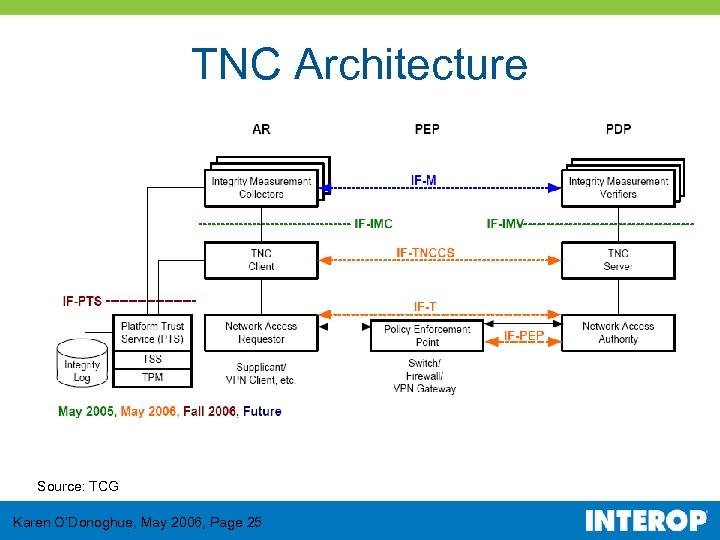
TNC Architecture Source: TCG Karen O’Donoghue, May 2006, Page 25
Current State of Affairs • Multiple non-interoperable solutions – Cisco NAC, Microsoft NAP, TCG TNC – Conceptually, all 3 are very similar – All with limitations – None completely functional • Industry efforts at convergence and standardization – TCG – IETF Karen O’Donoghue, May 2006, Page 26
What is the IETF role? • The Internet Engineering Task Force (IETF) is considering additional standards in this area – Network Endpoint Assessment BOF held in March 2005 – Co-chaired by Cisco and TNC representatives – Formation of a working group under consideration Karen O’Donoghue, May 2006, Page 27
Agenda • • • Why NAC? What is a Policy? Generic NAC architecture What is emerging today? What are your first steps? Where can you learn more? Karen O’Donoghue, May 2006, Page 28
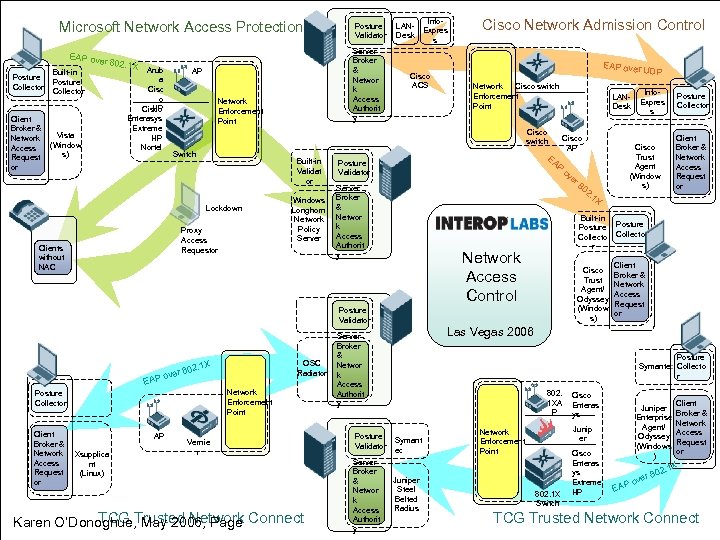
Microsoft Network Access Protection Server Broker & Networ k Access Authorit y EAP ov Posture Collector Client Broker & Network Access Request or Built-in Posture Collector er 802. 1 X Vista (Window s) Arub a Cisc o HP Cisco Enterasys Extreme HP Nortel Posture Validator AP Network Enforcement Point LANDesk Info. Expres s Cisco ACS Cisco Network Admission Control EAP over Cisco switch Network Enforcement Point Cisco switch Switch Built-in Validat or Lockdown Proxy Access Requestor Clients without NAC Windows Longhorn Network Policy Server Cisco AP EA Posture Validator LANDesk P ov er Server Broker & Networ k Access Authorit y EAP ove Network Enforcement Point Posture Collector Client Broker & Network Access Request or OSC Radiator AP Xsupplica nt (Linux) Vernie r TCG May 2006, Page Karen O’Donoghue, Trusted Network Connect Server Broker & Networ k Access Authorit y Client Broker & Network Access Request or Cisco Trust Agent/ Odyssey (Window s) Posture Collector Client Broker & Network Access Request or Las Vegas 2006 Server Broker & Networ k Access Authorit y Posture Validator Posture Collector 1 X Built-in Posture Collecto r Network Access Control Info. Expres s Cisco Trust Agent (Window s) 2. Posture Validator . 1 X r 802 80 UDP Posture Symantec Collecto r 802. 1 XA P Symant ec Juniper Steel Belted Radius Cisco Enteras ys Juniper Enterprise Agent/ Odyssey (Windows ) Junip er Network Enforcement Point 802. 1 X Switch Cisco Enteras ys Extreme HP EAP r ove Client Broker & Network Access Request or . 1 X 802 TCG Trusted Network Connect
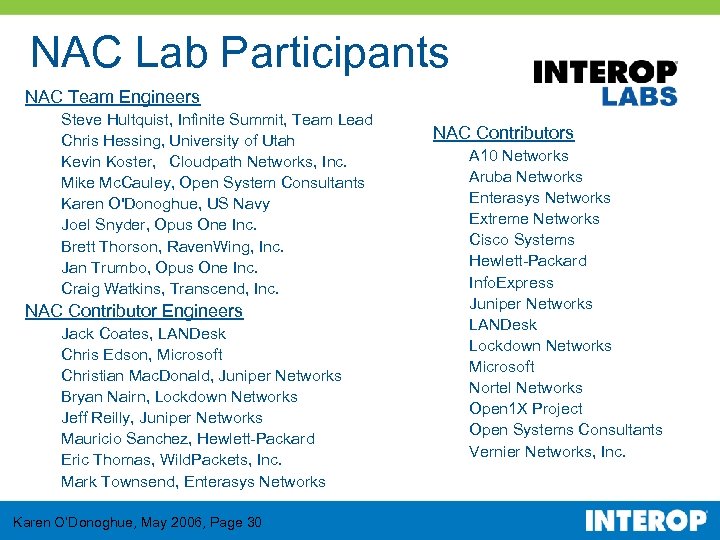
NAC Lab Participants NAC Team Engineers Steve Hultquist, Infinite Summit, Team Lead Chris Hessing, University of Utah Kevin Koster, Cloudpath Networks, Inc. Mike Mc. Cauley, Open System Consultants Karen O'Donoghue, US Navy Joel Snyder, Opus One Inc. Brett Thorson, Raven. Wing, Inc. Jan Trumbo, Opus One Inc. Craig Watkins, Transcend, Inc. NAC Contributor Engineers Jack Coates, LANDesk Chris Edson, Microsoft Christian Mac. Donald, Juniper Networks Bryan Nairn, Lockdown Networks Jeff Reilly, Juniper Networks Mauricio Sanchez, Hewlett-Packard Eric Thomas, Wild. Packets, Inc. Mark Townsend, Enterasys Networks Karen O’Donoghue, May 2006, Page 30 NAC Contributors A 10 Networks Aruba Networks Enterasys Networks Extreme Networks Cisco Systems Hewlett-Packard Info. Express Juniper Networks LANDesk Lockdown Networks Microsoft Nortel Networks Open 1 X Project Open Systems Consultants Vernier Networks, Inc.
Getting started with NAC • Answer three basic questions. – What is your access control policy? – What access methods do you want to protect? – What is your existing infrastructure? • Test early and often • Monitor the progress of open standards based solutions • Don’t do this alone! (at least today) Karen O’Donoghue, May 2006, Page 31
Where can you learn more? • Visit the Interop Labs Booth (#2506) – Live Demonstrations of all three major NAC architectures with engineers to answer questions – White Papers available: ¨ ¨ ¨ ¨ What is NAC? What is 802. 1 X? Getting Started with Network Access Control What is TCG’s Trusted Network Connect? What is Microsoft’s Network Access Protection? What is Cisco Network Admission Control? What is the IETF NAC Strategy? Network Access Control Resources • Visit us online: – http: //www. opus 1. com/nac • Interop Labs white papers, this presentation, and demonstration layout diagram Karen O’Donoghue, May 2006, Page 32
Thank You! Questions? Interop Labs -- Booth 2506 http: //www. opus 1. com/nac Karen O’Donoghue, May 2006, Page 33
Скачать презентацию Interop Labs Network Access Control Interop Las Vegas
fa5d522df21e6c4fdc8bcdc2a9de8a1d.ppt