 Скачать презентацию INTERNSHIP FORUM 2005 TOKYO Bruce A Lumsden Director
68a546a90487f65854311eef77a1d7af.ppt
- Количество слайдов: 65




INTERNSHIP FORUM 2005, TOKYO Bruce A. Lumsden, Director, CECS Sujeet K. Chaudhuri, Professor, E&CE University of Waterloo, CANADA and Peter Franks, CEO, WACE, USA February 21, 2005

WORK INTEGRATED LEARNING (WIL)-TRENDS & CHALLENGES IN CO-OPERATIVE( Co-op) EDUCATION - A CANADIAN PERSPECTIVE
PRESENTATION OUTLINE Generic Description of Co-op Education in Canada A Case Study- UW Experience International Trends/Directions/Findings For New Start References/ Q & A
What is Co-operative Education? • An instrument for developing a nation's human resources • A strategy for helping students, businesses, and governments succeed in a global economy • A foundation for lifelong learning A partnership
What Is Co-operative Education? Experiential Learning A structured educational program combining classroom learning with productive work experience in a field related to a student's academic or career goals An integrated academic model A partnership among students, educational institutions (faculty and administration) and employers, with specific responsibilities for each partner
Definition Of Cooperative Education Co-op is an educational strategy integrating classroom curriculum with academically related work experience. It is called cooperative education since it requires the cooperation of the three parties involved: student, educational institution, and employer. It reinforces and expands critical thinking skills by combining the traditional academic curriculum with practical applications and experience (experiential learning).
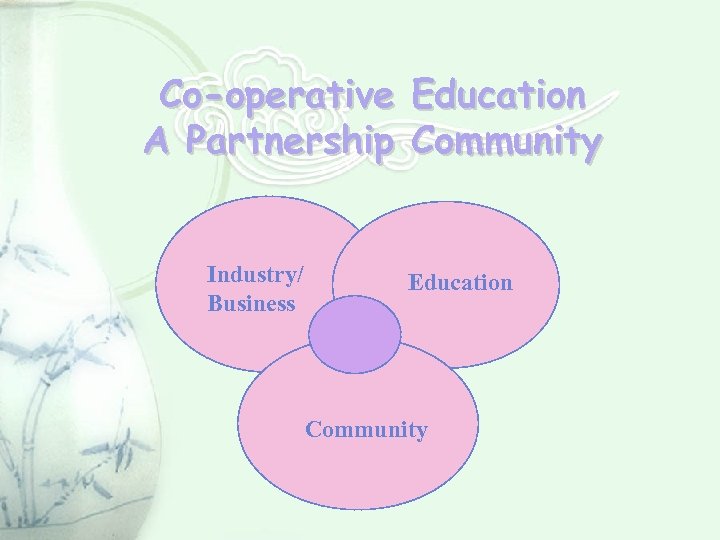
Co-operative Education A Partnership Community Industry/ Business Education Community
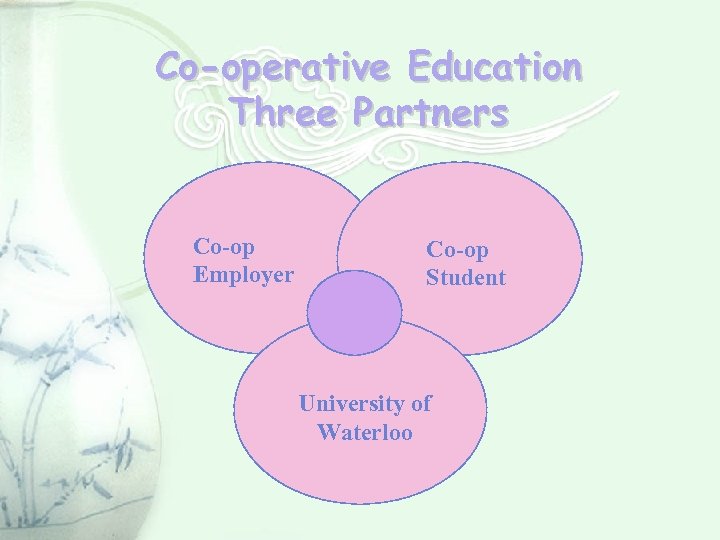
Co-operative Education Three Partners Co-op Employer Co-op Student University of Waterloo
Six Questions 1. What is the main reason to consider the concept of Co-operative Education? 2. What is the purpose of the program? 3. Who should be involved? 4. What is the role of those involved? 5. How should the program be organized and managed? 6. How should the activity be funded?
Partnerships Practice of partnership is critical for successful sustainable co-op Partners Students Employers Academic Institutions Governments Alumni Within the institution Outside the institution Common Purpose/Motive Commitment
What Are the Characteristics of Co-op? Each work situation is developed and/or approved by the co-operative educational institution as a suitable learning situation. Student is engaged in productive work, not merely observing. Student receives remuneration for the work performed. Student's progress on the job is monitored by the educational institution. Student's progress on the job is supervised and evaluated by the employer. The total co-operative work experience constitutes a significant portion of the academic program (normally between 30 and 50% of the total program).
Co-op in Canada Institutions 1957 - 1 2003 - 85 Canada (46 University-36 Colleges) 2003 -28 Ontario (13 Universities-15 Colleges) three sizes – small, medium, large Students 74, 742 Undergraduates in Canada - 49, 352 Universities - 25, 390 colleges 39, 668 Undergraduates in Ontario - 20, 953 Universities - 18, 715 Colleges Graduate ?
Co-op in Canada Programs 1957 - 1 2003 – 1000+ Applied Sciences Pure Sciences Social Sciences Humanities Fine Arts Models alternating internship parallel other Job Types professional/occupational entrepreneurial humanitarian international
Benefits to Students Integrate classroom theory with workplace practice Earn money to pay for their education Greater certainty about career choice prior to graduation More informed about career opportunities Perceive their own abilities and limitations better Greater sense of autonomy, self-confidence, independence Better understanding of workplace culture Better matched to their jobs
Investments by Students Higher fees: UW co-op students pay an additional fee of $445, plus a work-report marking fee of $14 per term Move every 4 months - always slightly off balance More difficult to get in the flow of campus life, e. g. , varsity sports Takes longer to graduate (five years instead of four) Increased stress as interviews occur in mid-term
Benefits to Employers Short Term ability to hire students to complete project work d flexibility in hiring: additional help without full-time commitment d enthusiastic, motivated employees with new ideas and skills d cost-effectiveness d Long Term ability to screen future employees d connection with the educational institution provides employers with a flexible means of meeting staffing needs and an effective source of full-time recruitment d contribution to the development of young professionals and to the national society and economy d
Investment by Employers Initial lack of productivity; training required Supervisor's time Salary and benefits Loss of trained employees through turnover and returning to school
Benefits to Institution Makes the institution more attractive and affordable for students More efficient use of resources, physical plant, libraries, other facilities: UW operates year round Attracts excellent students who are highly motivated More relevant curriculum Knowledge transfer from the workplace to the classroom Builds links with business and industry
Investments by Institution Work-Term Related Costs d recovered from the students enrolled in co-op programs Academic Delivery Costs d Courses are offered a second or third time in a year to accommodate the alternating work/academic terms. Year-Round Operation Costs Total extra costs at UW are estimated to be $23. 5 million per annum
Financial Paybacks Taxes on income earned Higher starting salaries Fewer draw on government loans Smaller loans Faster loan repayment Lower default rates
Beginnings of Co-op at Waterloo Founded in 1957 Small Quiet Community in Ontario Mixture of Industry and Business Small Liberal Arts College End of W. W. II - Economic Growth Visionary Community Leaders

North America
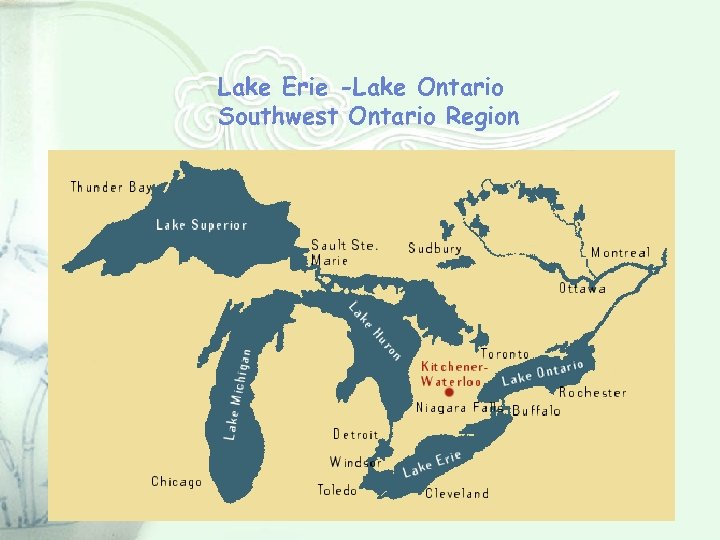
Lake Erie -Lake Ontario Southwest Ontario Region
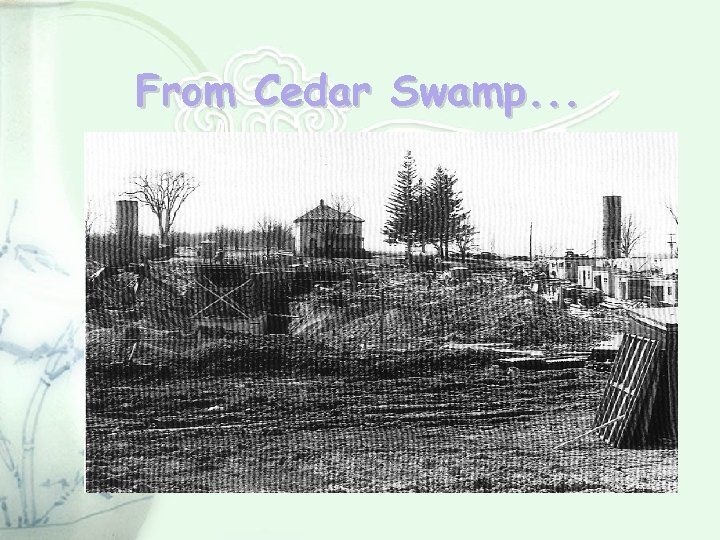
From Cedar Swamp. . .
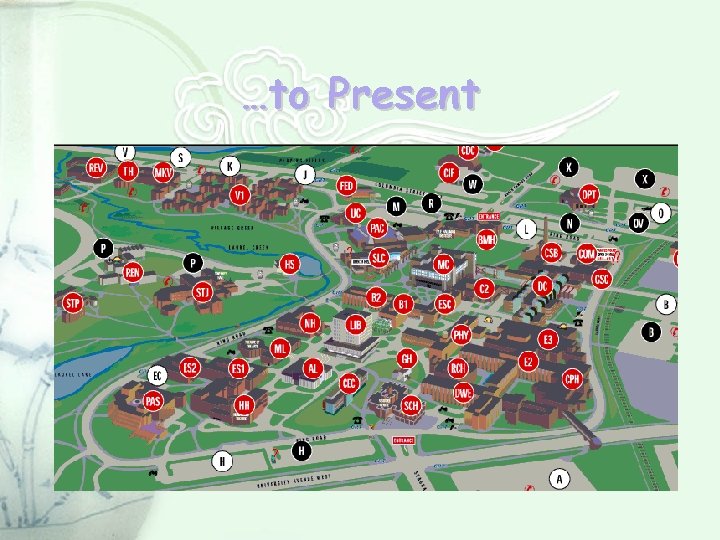
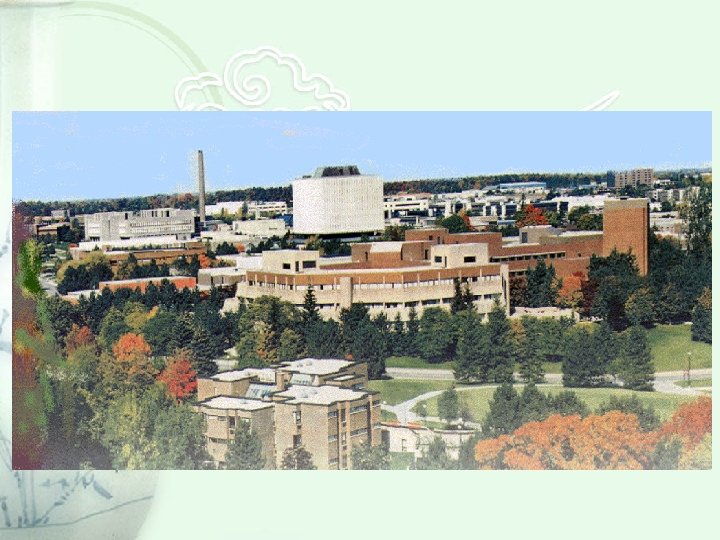
…to Present
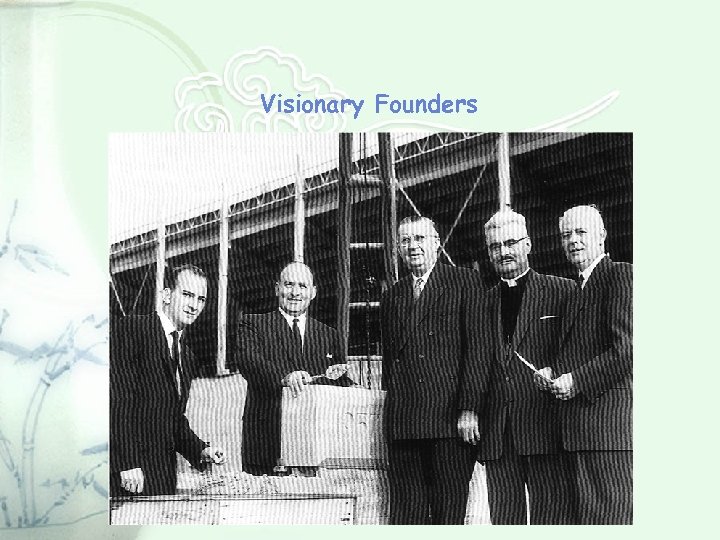
Visionary Founders
The University 1, 000 acre campus 21, 500 full and part-time undergraduates 2, 400 full and part-time graduate students 787 faculty members 2, 100 staff members $375 million budget $100 million external research funding 112, 000 alumni in 135 countries
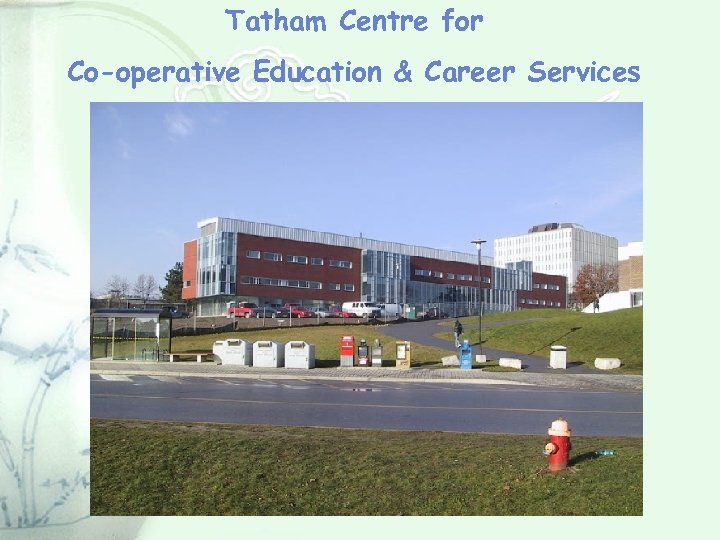
Tatham Centre for Co-operative Education & Career Services
Facts About UW Co-op Largest Co-op Program - enrolment of 11, 000 students Over 60% of all full time undergraduates are Co-op Over 100 Academic Programs in six academic faculties Co-op mandatory in some programs, optional in others UW is 63% of the Ontario university co-op system and 28% of the Canadian university co-op system UW is 30% of total post-secondary Co-op enrolment in Ontario and 14. 5% of total post-secondary Co-op enrolment in Canada Students earned approximately $119 million on work terms in 2002
More Facts About UW Co-op • 3, 500 active employers • 90% of co-op jobs are in Ontario • 75% of jobs are in the private sector and 25% in the public sector • 862 UW co-op students participated in work terms outside Canada in 2002/2003, 556 worked in the U. S. • UW hired 541 co-op students in 2003
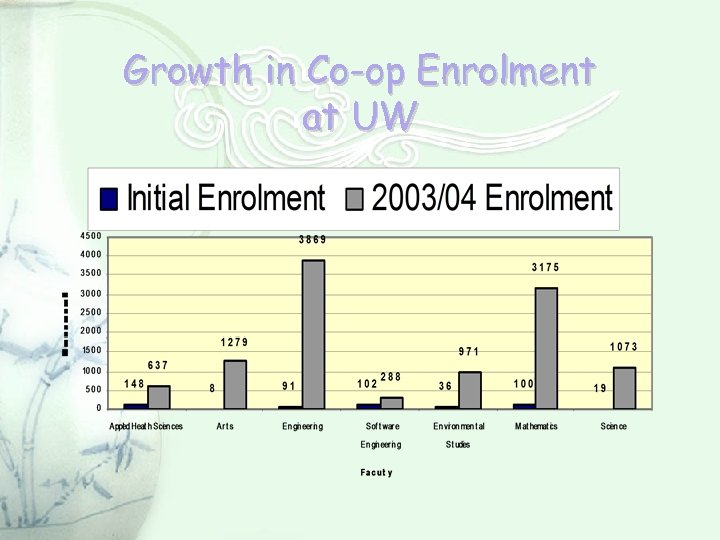
Growth in Co-op Enrolment at UW
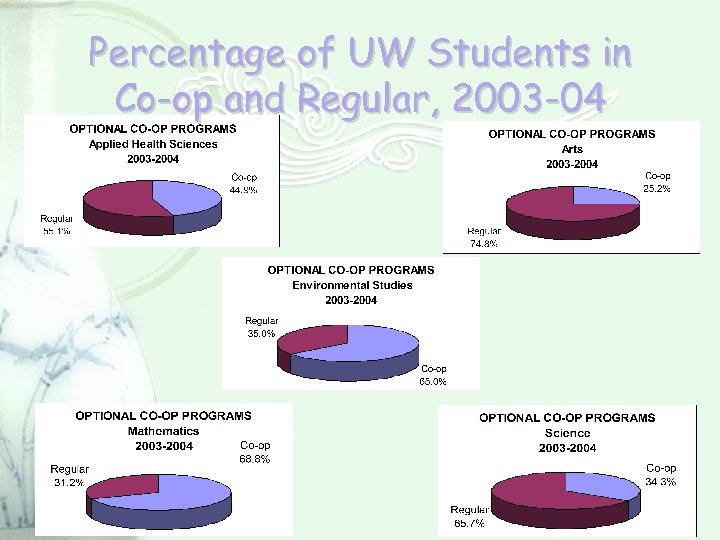
Percentage of UW Students in Co-op and Regular, 2003 -04
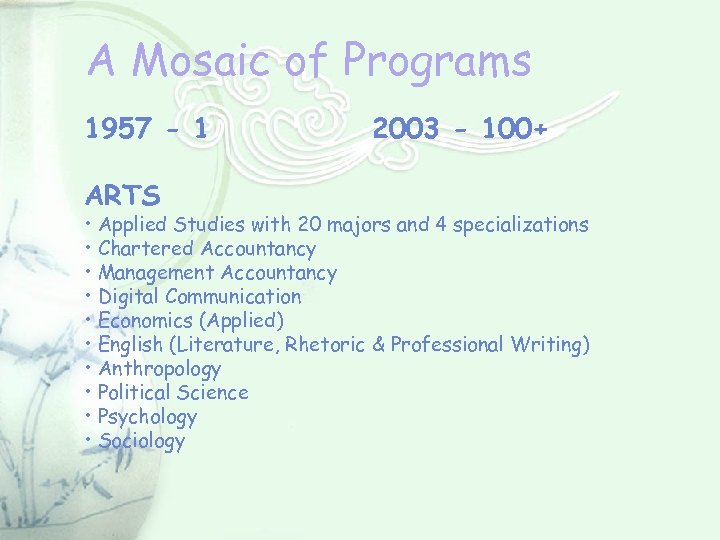
A Mosaic of Programs 1957 - 1 ARTS 2003 - 100+ • Applied Studies with 20 majors and 4 specializations • Chartered Accountancy • Management Accountancy • Digital Communication • Economics (Applied) • English (Literature, Rhetoric & Professional Writing) • Anthropology • Political Science • Psychology • Sociology
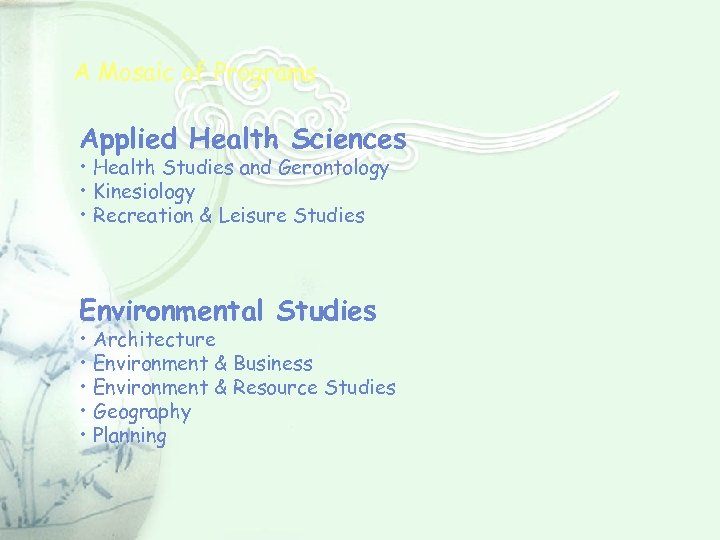
A Mosaic of Programs Applied Health Sciences • Health Studies and Gerontology • Kinesiology • Recreation & Leisure Studies Environmental Studies • Architecture • Environment & Business • Environment & Resource Studies • Geography • Planning
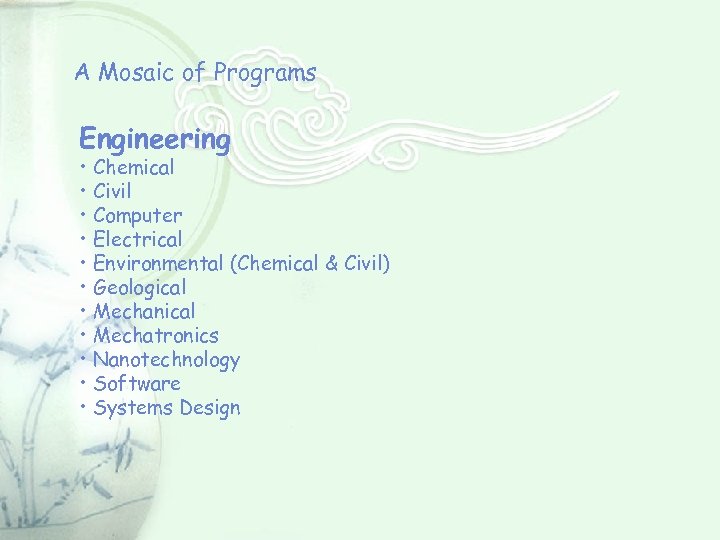
A Mosaic of Programs Engineering • Chemical • Civil • Computer • Electrical • Environmental (Chemical & Civil) • Geological • Mechanical • Mechatronics • Nanotechnology • Software • Systems Design
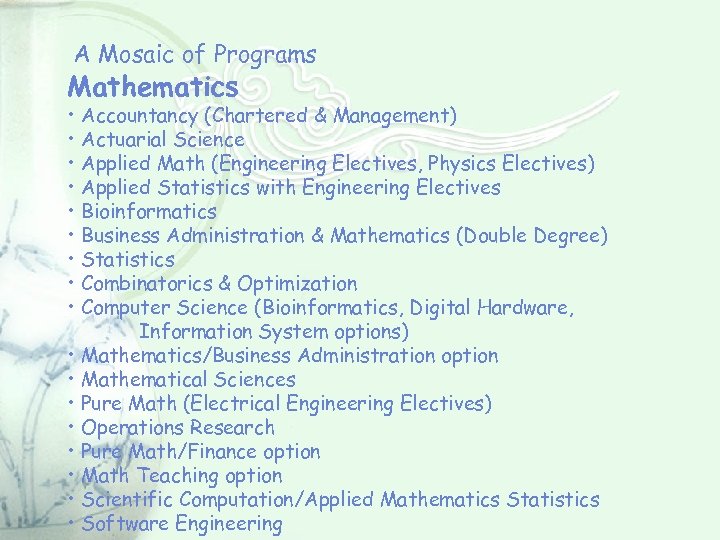
A Mosaic of Programs Mathematics • Accountancy (Chartered & Management) • Actuarial Science • Applied Math (Engineering Electives, Physics Electives) • Applied Statistics with Engineering Electives • Bioinformatics • Business Administration & Mathematics (Double Degree) • Statistics • Combinatorics & Optimization • Computer Science (Bioinformatics, Digital Hardware, Information System options) • Mathematics/Business Administration option • Mathematical Sciences • Pure Math (Electrical Engineering Electives) • Operations Research • Pure Math/Finance option • Math Teaching option • Scientific Computation/Applied Mathematics Statistics • Software Engineering
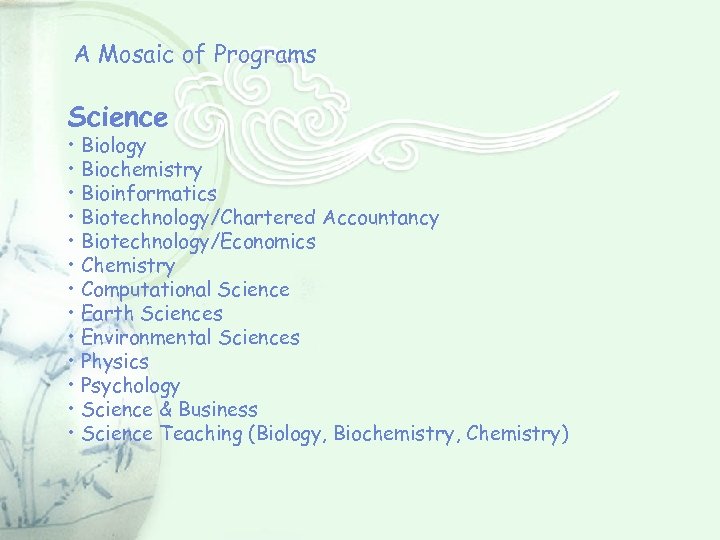
A Mosaic of Programs Science • Biology • Biochemistry • Bioinformatics • Biotechnology/Chartered Accountancy • Biotechnology/Economics • Chemistry • Computational Science • Earth Sciences • Environmental Sciences • Physics • Psychology • Science & Business • Science Teaching (Biology, Biochemistry, Chemistry)
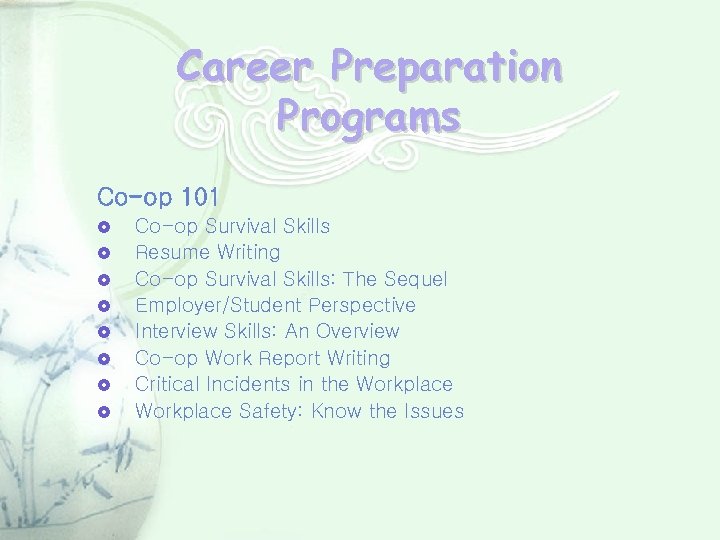
Career Preparation Programs Co-op 101 Co-op Survival Skills Resume Writing Co-op Survival Skills: The Sequel Employer/Student Perspective Interview Skills: An Overview Co-op Work Report Writing Critical Incidents in the Workplace Safety: Know the Issues
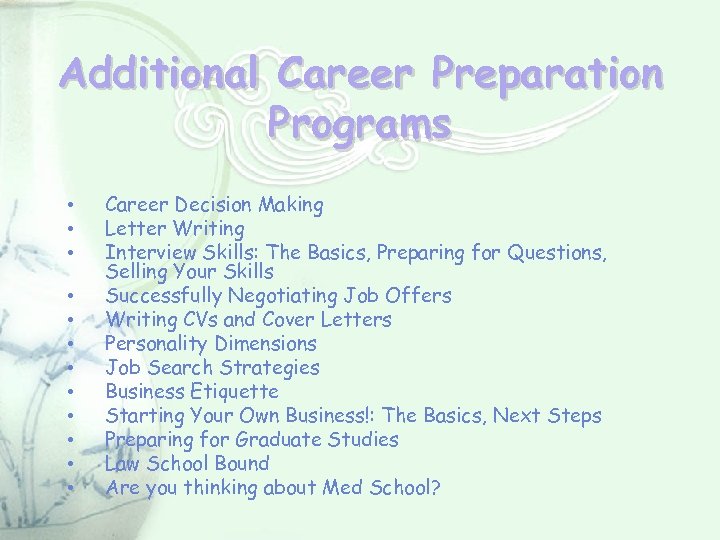
Additional Career Preparation Programs Career Decision Making Letter Writing Interview Skills: The Basics, Preparing for Questions, Selling Your Skills Successfully Negotiating Job Offers Writing CVs and Cover Letters Personality Dimensions Job Search Strategies Business Etiquette Starting Your Own Business!: The Basics, Next Steps Preparing for Graduate Studies Law School Bound Are you thinking about Med School?
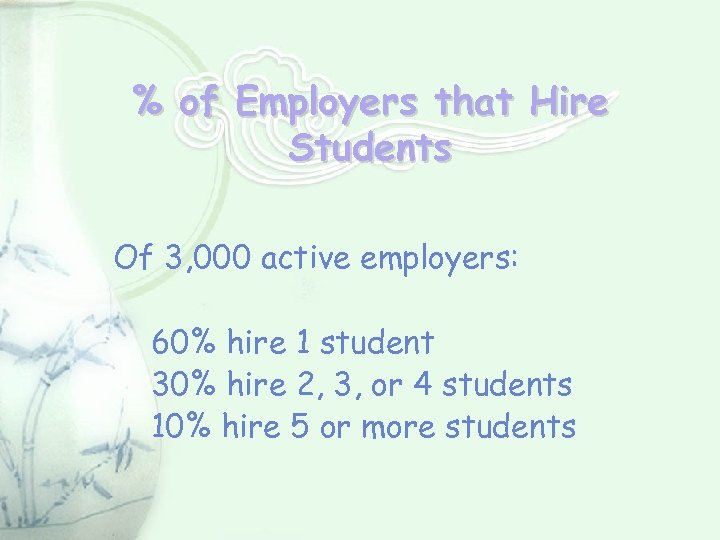
% of Employers that Hire Students Of 3, 000 active employers: 60% hire 1 student 30% hire 2, 3, or 4 students 10% hire 5 or more students
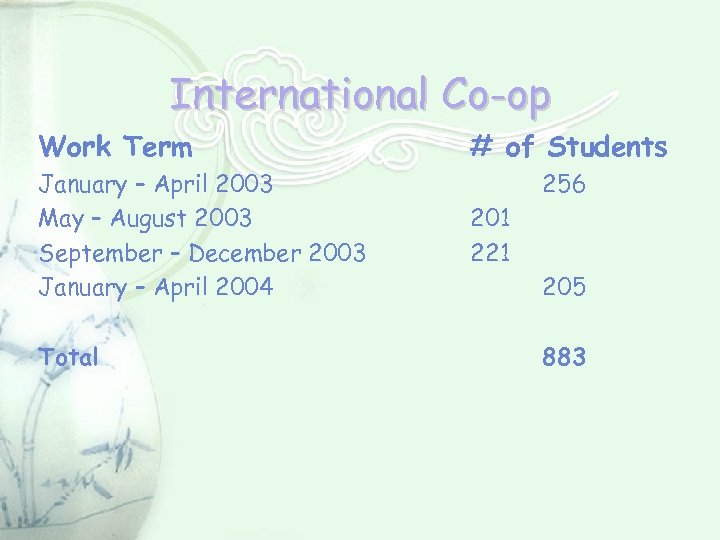
International Co-op Work Term January – April 2003 May – August 2003 September – December 2003 January – April 2004 Total # of Students 256 201 221 205 883
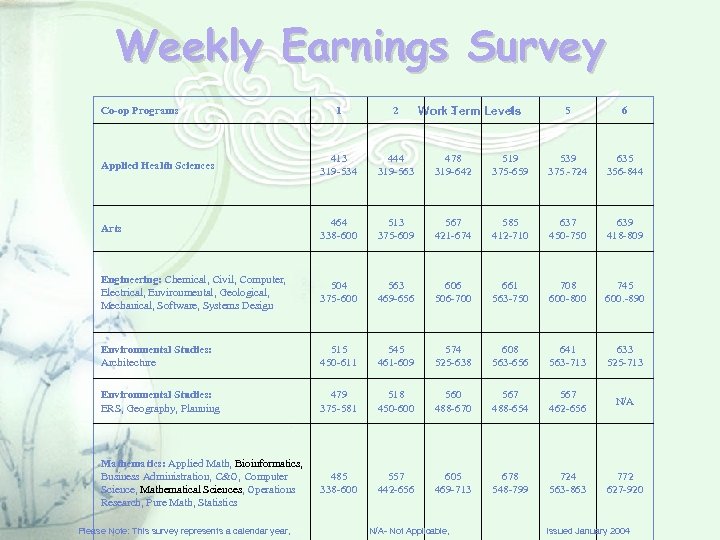
Weekly Earnings Survey Co-op Programs 1 2 5 6 Applied Health Sciences 413 319 -534 444 319 -563 478 319 -642 519 375 -659 539 375. -724 635 356 -844 Arts 464 338 -600 513 375 -609 567 421 -674 585 412 -710 637 450 -750 639 418 -809 Engineering: Chemical, Civil, Computer, Electrical, Environmental, Geological, Mechanical, Software, Systems Design 504 375 -600 563 469 -656 606 506 -700 661 563 -750 708 600 -800 745 600. -890 Environmental Studies: Architecture 515 450 -611 545 461 -609 574 525 -638 608 563 -656 641 563 -713 633 525 -713 Environmental Studies: ERS, Geography, Planning 479 375 -581 518 450 -600 560 488 -670 567 488 -654 567 462 -656 N/A Mathematics: Applied Math, Bioinformatics, Business Administration, C&O, Computer Science, Mathematical Sciences, Operations Research, Pure Math, Statistics 485 338 -600 557 442 -656 605 469 -713 678 548 -799 724 563 -863 772 627 -920 Please Note: This survey represents a calendar year, 4 Work 3 Term Levels N/A- Not Applicable, Issued January 2004
Academic Credit for the Work Experience Credit for the work experience Academic enhancement d d d d d Leadership Ethics/Law Intellectual Property Risk management Managing change Communication Critical analysis Professional responsibility Health/Safety
The Impact of Co-op Quality of Students Reputation Relationships Spin off companies (IP policy) Community Transfer of knowledge Acceptance by other institutions
What has been successful ? The idea itself Growth Enrollment of students Diversity of programs Quality of students Relationships (employers) human resource strategy knowledge transfer Reputation Alumni, Leaders of Tomorrow Community benefits
Concerns from the Partners From students about process control the busyness From employers about the process the model technology From the University about the idea itself funding benign acceptance
Benefits of Cooperative Education Higher retention rate and higher job satisfaction of coop employees Ability for employers to test co-op students Steady supply of trained staff at reduced costs Excellent training ground for future professionals – provides students with real-world experience International Co-op programs train students with global perspectives Grassroots support is generated for building cooperative education programs in both industrialized and developing countries
International Scope Practiced in over 40 countries around the world utilizing different models that must adapt well with the educational institutions schedule and format The concept of Co-op or work based education in its broader context is growing rapidly - particularly in developing nations due to the improved way it prepares youth for productive lives which in turn improves the nation’s economy Models d d Sandwich Alternating Parallel Others based on local needs
Recent Developments in Co -op Education Boundaries between universities & workplace as learning sites becoming increasingly blurred – new partnerships emerging: universities, corporations & governments In Indonesia, emerging from its ‘link and match’ program to more developed form In Malaysia, associated especially with its major program of developments in IT and multi-media In Thailand, associated with the emergence of new universities: SUT & Walailak University

A New Approach in the ‘Creative Industries’ include journalism, advertising, media production, animation, etc. In Australia, Queensland University of Technology is in partnership with the Queensland government, business and industry in the ‘Creative Industries”. Research & training facilities, incubator firms, public event space, as well as specialized retail outlets come together.
History of WACE was founded in 1983 International nonprofit organization Advocates cooperative education or WIL around the world (unique) Provider of technical service to establish or strengthen cooperative education programs Current membership: 1, 000 representing 43 countries
WACE Objectives Promote work-integrated learning around the world Advocate and advance work-integrated learning as an international human resource development strategy Build global alliances of education, industry, and government Provide value-added services, information, and products including assistance with networking opportunities Sponsor regional forums and a biennial world conference for association with discounts in fees for members Next World Conference: Boston June 14 -17, 2005
Cooperative Education as a Source of Labor Supply to Firms in the College Labor Market Based on a Research Project By Center for Labor Market Studies Northeastern University for the World Association for Cooperative Education, Inc.
Main Findings Occupational Mobility, Retention, Performance Appraisals and Promotions Compared to non-coop hires: Ø Coop hires experienced significantly greater upward occupational mobility Ø Coop hires had higher retention rates Ø Coop hires received substantially better performance appraisals Ø Coop hires received many more promotions regardless of the length of their tenure at the firm
Main Findings Coop as a Source Certain Kinds of Labor Supply to the Firm Ø Cooperative education and college recruitment were the most effective sources of labor supply for hard-to-fill engineering and information technology positions Ø Coop was very effective in aiding the employer in hiring race and ethnic minorities
Performance Appraisal Ø Coop hires received consistently better performance appraisals than non-coop hires Ø On a scale of 1 to 5 with 1 being the worst and 5 being the best, the mean performance appraisal of coop hires was 3. 53 versus 3. 26 for non-coop hires, a relative difference of 8 percent Ø Coop hires were twice as likely as non-coop hires to receive the highest performance appraisal rating by their supervisors (22 percent versus 11 percent) Ø The performance of nearly 35 percent of coop hires was rated by their supervisors as exceeding all job requirements. Only 21 percent of non-coop hires received such performance ratings
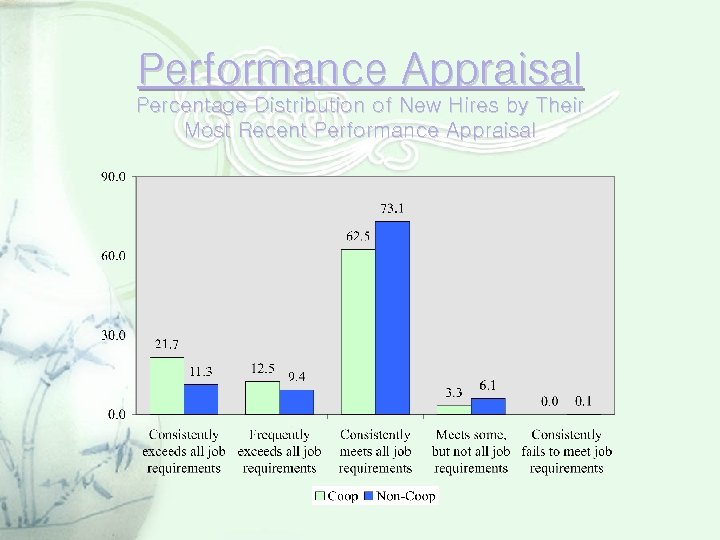
Performance Appraisal Percentage Distribution of New Hires by Their Most Recent Performance Appraisal
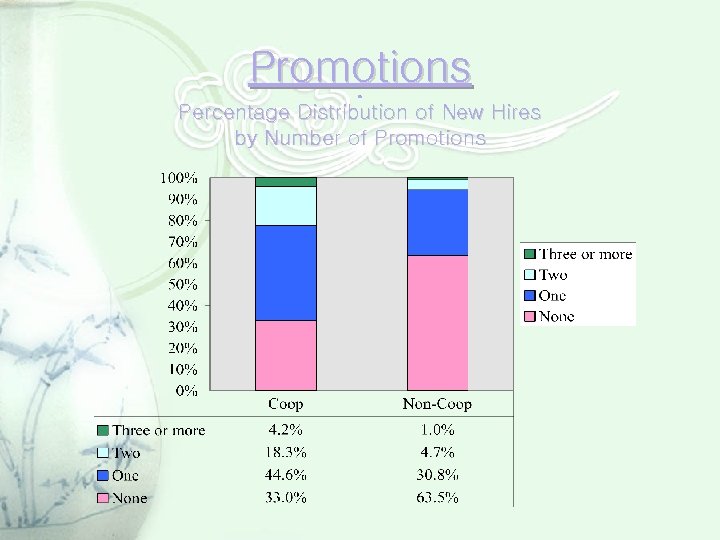
Promotions. Percentage Distribution of New Hires by Number of Promotions
Advice for a New Start Is the inclusion of a co-operative education program consistent with the mission and goals of the institution? Will the development of a co-operative education program detract seriously from other important programs of the institution? Is the institution able and willing to make internal changes necessary for the effective operation of a co-operative education program? Does the institution have sufficient financial resources to support a co-op program and is it willing to allocate those resources to it? Is there a real likelihood of developing collaborative relationships with business and industry to provide co-operative work experiences for students?
Keys to a Successful Co-op Program Co-op must be a fully-integrated component of the student’s learning. The institution must have a strong commitment to the concept. Stakeholders (students, employers, faculty, the cooperative education department, and university administrators) must contribute as full partners. Communication links among the partners must be strong.
Ongoing Issues What model to adopt A constantly changing economy Constantly changing attitudes of students, employers, the institution How big to grow and at what speed Academic credit for the work experience Acceptance of Career Education
Internet Websites WACE: http: //www. waceinc. org CACEE: http: //www. cacee. com CEA: http: //www. ceainc. org/ CAFCE: http: //www. cafce. ca University of Waterloo: http: //www. uwaterloo. ca/ CECS: http: //www. cecs. uwaterloo. ca
Sources of Further Information Journal of Co-operative Education Wilson, James W. , 1997, Creating and Initiating a Cooperative Education Program, Boston, USA: World Association for Cooperative Education R. Coll and C. Eames, International Handbook for Cooperative Education, Boston, USA: World Association for Cooperative Education

THANK YOU
Скачать презентацию INTERNSHIP FORUM 2005 TOKYO Bruce A Lumsden Director
68a546a90487f65854311eef77a1d7af.ppt