 Скачать презентацию Internet services as a support to library services
1e96b1b9bcb264a9f12ad3389502d0df.ppt
- Количество слайдов: 71



Internet services as a support to library services Radovan Vrana Department of information and communication sciences Faculty of humanities and social sciences Zagreb September 2012.
Introduction 2 Internet services as a support to library services rvrana@ffzg. hr 2012. for IP Lib. CMASS Introduction • The internet – one of the most interesting technological innovations of the 20 th century • Most unpredictable medium • Influence on developments in computer technology, software development, commerce, public services, education, all areas of human life and society in general
Introduction • Libraries provide access to an endless variety of information resources and opportunities for interactive communication (Holmberg, Huvila, Kronqvist-Berg and Wide´n-Wulff, 2008) 3 Internet services as a support to library services rvrana@ffzg. hr 2012. for IP Lib. CMASS Introduction • Libraries: traditionally seen as collections of information resources and services
Introduction – Development of various information resources in digital format and enhanced traditional library operations such as collection, processing, storing, managing and use of information resources – Enhancement of library services supported by use of ICT 4 Internet services as a support to library services rvrana@ffzg. hr 2012. for IP Lib. CMASS Introduction • Global technological advancement helped in:
Introduction – personalization, – self service, – mobility – interactivity 5 Internet services as a support to library services rvrana@ffzg. hr 2012. for IP Lib. CMASS Introduction • Current trends in library development:
Brief history of the internet – Before Web (until 1991. ): • first internet connections, major internet services emerged, TCP/IP set of protocols invented – After Web (from 1991. ): 6 • 1991: The World Wide Web (WWW, The Web) developed by Tim Berners Lee at CERN • 1993: First Web browser Mosaic • 1995: First audio streaming service • 1997: Web log created (today’s blog) • 1997: Google launchedsupport to library services Internet services as a rvrana@ffzg. hr 2012. for IP Lib. CMASS internet history • The inernet development timeline:
Brief history of the internet …and many more will come 7 Internet services as a support to library services rvrana@ffzg. hr 2012. for IP Lib. CMASS internet history – 2001: Wikipedia launched – 2003: My. Space launched – 2004: Facebook launched – 2006: Social bookmarking and Twitter
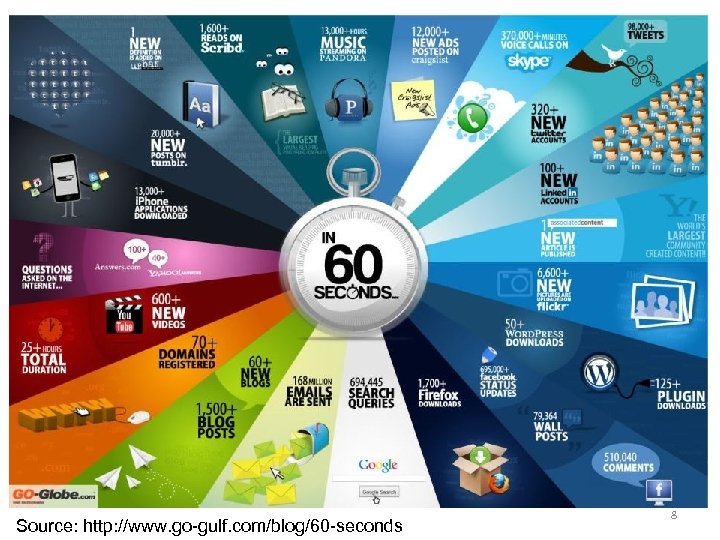
Source: http: //www. go-gulf. com/blog/60 -seconds 8
• Dual nature of the internet: – Channel for communication over great distances – Virtual space for development of new social relationships 9 Internet services as a support to library services rvrana@ffzg. hr 2012. for IP Lib. CMASS About the internet Dual nature of the internet
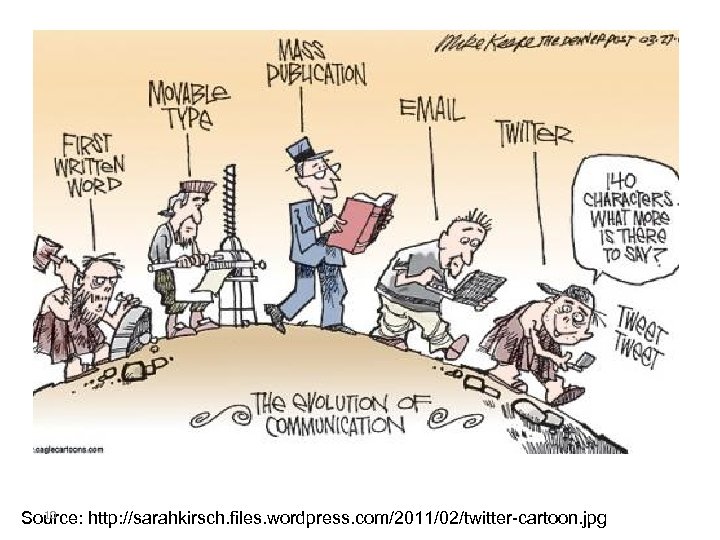
10 Source: http: //sarahkirsch. files. wordpress. com/2011/02/twitter-cartoon. jpg
Web 2. 0 • The term “Web 2. 0” refers to: • The second generation development and design of the web that aims to facilitate communication and to secure information sharing, interoperability and user centered design 11 Internet services as a support to library services rvrana@ffzg. hr 2012. for IP Lib. CMASS Web 2. 0 • Web 1. 0 – Web site created between 1994. and 2004.
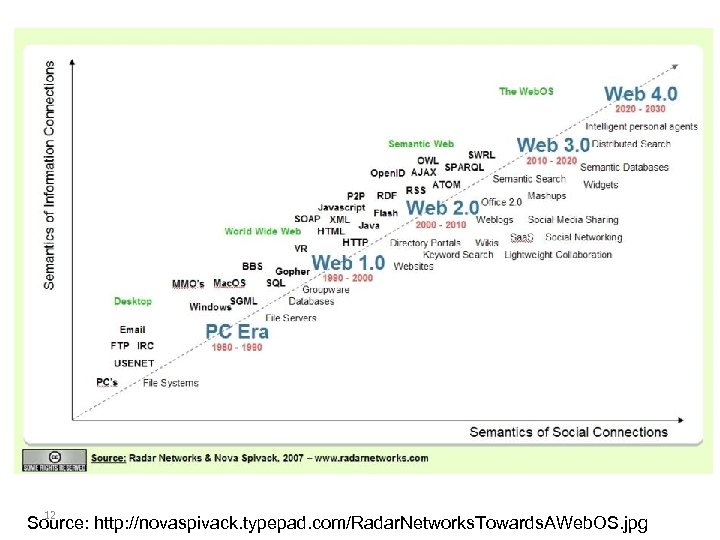
12 Source: http: //novaspivack. typepad. com/Radar. Networks. Towards. AWeb. OS. jpg
Web 2. 0 – – – 13 Gain access, Contribute, Describe, Harvest, Tag, Annotate and bookmark web mediated content in various formats, such as text, video, audio, pictures and graphs (Macaskill and Owen, 2006 in Tripathi and Kumar, 2010) Internet services as a support to library services rvrana@ffzg. hr 2012. for IP Lib. CMASS Web 2. 0 • Web 2. 0 tools: a web-based platform which allows users to:
Web 2. 0 • Web 2. 0 applications enable library users to be an integral part of the virtual community by sharing their ideas, thoughts, feelings, and other content (Farkas, 2007) • Library users can contribute to the maintenance of catalogues, review resources, locate and share relevant information with other users and society (Farkas, 2007) 14 Web 2. 0 • Web 2. 0 and libraries: Web 2. 0 has the potential to promote participatory networking where librarians and users can communicate, collaborate, and cocreate content (Chua and Goh, 2010)
Library 2. 0 • Library 2. 0: the application of interactive, collaborative, and multi-media web-based technologies to web-based library services and collections (Mannes, 2006) • Model of constant change, giving library users control through participatory, user-driven services 15 Library 2. 0 • Natural evolution of library services • New level where the library user is in control of how and when he/she gets access to the services she needs and wants
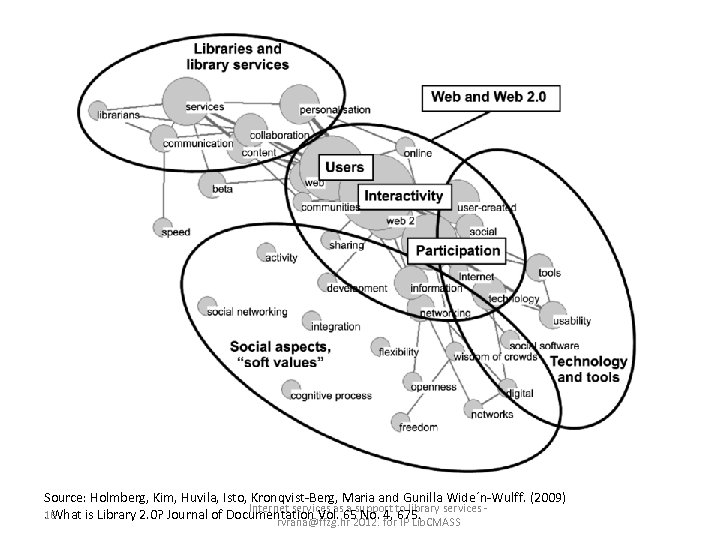
Source: Holmberg, Kim, Huvila, Isto, Kronqvist-Berg, Maria and Gunilla Wide´n-Wulff. (2009) Internet services as a support to library services 16. What is Library 2. 0? Journal of Documentation Vol. 65 No. 4, 675. rvrana@ffzg. hr 2012. for IP Lib. CMASS
Library 2. 0 1. 2. 3. 4. 17 user-centered, multimedia, socially rich, and communally innovative Internet services as a support to library services rvrana@ffzg. hr 2012. for IP Lib. CMASS Library 2. 0 • Library 2. 0 consists of 4 essential elements and differs from Library 1. 0 in several aspects (Maness in Xu, Ouyang and Chu, 2009):
Library 2. 0 • Concepts in Library 2. 0 (Needleman, 2007) 18 Internet services as a support to library services rvrana@ffzg. hr 2012. for IP Lib. CMASS Library 2. 0 – Make services available at the point of need rather than making the users come to the services (portals, virtual learning environments, and e-commerce systems) – Allow data to be exposed, discovered, and manipulated in a variety of ways distinct from perhaps the original reason the data were created or the application that originally created or accessed it
Library 2. 0 19 Internet services as a support to library services rvrana@ffzg. hr 2012. for IP Lib. CMASS Library 2. 0 – Build applications that can draw from a number of different sources; build applications that can be rapidly deployed and are lightweight, flexible, intelligent, and responsive to users needs. – Facilitate communication, community, and user participation. Focus on the user and the user’s needs. – Enrich data and expose hidden collections.
Internet services as a support to library services • Internet services that can be used in libraries: 20 chat, social tagging, social networks, blogs, wikis, podcasting, RSS feeds, instant messaging and mashups Internet services as a support to library services rvrana@ffzg. hr 2012. for IP Lib. CMASS Library 2. 0 – – – – –
Social software – Allows people to communicate, collaborate, and build communities online – Can be syndicated, shared, reused or remixed or it facilitates syndication – Lets people learn easily from and capitalize on the behavior or knowledge of others (Farkas, 2007) 21 Internet services as a support to library services rvrana@ffzg. hr 2012. for IP Lib. CMASS Social software • Social software: software which supports, extends or derives added value from human social behaviour – message boards, music taste sharing, photo sharing, instant messaging, mailing lists, social networking (Tom Coates) • Social software:
Social software – Easy content creation and content sharing – Online collaboration – Conversation: distributed and in real time – Communities developed from the bottom up – Capitilizing on the wisdom of the crowds – Personalization – Portability – Overcoming barriers of distance and time 22 Internet services as a support to library services rvrana@ffzg. hr 2012. for IP Lib. CMASS Social software • Characteristics of social software (Farkas, 2007):
Social software 23 Internet services as a support to library services rvrana@ffzg. hr 2012. for IP Lib. CMASS Social software • Social software can improve the ways in which libraries communicate with users • It can improve internal communication and knowledge sharing, market research, build presence, market services, provide reference services • Simply: getting closer to users and nonusers
Blog 24 Internet services as a support to library services rvrana@ffzg. hr 2012. for IP Lib. CMASS Blog • Blog: a web-based publication comprising individual articles that are posted periodically and are usually displayed in reverse chronological order (Curran et al. , 2006) • Initially: online diary (Web log) • Purpose: recording what individuals are doing or thinking at a particular period of time
Blog • Mechanism for exchanging ideas 25 Internet services as a support to library services rvrana@ffzg. hr 2012. for IP Lib. CMASS Blog • The best informal communication channel to extract latent feedback information from the users to enhance the quality of library services (Harinarayana and Raju, 2009)
Blog • Characteristics of blogs (Bradley, 2007): 26 Internet services as a support to library services rvrana@ffzg. hr 2012. for IP Lib. CMASS Blog – Blogs are personal: owners expressing their ideas – Blogs are chronological: most recent information are display first at the top of the page – Currency is important: blogs need to be current – Blogs respond, they don’t create: blogs offer comments – Possibility of cooperation with blog author – Subject of the blog is most important
Blog • Use in libraries: 27 Internet services as a support to library services rvrana@ffzg. hr 2012. for IP Lib. CMASS Blog – Fast way to disseminate information – Medium for attracting new users – Used for internal communication (King and Porter, 2007 in Tripathi and Kumar, 2010) – Medium for educating library users – Disseminating information to other librarians – Tools for creating forums for communication with library users (Farkas, 2007)
Blog 28 Internet services as a support to library services rvrana@ffzg. hr 2012. for IP Lib. CMASS Blog – Outreach to library users – Promotional tools to inform users of changes, additions and other developments in library services and collections (Alcock, 2003; Weaver, 2003 in Tripathi and Kumar, 2010) – General information – Research tips – List of new books – Book reviews/discussions – Information literacy – List of e-resources and databases – Hours of operation, holidays etc. (Tripathi and Kumar, 2010)
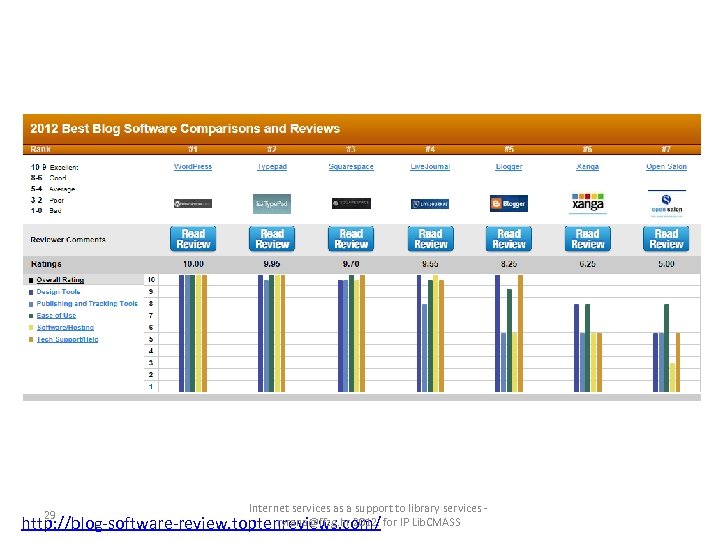
Internet services as a support to library services rvrana@ffzg. hr 2012. http: //blog-software-review. toptenreviews. com/ for IP Lib. CMASS 29
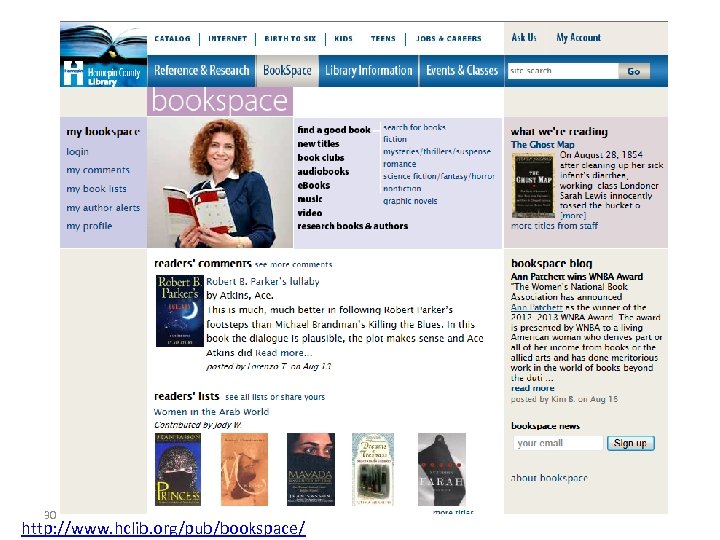
30 http: //www. hclib. org/pub/bookspace/
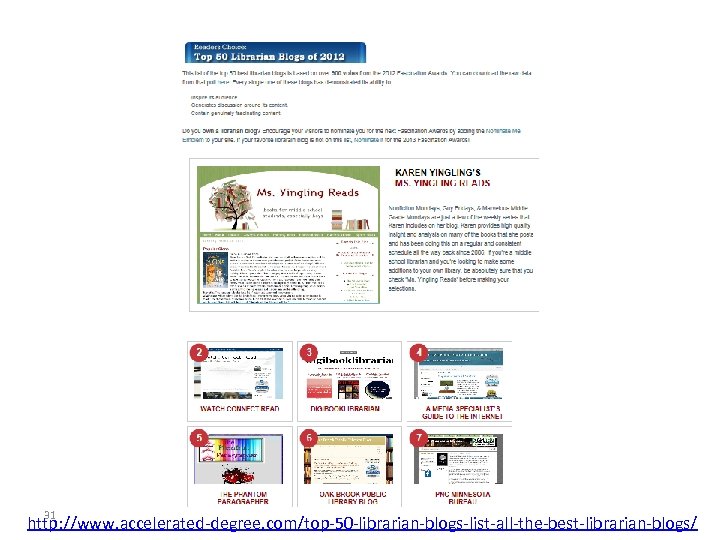
31 http: //www. accelerated-degree. com/top-50 -librarian-blogs-list-all-the-best-librarian-blogs/
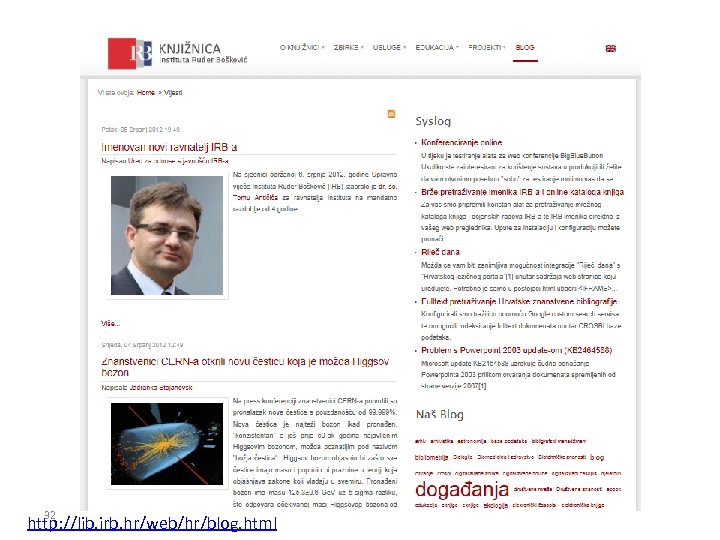
32 http: //lib. irb. hr/web/hr/blog. html
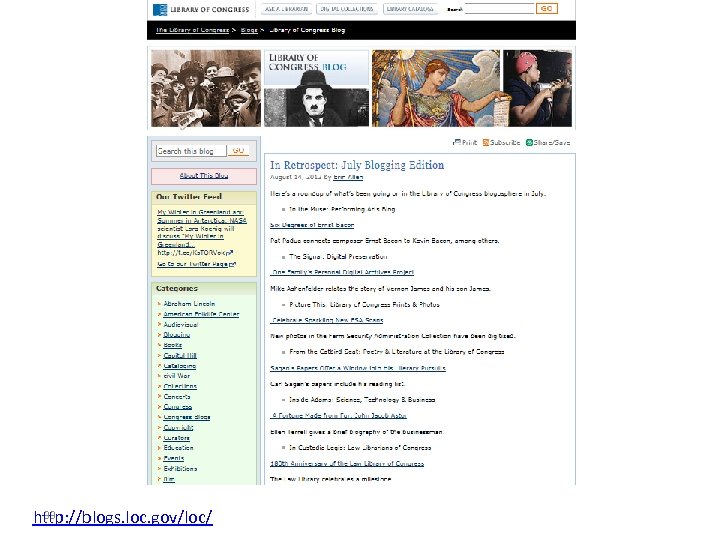
33 http: //blogs. loc. gov/loc/
Wiki 34 Internet services as a support to library services rvrana@ffzg. hr 2012. for IP Lib. CMASS Wiki • Wiki: Application which allows a group of people with no knowledge of HTML or other markup language develop a Web site collaboratively • Spaces for quick and easy Web publishing and editing • It has no predetermined structure, they are organized by hyperlinks • No one and everyone owns content • It is perpetual work in progress
Wiki • Wiki characteristics (Cunningham and Bo Leuf in Farkas 2007): 35 Internet services as a support to library services rvrana@ffzg. hr 2012. for IP Lib. CMASS Wiki – Users can edit any page or create new pages within the wiki Web site, using only a plain-vanilla Web browser without any extra add-ons – A wiki promotes meaningful topic association between different pages by making page link creation about intuitively easy and by showing whether an intended target page exists or not – A wiki is not a carefully crafted site for casual visitors. Instead, it seeks to involve the visitor in an ongoing process of creation and collaboration that constantly changes the Web site landscape.
Wiki • Use in libraries: 36 Internet services as a support to library services rvrana@ffzg. hr 2012. for IP Lib. CMASS Wiki – Fast and easy collaboration on creating content – Cooperation with library users in creating dictionaries, encyclopedias, books review and instructional resources – Internal Wikis for communication among staff members – Subject guides – Project planning – Listings of resources – Helpdesk (Tripathi and Kumar, 2010)
Wiki 37 Internet services as a support to library services rvrana@ffzg. hr 2012. for IP Lib. CMASS Wiki – Development of user communities – library as a community center – Thematic Wikies – subject guides – Development of library policies and other documents – Repositories for collective knowledge – for reference librarians – Users can suggest resources via subject-based wikis or take part in the strategic plan in which all users and staff are invited to participate for the vision of the library future (Nguyen, Partridge and Edwards, 2012. ) – Help in organiseing online study groups that users, librarians, and faculty members can collaboratively work and study on a topic of interest (Nguyen, Partridge and Edwards, 2012. )
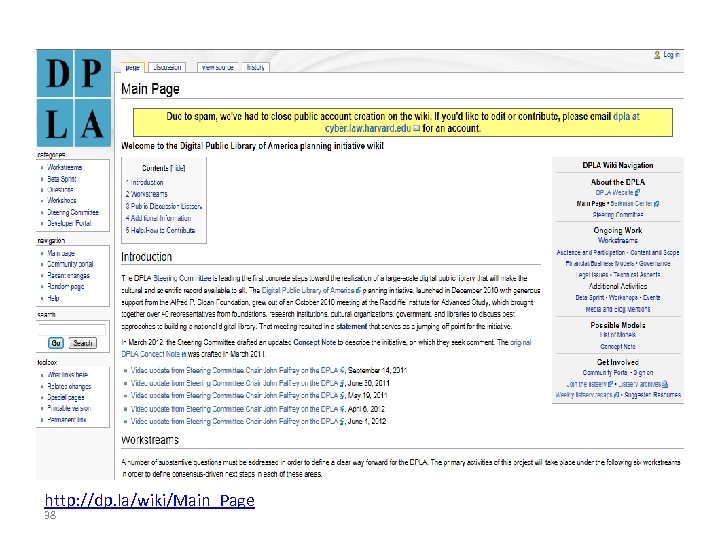
http: //dp. la/wiki/Main_Page 38
Social networks 39 Internet services as a support to library services rvrana@ffzg. hr 2012. for IP Lib. CMASS Social networks • A social networking service: is an online service, platform, or site that focuses on building and reflecting of social networks or social relations among people, who, for example, share interests and/or activities and people with similar or somewhat similar interests, backgrounds and/or activities make their own communities (Mashable. com)
Social networks 40 Internet services as a support to library services rvrana@ffzg. hr 2012. for IP Lib. CMASS Social networks • Social networking sites allow users to share ideas, activities, events, and interests within their individual networks. (Mashable. com) • Allow people to develop online identities and online communities • Profiles are central parts of social software • Creation to create and join groups
Social networks – Allow people to connect with others who share same interests – Use in library marketing – Attracting younger library users and other users who are using social networks – Educating library users about library services but also about online world and its advantages and disadvantages 41 Internet services as a support to library services rvrana@ffzg. hr 2012. for IP Lib. CMASS Social networks • Use in libraries:
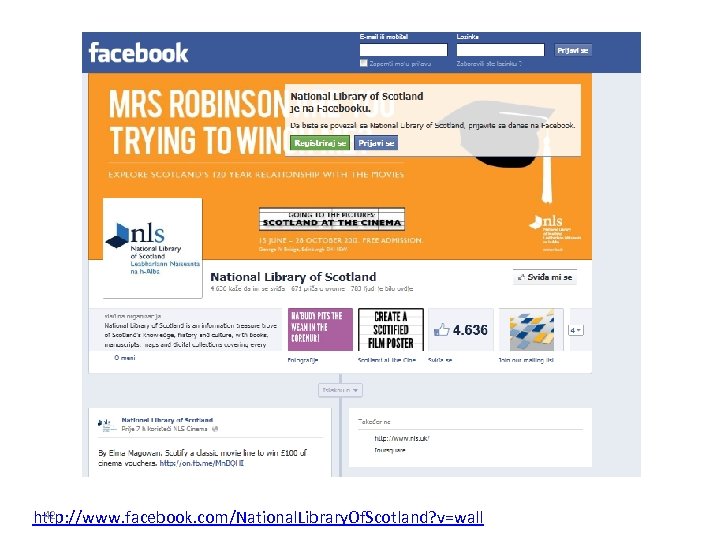
42 http: //www. facebook. com/National. Library. Of. Scotland? v=wall
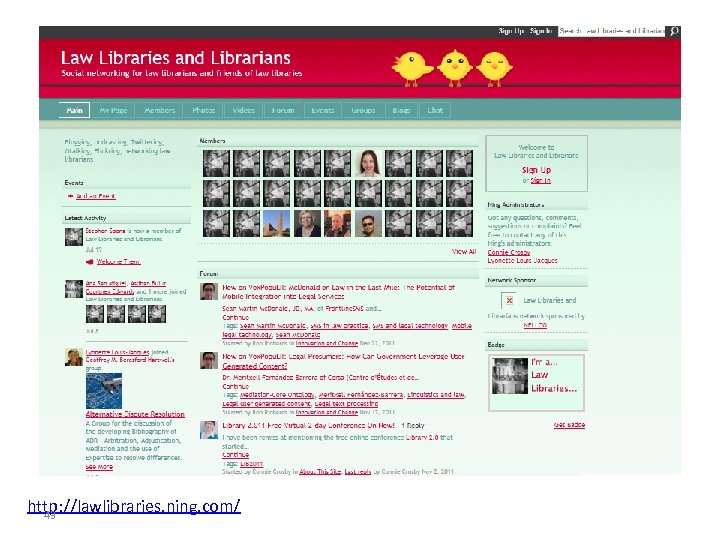
http: //lawlibraries. ning. com/ 43
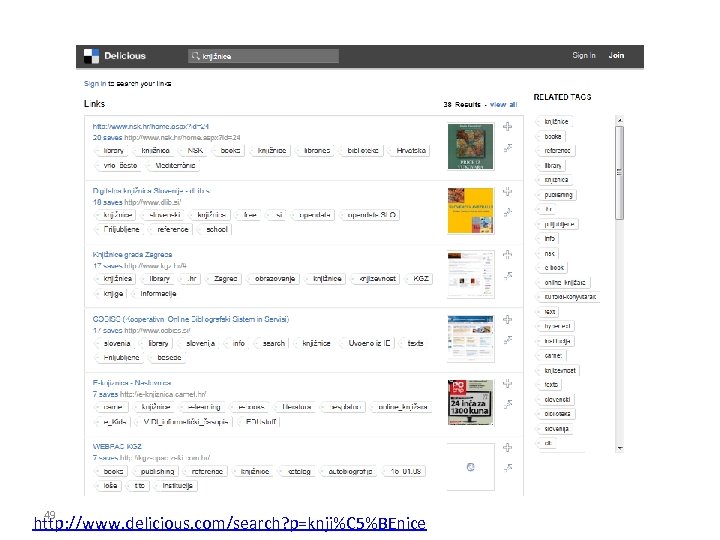
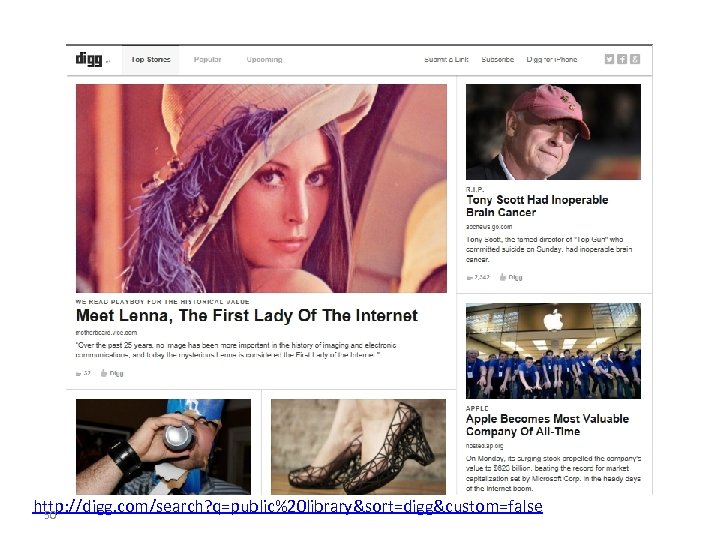
• Method for internet users to organize, store, manage and search for bookmarks of resources online (Wikipedia. org) • Abundance of information on the internet • Not easy to look for quality resources – search engine produce to many results – some of them irrelevant • Social bookmarking allows people to catalog the Web using arbitrary terms • They “tag” online information resources 44 Internet services as a support to library services rvrana@ffzg. hr 2012. for IP Lib. CMASS Social bookmarking
• Online services that store URLs about information resources as well as tags that describe them so that they can be accessed from any computer connected to the internet 45 Internet services as a support to library services rvrana@ffzg. hr 2012. for IP Lib. CMASS Social bookmarking
• Searchable tags • Folksonomy: making the Web more sensible place through tagging • Structure without proper hierarchy • Uncontrolled tags vs. controlled vocabularies 46 Internet services as a support to library services rvrana@ffzg. hr 2012. for IP Lib. CMASS Social bookmarking
• Only one word is used: – Movies – Silent_movies, silent-movies, silentmovies • Synonims • People concieve things differently – different terms for the same phenomenon • Use in libraries: – Teaching knowledge organization – Helping library users to organize their online content 47 Internet services as a support to library services rvrana@ffzg. hr 2012. for IP Lib. CMASS Social bookmarking
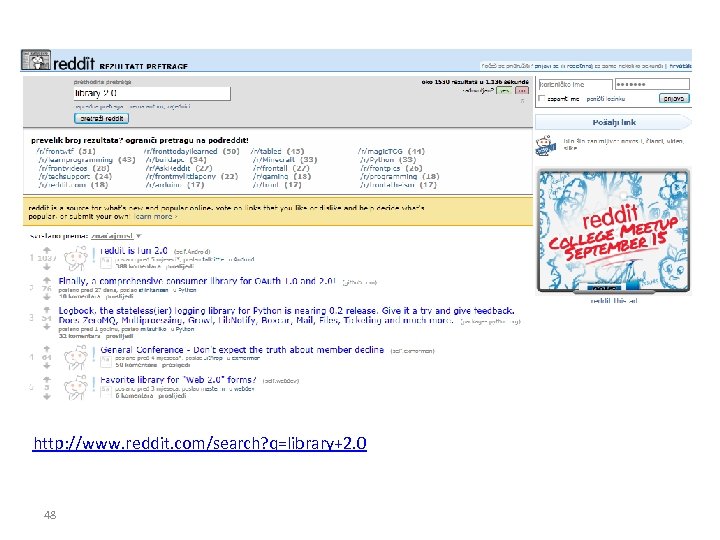
http: //www. reddit. com/search? q=library+2. 0 48
49 http: //www. delicious. com/search? p=knji%C 5%BEnice
http: //digg. com/search? q=public%20 library&sort=digg&custom=false 50
Podcasting 51 Internet services as a support to library services rvrana@ffzg. hr 2012. for IP Lib. CMASS Podcasting • Podcast – term coined from “i. Pod” and “broadcast” • Podcast: syndicated audio broadcasts that can be played on any MP 3 player or device capable of playing MP 3 format • Audio content available on the internet that can be automatically delivered to a personal computer or MP 3 player (Harinarayana and Raju, 2009)
Podcast – As a file or – As a streaming media 52 Internet services as a support to library services rvrana@ffzg. hr 2012. for IP Lib. CMASS Podcasting • Available in two ways:
Podcasting 53 Internet services as a support to library services rvrana@ffzg. hr 2012. for IP Lib. CMASS Podcasting • Anyone can create a podcast • Recording podcasts: a computer with a microphone or a headset and recording software • Podcasts – alternative or addition to text • Not everyone likes podcasts – inability do advance recorded content – you can skip pages of text • On demand service
Podcasting • Use in libraries: 54 Internet services as a support to library services rvrana@ffzg. hr 2012. for IP Lib. CMASS Podcasting – To empower young users and encourage their creativity (Farkas, 2007) – To announce events – To provide library service instructions to library users – Marketing library services to attract new users – Library orientation tours – Guidance to use resources – Guidance to use other library facilities (Tripathi and Kumar, 2010)
Podcasting 55 – Entertainment, dissemination of news, education, – Alternative to traditional libray content (especially for children: story telling) – Education of users how to use library services or information resources – Users can also record podcasts about their experiences with information resources or library services – Information literacy and research help Internet services as a support to library (Harinarayana and Raju, 2009)services rvrana@ffzg. hr 2012. for IP Lib. CMASS
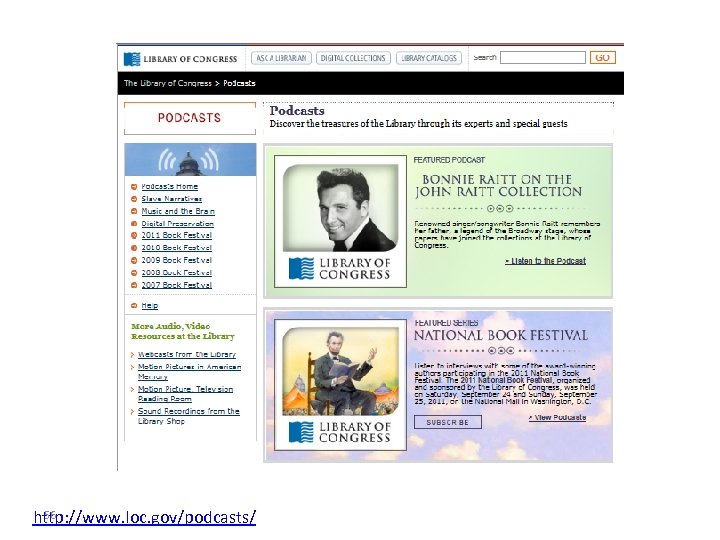
56 http: //www. loc. gov/podcasts/
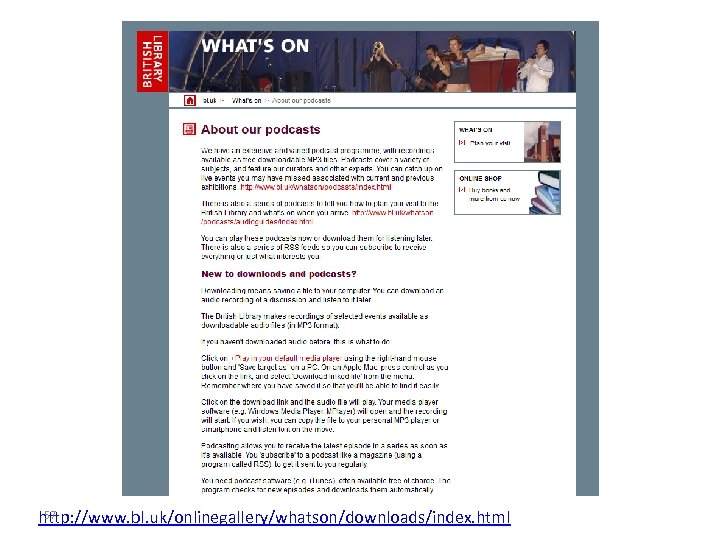
57 http: //www. bl. uk/onlinegallery/whatson/downloads/index. html
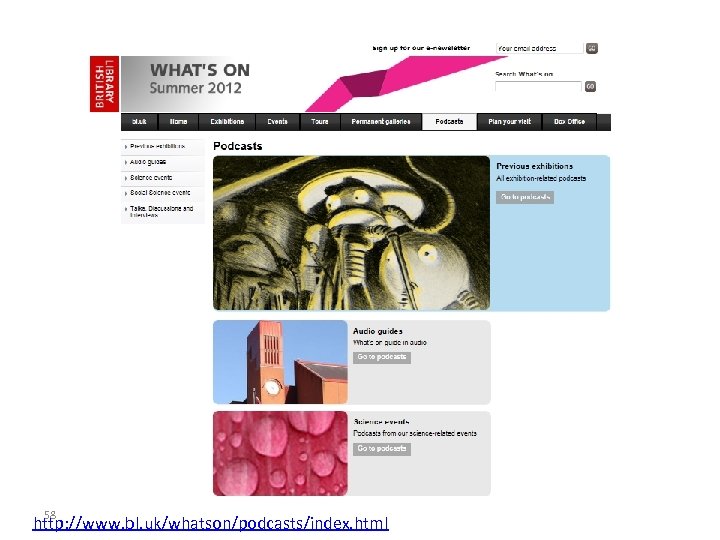
58 http: //www. bl. uk/whatson/podcasts/index. html
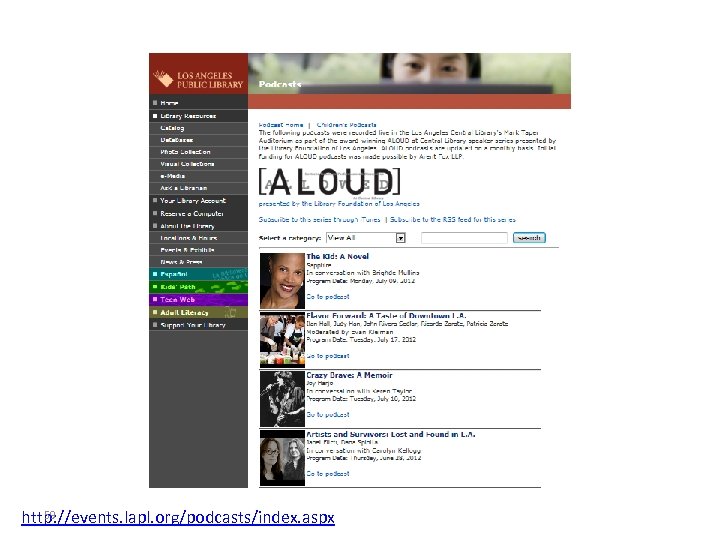
59 http: //events. lapl. org/podcasts/index. aspx
Vodcasting 60 Internet services as a support to library services rvrana@ffzg. hr 2012. for IP Lib. CMASS Vodcasting • Video broadcasts shared as files or straming media on the internet • Video blogs • Rarely used in libraries • Promoting library and its services – staff producing videos • Sharing experiences with other users – users producing videos • Difficult to produce – many technical issues involved
Vodcasting – Explaining physical layout of the library – Explaining general searching skills – Explaining self-issuing and returning of books – Guidance to use e-resources: databases and ebooks – Guidance to access catalogue – Explained procedure for self issuing and returning(Tripathi and Kumar, 2010) 61 Internet services as a support to library services rvrana@ffzg. hr 2012. for IP Lib. CMASS Vodcasting • Use in libraries (short videos, up to 5 minutes of duration):
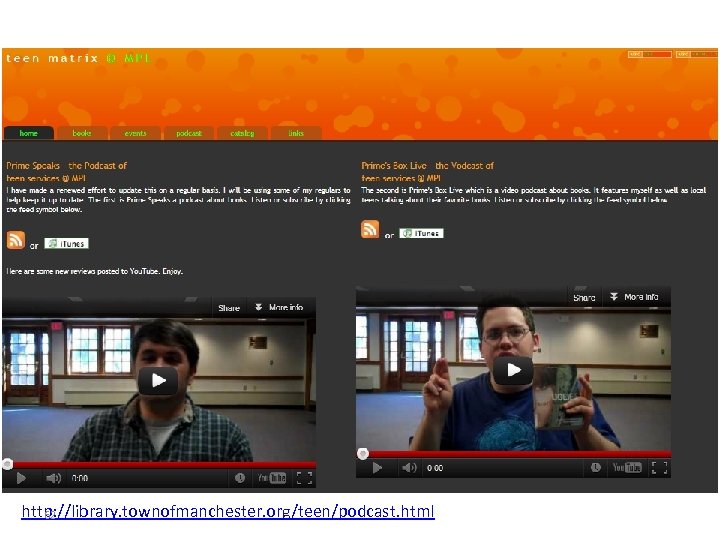
http: //library. townofmanchester. org/teen/podcast. html 62
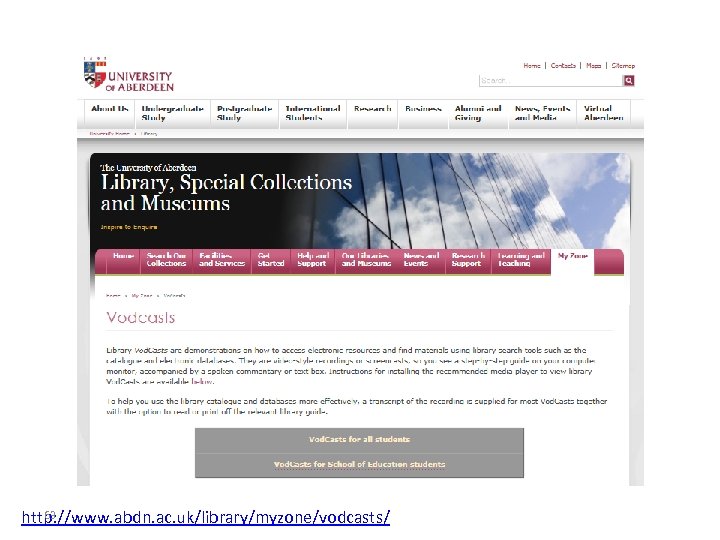
63 http: //www. abdn. ac. uk/library/myzone/vodcasts/
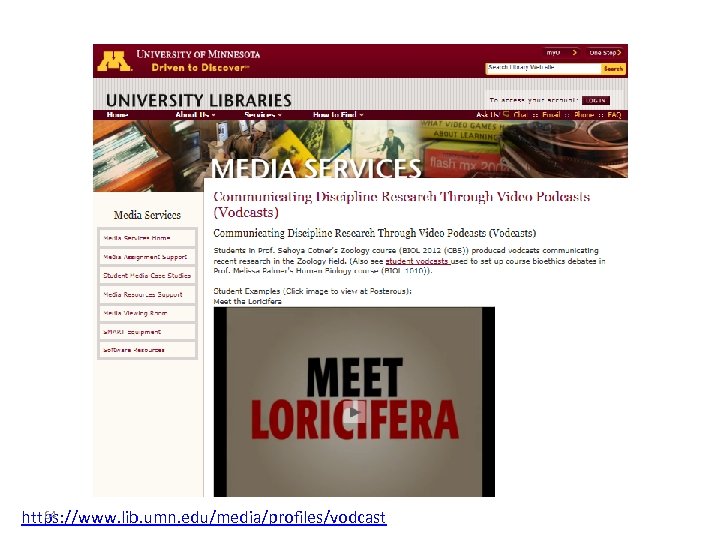
64 https: //www. lib. umn. edu/media/profiles/vodcast
• Instant messaging: internet services which allow quick exchange of short messages between online users in real time • A live online synchronous communication channel which facilitates online interaction between two people (Harinarayana and Raju, 2009) • Profile: address book with contacts • Users using instant messaging must have identical software to communicate successfully • Users can see each other’s online status • Additional functions: sharing files, video calls, Vo. IP, Web conferencing etc. 65 Internet services as a support to library services rvrana@ffzg. hr 2012. for IP Lib. CMASS Instant messaging
• Use in libraries: – Virtual reference services – Improving access to other library services – Providing latest information to library users – Interaction between library users – Guidance to access resources (Tripathi and Kumar, 2010) 66 Internet services as a support to library services rvrana@ffzg. hr 2012. for IP Lib. CMASS Instant messaging
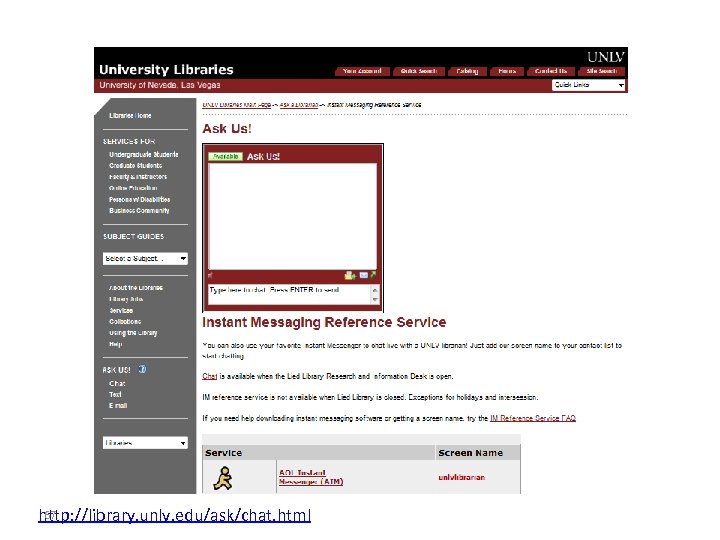
67 http: //library. unlv. edu/ask/chat. html
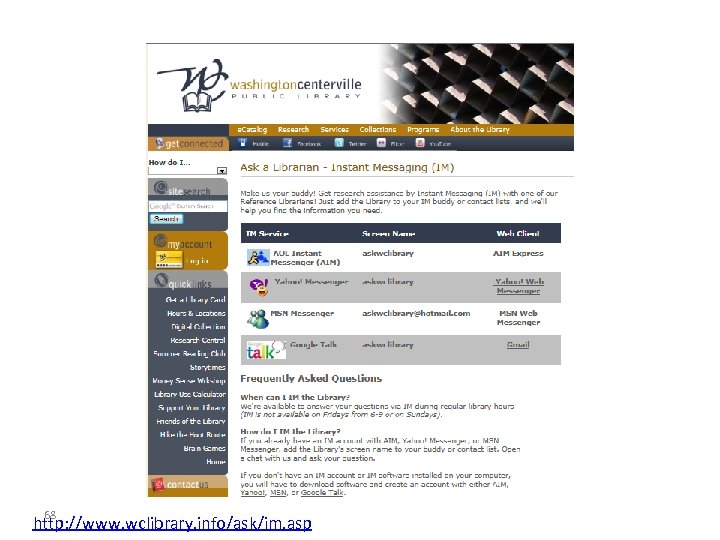
68 http: //www. wclibrary. info/ask/im. asp
References • • • 69 Anderson, P. (2007), What Is Web 2. 0? Ideas, Technologies and Implications for Education, JISC Tech. Watch report, available at: www. jisc. ac. uk/media/documents/techwatch/tsw 0701 bword. doc (accessed 15 July 2012) Buigues-García, Mar and Vicent, Giménez-Chornetb, (2012), "Impact of Web 2. 0 on national libraries", International Journal of Information Management, Vol. 32, No. 1, pp. 3– 10. Bradley, Phil. How to Use Web 2. 0 in Your Library, Facet Publishing, 2007. Chua, Alton Y. K. and Dion H Goh. (2010), "A study of Web 2. 0 applications in librarywebsites", Library & Information Science Research, Volume 32 No 3, pp. 203 – 211. Harinarayana, N. S. and N. Vasantha Raju. (2009), "Web 2. 0 features in university library web sites", The Electronic Library, Vol. 28 No. 1, 69 -88. Farkas, Meredith, Social Software in Libraries: Building Collaboration, Communication, and Community Online, Information Today, Inc. , 2007. Internet services as a support to library services rvrana@ffzg. hr 2012. for IP Lib. CMASS
References • Maness, Jack M. (2006), “Library 2. 0 theory: Web 2. 0 and its implications for libraries”, Webology, Vol. 3 No. 2, available at: www. webology. ir/2006/v 3 n 2/a 25. html (accessed 15 July 2012) • Mi, Jia; Nesta, Frederick. (2011), "Library 2. 0 or Library III: returning to leadership", Library Management, Vol. 32 No. 1/2, pp. 85 -97. • Miller, Joseph B. internet technologies and information services, Libraries Unlimited, 2009. • Needleman, Mark. (2007). Web 2. 0/Lib 2. 0—What Is It? (If It’s Anything at All), Serials Review, Vol. 33, pp. 202– 203. • Ram, Shri, Anbu, John Paul K and Sanjay Kataria. (2011), "Responding to user’s expectation in the library: innovative Web 2. 0 applications at JUIT Library", Program: electronic library and information systems, Vol. 45 No. 4, 452 -469. 70 Internet services as a support to library services rvrana@ffzg. hr 2012. for IP Lib. CMASS
References • • 71 Tripathi, Manorama and Sunil Kumar. (2010), "Use of Web 2. 0 tools in academic libraries: A reconnaissance of the international landscape, The International Information & Library Review, Vol. 42 No. 3, pp. 195 -207. Xu, Chen, Ouyang, Fenfei and Heting Chu. (2009). The Academic Library Meets Web 2. 0: Applications and Implications, The Journal of Academic Librarianship, Vol. 35, No. 4, pp. 324– 331. Internet services as a support to library services rvrana@ffzg. hr 2012. for IP Lib. CMASS
Скачать презентацию Internet services as a support to library services
1e96b1b9bcb264a9f12ad3389502d0df.ppt