


 Скачать презентацию Internet Security CSCE 813 Transport Layer Security
fd66a4bd5a2d816a8184574ad4738223.ppt
- Количество слайдов: 44
 Internet Security CSCE 813 Transport Layer Security
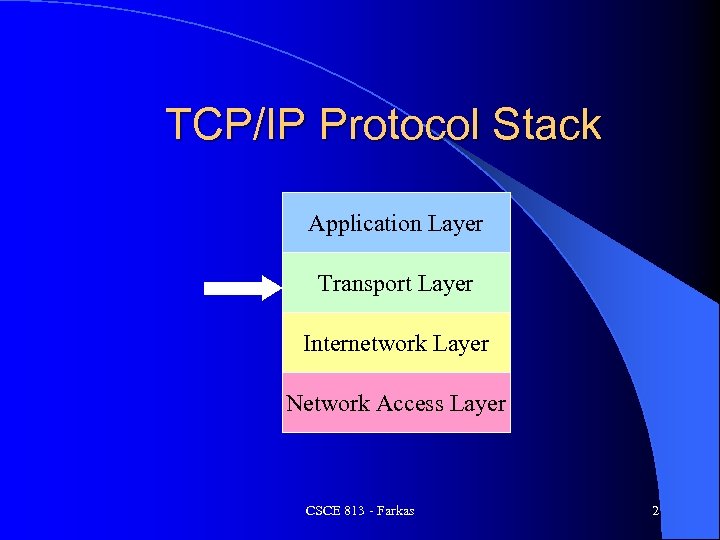 TCP/IP Protocol Stack Application Layer Transport Layer Internetwork Layer Network Access Layer CSCE 813 - Farkas 2
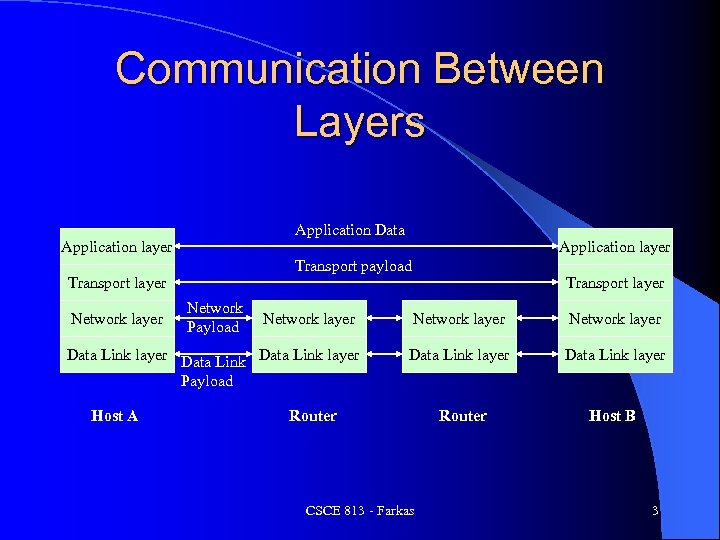 Communication Between Layers Application Data Application layer Transport payload Transport layer Network layer Application layer Network Payload Transport layer Network layer Data Link layer Payload Data Link layer Router Host B Host A Router CSCE 813 - Farkas 3
 Transport Layer l Provides services to the application layer l Services: – Connection-oriented or connectionless transport – Reliable or unreliable transport – Security CSCE 813 - Farkas 4
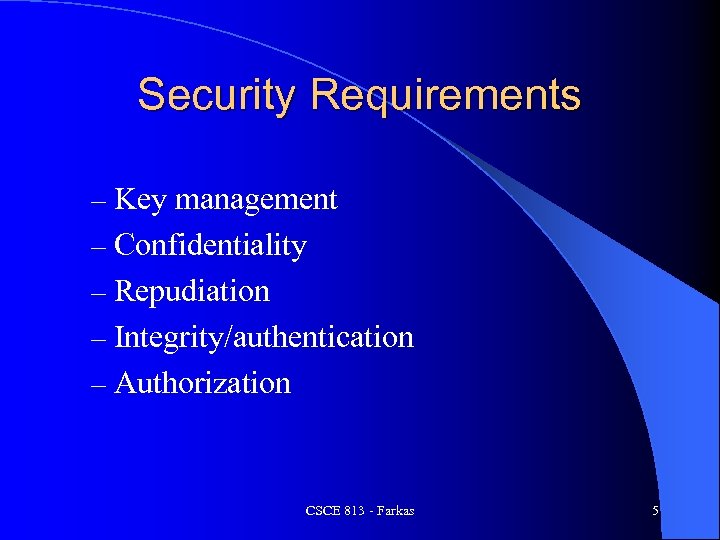 Security Requirements – Key management – Confidentiality – Repudiation – Integrity/authentication – Authorization CSCE 813 - Farkas 5
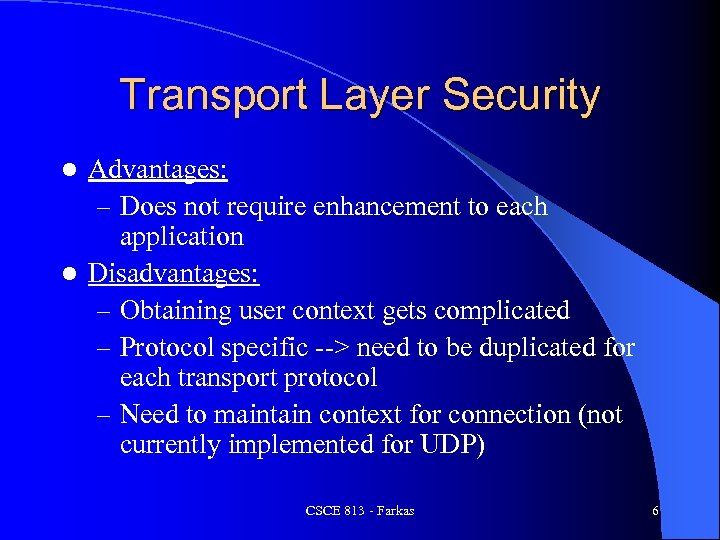 Transport Layer Security Advantages: – Does not require enhancement to each application l Disadvantages: – Obtaining user context gets complicated – Protocol specific --> need to be duplicated for each transport protocol – Need to maintain context for connection (not currently implemented for UDP) l CSCE 813 - Farkas 6
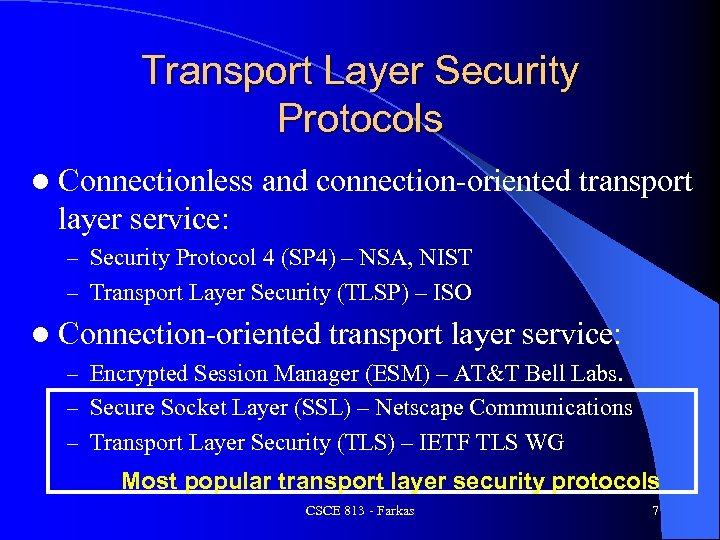 Transport Layer Security Protocols l Connectionless and connection-oriented transport layer service: – Security Protocol 4 (SP 4) – NSA, NIST – Transport Layer Security (TLSP) – ISO l Connection-oriented transport layer service: – Encrypted Session Manager (ESM) – AT&T Bell Labs. – Secure Socket Layer (SSL) – Netscape Communications – Transport Layer Security (TLS) – IETF TLS WG Most popular transport layer security protocols CSCE 813 - Farkas 7
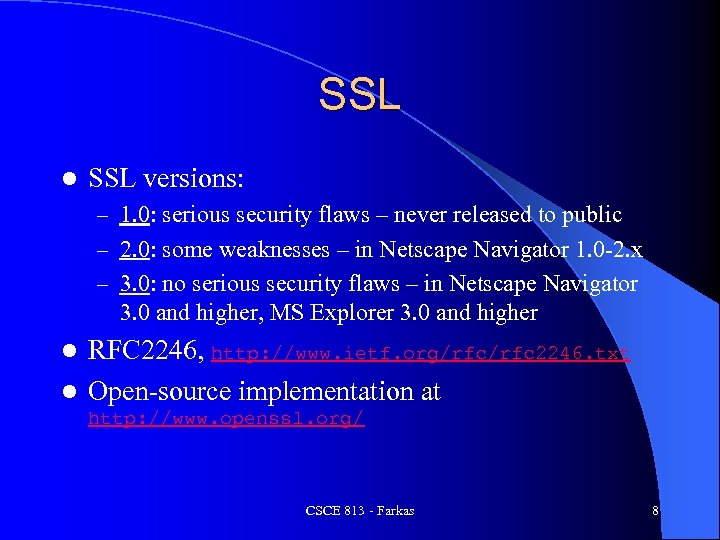 SSL l SSL versions: – 1. 0: serious security flaws – never released to public – 2. 0: some weaknesses – in Netscape Navigator 1. 0 -2. x – 3. 0: no serious security flaws – in Netscape Navigator 3. 0 and higher, MS Explorer 3. 0 and higher RFC 2246, http: //www. ietf. org/rfc 2246. txt l Open-source implementation at l http: //www. openssl. org/ CSCE 813 - Farkas 8
 SSL 2. 0 Vulnerabilities l Short key length l Weak MAC construction l Message integrity vulnerability l Ciphersuite rollback attack CSCE 813 - Farkas 9
 SSL l Intermediate security layer between the transport layer and the application layer l Based on connection-oriented and reliable service (e. g. , TCP) l Able to provide security services for any TCP-based application protocol, e. g. , HTTP, FTP, TELNET, POP 3, etc. l Application independent CSCE 813 - Farkas 10
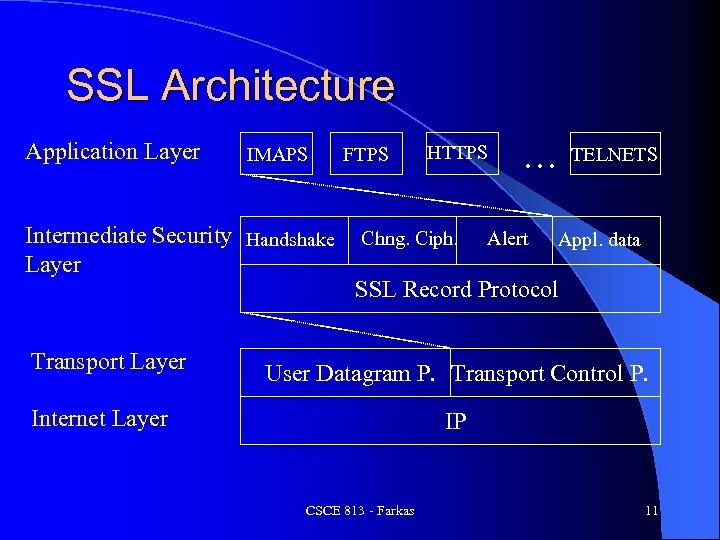 SSL Architecture Application Layer IMAPS Intermediate Security Handshake Layer Transport Layer FTPS HTTPS Chng. Ciph. … Alert TELNETS Appl. data SSL Record Protocol User Datagram P. Transport Control P. Internet Layer IP CSCE 813 - Farkas 11
 SSL Services l SSL provides – Client- server authentication (public-key cryptography) – Data traffic confidentiality – Message authentication and integrity check l SSL does not provide – Traffic analysis – TCP implementation oriented attacks CSCE 813 - Farkas 12
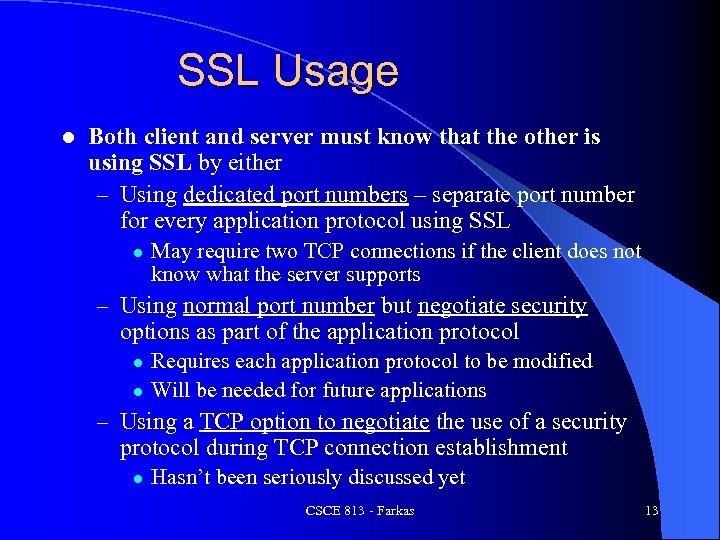 SSL Usage l Both client and server must know that the other is using SSL by either – Using dedicated port numbers – separate port number for every application protocol using SSL l May require two TCP connections if the client does not know what the server supports – Using normal port number but negotiate security options as part of the application protocol l l Requires each application protocol to be modified Will be needed for future applications – Using a TCP option to negotiate the use of a security protocol during TCP connection establishment l Hasn’t been seriously discussed yet CSCE 813 - Farkas 13
 SSL l Connection: a transport that provides a service. Every connection is associated with a session l Session: association between a client and a server. Created by the Handshake protocol. CSCE 813 - Farkas 14
 SSL State Information session is stateful SSL protocol must initialize and maintain session state information on either side of the session l SSL session can be used for several connections connection state information l SSL CSCE 813 - Farkas 15
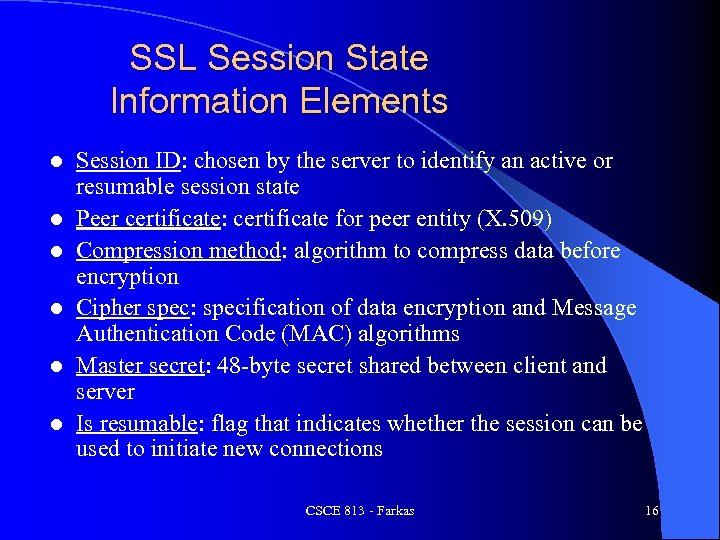 SSL Session State Information Elements l l l Session ID: chosen by the server to identify an active or resumable session state Peer certificate: certificate for peer entity (X. 509) Compression method: algorithm to compress data before encryption Cipher spec: specification of data encryption and Message Authentication Code (MAC) algorithms Master secret: 48 -byte secret shared between client and server Is resumable: flag that indicates whether the session can be used to initiate new connections CSCE 813 - Farkas 16
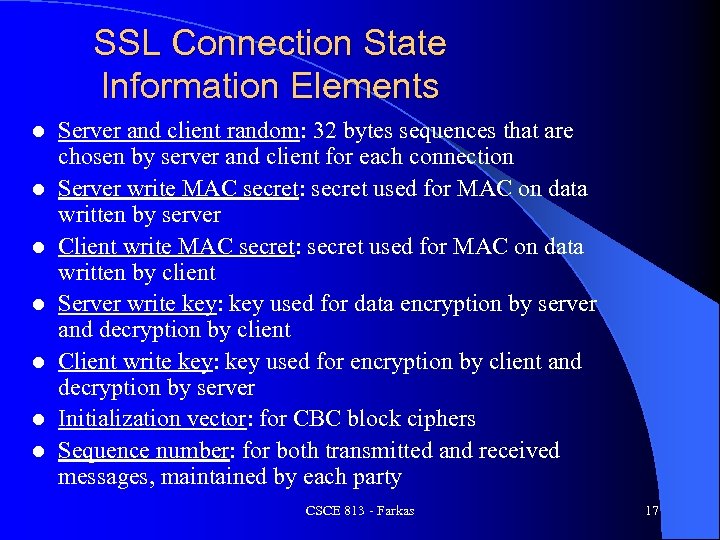 SSL Connection State Information Elements l l l l Server and client random: 32 bytes sequences that are chosen by server and client for each connection Server write MAC secret: secret used for MAC on data written by server Client write MAC secret: secret used for MAC on data written by client Server write key: key used for data encryption by server and decryption by client Client write key: key used for encryption by client and decryption by server Initialization vector: for CBC block ciphers Sequence number: for both transmitted and received messages, maintained by each party CSCE 813 - Farkas 17
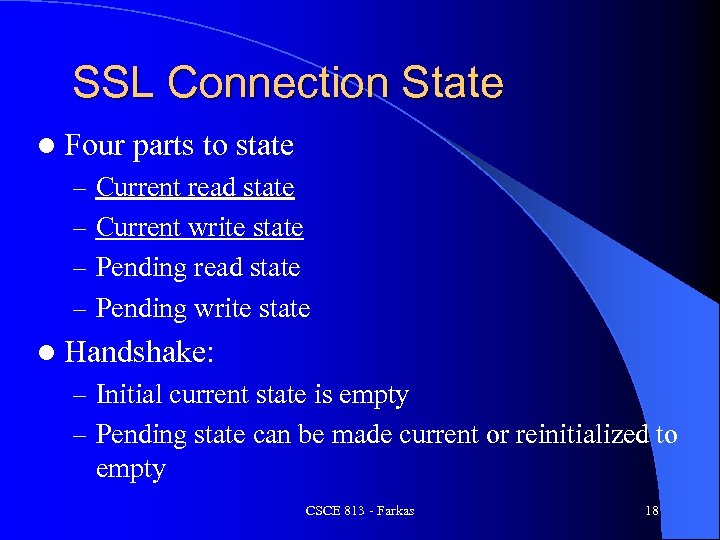 SSL Connection State l Four parts to state – Current read state – Current write state – Pending read state – Pending write state l Handshake: – Initial current state is empty – Pending state can be made current or reinitialized to empty CSCE 813 - Farkas 18
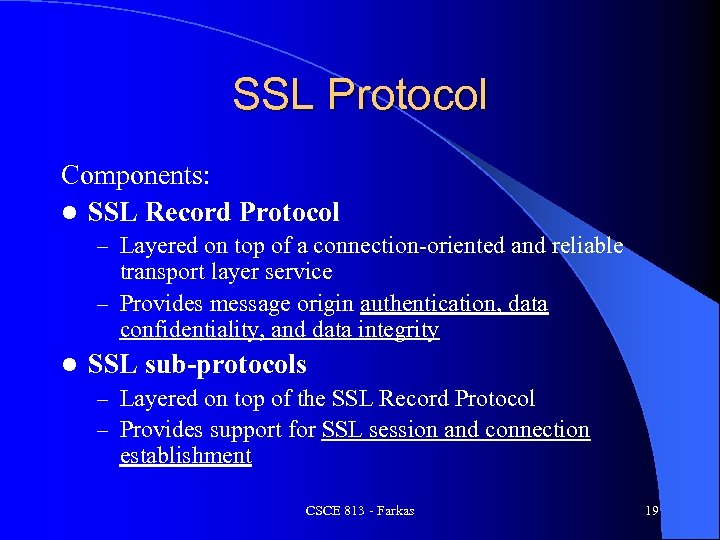 SSL Protocol Components: l SSL Record Protocol – Layered on top of a connection-oriented and reliable transport layer service – Provides message origin authentication, data confidentiality, and data integrity l SSL sub-protocols – Layered on top of the SSL Record Protocol – Provides support for SSL session and connection establishment CSCE 813 - Farkas 19
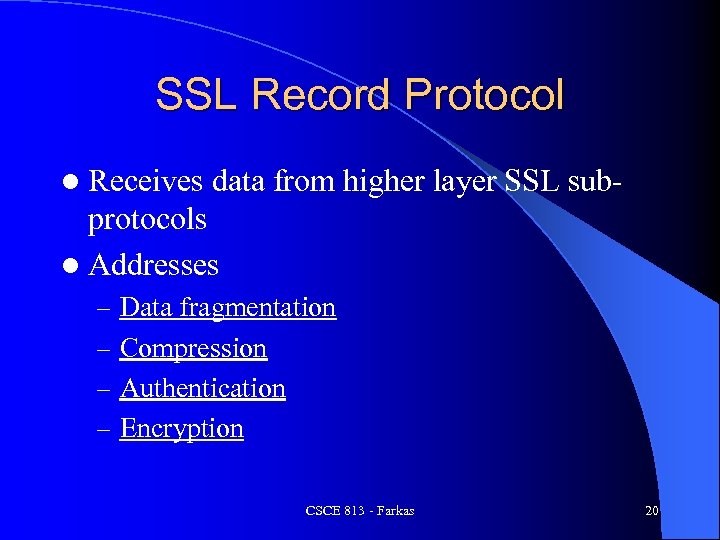 SSL Record Protocol l Receives data from higher layer SSL sub- protocols l Addresses – Data fragmentation – Compression – Authentication – Encryption CSCE 813 - Farkas 20
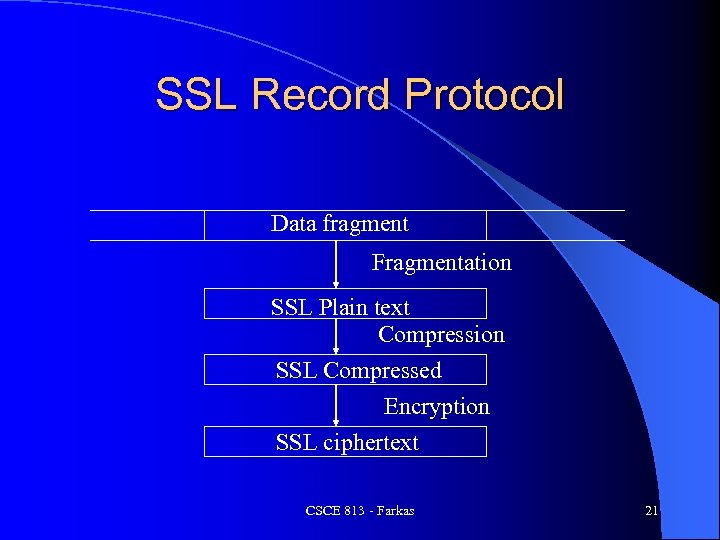 SSL Record Protocol Data fragment Fragmentation SSL Plain text Compression SSL Compressed Encryption SSL ciphertext CSCE 813 - Farkas 21
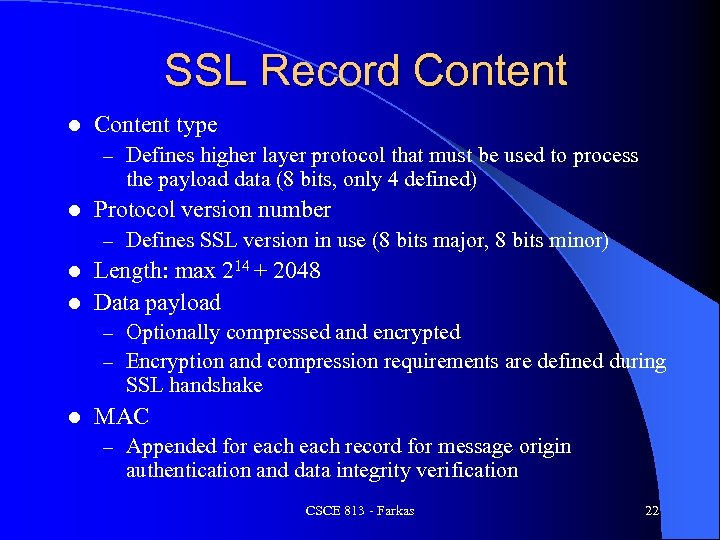 SSL Record Content l Content type – Defines higher layer protocol that must be used to process the payload data (8 bits, only 4 defined) l Protocol version number – Defines SSL version in use (8 bits major, 8 bits minor) Length: max 214 + 2048 l Data payload l – Optionally compressed and encrypted – Encryption and compression requirements are defined during SSL handshake l MAC – Appended for each record for message origin authentication and data integrity verification CSCE 813 - Farkas 22
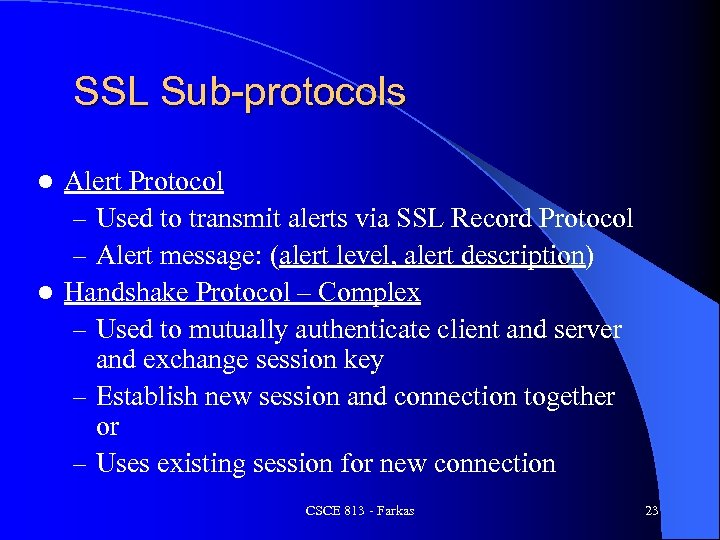 SSL Sub-protocols Alert Protocol – Used to transmit alerts via SSL Record Protocol – Alert message: (alert level, alert description) l Handshake Protocol – Complex – Used to mutually authenticate client and server and exchange session key – Establish new session and connection together or – Uses existing session for new connection l CSCE 813 - Farkas 23
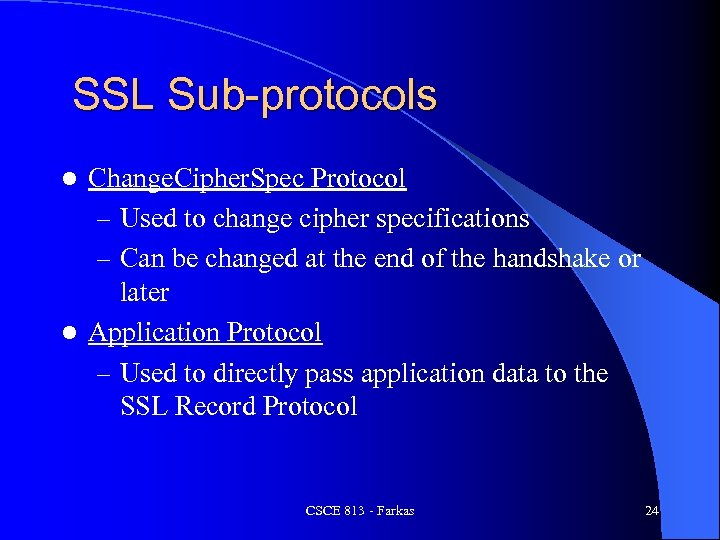 SSL Sub-protocols Change. Cipher. Spec Protocol – Used to change cipher specifications – Can be changed at the end of the handshake or later l Application Protocol – Used to directly pass application data to the SSL Record Protocol l CSCE 813 - Farkas 24
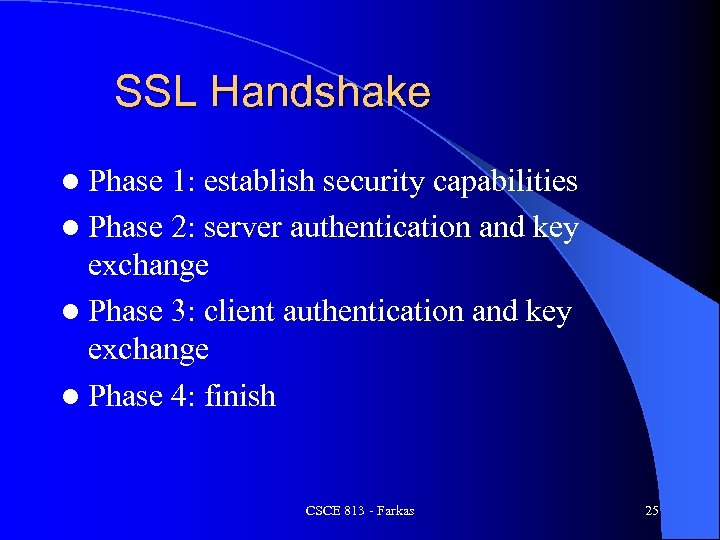 SSL Handshake l Phase 1: establish security capabilities l Phase 2: server authentication and key exchange l Phase 3: client authentication and key exchange l Phase 4: finish CSCE 813 - Farkas 25
![SSL Handshake Phase 1 CLIENTHELLO SERVERHELLO [CERTIFICATE] Phase 2 [SERVERKEYEXCHANGE] Optional server messages [CERTIFICATEREQUEST]](https://present5.com/presentation/fd66a4bd5a2d816a8184574ad4738223/image-26.jpg "SSL Handshake Phase 1 CLIENTHELLO SERVERHELLO [CERTIFICATE] Phase 2 [SERVERKEYEXCHANGE] Optional server messages [CERTIFICATEREQUEST]") SSL Handshake Phase 1 CLIENTHELLO SERVERHELLO [CERTIFICATE] Phase 2 [SERVERKEYEXCHANGE] Optional server messages [CERTIFICATEREQUEST] SERVERHELLODONE 3. C S: [CERTIFICATE] Phase 3 CLIENTKEYEXCHANGE Client key exchange [CERTIFICATEVERIFY] CHANGECIPHERSPEC FINISH Phase 4 CHANGECIPHERSPEC Change cipher suite 4. S C: FINISH CSCE 813 - Farkas Security capabilities 1. C S: 2. S C: 26
SSL Handshake Phase 1 CLIENTHELLO SERVERHELLO [CERTIFICATE] Phase 2 [SERVERKEYEXCHANGE] Optional server messages [CERTIFICATEREQUEST] SERVERHELLODONE 3. C S: [CERTIFICATE] Phase 3 CLIENTKEYEXCHANGE Client key exchange [CERTIFICATEVERIFY] CHANGECIPHERSPEC FINISH Phase 4 CHANGECIPHERSPEC Change cipher suite 4. S C: FINISH CSCE 813 - Farkas Security capabilities 1. C S: 2. S C: 26
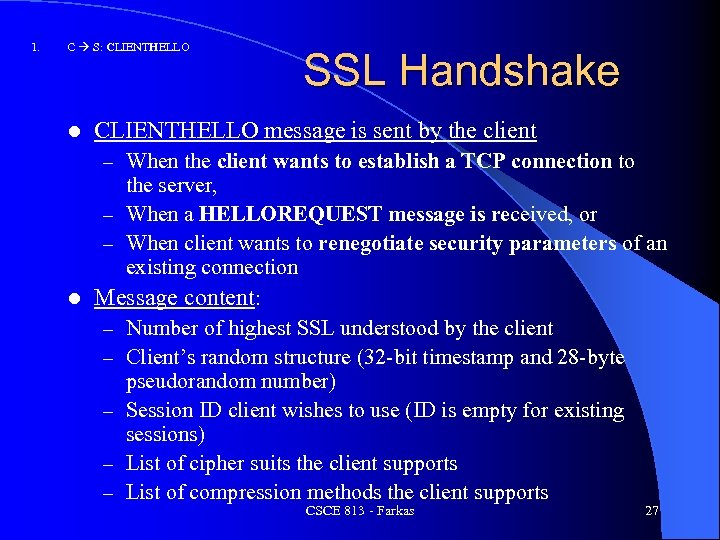 1. C S: CLIENTHELLO l SSL Handshake CLIENTHELLO message is sent by the client – When the client wants to establish a TCP connection to the server, – When a HELLOREQUEST message is received, or – When client wants to renegotiate security parameters of an existing connection l Message content: – Number of highest SSL understood by the client – Client’s random structure (32 -bit timestamp and 28 -byte pseudorandom number) – Session ID client wishes to use (ID is empty for existing sessions) – List of cipher suits the client supports – List of compression methods the client supports CSCE 813 - Farkas 27
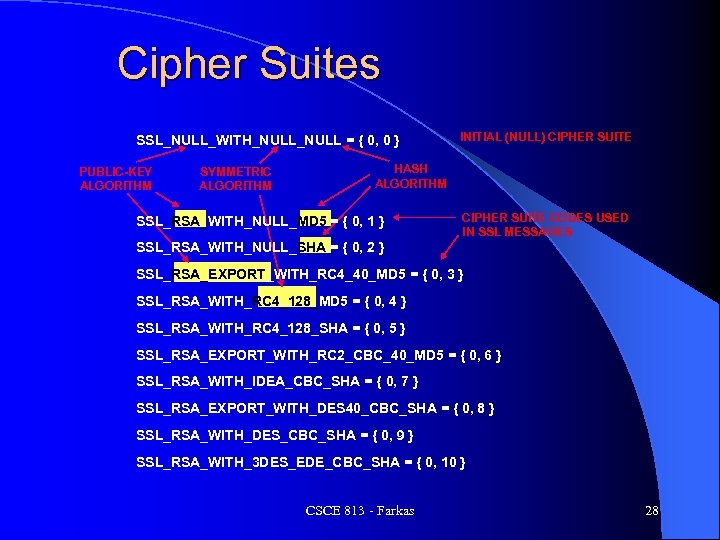 Cipher Suites SSL_NULL_WITH_NULL = { 0, 0 } PUBLIC-KEY ALGORITHM SYMMETRIC ALGORITHM INITIAL (NULL) CIPHER SUITE HASH ALGORITHM SSL_RSA_WITH_NULL_MD 5 = { 0, 1 } CIPHER SUITE CODES USED IN SSL MESSAGES SSL_RSA_WITH_NULL_SHA = { 0, 2 } SSL_RSA_EXPORT_WITH_RC 4_40_MD 5 = { 0, 3 } SSL_RSA_WITH_RC 4_128_MD 5 = { 0, 4 } SSL_RSA_WITH_RC 4_128_SHA = { 0, 5 } SSL_RSA_EXPORT_WITH_RC 2_CBC_40_MD 5 = { 0, 6 } SSL_RSA_WITH_IDEA_CBC_SHA = { 0, 7 } SSL_RSA_EXPORT_WITH_DES 40_CBC_SHA = { 0, 8 } SSL_RSA_WITH_DES_CBC_SHA = { 0, 9 } SSL_RSA_WITH_3 DES_EDE_CBC_SHA = { 0, 10 } CSCE 813 - Farkas 28
![2. S C: SERVERHELLO [CERTIFICATE] [SERVERKEYEXCHANGE] [CERTIFICATEREQUEST] SERVERHELLODONE SSL Handshake Server processes CLIENTHELLO message](https://present5.com/presentation/fd66a4bd5a2d816a8184574ad4738223/image-29.jpg "2. S C: SERVERHELLO [CERTIFICATE] [SERVERKEYEXCHANGE] [CERTIFICATEREQUEST] SERVERHELLODONE SSL Handshake Server processes CLIENTHELLO message") 2. S C: SERVERHELLO [CERTIFICATE] [SERVERKEYEXCHANGE] [CERTIFICATEREQUEST] SERVERHELLODONE SSL Handshake Server processes CLIENTHELLO message l Server Respond to client with SERVERHELLO message: l – Server version number: lower version of that suggested – – by the client and the highest supported by the server Server’s random structure: 32 -bit timestamp and 28 byte pseudorandom number Session ID: corresponding to this connection Cipher suite: selected by the server for client’s list Compression method: selected by the server from client’s list CSCE 813 - Farkas 29
2. S C: SERVERHELLO [CERTIFICATE] [SERVERKEYEXCHANGE] [CERTIFICATEREQUEST] SERVERHELLODONE SSL Handshake Server processes CLIENTHELLO message l Server Respond to client with SERVERHELLO message: l – Server version number: lower version of that suggested – – by the client and the highest supported by the server Server’s random structure: 32 -bit timestamp and 28 byte pseudorandom number Session ID: corresponding to this connection Cipher suite: selected by the server for client’s list Compression method: selected by the server from client’s list CSCE 813 - Farkas 29
![2. S C: SERVERHELLO [CERTIFICATE] [SERVERKEYEXCHANGE] [CERTIFICATEREQUEST] SERVERHELLODONE } SSL Handshake Optional messages: Phase](https://present5.com/presentation/fd66a4bd5a2d816a8184574ad4738223/image-30.jpg "2. S C: SERVERHELLO [CERTIFICATE] [SERVERKEYEXCHANGE] [CERTIFICATEREQUEST] SERVERHELLODONE } SSL Handshake Optional messages: Phase") 2. S C: SERVERHELLO [CERTIFICATE] [SERVERKEYEXCHANGE] [CERTIFICATEREQUEST] SERVERHELLODONE } SSL Handshake Optional messages: Phase 2– server authentication l CERTIFICATE: – If the server is using certificate-based authentication – May contain RSA public key good for key exchange l SERVERKEYEXCHANGE: – If the client does not have certificate, has certificate that can only be used to verify digital signatures, or uses FORTEZZA token-based key exchange (not recommended) l CERTIFICATEREQUEST: – Server may request personal certificate to authenticate a client CSCE 813 - Farkas 30
2. S C: SERVERHELLO [CERTIFICATE] [SERVERKEYEXCHANGE] [CERTIFICATEREQUEST] SERVERHELLODONE } SSL Handshake Optional messages: Phase 2– server authentication l CERTIFICATE: – If the server is using certificate-based authentication – May contain RSA public key good for key exchange l SERVERKEYEXCHANGE: – If the client does not have certificate, has certificate that can only be used to verify digital signatures, or uses FORTEZZA token-based key exchange (not recommended) l CERTIFICATEREQUEST: – Server may request personal certificate to authenticate a client CSCE 813 - Farkas 30
![3. C S: [CERTIFICATE] CLIENTKEYEXCHANGE [CERTIFICATEVERIFY] CHANGECIPHERSPEC FINISH l Client SSL Handshake processing: –](https://present5.com/presentation/fd66a4bd5a2d816a8184574ad4738223/image-31.jpg "3. C S: [CERTIFICATE] CLIENTKEYEXCHANGE [CERTIFICATEVERIFY] CHANGECIPHERSPEC FINISH l Client SSL Handshake processing: –") 3. C S: [CERTIFICATE] CLIENTKEYEXCHANGE [CERTIFICATEVERIFY] CHANGECIPHERSPEC FINISH l Client SSL Handshake processing: – Verifies site certification l Valid site certification if the server’s name matches the host part of the URL the client wants to access – Checks security parameters supplied by the SERVERHELLO CSCE 813 - Farkas 31
3. C S: [CERTIFICATE] CLIENTKEYEXCHANGE [CERTIFICATEVERIFY] CHANGECIPHERSPEC FINISH l Client SSL Handshake processing: – Verifies site certification l Valid site certification if the server’s name matches the host part of the URL the client wants to access – Checks security parameters supplied by the SERVERHELLO CSCE 813 - Farkas 31
![3. C S: [CERTIFICATE] CLIENTKEYEXCHANGE [CERTIFICATEVERIFY] CHANGECIPHERSPEC FINISH l SSL Handshake Client messages: Phase](https://present5.com/presentation/fd66a4bd5a2d816a8184574ad4738223/image-32.jpg "3. C S: [CERTIFICATE] CLIENTKEYEXCHANGE [CERTIFICATEVERIFY] CHANGECIPHERSPEC FINISH l SSL Handshake Client messages: Phase") 3. C S: [CERTIFICATE] CLIENTKEYEXCHANGE [CERTIFICATEVERIFY] CHANGECIPHERSPEC FINISH l SSL Handshake Client messages: Phase 3 – client authentication and key exchange – CERTIFICATE l If server requested a client authentication, client sends – CLIENTKEYEXCHANGE l Format depends on the key exchange algorithm selected by the server – RSA: 48 -byte premaster secret encrypted by the server’s public key – Diffie-Hellman: public parameters between server and client in SERVERKEYEXCHANGE and CLIENTKEYEXCHANGE msgs. – FORTEZZA: token-based key exchange based on public and private parameters l Premaster key is transformed into a 48 -byte master secret, stored in the session state CSCE 813 - Farkas 32
3. C S: [CERTIFICATE] CLIENTKEYEXCHANGE [CERTIFICATEVERIFY] CHANGECIPHERSPEC FINISH l SSL Handshake Client messages: Phase 3 – client authentication and key exchange – CERTIFICATE l If server requested a client authentication, client sends – CLIENTKEYEXCHANGE l Format depends on the key exchange algorithm selected by the server – RSA: 48 -byte premaster secret encrypted by the server’s public key – Diffie-Hellman: public parameters between server and client in SERVERKEYEXCHANGE and CLIENTKEYEXCHANGE msgs. – FORTEZZA: token-based key exchange based on public and private parameters l Premaster key is transformed into a 48 -byte master secret, stored in the session state CSCE 813 - Farkas 32
![3. C S: [CERTIFICATE] CLIENTKEYEXCHANGE [CERTIFICATEVERIFY] CHANGECIPHERSPEC FINISH l SSL Handshake Client messages: –](https://present5.com/presentation/fd66a4bd5a2d816a8184574ad4738223/image-33.jpg "3. C S: [CERTIFICATE] CLIENTKEYEXCHANGE [CERTIFICATEVERIFY] CHANGECIPHERSPEC FINISH l SSL Handshake Client messages: –") 3. C S: [CERTIFICATE] CLIENTKEYEXCHANGE [CERTIFICATEVERIFY] CHANGECIPHERSPEC FINISH l SSL Handshake Client messages: – CERTIFICATEVERIFY l l If client authentication is required Provides explicit verification of the use’s identity (personal certificate) – CHANGECIPHERSPEC l Completes key exchange and cipher specification – FINISH l l Encrypted by the newly negotiated session key Verifies that the keys are properly installed in both sites CSCE 813 - Farkas 33
3. C S: [CERTIFICATE] CLIENTKEYEXCHANGE [CERTIFICATEVERIFY] CHANGECIPHERSPEC FINISH l SSL Handshake Client messages: – CERTIFICATEVERIFY l l If client authentication is required Provides explicit verification of the use’s identity (personal certificate) – CHANGECIPHERSPEC l Completes key exchange and cipher specification – FINISH l l Encrypted by the newly negotiated session key Verifies that the keys are properly installed in both sites CSCE 813 - Farkas 33
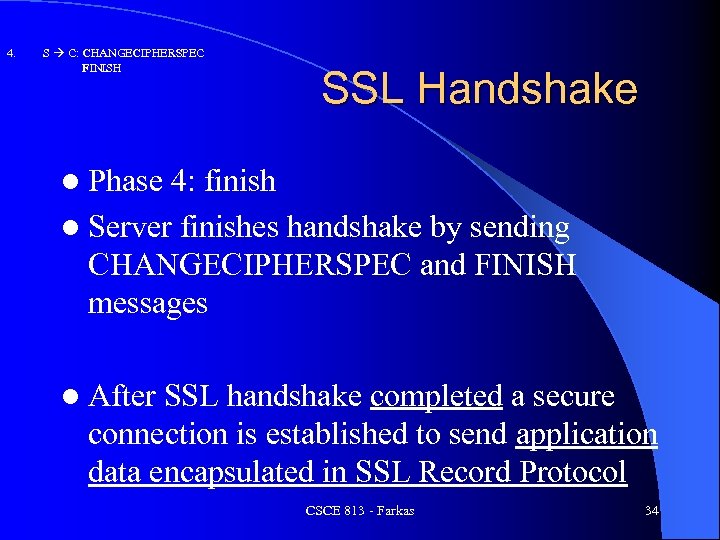 4. S C: CHANGECIPHERSPEC FINISH SSL Handshake l Phase 4: finish l Server finishes handshake by sending CHANGECIPHERSPEC and FINISH messages l After SSL handshake completed a secure connection is established to send application data encapsulated in SSL Record Protocol CSCE 813 - Farkas 34
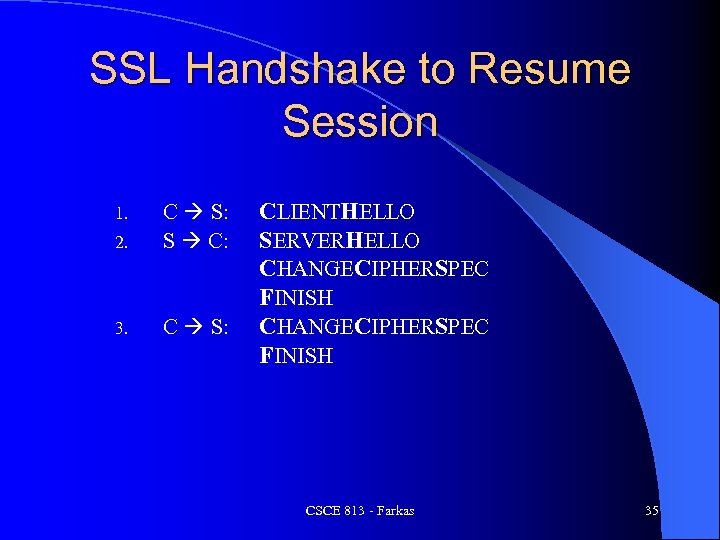 SSL Handshake to Resume Session 2. C S: S C: 3. C S: 1. CLIENTHELLO SERVERHELLO CHANGECIPHERSPEC FINISH CSCE 813 - Farkas 35
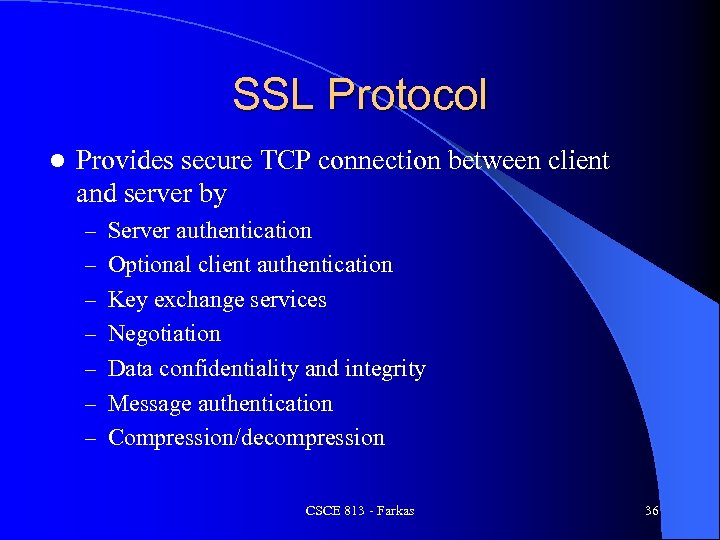 SSL Protocol l Provides secure TCP connection between client and server by – Server authentication – Optional client authentication – Key exchange services – Negotiation – Data confidentiality and integrity – Message authentication – Compression/decompression CSCE 813 - Farkas 36
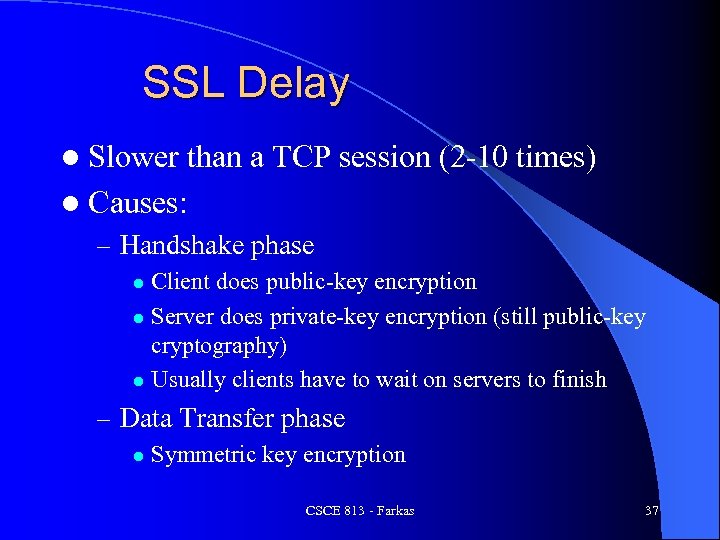 SSL Delay l Slower than a TCP session (2 -10 times) l Causes: – Handshake phase Client does public-key encryption l Server does private-key encryption (still public-key cryptography) l Usually clients have to wait on servers to finish l – Data Transfer phase l Symmetric key encryption CSCE 813 - Farkas 37
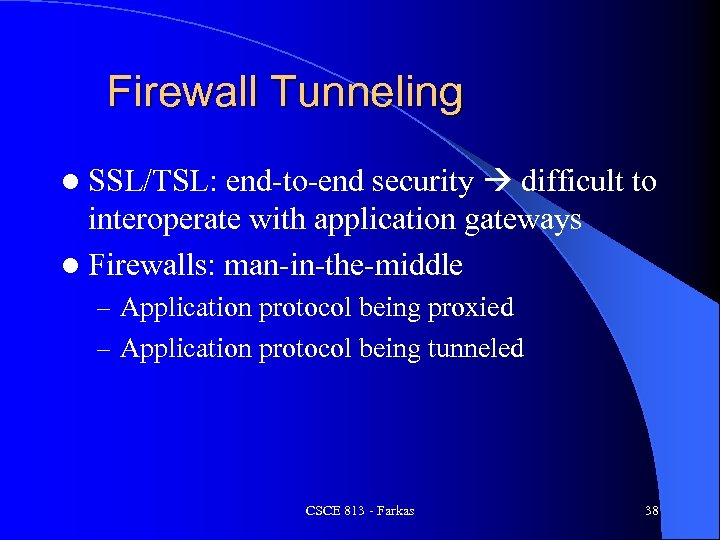 Firewall Tunneling end-to-end security difficult to interoperate with application gateways l Firewalls: man-in-the-middle l SSL/TSL: – Application protocol being proxied – Application protocol being tunneled CSCE 813 - Farkas 38
 Proxied Protocol Proxy server is aware of the specifics of the protocol and understand protocol level processing l Support: l – Protocol-level filtering – Access control – Accounting – Logging l Usually proxied protocols: telnet, ftp, http CSCE 813 - Farkas 39
 Tunneled Protocol l Proxy server: – NOT aware of the specifics of the protocol simply relaying the data between Client and Server – Does NOT have access to data being transferred – Knows: source and destination addresses (IP and port) and the requesting user (if authentication is supported) Cannot support: protocol –level filtering, access control, and logging at the same extend as the proxied version. l Usually tunneled protocols: SSL-enhanced protocols l CSCE 813 - Farkas 40
 Summary l Advantages of SSL/TSL: – Simplicity – Wide deployment l Disadvantages: – Do not secure UDP – Work poorly with applications gateways CSCE 813 - Farkas 41
 Testing for SSL-TLS (OWASP-CM-001) l Problem: legacy and new web servers are often able and configured to handle weak cryptographic options l Causes: historic export restrictions of high grade cryptography CSCE 813 - Farkas 42
 SSL testing criteria https: //www. owasp. org/index. php/Testing_for_SSLTLS_%28 OWASP-CM-001%29 Minimum checklist: l SSLv 2, due to known weaknesses in protocol design l Export (EXP) level cipher suites in SSLv 3 l Cipher suites with symmetric encryption algorithm smaller than 128 bits l X. 509 certificates with RSA or DSA key smaller than 1024 bits l X. 509 certificates signed using MD 5 hash, due to known collision attacks on this hash l TLS Renegotiation vulnerability – patch available CSCE 813 - Farkas 43
 Next Class: Application Layer Security