 Скачать презентацию Internet resource sharing a way forward Bob Briscoe
0461c7bb3ffdf239b9a366f7fe934053.ppt
- Количество слайдов: 26



Internet resource sharing: a way forward? Bob Briscoe Chief Researcher, BT May 2009 This work is partly funded by Trilogy, a research project supported by the European Community www. trilogy-project. org
fair capacity sharing – a huge responsibility • getting this right will open a new chapter of Internet innovation • freedom for a huge variety of source behaviours • so much more than the TCP-friendly monoculture • rate response to congestion still important, but not the basis of capacity sharing • getting it wrong leaves ISPs no choice but to close off the future • TCP/IP suite wasn't designed for ISPs to even see congestion • without visibility of correct metric, ISPs resort to app analysis • getting impossible to deploy a new use of the Internet • must negotiate the arbitrary blocks and throttles en route • grudging acceptance of proverb: "good fences make good neighbours" • not natural for most of us to design fences • but lacking a good fence design, the industry is building bad ones • cf. lack of an IETF/IRTF firewall architecture • goal: a building block for fences that doesn't encourage fence-mentality 2
design team's top level research agenda? • statement of ultimate target • metrics & deprecated metrics • structure & deprecated structure • enduring concepts • standards agenda • weighted congestion controls • ECN gaps • re-ECN • deployment scenarios • unilateral • co-ordinated 3
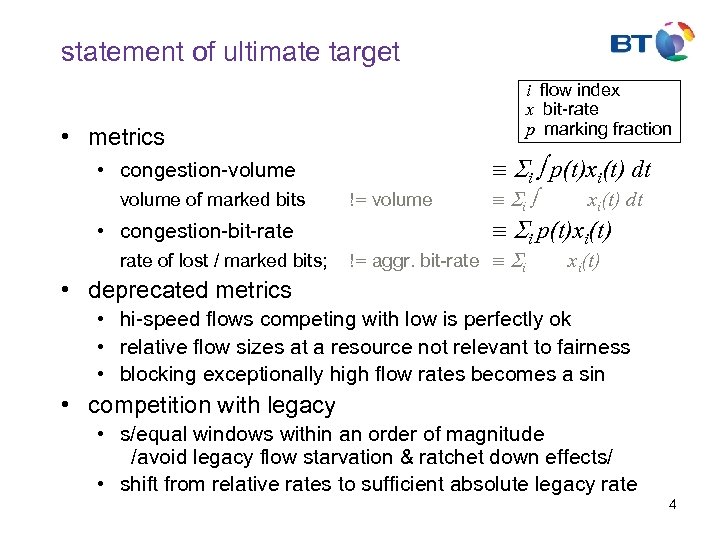
statement of ultimate target i flow index x bit-rate p marking fraction • metrics i p(t)xi(t) dt • congestion-volume of marked bits • congestion-bit-rate of lost / marked bits; != volume i xi(t) dt i p(t)xi(t) != aggr. bit-rate i xi(t) • deprecated metrics • hi-speed flows competing with low is perfectly ok • relative flow sizes at a resource not relevant to fairness • blocking exceptionally high flow rates becomes a sin • competition with legacy • s/equal windows within an order of magnitude /avoid legacy flow starvation & ratchet down effects/ • shift from relative rates to sufficient absolute legacy rate 4
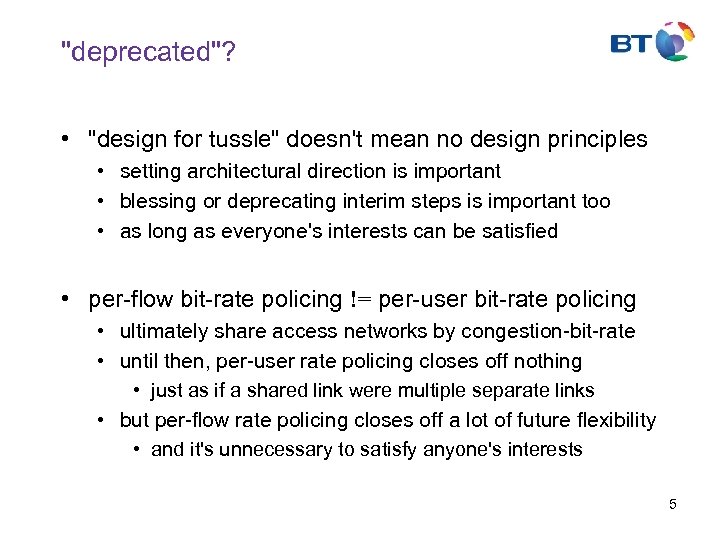
"deprecated"? • "design for tussle" doesn't mean no design principles • setting architectural direction is important • blessing or deprecating interim steps is important too • as long as everyone's interests can be satisfied • per-flow bit-rate policing != per-user bit-rate policing • ultimately share access networks by congestion-bit-rate • until then, per-user rate policing closes off nothing • just as if a shared link were multiple separate links • but per-flow rate policing closes off a lot of future flexibility • and it's unnecessary to satisfy anyone's interests 5
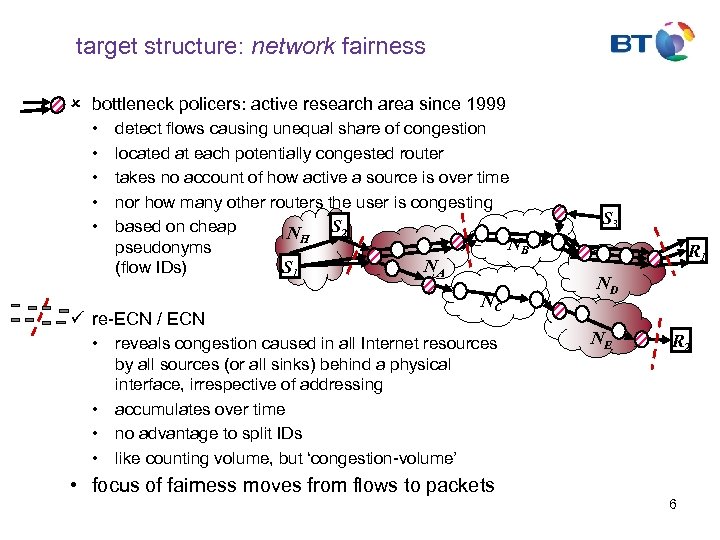
target structure: network fairness û bottleneck policers: active research area since 1999 • • • detect flows causing unequal share of congestion located at each potentially congested router takes no account of how active a source is over time nor how many other routers the user is congesting based on cheap NH S 2 NB pseudonyms NA S 1 (flow IDs) ü re-ECN / ECN NC • reveals congestion caused in all Internet resources by all sources (or all sinks) behind a physical interface, irrespective of addressing • accumulates over time • no advantage to split IDs • like counting volume, but ‘congestion-volume’ S 3 R 1 ND NE R 2 • focus of fairness moves from flows to packets 6
!['Cost': Congestion-Volume: Total TCP Loss [Byte] Initial results measured on Naples Uni network feeding](https://present5.com/presentation/0461c7bb3ffdf239b9a366f7fe934053/image-7.jpg "'Cost': Congestion-Volume: Total TCP Loss [Byte] Initial results measured on Naples Uni network feeding")
'Cost': Congestion-Volume: Total TCP Loss [Byte] Initial results measured on Naples Uni network feeding numerous residential networks Each point is a user correlation coefficient: 0. 43 : ING ation N AR valid data W s e ire ampl qu Re ore s m ith w % 0 10 % 10 1% 1% 0. % 01 0. on % ge esti on 01 ra ti. 0 ve ong rac 0 a c f Volume: Total TCP Traffic Volume [Byte] 7
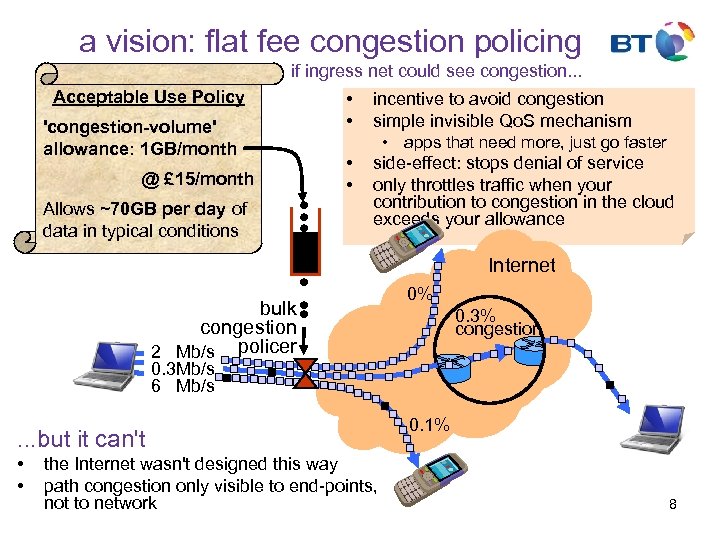
a vision: flat fee congestion policing if ingress net could see congestion. . . Acceptable Use Policy 'congestion-volume' allowance: 1 GB/month @ £ 15/month Allows ~70 GB per day of data in typical conditions • • incentive to avoid congestion simple invisible Qo. S mechanism • apps that need more, just go faster side-effect: stops denial of service only throttles traffic when your contribution to congestion in the cloud exceeds your allowance Internet bulk congestion 2 Mb/s policer 0% 0. 3% congestion 0. 3 Mb/s 6 Mb/s . . . but it can't • • the Internet wasn't designed this way path congestion only visible to end-points, not to network 0. 1% 8
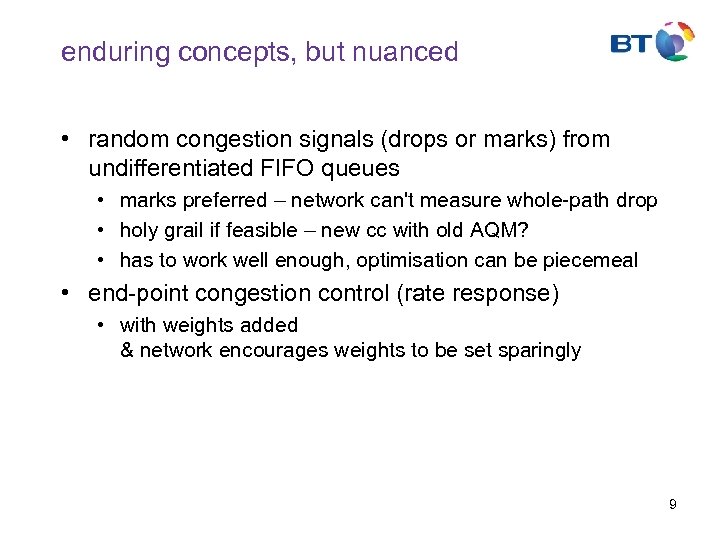
enduring concepts, but nuanced • random congestion signals (drops or marks) from undifferentiated FIFO queues • marks preferred – network can't measure whole-path drop • holy grail if feasible – new cc with old AQM? • has to work well enough, optimisation can be piecemeal • end-point congestion control (rate response) • with weights added & network encourages weights to be set sparingly 9
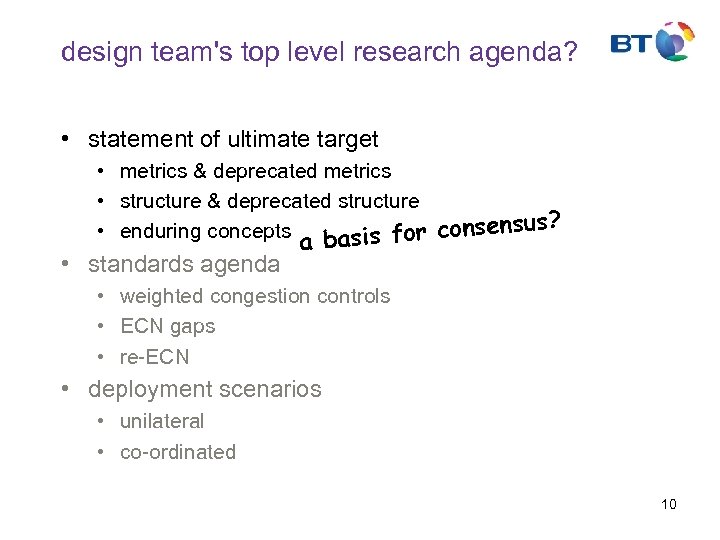
design team's top level research agenda? • statement of ultimate target • metrics & deprecated metrics • structure & deprecated structure s? • enduring concepts for consensu basis • standards agenda a • weighted congestion controls • ECN gaps • re-ECN • deployment scenarios • unilateral • co-ordinated 10
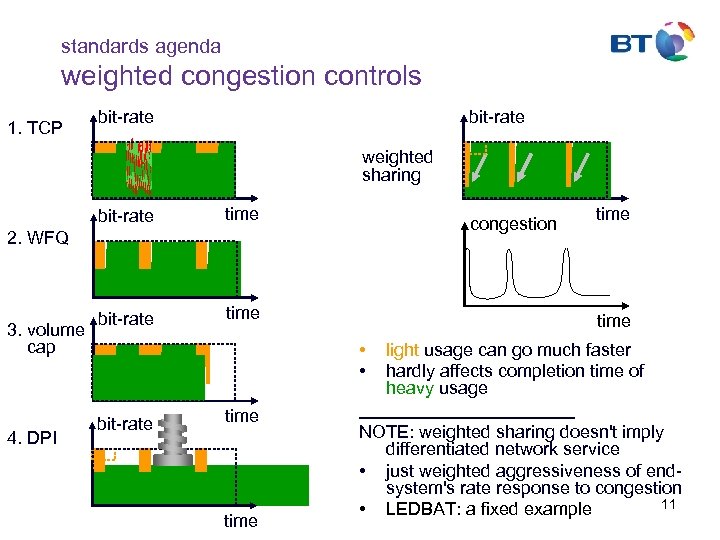
standards agenda weighted congestion controls 1. TCP bit-rate weighted sharing bit-rate time congestion 2. WFQ 3. volume cap 4. DPI time • • bit-rate time light usage can go much faster hardly affects completion time of heavy usage NOTE: weighted sharing doesn't imply differentiated network service • just weighted aggressiveness of endsystem's rate response to congestion 11 • LEDBAT: a fixed example
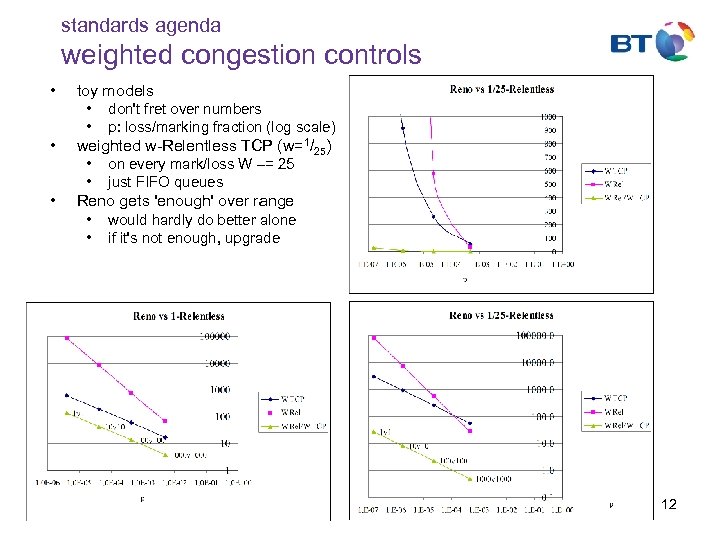
standards agenda weighted congestion controls • • • toy models • don't fret over numbers • p: loss/marking fraction (log scale) weighted w-Relentless TCP (w=1/25) • on every mark/loss W –= 25 • just FIFO queues Reno gets 'enough' over range • would hardly do better alone • if it's not enough, upgrade 12
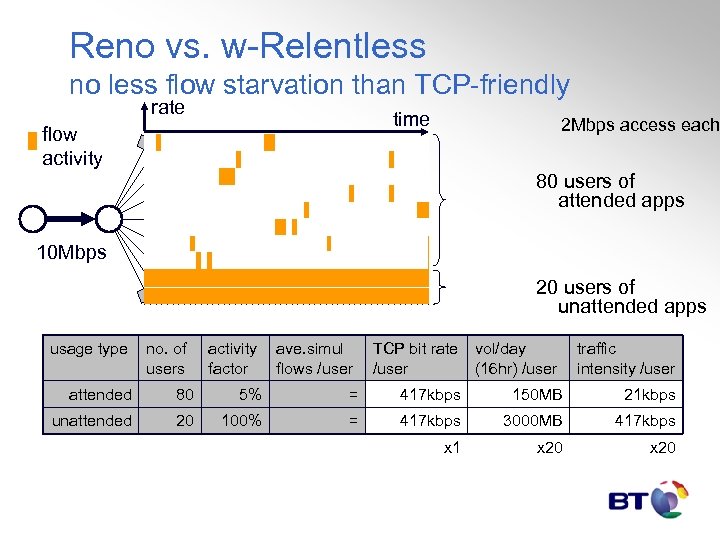
Reno vs. w-Relentless no less flow starvation than TCP-friendly rate time flow activity 2 Mbps access each 80 users of attended apps 10 Mbps 20 users of unattended apps usage type no. of users activity factor ave. simul flows /user TCP bit rate /user vol/day (16 hr) /user traffic intensity /user attended 80 5% = 417 kbps 150 MB 21 kbps unattended 20 100% = 417 kbps 3000 MB 417 kbps x 1 x 20
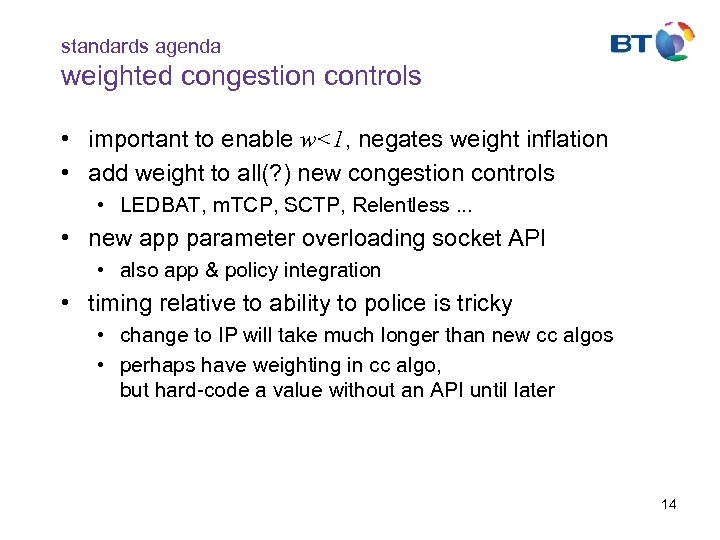
standards agenda weighted congestion controls • important to enable w<1, negates weight inflation • add weight to all(? ) new congestion controls • LEDBAT, m. TCP, SCTP, Relentless. . . • new app parameter overloading socket API • also app & policy integration • timing relative to ability to police is tricky • change to IP will take much longer than new cc algos • perhaps have weighting in cc algo, but hard-code a value without an API until later 14
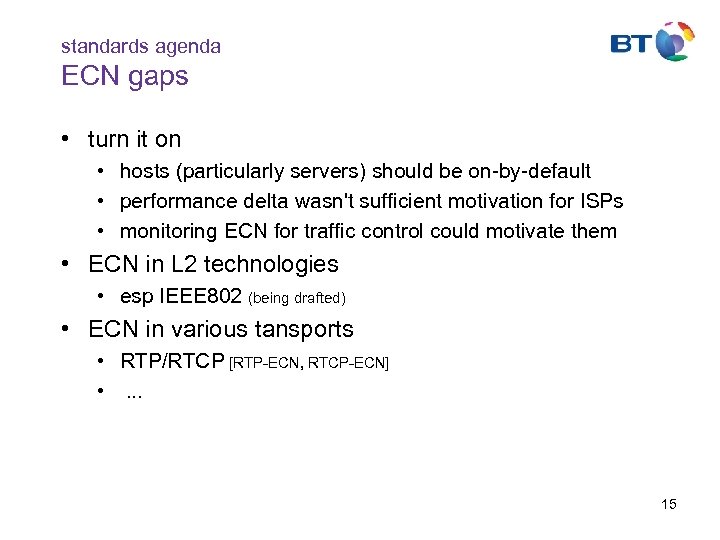
standards agenda ECN gaps • turn it on • hosts (particularly servers) should be on-by-default • performance delta wasn't sufficient motivation for ISPs • monitoring ECN for traffic control could motivate them • ECN in L 2 technologies • esp IEEE 802 (being drafted) • ECN in various tansports • RTP/RTCP [RTP-ECN, RTCP-ECN] • . . . 15
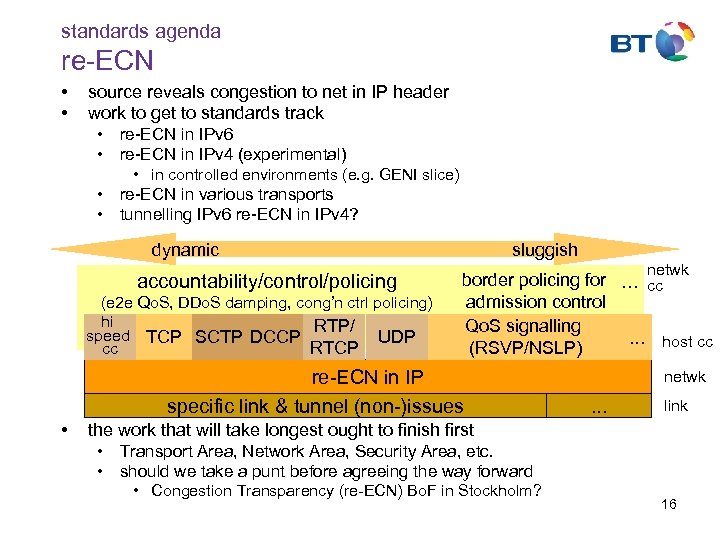
standards agenda re-ECN • • source reveals congestion to net in IP header work to get to standards track • re-ECN in IPv 6 • re-ECN in IPv 4 (experimental) • in controlled environments (e. g. GENI slice) • re-ECN in various transports • tunnelling IPv 6 re-ECN in IPv 4? dynamic accountability/control/policing (e 2 e Qo. S, DDo. S damping, cong’n ctrl policing) hi RTP/ speed TCP SCTP DCCP UDP RTCP cc sluggish re-ECN in IP specific link & tunnel (non-)issues • netwk border policing for. . . cc admission control Qo. S signalling. . . host cc (RSVP/NSLP) netwk . . . link the work that will take longest ought to finish first • Transport Area, Network Area, Security Area, etc. • should we take a punt before agreeing the way forward • Congestion Transparency (re-ECN) Bo. F in Stockholm? 16
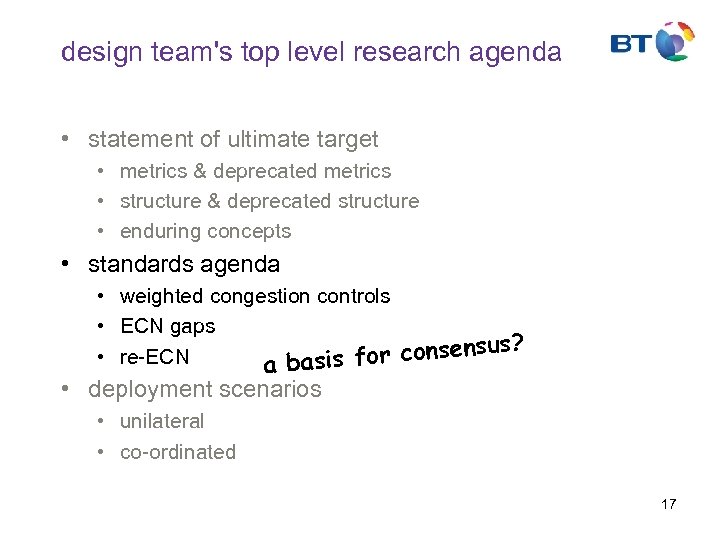
design team's top level research agenda • statement of ultimate target • metrics & deprecated metrics • structure & deprecated structure • enduring concepts • standards agenda • weighted congestion controls • ECN gaps r consensus? • re-ECN a basis fo • deployment scenarios • unilateral • co-ordinated 17
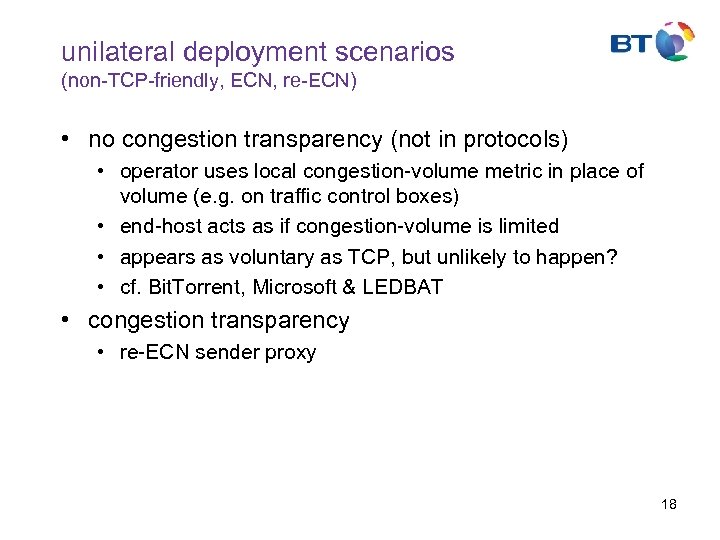
unilateral deployment scenarios (non-TCP-friendly, ECN, re-ECN) • no congestion transparency (not in protocols) • operator uses local congestion-volume metric in place of volume (e. g. on traffic control boxes) • end-host acts as if congestion-volume is limited • appears as voluntary as TCP, but unlikely to happen? • cf. Bit. Torrent, Microsoft & LEDBAT • congestion transparency • re-ECN sender proxy 18
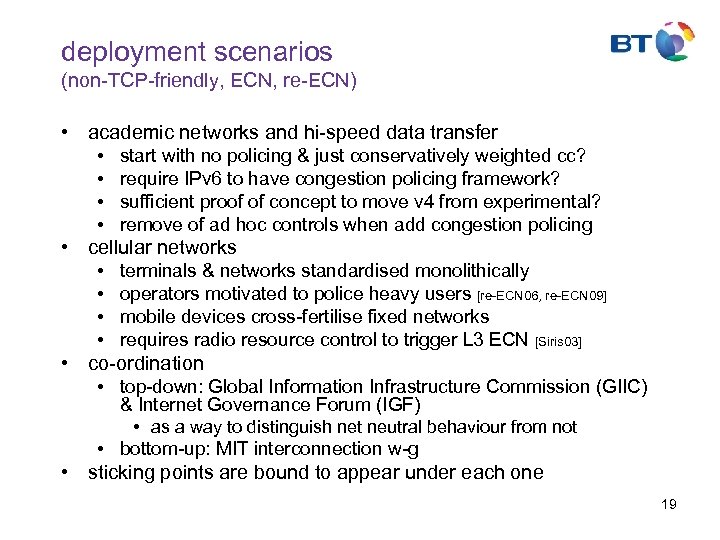
deployment scenarios (non-TCP-friendly, ECN, re-ECN) • academic networks and hi-speed data transfer • start with no policing & just conservatively weighted cc? • require IPv 6 to have congestion policing framework? • sufficient proof of concept to move v 4 from experimental? • remove of ad hoc controls when add congestion policing • cellular networks • terminals & networks standardised monolithically • operators motivated to police heavy users [re-ECN 06, re-ECN 09] • mobile devices cross-fertilise fixed networks • requires radio resource control to trigger L 3 ECN [Siris 03] • co-ordination • top-down: Global Information Infrastructure Commission (GIIC) & Internet Governance Forum (IGF) • as a way to distinguish net neutral behaviour from not • bottom-up: MIT interconnection w-g • sticking points are bound to appear under each one 19
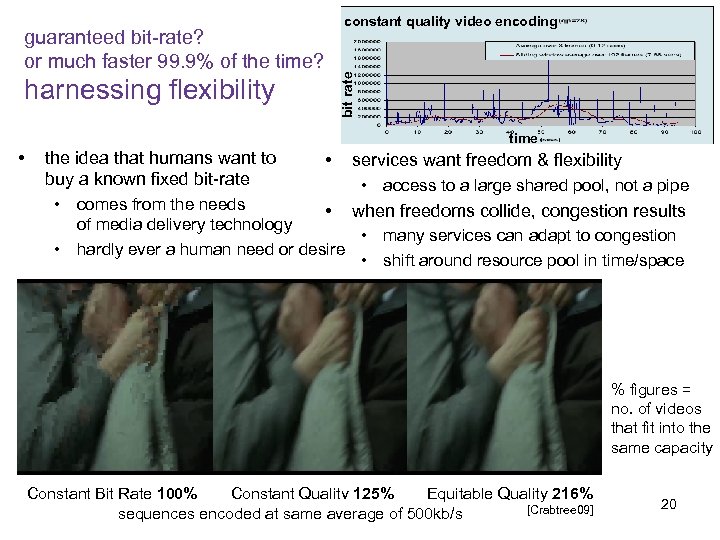
constant quality video encoding bit rate guaranteed bit-rate? or much faster 99. 9% of the time? harnessing flexibility time • the idea that humans want to buy a known fixed bit-rate • comes from the needs • services want freedom & flexibility • access to a large shared pool, not a pipe • when freedoms collide, congestion results of media delivery technology • many services can adapt to congestion • hardly ever a human need or desire • shift around resource pool in time/space % figures = no. of videos that fit into the same capacity Equitable Quality 216% Constant Bit Rate 100% Constant Quality 125% [Crabtree 09] sequences encoded at same average of 500 kb/s 20
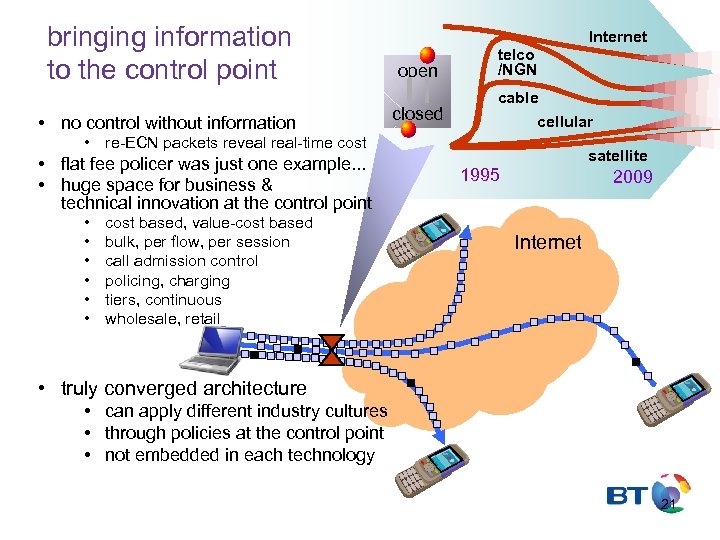
bringing information to the control point • no control without information open closed telco /NGN cable cellular • re-ECN packets reveal real-time cost • flat fee policer was just one example. . . • huge space for business & technical innovation at the control point • • • cost based, value-cost based bulk, per flow, per session call admission control policing, charging tiers, continuous wholesale, retail Internet satellite 1995 2009 Internet • truly converged architecture • can apply different industry cultures • through policies at the control point • not embedded in each technology 21
a design team needs a name • some potential keywords • • • Internet resource/capacity sharing beyond TCP-friendly fair congestion 22
more info Re-architecting the Internet: The Trilogy project <www. trilogy-project. org> re-ECN & re-feedback project page: http: //www. cs. ucl. ac. uk/staff/B. Briscoe/projects/refb/ These slides <www. cs. ucl. ac. uk/staff/B. Briscoe/present. html> bob. briscoe@bt. com deployment incentives [re-ECN 06] Using Self-interest to Prevent Malice; Fixing the Denial of Service Flaw of the Internet, Bob Briscoe (BT & UCL), The Workshop on the Economics of Securing the Information Infrastructure (Oct 2006) [re-ECN] <draft-briscoe-tsvwg-re-ecn-tcp> [re-ECN 09] <draft-briscoe-tsvwg-re-ecn-tcp-motivation> [Crabtree 09] B. Crabtree, M. Nilsson, P. Mulroy and S. Appleby “Equitable quality video streaming” Computer Communications and Networking Conference, Las Vegas, (Jan 2009) ECN @ L 2 [Siris 02] ``Resource Control for Elastic Traffic in CDMA Networks'' In Proc. ACM MOBICOM 2002, Atlanta, USA, 23 -28 (2002). <www. ics. forth. gr/netlab/wireless. html> ECN @ L 4 -7 [RTP-ECN] draft-carlberg-avt-rtp-ecn [RTCP-ECN] draft-carlberg-avt-rtcp-xr-ecn 23
Internet resource sharing: a way forward? discuss. . . 24
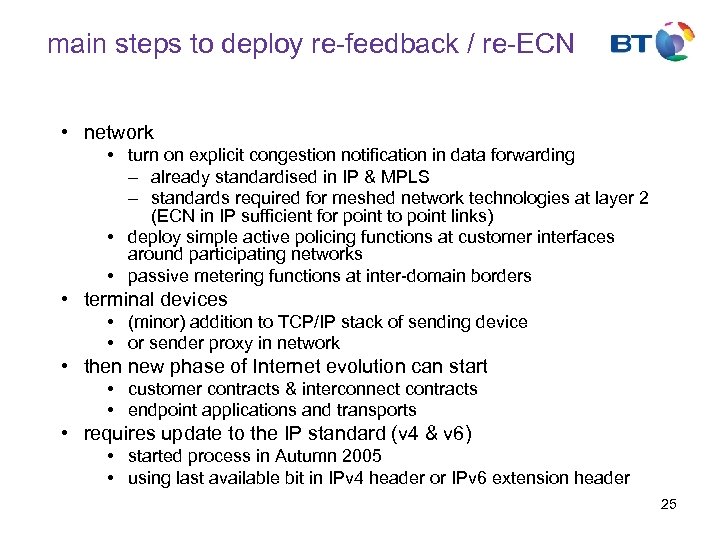
main steps to deploy re-feedback / re-ECN • network • turn on explicit congestion notification in data forwarding – already standardised in IP & MPLS – standards required for meshed network technologies at layer 2 (ECN in IP sufficient for point to point links) • deploy simple active policing functions at customer interfaces around participating networks • passive metering functions at inter-domain borders • terminal devices • (minor) addition to TCP/IP stack of sending device • or sender proxy in network • then new phase of Internet evolution can start • customer contracts & interconnect contracts • endpoint applications and transports • requires update to the IP standard (v 4 & v 6) • started process in Autumn 2005 • using last available bit in IPv 4 header or IPv 6 extension header 25
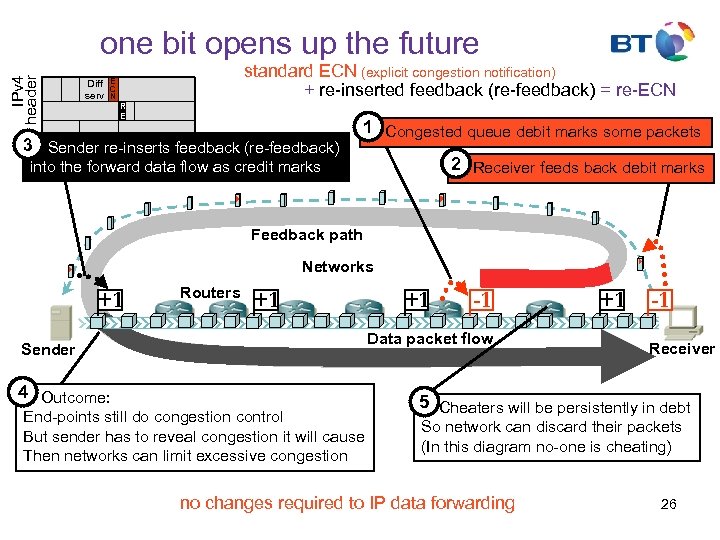
IPv 4 header one bit opens up the future Diff serv standard ECN (explicit congestion notification) + re-inserted feedback (re-feedback) = re-ECN E C N R E 33. Sender re-inserts feedback (re-feedback) 1 Congested queue debit marks some packets 1. 2 Receiver feeds back debit marks 2. into the forward data flow as credit marks Feedback path Networks +1 Routers +1 +1 -1 Data packet flow Sender 4 Outcome: 4. End-points still do congestion control But sender has to reveal congestion it will cause Then networks can limit excessive congestion +1 -1 Receiver 5 Cheaters will be persistently in debt 5. So network can discard their packets (In this diagram no-one is cheating) no changes required to IP data forwarding 26
Скачать презентацию Internet resource sharing a way forward Bob Briscoe
0461c7bb3ffdf239b9a366f7fe934053.ppt