 Скачать презентацию Internet Qo S the underlying economics Bob Briscoe
b91a7d2d04c83e46fcb2e6cdc663b59e.ppt
- Количество слайдов: 79



Internet Qo. S the underlying economics Bob Briscoe Chief Researcher, BT Group Sep 2008
executive summary congestion accountability – the missing link • unwise NGN obsession with per-session Qo. S guarantees • scant attention to competition from 'cloud Qo. S' • rising general Qo. S expectation from the public Internet • cost-shifting between end-customers (including service providers) • questionable economic sustainability • 'cloud' resource accountability is possible • principled way to heal the above ills • requires shift in economic thinking – from volume to congestion volume • provides differentiated cloud Qo. S without further mechanism • also the basis for a far simpler per-session Qo. S mechanism • having fixed the competitive environment to make per-session Qo. S viable 2
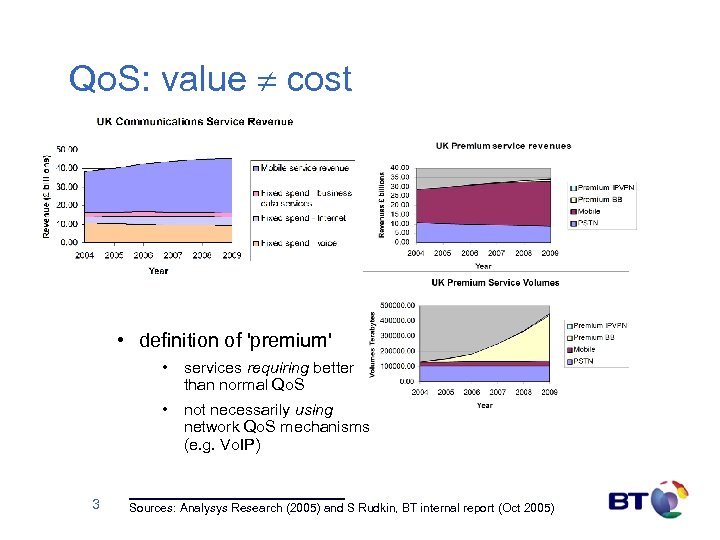
Qo. S: value ¹ cost • definition of 'premium' • services requiring better than normal Qo. S • not necessarily using network Qo. S mechanisms (e. g. Vo. IP) 3 Sources: Analysys Research (2005) and S Rudkin, BT internal report (Oct 2005)
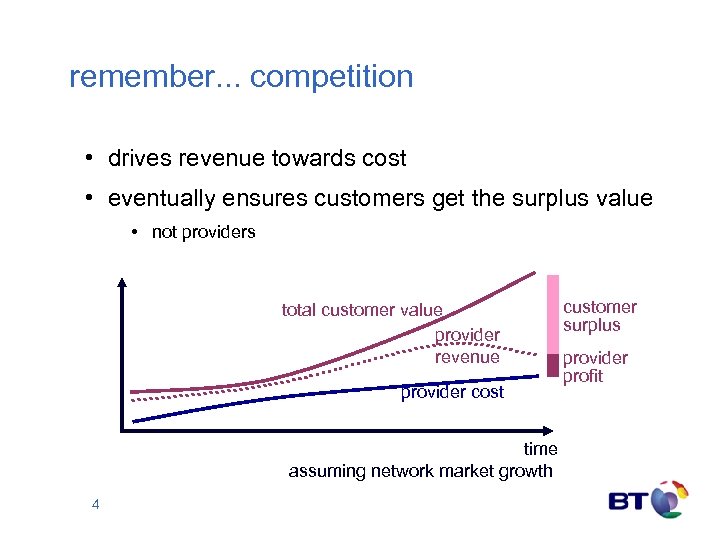
remember. . . competition • drives revenue towards cost • eventually ensures customers get the surplus value • not providers total customer value provider revenue provider cost time assuming network market growth 4 customer surplus provider profit
Internet Qo. S first, fix cost-based accountability Bob Briscoe
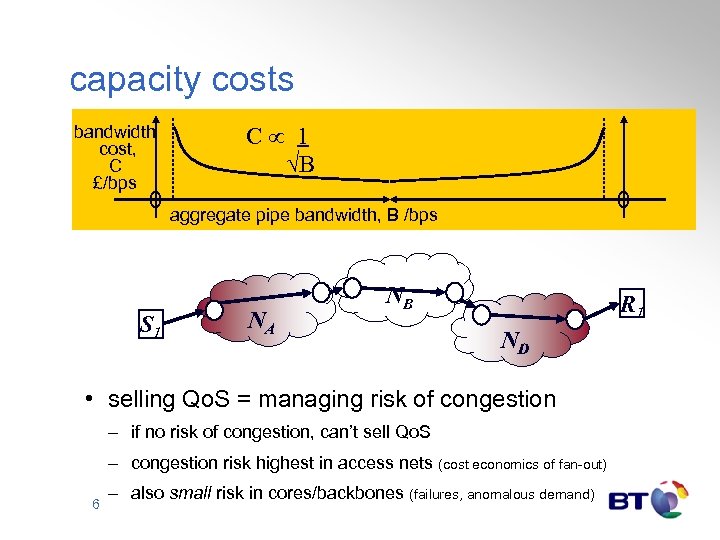
capacity costs bandwidth cost, C £/bps 0 S 1 C 1 B 0 aggregate pipe bandwidth, B /bps NA NB R 1 ND • selling Qo. S = managing risk of congestion – if no risk of congestion, can’t sell Qo. S – congestion risk highest in access nets (cost economics of fan-out) 6 – also small risk in cores/backbones (failures, anomalous demand)
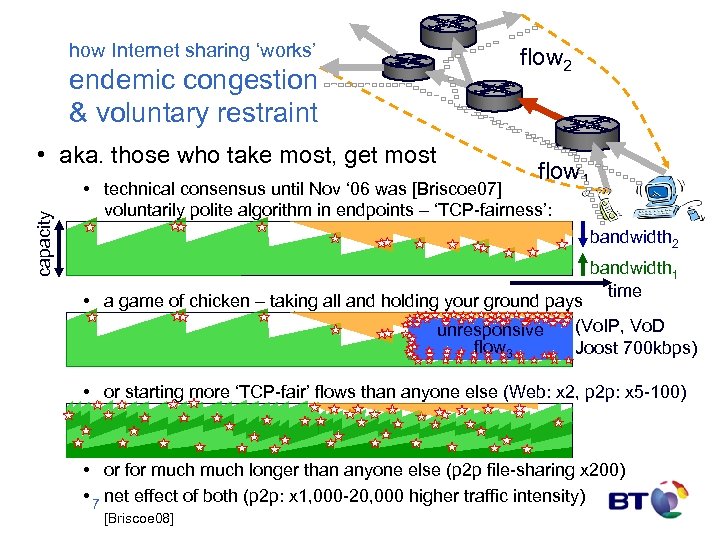
how Internet sharing ‘works’ endemic congestion & voluntary restraint capacity • aka. those who take most, get most flow 2 flow 1 • technical consensus until Nov ‘ 06 was [Briscoe 07] voluntarily polite algorithm in endpoints – ‘TCP-fairness’: bandwidth 2 bandwidth 1 time • a game of chicken – taking all and holding your ground pays (Vo. IP, Vo. D unresponsive flow 3 Joost 700 kbps) • or starting more ‘TCP-fair’ flows than anyone else (Web: x 2, p 2 p: x 5 -100) • or for much longer than anyone else (p 2 p file-sharing x 200) • 7 net effect of both (p 2 p: x 1, 000 -20, 000 higher traffic intensity) [Briscoe 08]
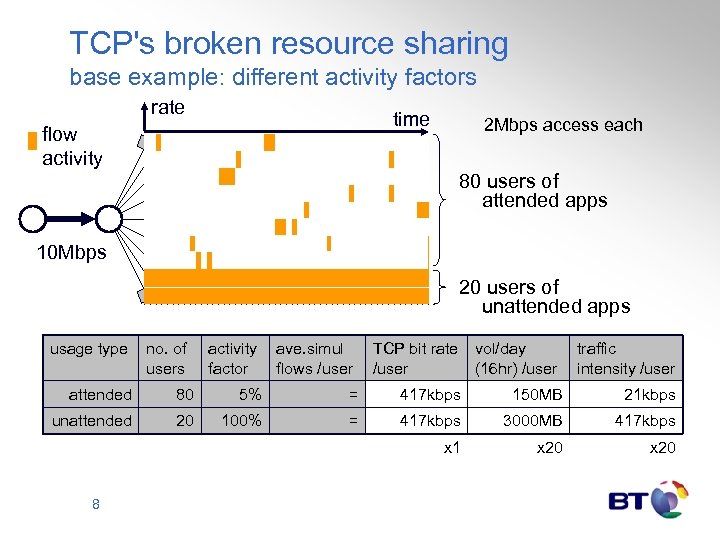
TCP's broken resource sharing base example: different activity factors rate time flow activity 2 Mbps access each 80 users of attended apps 10 Mbps 20 users of unattended apps usage type no. of users attended 80 5% = 417 kbps 150 MB 21 kbps unattended 20 100% = 417 kbps 3000 MB 417 kbps x 1 x 20 8 activity ave. simul factor flows /user TCP bit rate /user vol/day (16 hr) /user traffic intensity /user
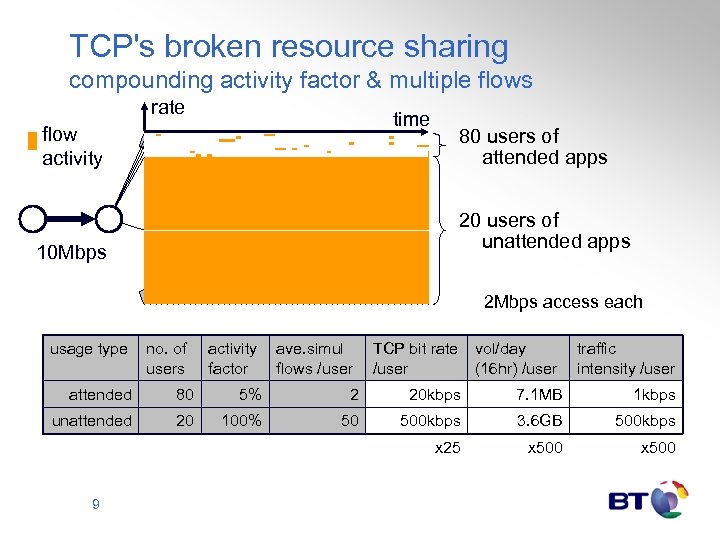
TCP's broken resource sharing compounding activity factor & multiple flows rate time flow activity 80 users of attended apps 20 users of unattended apps 10 Mbps 2 Mbps access each usage type no. of users attended 80 5% 2 20 kbps 7. 1 MB 1 kbps unattended 20 100% 50 500 kbps 3. 6 GB 500 kbps x 25 x 500 9 activity ave. simul factor flows /user TCP bit rate /user vol/day (16 hr) /user traffic intensity /user
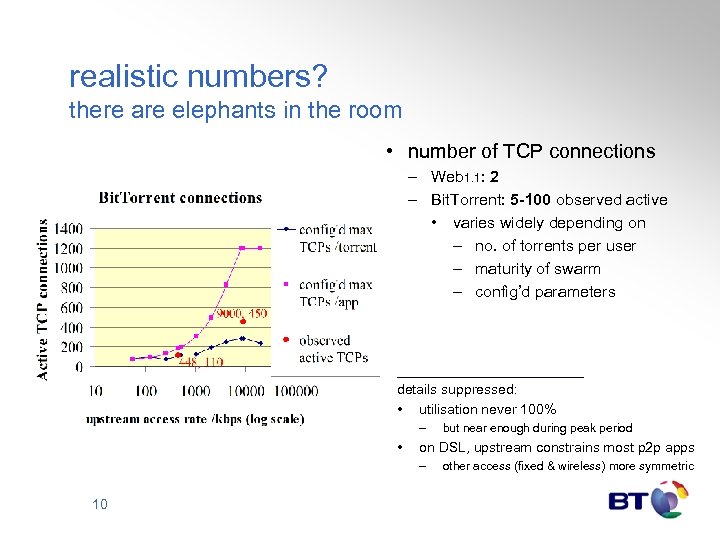
realistic numbers? there are elephants in the room • number of TCP connections – Web 1. 1: 2 – Bit. Torrent: 5 -100 observed active • varies widely depending on – no. of torrents per user – maturity of swarm – config’d parameters details suppressed: • utilisation never 100% – • on DSL, upstream constrains most p 2 p apps – 10 but near enough during peak period other access (fixed & wireless) more symmetric
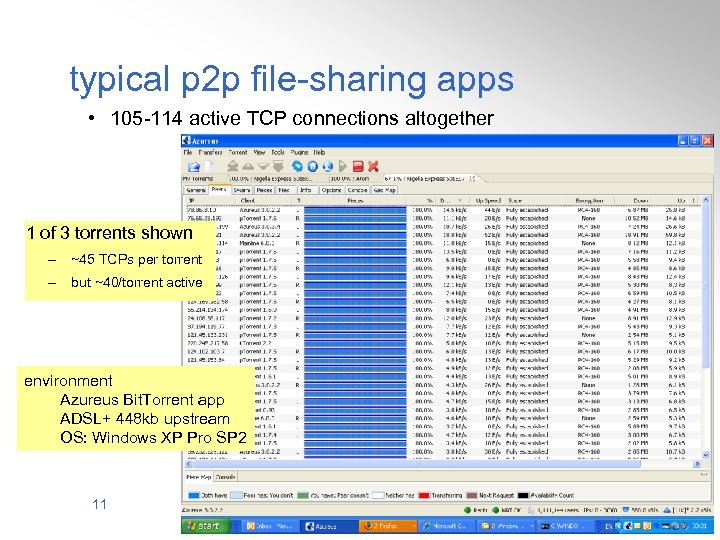
typical p 2 p file-sharing apps • 105 -114 active TCP connections altogether 1 of 3 torrents shown – ~45 TCPs per torrent – but ~40/torrent active environment Azureus Bit. Torrent app ADSL+ 448 kb upstream OS: Windows XP Pro SP 2 11
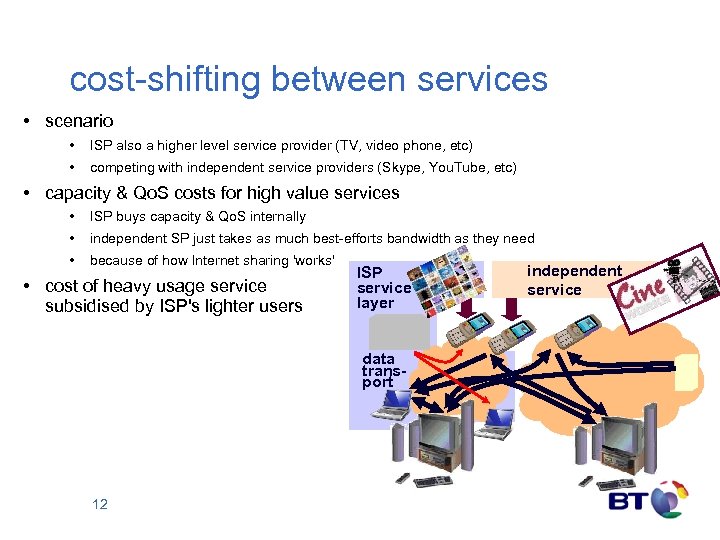
cost-shifting between services • scenario • ISP also a higher level service provider (TV, video phone, etc) • competing with independent service providers (Skype, You. Tube, etc) • capacity & Qo. S costs for high value services • ISP buys capacity & Qo. S internally • independent SP just takes as much best-efforts bandwidth as they need • because of how Internet sharing 'works' • cost of heavy usage service subsidised by ISP's lighter users ISP service layer data transport 12 independent service
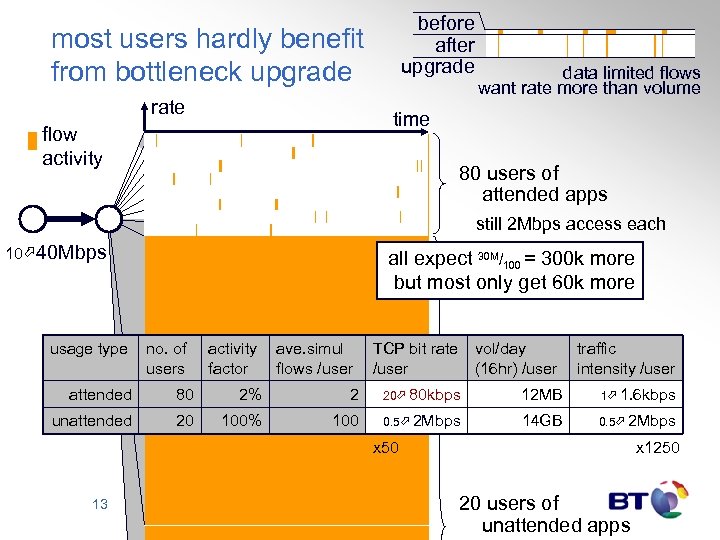
before after upgrade most users hardly benefit from bottleneck upgrade rate data limited flows want rate more than volume time flow activity 80 users of attended apps still 2 Mbps access each 10 40 Mbps all expect 30 M/100 = 300 k more but most only get 60 k more usage type no. of users activity ave. simul factor flows /user TCP bit rate /user vol/day (16 hr) /user traffic intensity /user attended 80 2% 2 20 80 kbps 12 MB 1 1. 6 kbps unattended 20 100% 100 0. 5 2 Mbps 14 GB 0. 5 2 Mbps x 50 13 x 1250 20 users of unattended apps
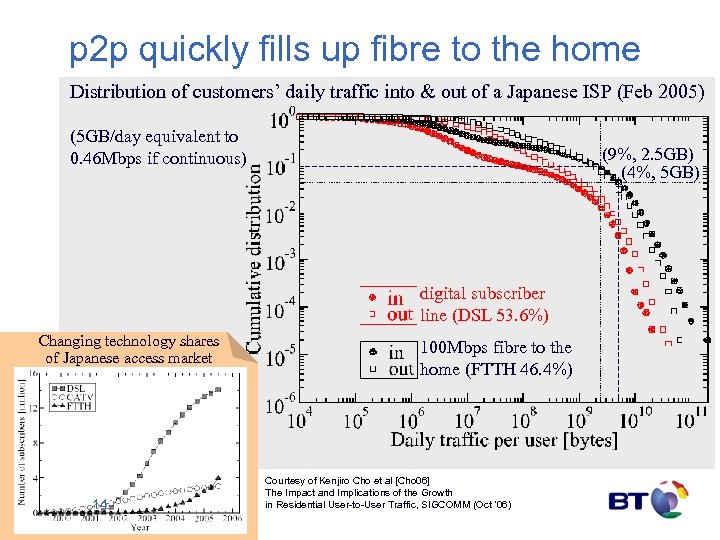
p 2 p quickly fills up fibre to the home Distribution of customers’ daily traffic into & out of a Japanese ISP (Feb 2005) (5 GB/day equivalent to 0. 46 Mbps if continuous) (9%, 2. 5 GB) (4%, 5 GB) digital subscriber line (DSL 53. 6%) Changing technology shares of Japanese access market 14 100 Mbps fibre to the home (FTTH 46. 4%) Courtesy of Kenjiro Cho et al [Cho 06] The Impact and Implications of the Growth in Residential User-to-User Traffic, SIGCOMM (Oct ’ 06)
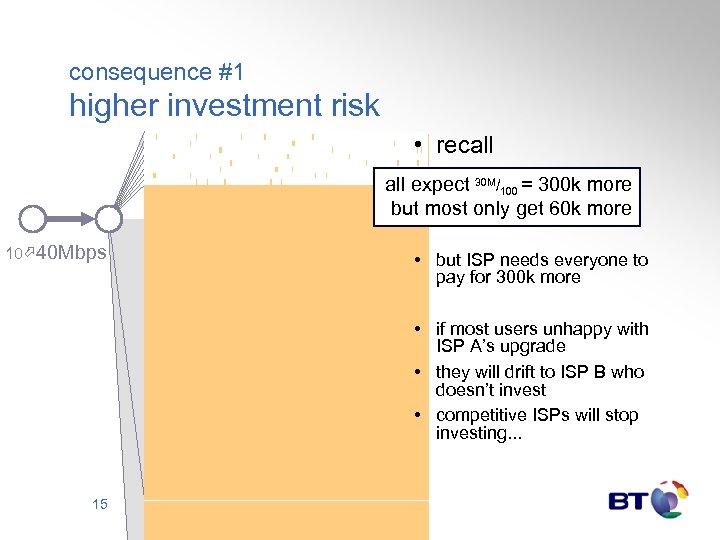
consequence #1 higher investment risk • recall expect 30 M/100 = 300 k more but most only get 60 k more 10 40 Mbps • but ISP needs everyone to pay for 300 k more • if most users unhappy with ISP A’s upgrade • they will drift to ISP B who doesn’t invest • competitive ISPs will stop investing. . . 15
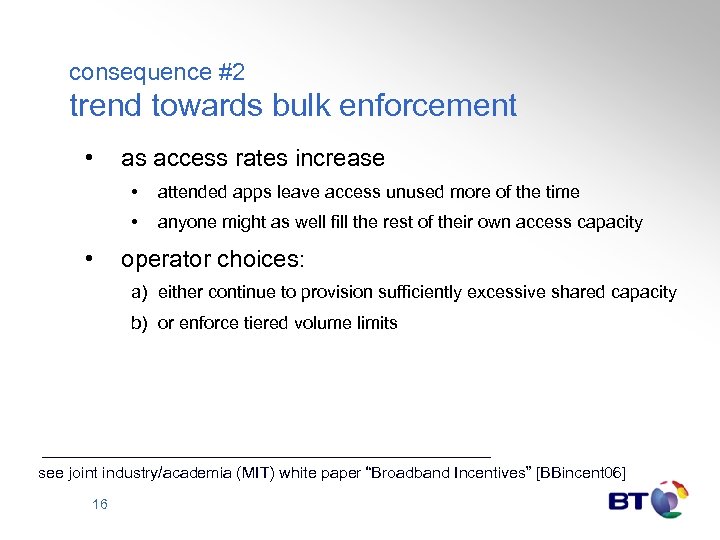
consequence #2 trend towards bulk enforcement • as access rates increase • • • attended apps leave access unused more of the time anyone might as well fill the rest of their own access capacity operator choices: a) either continue to provision sufficiently excessive shared capacity b) or enforce tiered volume limits see joint industry/academia (MIT) white paper “Broadband Incentives” [BBincent 06] 16
consequence #3 networks making choices for users • characterisation as two user communities over-simplistic • • heavy users mix heavy and light usage two enforcement choices a) bulk: network throttles all a heavy user’s traffic indiscriminately • encourages the user to self-throttle least valued traffic • but many users have neither the software nor the expertise b) selective: network infers what the user would do • • using deep packet inspection (DPI) and/or addresses to identify apps even if DPI intentions honourable • • user’s priorities are task-specific, not app-specific • 17 confusable with attempts to discriminate against certain apps customers understandably get upset when ISP guesses wrongly
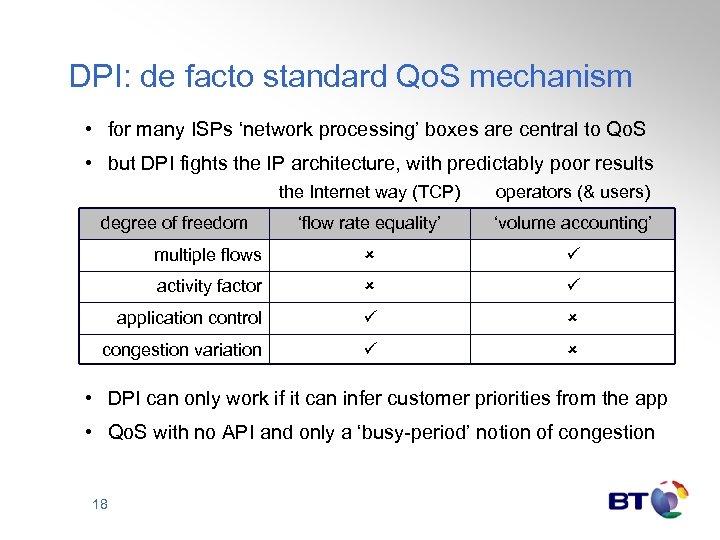
DPI: de facto standard Qo. S mechanism • for many ISPs ‘network processing’ boxes are central to Qo. S • but DPI fights the IP architecture, with predictably poor results the Internet way (TCP) operators (& users) ‘flow rate equality’ ‘volume accounting’ multiple flows activity factor application control congestion variation degree of freedom • DPI can only work if it can infer customer priorities from the app • Qo. S with no API and only a ‘busy-period’ notion of congestion 18
underlying problems blame our choices, not p 2 p • commercial Q. what is cost of network usage? A. volume? NO; rate? NO A. 'congestion volume' • our own unforgivable sloppiness over what our costs are • technical • lack of cost accountability in the Internet protocol (IP) • p 2 p file-sharers exploiting loopholes in technology we've chosen • we haven't designed our contracts & technology for machine-powered customers 19
costs • • infrastructure costs: sunk operational costs: usage independent usage and congestion: cost operator nothing congestion: costs those sharing each resource • approximations to congestion metrics 1. by time: time-of-day volume pricing 2. by route: on/off-net, domain hops, distance 3. by class of service: flat fee for each class, volume price for each class • accurate congestion metrics (in all 3 dimensions) • loss rate • explicit congestion notification… 20
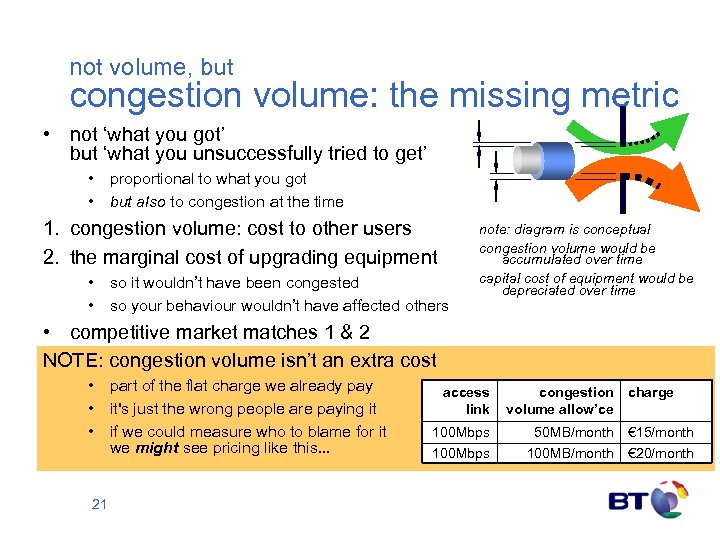
not volume, but congestion volume: the missing metric • not ‘what you got’ but ‘what you unsuccessfully tried to get’ • proportional to what you got • but also to congestion at the time 1. congestion volume: cost to other users 2. the marginal cost of upgrading equipment • so it wouldn’t have been congested • so your behaviour wouldn’t have affected others note: diagram is conceptual congestion volume would be accumulated over time capital cost of equipment would be depreciated over time • competitive market matches 1 & 2 NOTE: congestion volume isn’t an extra cost • part of the flat charge we already pay • it's just the wrong people are paying it • if we could measure who to blame for it we might see pricing like this. . . 21 access link congestion volume allow’ce charge 100 Mbps 50 MB/month € 15/month 100 Mbps 100 MB/month € 20/month
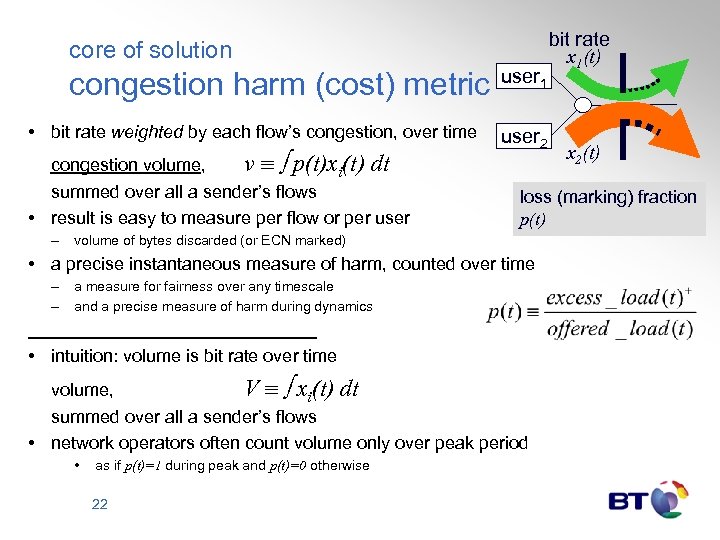
core of solution congestion harm (cost) metric • bit rate weighted by each flow’s congestion, over time congestion volume, v p(t)xi(t) dt summed over all a sender’s flows • result is easy to measure per flow or per user – user 1 user 2 volume of bytes discarded (or ECN marked) a measure for fairness over any timescale and a precise measure of harm during dynamics • intuition: volume is bit rate over time volume, V xi(t) dt summed over all a sender’s flows • network operators often count volume only over peak period • as if p(t)=1 during peak and p(t)=0 otherwise 22 x 2(t) loss (marking) fraction p(t) • a precise instantaneous measure of harm, counted over time – – bit rate x 1(t)
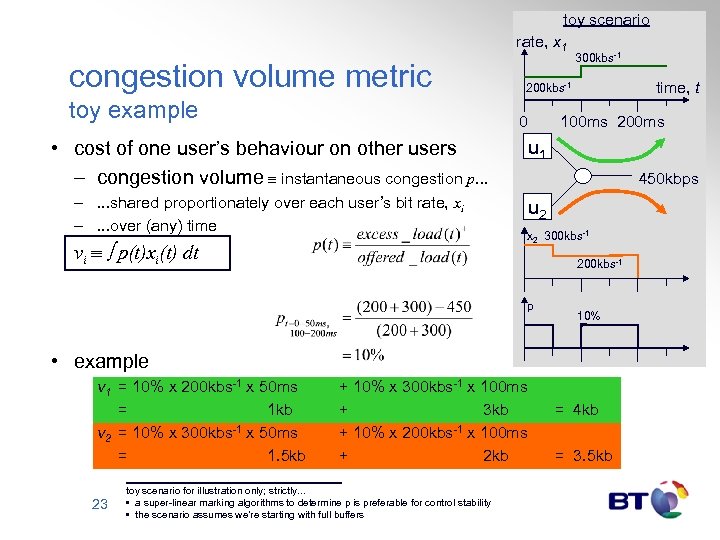
toy scenario rate, x 1 congestion volume metric toy example 300 kbs-1 time, t 200 kbs-1 0 100 ms 200 ms • cost of one user’s behaviour on other users – congestion volume instantaneous congestion p. . . u 1 –. . . shared proportionately over each user’s bit rate, xi –. . . over (any) time u 2 vi p(t)xi(t) dt 450 kbps x 2 300 kbs-1 200 kbs-1 p 10% • example v 1 = 10% x 200 kbs-1 x 50 ms = 1 kb v 2 = 10% x 300 kbs-1 x 50 ms = 1. 5 kb 23 + 10% x 300 kbs-1 x 100 ms + 3 kb + 10% x 200 kbs-1 x 100 ms + 2 kb toy scenario for illustration only; strictly. . . • a super-linear marking algorithms to determine p is preferable for control stability • the scenario assumes we’re starting with full buffers = 4 kb = 3. 5 kb
![usage vs subscription prices Pricing Congestible Network Resources [Mac. Kie. Varian 95] • assume](https://present5.com/presentation/b91a7d2d04c83e46fcb2e6cdc663b59e/image-24.jpg "usage vs subscription prices Pricing Congestible Network Resources [Mac. Kie. Varian 95] • assume")
usage vs subscription prices Pricing Congestible Network Resources [Mac. Kie. Varian 95] • assume competitive providers buy capacity K [b/s] at cost rate [€/s] of c(K) • c assume they offer a dual tariff to customer i • subscription price q [€/s] • usage price p [€/b] for usage xi [b/s], then charge rate [€/s], gi = q + pxi • q e slop what’s the most competitive choice of p & q? • gi where e is elasticity of scale • if charge less for usage and more for subscription, quality will be worse than competitors • if charge more for usage and less for subscription, utilisation will be poorer than competitors 24 c K p xi st co st ge al co ra gin ve mar a K
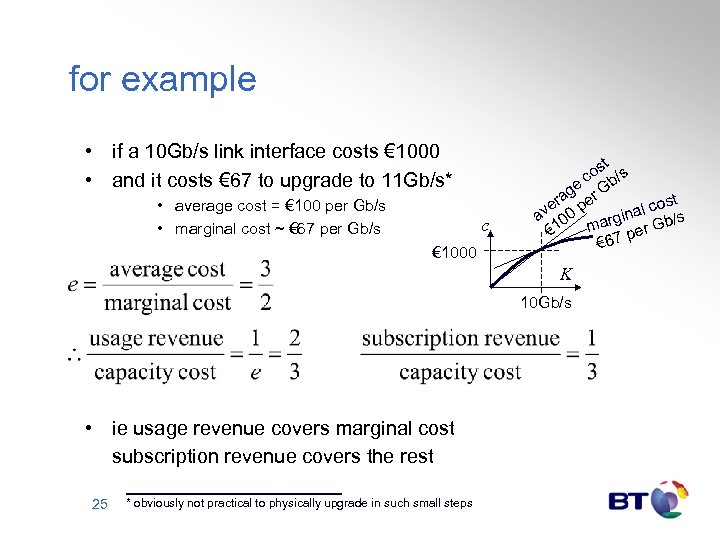
for example • if a 10 Gb/s link interface costs € 1000 • and it costs € 67 to upgrade to 11 Gb/s* • average cost = € 100 per Gb/s • marginal cost ~ € 67 per Gb/s c € 1000 t os /s c e Gb ag r st er pe v 0 al co /s a 0 gin 1 mar per Gb € € 67 K 10 Gb/s • ie usage revenue covers marginal cost subscription revenue covers the rest 25 * obviously not practical to physically upgrade in such small steps
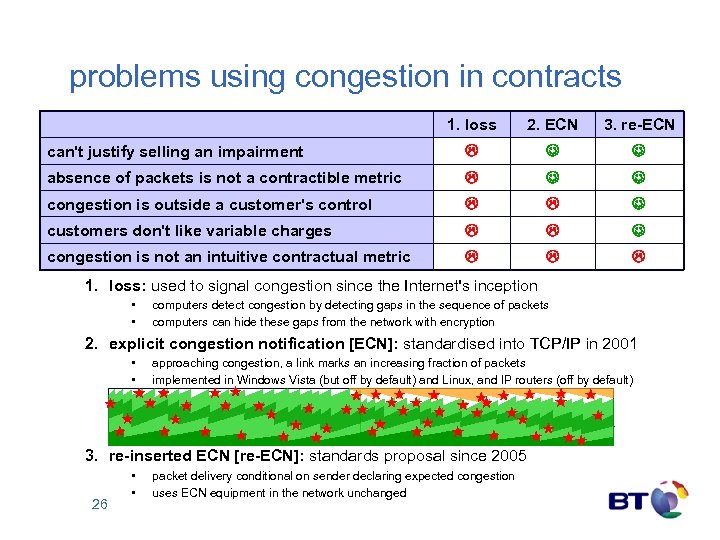
problems using congestion in contracts 1. loss 2. ECN 3. re-ECN can't justify selling an impairment absence of packets is not a contractible metric congestion is outside a customer's control customers don't like variable charges congestion is not an intuitive contractual metric 1. loss: used to signal congestion since the Internet's inception • • computers detect congestion by detecting gaps in the sequence of packets computers can hide these gaps from the network with encryption 2. explicit congestion notification [ECN]: standardised into TCP/IP in 2001 • • approaching congestion, a link marks an increasing fraction of packets implemented in Windows Vista (but off by default) and Linux, and IP routers (off by default) 3. re-inserted ECN [re-ECN]: standards proposal since 2005 26 • • packet delivery conditional on sender declaring expected congestion uses ECN equipment in the network unchanged
![addition of re-feedback [re-ECN] – in brief • before: congested nodes mark packets receiver](https://present5.com/presentation/b91a7d2d04c83e46fcb2e6cdc663b59e/image-27.jpg "addition of re-feedback [re-ECN] – in brief • before: congested nodes mark packets receiver")
addition of re-feedback [re-ECN] – in brief • before: congested nodes mark packets receiver feeds back marks to sender • after: sender must pre-load expected congestion by re-inserting feedback • if sender understates expected compared to actual congestion, network discards packets • result: packets will carry prediction of downstream congestion • policer can then limit congestion caused (or base penalties on it) before no info S control after policer info S 27 latent contro l control info & contro l latent no info contro l info & contro l no info latent contro l info R info & contro l R
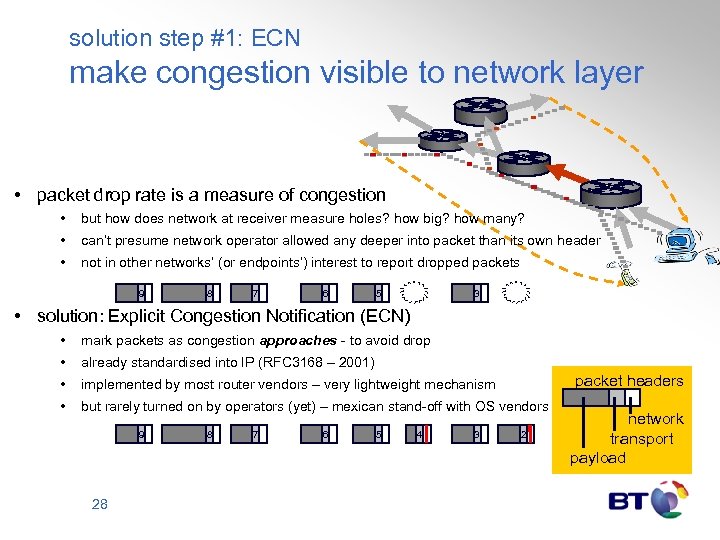
solution step #1: ECN make congestion visible to network layer • packet drop rate is a measure of congestion • but how does network at receiver measure holes? how big? how many? • can’t presume network operator allowed any deeper into packet than its own header • not in other networks’ (or endpoints’) interest to report dropped packets 9 8 7 6 5 3 • solution: Explicit Congestion Notification (ECN) • mark packets as congestion approaches - to avoid drop • already standardised into IP (RFC 3168 – 2001) • implemented by most router vendors – very lightweight mechanism • but rarely turned on by operators (yet) – mexican stand-off with OS vendors 9 28 8 7 6 5 4 3 packet headers 2 network transport payload
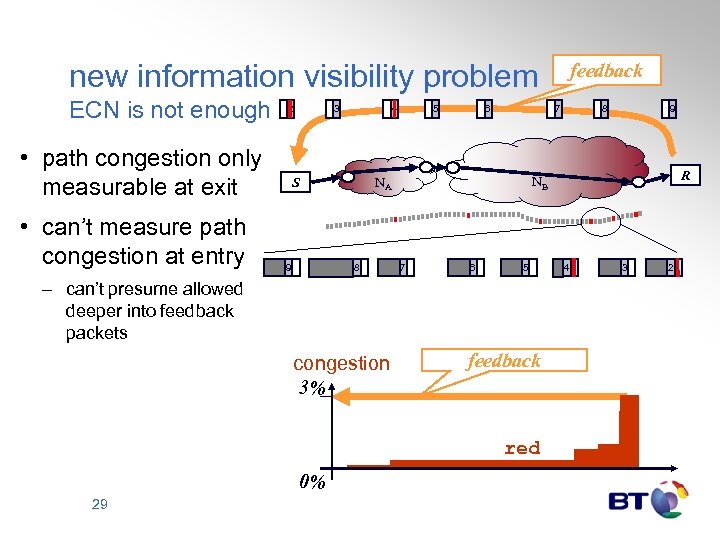
new information visibility problem ECN is not enough • path congestion only measurable at exit • can’t measure path congestion at entry 2 3 4 6 7 8 7 6 5 – can’t presume allowed deeper into feedback packets congestion 3% feedback red 0% 29 8 9 R NB NA S 9 5 feedback 4 3 2
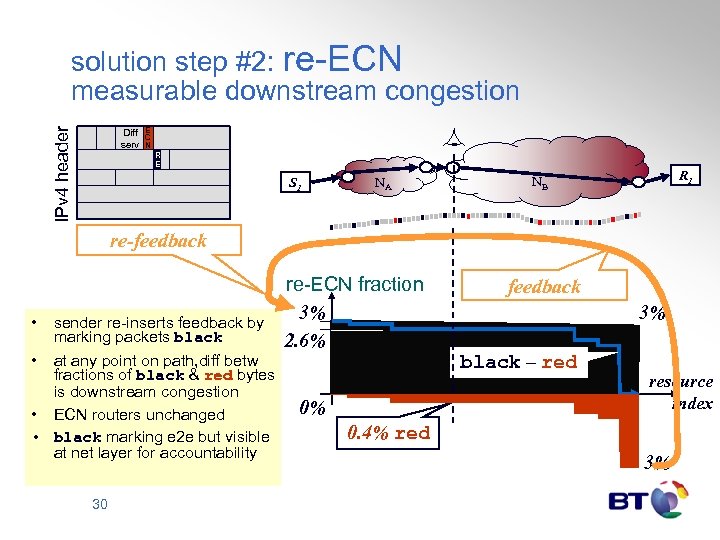
IPv 4 header solution step #2: re-ECN measurable downstream congestion Diff serv E C N R E S 1 NA R 1 NB re-feedback • sender re-inserts feedback by marking packets black re-ECN fraction 3% 2. 6% • at any point on path, diff betw fractions of black & red bytes is downstream congestion • ECN routers unchanged • black marking e 2 e but visible at net layer for accountability 30 0% feedback 3% black – red resource index 0. 4% red 3%
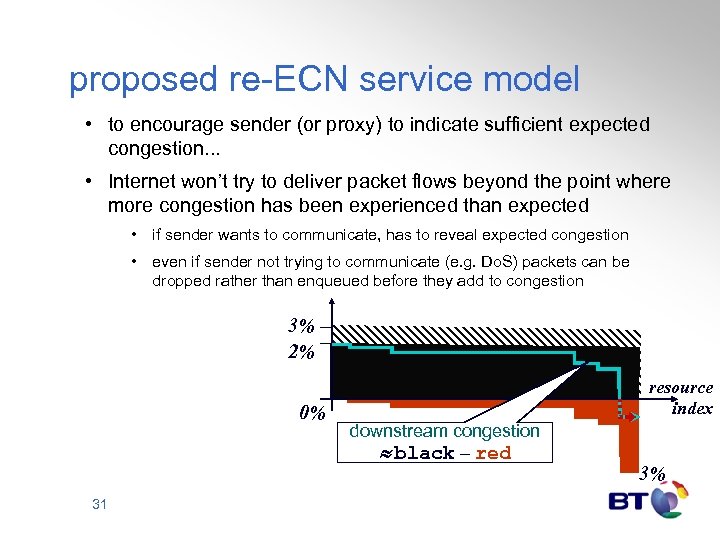
proposed re-ECN service model • to encourage sender (or proxy) to indicate sufficient expected congestion. . . • Internet won’t try to deliver packet flows beyond the point where more congestion has been experienced than expected • if sender wants to communicate, has to reveal expected congestion • even if sender not trying to communicate (e. g. Do. S) packets can be dropped rather than enqueued before they add to congestion 3% 2% 0% 31 resource index downstream congestion black – red 3%
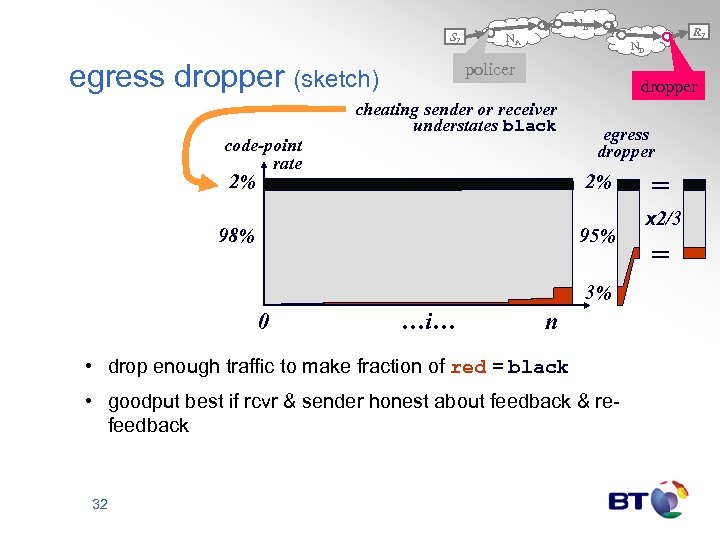
S 1 egress dropper (sketch) code-point rate NB NA ND policer dropper cheating sender or receiver understates black 2% egress dropper 2% 98% 95% 3% 0 …i… n • drop enough traffic to make fraction of red = black • goodput best if rcvr & sender honest about feedback & refeedback 32 R 1 = x 2/3 =
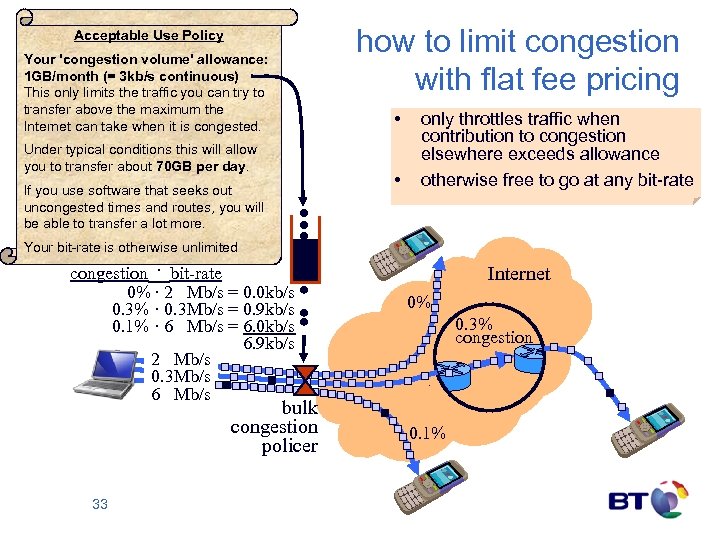
Acceptable Use Policy Your 'congestion volume' allowance: 1 GB/month (= 3 kb/s continuous) This only limits the traffic you can try to transfer above the maximum the Internet can take when it is congested. Under typical conditions this will allow you to transfer about 70 GB per day. If you use software that seeks out uncongested times and routes, you will be able to transfer a lot more. how to limit congestion with flat fee pricing • • only throttles traffic when contribution to congestion elsewhere exceeds allowance otherwise free to go at any bit-rate Your bit-rate is otherwise unlimited congestion · bit-rate 0% · 2 Mb/s = 0. 0 kb/s 0. 3% · 0. 3 Mb/s = 0. 9 kb/s 0. 1% · 6 Mb/s = 6. 0 kb/s 6. 9 kb/s 2 Mb/s 0. 3 Mb/s 6 Mb/s bulk congestion policer 33 Internet 0% 0. 3% congestion 0. 1%
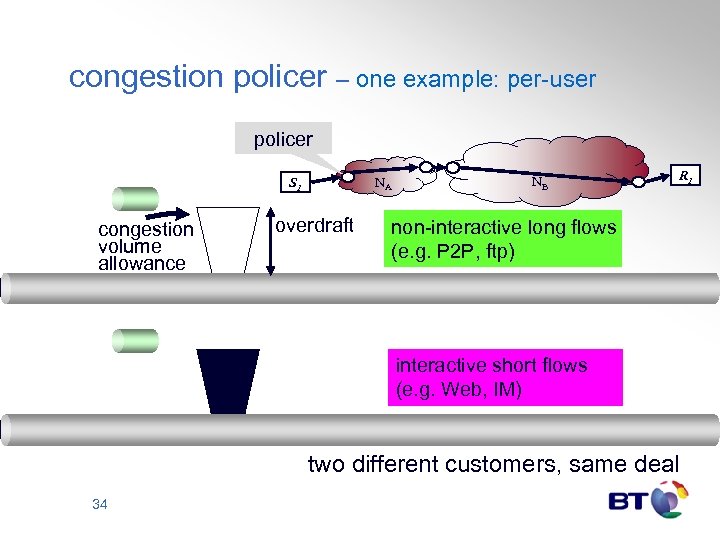
congestion policer – one example: per-user policer NA S 1 congestion volume allowance overdraft NB R 1 non-interactive long flows (e. g. P 2 P, ftp) interactive short flows (e. g. Web, IM) two different customers, same deal 34
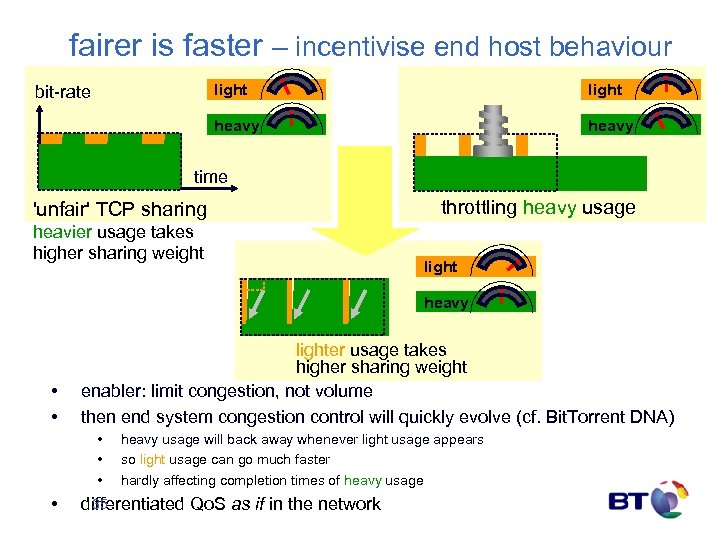
fairer is faster – incentivise end host behaviour light heavy bit-rate heavy time 'unfair' TCP sharing heavier usage takes higher sharing weight throttling heavy usage light heavy • • lighter usage takes higher sharing weight enabler: limit congestion, not volume then end system congestion control will quickly evolve (cf. Bit. Torrent DNA) • • heavy usage will back away whenever light usage appears so light usage can go much faster hardly affecting completion times of heavy usage 35 differentiated Qo. S as if in the network
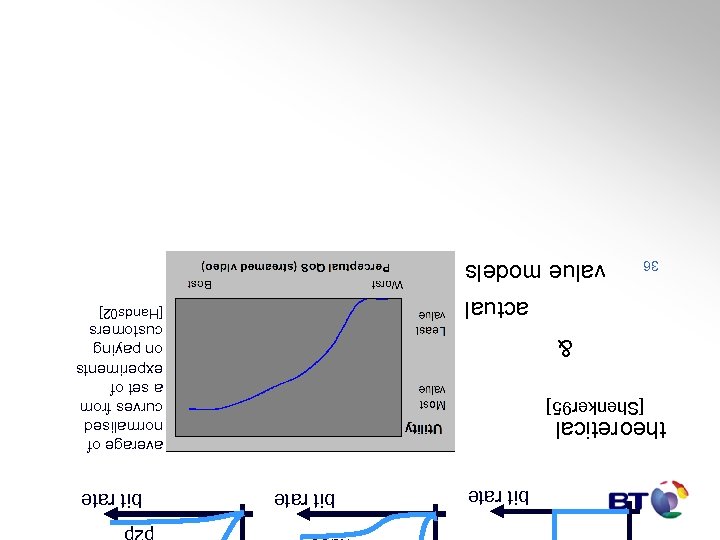
bit rate video bit rate p 2 p bit rate average of normalised curves from a set of experiments on paying customers theoretical [Shenker 95] & actual 36 [Hands 02] value models
![value – cost: customer’s optimisation [Kelly 98] charge customer surplus network revenue value €/s](https://present5.com/presentation/b91a7d2d04c83e46fcb2e6cdc663b59e/image-37.jpg "value – cost: customer’s optimisation [Kelly 98] charge customer surplus network revenue value €/s")
value – cost: customer’s optimisation [Kelly 98] charge customer surplus network revenue value €/s charge €/s bit rate b/s net value = value – charge €/s bit rate 37 value increasing price €/b bit rate net value bit rate
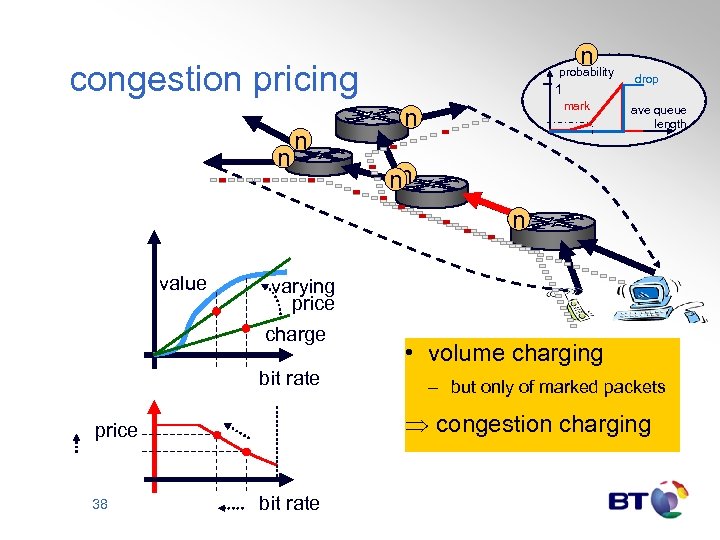
n congestion pricing n n probability 1 mark n drop ave queue length nn n value varying price charge bit rate – but only of marked packets Þ congestion charging price 38 • volume charging bit rate
![maximises social welfare across whole Internet [Kelly 98, Gibbens 99] DIY Qo. S [Gibbens](https://present5.com/presentation/b91a7d2d04c83e46fcb2e6cdc663b59e/image-39.jpg "maximises social welfare across whole Internet [Kelly 98, Gibbens 99] DIY Qo. S [Gibbens")
maximises social welfare across whole Internet [Kelly 98, Gibbens 99] DIY Qo. S [Gibbens 99] price n n 1 mark s n n n probability inelastic (audio) n drop ave queue length price s price (shadow) price = ECN n network algorithm 39 s sender algorithms target rate TCP target rate s ultra-elastic (p 2 p) target rate
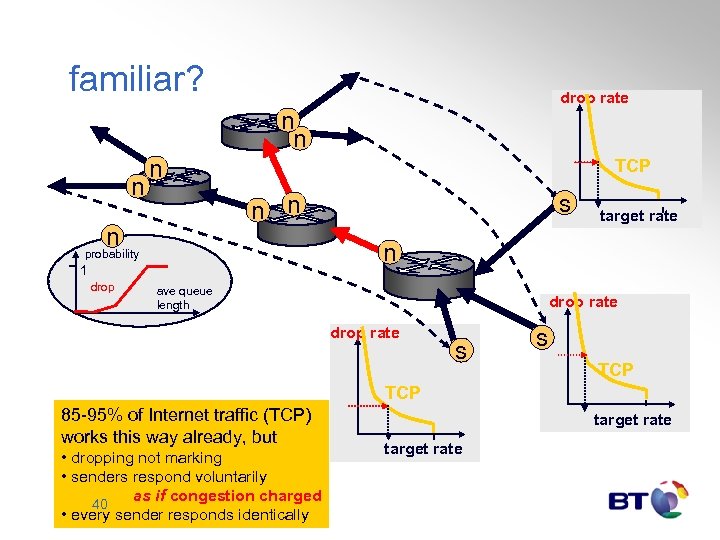
familiar? drop rate n n TCP n target rate n probability 1 drop s n n ave queue length drop rate s s TCP 85 -95% of Internet traffic (TCP) works this way already, but • dropping not marking • senders respond voluntarily as if congestion charged 40 • every sender responds identically target rate
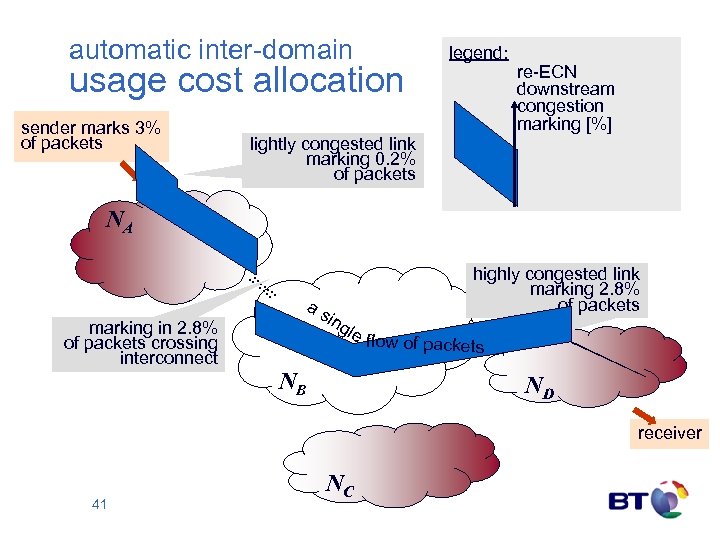
automatic inter-domain usage cost allocation sender marks 3% of packets legend: re-ECN downstream congestion marking [%] lightly congested link marking 0. 2% of packets NA marking in 2. 8% of packets crossing interconnect a s i ng le NB highly congested link marking 2. 8% of packets flow of packets ND receiver 41 NC
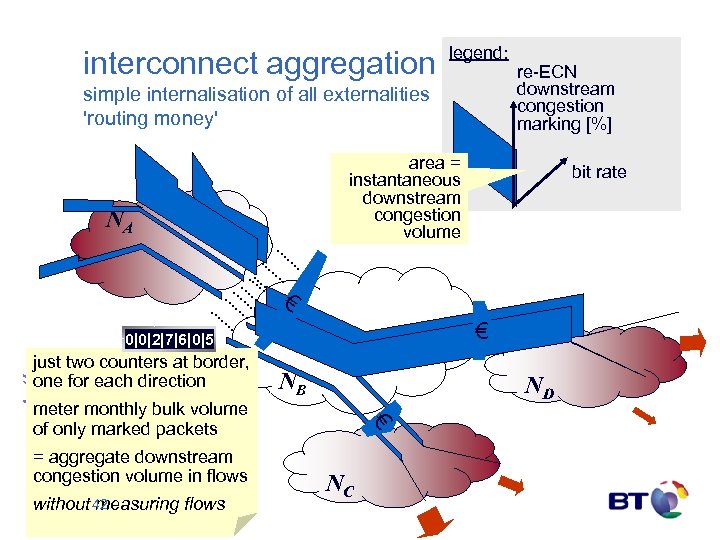
interconnect aggregation legend: simple internalisation of all externalities 'routing money' re-ECN downstream congestion marking [%] area = instantaneous downstream congestion volume NA bit rate € € solution 0|0|2|7|6|0|5 just two counters at border, one for each direction NB ND = aggregate downstream congestion volume in flows without 42 measuring flows € meter monthly bulk volume of only marked packets NC
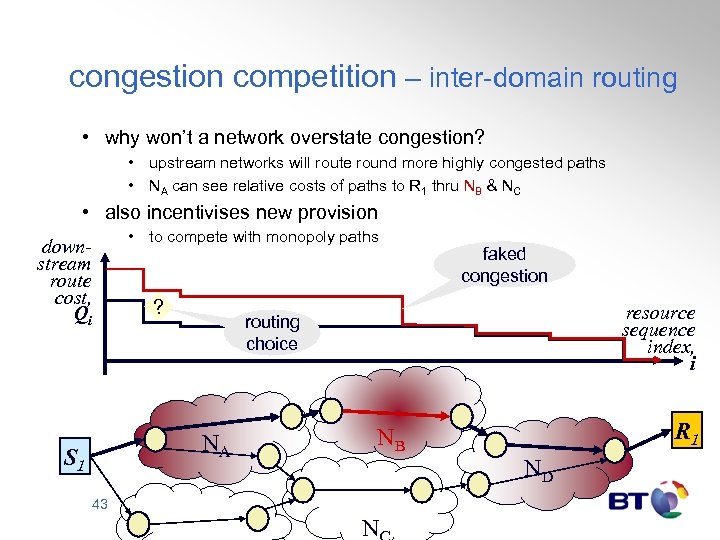
congestion competition – inter-domain routing • why won’t a network overstate congestion? • upstream networks will route round more highly congested paths • NA can see relative costs of paths to R 1 thru NB & NC • also incentivises new provision • to compete with monopoly paths downstream route cost, Qi ? resource sequence index, i routing choice NA S 1 faked congestion R 1 NB ND 43 N
minimal operational support system impact • single bulk contractual mechanism • for end-customers and inter-network • also designed to simplify layered wholesale/retail market • automated provisioning • driven by per-interface ECN stats – demand-driven supply • automated inter-network monitoring & accounting • Qo. S an attribute of customer contract not network • automatically adjusts to attachment point during mobility 44
summary so far congestion accountability – the missing link • unwise NGN obsession with per-session Qo. S guarantees • scant attention to competition from 'cloud Qo. S' • rising general Qo. S expectation from the public Internet • cost-shifting between end-customers (including service providers) • questionable economic sustainability • 'cloud' resource accountability is possible • principled way to heal the above ills • requires shift in economic thinking – from volume to congestion volume • provides differentiated cloud Qo. S without further mechanism next • also the basis for a far simpler per-session Qo. S mechanism • having fixed the competitive environment to make per-session Qo. S viable 45
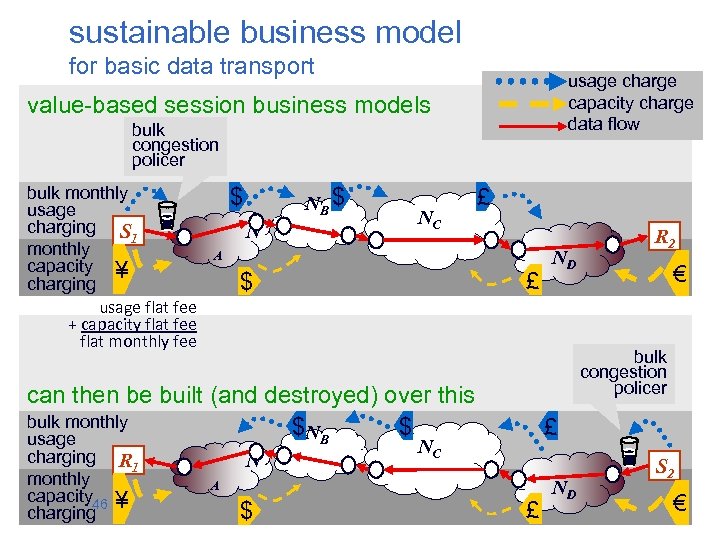
sustainable business model for basic data transport usage charge capacity charge data flow value-based session business models bulk congestion policer bulk monthly usage charging S 1 monthly capacity ¥ charging usage flat fee + capacity flat fee flat monthly fee $ NB $ N NC £ A £ $ N £ NC A $ € bulk congestion policer can then be built (and destroyed) over this bulk monthly $ NB $ usage charging R 1 monthly capacity 46 ¥ charging ND R 2 £ ND S 2 €
Internet Qo. S value-based per-session charging Bob Briscoe
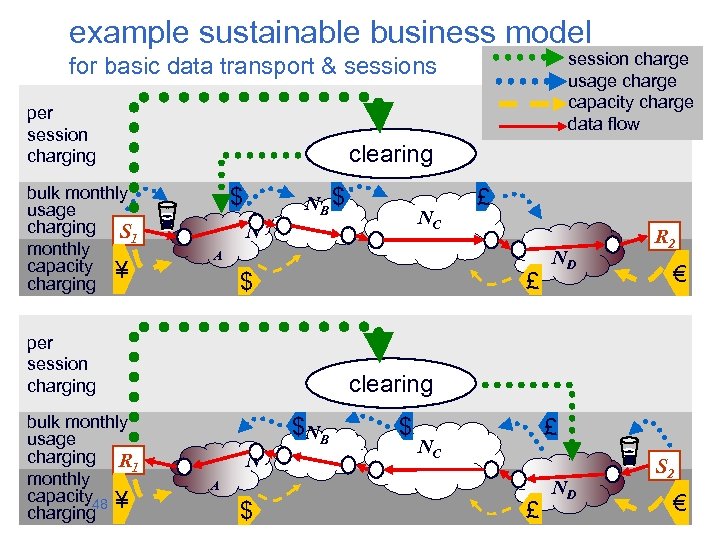
example sustainable business model session charge usage charge capacity charge data flow for basic data transport & sessions per session charging bulk monthly usage charging S 1 monthly capacity ¥ charging clearing $ NB $ N A £ $ per session charging bulk monthly usage charging R 1 monthly capacity 48 ¥ charging NC £ ND R 2 € clearing $ NB N $ £ NC A $ £ ND S 2 €
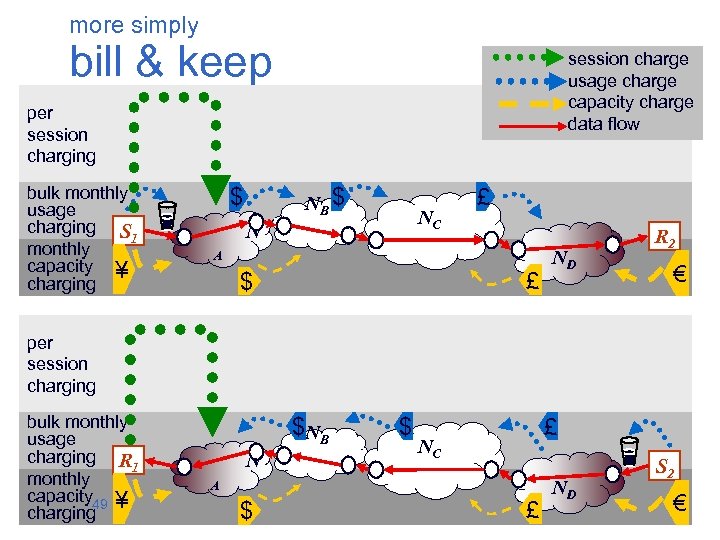
more simply bill & keep session charge usage charge capacity charge data flow per session charging bulk monthly usage charging S 1 monthly capacity ¥ charging $ NB $ NC N £ A £ $ ND R 2 € per session charging bulk monthly usage charging R 1 monthly capacity 49 ¥ charging $ NB N $ £ NC A $ £ ND S 2 €
what's the added value to sessions? • insurance – risk brokerage • once admitted, a session will complete • at a fixed per session price (per service, per time, etc) • low loss, low jitter • even for high & variable bandwidth • video, audio • re-ECN proposal is not 'carrier grade' • but with two tweaks it is • pre-congestion notification [PCN] • admission control • both are also built on similar simple economic principles. . . 50
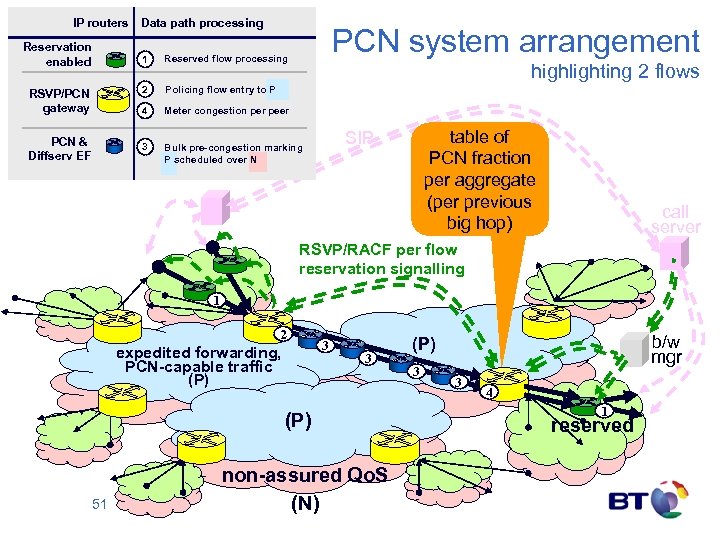
IP routers Reservation enabled Data path processing PCN system arrangement 1 2 Meter congestion per peer 3 PCN & Diffserv EF Policing flow entry to P 4 RSVP/PCN gateway Reserved flow processing Bulk pre-congestion marking P scheduled over N highlighting 2 flows table of PCN fraction per aggregate (per previous big hop) SIP call server RSVP/RACF per flow reservation signalling 1 2 expedited forwarding, PCN-capable traffic (P) 3 3 (P) 51 non-assured Qo. S (N) b/w mgr (P) 3 3 4 1 reserved
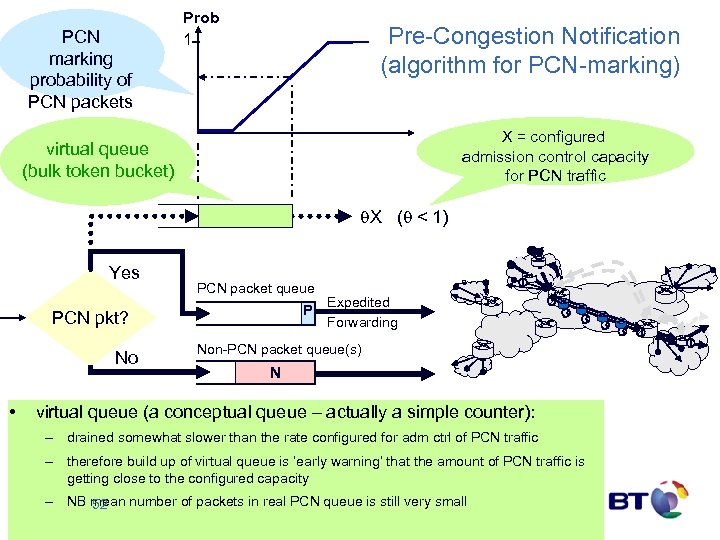
PCN marking probability of PCN packets Prob 1 Pre-Congestion Notification (algorithm for PCN-marking) X = configured admission control capacity for PCN traffic virtual queue (bulk token bucket) X ( < 1) Yes PCN packet queue P PCN pkt? No • 1 Expedited Forwarding 2 3 3 4 Non-PCN packet queue(s) N virtual queue (a conceptual queue – actually a simple counter): – drained somewhat slower than the rate configured for adm ctrl of PCN traffic – therefore build up of virtual queue is ‘early warning’ that the amount of PCN traffic is getting close to the configured capacity – NB mean number of packets in real PCN queue is still very small 52 1
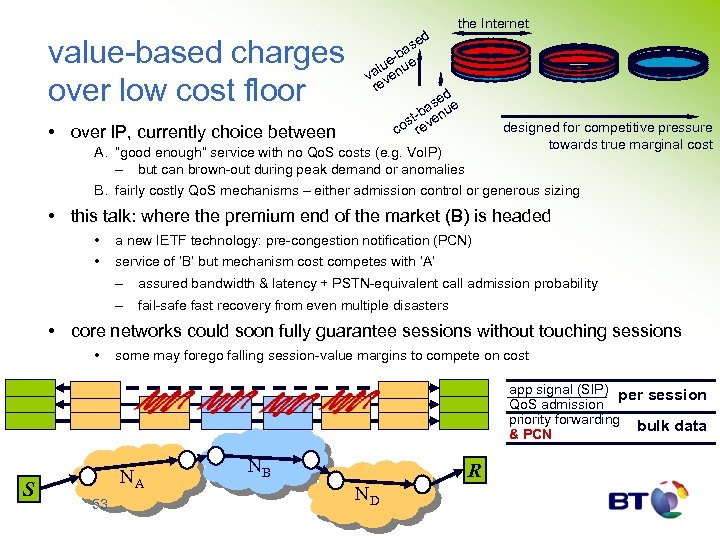
the Internet value-based charges over low cost floor • over IP, currently choice between ed as -b ue nue l va ve re d se ue ba st- even co r designed for competitive pressure towards true marginal cost A. “good enough” service with no Qo. S costs (e. g. Vo. IP) – but can brown-out during peak demand or anomalies B. fairly costly Qo. S mechanisms – either admission control or generous sizing • this talk: where the premium end of the market (B) is headed • a new IETF technology: pre-congestion notification (PCN) • service of ‘B’ but mechanism cost competes with ‘A’ – assured bandwidth & latency + PSTN-equivalent call admission probability – fail-safe fast recovery from even multiple disasters • core networks could soon fully guarantee sessions without touching sessions • some may forego falling session-value margins to compete on cost app signal (SIP) per session Qo. S admission priority forwarding bulk data & PCN S NA 53 NB R ND
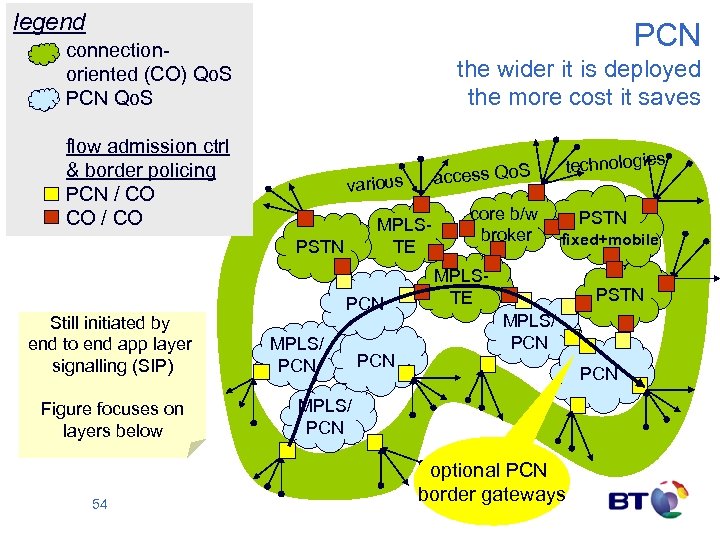
legend PCN connectionoriented (CO) Qo. S PCN Qo. S the wider it is deployed the more cost it saves flow admission ctrl & border policing PCN / CO CO / CO ies hnolog s Qo. S tec ces various ac MPLSTE PSTN Still initiated by end to end app layer signalling (SIP) Figure focuses on layers below 54 PCN MPLS/ PCN core b/w PSTN broker fixed+mobile MPLSTE PSTN MPLS/ PCN optional PCN border gateways
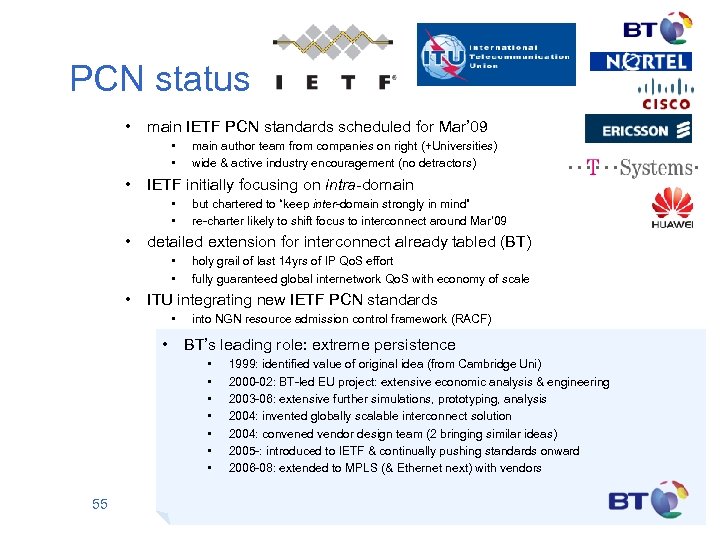
PCN status • main IETF PCN standards scheduled for Mar’ 09 • • • IETF initially focusing on intra-domain • • • but chartered to “keep inter-domain strongly in mind” re-charter likely to shift focus to interconnect around Mar’ 09 detailed extension for interconnect already tabled (BT) • • • main author team from companies on right (+Universities) wide & active industry encouragement (no detractors) holy grail of last 14 yrs of IP Qo. S effort fully guaranteed global internetwork Qo. S with economy of scale ITU integrating new IETF PCN standards • • into NGN resource admission control framework (RACF) BT’s leading role: extreme persistence • • 55 1999: identified value of original idea (from Cambridge Uni) 2000 -02: BT-led EU project: extensive economic analysis & engineering 2003 -06: extensive further simulations, prototyping, analysis 2004: invented globally scalable interconnect solution 2004: convened vendor design team (2 bringing similar ideas) 2005 -: introduced to IETF & continually pushing standards onward 2006 -08: extended to MPLS (& Ethernet next) with vendors
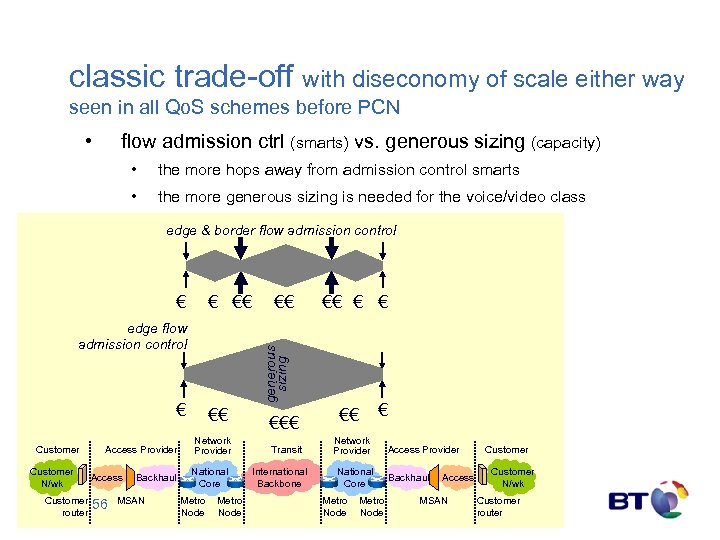
classic trade-off with diseconomy of scale either way seen in all Qo. S schemes before PCN • flow admission ctrl (smarts) vs. generous sizing (capacity) • the more hops away from admission control smarts • the more generous sizing is needed for the voice/video class edge & border flow admission control € € €€ € Customer N/wk Customer router Access Provider Access 56 Backhaul MSAN €€ € € generous sizing edge flow admission control €€ €€ Network Provider National Core Metro Node €€€ Transit International Backbone € €€ Network Provider National Core Metro Node Access Provider Backhaul Access MSAN Customer N/wk Customer router
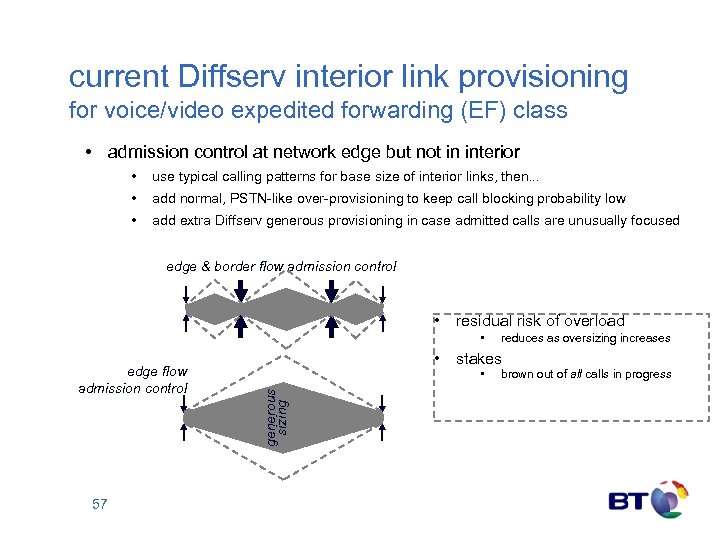
current Diffserv interior link provisioning for voice/video expedited forwarding (EF) class • admission control at network edge but not in interior • use typical calling patterns for base size of interior links, then. . . • add normal, PSTN-like over-provisioning to keep call blocking probability low • add extra Diffserv generous provisioning in case admitted calls are unusually focused edge & border flow admission control • residual risk of overload • 57 generous sizing edge flow admission control • reduces as oversizing increases stakes • brown out of all calls in progress
![new IETF simplification pre-congestion notification [PCN] • PCN: radical cost reduction • compared here](https://present5.com/presentation/b91a7d2d04c83e46fcb2e6cdc663b59e/image-58.jpg "new IETF simplification pre-congestion notification [PCN] • PCN: radical cost reduction • compared here")
new IETF simplification pre-congestion notification [PCN] • PCN: radical cost reduction • compared here against simplest alternative – against 6 alternatives on spare slide • no need for any Diffserv generous provisioning between admission control points – 81% less b/w for BT’s UK PSTN-replacement – ~89% less b/w for BT Global’s premium IP Qo. S – still provisioned for low (PSTN-equivalent) call blocking ratios as well as carrying re-routed traffic after any dual failure • no need for interior flow admission control smarts, just one big hop between edges • PCN involves a simple change to Diffserv PCN • interior nodes randomly mark packets as the class nears its provisioned rate • pairs of edge nodes use level of marking between them to control flow admissions • much cheaper and more certain way to handle very unlikely possibilities • interior nodes can be IP, MPLS or Ethernet • 58 can use existing hardware, tho not all is ideal
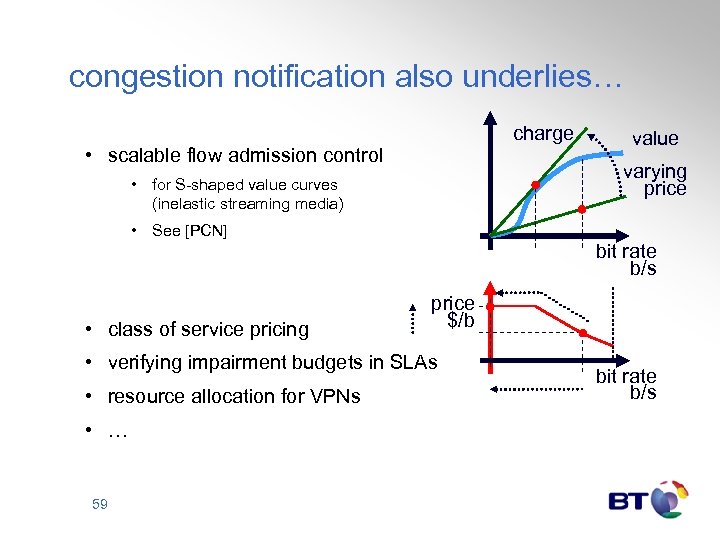
congestion notification also underlies… charge • scalable flow admission control value varying price • for S-shaped value curves (inelastic streaming media) • See [PCN] bit rate b/s • class of service pricing price $/b • verifying impairment budgets in SLAs • resource allocation for VPNs • … 59 bit rate b/s
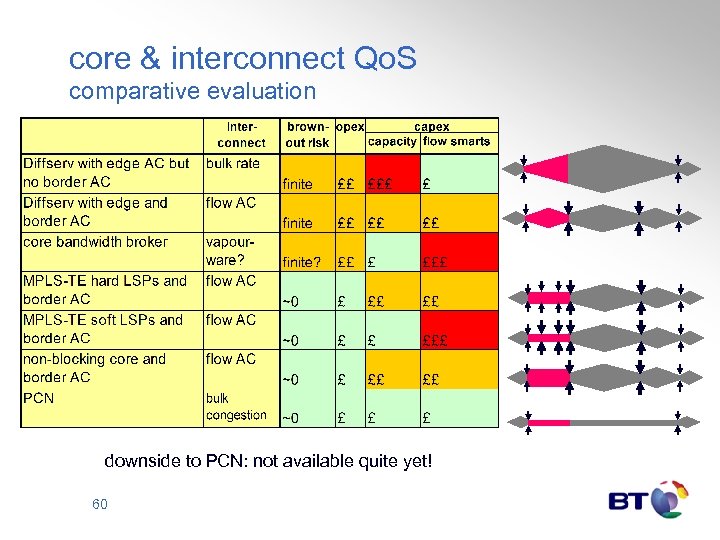
core & interconnect Qo. S comparative evaluation downside to PCN: not available quite yet! 60
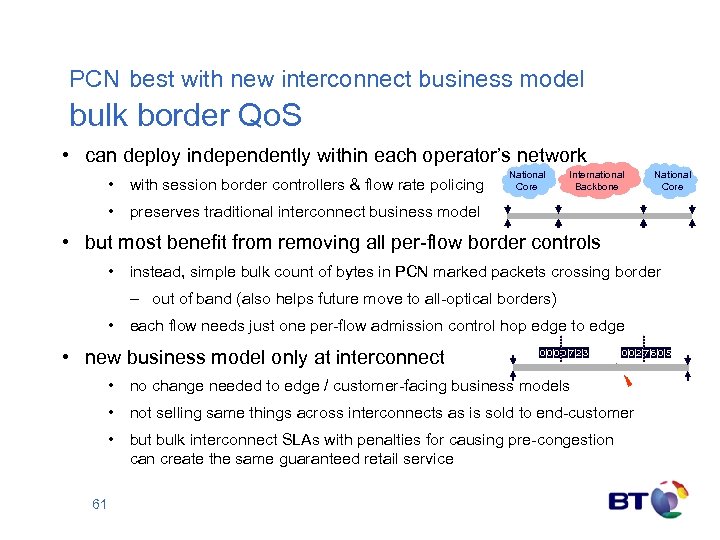
PCN best with new interconnect business model bulk border Qo. S • can deploy independently within each operator’s network • with session border controllers & flow rate policing National Core International Backbone National Core • preserves traditional interconnect business model • but most benefit from removing all per-flow border controls • instead, simple bulk count of bytes in PCN marked packets crossing border – out of band (also helps future move to all-optical borders) • each flow needs just one per-flow admission control hop edge to edge • new business model only at interconnect 0|0|7|2|3 0|0|2|7|6|0|5 • no change needed to edge / customer-facing business models • not selling same things across interconnects as is sold to end-customer • but bulk interconnect SLAs with penalties for causing pre-congestion can create the same guaranteed retail service 61
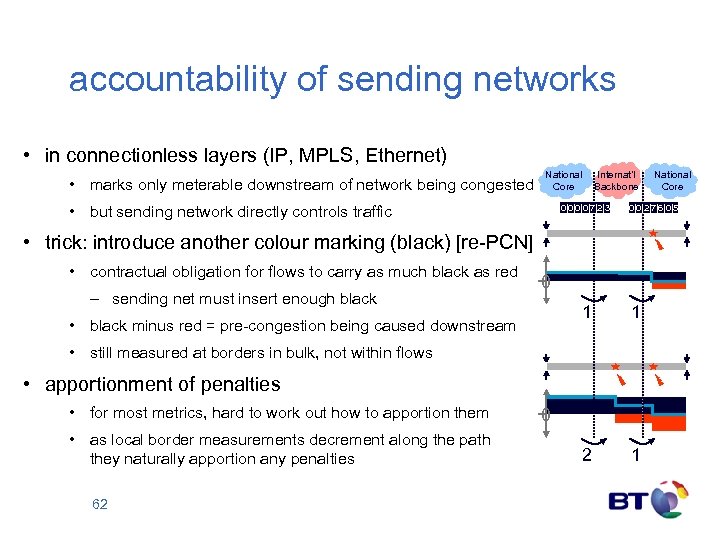
accountability of sending networks • in connectionless layers (IP, MPLS, Ethernet) • marks only meterable downstream of network being congested National Core • but sending network directly controls traffic Internat’l Backbone 0|0|7|2|3 0|0|2|7|6|0|5 • trick: introduce another colour marking (black) [re-PCN] • contractual obligation for flows to carry as much black as red – sending net must insert enough black 0 1 • black minus red = pre-congestion being caused downstream 1 2 1 • still measured at borders in bulk, not within flows • apportionment of penalties • for most metrics, hard to work out how to apportion them • as local border measurements decrement along the path they naturally apportion any penalties 62 National Core 0
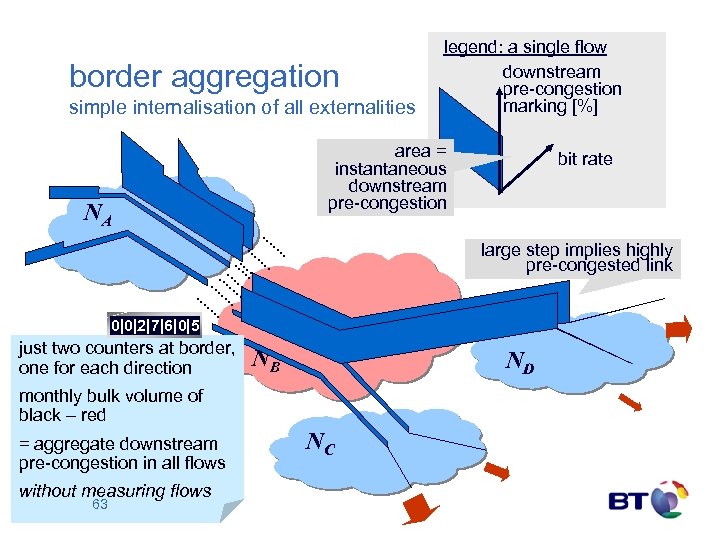
border aggregation simple internalisation of all externalities legend: a single flow downstream pre-congestion marking [%] area = instantaneous downstream pre-congestion NA bit rate large step implies highly pre-congested link 0|0|2|7|6|0|5 just two counters at border, one for each direction NB ND monthly bulk volume of black – red = aggregate downstream pre-congestion in all flows without measuring flows 63 NC
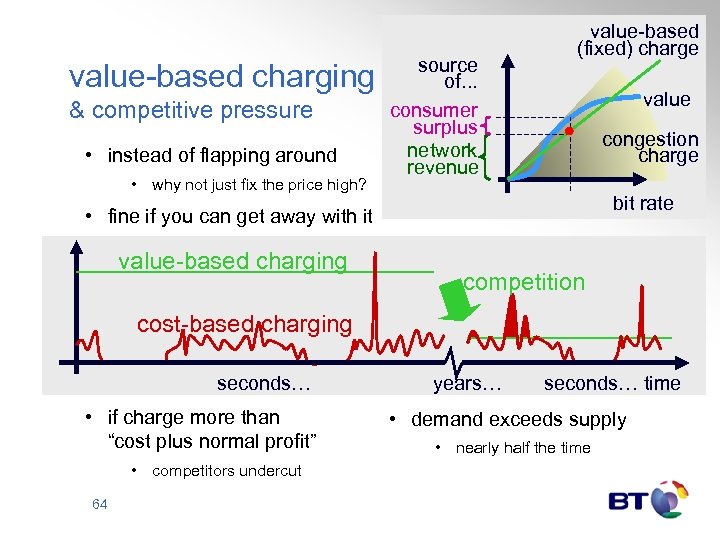
value-based charging & competitive pressure • instead of flapping around • why not just fix the price high? source of. . . consumer surplus network revenue value-based (fixed) charge congestion charge bit rate • fine if you can get away with it value-based charging value competition cost-based charging seconds… • if charge more than “cost plus normal profit” • competitors undercut 64 years… seconds… time • demand exceeds supply • nearly half the time
Internet Qo. S summary Bob Briscoe
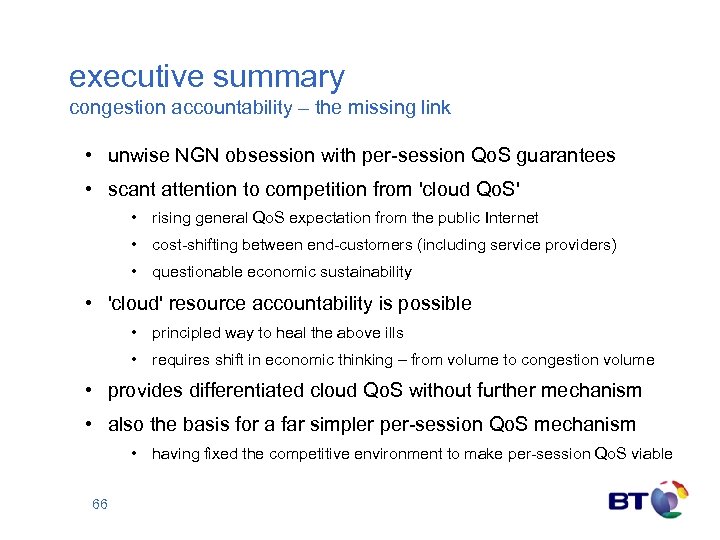
executive summary congestion accountability – the missing link • unwise NGN obsession with per-session Qo. S guarantees • scant attention to competition from 'cloud Qo. S' • rising general Qo. S expectation from the public Internet • cost-shifting between end-customers (including service providers) • questionable economic sustainability • 'cloud' resource accountability is possible • principled way to heal the above ills • requires shift in economic thinking – from volume to congestion volume • provides differentiated cloud Qo. S without further mechanism • also the basis for a far simpler per-session Qo. S mechanism • having fixed the competitive environment to make per-session Qo. S viable 66
more info. . . • Inevitability of policing • • Stats on p 2 p usage across 7 Japanese ISPs with high FTTH penetration • • [Briscoe 06] Bob Briscoe, Andrew Odlyzko & Ben Tilly, "Metcalfe's Law is Wrong", IEEE Spectrum, Jul 2006 Re-architecting the Future Internet: • • [Briscoe 05] Bob Briscoe and Steve Rudkin "Commercial Models for IP Quality of Service Interconnect" BT Technology Journal 23 (2) pp. 171 --195 (April, 2005) Growth in value of a network with size • • [Briscoe 08] Bob Briscoe et al, "Problem Statement: Transport Protocols Don't Have To Do Fairness", IETF Internet Draft (Jul 2008) Understanding why Qo. S interconnect is better understood as a congestion issue • • [Briscoe 07] Bob Briscoe, "Flow Rate Fairness: Dismantling a Religion" ACM Computer Communications Review 37(2) 63 -74 (Apr 2007) How wrong Internet capacity sharing is and why it's causing an arms race • • [Cho 06] Kenjiro Cho et al, "The Impact and Implications of the Growth in Residential User-to-User Traffic", In Proc ACM SIGCOMM (Oct ’ 06) Slaying myths about fair sharing of capacity • • [BBincent 06] The Broadband Incentives Problem, Broadband Working Group, MIT, T, Cisco, Comcast, Deutsche B Telekom / T-Mobile, France Telecom, Intel, Motorola, Nokia, Nortel (May ’ 05 & follow-up Jul ’ 06) <cfp. mit. edu> The Trilogy project Re-ECN & re-feedback project page: [re-ECN] http: //www. cs. ucl. ac. uk/staff/B. Briscoe/projects/refb/ • These slides <www. cs. ucl. ac. uk/staff/B. Briscoe/present. html> 67
![more info on pre-congestion notification (PCN) • Diffserv’s scaling problem [Reid 05] Andy B.](https://present5.com/presentation/b91a7d2d04c83e46fcb2e6cdc663b59e/image-68.jpg "more info on pre-congestion notification (PCN) • Diffserv’s scaling problem [Reid 05] Andy B.")
more info on pre-congestion notification (PCN) • Diffserv’s scaling problem [Reid 05] Andy B. Reid, Economics and scalability of Qo. S solutions, BT Technology Journal, 23(2) 97– 117 (Apr’ 05) • PCN interconnection for commercial and technical audiences: [Briscoe 05] Bob Briscoe and Steve Rudkin, Commercial Models for IP Quality of Service Interconnect, in BTTJ Special Edition on IP Quality of Service, 23(2) 171– 195 (Apr’ 05) <www. cs. ucl. ac. uk/staff/B. Briscoe/pubs. html#ixqos> • IETF PCN working group documents <tools. ietf. org/wg/pcn/> in particular: [PCN] Phil Eardley (Ed), Pre-Congestion Notification Architecture, Internet Draft <www. ietf. org/internet-drafts/draft-ietf-pcn-architecture-06. txt> (Sep’ 08) [re-PCN] Bob Briscoe, Emulating Border Flow Policing using Re-PCN on Bulk Data, Internet Draft <www. cs. ucl. ac. uk/staff/B. Briscoe/pubs. html#repcn> (Sep’ 08) • These slides <www. cs. ucl. ac. uk/staff/B. Briscoe/present. html> 68
![further references • • • [Clark 05] David D Clark, John Wroclawski, Karen Sollins](https://present5.com/presentation/b91a7d2d04c83e46fcb2e6cdc663b59e/image-69.jpg "further references • • • [Clark 05] David D Clark, John Wroclawski, Karen Sollins")
further references • • • [Clark 05] David D Clark, John Wroclawski, Karen Sollins and Bob Braden, "Tussle in Cyberspace: Defining Tomorrow's Internet, " IEEE/ACM Transactions on Networking (To. N) 13(3) 462– 475 (June 2005) <portal. acm. org/citation. cfm? id=1074049> [Mac. Kie. Varian 95] Mac. Kie-Mason, J. and H. Varian, “Pricing Congestible Network Resources, ” IEEE Journal on Selected Areas in Communications, `Advances in the Fundamentals of Networking' 13(7)1141 --1149, 1995 http: //www. sims. berkeley. edu/~hal/Papers/pricing-congestible. pdf [Shenker 95] Scott Shenker. Fundamental design issues for the future Internet. IEEE Journal on Selected Areas in Communications, 13(7): 1176– 1188, 1995 [Hands 02] David Hands (Ed. ). M 3 I user experiment results. Deliverable 15 Pt 2, M 3 I Eu Vth Framework Project IST-1999 -11429, URL: http: //www. m 3 i. org/private/, February 2002. (Partner access only) [Kelly 98] Frank P. Kelly, Aman K. Maulloo, and David K. H. Tan. Rate control for communication networks: shadow prices, proportional fairness and stability. Journal of the Operational Research Society, 49(3): 237– 252, 1998 [Gibbens 99] Richard J. Gibbens and Frank P. Kelly, Resource pricing and the evolution of congestion control, Automatica 35 (12) pp. 1969— 1985, December 1999 (lighter version of [Kelly 98]) [ECN] KK Ramakrishnan, Sally Floyd and David Black "The Addition of Explicit Congestion Notification (ECN) to IP" IETF RFC 3168 (Sep 2001) [Key 04] Key, P. , Massoulié, L. , Bain, A. , and F. Kelly, “Fair Internet traffic integration: network flow models and analysis, ” Annales des Télécommunications 59 pp 1338 --1352, 2004 http: //citeseer. ist. psu. edu/641158. html [Briscoe 05] Bob Briscoe, Arnaud Jacquet, Carla Di-Cairano Gilfedder, Andrea Soppera and Martin Koyabe, "Policing Congestion Response in an Inter-Network Using Re-Feedback“ In: Proc. ACM SIGCOMM'05, Computer Communication Review 35 (4) (September, 2005) [Siris] Future Wireless Network Architecture <www. ics. forth. gr/netlab/wireless. html> Market Managed Multi-service Internet consortium <www. m 3 i_project. org/> 69
Internet Qo. S the underlying economics Q&A
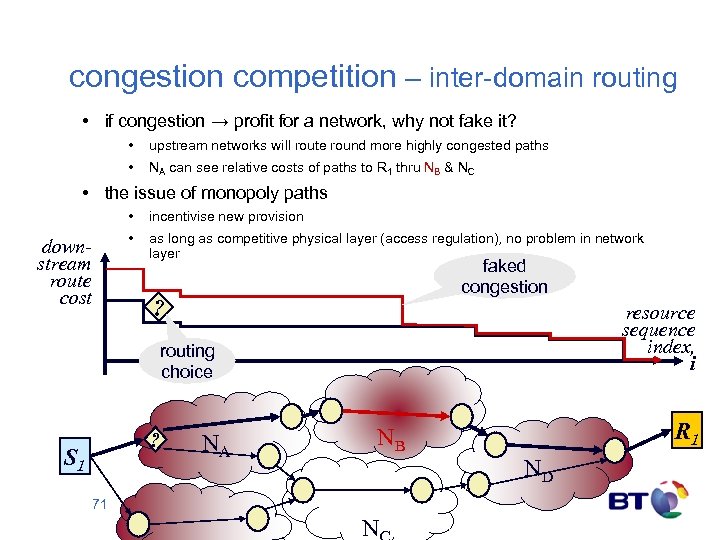
congestion competition – inter-domain routing • if congestion → profit for a network, why not fake it? • upstream networks will route round more highly congested paths • NA can see relative costs of paths to R 1 thru NB & NC • the issue of monopoly paths • • downstream route cost incentivise new provision as long as competitive physical layer (access regulation), no problem in network layer faked congestion ? resource sequence index, i routing choice ? S 1 NA R 1 NB ND 71 N
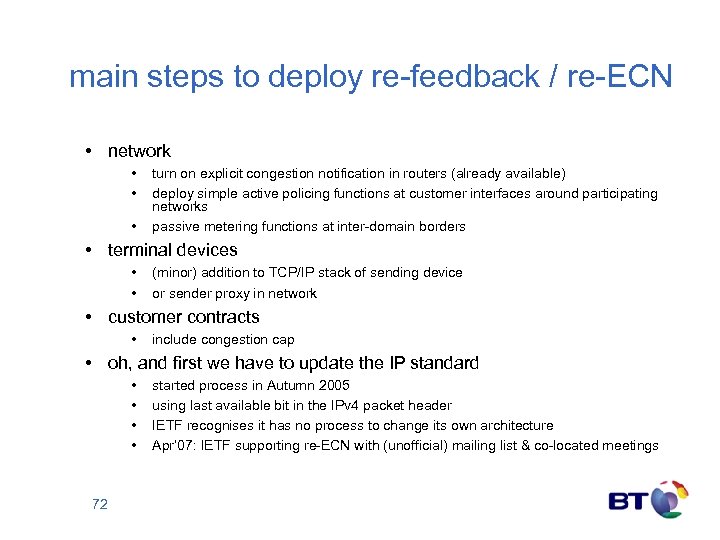
main steps to deploy re-feedback / re-ECN • network • • • turn on explicit congestion notification in routers (already available) deploy simple active policing functions at customer interfaces around participating networks passive metering functions at inter-domain borders • terminal devices • • (minor) addition to TCP/IP stack of sending device or sender proxy in network • customer contracts • include congestion cap • oh, and first we have to update the IP standard • • 72 started process in Autumn 2005 using last available bit in the IPv 4 packet header IETF recognises it has no process to change its own architecture Apr’ 07: IETF supporting re-ECN with (unofficial) mailing list & co-located meetings
Internet Qo. S the value of connectivity Bob Briscoe
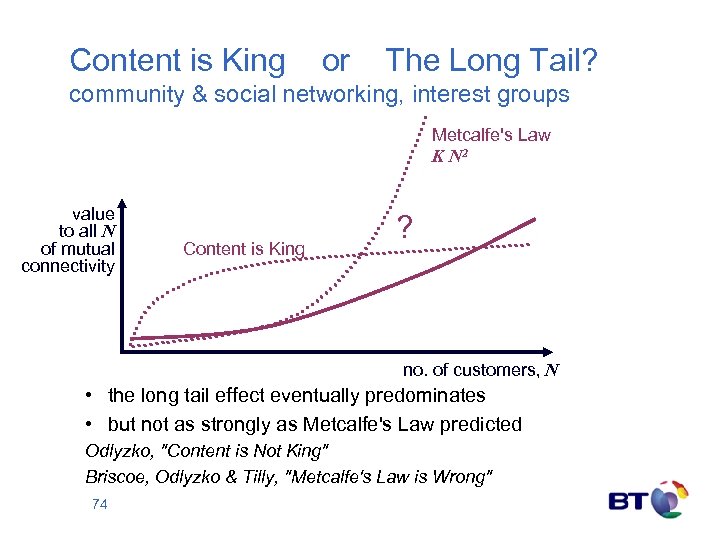
Content is King or The Long Tail? community & social networking, interest groups Metcalfe's Law K N 2 value to all N of mutual connectivity Content is King ? no. of customers, N • the long tail effect eventually predominates • but not as strongly as Metcalfe's Law predicted Odlyzko, "Content is Not King" Briscoe, Odlyzko & Tilly, "Metcalfe's Law is Wrong" 74
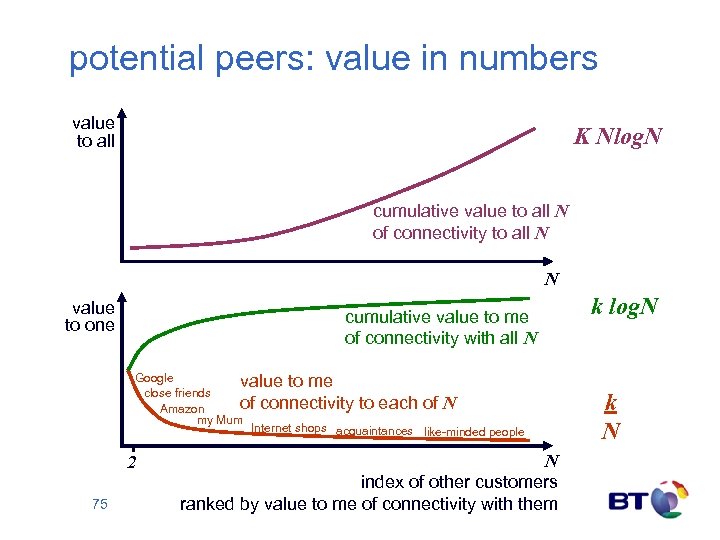
potential peers: value in numbers value to all K Nlog. N cumulative value to all N of connectivity to all N N value to one cumulative value to me of connectivity with all N Google value to me close friends of connectivity to each of N Amazon my Mum Internet shops acquaintances like-minded people 2 75 N index of other customers ranked by value to me of connectivity with them k log. N k N
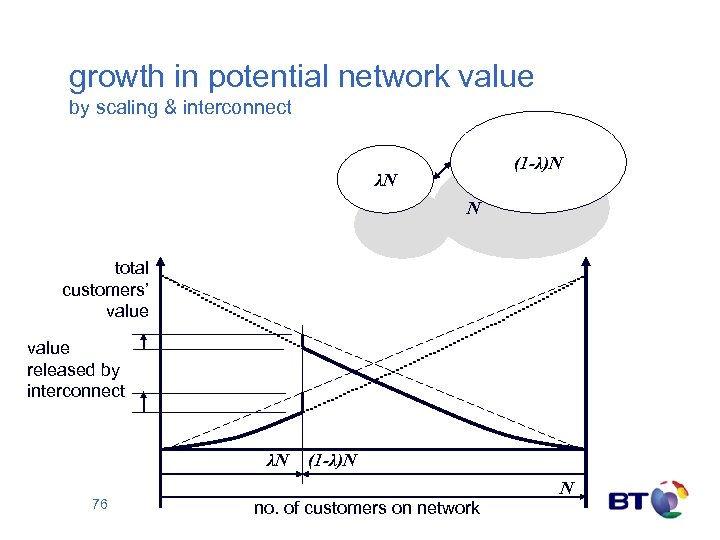
growth in potential network value by scaling & interconnect (1 -λ)N λN N total customers’ value released by interconnect λN 76 (1 -λ)N no. of customers on network N
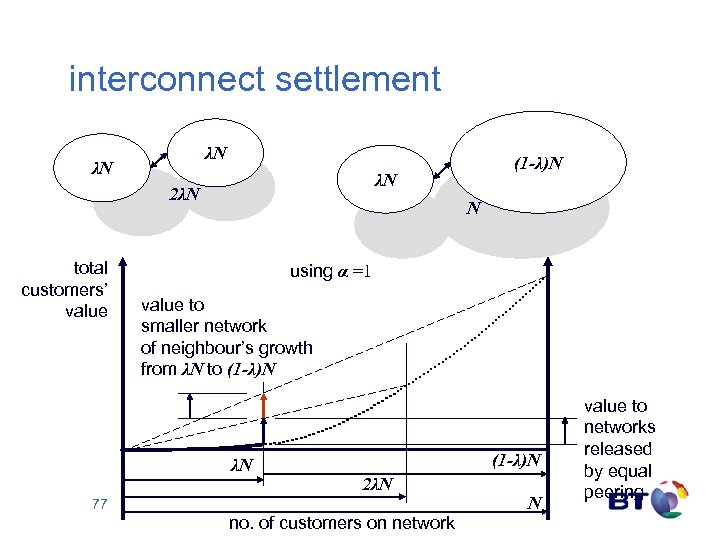
interconnect settlement λN λN λN 2λN total customers’ value (1 -λ)N N using α =1 value to smaller network of neighbour’s growth from λN to (1 -λ)N λN (1 -λ)N 2λN 77 no. of customers on network N value to networks released by equal peering
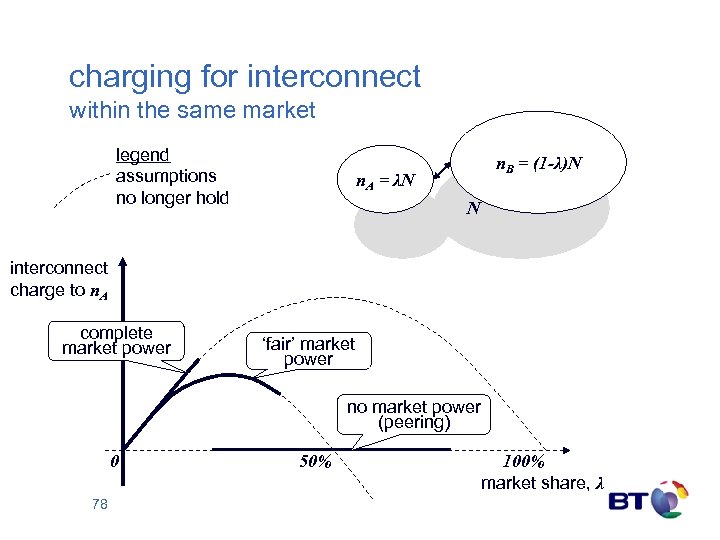
charging for interconnect within the same market legend assumptions no longer hold n. B = (1 -λ)N n. A = λN N interconnect charge to n. A complete market power ‘fair’ market power no market power (peering) 0 78 50% 100% market share, λ
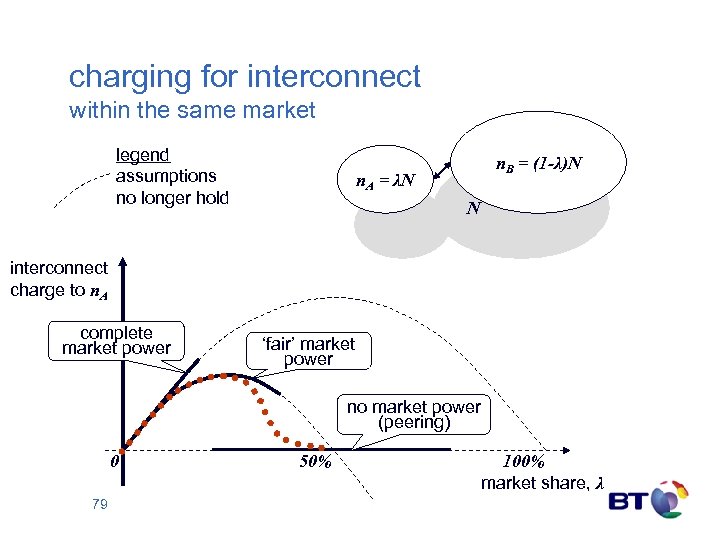
charging for interconnect within the same market legend assumptions no longer hold n. B = (1 -λ)N n. A = λN N interconnect charge to n. A complete market power ‘fair’ market power no market power (peering) 0 79 50% 100% market share, λ
Скачать презентацию Internet Qo S the underlying economics Bob Briscoe
b91a7d2d04c83e46fcb2e6cdc663b59e.ppt