 Скачать презентацию Internet Gateway for Delivering Biodiversity Data ESRI User
1f96ab263007f15d64bdae353a2ee926.ppt
- Количество слайдов: 22



Internet Gateway for Delivering Biodiversity Data ESRI User Conference July 2005
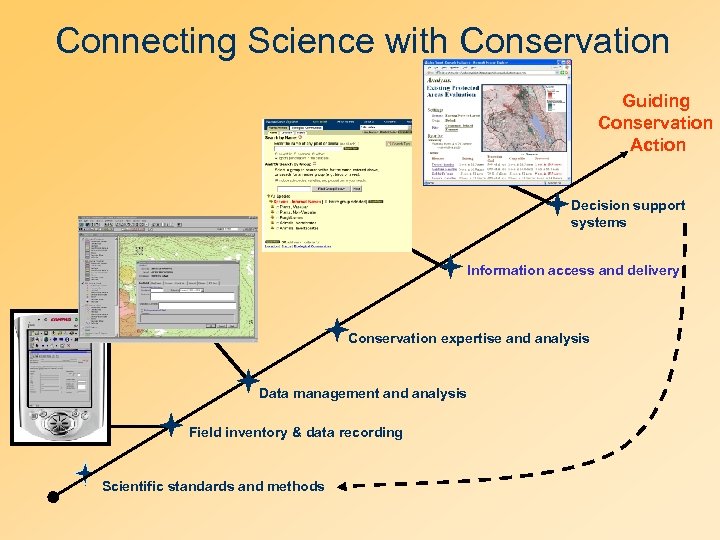
Connecting Science with Conservation Guiding Conservation Action Decision support systems Information access and delivery Conservation expertise and analysis Data management and analysis Field inventory & data recording Scientific standards and methods
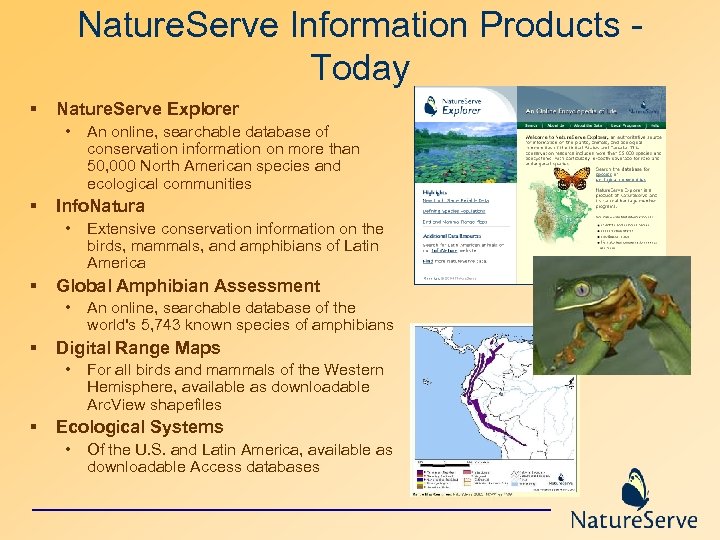
Nature. Serve Information Products Today § Nature. Serve Explorer • § Info. Natura • § An online, searchable database of the world's 5, 743 known species of amphibians Digital Range Maps • § Extensive conservation information on the birds, mammals, and amphibians of Latin America Global Amphibian Assessment • § An online, searchable database of conservation information on more than 50, 000 North American species and ecological communities For all birds and mammals of the Western Hemisphere, available as downloadable Arc. View shapefiles Ecological Systems • Of the U. S. and Latin America, available as downloadable Access databases
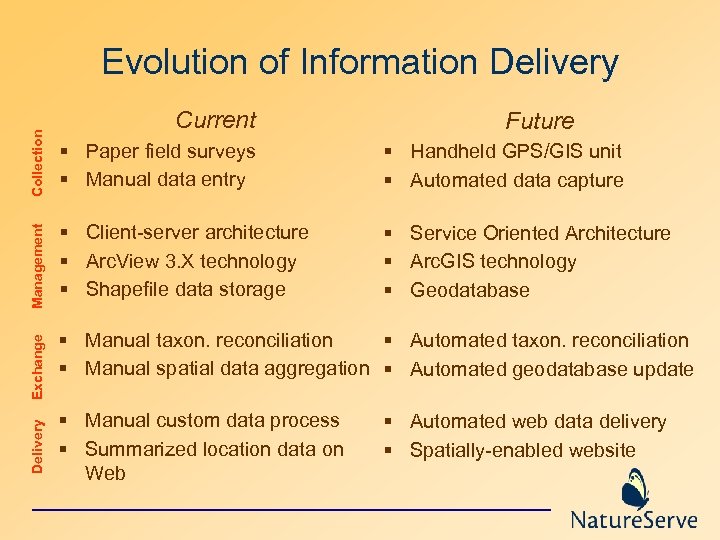
Evolution of Information Delivery Collection § Handheld GPS/GIS unit § Automated data capture § Client-server architecture § Arc. View 3. X technology § Shapefile data storage § Service Oriented Architecture § Arc. GIS technology § Geodatabase § Manual taxon. reconciliation § Automated taxon. reconciliation § Manual spatial data aggregation § Automated geodatabase update Delivery § Paper field surveys § Manual data entry Management Future Exchange Current § Manual custom data process § Summarized location data on Web § Automated web data delivery § Spatially-enabled website
Internet Gateway Why? 1. Improve the availability and use of biological and ecological information for informing conservation and land use decisions 1. Improve interoperability with international biodiversity networks (e. g. , GBIF, NBII) 1. Improve the currency and quality of Nature. Serve data products
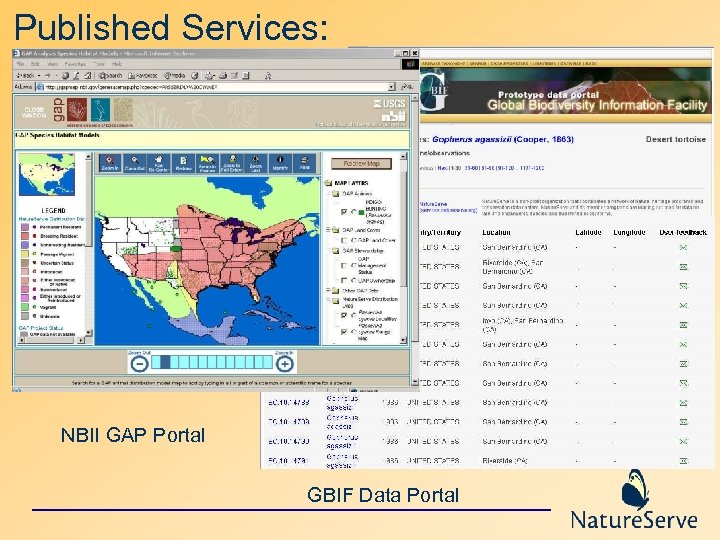
Published Services: NBII GAP Portal GBIF Data Portal
Internet Gateway to What? § What is it? • Taxonomy & classification of species and natural communities (Elements) § Where is it? • Mapped locations of species populations and natural communities (Element Occurrences) § How is it doing? • Quality and condition of each element occurrence • Conservation status and trend of each element type
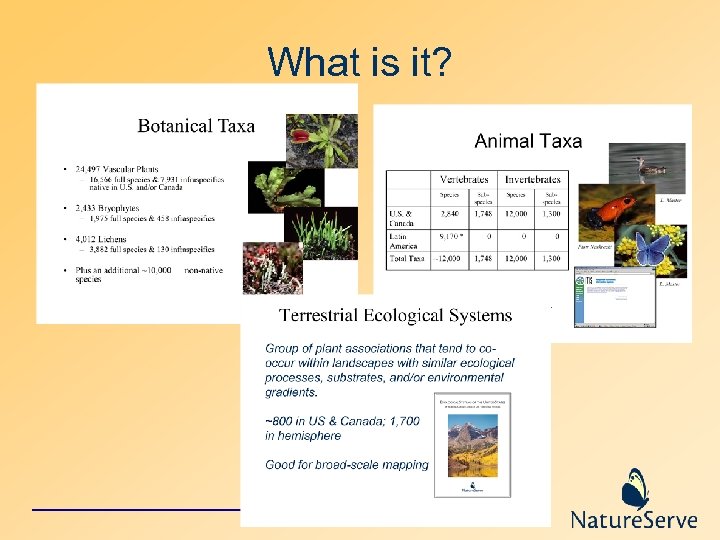
What is it?
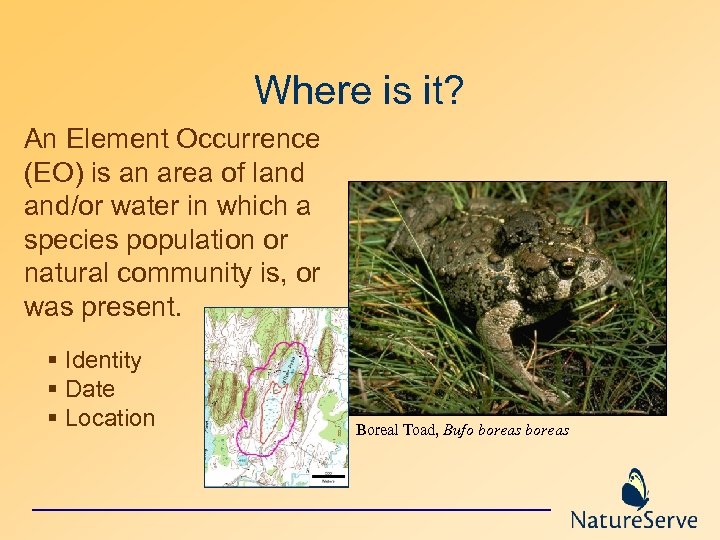
Where is it? An Element Occurrence (EO) is an area of land and/or water in which a species population or natural community is, or was present. § Identity § Date § Location Boreal Toad, Bufo boreas
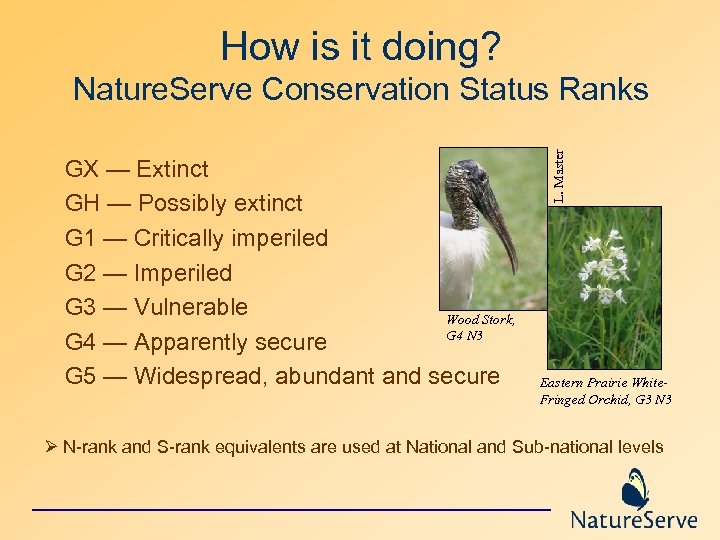
How is it doing? GX — Extinct GH — Possibly extinct G 1 — Critically imperiled G 2 — Imperiled G 3 — Vulnerable Wood Stork, G 4 N 3 G 4 — Apparently secure G 5 — Widespread, abundant and secure L. Master Nature. Serve Conservation Status Ranks Eastern Prairie White. Fringed Orchid, G 3 N 3 Ø N-rank and S-rank equivalents are used at National and Sub-national levels
Internet Gateway How? § Build a menu of map and web services that: • Expose selected sets of data (defined by XML schemas) • Are directly accessible to other applications • Provide a custom user experience § Improve synchronization across Network nodes: • Separate record-level data updates from taxonomic reconciliation • On-demand data exchanges (change-driven, not time-driven) • More automated (XML, web-services-based process) § Share data, control who accesses it, and how they interact with it: • Local nodes set access control policies (not one size fits all) • Maximize level of access provided by each node
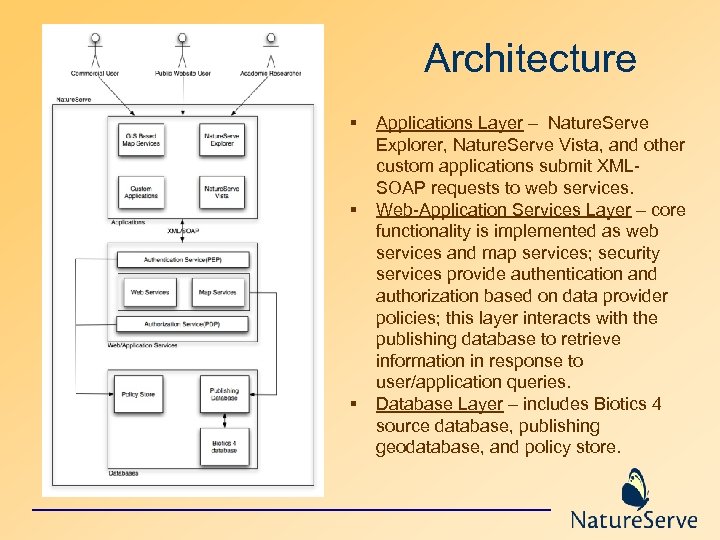
Architecture § § § Applications Layer – Nature. Serve Explorer, Nature. Serve Vista, and other custom applications submit XMLSOAP requests to web services. Web-Application Services Layer – core functionality is implemented as web services and map services; security services provide authentication and authorization based on data provider policies; this layer interacts with the publishing database to retrieve information in response to user/application queries. Database Layer – includes Biotics 4 source database, publishing geodatabase, and policy store.
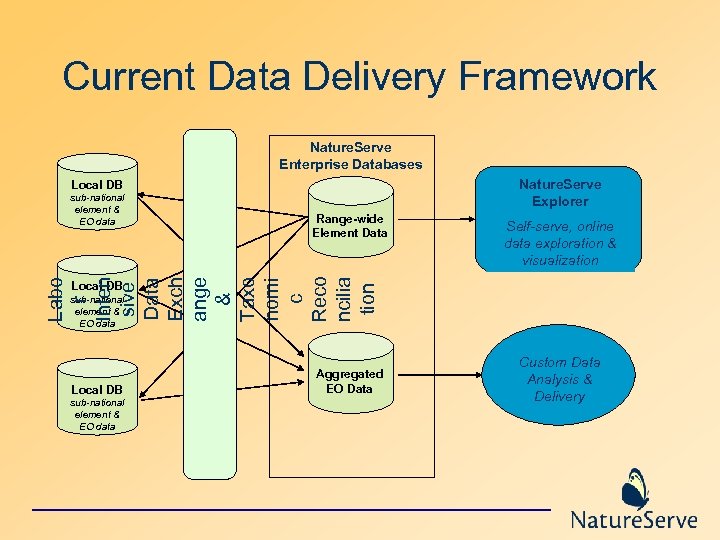
Current Data Delivery Framework Nature. Serve Enterprise Databases Nature. Serve Explorer Local DB Range-wide Element Data Self-serve, online data exploration & visualization Labo r Inten sive Data Exch ange & Taxo nomi c Reco ncilia tion sub-national element & EO data Local DB sub-national element & EO data Aggregated EO Data Custom Data Analysis & Delivery
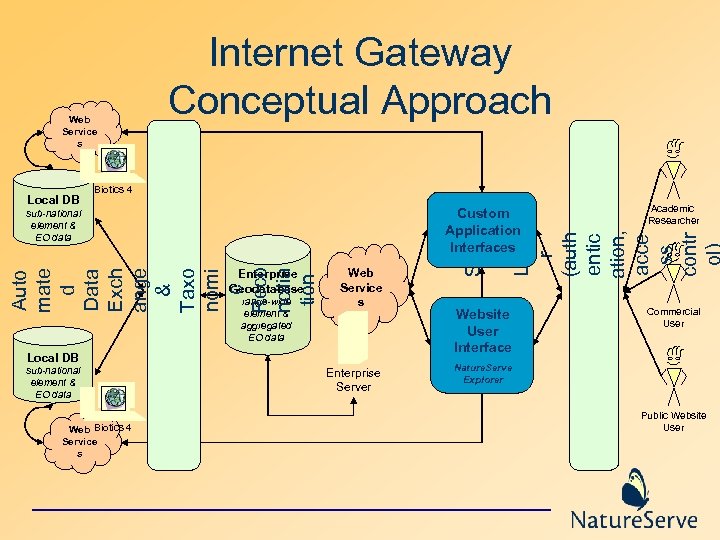
Web Service s Biotics 4 Custom Application Interfaces Auto mate d Data Exch ange & Taxo nomi c Reco ncilia tion sub-national element & EO data Enterprise Geodatabase range-wide element & aggregated EO data Web Service s Local DB sub-national element & EO data Web Biotics 4 Service s Enterprise Server Academic Researcher Website User Interface Commercial User Secu rity Laye r (auth entic ation, acce ss contr Local DB Internet Gateway Conceptual Approach Nature. Serve Explorer Public Website User
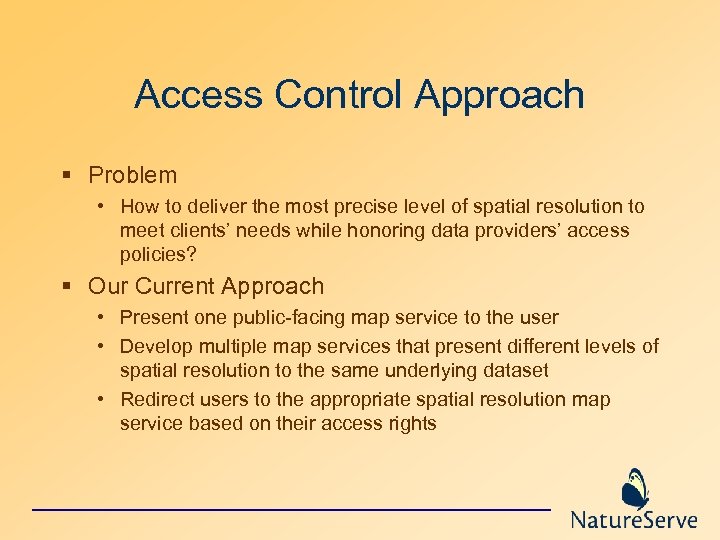
Access Control Approach § Problem • How to deliver the most precise level of spatial resolution to meet clients’ needs while honoring data providers’ access policies? § Our Current Approach • Present one public-facing map service to the user • Develop multiple map services that present different levels of spatial resolution to the same underlying dataset • Redirect users to the appropriate spatial resolution map service based on their access rights
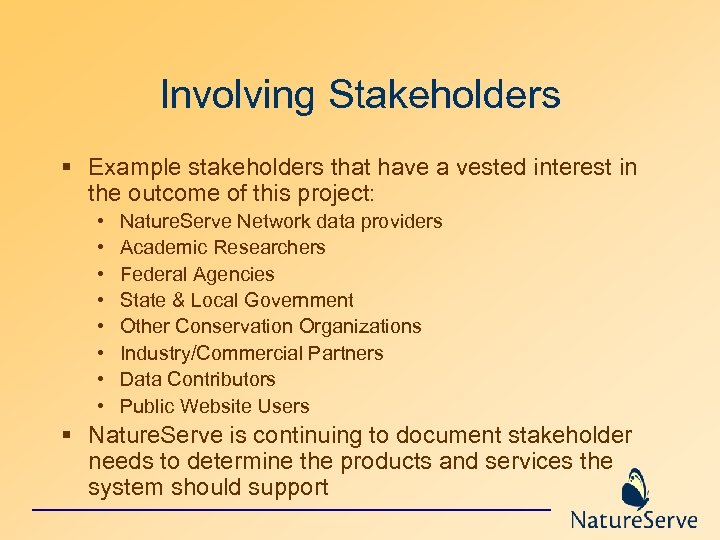
Involving Stakeholders § Example stakeholders that have a vested interest in the outcome of this project: • • Nature. Serve Network data providers Academic Researchers Federal Agencies State & Local Government Other Conservation Organizations Industry/Commercial Partners Data Contributors Public Website Users § Nature. Serve is continuing to document stakeholder needs to determine the products and services the system should support
Example Web Services § Submit species name and retrieve detailed species information, including legal and conservation status § Submit a boundary, and retrieve a yes/no response indicator for threatened and endangered species in that area § Submit a boundary and legal or conservation status, and retrieve a list of the species known to occur in that area
Example Map Services § Submit species name and display all known population occurrences for that species in North America § Submit a species name and a boundary, and display all known population occurrences for that species within the provided area § Select a USGS 7. 5’ quad and display all known species occurrences that intersect the quad boundary
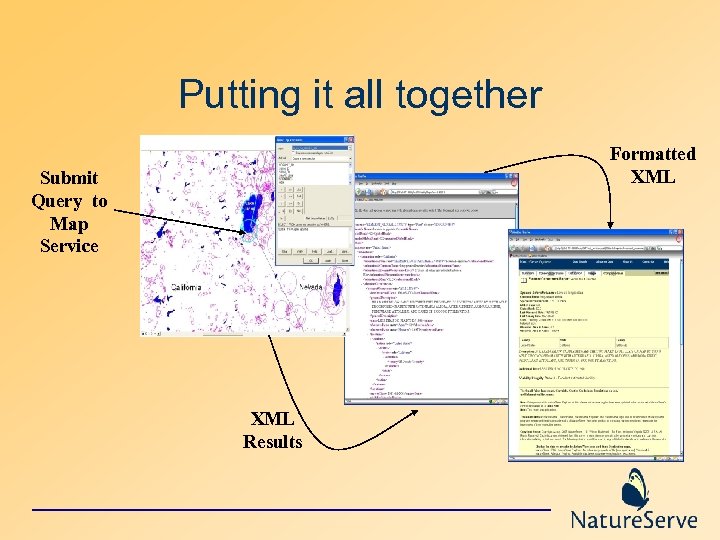
Putting it all together Formatted XML Submit Query to Map Service XML Results
Internet Gateway Timeline § Year 1: ü Data access workshop, November 2004 Nature. Serve Leadership Conference ü Establish enterprise geodatabase and Di. GIR registry ü Hold user story workshops to gather requirements for data content and data access § Year 2: (getting underway now) • Development iterations begin for candidate releases • Web application interface to geodatabase content • Web services • Data synchronization process and tools § Year 3: • Development iterations continue for production releases • Implement web services at two member program pilot sites • Rollout plan for network-wide implementation
Resources § Project Contacts: • Lori Scott lori_scott@natureserve. org • Douglas Sellers douglas_sellers@natureserve. org § For More Information: • www. natureserve. org • www. gbif. net § Get involved: • Review XML schema • Beta test web services
Acknowledgements Financial support is provided by the National Science Foundation Biological Databases and Informatics program (grant # 0345400) and the U. S. Environmental Protection Agency Environmental Information Exchange Network Grant program, through a cooperative agreement with the Delaware Department of Natural Resources and Environmental Control.
Скачать презентацию Internet Gateway for Delivering Biodiversity Data ESRI User
1f96ab263007f15d64bdae353a2ee926.ppt