 Скачать презентацию Internet Evolution Dr Lawrence Roberts CEO Founder Anagran
5e322b625cb6fa3bf5f74b1a4d6d1d5b.ppt
- Количество слайдов: 26



Internet Evolution Dr. Lawrence Roberts CEO, Founder, Anagran 1
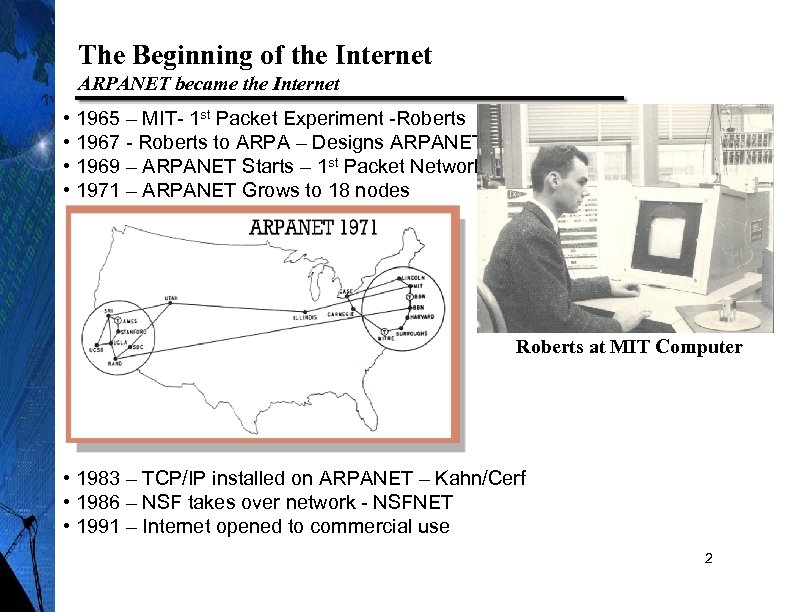
The Beginning of the Internet ARPANET became the Internet • 1965 – MIT- 1 st Packet Experiment -Roberts • 1967 - Roberts to ARPA – Designs ARPANET • 1969 – ARPANET Starts – 1 st Packet Network • 1971 – ARPANET Grows to 18 nodes Roberts at MIT Computer • 1983 – TCP/IP installed on ARPANET – Kahn/Cerf • 1986 – NSF takes over network - NSFNET • 1991 – Internet opened to commercial use 2
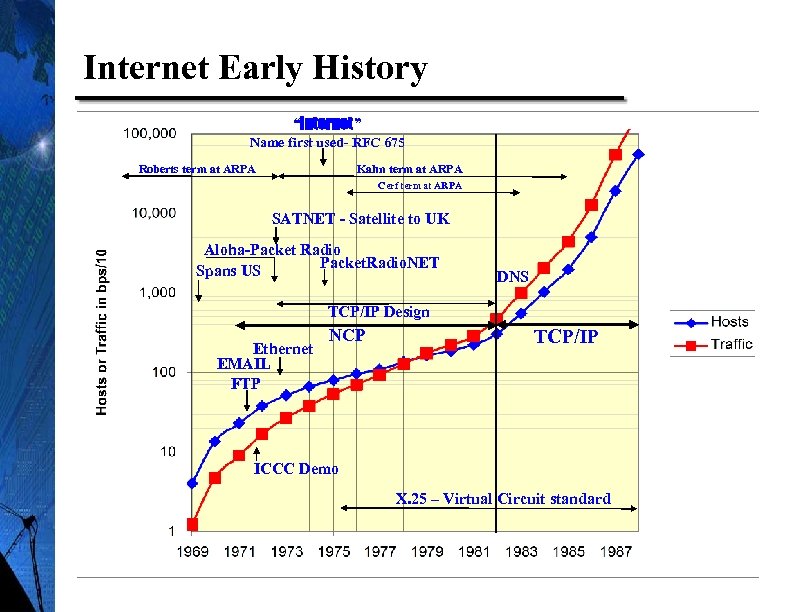
Internet Early History “Internet” Name first used- RFC 675 Roberts term at ARPA Kahn term at ARPA Cerf term at ARPA SATNET - Satellite to UK Aloha-Packet Radio Packet. Radio. NET Spans US DNS TCP/IP Design Ethernet EMAIL FTP NCP TCP/IP ICCC Demo X. 25 – Virtual Circuit standard 3
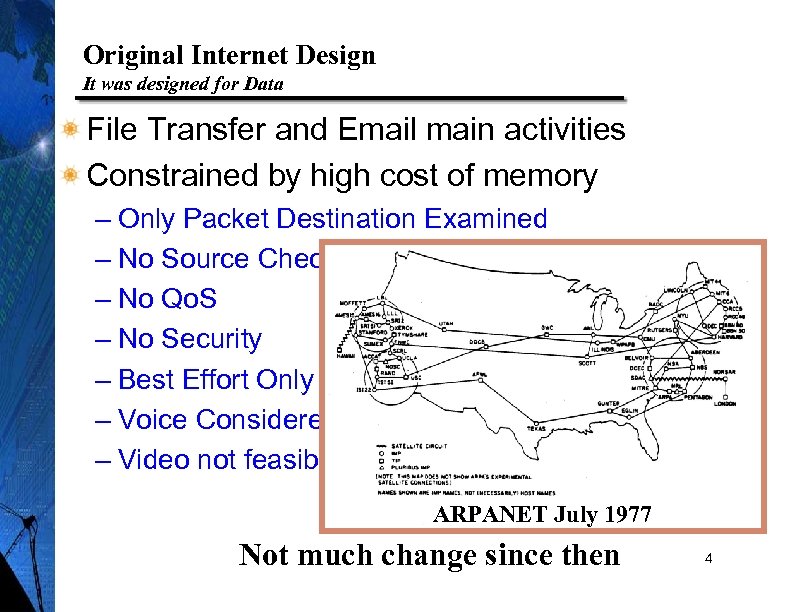
Original Internet Design It was designed for Data File Transfer and Email main activities Constrained by high cost of memory – Only Packet Destination Examined – No Source Checks – No Qo. S – No Security – Best Effort Only – Voice Considered – Video not feasible ARPANET July 1977 Not much change since then 4
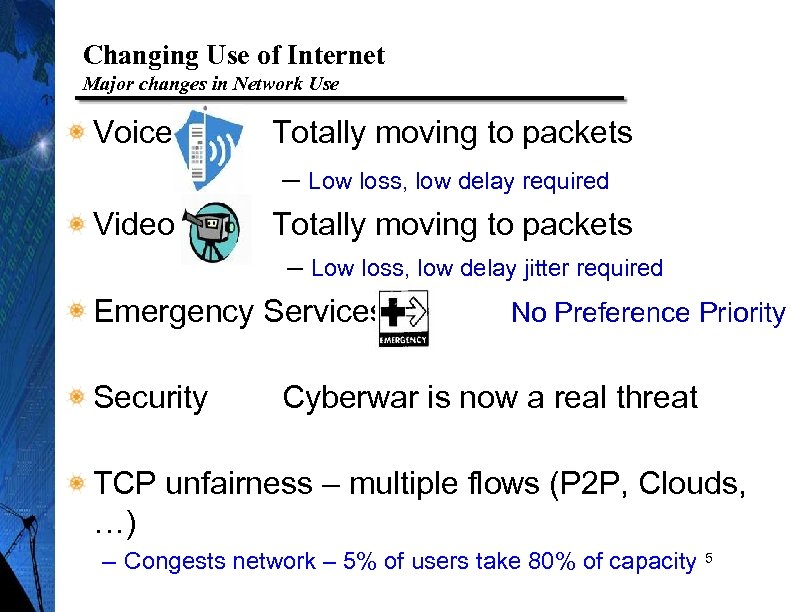
Changing Use of Internet Major changes in Network Use Voice Video Totally moving to packets – Low loss, low delay required Totally moving to packets – Low loss, low delay jitter required Emergency Services Security No Preference Priority Cyberwar is now a real threat TCP unfairness – multiple flows (P 2 P, Clouds, …) – Congests network – 5% of users take 80% of capacity 5
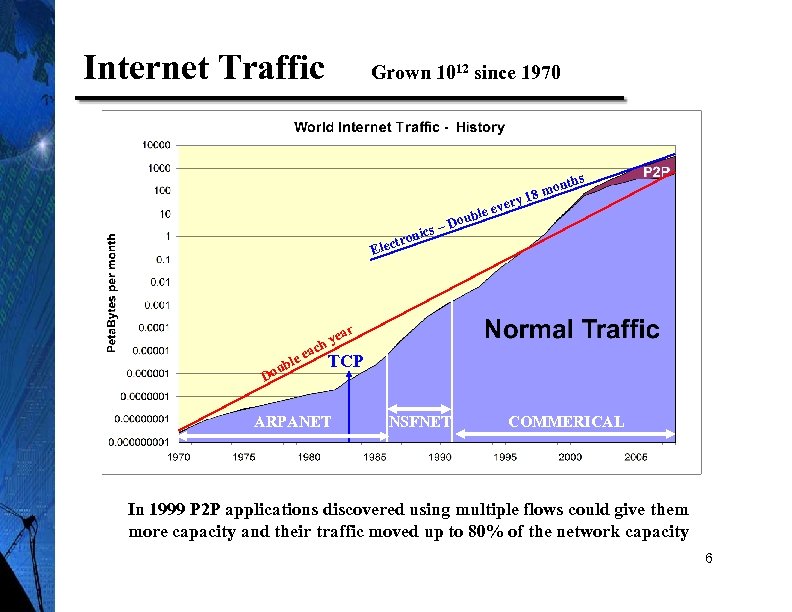
Internet Traffic Grown 1012 since 1970 ery le ev E 18 s onth m oub s–D onic lectr r ac ea hy e ble u Do TCP ARPANET NSFNET COMMERICAL In 1999 P 2 P applications discovered using multiple flows could give them more capacity and their traffic moved up to 80% of the network capacity 6
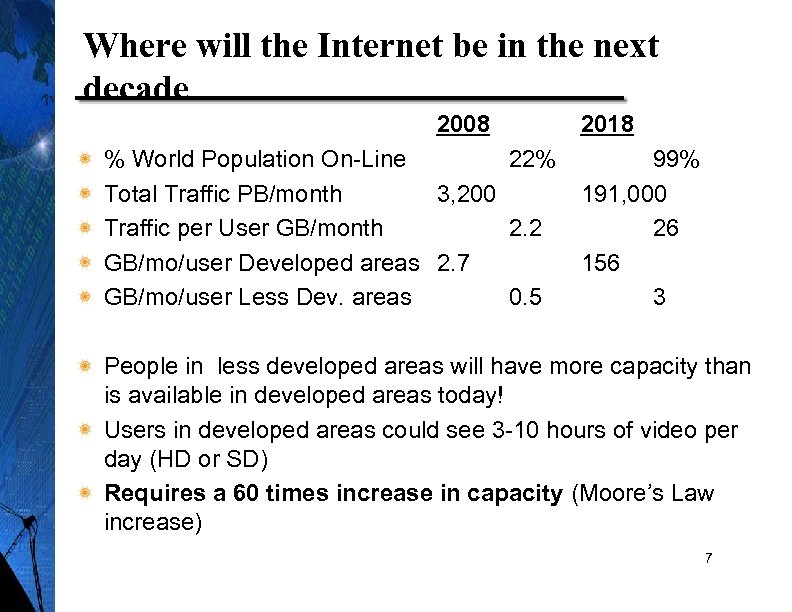
Where will the Internet be in the next decade 2008 2018 % World Population On-Line 22% 99% Total Traffic PB/month 3, 200 191, 000 Traffic per User GB/month 2. 2 26 GB/mo/user Developed areas 2. 7 156 GB/mo/user Less Dev. areas 0. 5 3 People in less developed areas will have more capacity than is available in developed areas today! Users in developed areas could see 3 -10 hours of video per day (HD or SD) Requires a 60 times increase in capacity (Moore’s Law increase) 7
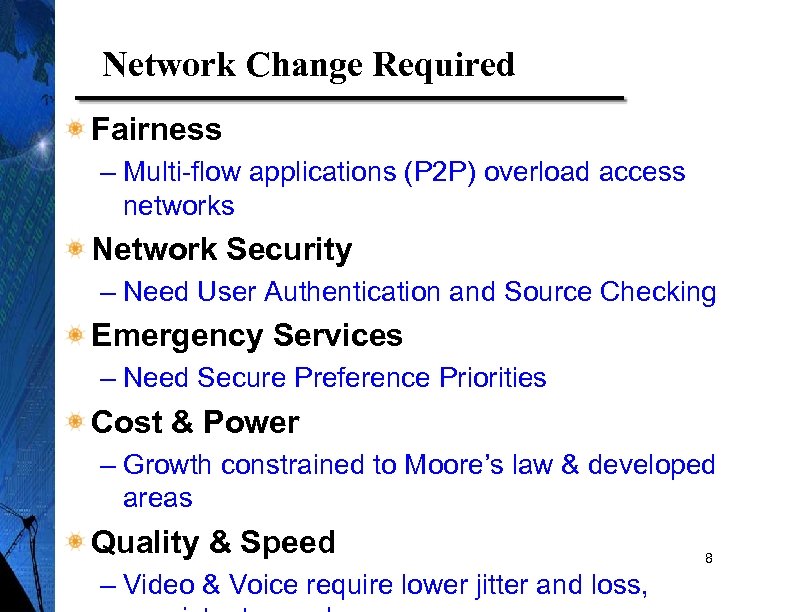
Network Change Required Fairness – Multi-flow applications (P 2 P) overload access networks Network Security – Need User Authentication and Source Checking Emergency Services – Need Secure Preference Priorities Cost & Power – Growth constrained to Moore’s law & developed areas Quality & Speed – Video & Voice require lower jitter and loss, 8
Technology Improvement – Flow Management Historically, congestion managed by queues and discards – Creates delay, jitter, and random losses – TCP flow rates vary widely, often stall – UDP can overload, if so all flows hurt Alternatively, flows can be rate controlled to fill link – Keep table of all flows, measure output, assign rates to each flow – Rate control TCP flows to avoid congestion but maintain utilization – Limit total fixed rate flow utilization by rejecting excessive requests 9 – Assign rate priorities to flows to insure fairness and quality
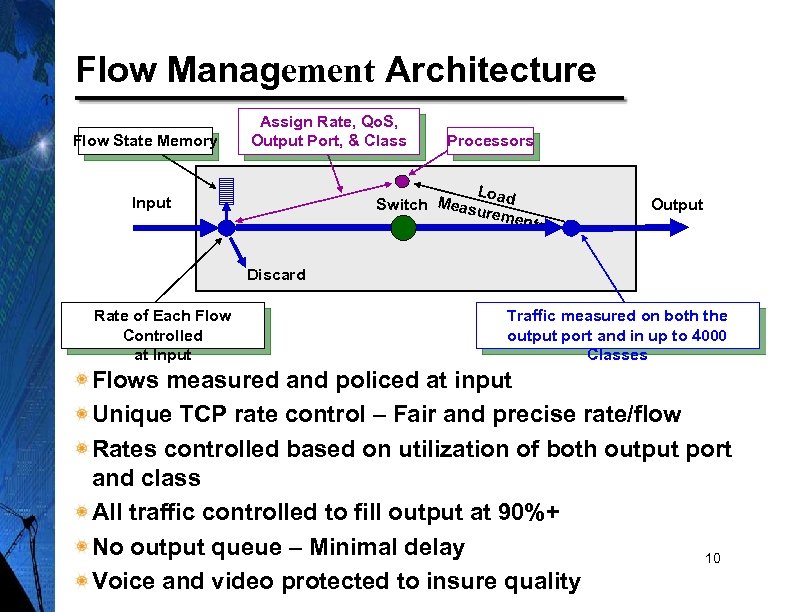
Flow Management Architecture Flow State Memory Assign Rate, Qo. S, Output Port, & Class Processors Loa Switch Measur d emen ts Input Output Discard Rate of Each Flow Controlled at Input Traffic measured on both the output port and in up to 4000 Classes Flows measured and policed at input Unique TCP rate control – Fair and precise rate/flow Rates controlled based on utilization of both output port and class All traffic controlled to fill output at 90%+ No output queue – Minimal delay 10 Voice and video protected to insure quality
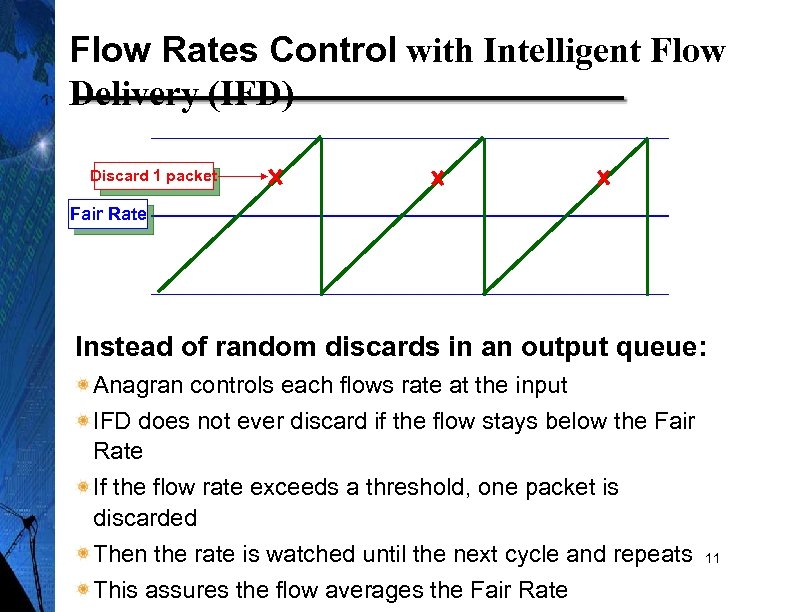
Flow Rates Control with Intelligent Flow Delivery (IFD) Discard 1 packet Fair Rate Instead of random discards in an output queue: Anagran controls each flows rate at the input IFD does not ever discard if the flow stays below the Fair Rate If the flow rate exceeds a threshold, one packet is discarded Then the rate is watched until the next cycle and repeats This assures the flow averages the Fair Rate 11
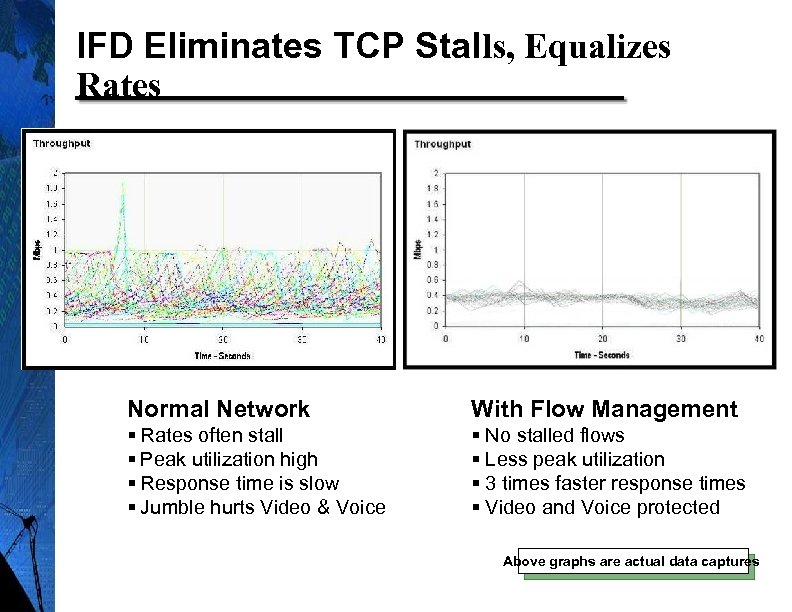
IFD Eliminates TCP Stalls, Equalizes Rates Normal Network With Flow Management § Rates often stall § Peak utilization high § Response time is slow § Jumble hurts Video & Voice § No stalled flows § Less peak utilization § 3 times faster response times § Video and Voice protected 12 Above graphs are actual data captures
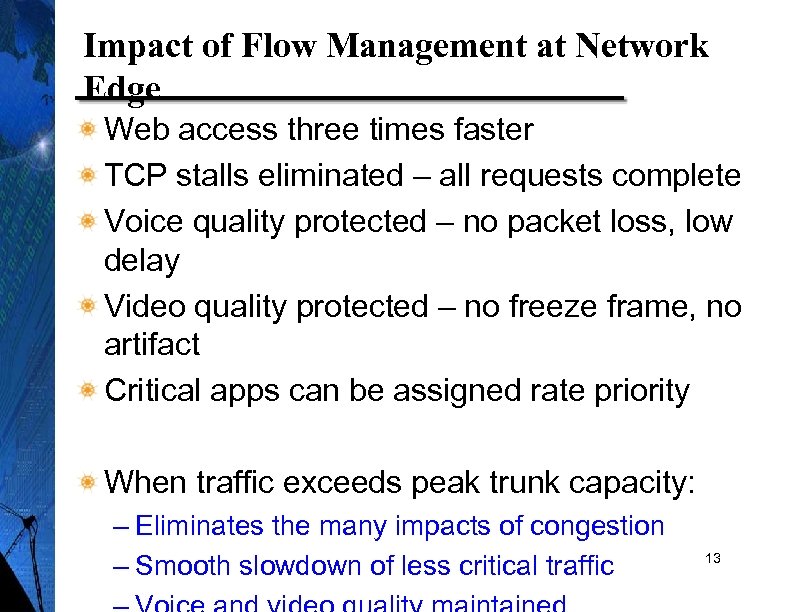
Impact of Flow Management at Network Edge Web access three times faster TCP stalls eliminated – all requests complete Voice quality protected – no packet loss, low delay Video quality protected – no freeze frame, no artifact Critical apps can be assigned rate priority When traffic exceeds peak trunk capacity: – Eliminates the many impacts of congestion – Smooth slowdown of less critical traffic 13
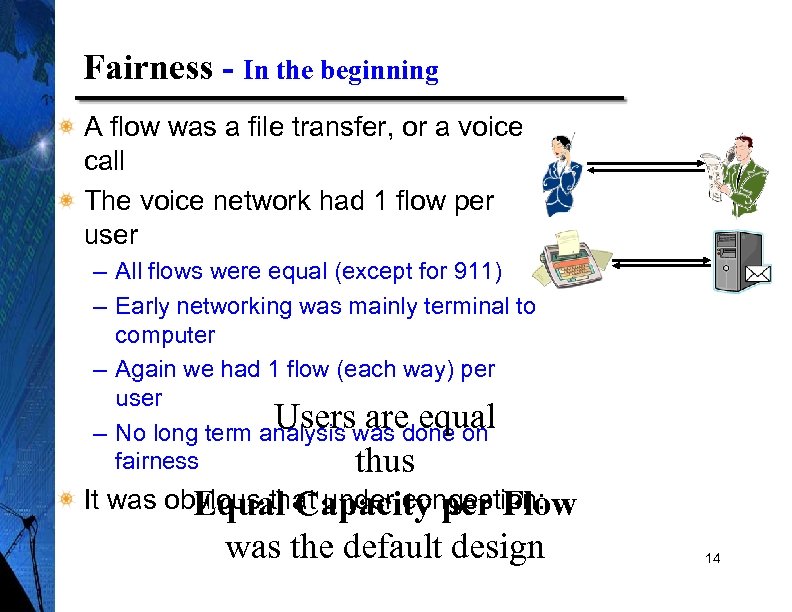
Fairness - In the beginning A flow was a file transfer, or a voice call The voice network had 1 flow per user – All flows were equal (except for 911) – Early networking was mainly terminal to computer – Again we had 1 flow (each way) per user Users are equal – No long term analysis was done on fairness thus It was obvious that under congestion: Equal Capacity per Flow was the default design 14
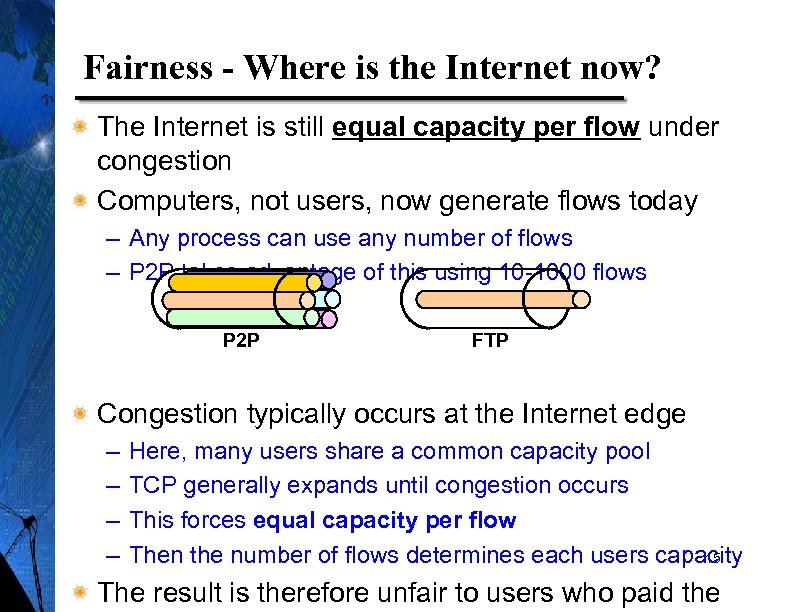
Fairness - Where is the Internet now? The Internet is still equal capacity per flow under congestion Computers, not users, now generate flows today – Any process can use any number of flows – P 2 P takes advantage of this using 10 -1000 flows P 2 P FTP Congestion typically occurs at the Internet edge – – Here, many users share a common capacity pool TCP generally expands until congestion occurs This forces equal capacity per flow Then the number of flows determines each users capacity 15 The result is therefore unfair to users who paid the
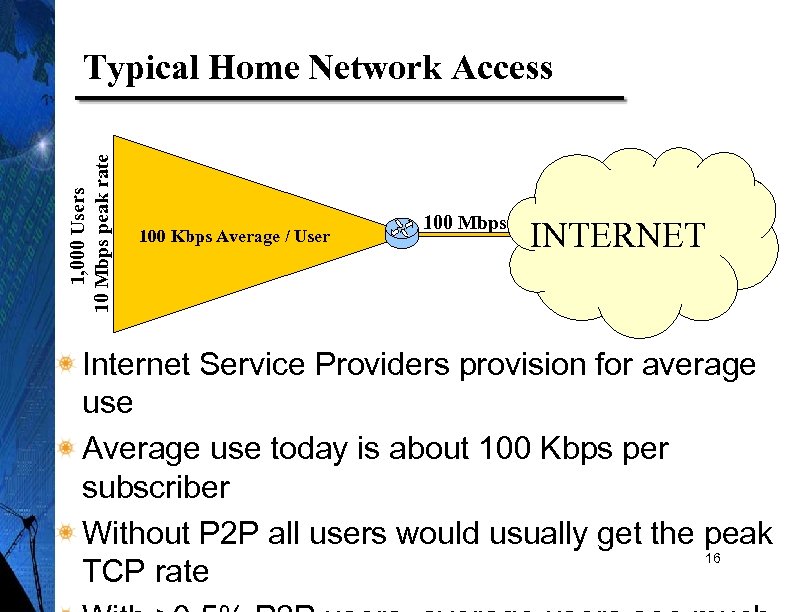
1, 000 Users 10 Mbps peak rate Typical Home Network Access 100 Kbps Average / User 100 Mbps INTERNET Internet Service Providers provision for average use Average use today is about 100 Kbps per subscriber Without P 2 P all users would usually get the peak 16 TCP rate
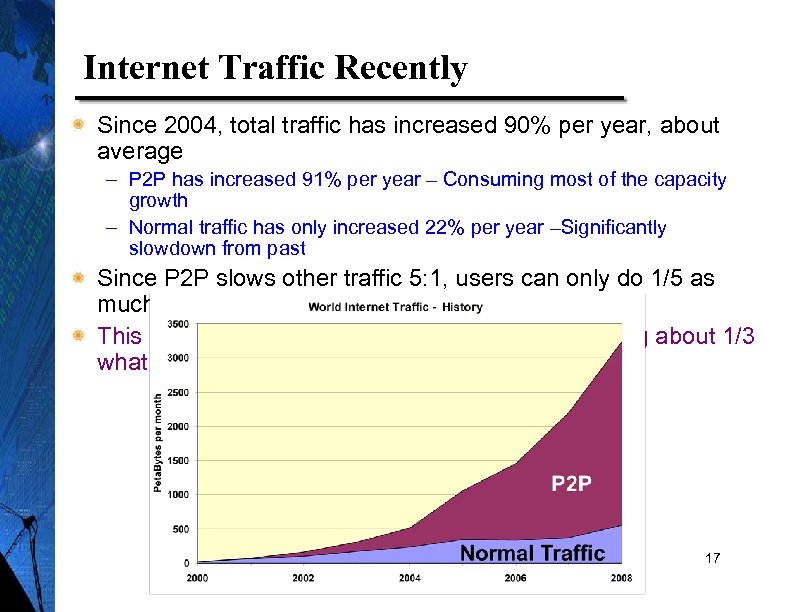
Internet Traffic Recently Since 2004, total traffic has increased 90% per year, about average – P 2 P has increased 91% per year – Consuming most of the capacity growth – Normal traffic has only increased 22% per year –Significantly slowdown from past Since P 2 P slows other traffic 5: 1, users can only do 1/5 as much This may account for the normal traffic growth being about 1/3 what it should be with normal growth 17
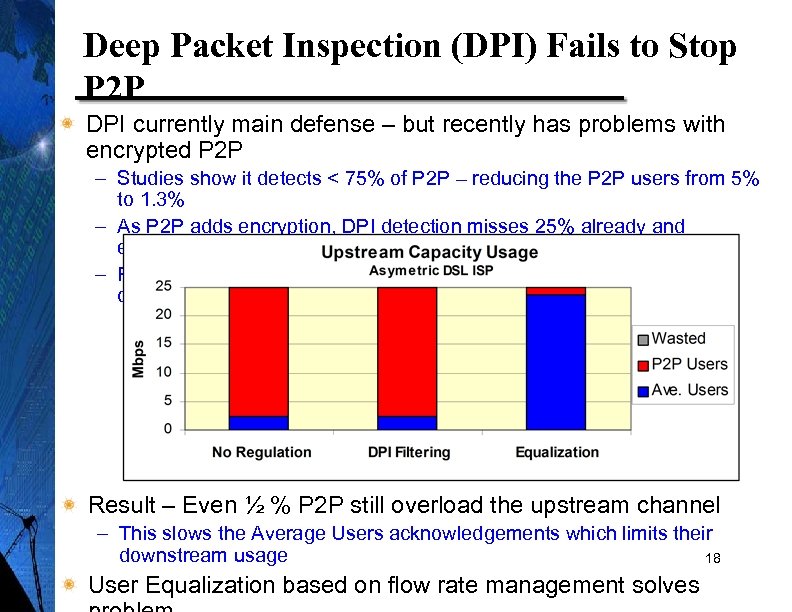
Deep Packet Inspection (DPI) Fails to Stop P 2 P DPI currently main defense – but recently has problems with encrypted P 2 P – Studies show it detects < 75% of P 2 P – reducing the P 2 P users from 5% to 1. 3% – As P 2 P adds encryption, DPI detection misses 25% already and encryption growing – Remainder of P 2 P simply adds more flows, again filling capacity to congestion Result – Even ½ % P 2 P still overload the upstream channel – This slows the Average Users acknowledgements which limits their downstream usage 18 User Equalization based on flow rate management solves
A New Fairness Rule Inequity in TCP/IP – Currently equal capacity per flow – P 2 P has taken advantage of this, using 10 -1000 flows – This gives the 5% P 2 P users 80 -95% of the capacity – P 2 P does not know when to stop until it sees congestion Instead we should give equal capacity for equal pay – This is simply a revised equality rule – similar users get equal capacity – This tracks with what we pay – If network assures all similar users get equal service, file sharing will find the best equitable method – perhaps slack time and local hosts This is a major worldwide problem – P 2 P is not bad, it can be quite effective – But, without revised fairness, multi-flow applications can 19 take capacity away from other users, dramatically slowing their network use
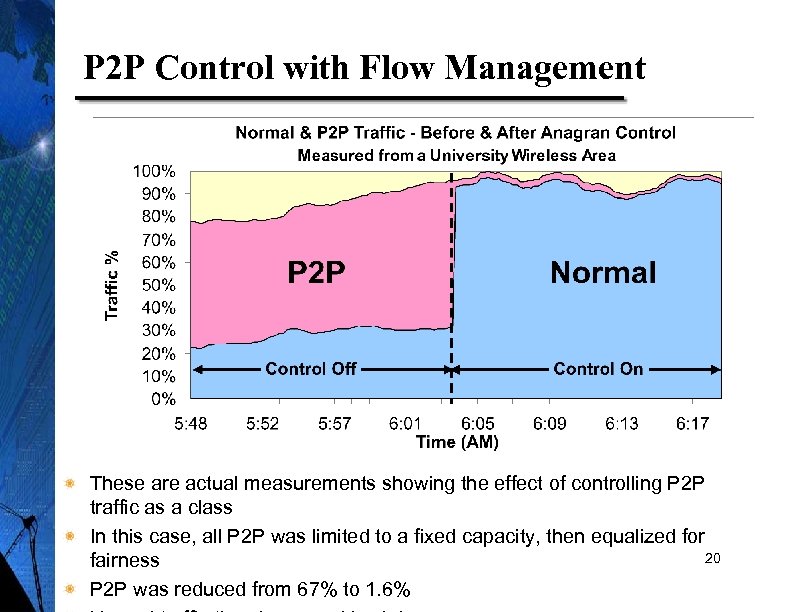
P 2 P Control with Flow Management These are actual measurements showing the effect of controlling P 2 P traffic as a class In this case, all P 2 P was limited to a fixed capacity, then equalized for 20 fairness P 2 P was reduced from 67% to 1. 6%
Why is it Important to Change Fairness Rule? P 2 P is attractive and growing rapidly It cannot determine its fair share itself The network must provide the fair boundary Without fairness, normal users will slow down and stall Multi-flow applications will be misled on economics – Today most P 2 P users believe their peak capacity is theirs – They do not realize they may be slowing down other users 21 – The economics of file transfer are thus badly
Network Security Wireshark users know the value of watching communication Today the network is open and unchecked All security is based on “flawless” computer systems This needs to change - the network must help Finding Bots is best done watching network traffic Knowing who is trying to connect can help stop penetration 22 Allocating high priority capacity requires authentication
Authentication Security Program New DARPA project will allow users to be authenticated The network can insure source IP address is not faked The network can assign user based priorities – Emergency services needs priority – Corporations have priority applications The recipient can know who is trying to connect – Filter out request from un-authenticated sources – Control application access to specific users Today security is based on fixing all computer 23 holes
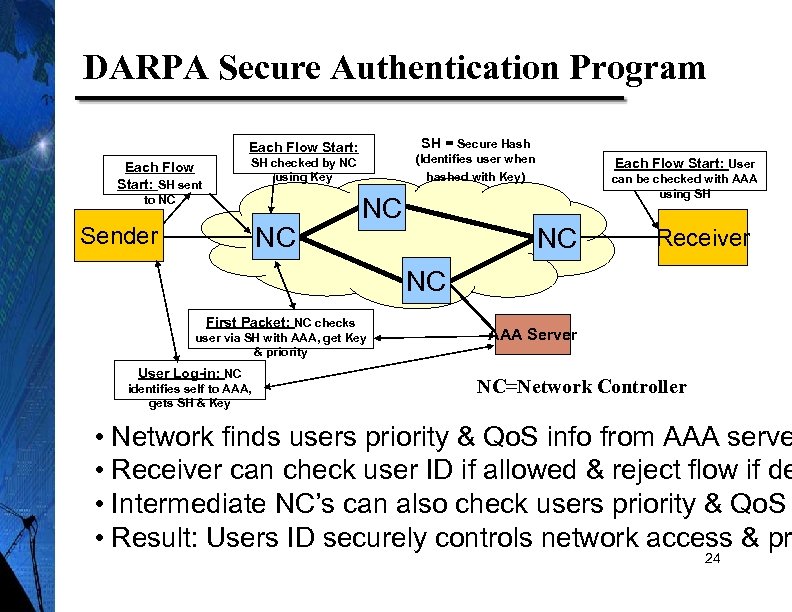
DARPA Secure Authentication Program SH = Secure Hash Each Flow Start: (Identifies user when SH checked by NC using Key Each Flow Start: SH sent to NC NC Sender Each Flow Start: User can be checked with AAA using SH hashed with Key) NC NC Receiver NC First Packet: NC checks user via SH with AAA, get Key & priority User Log-in: NC identifies self to AAA, gets SH & Key AAA Server NC=Network Controller • Network finds users priority & Qo. S info from AAA serve • Receiver can check user ID if allowed & reject flow if de • Intermediate NC’s can also check users priority & Qo. S • Result: Users ID securely controls network access & pr 24
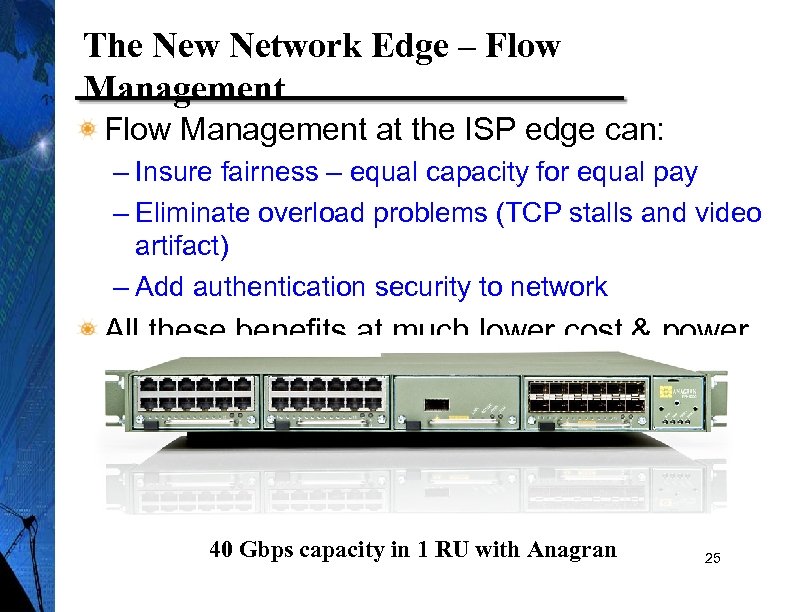
The New Network Edge – Flow Management at the ISP edge can: – Insure fairness – equal capacity for equal pay – Eliminate overload problems (TCP stalls and video artifact) – Add authentication security to network All these benefits at much lower cost & power vs. DP 40 Gbps capacity in 1 RU with Anagran 25
Summary Today’s IP Networks need improvement Fairness is poor – 5% of users take 80% of capacity – The cause is the old rule of equal capacity per flow – This needs to change to equal capacity for equal pay Response time and Qo. S suffer from random discards – Web access suffers from unequal flow rates, TCP stalls – Video suffers from packet loss and TCP stalls – Voice suffers from packet loss and excessive delay Security could be improved if network did authentication 26
Скачать презентацию Internet Evolution Dr Lawrence Roberts CEO Founder Anagran
5e322b625cb6fa3bf5f74b1a4d6d1d5b.ppt