


 Скачать презентацию Internet Capacity Sharing Architecture a design team of
3809d3690f819ba3823c29956387f8a3.ppt
- Количество слайдов: 23
 Internet Capacity Sharing Architecture a design team of the ICCRG congestion control research agenda Matt Mathis & Bob Briscoe PSC & BT Mar 2010 Bob Briscoe is partly funded by Trilogy, a research project supported by the European Community www. trilogy-project. org
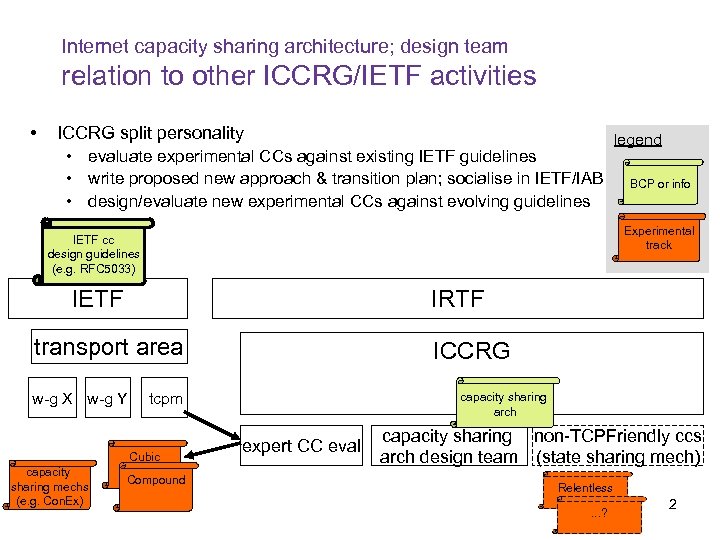 Internet capacity sharing architecture; design team relation to other ICCRG/IETF activities • ICCRG split personality legend • evaluate experimental CCs against existing IETF guidelines • write proposed new approach & transition plan; socialise in IETF/IAB BCP or info • design/evaluate new experimental CCs against evolving guidelines Experimental track IETF cc design guidelines (e. g. RFC 5033) IETF IRTF transport area w-g X w-g Y tcpm Cubic capacity sharing mechs (e. g. Con. Ex) ICCRG Compound capacity sharing arch expert CC eval capacity sharing non-TCPFriendly ccs arch design team (state sharing mech) Relentless. . . ? 2
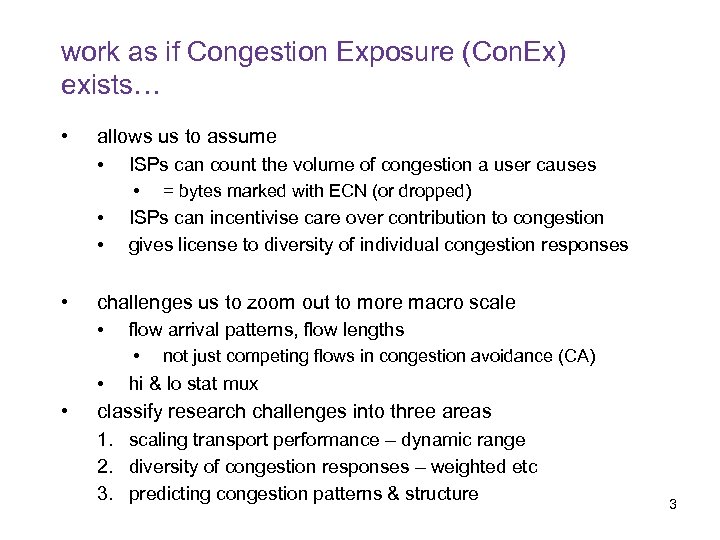 work as if Congestion Exposure (Con. Ex) exists… • allows us to assume • ISPs can count the volume of congestion a user causes • • = bytes marked with ECN (or dropped) ISPs can incentivise care over contribution to congestion gives license to diversity of individual congestion responses challenges us to zoom out to more macro scale • flow arrival patterns, flow lengths • not just competing flows in congestion avoidance (CA) hi & lo stat mux • • classify research challenges into three areas 1. scaling transport performance – dynamic range 2. diversity of congestion responses – weighted etc 3. predicting congestion patterns & structure 3
 research area #1 scaling transport performance
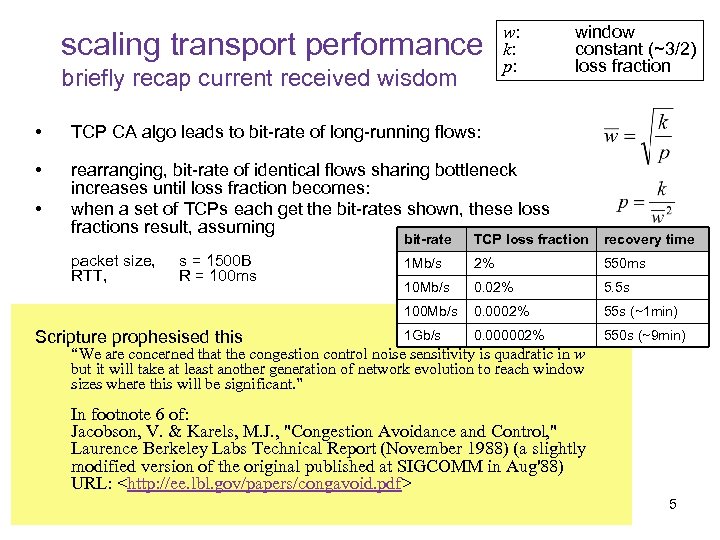 scaling transport performance briefly recap current received wisdom w: k: p: • TCP CA algo leads to bit-rate of long-running flows: • window constant (~3/2) loss fraction rearranging, bit-rate of identical flows sharing bottleneck increases until loss fraction becomes: when a set of TCPs each get the bit-rates shown, these loss fractions result, assuming • bit-rate s = 1500 B R = 100 ms Scripture prophesised this recovery time 1 Mb/s 2% 550 ms 10 Mb/s 0. 02% 5. 5 s 100 Mb/s packet size, RTT, TCP loss fraction 0. 0002% 55 s (~1 min) 1 Gb/s 0. 000002% 550 s (~9 min) “We are concerned that the congestion control noise sensitivity is quadratic in w but it will take at least another generation of network evolution to reach window sizes where this will be significant. ” In footnote 6 of: Jacobson, V. & Karels, M. J. , "Congestion Avoidance and Control, " Laurence Berkeley Labs Technical Report (November 1988) (a slightly modified version of the original published at SIGCOMM in Aug'88) URL:
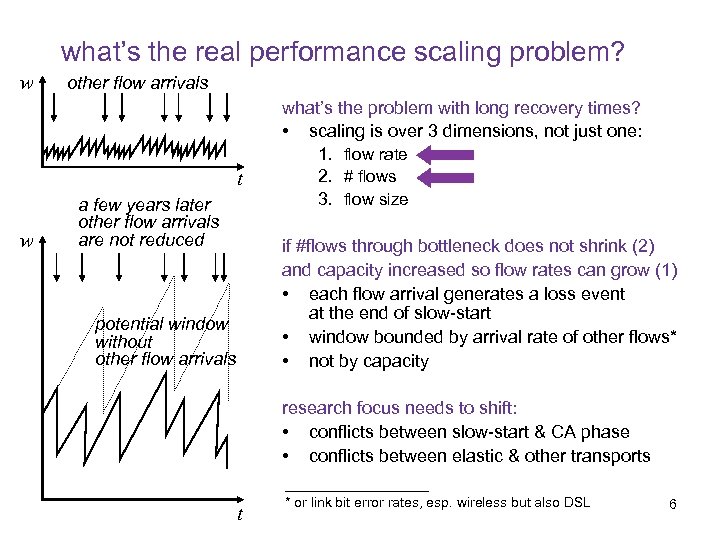 what’s the real performance scaling problem? w other flow arrivals t w a few years later other flow arrivals are not reduced what’s the problem with long recovery times? • scaling is over 3 dimensions, not just one: 1. flow rate 2. # flows 3. flow size if #flows through bottleneck does not shrink (2) and capacity increased so flow rates can grow (1) • each flow arrival generates a loss event at the end of slow-start • window bounded by arrival rate of other flows* • not by capacity potential window without other flow arrivals research focus needs to shift: • conflicts between slow-start & CA phase • conflicts between elastic & other transports t * or link bit error rates, esp. wireless but also DSL 6
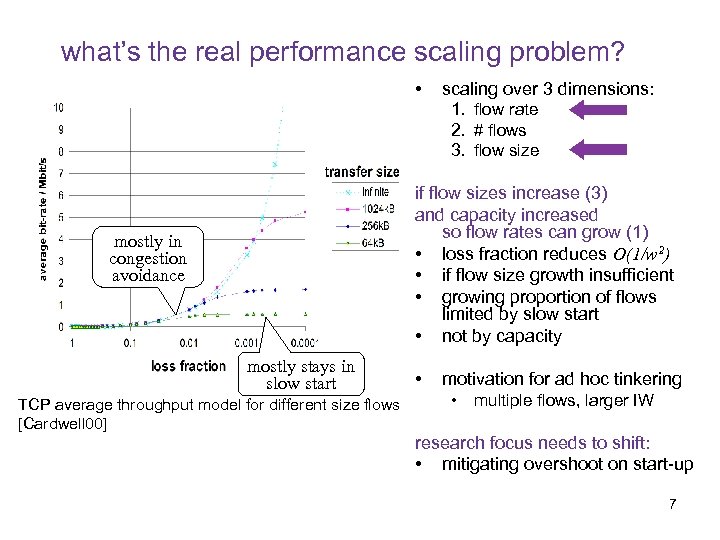 what’s the real performance scaling problem? • scaling over 3 dimensions: 1. flow rate 2. # flows 3. flow size if flow sizes increase (3) and capacity increased so flow rates can grow (1) • loss fraction reduces O(1/w 2) • if flow size growth insufficient • growing proportion of flows limited by slow start • not by capacity mostly in congestion avoidance mostly stays in slow start TCP average throughput model for different size flows [Cardwell 00] • motivation for ad hoc tinkering • multiple flows, larger IW research focus needs to shift: • mitigating overshoot on start-up 7
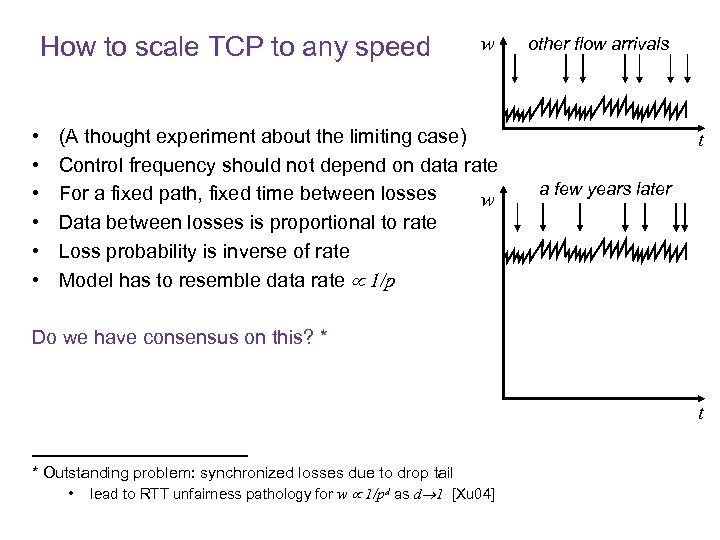 How to scale TCP to any speed • • • w (A thought experiment about the limiting case) Control frequency should not depend on data rate For a fixed path, fixed time between losses w Data between losses is proportional to rate Loss probability is inverse of rate Model has to resemble data rate 1/p other flow arrivals t a few years later Do we have consensus on this? * t * Outstanding problem: synchronized losses due to drop tail • lead to RTT unfairness pathology for w 1/pd as d 1 [Xu 04]
 network support? • what new network feature is needed, if any, to help e 2 e transport performance scale? • challenge #1 in “Open Research Issues in Internet Congestion Control”
 delay sensing – not a panacea • scaling any of the 3 dimensions upwards drives queuing delay downwards [Kelly 00; § 2] 1. flow rate 2. # flows 3. flow size • increasingly hard to distinguish tiny queuing delay from noise 10
 is a scalable congestion control sufficient? • more aggressive • and more robust to aggression • loss probability reduces over the years • loss rate remains the same for the fast transfers • if a sensitive app (e. g. Vo. IP) works today • it should work tomorrow. . ? • the challenge • high acceleration • overshoot when sensing available capacity 11
 Do we need flow isolation too? • Isolate traffic such that greedy flows can't harm others • Undo “Simple network” assumption • Requires the network to distinguish between flows • Send more signals to aggressive flows • Ideally small (short or low rate) flows have predictable rates • See: draft-livingood-woundy-congestion-mgmt-03 • See: later talk by Matt Mathis • fundamental conflict with weighted congestion control
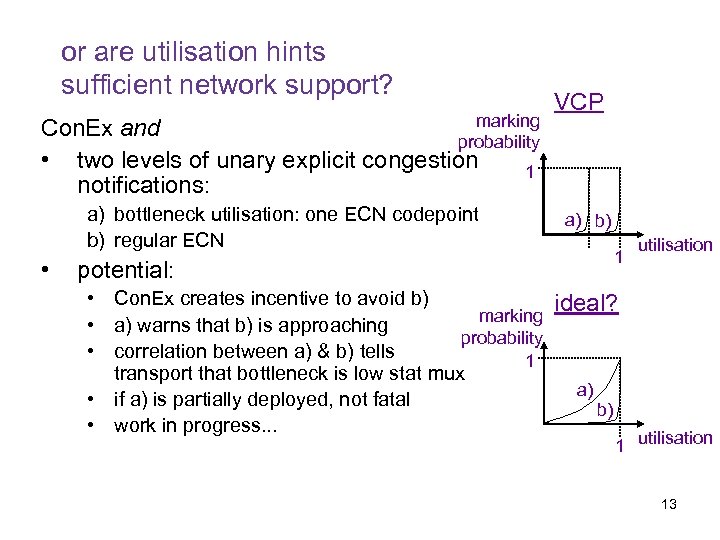 or are utilisation hints sufficient network support? marking Con. Ex and probability • two levels of unary explicit congestion 1 notifications: a) bottleneck utilisation: one ECN codepoint b) regular ECN • potential: VCP a) b) 1 utilisation • Con. Ex creates incentive to avoid b) ideal? marking • a) warns that b) is approaching probability • correlation between a) & b) tells 1 transport that bottleneck is low stat mux a) • if a) is partially deployed, not fatal b) • work in progress. . . 1 utilisation 13
 research area #2 diversity of congestion responses
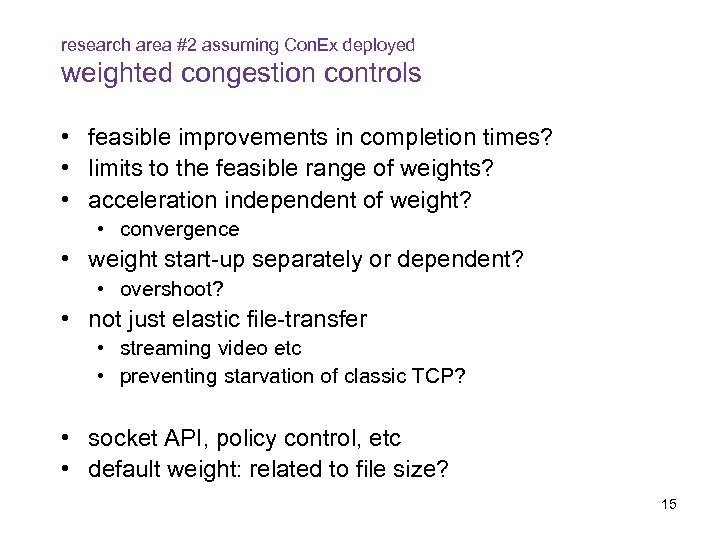 research area #2 assuming Con. Ex deployed weighted congestion controls • feasible improvements in completion times? • limits to the feasible range of weights? • acceleration independent of weight? • convergence • weight start-up separately or dependent? • overshoot? • not just elastic file-transfer • streaming video etc • preventing starvation of classic TCP? • socket API, policy control, etc • default weight: related to file size? 15
 research area #3 predicting congestion patterns & structure
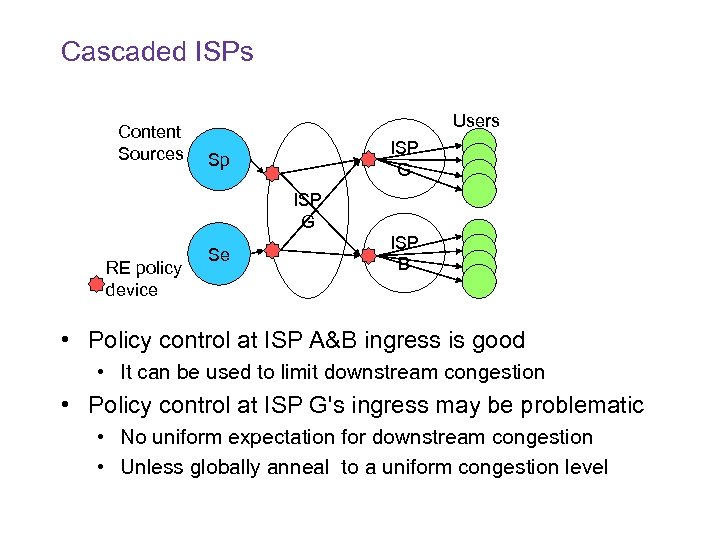 Cascaded ISPs Content Sources Users ISP G Sp ISP G RE policy device Se ISP B • Policy control at ISP A&B ingress is good • It can be used to limit downstream congestion • Policy control at ISP G's ingress may be problematic • No uniform expectation for downstream congestion • Unless globally anneal to a uniform congestion level
 Problem: Unexpected performance • Application performance explicitly depends on other users • Expected be more erratic than the current net • Some people might disagree • Especially if users can bid for congestion • Most users would prefer stable prices and data rates • Moves the net away from performance guarantees • A big headache for high performance applications • Not that we can do performance guarantees today • RE-ECN is likely to be quite a bit worse
 More predictable performance? • Re-ECN doesn’t change the congestion control • explicit dependence on other users unchanged • solely enables operator to switch on the significance of minimising congestion • likely to encourage shifting of peaks into troughs • Moves the net towards more assured performance • global ‘annealing’ • If using network at maximum efficiency • can have either stable prices or stable performance • if want both, have to pay a constant but higher price • or accept lower but consistent service Which of the two views is probably correct?
 Problem: not diagnosable Point • Performance depends on things not observable • User can't tell why any particular marking rate • Provider sees aggregate marking & data rates • No specific information about any particular flow • Problem may be an unrelated flow that user can't identify • Out bidding may not be feasible Counterpoint • re-ECN gives operator info it doesn’t currently have • can locate problems to neighbouring networks • measuring aggregates is sufficient • but nothing to stop looking per flow (e. g. for fault diganosis)
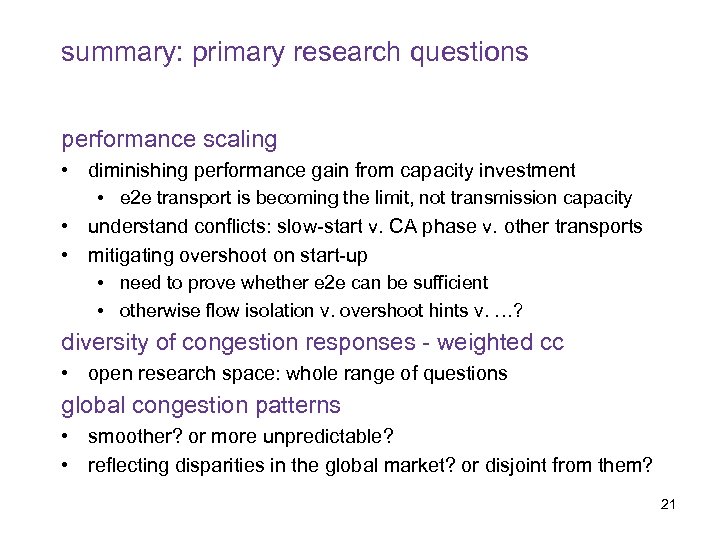 summary: primary research questions performance scaling • diminishing performance gain from capacity investment • e 2 e transport is becoming the limit, not transmission capacity • understand conflicts: slow-start v. CA phase v. other transports • mitigating overshoot on start-up • need to prove whether e 2 e can be sufficient • otherwise flow isolation v. overshoot hints v. …? diversity of congestion responses - weighted cc • open research space: whole range of questions global congestion patterns • smoother? or more unpredictable? • reflecting disparities in the global market? or disjoint from them? 21
![references • [Cardwell 00] N. Cardwell, S. Savage and T. Anderson,](https://present5.com/presentation/3809d3690f819ba3823c29956387f8a3/image-22.jpg "references • [Cardwell 00] N. Cardwell, S. Savage and T. Anderson,") references • [Cardwell 00] N. Cardwell, S. Savage and T. Anderson, "Modeling TCP latency, “In Proceedings of IEEE INFOCOM, Tel Aviv, Israel, March 2000. http: //citeseer. ist. psu. edu/cardwell 00 modeling. html • [Wischik 07] Wischik, D. , "Short Messages, " In: Proc. Workshop on Networks: Modelling and Control Royal Society (September 2007) http: //www. cs. ucl. ac. uk/staff/ucacdjw/Research/shortmsg. pdf • [Xu 04] Lisong Xu, Khaled Harfoush, and Injong Rhee, "Binary Increase Congestion Control for Fast Long-Distance Networks", In: Proc IEEE INFOCOM 2004, pp. 2514 -2524 (March 2004) • [Kelly 00] Kelly, F. P. , "Models for a Self-Managed Internet, " Philosophical Transactions of the Royal Society 358(1773): 2335 --2348 (August 2000) http: //www. statslab. cam. ac. uk/~frank/smi. html 22
references • [Cardwell 00] N. Cardwell, S. Savage and T. Anderson, "Modeling TCP latency, “In Proceedings of IEEE INFOCOM, Tel Aviv, Israel, March 2000. http: //citeseer. ist. psu. edu/cardwell 00 modeling. html • [Wischik 07] Wischik, D. , "Short Messages, " In: Proc. Workshop on Networks: Modelling and Control Royal Society (September 2007) http: //www. cs. ucl. ac. uk/staff/ucacdjw/Research/shortmsg. pdf • [Xu 04] Lisong Xu, Khaled Harfoush, and Injong Rhee, "Binary Increase Congestion Control for Fast Long-Distance Networks", In: Proc IEEE INFOCOM 2004, pp. 2514 -2524 (March 2004) • [Kelly 00] Kelly, F. P. , "Models for a Self-Managed Internet, " Philosophical Transactions of the Royal Society 358(1773): 2335 --2348 (August 2000) http: //www. statslab. cam. ac. uk/~frank/smi. html 22
 Internet Capacity Sharing Architecture congestion control research agenda Q&A Bob Briscoe is partly funded by Trilogy, a research project supported by the European Community www. trilogy-project. org