 Скачать презентацию Internet Based Distance Education at the HAS Bratislava
9fdf58afcb3651de5e1274774e5a5bea.ppt
- Количество слайдов: 23



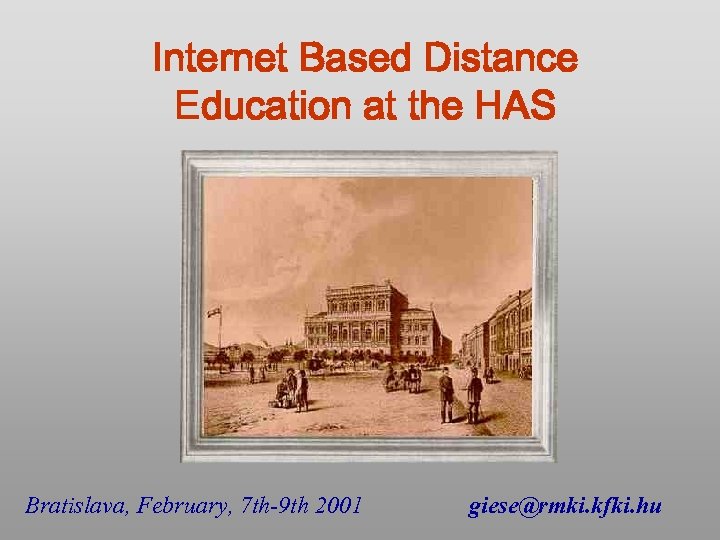
Internet Based Distance Education at the HAS Bratislava, February, 7 th-9 th 2001 giese@rmki. kfki. hu
Overview v Short description of HAS v Distance education project § key ideas § activities § background v Things to do Bratislava February, 7 th-9 th 2001 giese@rmki. kfki. hu
The Hungarian Academy of Sciences - HAS § independent public body based on the principle of self-government § constituted by the members of the Academy (ordinary , corresponding as well as external and honorary members) and active representatives of science (Ph. D or D. Sc) Bratislava February, 7 th-9 th 2001 giese@rmki. kfki. hu
Rights and duty of the Academy are § to support the development of sciences § to evaluate scientific research results § to represent Hungarian science in Hungarian public life and at international scientific fora Bratislava February, 7 th-9 th 2001 giese@rmki. kfki. hu
To perform its task the Academy 1. establishes and maintains research institutes 2. (~40 institutes and >100 res. groups at Universities) 3. sets up scientific sections and committees 4. to coordinate the activity of researchers 5. The Academy gives its opinion on issues relating to sciences and other important questions and problems concerning the Hungarian society and economy without any request or Bratislava February, 7 th-9 th 2001 giese@rmki. kfki. hu permissions of organs, fields or governing groups concerned.
Within the scope of its activity HAS: 1. maintains contacts with scientific organs and 2. societies of the country 3. organizes scientific congresses and sessions 4. announces competitions and awards prizes 5. takes part in scientific qualification process 1. awards the scientific title 2. Doctor of the Hungarian Academy of Sciences 3. participates in higher education and Ph. D training Bratislava February, 7 th-9 th 2001 giese@rmki. kfki. hu
The Academy’s sources of funds are 1. the central governmental budget 2. receipts from the Academy’s activity 3. foundations, donations and support for the 4. promotion of the Academy’s activity 5. The President of the Academy annually informs the Government on the Academy’s activity and regularly gives account to Parliament Bratislava February, 7 th-9 th 2001 giese@rmki. kfki. hu
The Hungarian Academy of Science has started a project supporting the modern form of distance education using the advanced information technologies. It runs under the control of the Secretary-General Bratislava February, 7 th-9 th 2001 giese@rmki. kfki. hu
Key ideas (1) § to spread knowledge about Internet-based education § to develop Internet courses based on existing courses – in Hungarian § to bring into the teaching material the expertise of the Hungarian research community (enlarging of the university studies) Bratislava, February, 7 th-9 th 2001 giese@rmki. kfki. hu
Key ideas (2) 1. to develop flexible education media based 2. on research units targeting the 3. postgraduate, post-doctoral level studies 4. to offer an opportunity to reach the very much 5. centralized Hungarian science and culture Bratislava, February, 7 th-9 th 2001 6. giese@rmki. kfki. hu
Main activities of the project: § establishing a forum for learning content management (program committee) § building an ILS server containing distance courses, discussion and collaboration § developing Internet-based learning materials § organizing training and workshops for future authors, tutors and managers in this field § participating in strategic development Bratislava February, 7 th-9 th 2001 giese@rmki. kfki. hu
Why undertakes this work the Academy ? Bratislava February, 7 th-9 th 2001 giese@rmki. kfki. hu
Background § Human resources § Technical resources § Initiatives of research institutes § Current situation of distance education in Hungary Bratislava February, 7 th-9 th 2001 giese@rmki. kfki. hu
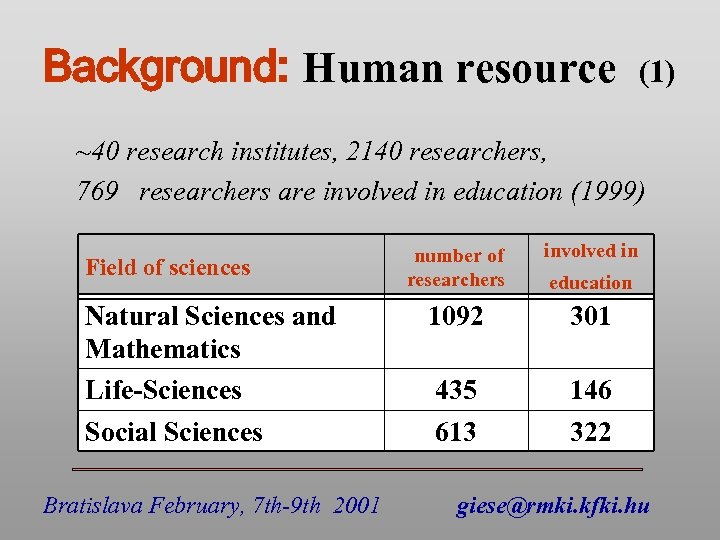
Background: Human resource (1) ~40 research institutes, 2140 researchers, 769 researchers are involved in education (1999) Field of sciences Natural Sciences and Mathematics Life-Sciences Social Sciences Bratislava February, 7 th-9 th 2001 number of researchers involved in 1092 301 435 613 146 322 education giese@rmki. kfki. hu
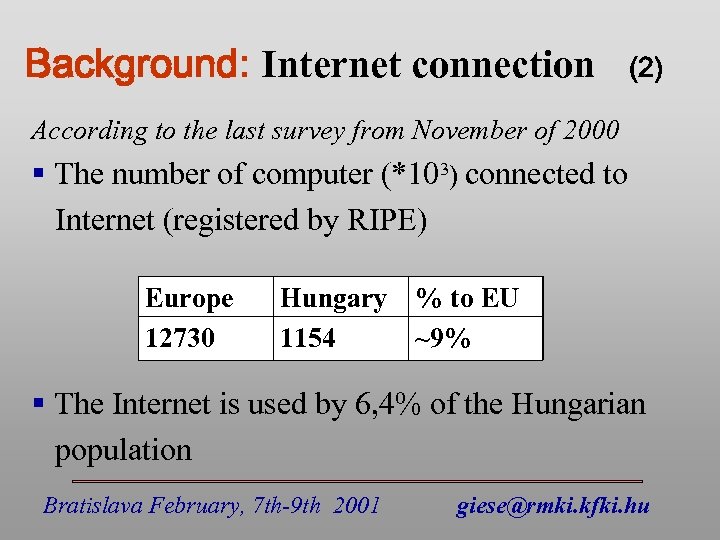
Background: Internet connection (2) According to the last survey from November of 2000 § The number of computer (*103) connected to Internet (registered by RIPE) Europe 12730 Hungary % to EU 1154 ~9% § The Internet is used by 6, 4% of the Hungarian population Bratislava February, 7 th-9 th 2001 giese@rmki. kfki. hu
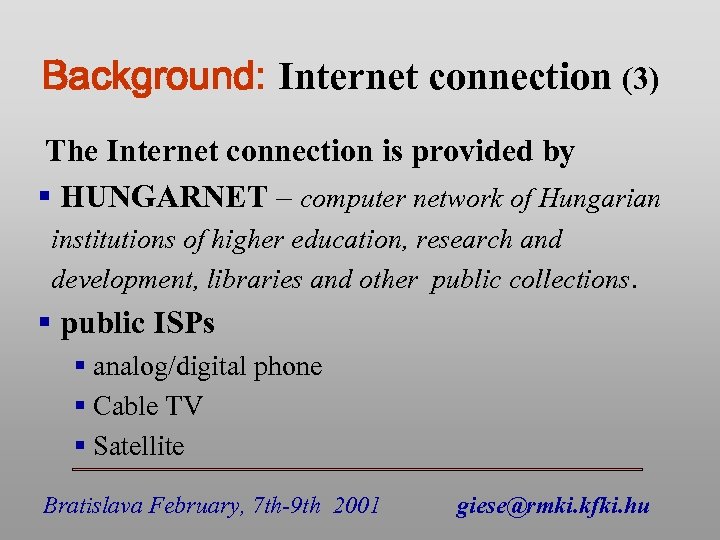
Background: Internet connection (3) The Internet connection is provided by § HUNGARNET – computer network of Hungarian institutions of higher education, research and development, libraries and other public collections. § public ISPs § analog/digital phone § Cable TV § Satellite Bratislava February, 7 th-9 th 2001 giese@rmki. kfki. hu
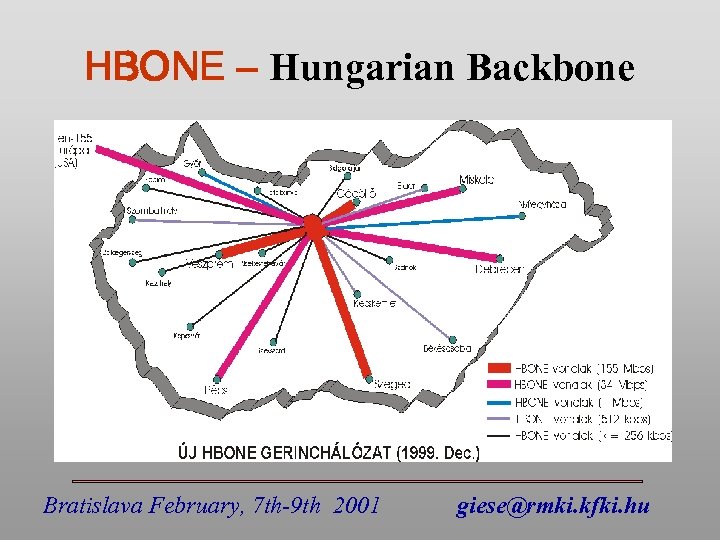
HBONE – Hungarian Backbone Bratislava February, 7 th-9 th 2001 giese@rmki. kfki. hu
Background: Initiatives (5) v. The Open University of the Institute for Philosophical Research Main characteristics are: § high level on-line courses on the Web § free with registration by e-mail § on-line consultation (e-mail) § on-demand oral examination Bratislava February, 7 th-9 th 2001 giese@rmki. kfki. hu
Background: Initiatives (6) The main topics of the Open University for Philosophy are: § History of the Philosophy § Philosophy of the Science § Social Philosophy § Religious Philosophy § Communication Philosophy http: //www. phil-inst. hu/ Bratislava February, 7 th-9 th 2001 giese@rmki. kfki. hu
Background: Initiatives (7) v Distance Learning solution at KFKI RMKI (*) for teaching and training young researchers: § on the WWW based teaching platform developed in the University of Hagen - Germany § on the Gentle-WBT set up at KFKI RMKI http: //www. rmki. kfki. hu/lho/elearning. htm (*) KFKI Research Institute for Particle and Nuclear Physics) Bratislava February, 7 th-9 th 2001 giese@rmki. kfki. hu
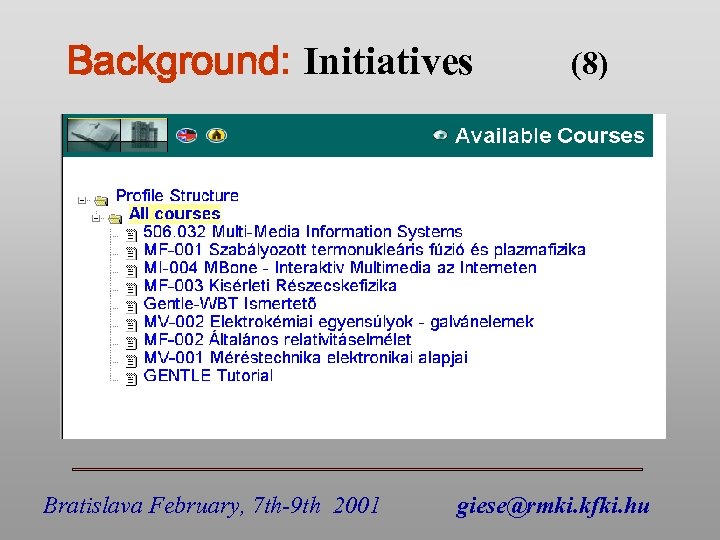
Background: Initiatives Bratislava February, 7 th-9 th 2001 (8) giese@rmki. kfki. hu
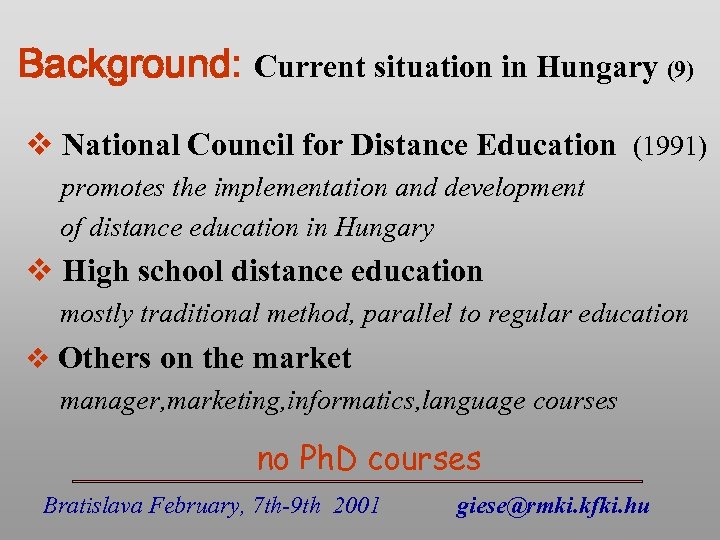
Background: Current situation in Hungary (9) v National Council for Distance Education (1991) promotes the implementation and development of distance education in Hungary v High school distance education mostly traditional method, parallel to regular education v Others on the market manager, marketing, informatics, language courses no Ph. D courses Bratislava February, 7 th-9 th 2001 giese@rmki. kfki. hu
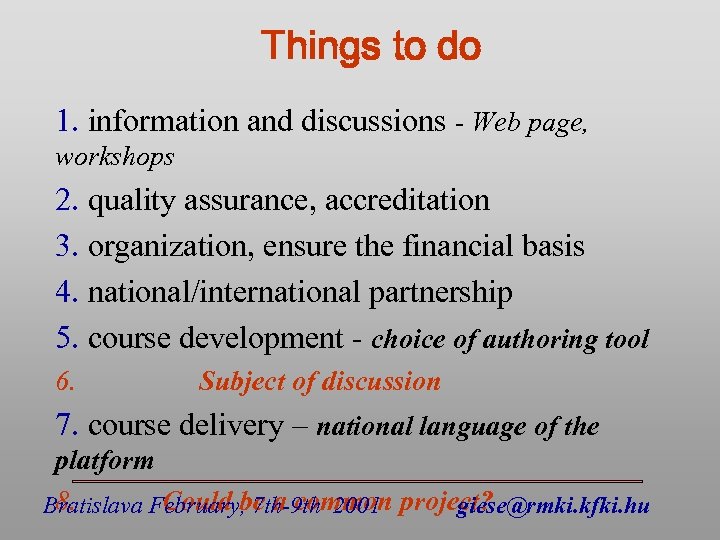
Things to do 1. information and discussions - Web page, workshops 2. quality assurance, accreditation 3. organization, ensure the financial basis 4. national/international partnership 5. course development - choice of authoring tool 6. Subject of discussion 7. course delivery – national language of the platform 8. Could be a common Bratislava February, 7 th-9 th 2001 project? giese@rmki. kfki. hu
Скачать презентацию Internet Based Distance Education at the HAS Bratislava
9fdf58afcb3651de5e1274774e5a5bea.ppt