


 Скачать презентацию INTERNATIONALIZATION STRATEGY OF RUSSIAN STANDARD USA CONTEXT Graduate
Russian_Standard.pptx
- Количество слайдов: 15
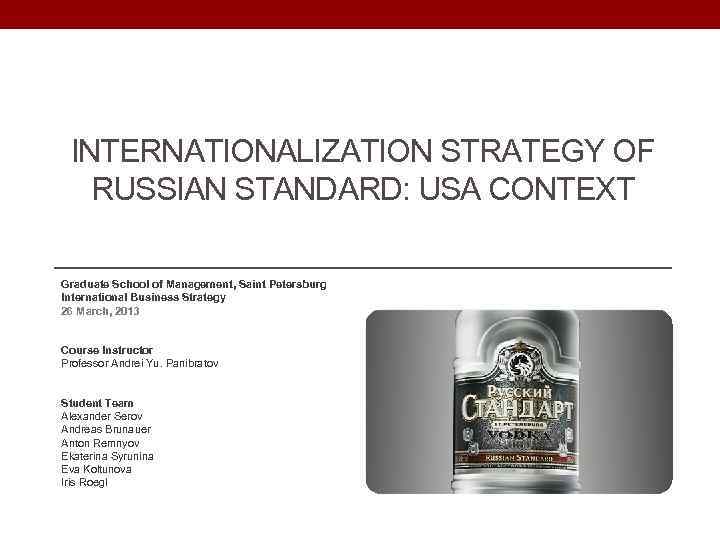 INTERNATIONALIZATION STRATEGY OF RUSSIAN STANDARD: USA CONTEXT Graduate School of Management, Saint Petersburg International Business Strategy 26 March, 2013 Course Instructor Professor Andrei Yu. Panibratov Student Team Alexander Serov Andreas Brunauer Anton Remnyov Ekaterina Syrunina Eva Koltunova Iris Roegl
 International Business Strategy - Russian Standard Agenda ü History and background overview ü Global vodka market ü Competetive environment ü From local to global: factors and reasons ü Internationalization strategy in the USA ü Internal analysis: ü VRIS-analysis ü Marketing mix ü SWOT analysis ü Recommendations 2
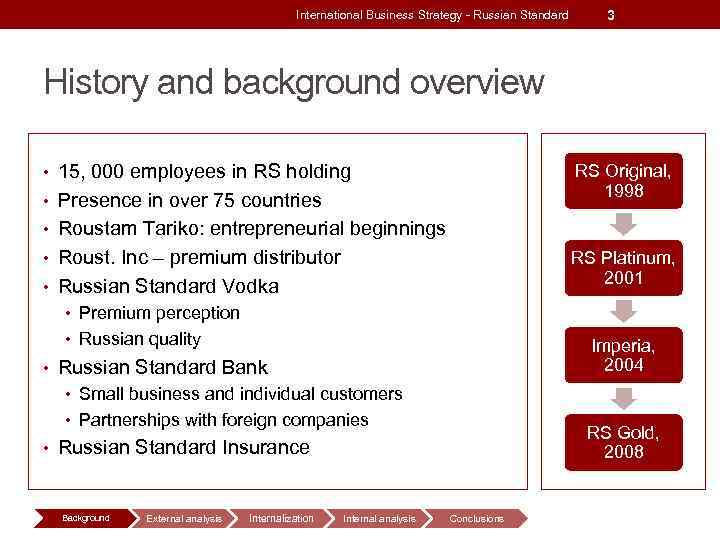 International Business Strategy - Russian Standard 3 History and background overview • 15, 000 employees in RS holding RS Original, 1998 • Presence in over 75 countries • Roustam Tariko: entrepreneurial beginnings • Roust. Inc – premium distributor RS Platinum, 2001 • Russian Standard Vodka • Premium perception • Russian quality Imperia, 2004 • Russian Standard Bank • Small business and individual customers • Partnerships with foreign companies RS Gold, 2008 • Russian Standard Insurance Background External analysis Internalization Internal analysis Conclusions
 International Business Strategy - Russian Standard 4 Global vodka market • Worldwide consumption of vodka: about 6. 5 billion bottles/year • Largest international trade spirit • 2010 – 2015 F: 0. 7% compound annual growth rate • Highly fragmented • Biggest vodka markets: Russia, Ukraine, US • Four price segments: low, standard, premium, super-premium • Global players: • Diageo (Smirnoff, Ciroc) • CEDC (Parliament, Absolwent) • Pernod Recard (Absolut, Wyborowa) • Stock spirits Background External analysis Internalization Internal analysis Conclusions
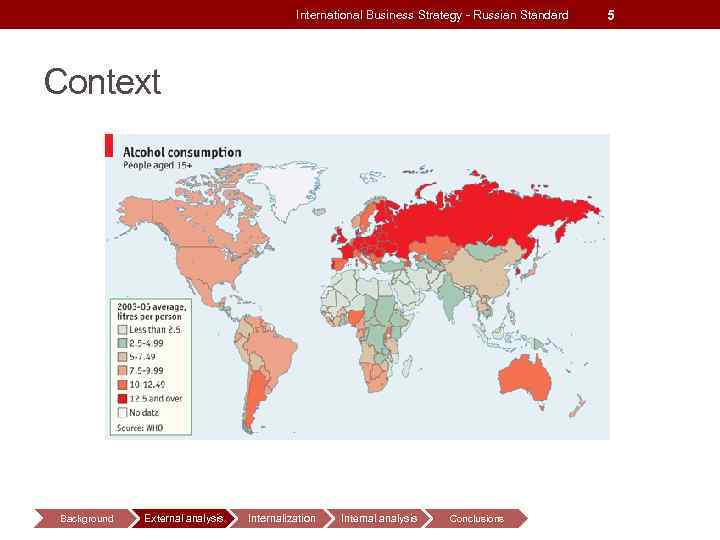 International Business Strategy - Russian Standard Context Background External analysis Internalization Internal analysis Conclusions 5
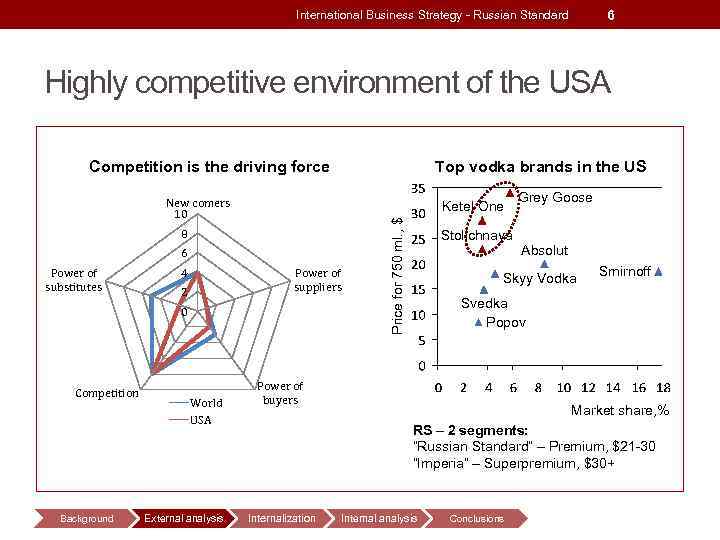 6 International Business Strategy - Russian Standard Highly competitive environment of the USA Competition is the driving force Top vodka brands in the US New comers 10 8 6 Power of substitutes 4 Power of suppliers 2 0 Competition Background World USA External analysis Price for 750 ml. , $ Ketel One Stolichnaya Grey Goose Absolut Skyy Vodka Smirnoff Svedka Popov Power of buyers Market share, % RS – 2 segments: “Russian Standard” – Premium, $21 -30 “Imperia” – Superpremium, $30+ Internalization Internal analysis Conclusions
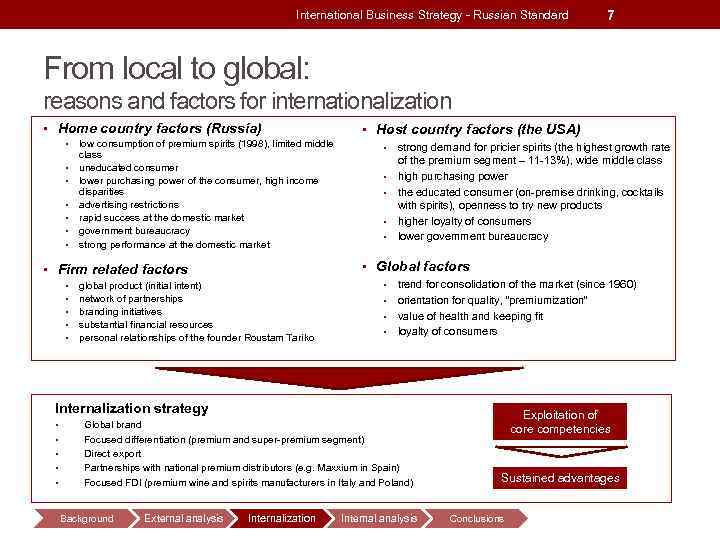 International Business Strategy - Russian Standard 7 From local to global: reasons and factors for internationalization • Home country factors (Russia) • • low consumption of premium spirits (1998), limited middle class uneducated consumer lower purchasing power of the consumer, high income disparities advertising restrictions rapid success at the domestic market government bureaucracy strong performance at the domestic market • • • strong demand for pricier spirits (the highest growth rate of the premium segment – 11 -13%), wide middle class high purchasing power the educated consumer (on-premise drinking, cocktails with spirits), openness to try new products higher loyalty of consumers lower government bureaucracy • Global factors • Firm related factors • • • Host country factors (the USA) global product (initial intent) network of partnerships branding initiatives substantial financial resources personal relationships of the founder Roustam Tariko trend for consolidation of the market (since 1960) • orientation for quality, “premiumization” • value of health and keeping fit • loyalty of consumers • Internalization strategy • • • Global brand Focused differentiation (premium and super-premium segment) Direct export Partnerships with national premium distributors (e. g. Maxxium in Spain) Focused FDI (premium wine and spirits manufacturers in Italy and Poland) Background External analysis Internalization Internal analysis Exploitation of core competencies Sustained advantages Conclusions
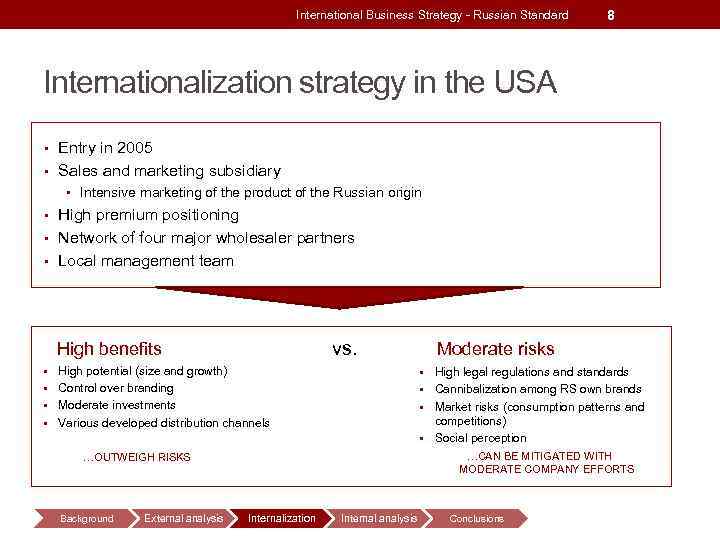 International Business Strategy - Russian Standard 8 Internationalization strategy in the USA • Entry in 2005 • Sales and marketing subsidiary • Intensive marketing of the product of the Russian origin • High premium positioning • Network of four major wholesaler partners • Local management team High benefits vs. Moderate risks • High potential (size and growth) • High legal regulations and standards • Control over branding • Cannibalization among RS own brands • Moderate investments • Market risks (consumption patterns and • Various developed distribution channels competitions) • Social perception …CAN BE MITIGATED WITH MODERATE COMPANY EFFORTS …OUTWEIGH RISKS Background External analysis Internalization Internal analysis Conclusions
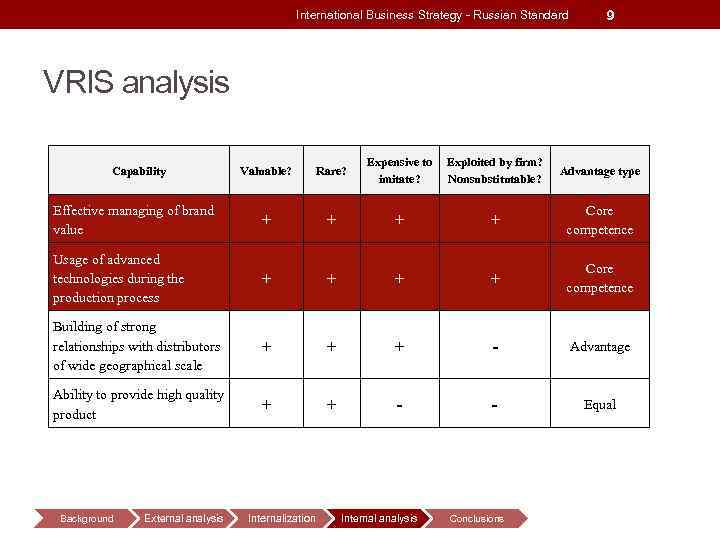 International Business Strategy - Russian Standard 9 VRIS analysis Valuable? Rare? Expensive to imitate? Exploited by firm? Nonsubstitutable? Advantage type Effective managing of brand value + + Core competence Usage of advanced technologies during the production process + + Core competence Building of strong relationships with distributors of wide geographical scale + + + - Advantage Ability to provide high quality product + + - - Equal Capability Background External analysis Internalization Internal analysis Conclusions
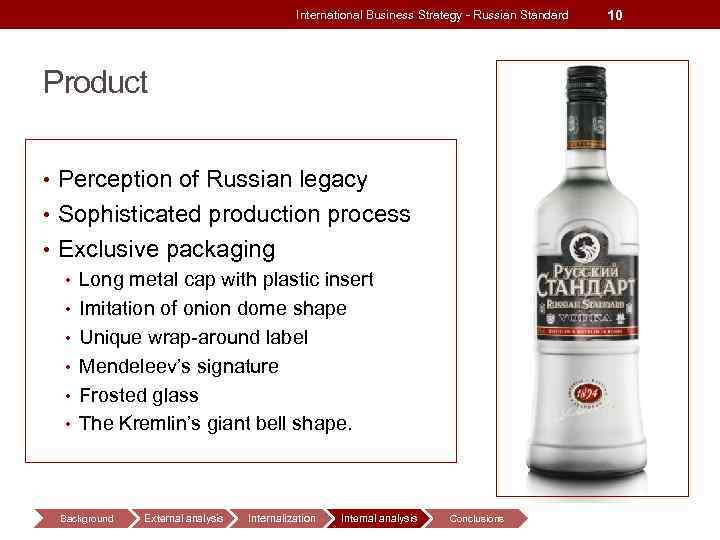 International Business Strategy - Russian Standard Product • Perception of Russian legacy • Sophisticated production process • Exclusive packaging • Long metal cap with plastic insert • Imitation of onion dome shape • Unique wrap-around label • Mendeleev’s signature • Frosted glass • The Kremlin’s giant bell shape. Background External analysis Internalization Internal analysis Conclusions 10
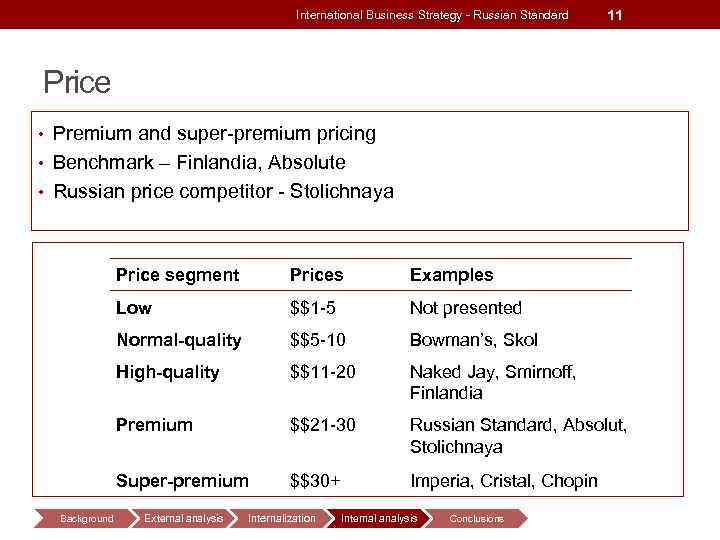 International Business Strategy - Russian Standard 11 Price • Premium and super-premium pricing • Benchmark – Finlandia, Absolute • Russian price competitor - Stolichnaya Price segment Examples Low $$1 -5 Not presented Normal-quality $$5 -10 Bowman’s, Skol High-quality $$11 -20 Naked Jay, Smirnoff, Finlandia Premium $$21 -30 Russian Standard, Absolut, Stolichnaya Super-premium Background Prices $$30+ Imperia, Cristal, Chopin External analysis Internalization Internal analysis Conclusions
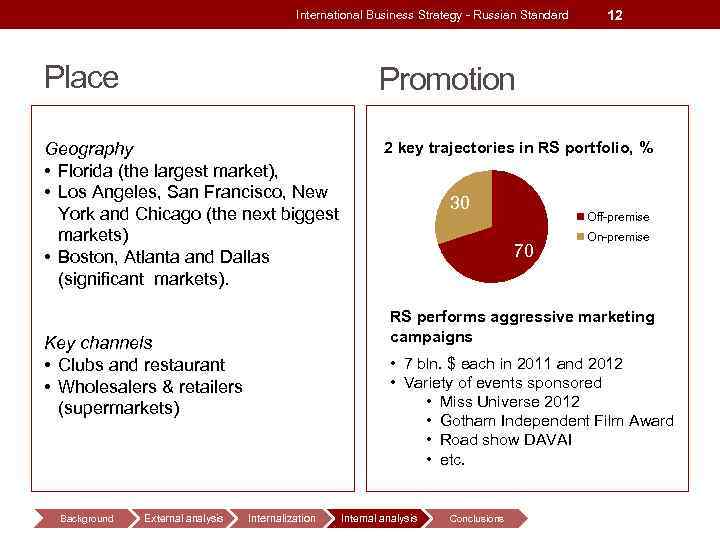 International Business Strategy - Russian Standard Place Promotion Geography • Florida (the largest market), • Los Angeles, San Francisco, New York and Chicago (the next biggest markets) • Boston, Atlanta and Dallas (significant markets). Key channels • Clubs and restaurant • Wholesalers & retailers (supermarkets) Background 12 External analysis Internalization 2 key trajectories in RS portfolio, % 30 Off-premise 70 On-premise RS performs aggressive marketing campaigns • 7 bln. $ each in 2011 and 2012 • Variety of events sponsored • Miss Universe 2012 • Gotham Independent Film Award • Road show DAVAI • etc. Internal analysis Conclusions
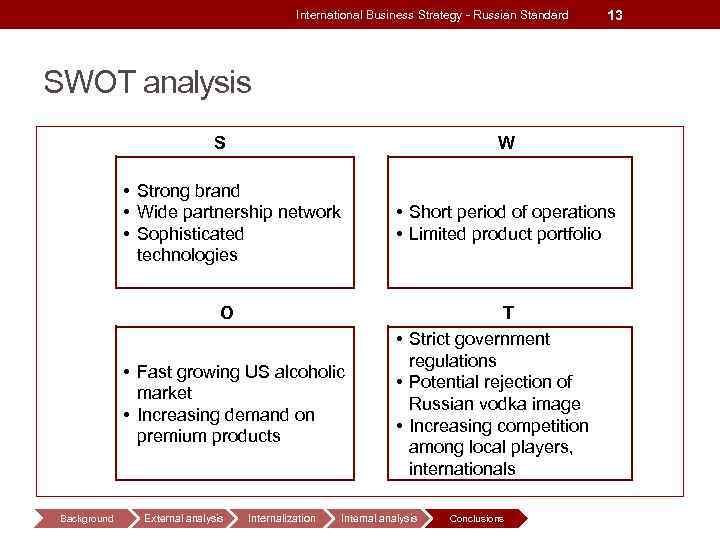 International Business Strategy - Russian Standard 13 SWOT analysis S W • Strong brand • Wide partnership network • Sophisticated technologies • Short period of operations • Limited product portfolio O • Fast growing US alcoholic market • Increasing demand on premium products Background External analysis Internalization T • Strict government regulations • Potential rejection of Russian vodka image • Increasing competition among local players, internationals Internal analysis Conclusions
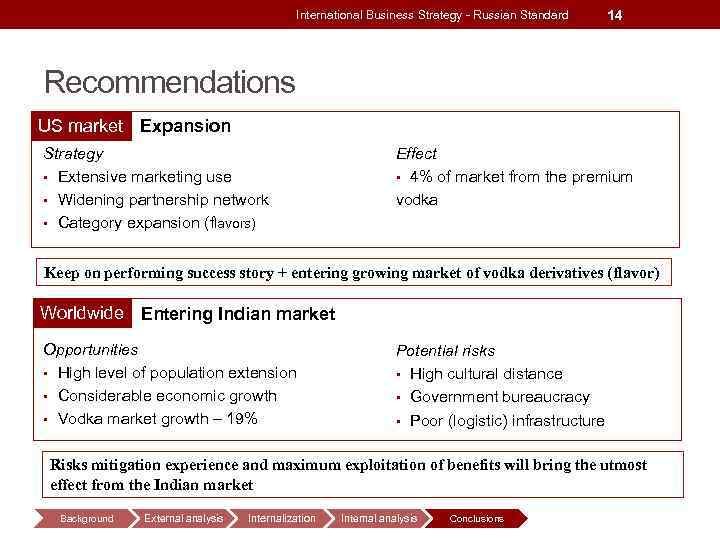 International Business Strategy - Russian Standard 14 Recommendations US market Expansion Strategy • Extensive marketing use • Widening partnership network • Category expansion (flavors) Effect • 4% of market from the premium vodka Keep on performing success story + entering growing market of vodka derivatives (flavor) Worldwide Entering Indian market Opportunities • High level of population extension • Considerable economic growth • Vodka market growth – 19% Potential risks • High cultural distance • Government bureaucracy • Poor (logistic) infrastructure Risks mitigation experience and maximum exploitation of benefits will bring the utmost effect from the Indian market Background External analysis Internalization Internal analysis Conclusions
 THANK YOU FOR YOUR ATTENTION!