


 Скачать презентацию Internationalization Higher Education Challenges and Oppurtunities Sherlyne A
0aa24ec944d4b42e9e2068c62eacfcc8.ppt
- Количество слайдов: 46
 Internationalization Higher Education: Challenges and Oppurtunities Sherlyne A. Almonte-Acosta, Ph. D. SEAMEO INNOTECH Strategic Planning Cebu Normal University
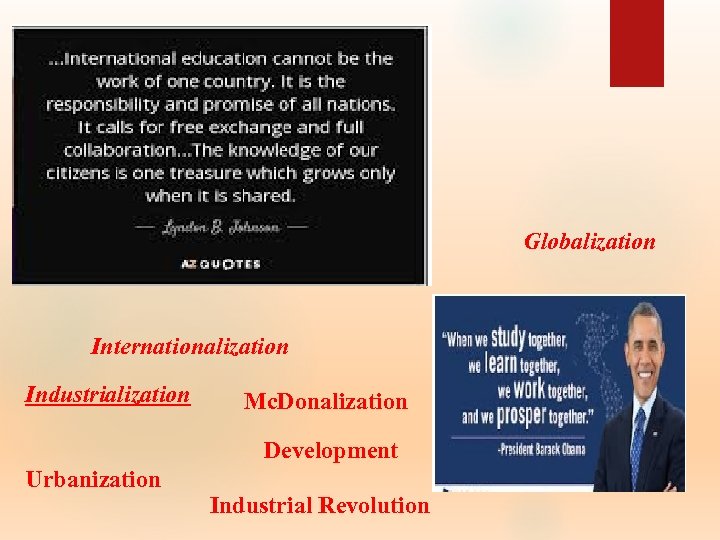 Globalization Internationalization Industrialization Mc. Donalization Development Urbanization Industrial Revolution
 Objectives On Internationalization As Process/Cycle Dimensions Evolution of the concept Key Drivers Philippine Context CHED’s Internationalization Key Drivers of Internationalization Challenges of Internationalization
 Approaches, Dimensions, Strategies
 Evolution of the concept… …is a process by which the educational provision of education system becomes more sophisticated, enriched and broadly applicable to students from all backgrounds and countries… …emphasizing especially the possibility of development programs which are internationally and cross-culturally compatible…. …with the view toward providing all students with experiences and training necessary to develop skills for life in a world characterized by increasing international exchange…Ebuchi, 1989
 Process of integrating an international and intercultural dimensions into the teaching, research and service functions of the institution (Knight, 1994) Any systematic effort aimed at making higher education responsive to the requirements and challenges related to globalization of societies, economy, and labor markets(Van der Wende, 1997) A change process from national to international higher education institution leading to the inclusion of international dimensions holistically to enhance quality of teaching & learning and to achieve desired competencies (Soderquist, 2002)
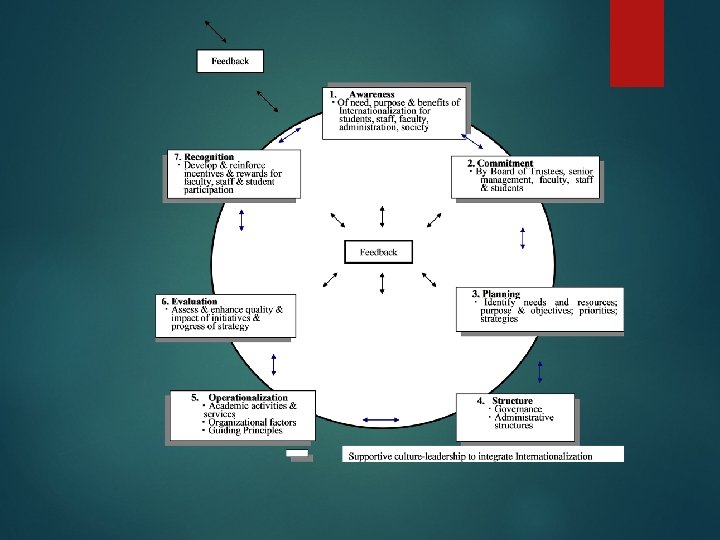
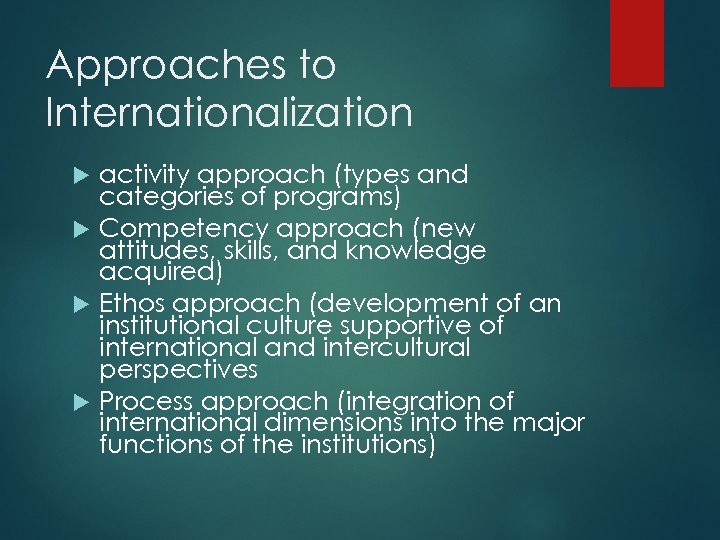 Approaches to Internationalization activity approach (types and categories of programs) Competency approach (new attitudes, skills, and knowledge acquired) Ethos approach (development of an institutional culture supportive of international and intercultural perspectives Process approach (integration of international dimensions into the major functions of the institutions)
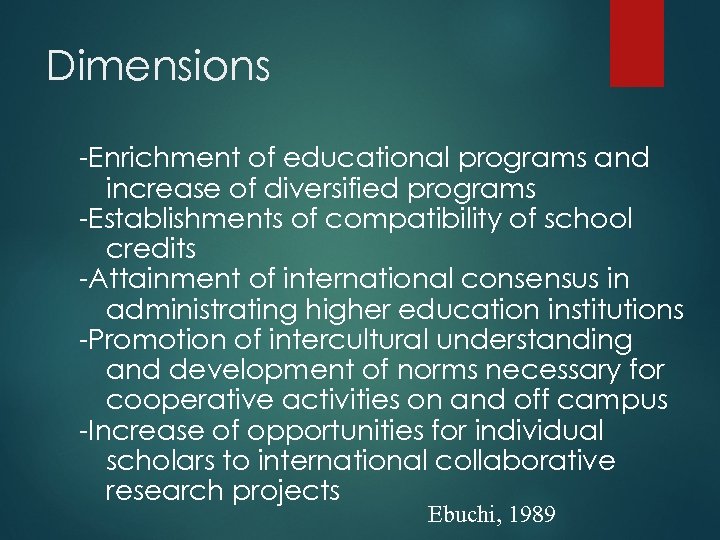 Dimensions -Enrichment of educational programs and increase of diversified programs -Establishments of compatibility of school credits -Attainment of international consensus in administrating higher education institutions -Promotion of intercultural understanding and development of norms necessary for cooperative activities on and off campus -Increase of opportunities for individual scholars to international collaborative research projects Ebuchi, 1989
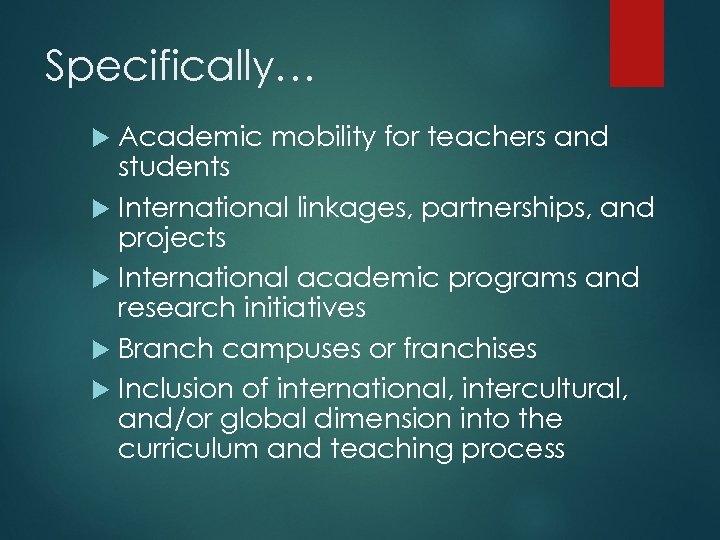 Specifically… Academic mobility for teachers and students International linkages, partnerships, and projects International academic programs and research initiatives Branch campuses or franchises Inclusion of international, intercultural, and/or global dimension into the curriculum and teaching process
 Programs strategies Research related activities Educational (instructional) activities Technical assistance activities Extra-curricular activities
 Organizational strategies Commitment and support of governing boards and senior administrators Support and involvement of faculty and staff Existence of an international office or position Adequate funding and support both internally and externally
 Organizational… A supportive policy framework Appropriate incentives and rewards for faculty and staff Existence of formal communication channels, and annual planning, budgeting and review process.
 Key Drivers of Internationalization
 Key drivers… Development of advanced communication and technological services Increased international labor mobility, more emphasis on market economy and trade liberalization Knowledge society Increased level of private investment Life long learning
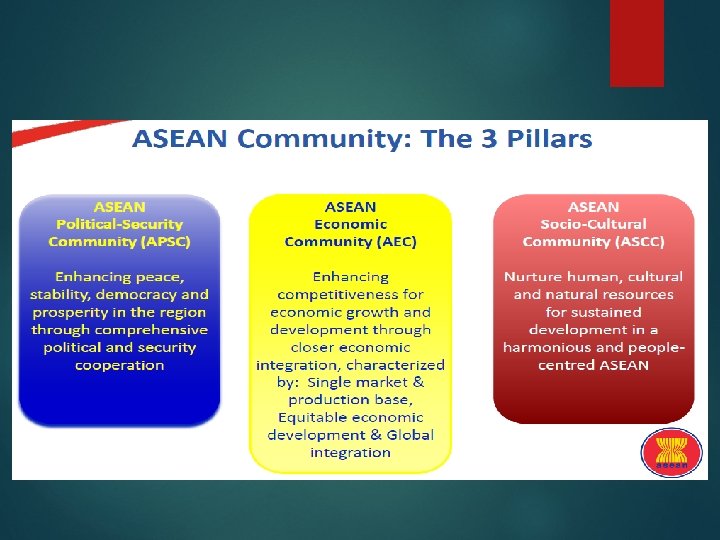
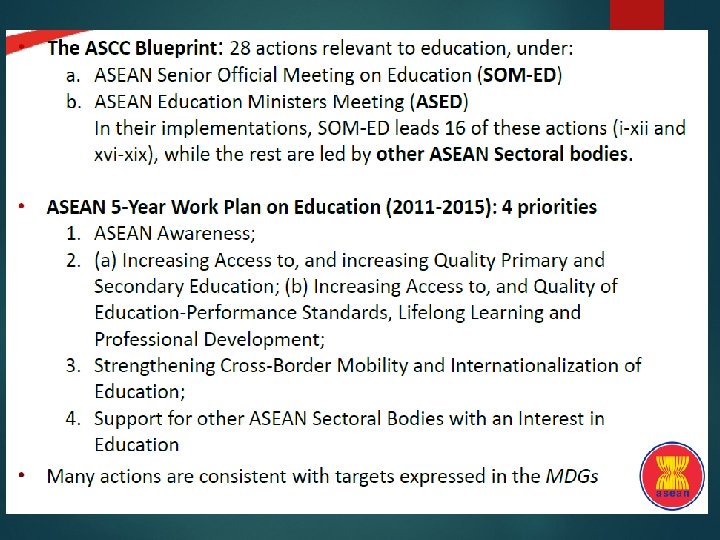
 ASEAN Integration of the ASEAN member countries one economic, political and socio-cultural community via increased interaction and cooperation, internationalization of calls for mobility, harmonization, diversity within a common educational space, learning through technology Intercultural and ASEAN dimensions Harmonization creates general guidelines Degree cycle and qualifications framework Quality assurance, lifelong learning, credit transfer system
 Harmonization Finding commonalities in practices Consensus in a system without jeopardizing cultural diversity and national identity Borrow ideas from others but expand introduce innovative idea Key Actors: SEAMEO RIHED, ASEA + 3 and ASEAN Universities Network (AUN)
 Harmonization (plan of actions) Regional Unified Accreditation Education Framework Improve Quality of Education Scholarship for students/Faculty exchange Regional Skills Competitions Increase use of English language
 Harmonization Programs – SEAMEO RIHED Empowering HEIs: Study visits programs Developing harmonization mechanism: (i. Award), Academic Credit Transfer Framework, Quality Assurance Framework Cultivating Globalized human resources: ASEAN International Mobility for Students (AIMS) Programme Advancing knowledge Frontiers in HEIs system management: Policy Action Research, building Academic Transfer Credit for Asia Promoting university social responsibility and sustainable development
 The Philippine Context
 Context of individual country: Improved analysis of benefits and costs Quality assurance Development of strategic alliances Broader dissemination of research findings
 Policy Framework and Strategies on the Internationalization of Philippine Higher Education CMO 55, s. 2016 Definition of Internationalization of Higher Education Process of integrating international, intercultural, and global dimensions into the goals, functions (teaching, learning, research, and service), and delivery of higher education Involves a process of interchange of higher education between nations, with partnerships between nations, between national systems of higher education, and between institutions of higher education.
 Why do we pursue Internationalization? Enhance the quality of HEI Uphold the country’s reputation as a center of higher education in identifies niches/programs of excellence; Strengthen the country’s role in an interconnected global community; Develop Philippine HEIs as productive members of the international academic community; Produce graduate with 21 st century competencies who are able to live and work in a diverse multicultural setting; and Foster closer cooperation and understanding between the Philippines and the rest of the world
 Policy Framework and Strategies on the Internationalization of Philippine Higher Education CMO 55, s. 2016 Pillars of Internationalization Home-based or campus-based Cross Border
 Home-based or campusbased internationalization Collaborative activities and events, networking, partnership and other forms of linkages with foreign higher education institutions often enabled by IT
 Home-based or campusbased internationalization Activities: On curriculum and programs On the teaching learning process On extra curricular activities On liaising with local cultural/ethnic groups On research and scholarly activity
 Cross-border education Involves mobility of students, faculty and researchers; programs, and institutions: Student/faculty/researcher mobility Program mobility Institutional mobility
 INTERNATIONALIZATION AS STRATEGY FOR QUALITY Developmental Role provision of advisory and technical assistance in the development and design on internationalization programs, training and capacity building provide information to guide choices and safeguard the legitimate interest of all stakeholders Regulatory Role promulgation of policies and standards for various types of internationalization arrangement, ensure compliance to existing laws and effective delivery of intended outcome
 Quality Assurance is a requirement for Internationalization is a mechanism for Quality Assurance
 DEFINITION OF QUALITY Distinctiveness, exceptionality or exclusivity Conformance to specification or standards Fitness for purpose Effectiveness in achieving institutional goals Meeting customers’ needs Transformation
 Functions of Quality Assurance Improvement of Education Accountability Public information and market transparency Steering of the higher education system in resources and planning
 Methodologies in International system of QA Self Evaluation Peer review by outside experts Statistical information and performance indicators A quality assurance audit
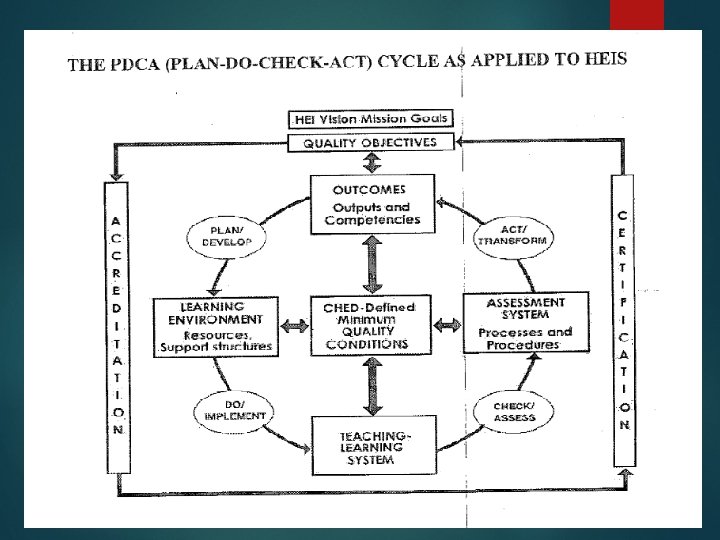
 QUALITY ASSURANCE An ongoing process of evaluating and enhancing the quality of a higher education system, institution, or program to assure stakeholders that acceptable standards of education, scholarships, and resources for delivery are being maintained. Quality assurance is about ensuring that there are mechanisms, procedures and processes in place to ensure that the desired quality is delivered.
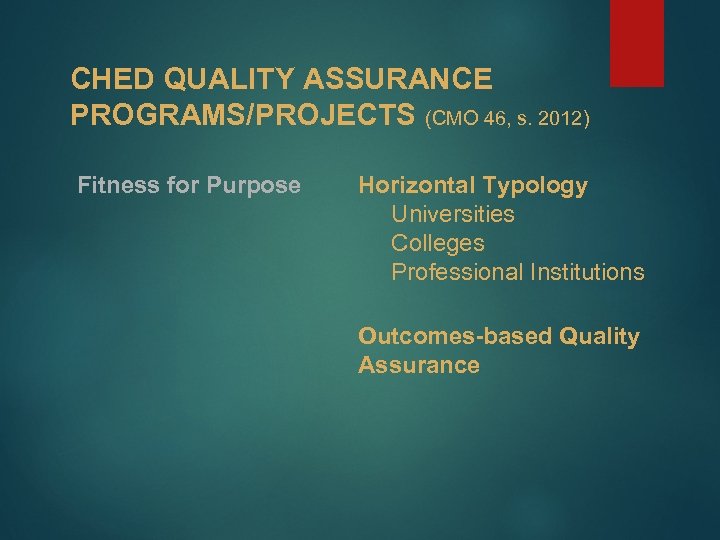 CHED QUALITY ASSURANCE PROGRAMS/PROJECTS (CMO 46, s. 2012) Fitness for Purpose Horizontal Typology Universities Colleges Professional Institutions Outcomes-based Quality Assurance
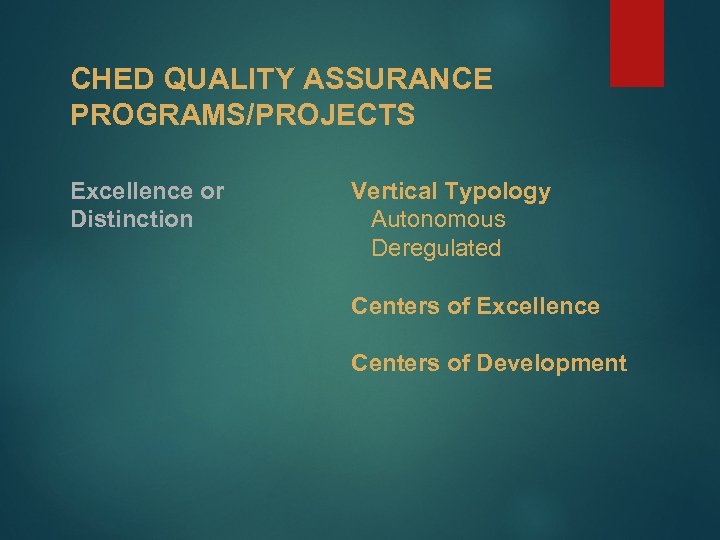 CHED QUALITY ASSURANCE PROGRAMS/PROJECTS Excellence or Distinction Vertical Typology Autonomous Deregulated Centers of Excellence Centers of Development
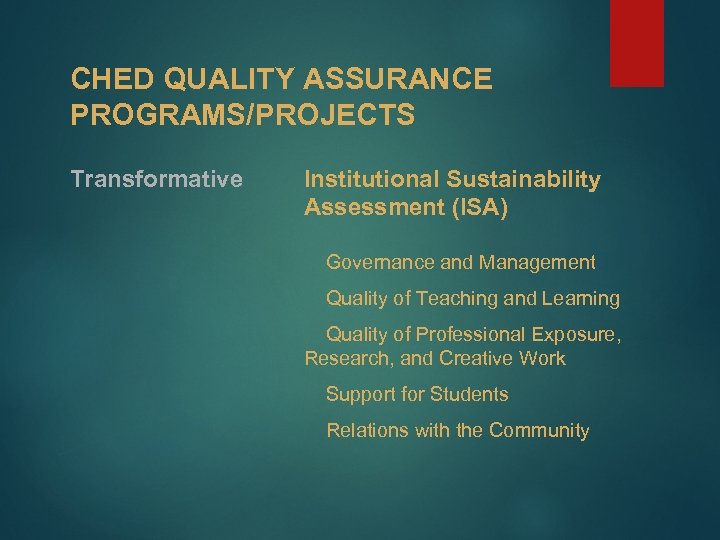 CHED QUALITY ASSURANCE PROGRAMS/PROJECTS Transformative Institutional Sustainability Assessment (ISA) Governance and Management Quality of Teaching and Learning Quality of Professional Exposure, Research, and Creative Work Support for Students Relations with the Community
 Challenges to Higher Education Rapid demand Commodification Virtual universities Branch campuses ICT in knowledge acquisition and dissemination Mobility of staff and students
 Education’s challenge will be. . To shape the cognitive skills, interpersonal sensibilities, and cultural sophistication of youth whose lives will be both engage in local contexts and responsive to larger transnational processes (Suarez-Orozco and Qin-Hilliard, p. 3).
 Challenge… What constitute an educated person? Are the curricula abreast with the demand of Internationalization? What are the values, skills, and understanding for life in international arena? How can students understand cultural, economic, political, and social convergence and divergence in an internationalizing environment?
 Consequences to education… Understanding of the divergence and convergence of perspectives within classrooms that are increasingly multicultural How the national and the international are reflected in (and shaped by) the local and the actualities and experiences of the people’s lives.
 How do Philippine higher education institutions respond to internationalization as they participate in the arena of ASEAN Integration? To what extent are faculty equipped with higher order skills on internationalization? What are the changing roles, functions and demands for teaching, research, social responsibility and sustainable development? How is the development of faculty members being considered in relation to internationalization of teaching, research productivity, social responsibility and sustainable development?
 Concluding remarks Full and positive appreciation for one’s own culture should be a foundation Internationalism should prevent national and regional orientations from devolving into chauvinism and xenophobia Internationalization should not be equated with superficiality Support must be based on honest appraisal of cost and benefits Clarity between forms of knowing and procedural knowledge
 References Bray, M. , Adamson, B. and Mason, M. (Eds. ) (2007). Comparative Education Research: Approaches and methods. Hong Kong: Springer CHED, CMO 46. s. 2012; CMO 55 s. 2016 Ebuchi, K. (1989). Internationalization of Education. USA: Sage Knight, Jane (2003). Internationalization of Higher Education