


 Скачать презентацию Internationalisation of the curriculum in action Wollongong University
4c95c5dc5d59b3338c51192eb7e05b15.ppt
- Количество слайдов: 35
 Internationalisation of the curriculum in action Wollongong University 4 November 2011 Associate Professor Betty Leask, Uni. SA Australian National Teaching Fellow
 ALTC National Teaching Fellowship ‘How can we internationalise the curriculum in this discipline area in this particular institutional context and ensure that, as a result, we improve the learning outcomes of all students? ’ • 13 Australian universities • 5 universities in England, US, The Netherlands and South Africa • Disciplines – Nursing; Journalism; Social Sciences; Public Relations; Management; Accounting; Applied Science; Medicine
 Outputs • • ‘Discipline-specific’ literature search A conceptual framework Case studies/vignettes of Io. C in action Process of Io. C described + support resources – Questionnaire (QIC) – ‘Blockers and Enablers’ survey • www. ioc. net. au
 Internationalisation of the curriculum • An internationalised curriculum (product) will purposefully develop the international and intercultural perspectives (skills, knowledge and attitudes) of all students • Io. C is the incorporation of an international and intercultural dimension into the preparation, delivery and outcomes of a program of study (process) (Leask 2009)
 Intercultural competence • ‘the ability to communicate effectively and appropriately in intercultural situations based on one’s intercultural knowledge, skills and attitudes’ (Deardorff 2006, p. 247). • mindset, skillset, and heartset (Bennett, 2008) • knowledge, behaviours, attitudes and values (Byram 1997) • Means confronting and challenging biases, beliefs and stereotypes
 A conceptual framework for internationalisation of the curriculum
 Knowledge in and across the disciplines
 Formal curriculum: What learning experiences, outcomes & assessment? Knowledge in and across the disciplines
 Informal curriculum: What services, opportunities for experience and extension beyond the formal curriculum? Formal curriculum: What learning experiences, outcomes & assessment? Knowledge in and across the disciplines
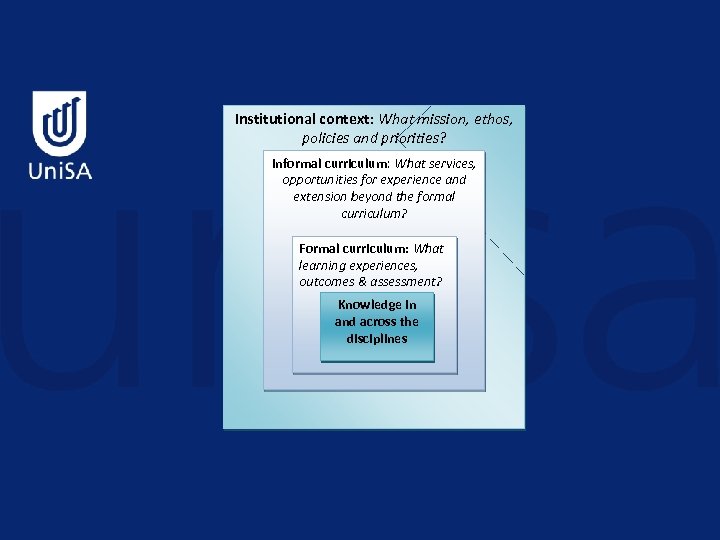 Institutional context: What mission, ethos, policies and priorities? Informal curriculum: What services, opportunities for experience and extension beyond the formal curriculum? Formal curriculum: What learning experiences, outcomes & assessment? Knowledge in and across the disciplines
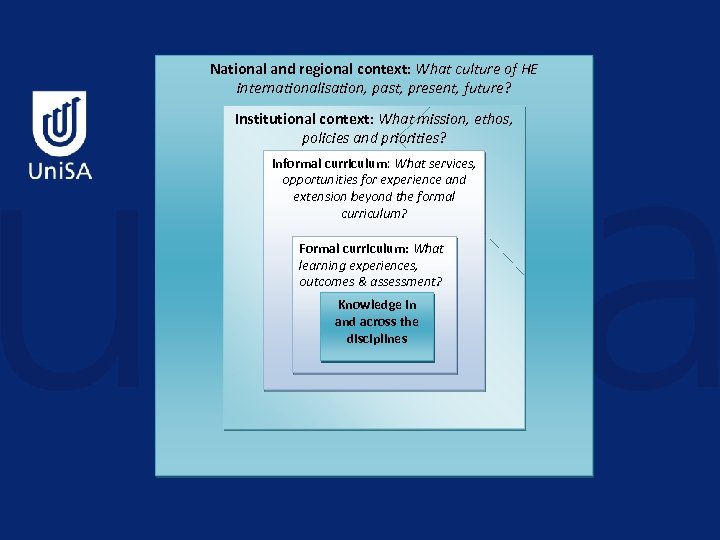 National and regional context: What culture of HE internationalisation, past, present, future? Institutional context: What mission, ethos, policies and priorities? Informal curriculum: What services, opportunities for experience and extension beyond the formal curriculum? Formal curriculum: What learning experiences, outcomes & assessment? Knowledge in and across the disciplines
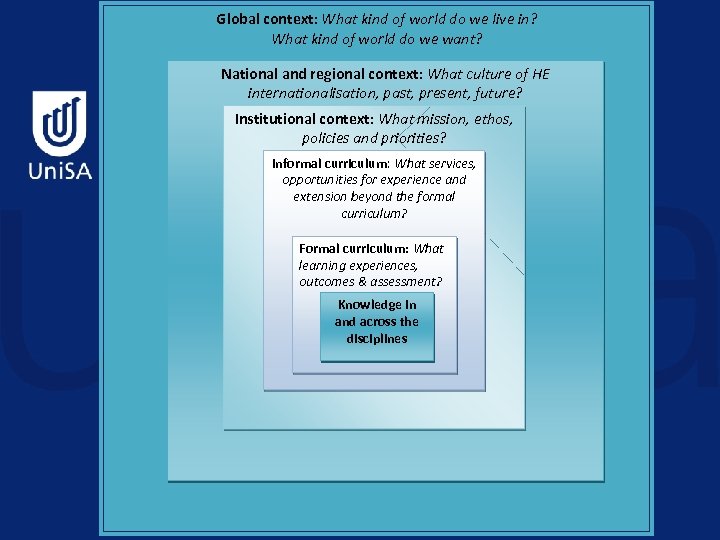 Global context: What kind of world do we live in? What kind of world do we want? National and regional context: What culture of HE internationalisation, past, present, future? Institutional context: What mission, ethos, policies and priorities? Informal curriculum: What services, opportunities for experience and extension beyond the formal curriculum? Formal curriculum: What learning experiences, outcomes & assessment? Knowledge in and across the disciplines
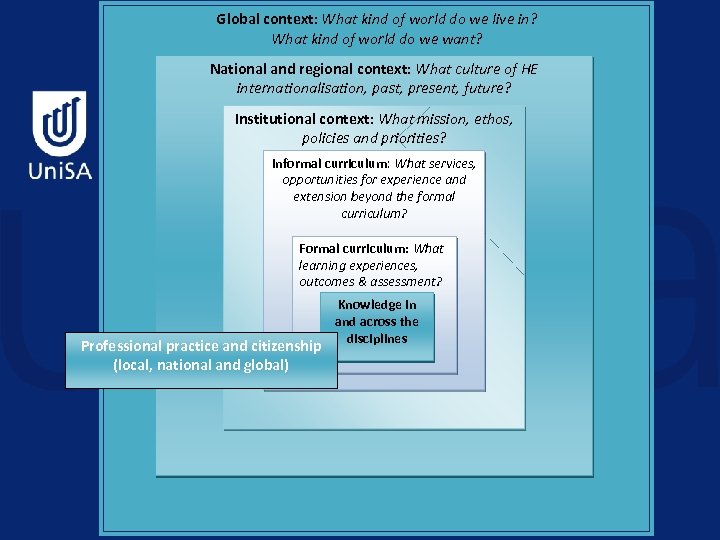 Global context: What kind of world do we live in? What kind of world do we want? National and regional context: What culture of HE internationalisation, past, present, future? Institutional context: What mission, ethos, policies and priorities? Informal curriculum: What services, opportunities for experience and extension beyond the formal curriculum? Formal curriculum: What learning experiences, outcomes & assessment? Professional practice and citizenship (local, national and global) Knowledge in and across the disciplines
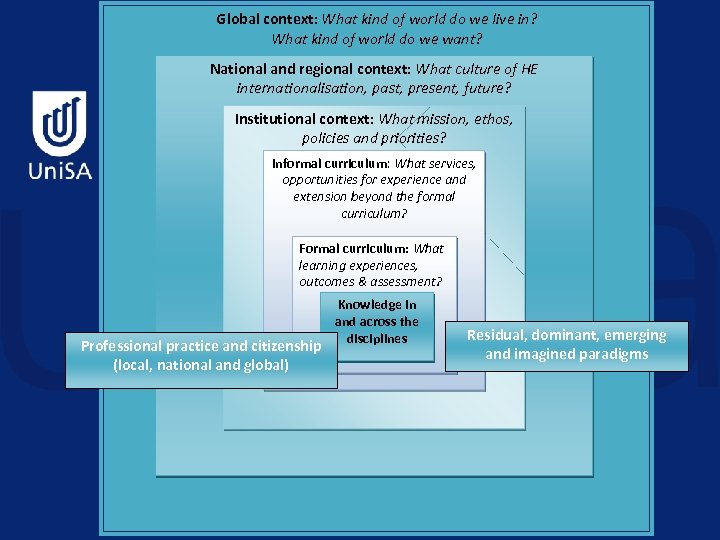 Global context: What kind of world do we live in? What kind of world do we want? National and regional context: What culture of HE internationalisation, past, present, future? Institutional context: What mission, ethos, policies and priorities? Informal curriculum: What services, opportunities for experience and extension beyond the formal curriculum? Formal curriculum: What learning experiences, outcomes & assessment? Professional practice and citizenship (local, national and global) Knowledge in and across the disciplines Residual, dominant, emerging and imagined paradigms
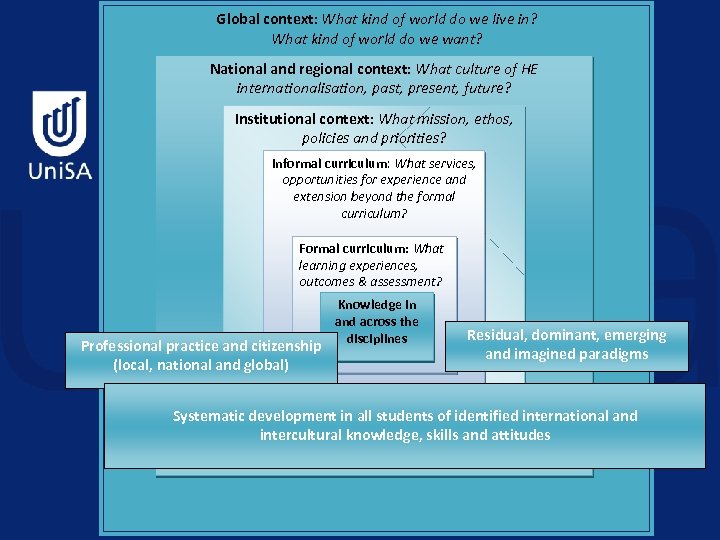 Global context: What kind of world do we live in? What kind of world do we want? National and regional context: What culture of HE internationalisation, past, present, future? Institutional context: What mission, ethos, policies and priorities? Informal curriculum: What services, opportunities for experience and extension beyond the formal curriculum? Formal curriculum: What learning experiences, outcomes & assessment? Professional practice and citizenship (local, national and global) Knowledge in and across the disciplines Residual, dominant, emerging and imagined paradigms Systematic development in all students of identified international and intercultural knowledge, skills and attitudes
 Internationalisation of the curriculum is: • Context sensitive – Multiple contextual layers • Future oriented – Critical perspectives on the past and present • Founded on excellent teaching and research – With clear ‘rationale’ and learning outcomes – ‘Aligned’ and student focussed
 Io. C in the disciplines • is related to the way in which disciplines and professions are culturally constructed, bound and constricted • requires that academic staff think outside of these traditional restrictive, boundaries • has ‘macro-level’ as well as ‘micro-level’ implications for programs • looks different in different disciplines
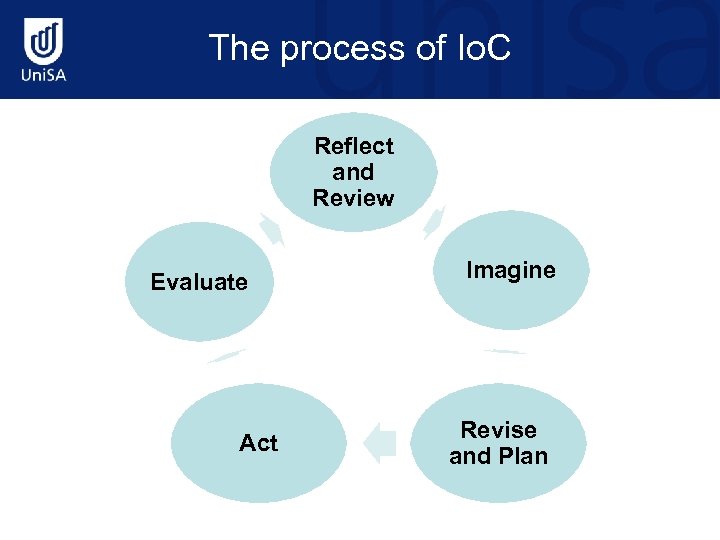 The process of Io. C Reflect and Review Evaluate Act Imagine Revise and Plan
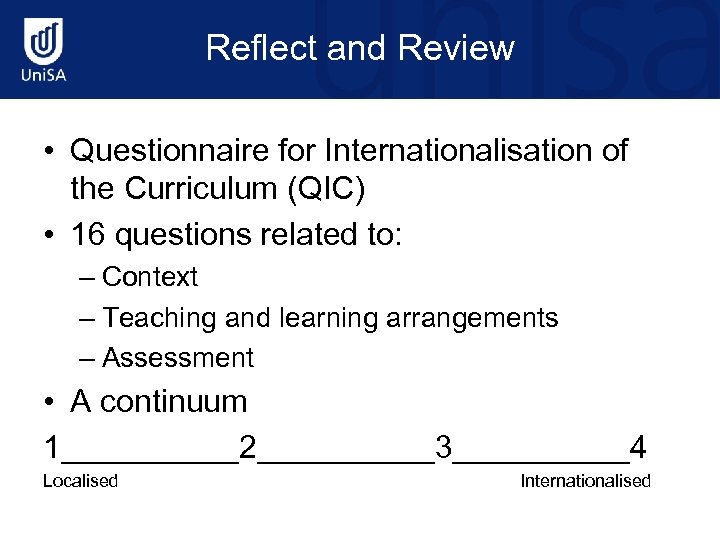 Reflect and Review • Questionnaire for Internationalisation of the Curriculum (QIC) • 16 questions related to: – Context – Teaching and learning arrangements – Assessment • A continuum 1_____2_____3_____4 Localised Internationalised
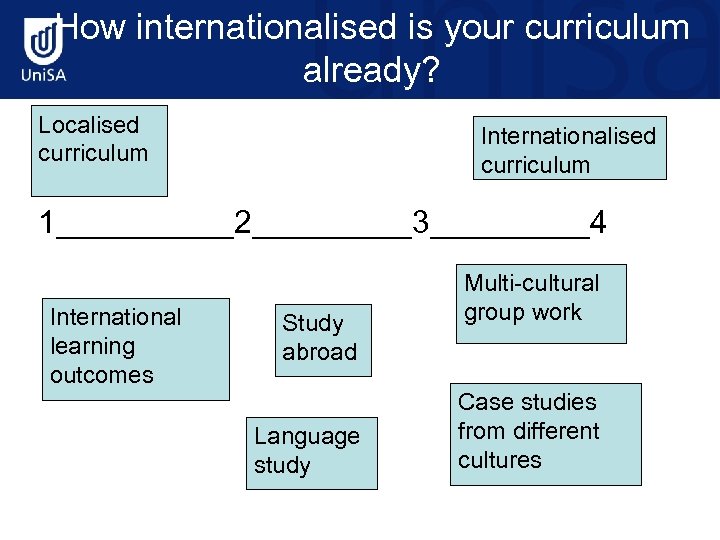 How internationalised is your curriculum already? Localised curriculum Internationalised curriculum 1_____2_____3_____4 International learning outcomes Study abroad Language study Multi-cultural group work Case studies from different cultures
 Nursing: Rationale • education can and should create the conditions necessary for health, peace and harmony as fundamental human rights in every society • nurses and midwives can make a valuable contribution to the promotion preservation and maintenance of these conditions (Sandstrom 1998, p. 146)
 Nursing: Learning Outcomes Learning outcomes for nurses in a globalised world • Ability to co-operate and collaborate in joint efforts across national and cultural boundaries • Intercultural communicative competence required for provision of professional health care to patients from diverse cultural backgrounds • Ability to obtain and utilise ideas and experiences from different parts of the world • Ability to function within the healthcare organisations of the future (Sandstrom 1998)
 Applied Science • a curriculum based on a critical analysis of the connections between culture, knowledge and professional practice in science within a globalised world • employs problem-based methodologies • prepares students to be flexible, adaptive and reflexive problem solvers who can conduct community-based as well as industry-based investigations (Carter 2008 p. 629)
 Public Relations 2005 • Curriculum was modified to include assessment options related to application of theory in different social and political contexts e. g. Development/analysis of communication materials generated in relation to: – Power blackouts in Malaysia and Western Australia – Water issues in Singapore & Malaysia – Taiwanese government elections (Surma & Fitch 2006)
 Public Relations 2011 • Literature review • Public Relations as a discipline is culturally constructed and culturally specific • Interviews with 17 PR professionals in Australia and Singapore 1. Intercultural challenges in PR practice 2. Contexts for intercultural competence 3. Intercultural competence and PR graduates 4. Intercultural competence and PR education Ongoing process
 Medicine 2011 • How do we ensure that our graduates are equipped to provide effective health care to patients from diverse linguistic and cultural backgrounds? • How do we know that they are appropriately equipped – K, S&A? • To what extent does our program focus on dominant Western paradigms of medicine? • Is this focus appropriate today? • What about in the future?
 Biological Sciences: 2011 Rationale • The big problems in biology are international problems that require international solutions • There are many important problems to be solved in the developing world
 Journalism 2011 • ‘Our aim is to promote a transformative educational experience for communicators of the future, who are able to work across diverse intercultural contexts’. • But the pervasiveness of westernised thought (mainly in the English language) dominates modes of dissemination which tends to produce a homogenous perspective from which other non western experiences are excluded. • Rhonda Breit; Levi Obijiofor; Richard Fitzgerald, University of Queensland
 Journalism 2011 • 2 courses fully focused on international and intercultural content and draw upon non western practice, theories and assessment in a number of other areas • but found did not have a full awareness of the range and scope of where this is and how it is incorporated in the curriculum • approached Io. C through lens of ‘de westernisation’
 Some key learnings
 The importance of teamwork

 Conclusion Internationalisation of the curriculum: • is related to the way in which disciplines and professions are culturally constructed, bound and constricted • requires that you think outside of these traditional restrictive, boundaries • has ‘macro-level’ as well as ‘micro-level’ implications for programs • is ‘owned’ by discipline experts
 References • Carter, L. (2008) Globalization and science education: the implications of science in the new economy. Journal of Research in Science Teaching 45(5), 617– 633. • Leask, B. (2009) Using formal and informal curricula to improve interactions between home and international students. Journal of Studies in International Education, Vol. 13, No. 2, 205 -221 • Sandstrom, S. (1998) Internationalisation in Swedish Undergraduate Nursing Education: It’s interpretation and implementation in the context of nursing with tender loving care. Research Bulletin 96 Helsinki: Faculty of Education: University of Helsinki. • Surma, A. & Fitch, K. , (2006). The challenges of international education: Developing a public relations unit for the Asian Region. Journal of University Teaching & Learning Practice, 3(2), 104 -113