


 Скачать презентацию Internationalisation of the curriculum Are you doing something
94d22f34d726c4facc3d1def193058af.ppt
- Количество слайдов: 16
 Internationalisation of the curriculum Are you doing something about it? Why? What? How? When? Éric Bel Learning and Teaching Conference
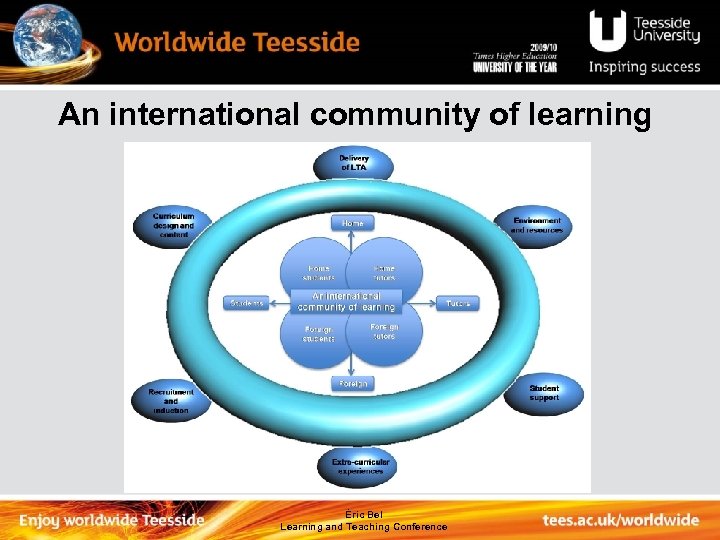 An international community of learning Éric Bel Learning and Teaching Conference
 Becoming an international university ‘While the international role and the international activities of universities are not new, a more recent concept is the internationalisation of universities. ‘Internationalisation’ involves developing an international focus for many, if not all, university activities so that the curriculum for all subjects includes international dimensions, the student experience includes international opportunities, research is recognisably international and the wider public service role of the university involves international outreach. ’ (Ketteridge et al. , 2002: 14) Éric Bel Learning and Teaching Conference
 What internationalisation of the curriculum may not necessarily be. . . ‘…“internationalisation” [is often considered as] non-UK students spending their money on a British education, rather than seeing education in British Higher Education as an international experience. This view (still current in common use of the phrase “international student”) assumes international students to be a euphemism for “non-British”. ’ (Luxon and Peelo, 2009: 52) ‘…attempts at curriculum internationalisation in UK HE appear to be based on the idea that more internationally educated graduates can be produced by means of a mere infusion of some international material in existing course syllabi. ’ (de Vita and Case, 2003: 388) Éric Bel Learning and Teaching Conference
 Internationalisation of the curriculum is. . . a broad term which encompasses face-to-face learning situations as well as other types of activities which students – all students, whether home or foreign – engage with over the period of time at university. . a process that applies to a number of specific areas of the students’ experience whilst studying in Higher Education, whether on campus, at work, at home, at a distance or online. . a systemic process, not only at the highest institutional level but, also, in Schools, Subject Groups, programme or module teams, as well as single learning events. Éric Bel Learning and Teaching Conference
 Internationalisation of the curriculum is. . . about adopting an approach to planning the students’ international experience in Higher Education that is systematic so that each stage of the students’ time at university is ‘constructively aligned’ (Biggs, 1999). . about enhancing the students’ time at university and involves the careful implementation of an inclusive, expectation-raising recruitment strategy, delivering an informative induction into institutional processes, making sure that all areas of the educational offering are carefully aligned to multi-cultural objectives, constructing a truly inter-national environment, and supporting students in developing an open-minded perspective on their learning and the world. Éric Bel Learning and Teaching Conference
 Recruitment and induction • • Get to know other educational systems. Encourage foreign students (and staff!) to share their prior experiences. Produce publicity material promoting the international nature of courses. Brief foreign students about Britain and more specific British Higher Education practices before they leave their home countries. • Create the space for all students to mix, whether home, foreign, with a certain culture, from a specific region, etc. • Shift your attention from foreign students to any students – whether home or from other countries – who need to develop international competences. Internationalising recruitment and induction: Are you doing something about it? Éric Bel Learning and Teaching Conference
 Curriculum design and content • • • Think differently about learning: Design learning for a global context. Plan the development of intercultural competences. Aim to seek awareness of other countries, cultures or languages. Intend to promote adaptability, curiosity, creativity, acceptance of diversity. Create the forum for the discovery of the complex and interacting factors that underpin different cultures and global relationships. • Expect students to demonstrate appreciation of the link between local and international decisions and actions, and their impact on local communities. • Design modules with themes based on global issues. Internationalising curriculum design and content: Are you doing something about it? Éric Bel Learning and Teaching Conference
 ‘The international classroom requires teachers to be skilled managers of a complex teaching and learning environment. They must not only possess the abilities associated with “good teaching” but be efficient intercultural learners who use cultural diversity in the classroom as a learning resource. They must be able to adapt their teaching to an international, culturally diverse teaching and learning environment rather than expecting learners to adapt to a “mono-cultural”, inflexible environment. . . The international classroom is in many ways. . . a meeting place between different cultures where there are not necessarily any shared values or beliefs about learning and teaching, roles and responsibilities. . . The international teachers must understand the way that their own cultural context has shaped all that they feel, do and believe, including the way they approach teaching, their expectations of students and the judgements that they make about them. ’ (Jones and Brown, 2007: 87 and 89) Éric Bel Learning and Teaching Conference
 Delivery of learning, teaching, assessment • Refer to a range of perspectives in the classroom to develop students’ knowledge and understanding of global issues. • Encourage comparative analysis and critical thinking. • Encourage students to include in their assessed work references, for examples, to their own or other countries, allowing them to broaden their understanding of other cultures. • Promote the acquisition of generic skills that are applicable in a multinational and -cultural context. • Mix students from different countries in learning activities. • Speak slowly, avoid colloquialisms. Internationalising the delivery of learning, teaching and assessment: Are you doing something about it? Éric Bel Learning and Teaching Conference
 Delivery of learning, teaching, assessment • Use pictures, texts and examples from other countries. • When using ‘imperial units’, if possible, give their equivalent in the ‘Système International’. • Regarding religious differences, for example in relation to the assessment calendar, try to accommodate specific requirements within the institutional system. • Write assessment criteria in such a way that they prompt all students to think globally. • Involve employers in evaluating whether students have developed the expected international competencies. Internationalising the delivery of learning, teaching and assessment: Are you doing something about it? Éric Bel Learning and Teaching Conference
 Environment and resources • Try to create a learning environment that ‘feels’ international. • Provide as many visual learning aids as you can, but design and choose them carefully: be sensitive to potential language and cultural misunderstandings. • Do not assume that all educational systems around the world use digital technology to the same extent as in Britain. • Encourage students to use global editions of textbooks, written for an international audience and which have a diverse range of case material and examples. Internationalising the environment and resources: Are you doing something about it? Éric Bel Learning and Teaching Conference
 Student support • Recognise the specific help that foreign students may need with their studies (but do not forget that, in learning situations, foreign students are first and foremost. . . students, with normal student needs!). • Refer students to the English language support team, if necessary. • Anticipate and address ‘assumptions of similarities’, ‘language differences’, ‘non-verbal misinterpretations’, ‘preconceptions and stereotypes’, ‘tendency to evaluate’, ‘high anxiety’; and ‘culture shock’ or ‘state of disease’ [sic] (Barna, 1998: 186). • Create opportunities for peer support, pair up home and foreign students. • Help all students – home and foreign – with finding work/placement opportunities in Britain and abroad. Internationalising student support: Are you doing something about it? Éric Bel Learning and Teaching Conference
 Extra-curricular activities • Involve students in international projects, for example based on the use of online communication tools. • Create opportunities for international conversations, such as monthly Language Café sessions. • Offer social and cultural activities that make a noticeable contribution to transforming the overall environment into a more international one. • Make the most of the range of different social, cultural or religious traditions that home as well as foreign students bring with them from within their own groupings, to create positive social and cultural diversity and synergy. Internationalising extra-curricular activities: Are you doing something about it? Éric Bel Learning and Teaching Conference
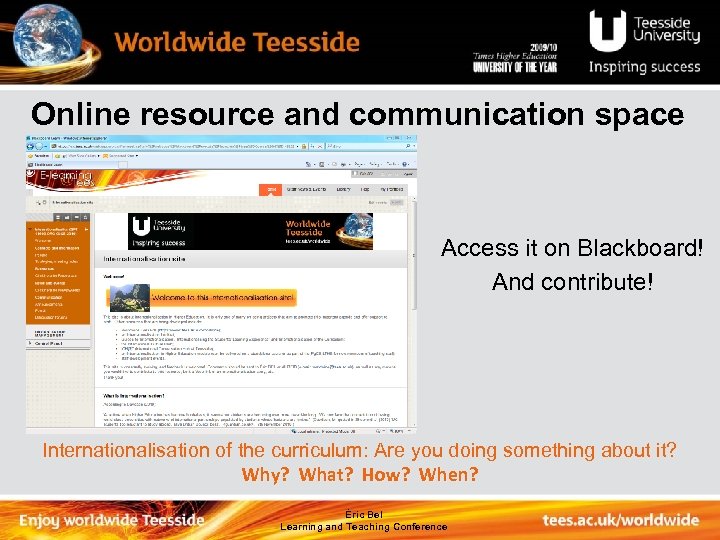 Online resource and communication space Access it on Blackboard! And contribute! Internationalisation of the curriculum: Are you doing something about it? Why? What? How? When? Éric Bel Learning and Teaching Conference
 References • • • Barna, L. M. (1998) ‘Stumbling blocks in intercultural communication’. In Bennett, M. J. (ed. ) Basic concepts of intercultural communication – Selected readings. Intercultural Press Inc, pp 173 -89. Biggs, J. (1999) Teaching for quality learning at university. Buckingham: Society for Research into Higher Education/Open University Press. de Vita, G. and Case, P. (2003) ‘Rethinking the internationalisation agenda in UK Higher Education’. Journal of Further and Higher Education. 27(4): 383 -398. Jones, E. and Brown, S. (eds) (2007) Internationalising Higher Education. Abingdon (Oxon): Routledge. Ketteridge, S. , Marshall, S. and Fry, H. (eds) (2002) The effective academic – A handbook for enhanced academic practice. London: Kogan Page. Luxon, T. and Peelo, M. (2009) ‘Internationalisation: Its implications for curriculum design and course development in UK Higher Education’. Innovations in Education and Teaching International. 46(1): 51 -60. Éric Bel Learning and Teaching Conference